
Assessing the Performance of WBAN using Reliability Analysis: UGFT - A Universal Generating Function Technique

ⓒ The Korean Sensors Society
This is an Open Access article distributed under the terms of the Creative Commons Attribution Non-Commercial License(https://creativecommons.org/licenses/by-nc/3.0/) which permits unrestricted non-commercial use, distribution, and reproduction in any medium, provided the original work is properly cited.
Abstract
The universal generating function technique (UGFT) is a well-known mathematical approach primarily used in realworld multi state systems that require recursive approach to solve the problem. This technique ensures the reliability of the system, in addition to other parameters such as security and authentication. The combination of reliability and security plays a major role in many real time systems in the fields of healthcare, agriculture, education and business, attracting significant research attention. In healthcare, researchers have contributed significantly to wireless body area network (WBAN), which requires both reliability and security to assess the performance. Sensor nodes deployed on the human body tend to gather health data and disseminate the sensed data to the mobile devices, thereby enabling healthcare professionals to serve the patients without delay. Reliability analysis is essential along with security aspects during data dissemination in WBAN and a mathematical approach such as UGFT is required to ensure reliability. This study discusses the reliability analysis of the WBAN with and without the security component—authentication center. The mathematical modeling and results reveal that the reliability is high when the security component AC is included.
Keywords:
Reliability, WBAN, UGFT, Authentication centre1. INTRODUCTION
Sensor nodes play a vital role in various real-life applications, such as Internet of Things (IoT), body area networks, wireless networks, and data analytics. Wireless sensor networks and the IoT are closely related. Wireless body area network (WBAN) is one of the main applications of wireless sensor network, comprising various sensor nodes to measure temperature, power, force, vibration, and humidity. Specifically, sensors for continuous monitoring of blood pressure, heart rate, body temperature, ECG, EEG, movement, and fitness activity are deployed on the body of bedridden elderly people. The healthcare sector is the focus of many ongoing studies, aiming to assist doctors and healthcare faculty in monitoring the health conditions of elderly people. Assessing the reliability of sensitive information transmission is an essential task that requires universal generating function method (UGFM), which is a mathematical modelling technique.
Yeh [1] demonstrated the importance of evaluating the network reliability when outlining, designing, and controlling systems. The shortest path (SP) is essential to assess network reliability. Before calculating the binary state network reliability between the source and sink nodes, the UGFM and a normalized composition operator were used to identify all the SPs. The study demonstrated how the proposed UGFM identifies all SPs and evaluates the time and space complexities of the algorithm. A newly developed UGFM for searching all the SPs was also reported. Using the proposed UGFM, SPs can be found with few calculations using the SP structure of a general network.
Ullah et al. [2] have proposed several potential routing solutions in their investigations on WBANs. They determined the significance of the reliability, energy efficiency, effects of stability, and lifetime of WBANs. Regarding the computation of time and space complexity, the authors concluded that clustering-based routing algorithms are a unique solution for high-bandwidth and low-memory WBAN. Finally, in cluster-based WBANs, they outlined several problems and threats related to reliability and energy efficiency, which must be addressed in the development of new solutions. The UGFM has been found to be adequate for all flow situations in a general flow network. The benefit of the proposed UGFM is that it does not identify identical SPs, thus dispensing with the need for eliminating duplicate SPs.
Section 2 briefs the literature survey, section 3 discusses the proposed method and section 4 details the reliability calculation and finally section 5 denotes the conclusion.
2. LITERATURE SURVEY
Yeh [3] used the sum-of-disjoint-product method and the well-known UGFM method to compute the ultimate flow network reliability according to the obtained SPs. This paper outlined a potential method to readily measure network reliability in a variety of situations involving acyclic binary-state networks (ABSNs) between source and sink nodes. The node-UGFs and subnet-UGFs proposed in this application are significantly different from the existing UGFM-based algorithms, and they contribute to the presentation of some special properties. Liao et al. [4] pointed out open issues and ongoing research in the I2O WBAN area, thereby encouraging the development of health-oriented IoT applications. At the relatively high data rate of 30 Mbps, 1.6-meter distance communication systems were demonstrated. Data routing techniques can significantly improve network lifetime, throughput, and propagation delay performance, as demonstrated by simulation results. A new energy-efficient incremental routing protocol was implemented based on an I2O WBAN system, which was recommended and compared with an existing two-relay protocol.
Sandhu et al. introduced a decisive and effective protocol for WBANs, namely the priority-aware protocol (PAP). As it is possible to efficiently transfer data using a priority-based approach, nodes within the PAP are associated with two priority values: fixed priority, which is based on the job allotted to them, and dynamic priority, which is assigned depending on the data they sense. As reported in the paper, data are sent according to their medical priorities, including sensitivity and value. Healthcare priority was considered when determining the sensing intervals and transmission rates. Several scenarios with a variety of priority data were analyzed using this protocol. DPPH, HOCA, and IEEE 802.15.4, are all inferior to those used in this study because of their throughput and end-to-end delay. In the high-priority group, the throughput improved by 20%, and the e2e delay decreased by 50%.
Using this network, Al Masud [5] tracked the vital signs and organs of patients distantly, providing an opinion in real time regarding medical diagnosis. With WBAN, healthcare and quality of life have improved through new, realistic, and ground-breaking applications. There were also discussions about Wi-Fi-based sensor networks (WSNs) and wireless local area networks (WLANs), technical challenges, the importance of quality of service (QoS), the latency of WBANs, energy efficiency issues, and existing WBAN technologies. Finally, open research challenges and issues are discussed.
Because packet loss of wireless body area networks is high, Arrobo et al. [6] proposed a new approach to reduce packet loss and improve the performance of WBAN. They proposed Cooperative Network Coding to increase throughput and avoid single-point failures, thereby increasing the reliability of the WBAN. In this methodology, packets from various nodes are combined and sent through multiple relays to avoid single-point failures. The QoS of a WBAN is crucial in healthcare applications. It is important to create an energy-efficient link to improve performance. Mkogwa et al. [7] established the link in the network layer with an optimal cost function and then introduced the IEEE 802.11 protocol in the data link layer to improve the QoS. It has been proven that combined terminology increases the reliability, throughput, lifetime, and successful delivery rate of WBAN. Peiravi [8] stated that low-cost human motion capture systems and microinertial sensors-on-hip are the possible solutions for increasing the reliability of WBAN. Further decision fusion and feature enhancement technologies with different sensors and topologies have been adopted to improve performance and reduce failure rate. First-order and second-order reliability methods overcome uncertainties in the engineering domain [9]. The authors analyzed the reliability and found that the Hasofer-Lind approach yielded better performance, and the response surface methodology could be used to find the index of the Hasofer-Lind approach. It is also evident that the failure rate can be determined by applying a reliability measure. Huang et al. [4] proposed structural reliability based on sampling. The authors identified that sampling is a better method for determining the stability of the system; however, for complex problems, the sampling process increases the computational cost. Various Monte Carlo simulations based on variance reduction techniques have been used to increase reliability at a low computational cost.
Different communication topologies and wide applications of WBAN were surveyed by Salayama et al. [10]. They reported that reliability and fault tolerance are key issues in WBAN. Body area networks play a more significant role in the healthcare domain than in entertainment, sports, and military applications. Data faults, software faults, hardware faults, and channel faults are the most commonly faults encountered in WBAN, and preventing these faults is necessary, rather than detecting them, to improve the performance with fewer failures. In [11], the reliability with respect to various parameters, such as the lifetime of the networks, number of sensors, and optimal value of sensors. An algorithm with an average group characteristic parameter was developed to reliably identify the optimal sensors in a WBAN. Chacko [12] proposed that the UGFM is suitable for continuous reliability in multistate systems (MSS). Solving reliability issues has been identified as a critical issue in MSS; hence, it has more than two states. The universal generating function algorithm was identified as an efficient and suitable algorithm for BSNs. The reliability of the ABSN is guaranteed by a modified universal function algorithm, in which the sum-of-disjoint-product method is introduced to maintain reliability with a minimal path [3]. In the proposed method, it is not necessary to expose all minimal paths initially; thus, the computational and time complexities are reduced. Destercke et al. [5] proposed an extended UGFM that considers the uncertainties in the network to ensure the reliability of MSSs. In a UGF system, modularity is considered to overcome the exponential growth of the probability analysis. In this study, uncertainties such as failure and repair rates were also considered to fix the upper and lower bounds of the reliability calculation. Further, the precise performance rates in the UGF method were replaced by adopting fuzzification.
The reliability evaluation of project completion time using UGF-based narrow reliability bounds was proposed by Babaei et al. [2]. This analytical method yielded a rapid reliability evaluation of MSSs. Here, instead of a specific probabilistic distribution function, a probabilistic mass function based on the element performance was utilized to achieve better reliability. Meena et al. [13] proposed an optimal reliability in MANET with time and cost constraints. In this study, different composition techniques were combined with UGF to obtain the reliability of homogeneous sensor network nodes. Further, the probability function was calculated from the source node of the MANET that reaches the destination node and from the subnodes between the source and destination nodes. The vehicular trusted authority centre (VTAC) plays a major role in maintaining the authority and security of VANET. Rajeswari et al. [14] adopted UGF and VTAC to increase the reliability of VANET. State-dependent probabilistic functions were applied to the UGF to calculate the reliability of the vehicle nodes. In the described UGF, the reliability was high in the presence of VTAC and low in its absence. The general UGF method combined with a generalized composition operator yields better network reliability. It is also useful for determining the minima path of a network, which is one of the most significant factors in reliability analysis. Hence, it is concluded that the UGF is a better technique for reliability analysis in flow networks without initially eliminating the minimal paths [15].
3. PROPOSED SYSTEM
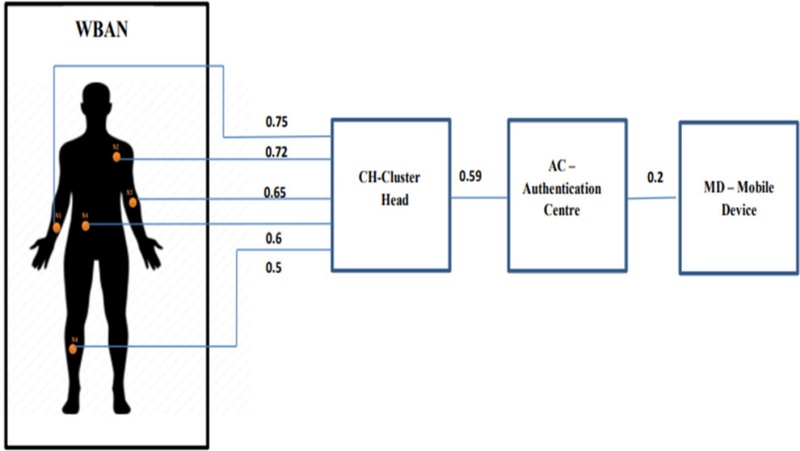
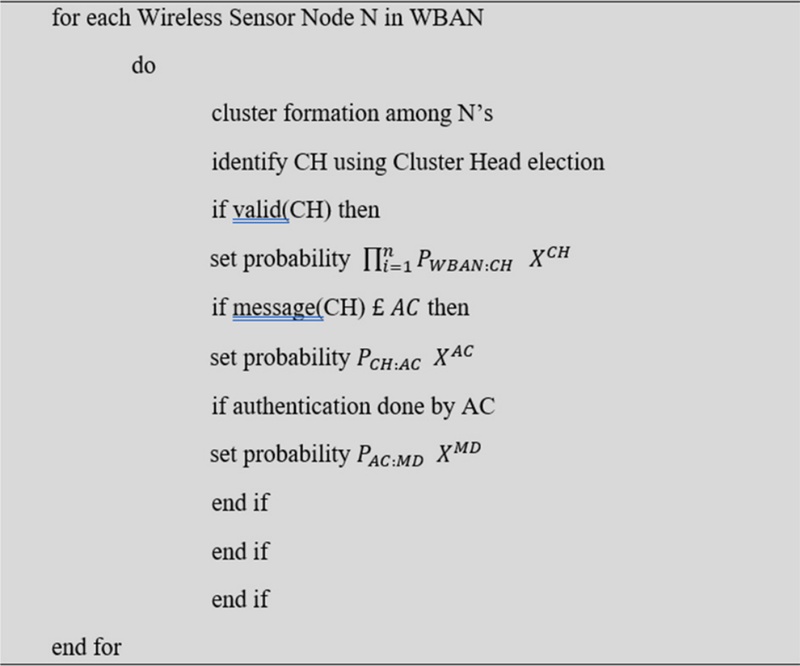
WBANs have been widely used in medical healthcare systems to enable continuous monitoring of elderly people and others who require continuous monitoring by doctors. Low-power, nonhostile, smart, and compact sensor devices are deployed on the patient’s body to sense health data that are transmitted through wireless media. Fig. 1 shows a reliable WBAN in the presence of an AC. This reliable WBAN functions such that sensitive data collection is the first step, followed by efficient storage and processing.
Reliable Wireless Body Area Network
Reliable Network
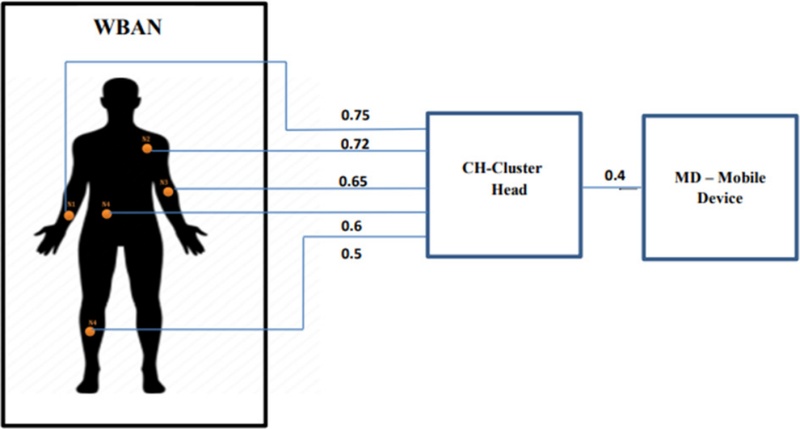
It is assumed that only five sensor nodes are deployed on the patient’s body to gather the patient’s health data. The UGF technique allows us to define the probability value when the first sensor node transmits sensed data to the cluster head (CH). Similarly, various probabilities are defined among the sensor nodes and CH. Reliability calculation is a probabilistic approach that represents probabilities defined in a random manner. Thus, the probability value 0.75 is defined when the first Sensor Node N1 transfers the sensed data to the CH, and a probability value of 0.72 is represented between the sensor nodes N2 and the CH, and vice versa. Various probabilities are considered among sensor nodes N1–N5 and the CH, and one of the best representations is shown in Fig. 1.
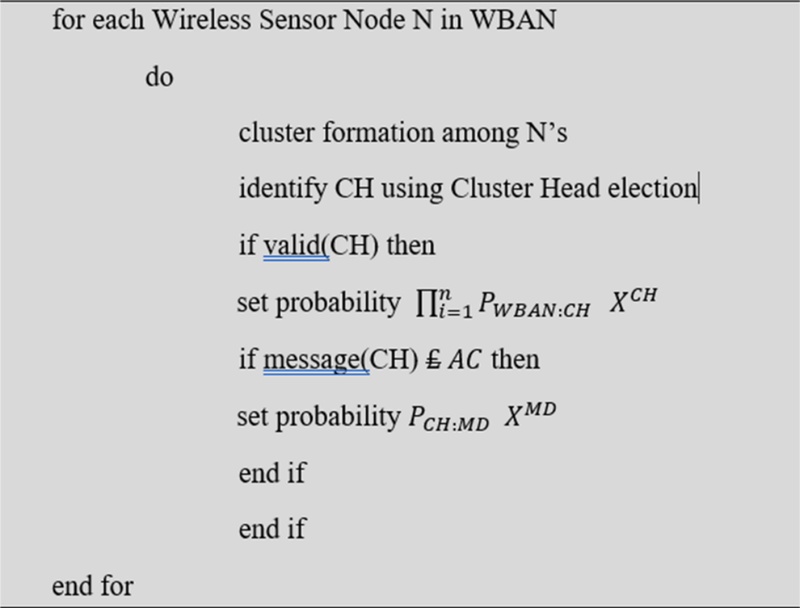
Fig. 2 represents unreliable WBAN that consists of a set of sensor nodes deployed on a human body, CH, and then a mobile device. Authentication center, which is responsible for ensuring the security, is not included, and hence, the corresponding link reliability is to be calculated.
Unreliable Wireless Body Area Network
Unreliable Network
4. RELIABILITY ANALYSIS
A Reliability Analysis of WBAN is exhibited in the presence and absence of AC.
Definition 1
The UGF of WBAN is defined as a polynomial in X such that
| (1) |
Where PWBAN:CH is the probability of disseminating the sensed patient information from the sensor nodes that are deployed in WBAN to Cluster Head CH.
Definition 2
The UGF of CH is described as a polynomial in X such that
| (2) |
where PCH:AC is the probability of distributing the patient details from CH to the authentication centre AC to perform encryption and decryption on the sensitive data.
Definition 3
The UGF of AC is stated as a polynomial in X such that
| (3) |
where PAC:MD is the probability of dispersing the encrypted sensitive patient data to the Mobile device MD for healthcare workers such as doctors, nurses, radiologists and pulmonologist for the immediate action.
Definition 4
The UGF of CH without including AC is given as a polynomial in X such that
| (4) |
where PCH:MD is the probability of propagating the sensitive patient data to the Mobile device MD without applying encryption and decryption by the authentication centre.
Working sets which includes the path and SDP – State Dependent Probability on calculating the reliability of WBAN with AC and without AC is given below in Table 1.

Working Sets of WBAN
4.1 Reliable WBAN
The sensor nodes that are deployed in the WBAN sense the patient-sensitive data and forward them to the CH, which propagates the data to the AC by applying encryption and decryption. Finally, the encrypted data are passed to a mobile device that enables doctors and nurses to monitor patients effectively.
4.2 Unreliable WBAN
Reliability calculation of the WBAN, which includes message dissemination from wireless sensor nodes to the CH and finally to the MD without applying any security mechanism using the AC.
5. CONCLUSION
Network reliability is an important factor in assessing the quality of any network and requires an effective mathematical modelling technique, such as the UGFM. The Body Area Network is an important network that helps healthcare faculties monitor the condition of a patient using various sensors implanted in the human body. In BAN, transmitting sensitive information in a secure manner without compromising reliability is challenging. A WBAN with and without an AC has been elaborated using an algorithm. In addition, reliability calculation has been investigated with and without AC, proving that reliability increases when we include AC and decreases significantly when there is no AC.
Acknowledgments
No external funding was received for this study.
References
-
W.C. Yeh, A Simple Universal Generating Function Method to Search for All Minimal Paths in Networks, IEEE Trans. Syst. Man Cybern. Part A Syst. Humans 39 (2009) 1247–1254.
[https://doi.org/10.1109/TSMCA.2009.2026209]

-
M. Babaei, A. Rashidi-baqhi, Universal generating function -based narrow reliability bounds to evaluate reliability of project completion time, Reliab. Eng. Syst. Saf. 218 (2022) 108121.
[https://doi.org/10.1016/j.ress.2021.108121]
-
W.C. Yeh, A Modified Universal Generating Function Algorithm for the Acyclic Binary-State Network Reliability, EEE Trans. Reliab. 61 (2012) 702–709.
[https://doi.org/10.1109/TR.2012.2207574]
-
C. Huang, A.E. Hami, B. Radi, Overview of Structural Reliability Analysis Methods — Part II : Sampling Methods, ISTE OpenScience (2016) 1–10.
[https://doi.org/10.21494/ISTE.OP.2017.0116]
-
S. Destercke, M. Sallak, An extension of Universal Generating Function in Multi-State Systems Considering Epistemic Uncertainties, IEEE Trans. Reliab. 62 (2013) 504–514.
[https://doi.org/10.1109/TR.2013.2259206]
-
G.E. Arrobo, R.D. Gitlin, Improving the Reliability of Wireless Body Area Networks, Proceedings of 2011 Annu. Int. Conf. IEEE Eng. Biol. Med. Soc., Boston, USA, 2011, pp. 2192–2295.
[https://doi.org/10.1109/IEMBS.2011.6090413]
-
K.G. Mkongwa, Q. Liu, C. Zhang, Link Reliability and Performance Optimization in Wireless Body Area Networks, IEEE Access7 (2019) 155392–155404.
[https://doi.org/10.1109/ACCESS.2019.2944573]
- A. Peiravi, Reliability of Wireless Body Area Networks used for Ambulatory Monitoring and Health Care, J. Life Sci. 6 (2009) 5–14.
- E. Bastidas-Arteaga, A.H. Soubra, Reliability Analysis Methods, In: M.A. Hicks, C. Jommi (Eds.), ALERT Doctoral School 2014 - Stochastic Analysis and Inverse Modelling, ALERT Geomaterials Doctoral School, France, 2014, pp. 53–77.
-
M. Salayma, A. Al-Dubai, I. Romdhani, Y. Nasser, Wireless Body Area Network (WBAN): A survey on reliability, fault tolerance, and technologies coexistence, ACM Comput. Surv. 50 (2017) 1–38.
[https://doi.org/10.1145/3041956]
-
F. Hu, X. Liu, D. Sui, M. Shao, L. Wang, Performance analysis of reliability in wireless body area network, IET Commun. 11 (2017) 925–929.
[https://doi.org/10.1049/iet-com.2016.0997]
- V.M. Chacko, Continuous Multistate System Universal Generating Function, Reliab. Theory Appl. 13 (2018) 74–84.
- K.S. Meena, T. Vasanthi, Optimum Reliability Analysis of Mobile Adhoc Networks using Universal Generating Function under Limited Delivery Time and Cost, Proceedings of Int. Conf. Inf. Eng., Manage. Secur. 2016 (ICIEMS 2016), Thiruppur, India, 2016, pp. 13–17.
- D. Rajeswari, M.D. Devassy, V.K. Priya, M. Divya, M.J. Davis, Vehicular Trusted Authority Centre to disseminate the traffic alert message using UGFT – Universal Generating Function Technique, Int. J. Pure Appl. Math. 119 (2018) 997–1005.
-
W.C. Yeh, An improved sum-of-disjoint-products technique for the symbolic network reliability analysis with known minimal paths, Reliab. Eng. Syst. Saf. 92 (2007) 260–268.
[https://doi.org/10.1016/j.ress.2005.12.006]