
Recent Advances and Challenges of Two-Dimensional MXene-based Chemoresistive Gas Sensors

ⓒ The Korean Sensors Society
This is an Open Access article distributed under the terms of the Creative Commons Attribution Non-Commercial License(https://creativecommons.org/licenses/by-nc/3.0/) which permits unrestricted non-commercial use, distribution, and reproduction in any medium, provided the original work is properly cited.
Abstract
The rise of the Internet of Things (IoT) and artificial intelligence has made chemical sensors crucial for applications such as environmental monitoring, hazardous chemical detection in industry, smart farming, and medical diagnostics. Among various sensor types, chemoresistive gas sensors are particularly well-suited for IoT integration due to their simple design, low manufacturing cost, and strong compatibility with electronic systems. However, conventional metal oxide-based sensors face limitations, requiring high operating temperatures and having rigid atomic structures, which restrict their use in emerging technologies like wearable and biocompatible sensors. MXene, a class of two-dimensional transition metal carbides, nitrides, and carbonitrides, has gained attention for its potential in sensing applications. This is due to its high electrical conductivity, ease of surface modification, mechanical flexibility, and large surface area. In this review, we provide an overview of recent advancements in MXene synthesis and its role in chemoresistive gas sensing. We also discuss the underlying mechanisms that allow MXene to detect gases at room temperature. Furthermore, we examine strategies such as surface functionalization and the formation of heterostructures with nanocomposites to improve the sensitivity and selectivity of MXene-based sensors for specific analytes, including NO2, NH3, and C2H5OH. Finally, we highlight current challenges and suggest promising avenues for future research to develop practical, multifunctional MXene-based gas sensors.
Keywords:
MXene, Two-dimensional materials, Chemoresistive gas sensor, Chemical sensor, Ti3C2Tx, Flexible sensor1. INTRODUCTION
With the rapid advancement in artificial intelligence (AI), the demand for sensors capable of detecting pressure, gas, liquid, and light has increased owing to their integration with Internet of Things (IoT) technologies [1,2]. Gas sensors are crucial for applications such as human health diagnostics, environmental monitoring, smart agriculture, and industrial safety [3-5]. Among gas sensors, chemoresistive sensors detect gas molecules by measuring changes in electrical resistance. This offers advantages such as a simple device structure, low fabrication cost, and easy integration with electronic components, making them ideal for IoT systems [6,7]. Metal oxide-based materials have dominated chemoresistive gas sensors due to their high sensitivity, chemical stability, and reliable performance [8,9]. However, metal oxide sensors typically require operating temperatures between 200°C and 400oC due to their high activation energies [10]. High-temperature operation introduces challenges such as increased fabrication complexity, high power consumption, and difficulties in deploying sensors in wearable or portable devices. To enable gas detection at room temperature, 2-dimensional (2D) materials, such as graphene [11,12], halide perovskite (HP) [13], and transition metal dichalcogenides (TMDs) [14-16], have been used owing to their high surface-to-volume ratio and relatively low activation energies. However, graphene-, HP-, and TMD-based gas sensors generally exhibit slow responses, low recovery rates, and poor selectivities.
Recently, MXenes, a family of 2D hexagonal carbides, nitrides, and carbonitrides, have emerged as promising materials for room-temperature gas sensing (Fig. 1) [17,18]. MXene materials have the general formula Mn+1XnTx, where M represents an early transition metal (such as Co, Cr, Ti, or Zr), X is carbon or nitrogen, and Tx denotes surface termination groups like hydroxyl (-OH), oxygen (-O), and fluorine (-F). MXenes are synthesized by selectively etching an atomic layer (IIIA or IVA elements with Al, Si, Ga, Ge, In, or Sn) from the MAX phases using fluoride-containing acidic solutions, resulting in abundant functional groups on their surfaces. MXene exhibits metallic-level electrical conductivity, provides high electron mobility, and enables the rapid detection of low-concentration gases with reduced signal-to-noise ratios [19]. Additionally, the abundance of surface functional groups facilitates efficient interactions with polar gases, enhancing gas reactivity [20]. Many MXene based gas sensors using Ti3C2Tx [21], V4C3Tx [22], and Mo2CTx [23] been reported for the detection of NO2, NH3, CO2 and volatile organic compounds (VOCs). Moreover, various strategies, such as surface functionalization (ADOPA [24] and FOTS [25]) and heterostructure formation (CuO/Mxene [26], SnO2/Mxene [27], and WSe2/Mxene [28]), have been investigated to enhance the gas detection properties. Fig. 2 shows the recent publication trends and citation counts related to MXene-based gas sensors, highlighting the rapidly growing research interest in MXene-based sensor technology.
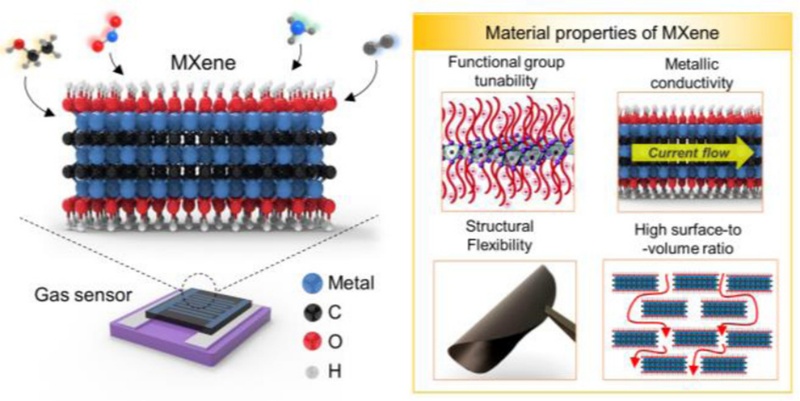
Schematic illustration of MXene-based gas sensors, highlighting the structural, electronic, and surface chemical properties relevant to gas sensing. Reprinted with permission from Ref. [29], Copyright (2019) American Chemical Society. Reprinted with permission from Ref. [30], Copyright (2015) Royal Society of Chemistry.
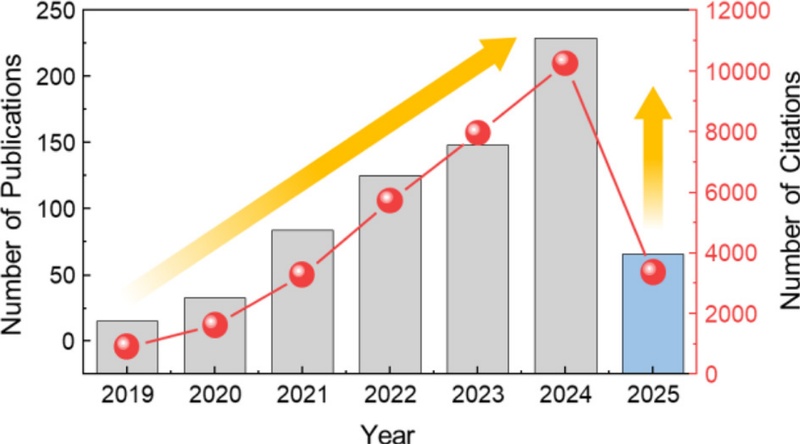
Number of publications and citations related to MXene-based gas sensors, with data obtained from the Web of Science Core Collection using the keywords “MXene gas sensor” and “MXene gas detection”.
This review systematically evaluates recent advances in MXene-based gas sensors, focusing on synthesis methods, intrinsic material properties, sensing mechanisms, and potential practical applications. It highlights the unique characteristics of MXenes that enhance the performance of chemoresistive gas sensors, such as tunable surface functional groups, metallic conductivity, structural flexibility, and high surface-to-volume ratios. The review also addresses critical challenges facing MXene gas sensors, including long-term stability, humidity resistance, and integration with AI technologies. Finally, it identifies key future research directions needed to advance MXene-based chemoresistive gas sensors for practical deployment in emerging sensing technologies.
2. FUNDAMENTALS OF MXene-BASED GAS SENSORS
MXene materials have attracted interest for gas-sensing applications owing to their unique properties, including metallic conductivity, versatile surface functionalization, and mechanical flexibility. These characteristics enable MXene-based chemoresistive gas sensors to deliver rapid response and a low signal-to-noise ratio at room temperature, distinguishing MXene from conventional metal oxides and other 2D materials, including TMD and graphene. This section provides a comprehensive overview of the fundamental properties of MXene, its synthesis from MAX phases, its unique structural features, and the gas detection mechanisms of MXene-based gas sensors.
2.1 Synthesis Methods of MXene
MXenes are synthesized by the selective etching of the A atomic layer (elements such as Al, Si, Ga, Ge, In, and Sn) from the MAX phase [31]. MAX phases have distinct bond strengths in M-X and M-A bonding, allowing for the selective removal of the A layers through chemical etching. Gogotsi et al. first demonstrated the synthesis of Ti3C2Tx MXenes by selectively removing the Al layer from Ti3AlC2 using HF (Fig. 3 (a)). During etching, the Al atoms in Ti3AlC2 reacted preferentially with HF to form soluble aluminum fluoride (AlF3), facilitating the removal of the Al layer. Subsequently, the synthesized MXene was washed and purified using a centrifuge to remove the residual etchant and impurities. Subsequently, MXene was subjected to ultrasonication to facilitate exfoliation. Figs. 3 (b) and 3 (c) present scanning electron microscopy (SEM) images of the TiAlC2 and resulting Ti3C2Tx, exhibiting a characteristic accordion-like morphology [32]. Similar HF-based etching methods have been used to successfully synthesize MXenes from other Al-containing MAX phases, such as Ti2AlC and Ta4AlC3, as shown in Figs. 3 (d) and (e).
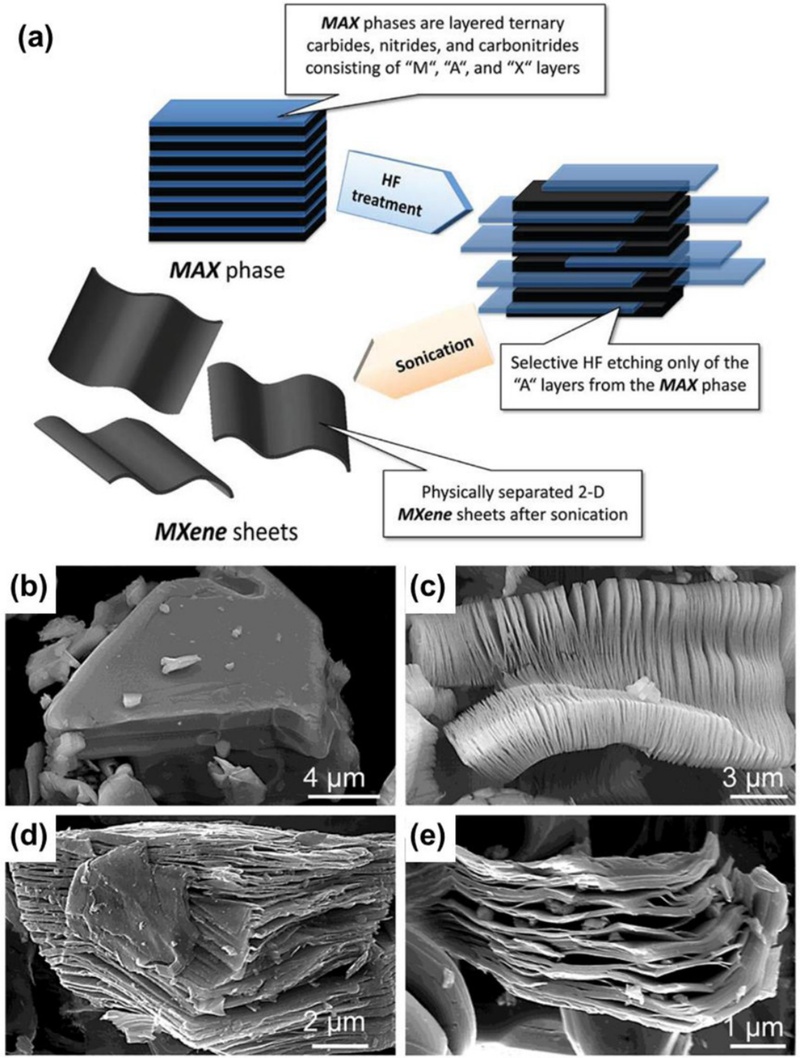
Synthesis process of MXenes from MAX phases. (a) Schematic illustration of the etching process from MAX phases to MXene. (b) Ti3AlC2 particle before treatment, representing unreacted MAX phases, (c) Ti3AlC2 after HF treatment, (d) Ti2AlC after HF treatment, (e) Ta4AlC3 after HF treatment. Reprinted with permission from Ref. [31], Copyright (2019) American Chemical Society.
However, HF etching methods require careful handling owing to the due to the toxicity and surface stabilization issues associated with residual HF. As a result, alternative, milder approaches have been explored, combining HF with less aggressive acids, such as hydrochloric acid (HCl) [33] or sulfuric acid (H2SO4) [34]. In particular, lithium fluoride (LiF)- and HCl-based minimally intensive layer delamination (MILD) etching has been developed as an effective method for MXene production [33]. This MILD approach enables high-yield synthesis of defect-free flakes with minimal structural damage. During MILD etching, Li+ ions serve as intercalants, expanding the interlayer spacing and facilitating subsequent delamination. Ghidiu et al. demonstrated MXene synthesis using LiF/HCl mixtures, resulting in hydrophilic MXene with fewer structural defects and larger lateral dimensions compared to the HF-only method [35].
In addition to LiF/HCl-based etching, organic intercalants such as dimethyl sulfoxide (DMSO) [36] and tetramethylammonium hydroxide (TMAOH) [37] have also been employed. Mashtalir et al. reported successful intercalation and delamination of Ti3C2Tx MXene using DMSO, resulting in hygroscopic and readily dispersible MXene powders [38]. Similarly, Xuan et al. utilized TMAOH for Ti3C2Tx MXene synthesis, demonstrating efficient Al-layer etching by formation of soluble Al(OH)4- ions [39]. Moreover, the bulky TMA+ cations were effectively intercalated between the MXene layers, enhancing the delamination efficiency. Therefore, MXenes are typically synthesized via selective chemical etching from MAX phases using acidic solutions coupled with various intercalation and delamination techniques to produce MXene materials.
2.2 Unique Structural Properties and Sensing Mechanisms of MXene-based Chemoresistive Gas Sensors
MXenes possess several unique properties that make them ideal materials for gas sensors. They feature abundant surface functional groups, such as -F, -OH, and -O, which play a critical role in gas sensing by selectively interacting with target gas molecules. For example, NO2 shows a strong affinity for -O groups, while acidic gases exhibit enhanced selectivity through hydrogen bonding interactions with -OH groups [20,21]. In terms of mechanical properties, the layered structure of MXenes provides high tolerance under external strain, with the Ti3C2Tx monolayer demonstrating a tensile strength of up to 15.4 GPa and a Young's modulus of approximately 0.484 TPa [40]. This combination of mechanical strength and flexibility makes MXenes suitable for flexible gas sensor applications. Additionally, MXenes exhibit metallic-level electrical conductivity, attributed to strong metal-carbon bonding and filled conduction-band states resulting from d-band electrons [41]. Their high conductivity leads to a low signal-to-noise ratio, allowing for effective gas detection at low concentrations. Furthermore, the rapid electron-hole mobilities in MXenes contribute to fast gas-sensing responses and quick recovery times.
The sensing mechanism of MXene gas sensors involves two primary phenomena: charge-transfer interactions between MXenes and gas molecules, and intercalation-induced interlayer swelling. Most MXenes, including Ti3C2Tx and V4C3Tx, exhibit p-type semiconducting properties. In the charge-transfer mechanism, when reducing gases (such as H2, NH3, and VOCs) are introduced to MXenes, they donate electrons to the MXene, reducing the hole concentration and increasing electrical resistance [42]. Conversely, when oxidizing gases (such as NO2 and O3) are introduced, they accept electrons from the MXenes, increasing the hole concentration and decreasing the resistance.
Another key mechanism is gas-induced interlayer swelling. The MXene films exhibited an accordion-like layered morphology, with gas molecules entering the interlayer spaces either physically or chemically, causing structural swelling and an increase in interlayer spacing [43]. This expansion disrupts the electron conduction pathways between adjacent MXene layers, leading to an overall increase in electrical resistance. Additionally, the adsorbed gas molecules contribute to electron scattering, which reduces carrier mobility. When the swelling-induced modulation of resistance exceeds the charge transfer effects, the MXene-based sensors show an increase in resistance, regardless of whether the gas is reducing or oxidizing.
3. RECENT PROGRESS IN MXene-based GAS SENSORS
MXenes provide notable advantages for gas sensors owing to their tunable surface functional groups, high conductivity, and high surface-to-volume ratios. Surface functional groups facilitate strong interactions with gas molecules, and high electrical conductivity reduces noise and improves detection limits. Various MXene-based gas sensors including Ti3C2Tx [44], Nb2CTx [45], V2CTx [46], and Mo2TiC2Tx [47] have been extensively investigated for the detection of diverse gases, including NO2, NH3, ethanol, acetone, and humidity. However, pristine MXenes exhibit limitations, including low response signals and humidity instability, which hinder their practical sensor applications. To address these challenges, the enhancement of MXene sensing performance has been explored through controlled surface functionalization and the creation of heterojunctions with nanostructures. Surface functionalization, such as polymer or fluorine treatment, improves MXenes' reactivity to specific gases, as well as their long-term and humidity stability [25]. In the case of heterojunctions, MXenes form composites with TMDs or metal oxides, leading to a high response to target gases through numerous junctions [28]. This section comprehensively discusses recent advances in pristine MXene-based gas sensors, surface functionalization of MXenes, and MXene-based nanocomposite heterostructures, highlighting specific strategies and performance improvements.
3.1 Gas Sensors Based on Pristine MXenes
Various pristine MXenes, including Ti3C2Tx, Nb2CTx, V2CTx, and Mo2TiC2T, have been explored as chemoresistive gas sensors. Kim et al. reported a pristine T3C2Tx MXene gas sensor for the detection of VOCs at low concentrations (50-100 ppb), which was synthesized by selective Al-layer etching from Ti3AlC2 using a LiF/HCl etchant (Fig. 4 (a)) [21]. The sensors were fabricated by coating Ti3C2Tx flakes between gold electrodes. The sensor response, defined as resistance variation relative to baseline resistance (ΔR/Rb (%)), was tested with gases including acetone, ethanol, ammonia, propanal, NO2, SO2, and CO2 (Fig. 4 (b)). The highest sensor response was observed for ethanol (1.7%), as shown in Fig. 4 (c). In particular, acidic gases showed high responses, which were attributed to strong interactions with the-OH groups on the Ti3C2Tx surfaces. Fig. 4 (d) compares Ti3C2Tx responses with other 2D materials, including reduced graphene oxide (RGO), MoS2, and black phosphorus (BP), for the detection of 100 ppm acetone, ethanol, and ammonia. Semiconducting materials with BP and MoS2 demonstrated higher responses to ammonia, whereas those with RGO and Ti3C2Tx exhibited stronger responses to VOCs. Ti3C2Tx exhibited a positive response to both ammonia (reducing) and NO2 (oxidizing), enabling effective discrimination between the gases (Fig. 4 (e)). Ti3C2Tx exhibited the lowest measured signal-to-noise ratio (0.005%) under N2 flow, outperforming BP (1.5%), MoS2 (1.0%), and RGO (0.02%), owing to its high electrical conductivity of Ti3C2Tx. Thus, the pristine Ti3C2Tx MXene demonstrated superior sensing performance for VOC detection at room temperature with excellent low-concentration sensitivity.
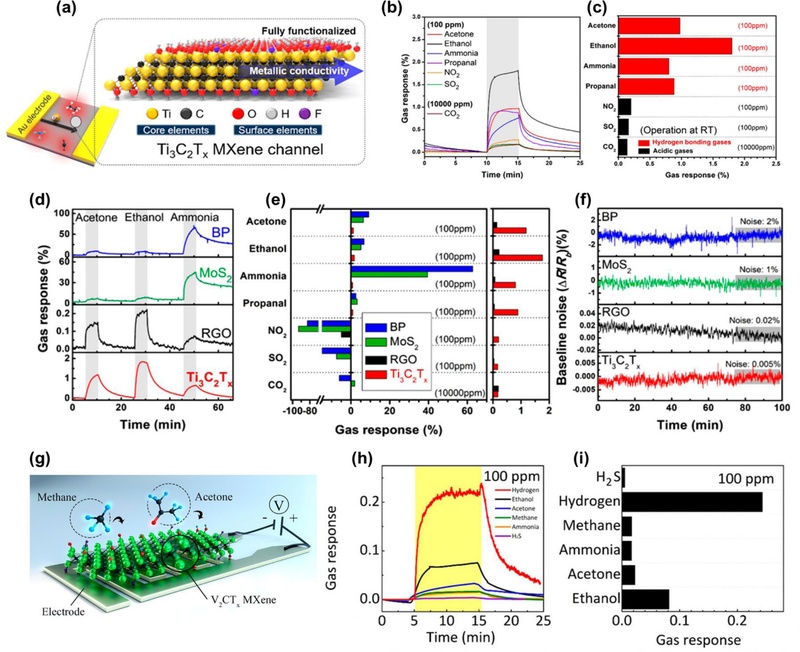
Gas sensors based on pristine MXenes. (a) Schematic illustration of Ti3C2Tx gas sensors with their structural and surface characterizations. (b) Dynamic response and (c) response plots of Ti3C2Tx sensors to 100 ppm of acetone, ethanol, ammonia, propanal, NO2, SO2, and 10000 ppm of CO2 at room temperature. (d) Gas response behaviors and (e) response plots of BP, MoS2, RGO, and Ti3C2Tx sensors to 100 ppm of various gases. (f) Electrical noise levels of the sensors under N2 exposure. Reprinted with permission from Ref. [21], Copyright (2018) American Chemical Society. (g) Schematic illustration of a V2CTx gas sensor. (h) Dynamic gas response and (i) response plots of V2CTx gas sensor to 100 ppm of H2, ethanol, acetone, methane, ammonia, and H2S at room temperature. Reprinted with permission from Ref. [48], Copyright (2019) American Chemical Society.
In addition to Ti3C2Tx, other MXenes such as Nb2CTx and V2CTx, have also been widely investigated as target gases. Lee et al. demonstrated a V2CTx MXene-based gas sensor for the room-temperature detection of H2 at the ppm level (Fig. 4 (g)) [48]. V2CTx was synthesized from the V2AlC MAX phase via HF etching for selective Al removal. After etching, tetra-n-butyl ammonium ions (TBA+) were used for intercalation to delaminate the V2CTx sheets (d-V2CTx) with ~1.75 thickness. The surface of d-V2CTx exhibited highly active states owing to the presence of–F,–O, and–OH functional groups. X-ray photoelectron spectroscopy (XPS) analysis confirmed the presence of surface species such as V-O, V-C-O, V-C-(OH)x, and fluorine terminations (V-F and C–F bonds). Gas-sensing performance tests of the d-V2CTx films showed an increase in resistance upon exposure to reducing gases, indicating p-type sensing behavior. The responses (ΔR/Rb) at 100 ppm gas exposure were 0.2435 (H2), 0.0816 (ethanol), 0.0226 (acetone), 0.0166 (ammonia), 0.0167 (methane), and 0.005 (H2S). The highest response to H2 gas was attributed to the active vanadium surface sites, similar to those of vanadium oxide and V-doped metal oxides [49,50]. The response and recovery times to H2 (reaching 90% of the steady-state response) were 2 and 7 min, respectively, with a theoretical detection limit of 1.375 ppm, calculated using a signal-to-noise ratio of 3. These results highlight the effectiveness of pristine MXenes for rapid, sensitive, and low-noise gas detection.
3.2 Gas Sensors Based on Surface Functionalized MXenes
Various studies have focused on controlling the surface chemistry of MXenes to enhance their sensitivity and selectivity to target gases. MXene surfaces contain diverse functional groups (–O,–OH, and–F) that influence gas adsorption properties. Density functional theory (DFT) calculations indicated that the-OH-terminated MXene strongly adsorbed acidic molecules, whereas the-F-terminated group improved the hydrophobicity and enhanced the humidity stability for practical sensor applications. Chen et al. demonstrated surfacefunctionalized Ti3C2Tx MXenes with superhydrophobic fluoroalkylsilane protective layers, specifically (3-chloropropyl) trimethoxysilane (CPTMS) and 1H,1H,2H,2H-perfluorooctyltriethoxysilane (FOTS), termed Ti3C2Tx-Cl and Ti3C2Tx-F, respectively [25]. Ti3C2Tx nanosheets were synthesized from Ti3AlC2 via LiF/HCl etching (Fig. 5 (a)). After surface functionalization with CPTMS and FOTS, Brunauer-EmmettTeller (BET) analysis showed increased surface areas of 20.4 m2/g for Ti3C2Tx-Cl and 32.9 m2/g for Ti3C2Tx-F. Water contact angle measurements demonstrated enhanced hydrophobicity, with values of 96o for Ti3C2Tx-Cl and 156o for Ti3C2Tx-F, compared to 33o °for pristine MXene (Fig. 5 (b)). Zeta-potential measurements also confirmed increased surface charge, with Ti3C2Tx-Cl and Ti3C2Tx-F exhibiting more negative zeta potentials of -35.8 mV and -50.1 mV, respectively, compared to -28.7 mV for pristine Ti3C2Tx (Fig. 5 (c)). These results indicate a substantial increase in the hydrophobicity of the FOTS and CPTMS functionalizations. To assess environmental stability, pristine Ti3C2Tx and Ti3C2Tx-F were stored under 5% and 100% relative humidity (RH) conditions (Fig. 5 (d)). Both the materials exhibited stable electrical conductance under dry conditions (5% RH). However, at 100% RH, pristine MXene rapidly degraded to only 2.7% of its initial conductance, whereas Ti3C2Tx-F retained 92.5%, indicating effective humidity protection. Sensor performance evaluation with ethanol concentration ranging from 5 ppm to 120 ppm at room temperature showed consistently higher responses (ΔR/Rb (%)) for Ti3C2Tx-F compared to pristine Ti3C2Tx (Fig. 5 (e)). In addition, Ti3C2Tx-F exhibits a nearly linear response (R2 > 0.98). DFT calculations supported these experimental results, revealing a higher ethanol adsorption energy for Ti3C2Tx-F (-0.745 eV) compared to pristine Ti3C2Tx (-0.621 eV). Moreover, the interlayer distance of Ti3C2Tx increased from 12.5 to 16.0 Å after FOTS functionalization, which facilitated gas diffusion, leading to enhanced gas detection (Fig. 5 (f)). Thus, surface functionalization with FOTS protection improved both humidity stability and ethanol detection capabilities.
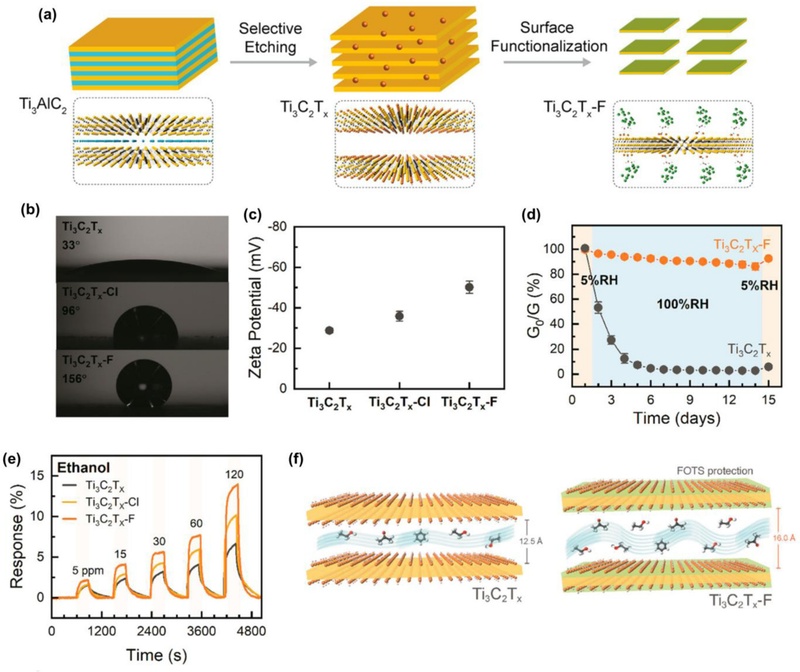
Gas sensors based on surface functionalized MXenes. (a) Schematic illustration of Ti3C2Tx functionalization for surface modification (b) Water contact angle measurements of Ti3C2Tx, Ti3C2Tx-Cl, and Ti3C2Tx-F film. (c) Zeta potential of Ti3C2Tx, Ti3C2Tx-Cl, and Ti3C2Tx-F film. (d) Changes in electrical conductance of Ti3C2Tx and Ti3C2Tx-F under 5% and 100% RH over two weeks. (e) Comparison of gas responses for the MXene sensors. (f) Schematic illustration of Ti3C2Tx and Ti3C2Tx-F under VOCs exposure. Reprinted with permission from Ref. [25], Copyright (2020) American Chemical Society.
Kim et al. demonstrated surface-functionalized MXenes using ADOPA ligands for enhanced sensitivity to NH3 and VOCs along with improved long-term stability [24]. Ti3C2Tx MXene sheets were synthesized from the Ti3AlC2 MAX phase using a LiF/HCl etching solution. Amphiphilic ADOPA ligands, produced by the esterification of DOPA and perfluoroalcohol derivatives, were grafted onto the MXene surfaces. The catechol groups within the ADOPA ligands form strong hydrogen bonds with the-OH groups on the MXene surface. Moreover, the fluorocarbon tail groups impart hydrophobicity to the MXene films. Ultrathin ADOPA-functionalized MXene films (AD1MX) approximately 10 nm thick were fabricated using a solvent-solvent interfacial self-assembly method, resulting in uniform and well-stacked MXene layers. Surface energy measurements showed increased hydrophobicity, with water contact angles of 95o for AD1MX compared to 63o for pristine Ti3C2Tx, reflecting the contribution of the fluorocarbon groups. Gas-sensing performance tests were conducted at room temperature on MXene films prepared by self-assembly and spin coating for acetone, ethanol, ammonia, and NO2 detection at a concentration of 100 ppm. The films fabricated by self-assembly exhibited a higher response than the spincoated samples across all the gases tested. Further comparison of self-assembled MXene films fabricated using ethanol/toluene (AD1MX_E/T) and acetone/toluene (AD1MX_A/T) solvents AD1MX_E/T exhibited a higher response than AD1MX_A/T for all gas types. Compared to pristine Ti3C2Tx, AD1MX_E/T exhibited notably enhanced responses, which were attributed to ADOPA ligand functionalization. DFT calculations confirmed stronger NH3 adsorption on AD1MX (-0.59 eV) compared to pristine Ti3C2Tx (-0.49 eV). Similar results were observed when applying ADOPA to other MXene materials such as Mo2TiC2Tx, demonstrating its broad applicability in enhancing gas sensor performance. These findings highlight the effectiveness of surface functionalization strategies in improving both the humidity stability and sensitivity to target gas molecules in MXene-based sensors.
3.3 Gas Sensors Based on MXene/Nanomaterial Heterostructures
MXene-based gas sensors incorporate nanocomposite heterostructures to enhance the gas detection performance. Combining MXenes with nanomaterials such as metal oxides (ZnO [51], SnO2 [27], and WO3 [52]), TMDs (SnS2 [53], WS2 [54], WSe2 [55]), graphene [56], and metal-organic frameworks (MOFs) [57] exploits the advantages of each material to increase active sites For example, heterostructures involving metal oxides or TMDs can induce surface band bending, expanding the Debye region and thus improving both sensitivity and selectivity [58].
Chen et al. developed a heterostructure sensor composed of Ti3C2Tx MXene nanosheets and WSe2 nanoflakes prepared via liquid-phase exfoliation to achieve selective ethanol detection. Ti3C2Tx was synthesized by HF etching, and the WSe2 nanoflakes were exfoliated in cetyltrimethylammonium bromide (CTAB) to form positively charged CTA+-WSe2 flakes (Fig. 6 (a)). Mixing the negatively charged Ti3C2Tx (zeta potential: -29.5 mV, due to -OH and -O functional groups) with the positively charged CTA+-WSe2 (zeta potential: +30 mV) led to electrostatic attraction and stable heterojunction formation. Gas-sensing tests under ethanol exposure (1–40 ppm) at room temperature revealed distinct sensing behaviors, characterized by increased resistance to gas exposure and incomplete recovery owing to the adsorption of ethanol molecules. Conversely, the Ti3C2Tx/WSe2 heterostructure exhibited n-type sensing behavior with decreasing resistance upon ethanol exposure and improved recovery. The response slope (response per ppm) for Ti3C2Tx/WSe2 was approximately 12-fold greater than that for pristine Ti3C2Tx without saturation, even at higher ethanol concentrations. The improved sensing performance was attributed to the efficient electron transport facilitated by the Ti3C2Tx/WSe2 heterojunction. Ti3C2Tx nanosheets with high conductivity supplied electrons to WSe2, forming junctions that enhanced the catalytic activity and reduced the number of carrier-depletion layers. Upon ethanol exposure, adsorbed oxygen reacts with ethanol molecules, releasing electrons into the conduction band, thereby reducing the depletion region and improving the sensor response. Additionally, Ti3C2Tx/WSe2 demonstrated enhanced humidity stability (Fig. 6 (c)). After exposure to 80% RH for over 10 days, Ti3C2Tx/WSe2 maintained 88% of its initial resistance and recovered to 92% in a dry environment, whereas pristine Ti3C2Tx degraded to only 21% of its original resistance. The flexible Ti3C2Tx/WSe2 sensors, fabricated via inkjet printing, maintained a consistent response to ethanol after 1000 bending cycles (radius = 5 mm), demonstrating stable mechanical flexibility and sustained electrical performance under mechanical deformation (Figs. 6 (d) and (e)).
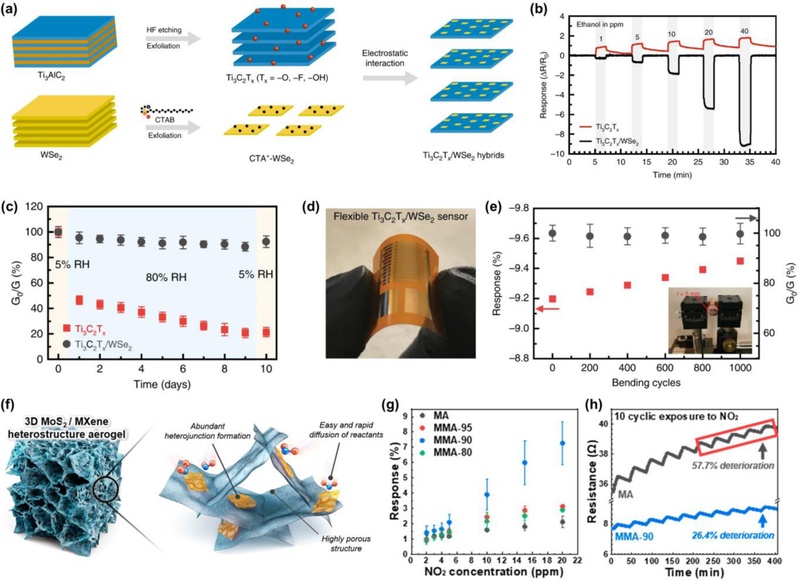
Gas sensors based on MXene/nanomaterials heterostructures. (a) Schematic illustration of the synthesis process of Ti3C2Tx/WSe2 nano-hybrids. (b) Dynamic response of Ti3C2Tx and Ti3C2Tx/WSe2 sensors to 1-400 ppm of C2H5OH. (c) Variation in electrical conductance of Ti3C2Tx and Ti3C2Tx/WSe2 sensors under 5% and 80% RH over 10 days. (d) Optical image of a flexible Ti3C2Tx/WSe2 sensor. (e) Changes in C2H5OH sensing response and electrical conductance under bending cycles. Reprinted with permission from Ref. [28], Copyright (2020) Springer Nature. (f) Schematic illustration of the 3D MoS2/MXene heterostructure aerogel. (g) Gas-sensing responses toward 2-20 ppm of NO2 for pristine MXene aerogel (MA) and MoS2/MXene heterostructure aerogels (MMA). (h) 10 cycle exposures and recoveries to 10 ppm of NO2 on MA and MMA-90. Reprinted with permission from Ref. [59], Copyright (2023) American Chemical Society.
Kim et al. demonstrated a MoS2/MXene heterostructured aerogel-based gas sensor designed for NO2 detection [59]. Ti3C2Tx MXene sheets were synthesized by selectively etching an Al layer from Ti3AlC2 using a LiF/HCl solution. MoS2 nanosheets were prepared from bulk MoS2 powder using hydrazine-assisted ball milling. The prepared Ti3C2Tx and MoS2 nanosheets were assembled into MoS2/MXene gels by mixing in an aqueous solution, facilitated by the similar hydrophilicity and negatively charged surfaces of the two materials. During freeze casting, the Ti3C2Tx sheets were interconnected to form a continuous three-dimensional (3D) network, with MoS2 nanosheets assembled uniformly onto the MXene frameworks. After freeze-drying, a MoS2/MXene composite aerogel (MMA) was obtained and designated as MMA-X, where X represents the mass percentage of Ti3C2Tx in the aerogel. The hierarchical 3D aerogel structure exhibited abundant heterojunctions and a highly porous framework, enabling efficient transport of analyte gases throughout the network (Fig. 6 (f)). The MMA demonstrated ultralow apparent density and an ultralight structure, capable of standing freely on a dandelion seed. These lightweight and porous characteristics are advantageous for applications requiring portability and space constraints, including wearable gas sensors. The gas-sensing performance of the MA (pure MXene aerogel) and MMA-X samples (MMA-95, MMA-90, and MMA-80) was evaluated with NO2 concentrations ranging from 1 to 20 ppm (Fig. 6 (g)). Increasing the MoS2 content in the MMA-X samples enhanced the sensors' response to NO2, demonstrating the catalytic effect of MoS2 decoration on the aerogel structure. Notably, the MMA-90 sample exhibited a response of 3.91% (ΔR/Rb (%)) upon exposure to 10 ppm of NO2, approximately 2.5 times higher than the response of MA. Cyclic tests involving 10 repeated exposure and recovery cycles at 10 ppm NO2 were conducted using MA and MMA-90 (Fig. 6 (h)). After five cycles, the response of MA degraded to 57.7% of the initial cycle's response, while MMA-90 retained higher stability, retaining 26.4% of its initial response. These results highlight the potential of MXene-based heterostructured aerogels as robust and sensitive architectures for chemoresistive gas-sensing applications.
4. PERSPECTIVES AND CHALLENGES
MXenes have attracted significant attention as sensing materials for room-temperature chemoresistive gas sensors, particularly for the detection of NO2, NH3, and VOCs. The key properties of MXenes, including their high electrical conductivity, abundant surface functional groups, mechanical flexibility, and high surface-to-volume ratio, provide distinct advantages for gas detection. High electrical conductivity enables rapid electron transport upon gas adsorption, facilitating fast response and recovery. In addition, the intrinsically low signal-to-noise ratio allows for the detection of gases at low concentrations. MXene surfaces possess diverse functional groups, such as -O, -OH, and -F, which directly interact with the target gases. Specific functional groups selectively enhance the sensor responses to certain gases. For instance, -O groups strongly interact with NO2, -OH groups facilitate the binding of acidic gases through hydrogen bonding, and -F groups enhance the sensor stability under humid conditions. MXenes such as Ti3C2Tx, V3C2Tx, and Mo3C2Tx are effective active layers in chemoresistive gas sensing.
Despite these promising properties, MXene-based sensors currently face several critical limitations, including instability in ambient air and moisture, insufficient sensor response compared to conventional metal oxide sensors, and limited gas selectivity. Regarding instability, MXenes are prone to oxidation in air and humidity, forming oxidized species (e.g., TiO2 in Ti3C2Tx). To address oxidation, protective layers such as PDMS and polyimide, and polymeric functional coatings such as FOTS and ADOPA have been effectively employed. The low response signal of MXene sensors compared to conventional metal-oxide-based gas sensors complicates practical electronic integration and signal detection. Constructing heterostructures between MXene and various nanomaterials (e.g., metal oxides, TMD, graphene, and MOF) enhances the sensing response through junction effects and improves catalytic activity. However, the limited gas selectivity, due to MXenes' broad reactivity with various gases, remains a challenge. Functionalization strategies involving noble metal nanoparticles (Au, Pd, Pt, and Ag) enhance selective responses through chemical and electronic sensitization mechanisms [60,61].
Future directions for MXene-based gas sensors include the development of sensor arrays [62], IoT applications [63], photoactivated sensors [64], and neuromorphy-integrated sensors [65]. Sensor arrays based on MXene heterostructures or noble metal decorations enable the discrimination of complex gas mixtures using principal component analysis (PCA) and machine learning methods [66]. Photoactivated MXene gas sensors utilize high-optical-absorption materials to further enhance sensor responses and reduce response and recovery times at room temperature [67]. The flexibility and room-temperature operability of MXene-based sensors support their application in biocompatible gas sensing, expanding the scope of IoT implementations for wearable devices. Finally, integrating MXene sensors with neuromorphic architectures that mimic biological olfactory functions, such as stimulus-dependent synaptic plasticity, short- and long-term memory, and analog signal modulation, can enable multimodal sensing, low-power operations, and effective interfaces with artificial intelligence technologies [68].
5. CONCLUSION
This review comprehensively discusses the MXene synthesis methods, fundamental sensing mechanisms, and recent advances in gas sensors that employ MXenes. Strategies to address current limitations of MXenes, such as humidity sensitivity, low selectivity, and limited sensor responses, have been highlighted, with a focus on surface functionalization and heterostructure formation approaches. To overcome these challenges, MXene-based sensors show promise as alternatives to conventional gas sensors, especially for wearable and biocompatible applications that require reliable room-temperature operation. Continued research efforts aimed at optimizing MXene properties, stabilizing performance under environmental conditions, and integrating MXenes with advanced technologies will enable MXene-based chemoresistive gas sensors to effectively meet future sensing demands.
Acknowledgments
This research was supported by the Nano & Material Technology Development Program through the National Research Foundation of Korea (NRF), funded by the Ministry of Science and ICT(RS-2024-00405016). This work was financially supported by the Cooperative Research Program for Agriculture Science and Technology Development (Project No. PJ01706703) of the Rural Development Administration, Republic of Korea. The Inter-University Semiconductor Research Center and Institute of Engineering Research at Seoul National University provided research facilities for this study.
References
-
S.C. Mukhopadhyay, S.K.S. Tyagi, N.K. Suryadevara, V. Piuri, F. Scotti, S. Zeadally, Artificial intelligence-based sensors for next generation IoT applications: A review, IEEE Sens. J. 21 (2021) 24920–24932.
[https://doi.org/10.1109/JSEN.2021.3055618]

-
F. Zhou, Y. Chai, Near-sensor and in-sensor computing, Nat. Electron. 3 (2020) 664–671.
[https://doi.org/10.1038/s41928-020-00501-9]
-
S. Lee, S. Kim, G.B. Nam, T.H. Eom, H.W. Jang, Chemoresistive Gas Sensors for Food Quality Monitoring, J. Semicond. Technol. Sci. 22 (2022) 244–258.
[https://doi.org/10.5573/JSTS.2022.22.4.244]
-
X. Zhou, Z. Xue, X. Chen, C. Huang, W. Bai, Z. Lu, et al., Nanomaterial-based gas sensors used for breath diagnosis, J. Mater. Chem. B 8 (2020) 3231–3248.
[https://doi.org/10.1039/C9TB02518A]
-
S.H. Cho, J.M. Suh, B. Jeong, T.H. Lee, K.S. Choi, T.H. Eom, et al., Substantially accelerated response and recovery in Pd-decorated WO3 nanorods gasochromic hydrogen sensor, Small 20 (2024) 2309744.
[https://doi.org/10.1002/smll.202309744]
-
S.Y. Jeong, J.S. Kim, J.H. Lee, Rational design of semiconductor-based chemiresistors and their libraries for next-generation artificial olfaction, Adv. Mater. 32 (2020) 2002075.
[https://doi.org/10.1002/adma.202002075]
-
D.Y. Nadargi, A. Umar, J.D. Nadargi, S.A. Lokare, S. Akbar, I.S. Mulla, et al., Gas sensors and factors influencing sensing mechanism with a special focus on MOS sensors, J. Mater. Sci. 58 (2023) 559–582.
[https://doi.org/10.1007/s10853-022-08072-0]
-
S.J. Park, S.M. Lee, J. Lee, S. Choi, G.B. Nam, Y.K. Jo, et al., Pd-W18O49 Nanowire MEMS Gas Sensor for Ultraselective Dual Detection of Hydrogen and Ammonia, Small 21 (2025) 2405809.
[https://doi.org/10.1002/smll.202405809]
-
G.B. Nam, T.H. Eom, S.H. Cho, Y.J. Kim, S. Choi, W.S. Cheon, et al., Maximized nanojunctions in Pd/SnO2 nanoparticles for ultrasensitive and rapid H2 detection, Chem. Eng. J. 494 (2024) 153116.
[https://doi.org/10.1016/j.cej.2024.153116]
-
N. Barsan, U. Weimar, Conduction model of metal oxide gas sensors, J. Electroceram. 7 (2001) 143–167.
[https://doi.org/10.1023/A:1014405811371]
-
Y. Kim, T. Kim, J. Lee, Y.S. Choi, J. Moon, S.Y. Park, et al., Tailored Graphene Micropatterns by Wafer-Scale Direct Transfer for Flexible Chemical Sensor Platform, Adv. Mater. 33 (2021) 2004827.
[https://doi.org/10.1002/adma.202004827]
-
W. Yuan, G. Shi, Graphene-based gas sensors, J. Mater. Chem. A 1 (2013) 10078–10091.
[https://doi.org/10.1039/c3ta11774j]
-
S.J. Kim, G.B. Nam, Y.J. Kim, T.H. Eom, J.-E. Ryu, H.J. Kim, et al., Ambient Stable CsCu2I3 Flexible Gas Sensors for Reliable NO2 Detection at Room Temperature, Nano Lett. (2025) 2894–2902.
[https://doi.org/10.1021/acs.nanolett.4c06149]
-
T. Pham, G. Li, E. Bekyarova, M.E. Itkis, A. Mulchandani, MoS2-based optoelectronic gas sensor with sub-parts-perbillion limit of NO2 gas detection, ACS Nano 13 (2019) 3196–3205.
[https://doi.org/10.1021/acsnano.8b08778]
-
D. Liu, Z. Tang, Z. Zhang, Comparative study on NO2 and H2S sensing mechanisms of gas sensors based on WS2 nanosheets, Sens. Actuators B Chem. 303 (2020) 127114.
[https://doi.org/10.1016/j.snb.2019.127114]
-
S.M. Lee, Y.J. Kim, S.J. Park, W.S. Cheon, J. Kim, G.B. Nam, et al., In-Situ Growth of 2D MOFs as a Molecular Sieving Layer on SnS2 Nanoflakes for Realizing Ultraselective H2S Detection, Adv. Funct. Mater. 35 (2025) 2417019.
[https://doi.org/10.1002/adfm.202417019]
-
A. VahidMohammadi, J. Rosen, Y. Gogotsi, The world of two-dimensional carbides and nitrides (MXenes), Science 372 (2021) eabf1581.
[https://doi.org/10.1126/science.abf1581]
-
H.J. Kim, C.W. Lee, S. Park, S. Choi, S.H. Park, G.B. Nam, et al., MXene-based high performance microfluidic pH sensors for electronic tongue, Sens. Actuators B Chem. 409 (2024) 135636.
[https://doi.org/10.1016/j.snb.2024.135636]
-
Z. Guo, L. Gao, Z. Xu, S. Teo, C. Zhang, Y. Kamata, et al., High electrical conductivity 2D MXene serves as additive of perovskite for efficient solar cells, Small 14 (2018) 1802738.
[https://doi.org/10.1002/smll.201802738]
-
Y. Wang, J. Fu, J. Xu, H. Hu, D. Ho, Atomic plasma grafting: precise control of functional groups on Ti3C2Tx MXene for room temperature gas sensors, ACS Appl. Mater. Interfaces 15 (2023) 12232–12239.
[https://doi.org/10.1021/acsami.2c22609]
-
S.J. Kim, H.-J. Koh, C.E. Ren, O. Kwon, K. Maleski, S.-Y. Cho, et al., Metallic Ti3C2Tx MXene gas sensors with ultrahigh signal-to-noise ratio, ACS Nano 12 (2018) 986–993.
[https://doi.org/10.1021/acsnano.7b07460]
-
W.-N. Zhao, N. Yun, Z.-H. Dai, Y.-F. Li, A high-performance trace level acetone sensor using an indispensable V4C3Tx Mxene, RSC Adv. 10 (2020) 1261–1270.
[https://doi.org/10.1039/C9RA09069J]
-
T. Thomas, J.A.R. Ramon, V. Agarwal, A. Álvarez-Méndez, J.A. Martinez, Y. Kumar, et al., Highly stable, fast responsive Mo2CTx MXene sensors for room temperature carbon dioxide detection, Microporous Mesoporous Mater. 336 (2022) 111872.
[https://doi.org/10.1016/j.micromeso.2022.111872]
-
S. Kim, T. Y. Ko, A. K. Jena, A. S. Nissimagoudar, J. Lee, S. Lee, et al., Instant Self-Assembly of Functionalized MXenes in Organic Solvents: General Fabrication to High-Performance Chemical Gas Sensors, Adv. Funct. Mater. 34 (2024) 2310641.
[https://doi.org/10.1002/adfm.202310641]
-
W.Y. Chen, S.-N. Lai, C.-C. Yen, X. Jiang, D. Peroulis, L.A. Stanciu, Surface functionalization of Ti3C2Tx MXene with highly reliable superhydrophobic protection for volatile organic compounds sensing, ACS nano 14 (2020) 11490–11501.
[https://doi.org/10.1021/acsnano.0c03896]
-
A. Hermawan, B. Zhang, A. Taufik, Y. Asakura, T. Hasegawa, J. Zhu, et al., CuO nanoparticles/Ti3C2Tx MXene hybrid nanocomposites for detection of toluene gas, ACS Appl. Nano Mater. 3 (2020) 4755–4766.
[https://doi.org/10.1021/acsanm.0c00749]
-
T. He, W. Liu, T. Lv, M. Ma, Z. Liu, A. Vasiliev, et al., MXene/SnO2 heterojunction based chemical gas sensors, Sens. Actuators B Chem. 329 (2021) 129275.
[https://doi.org/10.1016/j.snb.2020.129275]
-
W.Y. Chen, X. Jiang, S.-N. Lai, D. Peroulis, L. Stanciu, Nanohybrids of a MXene and transition metal dichalcogenide for selective detection of volatile organic compounds, Nat. Commun. 11 (2020) 1302.
[https://doi.org/10.1038/s41467-020-15092-4]
-
S. Hong, J.K. El-Demellawi, Y. Lei, Z. Liu, F.A. Marzooqi, H.A. Arafat, et al., Porous Ti3C2Tx MXene membranes for highly efficient salinity gradient energy harvesting, ACS nano 16 (2022) 792–800.
[https://doi.org/10.1021/acsnano.1c08347]
-
J. Chen, K. Chen, D. Tong, Y. Huang, J. Zhang, J. Xue, et al., CO2 and temperature dual responsive “Smart” MXene phases, Chem. Commun. 51 (2015) 314–317.
[https://doi.org/10.1039/C4CC07220K]
-
M. Naguib, O. Mashtalir, J. Carle, V. Presser, J. Lu, L. Hultman, et al., Two-dimensional transition metal carbides, ACS Nano 6 (2012) 1322–1331.
[https://doi.org/10.1021/nn204153h]
-
J. Peng, X. Chen, W.-J. Ong, X. Zhao, N. Li, Surface and heterointerface engineering of 2D MXenes and their nanocomposites: insights into electro-and photocatalysis, Chem 5 (2019) 18–50.
[https://doi.org/10.1016/j.chempr.2018.08.037]
-
T. Zhang, L. Pan, H. Tang, F. Du, Y. Guo, T. Qiu, et al., Synthesis of two-dimensional Ti3C2Tx MXene using HCl+ LiF etchant: enhanced exfoliation and delamination, J. Alloys Compd. 695 (2017) 818–826.
[https://doi.org/10.1016/j.jallcom.2016.10.127]
-
N. Goossens, K. Lambrinou, B. Tunca, V. Kotasthane, M.C. Rodríguez González, A. Bazylevska, et al., Upscaled Synthesis Protocol for Phase-Pure, Colloidally Stable MXenes with Long Shelf Lives, Small Methods 8 (2024) 2300776.
[https://doi.org/10.1002/smtd.202300776]
-
M. Ghidiu, M.R. Lukatskaya, M.-Q. Zhao, Y. Gogotsi, M.W. Barsoum, Conductive two-dimensional titanium carbide ‘clay’with high volumetric capacitance, Nature 516 (2014) 78–81.
[https://doi.org/10.1038/nature13970]
-
A. Qian, J.Y. Seo, H. Shi, J.Y. Lee, C.H. Chung, Surface functional groups and electrochemical behavior in dimethyl sulfoxide-delaminated Ti3C2Tx Mxene, ChemSusChem 11 (2018) 3719–3723.
[https://doi.org/10.1002/cssc.201801759]
-
S. Ren, J.-L. Xu, L. Cheng, X. Gao, S.-D. Wang, Amine-Assisted Delaminated 2D Ti3C2Tx MXenes for High Specific Capacitance in Neutral Aqueous Electrolytes, ACS Appl. Mater. Interfaces 13 (2021) 35878–35888.
[https://doi.org/10.1021/acsami.1c06161]
-
O. Mashtalir, M. Naguib, V.N. Mochalin, Y. Dall’Agnese, M. Heon, M.W. Barsoum, et al., Intercalation and delamination of layered carbides and carbonitrides, Nat. Commun. 4 (2013) 1716.
[https://doi.org/10.1038/ncomms2664]
-
J. Xuan, Z. Wang, Y. Chen, D. Liang, L. Cheng, X. Yang, et al., Organic-base-driven intercalation and delamination for the production of functionalized titanium carbide nanosheets with superior photothermal therapeutic performance, Angew. Chem. 128 (2016) 14789–14794.
[https://doi.org/10.1002/ange.201606643]
-
C. Rong, T. Su, Z. Li, T. Chu, M. Zhu, Y. Yan, et al., Elastic properties and tensile strength of 2D Ti3C2Tx MXene monolayers, Nat. Commun. 15 (2024) 1566.
[https://doi.org/10.1038/s41467-024-45657-6]
-
L. Jia, S. Zhou, A. Ahmed, Z. Yang, S. Liu, H. Wang, et al., Tuning MXene electrical conductivity towards multifunctionality, Chem. Eng. J. 475 (2023) 146361.
[https://doi.org/10.1016/j.cej.2023.146361]
-
R.A.B. John, K. Vijayan, N.L.W. Septiani, A. Hardiansyah, A.R. Kumar, B. Yuliarto, et al., Gas-sensing mechanisms and performances of MXenes and MXene-based heterostructures, Sensors 23 (2023) 8674.
[https://doi.org/10.3390/s23218674]
-
Y. Zhang, Y. Jiang, Z. Duan, Q. Huang, Y. Wu, B. Liu, et al., Highly sensitive and selective NO2 sensor of alkalized V2CTx MXene driven by interlayer swelling, Sens. Actuators B Chem. 344 (2021) 130150.
[https://doi.org/10.1016/j.snb.2021.130150]
-
X. Li, Z. An, Y. Lu, J. Shan, H. Xing, G. Liu, et al., Room temperature VOCs sensing with termination-modified Ti3C2Tx MXene for wearable exhaled breath monitoring, Adv. Mater. Technol. 7 (2022) 2100872.
[https://doi.org/10.1002/admt.202100872]
-
K. Rathi, N.K. Arkoti, K. Pal, Fabrication of delaminated 2D metal carbide MXenes (Nb2CTx) by CTAB-based NO2 Gas Sensor with Enhanced Stability, Adv. Mater. Interfaces 9 (2022) 2200415.
[https://doi.org/10.1002/admi.202200415]
-
S.M. Majhi, A. Ali, Y.E. Greish, H.F. El-Maghraby, S.T. Mahmoud, V2CTX MXene-based hybrid sensor with high selectivity and ppb-level detection for acetone at room temperature, Sci. Rep. 13 (2023) 3114.
[https://doi.org/10.1038/s41598-023-30002-6]
-
Q. Zhao, W. Zhou, M. Zhang, Y. Wang, Z. Duan, C. Tan, et al., Edge-enriched Mo2TiC2Tx/MoS2 heterostructure with coupling interface for selective NO2 monitoring, Adv. Funct. Mater. 32 (2022) 2203528.
[https://doi.org/10.1002/adfm.202270220]
-
E. Lee, A. VahidMohammadi, Y.S. Yoon, M. Beidaghi, D.-J. Kim, Two-dimensional vanadium carbide MXene for gas sensors with ultrahigh sensitivity toward nonpolar gases, ACS Sens. 4 (2019) 1603–1611.
[https://doi.org/10.1021/acssensors.9b00303]
-
Y.-T. Wang, W.-T. Whang, C.-H. Chen, Hollow V2O5 nanoassemblies for high-performance room-temperature hydrogen sensors, ACS Appl. Mater. Interfaces 7 (2015) 8480–8487.
[https://doi.org/10.1021/am509182s]
-
X. Xu, M. Yin, N. Li, W. Wang, B. Sun, M. Liu, et al., Vanadium-doped tin oxide porous nanofibers: Enhanced responsivity for hydrogen detection, Talanta 167 (2017) 638–644.
[https://doi.org/10.1016/j.talanta.2017.03.013]
-
Z. Yang, L. Jiang, J. Wang, F. Liu, J. He, A. Liu, et al., Flexible resistive NO2 gas sensor of three-dimensional crumpled MXene Ti3C2Tx/ZnO spheres for room temperature application, Sens. Actuators B Chem. 326 (2021) 128828.
[https://doi.org/10.1016/j.snb.2020.128828]
-
P. Wang, S. Guo, Y. Zhao, Z. Hu, Y. Tang, L. Zhou, et al., WO3 nanoparticles supported by Nb2CTx MXene for superior acetone detection under high humidity, Sens. Actuators B Chem. 398 (2024) 134710.
[https://doi.org/10.1016/j.snb.2023.134710]
-
T. He, S. Sun, B. Huang, X. Li, MXene/SnS2 heterojunction for detecting sub-ppm NH3 at room temperature, ACS Appl. Mater. Interfaces 15 (2023) 4194–4207.
[https://doi.org/10.1021/acsami.2c18097]
-
S. Sardana, A. Debnath, D. Aswal, A. Mahajan, WS2 nanosheets decorated multi-layered MXene based chemiresistive sensor for efficient detection and discrimination of NH3 and NO2, Sens. Actuators B Chem. 394 (2023) 134352.
[https://doi.org/10.1016/j.snb.2023.134352]
-
B. Maji, S. Badhulika, Fully Flexible WSe2/V2C MXene Heterostructure-based Gas Sensor: a detailed Sensing Analysis for ppb level Detection of Ammonia at Room Temperature, J. Alloys Compd. 1017 (2025) 179079.
[https://doi.org/10.1016/j.jallcom.2025.179079]
-
S.H. Lee, W. Eom, H. Shin, R.B. Ambade, J.H. Bang, H.W. Kim, et al., Room-temperature, highly durable Ti3C2Tx MXene/graphene hybrid fibers for NH3 gas sensing, ACS Appl. Mater. Interfaces 12 (2020) 10434–10442.
[https://doi.org/10.1021/acsami.9b21765]
-
N.K. Arkoti, K. Pal, Ti3C2Tx MXene-Derived Metal–Organic Frameworks for Room Temperature NO2 Detection, ACS Appl. Mater. Interfaces 17 (2025) 31316–31325.
[https://doi.org/10.1021/acsami.5c05667]
-
M. Mathew, P.V. Shinde, R. Samal, C.S. Rout, A review on mechanisms and recent developments in pn heterojunctions of 2D materials for gas sensing applications, J. Mater. Sci. 56 (2021) 9575–9604.
[https://doi.org/10.1007/s10853-021-05884-4]
-
S. Kim, H. Shin, J. Lee, C. Park, Y. Ahn, H.J. Cho, et al., Three-Dimensional MoS2/MXene Heterostructure Aerogel for Chemical Gas Sensors with Superior Sensitivity and Stability, ACS Nano 17 (2023) 19387–19397.
[https://doi.org/10.1021/acsnano.3c07074]
-
X. Li, L. Jin, A. Ni, L. Zhang, L. He, H. Gao, et al., Tough and antifreezing MXene@ Au hydrogel for low-temperature trimethylamine gas sensing, ACS Appl. Mater. Interfaces 14 (2022) 30182–30191.
[https://doi.org/10.1021/acsami.2c06749]
-
W.Y. Chen, C.D. Sullivan, S.-N. Lai, C.-C. Yen, X. Jiang, D. Peroulis, et al., Noble-Nanoparticle-Decorated Ti-C2Tx MXenes for Highly Sensitive Volatile Organic Compound Detection, ACS Omega 7 (2022) 29195–29203.
[https://doi.org/10.1021/acsomega.2c03272]
-
D. Li, G. Liu, Q. Zhang, M. Qu, Y. Q. Fu, Q. Liu, et al., Virtual sensor array based on MXene for selective detections of VOCs, Sens. Actuators B Chem. 331 (2021) 129414.
[https://doi.org/10.1016/j.snb.2020.129414]
-
R. Yuan, Y. Yang, B. Zou, Y. Zhang, MXene-enabled gas sensors for wearable breath monitoring, Chem. Eng. J. 510 (2025) 161414.
[https://doi.org/10.1016/j.cej.2025.161414]
-
G.B. Nam, J.-E. Ryu, T.H. Eom, S.J. Kim, J.M. Suh, S. Lee, et al., Real-time tunable gas sensing platform based on SnO2 nanoparticles activated by blue micro-light-emitting diodes, Nano Micro Lett. 16 (2024) 261.
[https://doi.org/10.1007/s40820-024-01486-2]
-
J.K. Han, M. Kang, J. Jeong, I. Cho, J.M. Yu, K.J. Yoon, et al., Artificial olfactory neuron for an in-sensor neuromorphic nose, Adv. Sci. 9 (2022) 2106017.
[https://doi.org/10.1002/advs.202106017]
-
S.-H. Sung, J.M. Suh, Y.J. Hwang, H.W. Jang, J.G. Park, S.C. Jun, Data-centric artificial olfactory system based on the eigengraph, Nat. Commun. 15 (2024) 1211.
[https://doi.org/10.1038/s41467-024-45430-9]
-
T. Zhou, P. Zhang, Z. Yu, M. Tao, D. Zhou, B. Yang, et al., Light-driven, ultra-sensitive and multifunctional ammonia wireless sensing system by plasmonic-functionalized Nb2CTx MXenes towards smart agriculture, Nano Energy 108 (2023) 108216.
[https://doi.org/10.1016/j.nanoen.2023.108216]
-
Y. Deng, M. Zhao, Y. Ma, S. Liu, M. Liu, B. Shen, et al., A Flexible and Biomimetic Olfactory Synapse with Gasotransmitter-Mediated Plasticity, Adv. Funct. Mater. 33 (2023) 2214139.
[https://doi.org/10.1002/adfm.202214139]

Gi Baek Nam is currently a PhD candidate under the supervision of Prof. Ho Won Jang of the Department of Materials Science and Engineering at Seoul National University (SNU). He received his BS degree in Materials Science and Engineering from Korea University in 2022. His research has focused on chemoresistive gas sensors based on metal oxides and sulfides for use in electronic noses.

Ho Won Jang is a professor in the Department of Materials Science and Engineering at Seoul National University. He earned his Ph.D. in Materials Science and Engineering from Pohang University of Science and Technology in 2004. From 2006 to 2009, he worked as a research associate at the University of Wisconsin, Madison. Before joining Seoul National University in 2012, he served as a senior research scientist at the Korea Institute of Science and Technology. His research interests include the synthesis of oxides, 2D materials, and halide perovskites, as well as their applications in chemical sensors, nanoelectronics, solar water-splitting cells, plasmonics, metal–insulator transitions, and ferroelectricity.