
Adaptive DROIC Equipped with Pixel-Level Multiple SS-ADC for High-Resolution Microbolometer IRFPAs

ⓒ The Korean Sensors Society
This is an Open Access article distributed under the terms of the Creative Commons Attribution Non-Commercial License(https://creativecommons.org/licenses/by-nc/3.0/) which permits unrestricted non-commercial use, distribution, and reproduction in any medium, provided the original work is properly cited.
Abstract
This paper introduces an adaptive digital readout integrated circuit (DROIC) equipped with a pixel-level multiple single-slope analog-to-digital converter designed for high-resolution microbolometer infrared focal plane arrays. This DROIC features exceptionally low power consumption, making it well-suited for ultralight portable devices. Because it was engineered to adjust to rapidly changing ambient conditions, the circuit enhances the dynamic range and signal-to-noise ratio across a broad input spectrum and efficiently offers multiple operational modes. The DROIC was designed using a 0.18 μm CMOS process and integrated into a 640 × 512 array of 17 μm × 17 μm pixels. It achieved a maximum integration time of 1.82 ms and dynamic range of 81.9 dB, while its power consumption remained below 20.5 nW per pixel at a frame rate of 30 Hz.
Keywords:
Uncooled infrared imager, Digital readout integrated circuit, Pixel-level ADC, Wide dynamic range, Multiple modes1. INTRODUCTION
Infrared (IR) cameras are extensively employed in the military, medical, and commercial sectors. Recent advancements have increased the demand for low-power micro-infrared cameras in ultralight portable devices such as drones and head-mounted displays (HMDs) [1]. Consequently, significant research has focused on uncooled IR detectors such as bolometers [2-11].
Digital readout integrated circuits (DROICs) incorporating monolithic analog-to-digital converters (ADCs) are pivotal for enhancing the efficiency of low-power micro-infrared cameras. These DROICs enable on-chip signal processing in systems on chips (SoCs), substantially reducing the overall size and cost of camera systems, while simultaneously improving the power efficiency and minimizing noise during data transmission. Among the various ADC designs, pixel-level ADCs are preferred over chip- and column-level ADCs because of their superior noise and power performances, offering enhanced control over signal integration processes that improve the integration time and dynamic range (DR) [12-18].
Research on implementing pixel-level ADCs in infrared cameras has led to the adoption of single-slope analog-to-digital converters (SS-ADCs) because of their simple architecture [19]. However, reducing the noise and power consumption remains challenging because the analog-to-digital (A/D) conversion occurs after signal integration. Pulse frequency modulation (PFM)-based ADCs offer better noise performance owing to their adequate charge handling capacity; however, their constant integration time, regardless of the signal intensity, leads to higher power consumption [20-22]. Time-to-digital converters (TDCs) optimize power usage by adjusting the integration times based on the signal intensity; however, they struggle to minimize the quantization noise for larger signals owing to the inverse relationship between the analog input and digital output [23].
A pixel-level ADC employing multiple SS-ADC was effectively utilized in the proposed DROIC. This multiple-SS-ADC design is characterized by its simplicity and ease of control, making it an ideal choice for pixel-level ADCs in micro-infrared cameras. The ADC was designed to dynamically adjust the integration time and A/D conversion period based on the intensity of the input signal, which significantly enhanced the SNR, DR, and power efficiency. This adaptability allows multiple operational modes to be tuned to adjust to various environmental conditions, while maintaining ultra-low power consumption.
2. PROPOSED PIXEL-LEVEL ADC
2.1 Basic concepts
Fig. 1 (a) shows a schematic of the unit circuit used to implement a pixel-level SS-ADC. This circuit includes an integrator for converting the input current (ISIG) into a voltage, a comparator for comparing the integrated voltage (V(CINT)) with a reference voltage (VTH) to measure the size of the input, and a memory component for storing the digital conversion value. Here,fRST, VRST, and CINT are the reset signal, reset voltage, and integration capacitor, respectively. Fig. 1 (b) displays the V(CINT) waveform during standard SS-ADC operation, showing example waveforms for two different input currents (ISIG1 and ISIG2). In conventional SS-ADCs, V(CINT) is maintained at the post-maximum integration time (Tm), and A/D conversion is conducted using a ramp signal. In scenarios where a high current such as ISIG1 reaches the saturation voltage (VSAT) before Tm, it cannot be reliably converted into a digital value, thus diminishing the DR. A solution to this limitation involves multiple samplings. If V(CINT) surpasses the reference value at time T0 before Tm, it is held, as shown by the dotted line in Fig. 1 (b), and the SS-ADC is carried out after Tm. Depending on when V(CINT) is maintained, subsequent adjustments are necessary for the digital value. By employing multiple integrations that dynamically adjust the integration time based on the signal intensity, accurate results can be achieved even for large inputs, thereby significantly enhancing the DR. However, this method leads to higher power consumption and complicates accurate A/D conversion owing to changes in the held V(CINT) value caused by the leakage current.
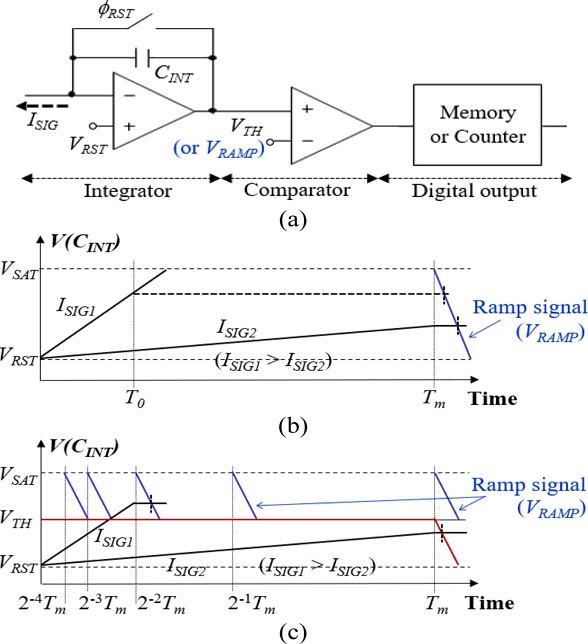
Pixel-level SS-ADC: (a) simplified schematic, (b) timing diagram for conventional SS-ADC, and (c) timing diagram for proposed ADC.
Fig. 1 (c) displays the timing diagram for the proposed multiple SS-ADC, as depicted in Fig. 1 (a). The maximum integration time, Tm, is subdivided as shown in Fig. 1 (c), and V(CINT) is compared with VTH, defined as 0.5(VSAT + VRST), at intervals of 2-nTm (n = 4, 3, 2, 1, 0). If V(CINT) exceeds VTH at any comparison point, it is held and SS-ADC is performed using a ramp signal. For lower inputs such as ISIG2, which do not reach the reference voltage by Tm, the SS-ADC proceeds using a ramp signal based on VTH. This method enhances the DR by dynamically adjusting the conversion gain according to the signal intensity and significantly reduces the power consumption by deactivating all analog circuits immediately after the digital result is captured.
2.2 Unit-cell circuit
Fig. 2 shows a schematic of the unit-cell circuit for the proposed pixel-level ADC. The integrator and comparator are configured using amplifiers A1 and A5, respectively. Amplifiers A1 and A2 are folded-cascode and two-stage amplifiers, respectively, and both amplifiers have an average power consumption of less than 100 nW. The two latches control the circuit based on the comparator outputs, and a 12-bit SRAM stores the digital conversion results. A 12-bit counter and VR control circuit, shared row-by-row outside the unit-cell array, generate globally synchronized signals. A bias current suppression method is employed to eliminate unnecessary bias current (IB) from the image and integrate only the signal current (ISIG) [24,25], thus reducing noise by ensuring an adequate integration time within the limited capacitance (CINT) owing to the constrained pixel area. Capacitor CCDS enables correlated double-sampling (CDS) operations [26-28]. The comparator output clarity is enhanced by an inverter and a level shifter, which ensure a proper logic-level understanding. To minimize the fall time of the comparator output, 0.5VDD is used as the low-side power for the inverter, aligning its logic threshold voltage closer to VDD.
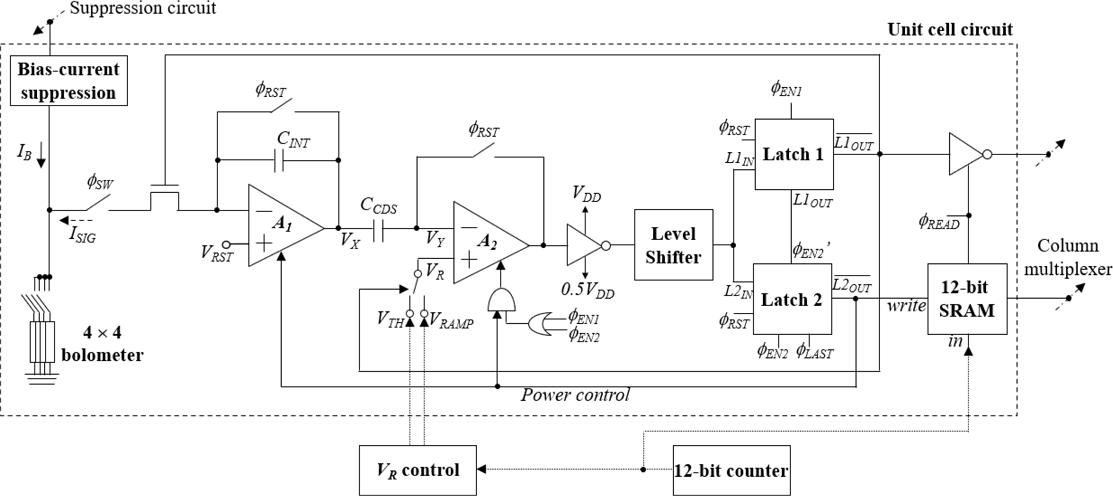
Schematic of the unit cell circuit for the proposed multiple SS-ADC.
Fig. 3 presents a detailed circuit diagram of the two latches depicted in Fig. 2, and Fig. 4 illustrates the timing diagram for the operation shown in Fig. 2. Given the extremely small pixel pitch of the target bolometer array in this study, incorporating the circuit shown in Fig. 2 within a single pixel is challenging. Consequently, the adjacent 4 × 4-pixel bolometers share a unit-cell circuit in a time-division manner, as shown in Fig. 2. The timing diagram in Fig. 4 applies to one pixel and accounts for 1/16 of the frame time, which is equivalent to 2.08 ms at a 30 Hz frame rate.
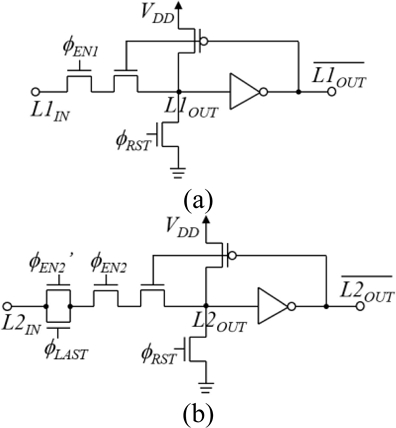
Detailed diagrams of the two latches in Fig. 2: (a) Latch 1 and (b) Latch 2.
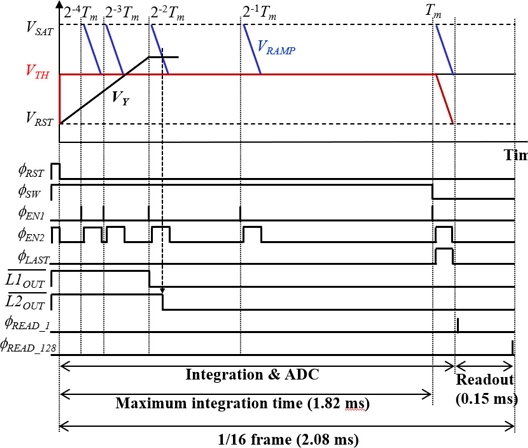
Timing diagram for the proposed ADC shown in Fig. 2.
Initially, the output voltage of the integrator (VX) and input voltage of the comparator (VY) are both set to VRST owing to the fRST signal, and the outputs of each latch, and , are initialized to the Logic 1 value. VY, which represents the integral of ISIG, increases in response to the fSW signal, which adjusts the maximum integration time. The comparator and Latch 1 inputs are enabled by the fEN1 signal to compare VY with the comparator's reference voltage, VR (= VTH), at 2-nTm. If VY is less than VTH at a specific comparison time, ISIG continues to integrate. However, if VY exceeds VTH, switches to Logic 0 and remains in this state until the next reset. At this point, when VY is held, VR is adjusted to VRAMP, and Latch 2 is activated by the fEN2’ signal. The held VY signal is compared with ramp signal VRAMP under the fEN2 signal; when VRAMP matches VY, switches to Logic 0, maintaining this state until the next reset. Simultaneously, the digital value from the 12-bit counter synchronized with VRAMP, is stored in the 12-bit SRAM, finalizing the digital conversion, and the power to the integrator and comparator is terminated. If VY does not reach VTH by Tm, VY is maintained at a constant value by fSW, latch 2 is activated by the fLAST signal, and the SS-ADC operation proceeds using VTH converted to a ramp signal. After the integration and A/D conversion, a digital signal is transmitted to the column multiplexer outside the unit-cell circuit array via a row-by-row fREAD signal.
2.3 Full readout integrated circuit
Fig. 5 presents a simplified block diagram of the comprehensive DROIC for the proposed multiple SS-ADC. Given that each 4 × 4 bolometer array shares a single unit- cell circuit, a 160 × 128 array of unit-cell circuits is needed to form a 640 ´ 512 infrared focal plane array (IRFPA). The system includes a row scan circuit to generate row-by-row control signals and reference signal generator that supplies reference voltages such as the VR signal for the unit-cell circuit. Additionally, a suppression circuit, column-level 12-bit ADC, and digital-to-analog converter (DAC) are employed to produce and retransmit the bias information of each bolometer for precise bias suppression. A dark sensor establishes a reference point for bias suppression and column multiplexer sequentially outputs the digital values transmitted from each unit-cell circuit.
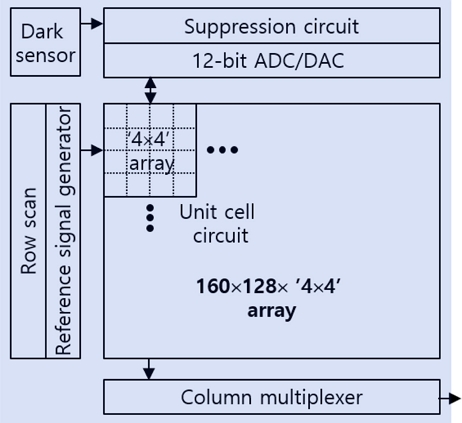
Block diagram of the complete DROIC.
3. SIMULATION RESULTS AND ANALYSIS
The DROIC was designed using a 0.18-μm CMOS process for an a-Si microbolometer. The design specifications of the target bolometer and readout circuit are listed in Table 1. The mask layout of the unit-cell circuit shown in Fig. 2 is illustrated in Fig. 6.

Design parameters of the microbolometer and readout circuit.
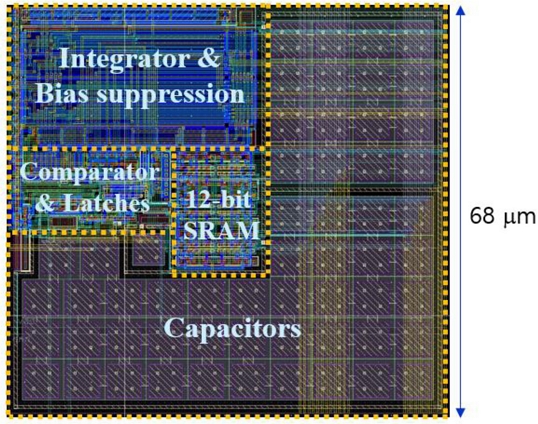
Mask layout of the unit-cell circuit shown in Fig. 2.
3.1 Operation of the unit cell circuit
Fig. 7 shows the operational-waveform simulation results for the proposed pixel-level ADC with three different input currents. For input current ISIG = 0.14 nA, the waveform at the conclusion of the digital conversion process is magnified and displayed as a dotted rectangle. When ISIG = 6.5 nA, VY exceeds VR (VTH) during the first comparison with fEN1, prompting VY to be held, whereas VR switches to ramp signal VRAMP controlled by L1OUT. The SS-ADC process then proceeds with fEN2 set to Logic 1. When VR (VRAMP) matches VY, the digital conversion value is stored by L2OUT. The stored digital value is transmitted to the column multiplexer using the fREAD_1 signal. For ISIG = 0.82 nA, VY first exceeds VTH during the fourth comparison with fEN1, leading to the holding of VY and subsequent execution of the SS-ADC operation after this comparison.
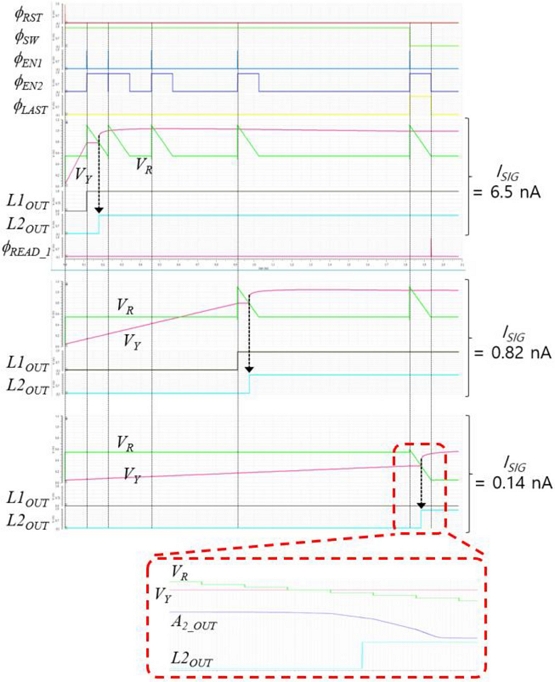
Simulation results showing operational waveforms for the proposed pixel-level ADC.
When ISIG = 0.14 nA, VY does not surpass VTH before the maximum integration time, Tm, elapses. As a result, L1OUT remains unchanged, and VY is held by fSW after integration until Tm. The SS-ADC operation then proceeds based on the fEN2 and fLAST signals. As depicted in the magnified section within the dotted rectangle, the ramp signal is a step waveform produced by the global 12-bit counter and DAC. Once ramp signal VR reaches the maintained VY, the output of the comparator (A2_OUT) transitions slowly from a high to low voltage. However, L2OUT responds quickly within one clock cycle, enabled by an inverter designed with a high logic threshold voltage at the A2_OUT terminal.
By dynamically adjusting the integration time based on the input signal intensity, the proposed pixel-level ADC achieves a wide DR and enhanced SNR for smaller inputs requiring sufficient integration time. Additionally, the accuracy of the A/D conversion is improved by implementing the ADC immediately after integration, and the average power consumption is significantly reduced by deactivating the power to the analog circuit immediately after the A/D conversion.
3.2 Noise characteristics and power consumption
In a readout circuit designed for high-quality infrared imaging, the noise characteristics that determine the minimum recognizable signal level are of paramount importance. The primary sources of noise in a microbolometer IRFPA are thermal and flicker noise, which can be reduced by providing sufficient integration time for the input current [4,5]. Therefore, a pixel-level readout circuit that can provide a sufficient integration time is advantageous. This necessitates the use of a large integration capacitor within the confined space of the pixel area, along with the integration of the input current after removing unnecessary bias current. For portable micro-IR cameras, where environmental conditions can change swiftly, the readout circuit must effectively process both small and large input signals. The ability to handle such varying input signals is quantified by the DR, which is defined as the ratio of the maximum available signal to the minimum recognizable signal.
Fig. 8 displays the estimated SNR characteristics of the proposed pixel-level multiple SS-ADC, which is designated as <A>, comparing it with the SNRs of other methodologies. In this figure, <A> represents the proposed ADC, while the remaining data pertain to the conventional SS-ADC after integration time. The methods labeled <B> and <B'> are designed with limited integration times to align the maximum input range with that of <A>. Notably, Method <B'> does not incorporate a bias-suppression circuit. In Method <C>, the input range is restricted to equalize the maximum integration time to that of <A>. The proposed ADC demonstrates superior SNR characteristics across a wide input range by employing an optimal integration time customized to the input intensity.
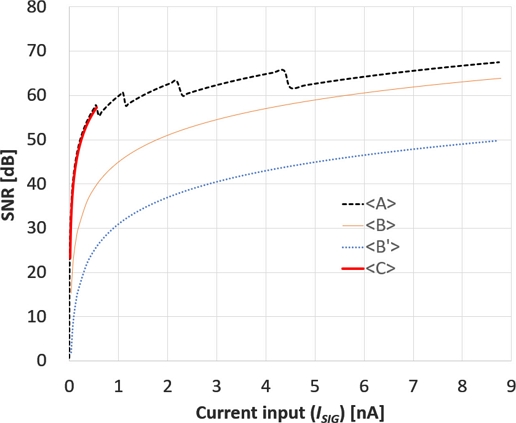
Comparison of SNR characteristics with current input.
Fig. 9 shows a comparison of the DR and power consumption per pixel values for the four methods shown in Fig. 8. Method <C> consumes a large quantity of power because the analog circuit is activated for a long integration time regardless of the input intensity. Methods <B> and <B'> suffer from a trade-off between power consumption and noise characteristics because of their limited integration times. The proposed ADC significantly reduces the average power consumption by optimizing the operational duration of the analog circuit in response to the input intensity.
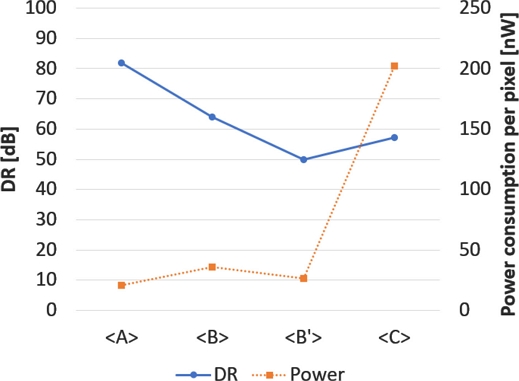
Comparison of DR characteristics and power consumption.
Table 2 presents a performance comparison between the proposed ADC and alternative methods. The design of the DROIC is strongly influenced by the specifications of the IRFPA. Consequently, the pixel-level ADC of the uncooled IRFPA is mainly selected for the comparative analysis. The maximum integration time, Tm, serves as an indicator of the noise level, and the power consumption per pixel is normalized against the frame rate. A PFM-based pixel-level ADC that requires multiple comparisons to achieve a wide DR consumes considerable power [20]. This problem can be addressed by employing a PFM-based two-stage ADC or extended-counting ADC (EC-ADC) [29]. However, an EC-ADC also has limitations in reducing the power consumption because the integration time remains constant regardless of the input signal intensity. While column-level (CL) ADCs are simpler to design than pixel-level ADCs, achieving low-noise characteristics is challenging because Tm is constrained by the array size [30].
Performance comparison.
3.3 Multiple modes for adaptive operation
The proposed DROIC offers multiple operational modes with adaptive characteristics that respond to the surrounding environment. Because each 4 × 4 bolometer array shares a single unit-cell circuit, the spatial resolution can be readily adjusted. Depending on ambient conditions, reducing the spatial resolution can enhance the DR, speed, and noise characteristics. Table 3 summarizes the four modes and their respective parameters.
Four modes and their parameters.
Fig. 10 compares the DR and power consumption values across the four modes. The wide-DR (WDR) mode enhances the DR by decreasing the spatial resolution, prolonging the time allocated to each pixel, and further subdividing the integration time. The fast mode increases the frame rate by reducing the spatial resolution. However, elevating the frame rate beyond 50 Hz is impractical owing to bolometer constraints. In scenarios in which the input signal is minimal, it is crucial to extend the integration time to reduce noise. An adequate integration time can be ensured by reducing both the spatial resolution and frame rate in the low-noise mode. Although the low-noise mode exhibits a diminished DR owing to its restricted input range and elevated power consumption owing to prolonged integration times, it significantly improves the SNR characteristics for small inputs, as illustrated in Fig. 11.
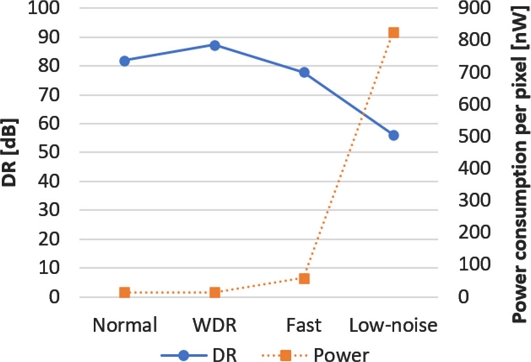
DR and power consumption comparisons across four operational modes.
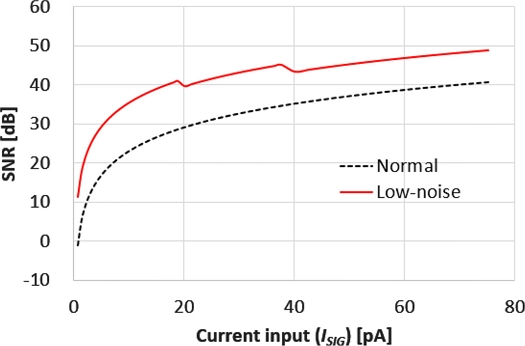
SNR characteristics for small inputs in low-noise mode.
4. CONCLUSIONS
A pixel-level ADC that utilizes multiple SS-ADCs was proposed to develop an adaptive DROIC for a microbolometer IRFPA for use in ultralight portable devices. Portable devices require excellent noise characteristics for a broad range of inputs. The proposed DROIC demonstrated superior SNR and DR characteristics across a wide input spectrum with extremely low power consumption. This is achieved by optimizing the integration time and ADC operation period in response to the intensity of the input signal. Moreover, the DROIC features multiple operational modes that can easily be adjusted to optimize the performance based on environmental conditions. Consequently, this DROIC is exceptionally well suited for ultralight portable applications.
Acknowledgments
The chip fabrication and EDA Tool were supported by the IC Design Education Center.
References
-
J.D. Yeo, D.H. Woo, Real-Time Non-Uniformity Correction without TEC for Microbolometer Array, Electronics 11 (2022) 3083.
[https://doi.org/10.3390/electronics11193083]

-
T. Akin, Low-Cost LWIR-Band CMOS Infrared (CIR) Microbolometers for High Volume Applications, Proceedings of 2020 IEEE 33rd International Conference on Micro Electro Mechanical Systems (MEMS), Vancouver, Canada, 2020, pp. 147–152.
[https://doi.org/10.1109/MEMS46641.2020.9056383]
-
S. Abbasi, A. Shafique, O. Ceylan, Y. Gurbuz, A Digital Readout IC for Microbolometer Imagers Offering Low Power and Improved Self-Heating Compensation, IEEE Sens. J. 20 (2020) 909–917.
[https://doi.org/10.1109/JSEN.2019.2944236]
-
P.-H. Yen, G.-D.J. Su, Uncooled Long-Wavelength Infrared Sensors Using Cytochrome C Protein on Suspension Electrodes With CMOS Readout Circuits, IEEE Sens. J. 19 (2019) 10221–10227.
[https://doi.org/10.1109/JSEN.2019.2928462]
-
Z. Jiang, L. Men, C. Wan, P. Xiao, C. Jiang, X. Tu, et al., Low-Noise Readout Integrated Circuit for Terahertz Array Detector, IEEE Trans. Terahertz Sci. Technol. 8 (2018) 350–356.
[https://doi.org/10.1109/TTHZ.2018.2819502]
-
P.E. Howard, J.E. Clarke, M.G. Bradley, A.C. Ionescu, C.C. Li, Progress in uncooled focal plane sensor technology at Boeing, Proceedings of SPIE: Infrared Technology and Applications XXVI, San Diego, USA, 2000, pp. 168–174.
[https://doi.org/10.1117/12.409844]
-
W.J. Parrish, J.T. Woolaway II, Improvements in uncooled systems using bias equalization, Proceedings of SPIE: AeroSense '99, Orlando, USA, 1999, pp. 748–755.
[https://doi.org/10.1117/12.354575]
- B. Dupont, A. Dupret, S. Becker, A. Hamelin, F. Guellec, P. Imperinetti, et al., A [10°C; 70°C] 640 × 480 17μm pixel pitch TEC-less IR bolometer imager with below 50mK and below 4V power supply, Proceedings of 2013 IEEE International Solid-State Circuits Conference Digest of Technical Papers, San Francisco, USA, 2013, pp. 394–395.
-
M.-H. Kwon, K. Yang, Y.-S. Park, Y.-H. Kim, H. Chung, Investigations of reactively sputtered TiO2-δ films for microbolometer applications, Proceedings of SPIE: Security + Defense, Cardiff, UK, 2008, p. 711306.
[https://doi.org/10.1117/12.800023]
-
C. Li, C.-J. Han, G. Skidmore, Overview of DRS uncooled VOx infrared detector development, Opt. Eng. 50 (2011) 061017.
[https://doi.org/10.1117/1.3593155]
-
Y. Park, H. Yang, J. Ahn, S. Kim, Column readout circuit with dual integration CDS for infrared imagers, IEICE Electron. Express 13 (2016) 20151037.
[https://doi.org/10.1587/elex.13.20151037]
-
B. Pain, E.R. Fossum, Approaches and analysis for on-focal-plane analog-to-digital conversion, Proceedings of Infrared Readout Electronics II; International Society for Optics and Photonics, Bellingham, USA, 1994, pp. 208–218.
[https://doi.org/10.1117/12.178483]
- Y. Joo, M.A. Brooke, N.M. Jokerst, Compact current input oversampling modulator design for a scalable high frame rate focal plane arrays, Proceedings of 2000 IEEE International Symposium on Circuits and Systems (ISCAS), Geneva, Switzerland, 2000, pp. 9–12.
-
C.H. Hwang, D.H. Woo, H.C. Lee, Pixel-level ADC with two-step integration for 2-D microbolometer IRFPA, IEICE Trans. Electron. E94-C (2011) 1909–1912.
[https://doi.org/10.1587/transele.E94.C.1909]
-
J. Kim, D. Woo, Pixel-Level Sequential TDC With Wide Dynamic Range for Large-Array Microbolometer IRFPAs, IEEE Sens. J. 25 (2025) 6572–6581.
[https://doi.org/10.1109/JSEN.2024.3523498]
-
D.H. Woo, C.B. Kim, H.C. Lee, Current Input Extended Counting ADC With Wide Dynamic Range for LWIR FPAs, IEEE Sens. J. 9 (2009) 441–448.
[https://doi.org/10.1109/JSEN.2008.2012198]
-
D. Woo, C. Hwang, Y. Lee, H.C. Lee, Time-based pixel-level ADC with wide dynamic range for 2-D LWIR applications, Electron. Lett. 41 (2005) 782–783.
[https://doi.org/10.1049/el:20051297]
-
D. X. Yang, B. Fowler, A. El Gamal, A nyquist-rate pixel-level ADC for CMOS image sensors, IEEE J. Solid-State Circuits 34 (1999) 348–356.
[https://doi.org/10.1109/4.748186]
-
Z. Huang, Y. Niu, W. Lu, G. Chen, Y. Li, S. Zhang, et al., A 16-bit Single-Slope based Pixel-level ADC for 15μm-pitch 640×512 MWIR FPAs, Proceedings of 2018 IEEE International Symposium on Circuits and Systems (ISCAS), Florence, Italy, 2018, pp. 1–5.
[https://doi.org/10.1109/ISCAS.2018.8351099]
-
M. Tchagaspanian, P. Villard, B. Dupont, G. Chammings, J. Martin, C. Pistre, et al., Design of ADC in 25 μm pixels pitch dedicated for IRFPA image processing at LETI, Proceedings of SPIE: Infrared Technology and Applications XXXIII, Orlando, USA, 2007, p. 65421W1–12.
[https://doi.org/10.1117/12.719148]
-
M. Li, F. Li, C. Zhang, Z. Wang, Pixel-level A/D conversion using voltage reset technique, J. Semicond. 35 (2014) 115009.
[https://doi.org/10.1088/1674-4926/35/11/115009]
-
S. Yang, L. Luo, W. Lu, G. Shi, B. Lyu, Y. Niu, et al., A 16-bit two-step pixel-level ADC for 384?288 infrared focal plane array, Proceedings of 2017 IEEE 12th International Conference on ASIC (ASICON), Guiyang, China, 2017, pp. 780–783.
[https://doi.org/10.1109/ASICON.2017.8252592]
-
Y.M. Jo, D. Woo, S. Kang, H.C. Lee, Very Wide Dynamic Range ROIC With Pixel-Level ADC for SWIR FPAs, IEEE Sens. J. 16 (2016) 7227–7233.
[https://doi.org/10.1109/JSEN.2016.2599181]
- D.H. Woo, S.G. Kang, H.C. Lee, Novel Two Step Background Suppression for 2-D LWIR Application, IEICE Trans. Electron. E87-C (2004) 1649–1651.
-
D.H. Woo, S.G. Kang, H.C. Lee, Novel current-mode background suppression for 2-D LWIR applications, IEEE Trans. Circuits Syst. II Express Briefs 52 (2005) 606–610.
[https://doi.org/10.1109/TCSII.2005.850456]
-
Y. Nitta, Y. Muramatsu, K. Amano, T. Toyama, K. Mishina, A. Suzuki, et al., High-Speed Digital Double Sampling with Analog CDS on Column Parallel ADC Architecture for Low-Noise Active Pixel Sensor, Proceedings of 2006 IEEE International Solid State Circuits Conference - Digest of Technical Papers, San Francisco, USA, 2006, pp. 2024–2031.
[https://doi.org/10.1109/ISSCC.2006.1696261]
-
N. Kawai, S. Kawahito, Effectiveness of a correlated multiple sampling differential averager for reducing 1/f noise, IEICE Electron. Express 2 (2005) 379–383.
[https://doi.org/10.1587/elex.2.379]
-
J. Seo, G. Kim, K. Lim, C. Seok, H. Kim, S. Im, et al., An analog front-end IC with regulated R-I amplifier and CDS CTIA for microbolometer, Proceedings of 2013 13th International Conference on Control, Automation and Systems (ICCAS), Gwangju, Korea (South), 2013, pp. 1312–1315.
[https://doi.org/10.1109/ICCAS.2013.6704156]
-
J. Lee, I. Nam, D. Woo, Current Input Pixel-Level ADC with High SNR and Wide Dynamic Range for a Microbolometer, Sensors 21 (2021) 2354.
[https://doi.org/10.3390/s21072354]
-
S. Yu, X. Shi, Y. Zhou, D. Ma, Y. Zhang, W. Lu, et al., A Low-Power DROIC With Extended-Counting ADC for Uncooled Infrared Silicon Diode Detectors, IEEE Trans. Circuits Syst. II Express Briefs 70 (2023) 1881–1885.
[https://doi.org/10.1109/TCSII.2022.3231427]