
Fabrication and Characterization of a Sliding-Type Capacitive Strain Sensor for Quantitative Strain Detection
ⓒ The Korean Sensors Society
This is an Open Access article distributed under the terms of the Creative Commons Attribution Non-Commercial License (https://creativecommons.org/licenses/by-nc/3.0/) which permits unrestricted non-commercial use, distribution, and reproduction in any medium, provided the original work is properly cited.
Abstract
In this study, a sliding-type capacitive strain sensor was fabricated and characterized for quantitative strain detection. The proposed sensor detects deformation through changes in the overlapping area between two electrodes while maintaining a constant electrode spacing, resulting in a simplified fabrication process and improved reproducibility compared with conventional capacitive structures. The sensor was fabricated using a micro-fabrication process and encapsulated in silicone rubber to provide mechanical flexibility and elastic recovery, allowing it to return to its initial state after load release. Capacitance variations were quantitatively measured using an LCR meter under applied tensile strain. The sensor exhibited consistent and repeatable responses during repeated loading and unloading cycles, demonstrating stable and reliable performance. These results confirm the feasibility of the proposed structure for accurate and quantitative strain detection, suggesting its potential applicability in flexible electronic devices and biomedical sensing platforms.
Keywords:
Sliding-type sensor, Capacitive strain sensor, Strain sensing, Flexible sensor, Elastic encapsulation1. INTRODUCTION
Monitoring mechanical deformation is essential in a wide range of applications, including wearable electronics, soft robotics, and biomedical devices, where accurate strain detection enables the precise evaluation of structural integrity and physiological motion [1,2]. Among various sensing mechanisms, capacitive-type strain sensors have attracted particular interest owing to their high sensitivity, simple structure, low energy consumption, and stable electrical performance [3,4]. Conventional capacitive strain sensors typically operate based on the variations in the distance between two parallel electrodes separated by a dielectric layer [5]. Although this configuration offers excellent sensitivity, maintaining uniform electrode spacing during fabrication is challenging, particularly when flexible substrates or microfabrication techniques are employed. Small deviations in the electrode gap can lead to nonlinear output characteristics and poor reproducibility, limiting their applicability for quantitative and repeatable strain detection [6,7].
To overcome these limitations, scholars have developed various design strategies, such as interdigitated electrode geometries, microstructured elastomeric dielectrics, and stretchable conductive composites to enhance the sensitivity and flexibility [8-10]. However, these approaches often require complex fabrication processes or result in unstable performances under repeated mechanical loading [11]. As an alternative, sliding-type capacitive strain sensors have recently been proposed as a new structural concept that simplifies fabrication and improves reproducibility [12,13]. In this configuration, the distance between electrodes remains constant, whereas the strain is detected through changes in the overlapping area between the two conductive electrodes. This structural design eliminates the need for precise gap control and provides highly reproducible capacitance–strain characteristics [14].
In this paper, we propose a sliding-type capacitive strain sensor that employs a simplified microfabrication process and an elastic encapsulation layer. Specifically, we introduce the use of silicone rubber as an encapsulating material to improve both the mechanical flexibility and elastic recovery, enabling the sensor to return to its initial state after load release. Based on this design concept, the proposed sensor is expected to exhibit stable, quantitative, and repeatable strain detection under cyclic deformation. The electromechanical performance of the sensor was evaluated using controlled tensile testing to verify its reliability and sensitivity. The proposed approach offers a facile and scalable fabrication method for developing reliable strain sensors, indicating its potential applicability in flexible electronic and biomedical sensing systems.
2. EXPERIMENTAL METHODS
2.1 Working Principle of the Proposed Capacitive Strain Sensor
The proposed sliding-type capacitive strain sensor operates based on the change in capacitance caused by variations in the overlapping area (A) between two parallel metal electrodes. The capacitance (C) is expressed as follows:
| (1) |
where ε0 is the vacuum permittivity, εr is the relative permittivity of the dielectric layer, A is the overlapping area between the electrodes, and d is the inter-electrode spacing. In conventional capacitive strain sensors, strain alters the distance d between the electrodes. In contrast, in the proposed sliding-type design, d remains constant, and the strain is detected through changes in overlapping area A. The overall structure of the proposed sliding-type capacitive strain sensor, composed of stacked metal electrodes, polyimide (PI) layers, and silicone rubber encapsulation, is illustrated in Fig. 1(a). The operating principle is schematically shown in Fig. 1(b), where the tensile strain causes the upper and lower electrodes to slide relative to each other, reducing their overlapping area and resulting in a corresponding decrease in capacitance according to Eq. (1). Because this displacement occurs laterally rather than vertically, the sensor achieves improved structural stability and measurement reproducibility. A schematic of the fabrication process is shown in Fig. 1(c).
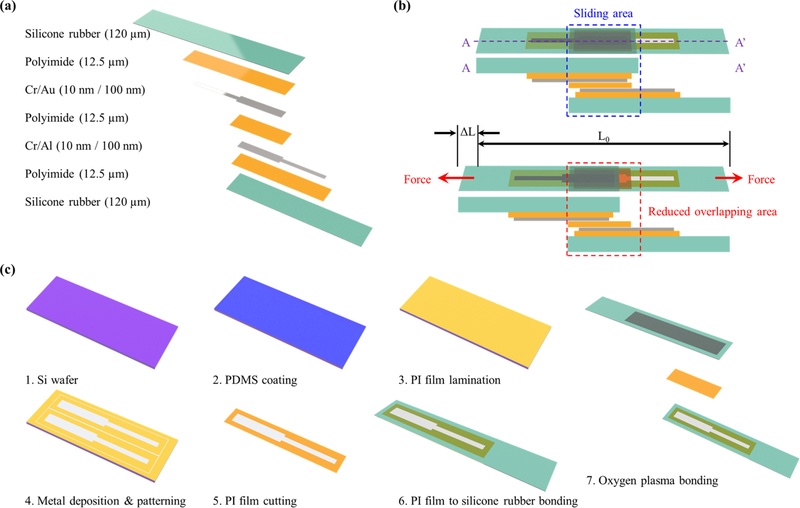
Conceptual design and structural configuration of the proposed sliding-type capacitive strain sensor. (a) Layer configuration composed of metal electrodes, PI films, and silicone-rubber encapsulation, (b) Schematic illustration of the sliding-base
2.2 Fabrication of a Capacitive Strain Sensor
The fabrication process of the proposed sliding-type capacitive strain sensor is schematically illustrated in Fig. 1(c). First, a polydimethylsiloxane (PDMS) solution composed of a Sylgard 184 base, curing agent, and n-hexane (96%) at a 10:1:10 weight ratio was spin-coated onto a silicon wafer at 3000 rpm for 40 s and cured at 80°C for 35 min to form an elastic base layer. A 12.5 µm-thick PI film was then laminated on top of the cured PDMS layer and trimmed to match the wafer geometry. A Cr/Al bilayer (10 nm / 100 nm) was deposited using in-line sputtering to form the electrode layer. After deposition, non-contact sheet resistance measurements were performed to examine the electrical uniformity and surface quality of the metal film, as shown in Fig. 2(a). A more detailed scan of the selected regions, shown in Fig. 2(b), highlighted the localized variations. All the measurement results were within the acceptable tolerance range, confirming that the deposited metal layer possessed good electrical uniformity, as summarized in Table 1.
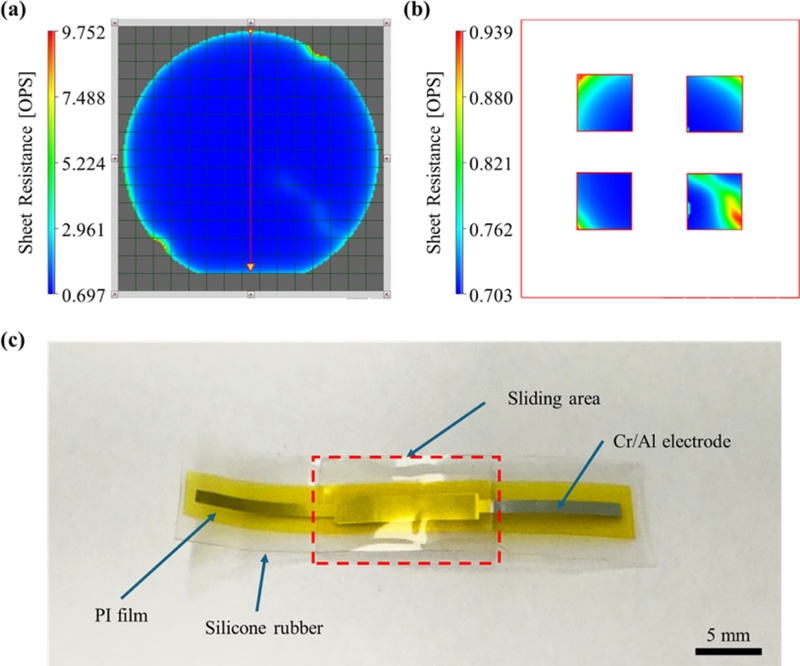
Fabrication results and electrical characterization of the sliding-type capacitive strain sensor. (a) Full-area non-contact sheet-resistance mapping, (b) Partial-area scan highlighting localized variation, and (c) Photograph of the fully fabricated sliding-type capacitive strain sensor after encapsulation.

Summary of non-contact sheet resistance measurements.
Subsequently, the AZ-GXR 601 photoresist was spin-coated at 2000 rpm for 30 s, soft-baked at 90°C for 90 s, and exposed to UV light using a patterned mask. The sample was developed for 1 min, and metal patterning was performed using inductively coupled plasma (ICP) etching (Al: 75 s, Cr: 30 s). After the photoresist removal, the patterned PI film was peeled off from the PDMS base layer to obtain a freestanding electrode structure. The fabricated electrodes consisted of a 2 mm × 10 mm electrode plate and a 1 mm × 10 mm electrode pad. A PI spacer film was inserted between the upper and lower electrodes to maintain a fixed gap (d), and the entire structure was encapsulated in silicone rubber to provide mechanical durability and electrical insulation. Oxygen plasma bonding was employed to achieve strong adhesion between the PI and silicone layers. The fully fabricated sliding-type capacitive strain sensor after encapsulation is shown in Fig. 2(c), which demonstrates its structural integrity and flexibility.
2.3 Electrical and Mechanical Characterization
The electromechanical performance of the fabricated sliding-type capacitive strain sensor was evaluated using a precision tensile testing system. The sensor was fixed at both ends using custom clamps connected to a linear motorized stage capable of applying controlled tensile displacement with a 10 µm resolution. The applied strain (ε) was calculated as the ratio of displacement to the effective gauge length (10 mm), and the applied strain range was limited to below 2% to prevent mechanical damage or delamination. Capacitance measurements were conducted using a precision LCR meter (Keysight E4980A) under an excitation of 100 mV at 1 MHz. Real-time data were recorded at a sampling rate of 10 Hz using LabVIEW software connected via GPIB communication. To evaluate repeatability, we tested the sensor using 100 continuous loading–unloading cycles at strain amplitudes of 0.5%, 1.0%, and 1.5%. All measurements were performed under controlled environmental conditions (25 ± 1°C, 45 ± 5% RH). The relative capacitance change (ΔC/C₀), where C₀ is the baseline capacitance in the unstrained state, was analyzed to assess the sensitivity, repeatability, and long-term stability of the proposed sensor.
3. RESULTS AND DISCUSSIONS
3.1 Deformation Behavior and Response Characteristics under Tensile Testing
The mechanical and electrical performances of the fabricated sliding-type capacitive strain sensors were investigated using a custom-built tensile testing system, as shown in Fig. 3(a). The setup converts the rotational motion of the servomotor into linear displacement through a movable plate, enabling precise and repeatable tensile deformation. The measured displacement range exhibited a linear relationship with the motor rotation angle, as shown in Fig. 3(b). Under controlled strain conditions, the sensor exhibited clear and repeatable capacitance variations, as shown in Fig. 3(c). When the applied displacement increased (160, 320, and 480 µm), the capacitance change (ΔC/C₀) increased proportionally, demonstrating high reproducibility and quantitative strain sensitivity. This confirmed that the sliding-type electrode configuration enables a stable capacitive response, even under repetitive deformation. A uniaxial tensile test was conducted to determine the mechanical durability of the sensor (Fig. 3(d)). The sensor endured an elongation of up to approximately 12 mm without delamination with a maximum tensile load of 3.8 N, demonstrating excellent flexibility and mechanical robustness. These results confirmed that the proposed structure maintains a reliable electrical and mechanical performance during repeated and extended operations.
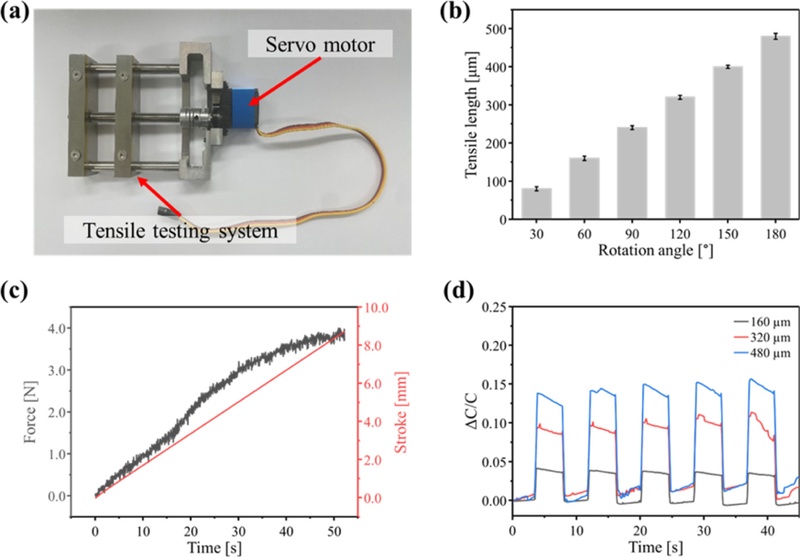
Integrated results of the sliding-type capacitive strain sensor. (a) Custom-built tensile testing system, (b) measured displacement range as a function of motor rotation angle, (c) tensile test results showing the fracture point and maximum elongation, and (d) capacitance responses under repeated deformation at different displacement levels (160, 320, 480 µm).
3.2 Hysteresis Behavior under Cyclic Loading
Fig. 4 shows the hysteresis characteristics of the proposed sensor during repeated loading and unloading cycles. In each cycle, the output increased with the applied tensile strain and decreased as the strain was released, thereby forming distinct loading and unloading paths. A consistent difference between these two curves was observed across the cycles, indicating the hysteresis inherent to the sliding-type electrode structure. Although hysteresis was present, the overall response trend remained stable over repeated cycles, demonstrating that the sensor can reproduce its output under identical deformation conditions. These results confirmed that the device maintains reliable operation during cyclic mechanical loading, with the observed hysteresis arising from mechanical interactions, such as interfacial friction and elastic recovery of the encapsulating materials during the sliding-electrode motion.
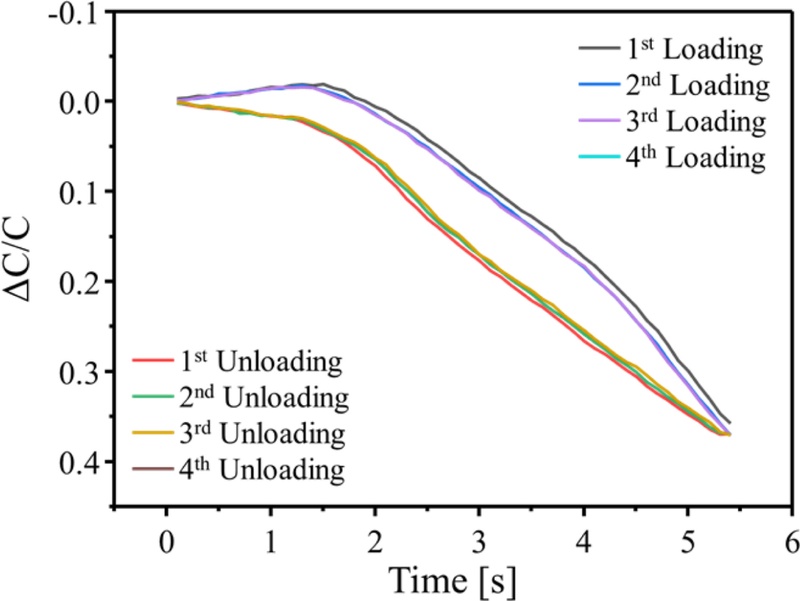
Hysteresis characteristics of the sliding-type capacitive strain sensor during repeated loading and unloading cycles.
3.3 Real-Time Dynamic Signal Encoding
To demonstrate the real-time response capability, we applied dynamic deformation patterns encoded with the Morse code of the word “KITECH” to the sensor (Fig. 5). Short and long pulses corresponding to the dots and dashes generated distinct capacitance variations, reproducing the encoded signal pattern with high fidelity. This confirmed that the sensor can accurately track time-dependent mechanical stimuli, highlighting its potential for applications in human–machine interfaces, soft robotic feedback systems, and physiological signal-monitoring platforms.
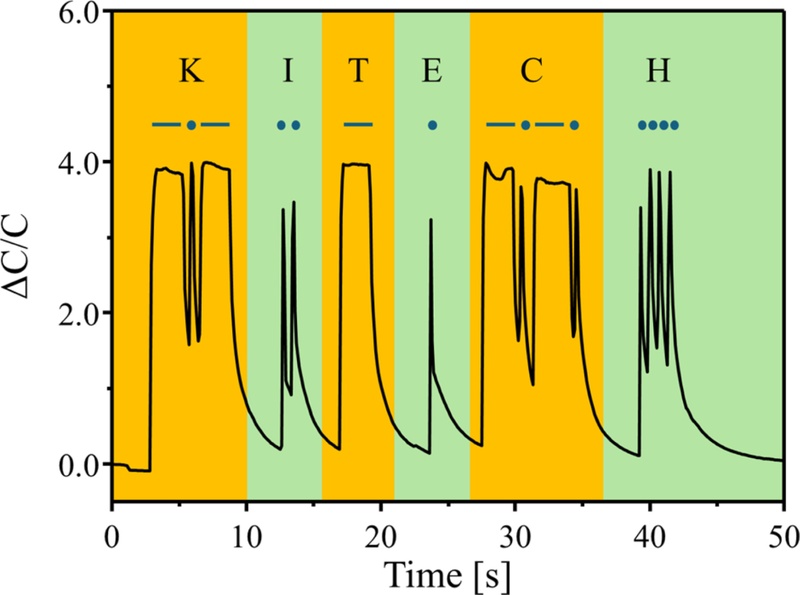
Real-time Morse code representation of “KITECH” using the sliding-type capacitive strain sensor.
4. CONCLUSION
In this study, a sliding-type capacitive strain sensor was designed and fabricated to quantitatively detect micro-scale deformations through changes in capacitance caused by variations in the overlapping area between two parallel electrodes. By maintaining a constant electrode spacing, the proposed structure minimizes geometric uncertainty and simplifies fabrication while ensuring stable signal acquisition. Experimental evaluations under cyclic tensile loading confirmed that the sensor exhibits high linearity, reproducibility, and mechanical durability, thereby validating the reliability of the sliding-based sensing principle. Furthermore, the use of a silicone rubber encapsulation layer provided elastic recovery and long-term operational stability, thereby enhancing the overall robustness of the device. These results demonstrate that the proposed sensor architecture enables precise and repeatable strain detection with a simple manufacturable design. Building on this foundation, future studies could incorporate an inductive element to form an LC resonant circuit, thereby enabling wireless battery-free signal transmission. Such an approach would expand the functionality of the sensor for real-time noninvasive monitoring applications. In particular, this advancement has strong potential for integration into implantable stent systems, where continuous and reliable monitoring of mechanical conditions is essential for the early diagnosis of vascular restenosis.
Acknowledgments
This research was supported by the Regional Innovation System & Education (RISE) program through the (Gwangju RISE Center), funded by the Ministry of Education(MOE) and the Gwangju Metropolitan City, Republic of Korea (2025-RISE-05-014).
REFERENCES
-
M. Amjadi, K.U. Kyung, I. Park, M. Sitti, Stretchable, skin‐mountable, and wearable strain sensors and their potential applications: A review, Adv. Funct. Mater. 26 (2016) 1678–1698.
[https://doi.org/10.1002/adfm.201504755]

-
X. Wang, Z. Liu, T. Zhang, Flexible sensing electronics for wearable/attachable health monitoring, Small 13 (2017) 1602790.
[https://doi.org/10.1002/smll.201602790]
-
T.Q. Trung, N.E. Lee, Flexible and stretchable physical sensor integrated platforms for wearable human‐activity monitoring and personal healthcare, Adv. Mater. 28 (2016) 4338–4372.
[https://doi.org/10.1002/adma.201504244]
-
Y. Wang, L. Wang, T. Yang, X. Li, X. Zang, M. Zhu, et al., Wearable and highly sensitive graphene strain sensors for human motion monitoring, Adv. Funct. Mater. 24 (2014) 4666–4670.
[https://doi.org/10.1002/adfm.201400379]
-
S.H. Bae, Y. Lee, B.K. Sharma, H.J. Lee, J.H. Kim, J.H. Ahn, Graphene-based transparent strain sensor, Carbon 51 (2013) 236–242.
[https://doi.org/10.1016/j.carbon.2012.08.048]
-
K. Takei, W. Honda, S. Harada, T. Arie, S. Akita, Toward flexible and wearable human-interactive health-monitoring devices, Adv. Healthc. Mater. 4 (2015) 487–500.
[https://doi.org/10.1002/adhm.201400546]
-
S.C.B. Mannsfeld, B.C-K. Tee, R.M. Stoltenberg, C.V.H-H. Chen, S. Barman, B.V.O. Muir, et al., Highly sensitive flexible pressure sensors with microstructured rubber dielectric layers, Nat. Mater. 9 (2010) 859–864.
[https://doi.org/10.1038/nmat2834]
-
C. Pang, G.Y. Lee, T. Kim, S.M. Kim, H.N. Kim, S.H. Ahn, et al., A flexible and highly sensitive strain-gauge sensor using reversible interlocking of nanofibres, Nat. Mater. 11 (2012) 795–801.
[https://doi.org/10.1038/nmat3380]
-
D.J. Lipomi, M. Vosgueritchian, B.C.K. Tee, S.L. Hellstrom, J.A. Lee, C.H. Fox, et al., Skin-like pressure and strain sensors based on transparent elastic films of carbon nanotubes, Nat. Nanotechnol. 6 (2011) 788–792.
[https://doi.org/10.1038/nnano.2011.184]
-
E. Roh, B.U. Hwang, D. Kim, B.Y. Kim, N.E. Lee, Stretchable, transparent, ultrasensitive, and patchable strain sensor for human–machine interfaces comprising a nanohybrid of carbon nanotubes and conductive elastomers, ACS Nano 9 (2015) 6252–6261.
[https://doi.org/10.1021/acsnano.5b01613]
-
T.Q. Trung, S. Ramasundaram, B.-U. Hwang, N.-E. Lee, An all‐elastomeric transparent and stretchable temperature sensor for body‐attachable wearable electronics, Adv. Mater. 28 (2016) 502–509.
[https://doi.org/10.1002/adma.201504441]
-
M.S. Sarwar, R. Ishizaki, K. Morton, C. Preston, T. Nguyen, X. Fan, et al., Touch, press and stroke: a soft capacitive sensor skin, Sci. Rep. 13 (2023) 17390.
[https://doi.org/10.1038/s41598-023-43714-6]
-
H. Nesser, G. Lubineau, Strain sensing by electrical capacitive variation: From stretchable materials to electronic interfaces, Adv. Electron. Mater. 7 (2021) 2100190.
[https://doi.org/10.1002/aelm.202100190]
-
Y. Zang, F. Zhang, C. Di, D. Zhu, Advances of flexible pressure sensors toward artificial intelligence and health care applications, Mater. Horiz. 2 (2015) 140–156.
[https://doi.org/10.1039/C4MH00147H]