
Recent Advances in Strain-Insensitive Pressure Sensors: Structural and Material Approaches
ⓒ The Korean Sensors Society
This is an Open Access article distributed under the terms of the Creative Commons Attribution Non-Commercial License (https://creativecommons.org/licenses/by-nc/3.0/) which permits unrestricted non-commercial use, distribution, and reproduction in any medium, provided the original work is properly cited.
Abstract
The development of strain-insensitive pressure sensors represents a critical breakthrough in stretchable electronics, addressing the fundamental challenge of strain-pressure coupling that has hindered the deployment of conventional sensors on deformable surfaces. This review comprehensively examines recent advances in overcoming measurement limitations caused by simultaneous pressure and strain stimuli in applications such as wearable health monitoring, soft robotics, and human-machine interfaces. We analyze two primary technological approaches: structural engineering strategies that physically decouple strain and pressure effects through mechanical architectures, hierarchical patterns, specialized electrode geometries, and simultaneous measurement systems; and material-based solutions utilizing ionic elastomers, liquid metals, and engineered composites with intrinsic strain-independent properties. Recent innovations have demonstrated remarkable performance achievements, including high sensitivity, exceptional strain insensitivity, and robust long-term stability. This review provides insights into current limitations, emerging challenges, and future directions for strain-insensitive pressure sensing technologies that will enable seamless integration of sensing capabilities into dynamically deforming environments.
Keywords:
Strain-insensitive sensors, Pressure sensors, Stretchable electronics, Strain-pressure decoupling1. INTRODUCTION
The development of strain-insensitive pressure sensors is one of the most important challenges in flexible electronics, because it addresses the fundamental coupling between mechanical deformations that have limited conventional sensing systems. When deployed on deformable surfaces, such as human skin, prosthetic limbs, or soft robotic platforms, traditional pressure sensors experience simultaneous pressure and strain stimuli that create substantial measurement errors [1-3]. This technological limitation has become increasingly problematic as the global wearable sensor market approaches $7.2 billion by 2035, and stretchable electronics demand 12.5% annual growth by 2033 [4,5].
The core issue arises from strain-pressure coupling effects, where the longitudinal strain typically causes normal compression, similar to pressure-induced deformation [2,6]. However, recent developments have led to breakthroughs in technologies that can effectively address this problem. These innovations have demonstrated clear efficacy in realizing strain-insensitive pressure sensors, marking a significant advancement in the field.
Current research has focused on two primary strategies: structural engineering approaches that physically decouple the strain and pressure effects, and material-based solutions that achieve strain insensitivity through intrinsic material properties, as shown in Fig. 1. Structural approaches utilize mechanically hierarchical architectures, isolated pressure-sensitive elements based on rigid islands, specialized electrode patterns, and geometric decoupling mechanisms, as illustrated in Fig. 1 [3,7]. Material approaches leverage ionic elastomers, liquid metals, and advanced composites, in which the sensing mechanism itself remains unaffected by mechanical deformation, as shown in Fig. 1(e,f) [2,8,9].
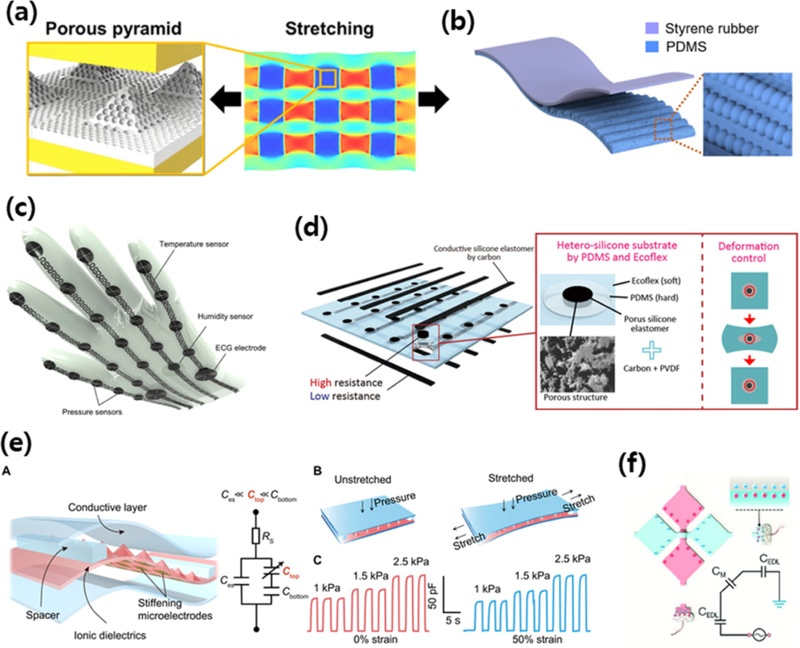
Representative approaches for strain-insensitive pressure sensors. (a) Mechanical stiffness difference. Adapted from Ref. [12]. (b) Architected material structures. Adapted from Ref. [3]. (c) Architected electrode patterns. Adapted from Ref. [22]. (d) Simultaneous strain/pressure measurement. Adapted from Ref. [6]. (e) Functional sensing materials. Adapted from Ref. [2]. (f) Functional electrode materials. Adapted from Ref. [28].
The commercial significance of strain-insensitive pressure sensors extends across wearable electronics for continuous health monitoring, soft robotics requiring precise tactile feedback, and biomedical applications, including implantable biodegradable sensors for surgical recovery monitoring [1]. As artificial intelligence integration and advanced manufacturing techniques mature, these strain-insensitive pressure-sensing systems may transform human-centered technologies by enabling the seamless integration of sensing capabilities into dynamically deforming environments [10].
2. STRUCTURAL APPROACHES TO STRAIN-INSENSITIVE PRESSURE SENSORS
2.1 Mechanical stiffness difference
Island-structured sensing regions provide a foundational approach in which rigid sensing elements are mechanically isolated from substrate strain through strategic design hierarchies [8,11]. The fundamental principle relies on the mechanical impedance mismatch between high-modulus sensing islands and compliant surrounding substrates, with the strain energy primarily dissipated in nonactive regions while maintaining the sensor geometry [8].
Yang et al. [12] demonstrated this concept using microstructured porous pyramid-based sensors embedded in hard elastomer islands within soft elastomer substrates, as shown in Fig. 2. Their system achieved high sensitivity of 44.5 kPa-1 in the sub 100 Pa range while maintaining strain and temperature insensitivity. The porous pyramidal dielectric layer enabled outstanding performance by preventing deformation-induced signal drift.
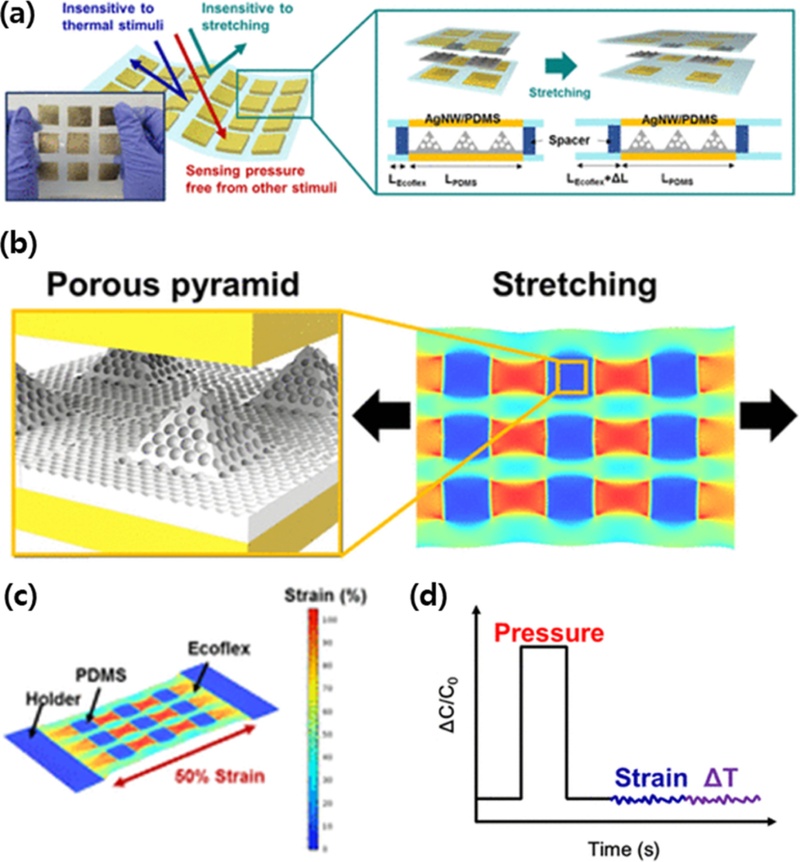
Microstructured porous pyramid-based pressure sensor with strain-insensitive characteristics. (a) Conceptual illustration of decoupled pressure and strain responses. (b) Schematic structure of the pressure sensor and finite element simulation showing strain distribution. (c) Finite element analysis of localized strain. (d) Sensor performance demonstrating pressure sensitivity and strain independence. Adapted from Ref. [12].
Advanced implementations have evolved toward quasi-homogeneous designs that minimize the mechanical mismatch between the layers. Feng et al. [11] combined in-plane strain modulation with a quasi-homogeneous interfacial design and achieved constant sensing performance over 5,000 stretching-releasing cycles within 20% strain. Their CNT/PDMS synergistic system demonstrated an exceptional interfacial strength exceeding a peel strength of 40.9 N·m-1 and shear strength of 124.8 kPa through topological interlocking mechanisms.
The most sophisticated recent developments by Xu et al. [13] are omnidirectional strain-unperturbed tactile arrays using modulus-regulated elastomer meshes, as illustrated in Fig. 3. By controlling fiber orientation in polyurethane meshes with tunable modulus from 0.23 to 8.23 MPa, they achieved 97% strain insensitivity under 100% stretching in all directions. This represents a significant advancement over previous unidirectional approaches, maintaining the performance after 5,000 cycles of severe stretching and pressing.
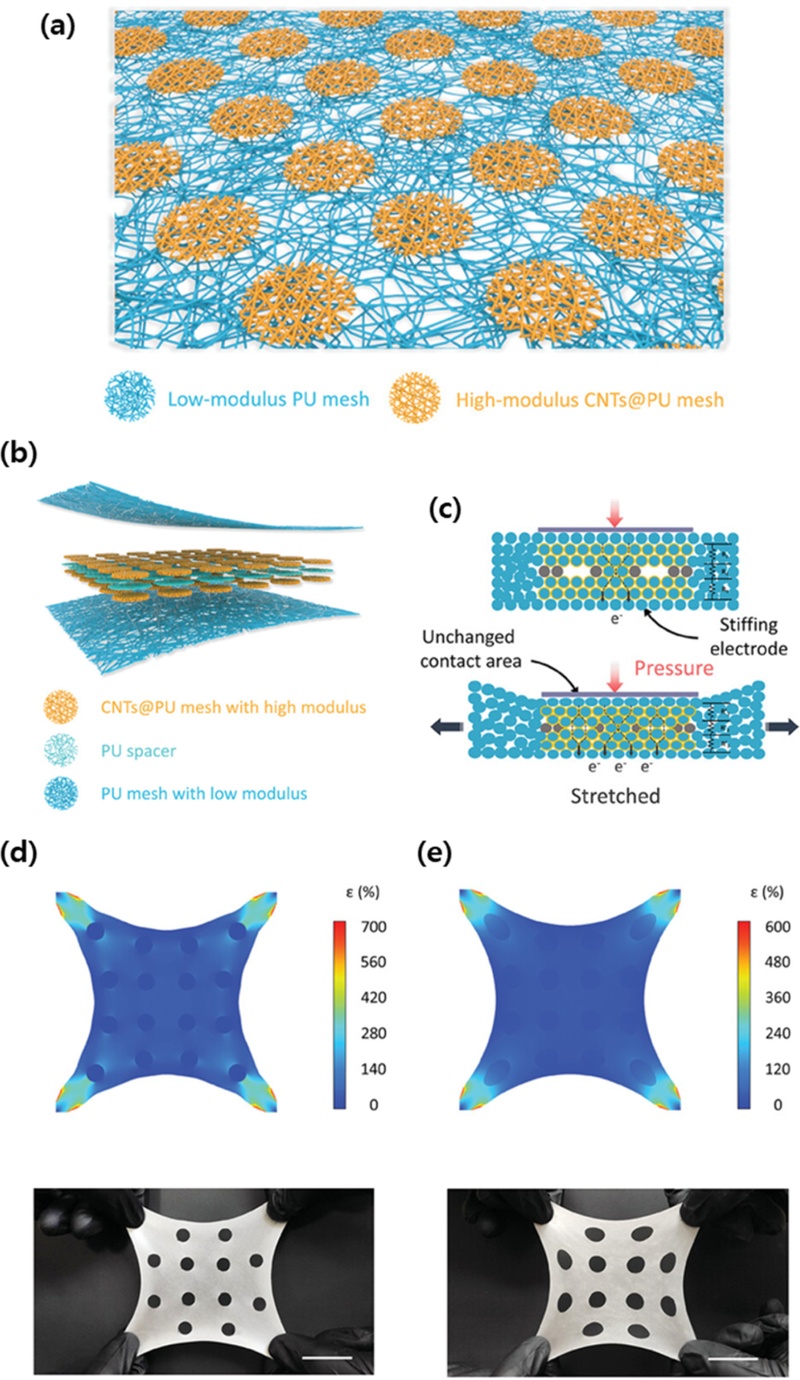
Strain-unperturbed tactile array from modulus regulation. (a) Schematic diagram of the quasi-homogeneous elastomer mesh. (b) Design concept of the omnidirectionally strain-unperturbed tactile array. (c) Working mechanism for normal pressure sensing. (d) Strain-distribution simulation and optical image of the quasi-homogeneous elastomer mesh with contrasting moduli. (e) Strain-distribution simulation and optical image of the quasi-homogeneous elastomer mesh with similar modulus. Adapted from Ref. [13].
Triboelectric implementations have expanded island concepts for energy harvesting applications [14]. Recently, stretchable dual-mode triboelectric nanogenerators have utilized interpenetrating polymer networks to create regional modulus differences, maintaining stable performance up to 120% stretching with less than 15% deformation in the modulus-enhanced regions when a 200% strain is applied to unmodified areas.
Despite the advantages of island-structured sensing regions, manufacturing scalability remains challenging owing to the complex fabrication requirements and space penalties for strain-dissipating areas. However, photocrosslinkable elastomer platforms now enable UV lithography-based selective crosslinking with rapid curing for scalable island formation, addressing previous processing limitations [15].
2.2 Architectured materials
Hierarchical material patterns achieve strain insensitivity through a strategic microstructural design that decouples the strain effects from pressure detection mechanisms. This fundamental approach creates multiple height levels that distribute mechanical stress across different scales, preventing saturation at any single contact point while maintaining continuous sensitivity [16].
Wearable triboelectric pressure sensors employing hierarchical superposition patterns utilize multilayered microstructures to decouple the strain from the pressure sensing, as demonstrated in Fig. 4 [3]. These devices sustained a uniform sensitivity under tensile strain by stacking microdome arrays of different heights. They achieved negligible signal changes during stretching, as the strain-induced output (<1 mV at 0–40% strain) was significantly lower than the pressure-induced signals (4–16 mV at 2–173 kPa). The optimized architecture achieved reliable pressure detection with strong repeatability and minimal crosss-ensitivity to strain, outperforming conventional triboelectric sensors under dynamic deformation conditions.
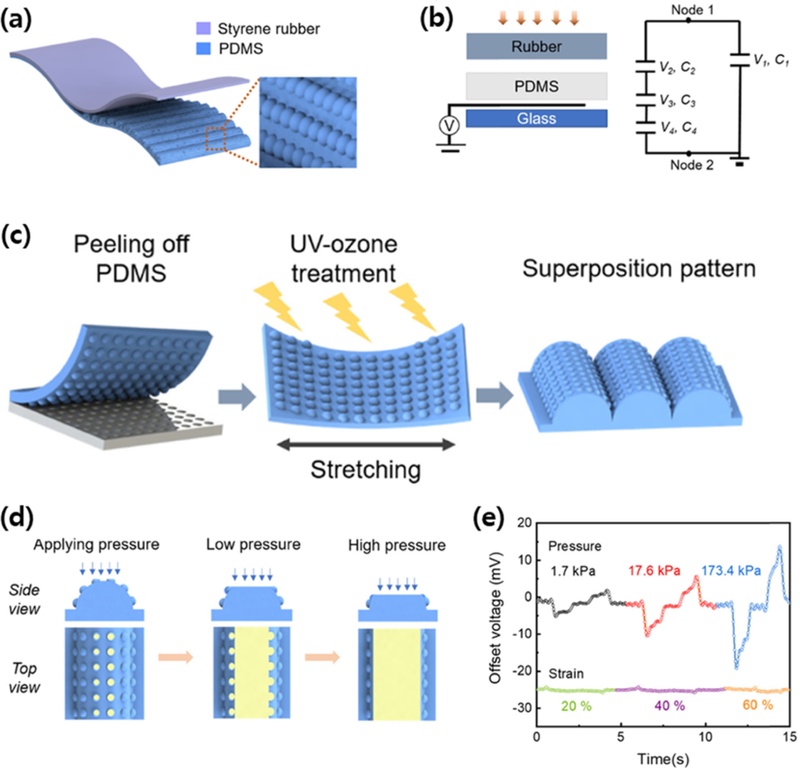
Triboelectric strain-insensitive pressure sensors utilizing hierarchical superposition patterns. (a) Structural design of the stretchable triboelectric pressure sensor featuring superposition pattern architecture. (b) Equivalent circuit model of the sensor under single-electrode mode. (c) Fabrication process for creating the superposition patterns. (d) Pressure application mechanism and deformation behavior of the superposition pattern. (e) Sensor response characteristics under varying pressure and strain conditions. Adapted from Ref. [3].
2.3 Architectured electrode patterns
Electrode pattern optimization addresses strain insensitivity through geometric designs that accommodate deformation while preserving the electrical functionality. [7,16] The core challenge involves maintaining the conductive pathways and sensing accuracy despite the large mechanical deformations that would typically disrupt conventional electrode architectures [17].
Serpentine pattern designs utilize sinusoidal geometries with optimized length-to-width ratios and amplitude-wavelength control [18]. A strain-insensitive soft pressure sensor using 3D-printed microchannel molds with liquid–metal integration effectively demonstrates this approach. Galinstan-filled serpentine microchannels provide mechanical compliance while maintaining electrical continuity, with finite element method (FEM) simulation verification of strain-insensitive behavior for health monitoring applications [19].
Kirigami-inspired sensor architectures demonstrate advanced engineering solutions, in which precisely patterned cuts enable out-of-plane buckling and effective stress redistribution. Building on this concept, Tolvanen et al. [20] demonstrated a dual-parameter tactile sensor utilizing Kirigami notches that achieved high sensitivity, multimodal sensing capabilities, and controllable stretchability for tensile strains of up to 80%. Mechanical stresses are predictably diverted away from the active-sensing region, enabling accurate and reliable measurements of dynamic pressure and proximity.
A stretching-insensitive, self-powered, and wearable pressure sensor was realized using a regular porous network of stretchable silver nanowire (AgNW) electrodes and layered elastic materials [21]. The sensor maintains stable conductivity and a constant internal impedance during up to 60% strain, meaning its sensitivity (0.1 nA·kPa-1) and electrical response to pressure remain nearly unchanged even while stretched. The device operates reliably when attached to moving joints and is well suited for wearable electronics and prosthetic applications.
Building on geometric and material advances, recent research has shown that ripple-like CNT-coated laser-engraved graphene electrode structures vertically integrated in smart gloves allow reliable multimodal sensing of pressure, temperature, humidity, and physiological signals with minimal crosstalk, despite substantial deformation, as shown in Fig. 5 [22]. By combining CO₂laser engraving, electrospinning, and layered ionic nanofiber membranes, these sensors achieved a highly strain-insensitive performance via distributed stress accommodation and cross-linked conductive networks that maintained electrical fidelity when stretched. This enables stable tactile and thermal detection for wearable robotics and human–machine interfaces, demonstrating the versatility of compliant multifunctional sensor arrays in challenging environments.
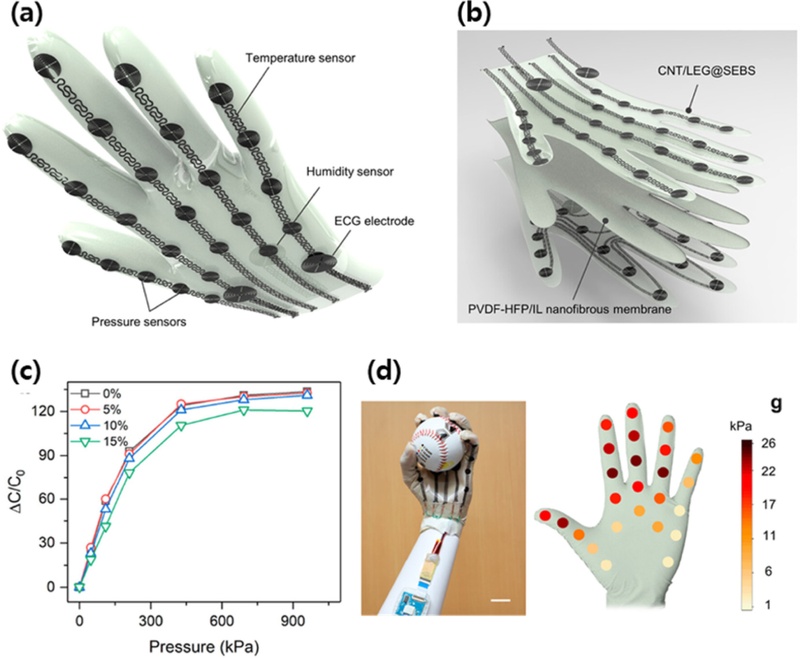
Stretchable and all-directional strain-insensitive electronic glove. (a) Schematic illustration of the e-glove with pressure sensing capability. (b) Exploded view showing three-layer structure with dielectric layer sandwiched between patterned electrodes. (c) Calibration curve of the e-glove pressure sensor under various strain conditions. (d) Demonstration of human hand wearing the e-glove while gripping a baseball and corresponding pressure distribution mapping across the palm surface. Adapted from Ref. [22].
Helically swollen core-sheath fiber structures integrated into textiles achieve bending-independent pressure perception through geometric constraints that preserve the electrode configuration under curvature [23]. The helical architecture maintained an identical microscopic structure and conductive paths regardless of the bending stress, enabling accurate pressure distribution mapping even in extremely folded configurations.
Fundamental mechanisms rely on distributed strain to reduce local stress concentrations, maintain electrical pathways under large deformations, and achieve strategic geometric optimization. Length-to-width ratio optimization, amplitude-wavelength control, and material selection for elastic substrates with appropriate Young's moduli are critical design parameters [16].
2.4 Simultaneous strain/pressure measurement
The independent measurement of strain and pressure without crosstalk interference represents the most advanced approach for addressing coupling effects. Rather than eliminating the strain effects, these systems employ dual-parameter sensing while maintaining signal independence through architectural and signal processing innovations.
The biodegradable strain and pressure sensors for orthopedic applications achieve simultaneous measurements using a vertical isolation architecture [24]. Two sensing elements were stacked vertically with complete mechanical and electrical isolation: strain sensing in the top layer using conductive polymer composites, and pressure sensing in the bottom layer using piezoresistive elements. This configuration achieved a minimum detectable strain of 0.4% and minimum detectable pressure of 12 Pa with negligible crosstalk through physical separation.
Heterosilicone substrate architectures demonstrate more complex implementations that combine structural and resistive controls, as shown in Fig. 6 [6]. Hard PDMS surrounding pressure sensors paired with soft Ecoflex for overall stretchability, combined with resistive decoupling, where the pressure sensor resistance is 1,000 times higher than the strain sensor resistance, enables independent readout through passive matrix addressing. The system maintains a linear pressure response of up to 18 kPa while accommodating 50% strain with less than 4.9% resistance variation in the pressure sensors.
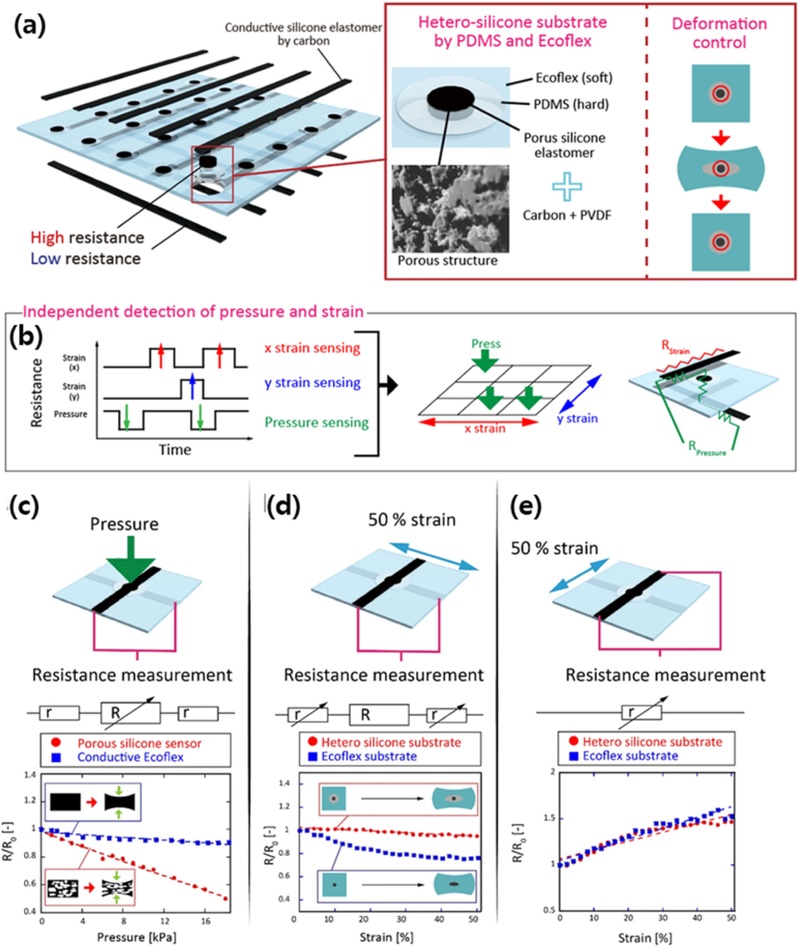
Stretchable sensing array for independent detection of pressure and strain. (a) Schematic structure of the dual-silicone substrate array with different hardness values for strain-resistant pressure sensing. (b) Measurement scheme showing independent detection of pressure and bidirectional strain stimuli. (c) Resistance variation of the sensor with applied pressure. (d,e) Resistance changes of the sensor on homogeneous and heterogeneous substrates under 50% strain. Adapted from Ref. [6].
The underlying principles include structural decoupling through vertical isolation and heteromaterial design, signal processing through resistive control, and multimodal sensing using different physical principles. Future applications of these technologies include medical implants for biodegradable surgical monitoring, wearable electronics for health monitoring without motion artifacts, soft robotics requiring tactile feedback systems, and human-machine interfaces for gesture recognition and control.
3. MATERIAL-BASED APPROACHES TO STRAIN-INSENSITIVE PRESSURE SENSORS
3.1 Functional sensing materials
Sensing materials engineered for intrinsic strain insensitivity achieve good performance through strategic material composition and microstructural design that decouples mechanical deformation from the electrical response, as shown in Fig. 7 [2]. The key breakthrough involved ionic elastomer systems using poly(vinylidene fluoride-co-hexafluoropropylene) (PVDF-HFP) with an ionic liquid (IL, EMIM TFSI) at 30 wt% and a hexamethylenediamine (HMDA) cross-linker. This composite facilitates electrical double-layer capacitive sensing, which dominates the overall sensor capacitance and remains unchanged under in-plane stretching. Combined with silicon-templated micropyramids (350 μm height) and patterned stiffening microelectrodes, the system exhibits 4.5 kPa-1 sensitivity (0–1 kPa) and 2.0 kPa-1 (1–10 kPa) with ~50 ms response time.
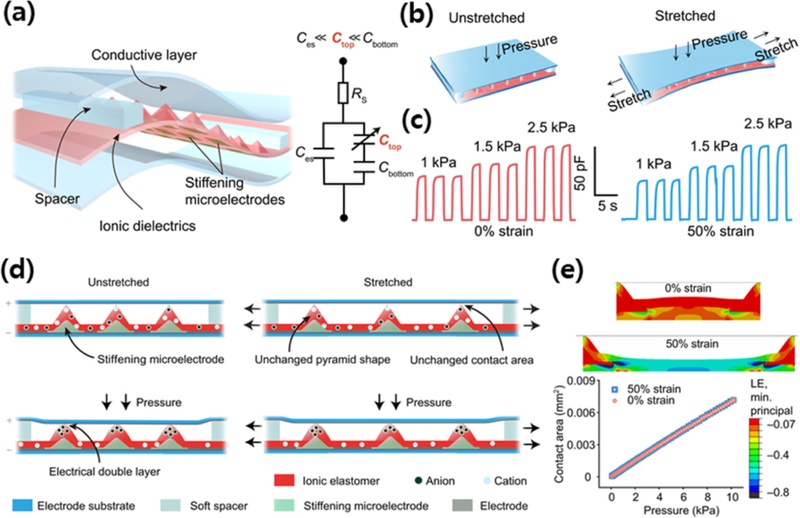
Stretchable and strain-unperturbed pressure sensor with ionic dielectric design. (a) Three-dimensional sensor structure and equivalent circuit showing electrostatic and electrical double layer capacitances. (b) Schematic illustrations of sensor operation under unstretched and stretched states. (c) Capacitance responses to repeated pressure cycles under different strain conditions. (d) Pressure sensing mechanism maintaining consistent performance during stretching. (e) Finite-element simulation of strain distribution in the dielectric layer and contact area changes between pyramid tips and electrode surface. Adapted from Ref. [2]
Structure-induced self-orientation engineering has emerged as a sophisticated approach for creating low-surface-energy regions through ridge-like structures that guide nanomaterial alignment [25]. This technique achieves triboelectric pressure-sensing materials with an optimal modulus through graphene nanosheets and microcrystalline cellulose self-orientation, maintaining a signal accuracy of greater than 95% under 0–60% lateral strain.
3.2 Functional electrode materials
Functional electrode materials provide inherent strain insensitivity through intrinsic properties that maintain their electrical performance under mechanical deformation [26,27]. These materials represent a fundamental change from traditional rigid electrodes to intrinsically deformable conductive systems that accommodate large mechanical deformations while preserving sensing functionality.
Liquid metal electrodes provide self-healing capabilities owing to their intrinsic fluidity at room temperature [26]. Bilayer liquid-solid conductor systems using eutectic gallium-indium (EGaIn) achieve maximum conductivity of 22,532 S·cm-1 maintained under strain, with only 0.34× resistance increase under 1000% strain and extreme stretchability up to 2260% elongation. The amphiphilic properties enable the top liquid metal interfaces with rigid electronics, whereas the bottom layers bond with elastomers, creating self-soldering interfaces with 30% lower resistance than that of traditional connections.
Hybrid ionic-electronic systems combine multiple conduction pathways to achieve robust performance [9]. Thermoplastic polyurethane matrices with reduced graphene oxide (rGO) fillers and IL EMIM-TFSI bridges create dual conduction through electronic percolation via the rGO and ionic conduction through the IL. This approach achieves ΔR/R₀ of only 0.024 under 140% strain after 1000 cycles, with ionic bridges providing additional conductive paths when electronic pathways are disrupted. When integrated with a micropatterned insulating layer, these composites enable piezoresistive pressure sensing and exhibit stable and uniform pressure sensitivity, even under tensile strain and bending deformation. The sensor can detect both contact pressure and noncontact proximity in a single device, making it suitable for advanced tactile, robotic, and wearable applications.
Ionic conductors provide strain-insensitive touch sensing through electrical double-layer (EDL) formation, as illustrated in Fig. 8 [28]. Polyvinyl alcohol matrices with lithium chloride achieve ionic conductivity of 3.2 × 10-³ S·cm-1 and enable direct inkjet printing on PDMS substrates with 40 μm resolution and 94.6% optical transparency. The coplanar interlocking diamond electrode layout delivered a 3× higher touch sensitivity than the parallel-plate configurations, detecting 2% capacitance changes at a distance of 60 mm. Strain insensitivity was achieved through fringe-field capacitive sensing mechanisms, where coplanar structures maintained a touch sensitivity of 47.3% under 40% uniaxial strain with a gauge factor of 0.25, which was four times lower than that of parallel-plate designs. The 4 × 4 matrix demonstrated multitouch detection, gesture recognition, and a 19 dB signal-to-noise ratio under 20% dynamic stretching. EDLs create a nanometer-scale charge separation that remains independent of mechanical deformation, allowing for stable touch detection over 10,000 stretch cycles. Integration with custom readout circuitry enables real-time spatial mapping and complex human-machine interactions under various deformation conditions.
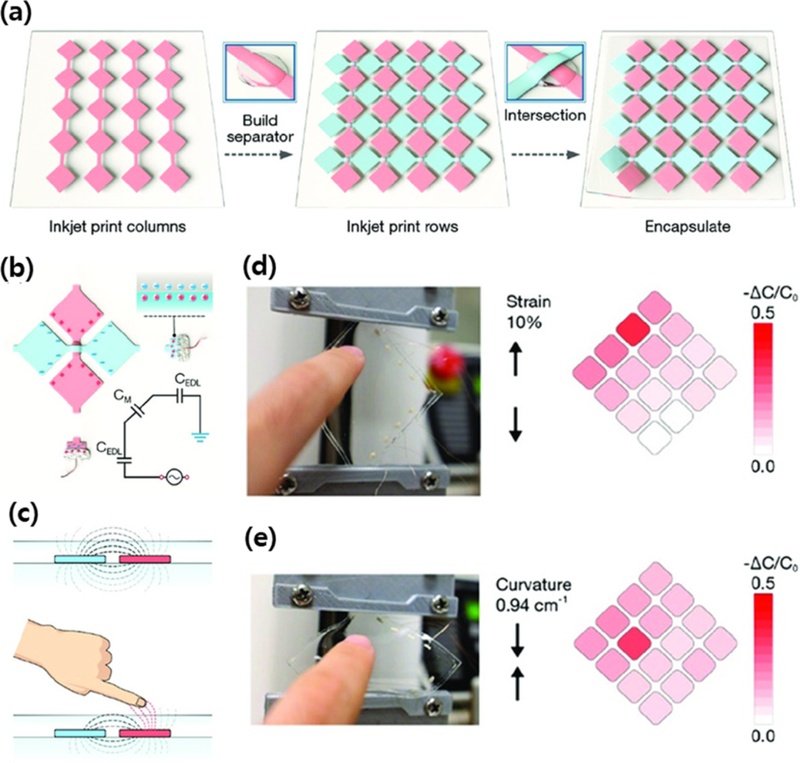
Inkjet-printed iontronic touch sensing matrix with strain-insensitive characteristics. (a) Manufacturing process of the fringe-field capacitive sensing matrix featuring interlocking-diamond electrode configuration. (b) Structure and equivalent circuit model of individual touch sensing taxel. (c) Operating principle of the coplanar fringe-field capacitive taxel based on charge coupling modulation by finger proximity. (d,e) Dynamic capacitance mapping demonstrating matrix performance under stretching and bending deformations. Adapted from Ref. [28].
4. FUTURE PERSPECTIVES AND TECHNOLOGICAL ROADMAP
The commercial trajectory of strain-insensitive pressure sensors has led to widespread adoption across healthcare monitoring, soft robotics, and human-machine interfaces with rapid market growth [4,5]. Success in addressing current limitations around long-term stability, temperature sensitivity, and manufacturing consistency will determine the pace of technology transition from laboratory demonstrations to commercial products that transform how we interact with our physical environment.
Manufacturing scalability constitutes a critical frontier, where roll-to-roll processing techniques, 3D printing processes, and molecular-level bottom-up engineering address cost-effective mass-production challenges [29,30]. Moreover, standardized testing protocols and performance metrics are essential for technology transfer from research laboratories to commercial applications, with particular emphasis on long-term stability under repeated mechanical deformation [31,32].
Strain-insensitive pressure sensors have diverse applications, each requiring specific functionalities to meet the unique requirements. Biointegrated applications are expanding toward biodegradable sensors for temporary implantable monitoring, self-healing materials that recover from mechanical damage, and living tissue-compatible systems for permanent integration [24,33]. The automotive sector incorporates strain-insensitive sensors into electric vehicle battery management systems, whereas smart textile companies embed sensors in wearable garments for continuous health monitoring [34-37].
Emerging technical challenges include developing universal strain-compensation algorithms that work across diverse sensor types, creating novel electrode geometries that inherently decouple strain effects, and advancing materials with tunable mechanical-electrical coupling properties [2,6]. The integration of multiple sensing principles into hybrid architectures offers promising pathways for multifunctional sensor systems [6].
5. CONCLUSION
Strain-insensitive pressure sensors have evolved from fundamental research challenges to advanced engineering solutions that address persistent problems in flexible electronics. The convergence of structural engineering approaches and advanced materials science has produced sensors with extremely high strain insensitivity and highly sensitive detection capabilities, achieving a level of performance that was considered impossible a decade ago. These achievements stem from a deep understanding of strain-pressure coupling mechanisms and innovative approaches that either physically isolate sensing elements from deformation or utilize materials with intrinsic strain-independent properties.
Structural approaches using island architectures, hierarchical patterns, specialized electrode geometries, and simultaneous measurement strategies have demonstrated robust pathways for decoupling strain effects from pressure sensing [8,12,16,18,20,24]. Material-based solutions using ionic conductors, liquid metals, and engineered composites provide complementary approaches in which the sensing mechanisms themselves remain unaffected by mechanical deformation [2,9,25,26].
This field has reached sufficient maturity for commercial implementation, with demonstrated applications in wearable health monitoring, soft robotics, tactile sensing, and biomedical implantable systems [2,11,24]. Recent advances in manufacturing scalability and multifunctional sensing capabilities have accelerated technology transfer from research laboratories to market deployment. The integration of machine learning for real-time signal processing combined with advances in biocompatible and biodegradable materials opens new possibilities for long-term implantable monitoring and seamless human technology integration [24,38].
Future success will require continued innovations in material synthesis, manufacturing processes, and system integration to address the challenges of long-term stability, environmental robustness, and cost-effective production. As the global market for stretchable electronics continues to expand rapidly, strain-insensitive pressure sensors represent a foundational technology that will enable the next generation of human-centered sensing systems to transform how we monitor our health, control robotic systems, and interact with our increasingly digital world.
Acknowledgments
This work was supported by the internal grant of the Electronics and Telecommunications Research Institute (ETRI) (25YB2100, Development of light-driven three-dimensional morphing technology for tangible visuo-haptic interaction).
REFERENCES
-
Y. Li, J. Feng, L. Wang, T. Li, Y. Pang, B. Liu, et al., Strain-insensitive bioelectronics, Chem. Eng. J. 482 (2024) 148758.
[https://doi.org/10.1016/j.cej.2024.148758]

-
Q. Su, Q. Zou, Y. Li, Y. Chen, S.-Y. Teng, J.T. Kelleher, et al., A stretchable and strain-unperturbed pressure sensor for motion interference–free tactile monitoring on skins, Sci. Adv. 7 (2021) eabi4563.
[https://doi.org/10.1126/sciadv.abi4563]
-
H.J. Lee, K.-Y. Chun, J.H. Oh, C.-S. Han, Wearable triboelectric strain-insensitive pressure sensors based on hierarchical superposition patterns, ACS Sens. 6 (2021) 2411–2418.
[https://doi.org/10.1021/acssensors.1c00640]
- EP&T Magazine, Wearable sensors market forecast to diversify. https://www.ept.ca/2024/12/wearable-sensors-market-forecast-to-diversify/, 2024 (accessed 19 September 2025).
- Verified Market Reports, Global stretchable strain sensors market size by material type, application, end-use industry, technology, form factor, geographic scope and forecast. https://www.verifiedmarketreports.com/product/stretchable-strain-sensors-market/, , 2025 (accessed 19 September 2025).
-
R. Matsuda, S. Mizuguchi, F. Nakamura, T. Endo, Y. Isoda, G. Inamori, et al., Highly stretchable sensing array for independent detection of pressure and strain exploiting structural and resistive control, Sci. Rep. 10 (2020) 12666.
[https://doi.org/10.1038/s41598-020-69689-2]
-
K. Yong, S. De, E.Y. Hsieh, J. Leem, N.R. Aluru, S. Nam, Kirigami-inspired strain-insensitive sensors based on atomically-thin materials, Mater. Today 34 (2020) 58–65.
[https://doi.org/10.1016/j.mattod.2019.08.013]
-
Y. Shen, Z. Li, Y. Xiang, J. Feng, X. Zhang, T. Wang, Decoupling stretching and sensing regions to achieve strain-insensitive iontronic pressure sensors for gesture recognition, Chem. Eng. J. 516 (2025) 163763.
[https://doi.org/10.1016/j.cej.2025.163763]
-
J. Park, Y. Ko, J.Y. Cho, S. Lee, Y. Lee, J. Han, et al., Stretchable ionic composites for strain-insensitive dual-mode pressure and proximity sensors, Chem. Eng. J. 480 (2024) 148172.
[https://doi.org/10.1016/j.cej.2023.148172]
-
T. Sun, B. Feng, J. Huo, Y. Xiao, W. Wang, J. Peng, et al., Artificial intelligence meets flexible sensors: Emerging smart flexible sensing systems driven by machine learning and artificial synapses, Nano-Micro Lett. 16 (2024) 14.
[https://doi.org/10.1007/s40820-023-01235-x]
-
X. Feng, S. Hu, J. Yu, Z. Guo, R. Wang, W. Zhu, et al., Synergistic creation of highly stable strain-insensitive pressure sensors by in-plane strain modulation and quasi-homogenous interfacial design, J. Mater. Sci. Technol. 159 (2023) 72–80.
[https://doi.org/10.1016/j.jmst.2023.02.047]
-
J.C. Yang, J.-O. Kim, J. Oh, S.Y. Kwon, J.Y. Sim, D.W. Kim, et al., Microstructured porous pyramid-based ultrahigh sensitive pressure sensor insensitive to strain and temperature, ACS Appl. Mater. Interfaces 11 (2019) 19472–19480.
[https://doi.org/10.1021/acsami.9b03261]
-
L. Xu, X. Zhao, X. Xun, F. Gao, L. Gao, S. Bi, et al., Omnidirectionally strain-unperturbed tactile array from modulus regulation in quasi-homogeneous elastomer meshes, Adv. Funct. Mater. 34 (2024) 2307475.
[https://doi.org/10.1002/adfm.202307475]
-
H. Wang, Z. Rao, Y. Liu, L. Shan, T. Guo, H. Chen, et al., A highly stretchable triboelectric nanogenerator with both stretch-insensitive sensing and stretch-sensitive sensing, Nano Energy 107 (2023) 108170.
[https://doi.org/10.1016/j.nanoen.2023.108170]
-
M. Kim, H. Park, E. Kim, M. Chung, J.H. Oh, Photo-crosslinkable organic materials for flexible and stretchable electronics, Mater. Horiz. 12 (2025) 4573–4607.
[https://doi.org/10.1039/D4MH01757A]
-
N.N.A.H. Zahri, A.N. Nordin, N.Z. Azlan, I.H. Hassan, L.H. Tung, L.M. Lim, et al., Wearable strain sensors: design shapes, fabrication, encapsulation and performance evaluation methods, Sens. Diagn. 3 (2024) 1635–1650.
[https://doi.org/10.1039/D4SD00190G]
-
D. Tsogbayar, J. Seo, T. Hwang, J. Park, E. Ko, Y. Kim, et al., Advanced flexible physical sensors with independent detection mechanisms of pressure and strain stimuli for overcoming signal interference, ACS Appl. Mater. Interfaces 16 (2024) 49574–49583.
[https://doi.org/10.1021/acsami.4c09337]
-
J. Zhou, X. Guo, Z. Xu, Q. Wu, J. Chen, J. Wu, et al., Highly sensitive and stretchable strain sensors based on serpentine-shaped composite films for flexible electronic skin applications, Compos. Sci. Technol. 197 (2020) 108215.
[https://doi.org/10.1016/j.compscitech.2020.108215]
-
K. Kim, J. Choi, Y. Jeong, M. Kim, I. Cho, S. Kim, et al., Strain-insensitive soft pressure sensor for health monitoring application using 3D-printed microchannel mold and liquid metal, Proceedings of the 20th International Conference on Solid-State Sensors, Actuators and Microsystems & Eurosensors XXXIII, Berlin, Germany, 2019, pp. 2535–2538.
[https://doi.org/10.1109/TRANSDUCERS.2019.8808472]
-
J. Tolvanen, J. Hannu, H. Jantunen, Kirigami-inspired dual-parameter tactile sensor with ultrahigh sensitivity, multimodal and strain-insensitive features, Flex. Print. Electron. 6 (2021) 035014.
[https://doi.org/10.1088/2058-8585/ac20e1]
-
F. Gao, X. Zhao, Z. Zhang, L. An, L. Xu, X. Xun, et al., A stretching-insensitive, self-powered and wearable pressure sensor, Nano Energy 91 (2022) 106695.
[https://doi.org/10.1016/j.nanoen.2021.106695]
-
S. Sharma, G.B. Pradhan, S. Jeong, S. Zhang, H. Song, J.Y. Park, Stretchable and all-directional strain-insensitive electronic glove for robotic skins and human–machine interfacing, ACS Nano 17 (2023) 8355–8366.
[https://doi.org/10.1021/acsnano.2c12784]
-
J. Deng, W. Zhuang, L. Bao, X. Wu, J. Gao, B. Wang, et al., A tactile sensing textile with bending-independent pressure perception and spatial acuity, Carbon 149 (2019) 63–70.
[https://doi.org/10.1016/j.carbon.2019.04.019]
-
C. M. Boutry, Y. Kaizawa, B. C. Schroeder, A. Chortos, A. Legrand, Z. Wang, et al., A stretchable and biodegradable strain and pressure sensor for orthopaedic application, Nat. Electron. 1 (2018) 314–321.
[https://doi.org/10.1038/s41928-018-0071-7]
-
X. Wang, T. Liu, J. Wang, Y. Liu, M. Chi, S. Zhang, et al., Wearable strain insensitive triboelectric materials enabled by structure-induced self-orientation, Nano Energy 134 (2025) 110569.
[https://doi.org/10.1016/j.nanoen.2024.110569]
-
S. C hen, S. Fan, J. Qi, Z. Xiong, Z. Qiao, Z. Wu, et al., Ultrahigh strain-insensitive integrated hybrid electronics using highly stretchable bilayer liquid metal based conductor, Adv. Mater. 35 (2023) 2208569.
[https://doi.org/10.1002/adma.202208569]
-
S. Wang, C. Liu, J. Liu, S. Li, F. Xu, D. Xu, et al., Highly stable liquid metal conductors with superior electrical stability and tough interface bonding for stretchable electronics, ACS Appl. Mater. Interfaces 15 (2023) 22291–22300.
[https://doi.org/10.1021/acsami.3c03182]
-
D. Gao, J. Wang, K. Ai, J. Xiong, S. Li, P.S. Lee, Inkjet-printed iontronics for transparent, elastic, and strain-insensitive touch sensing matrix, Adv. Mater. Technol. 2 (2020) 2000088.
[https://doi.org/10.1002/aisy.202000088]
-
L. Liu, D. Xiang, Y. Wu, Z. Zhou, H. Li, C. Zhao, et al., Conductive polymer composites based flexible strain sensors by 3D printing: A mini-review, Front. Mater. 8 (2021) 725420.
[https://doi.org/10.3389/fmats.2021.725420]
-
Y. Jin, S. Xue, Y. He, Flexible pressure sensors enhanced by 3D-printed microstructures, Adv. Funct. Mater. 37 (2025) 2500076.
[https://doi.org/10.1002/adma.202500076]
-
S. Wang, Q. Zong, H. Yang, C. Tan, Q. Huang, X. Liu, et al., Rapid fabrication of high-performance flexible pressure sensors using laser pyrolysis direct writing, ACS Appl. Mater. Interfaces 15 (2023) 41055–41066.
[https://doi.org/10.1021/acsami.3c04290]
-
M. Bibi, G. Hassan, A. Asif, A. Shuja, H. Ahmad, B. Mushtaq, et al., Strain sensing technologies: recent developments in materials, performance, and applications, ICCK Trans. Sens. Commun. Control 2 (2025) 168–199.
[https://doi.org/10.62762/TSCC.2025.665257]
-
R. Omar, W. Saliba, M. Khatib, Y. Zheng, C. Pieters, H. Oved, et al., Biodegradable, biocompatible, and implantable multifunctional sensing platform for cardiac monitoring, ACS Sens. 9 (2024) 126–138.
[https://doi.org/10.1021/acssensors.3c01755]
-
Z. Zhang, W. Zhao, Y. Ma, Y. Yao, T. Yu, W. Zhang, et al., A flexible integrated temperature-pressure sensor for wearable detection of thermal runaway in lithium batteries, Appl. Energy 381 (2025) 125191.
[https://doi.org/10.1016/j.apenergy.2024.125191]
-
F.I. Khan, M.M. Hossain, G. Lu, Sensing-based monitoring systems for electric vehicle battery - A review, Meas. Energy 6 (2025) 100050.
[https://doi.org/10.1016/j.meaene.2025.100050]
-
J. Hu, G. Dun, X. Geng, J. Chen, X. Wu, T.-L. Ren, Recent progress in flexible micro-pressure sensors for wearable health monitoring, Nanoscale Adv. 5 (2023) 3131–3145.
[https://doi.org/10.1039/D2NA00866A]
-
S.-G. Choi, S.-H. Kang, J.-Y. Lee, J.-H. Park, S.-K. Kang, Recent advances in wearable iontronic sensors for healthcare applications, Front. Bioeng. Biotechnol. 11 (2023) 1335188.
[https://doi.org/10.3389/fbioe.2023.1335188]
-
J. Lee, J.Y. Kwak, K. Keum, K.S. Kim, I. Kim, M.-J. Lee, et al., Recent advances in smart tactile sensory systems with brain-inspired neural networks, Adv. Intell. Syst. 6 (2024) 2300631.
[https://doi.org/10.1002/aisy.202300631]

Geonwoo Hwang is currently a researcher in the Tangible Interface Creative Research Section of the Electronics and Telecommunications Research Institute (ETRI). He received his B.S. degree in Mechanical Engineering from Pohang University of Science and Technology (POSTECH) in 2017 and his M.S. and Ph.D. degrees in Mechanical Engineering from the Korea Advanced Institute of Science and Technology (KAIST) in 2019 and 2024, respectively. His research interests include haptic interfaces, soft robotics, artificial skin and artificial muscles based on stretchable functional polymers.

Sungryul Yun is currently the principal researcher and director of the Tangible Interface Creative Research Section at the Electronics and Telecommunications Research Institute (ETRI). He received his B.S., M.S., and Ph.D. degrees in Mechanical Engineering from Inha University in Korea in 2003, 2005, and 2009, respectively. He then moved to the University of California at Los Angeles as a postdoctoral fellow in Materials Science and Engineering. His research interests include stimuli-responsive polymers for soft/flexible functional devices, such as physical/chemical sensors, artificial muscles, tunable lenses, and haptic interfaces.