
Gas Sensing Performance of Pd Single-Atom Loaded Monolayer Graphene
ⓒ The Korean Sensors Society
This is an Open Access article distributed under the terms of the Creative Commons Attribution Non-Commercial License (https://creativecommons.org/licenses/by-nc/3.0/) which permits unrestricted non-commercial use, distribution, and reproduction in any medium, provided the original work is properly cited.
Abstract
Graphene is a highly attractive sensing material due to its high surface-to-volume ratio, excellent electrical conductivity, and rapid charge transport. However, graphene-based gas sensors face challenges, including low selectivity and slow response times at room temperature, which limit their potential for commercialization. To address these issues, noble metal decoration is a highly effective strategy to enhance the performance of gas sensors, offering improved sensitivity, high selectivity, and accelerated response times. In this work, we fabricated a graphene-based gas sensor decorated with palladium single-atom catalysts (Pd SACs) via a simple drop-casting method. Structural characterization was performed using optical microscopy and scanning electron microscopy (SEM), while Raman spectroscopy was employed to investigate Pd-induced electronic effects within the graphene lattice. All sensors exhibited enhanced responses to NO2, NH3, and H2S at room temperature, with reduced response times. This study demonstrates that Pd SAC decoration effectively enhances the sensitivity and response time of monolayer graphene sensors, providing a simple, scalable, and practical approach for high-performance room-temperature gas sensing.
Keywords:
Graphene, Noble metal decoration, Pd single-atom catalyst (Pd SAC)1. INTRODUCTION
Gas sensors play a crucial role in environmental monitoring, industrial safety, and public health by detecting hazardous and toxic gases [1-3]. However, metal oxide-based gas sensors, which are the primary commercialized chemiresistive gas sensors, typically require high operating temperatures above 200°C to activate surface oxygen species, leading to high power consumption and limited applicability [4-8]. Furthermore, they often suffer from poor selectivity and slow response and recovery characteristics, which hinder their use in portable and low-power sensing applications.
Graphene has attracted significant attention as a promising sensing material candidate due to its high surface-to-volume ratio, excellent electrical conductivity, and rapid charge transport [9-11]. Graphene-based gas sensors exhibit high sensitivity at room temperature and enable the detection of a wide range of gas species. In addition, the surface can be easily modified or functionalized with various atoms or molecules, providing a versatile platform for tailoring gas sensing properties [12-15]. However, graphene-based sensors still face challenges, including slow response time at room temperature, which limit their practical applicability.
To overcome these limitations, noble metal decoration has been widely adopted as an effective strategy to enhance gas sensing performance [16-19]. Noble metals such as Pd and Pt act as catalytically active sites, facilitating the dissociation of gas molecules and promoting charge transfer through spillover effects [20,21]. Nevertheless, conventional nanoparticle-based decoration often leads to aggregation and inefficient utilization of active sites. In this regard, single atom catalysts (SACs) are promising alternatives, offering maximized atomic efficiency and uniformly distributed active sites [22-24]. Recently, SACs featuring atomically dispersed Pd species supported on carbon-based or metal oxide substrates have been demonstrated to exhibit strong sensing potential and selective interactions with target gas molecules, which can be leveraged to improve both sensitivity and selectivity in gas sensing [25,26]. The incorporation of Pd single atoms can significantly enhance the sensing performance by providing well-defined, coordinatively unsaturated adsorption sites that promote specific gas adsorption and facilitate efficient charge transfer between gas molecules and the sensing layer.
In this study, we report a graphene-based gas sensor decorated with Pd SACs, which provide high atomic utilization efficiency and uniformly distributed active sites, via a facile drop-casting method. The proposed sensor demonstrates enhanced gas sensing performance, including improved sensitivity, selectivity, and faster response behavior toward target gases such as NO2, NH3, and H2S at room temperature.
2. EXPERIMENTAL
2.1 Gas sensor fabrication
Monolayer graphene was grown on Cu foil (purity: 99.99%) using conventional thermal chemical vapor deposition (CVD) at 990°C with a hydrocarbon source (CH4, 50 sccm) and hydrogen (H2, 10 sccm). The graphene/Cu foil was wet-transferred onto a SiO2/Si (285 nm/525 μm) substrate, followed by PMMA removal using acetone for 30 minutes. Subsequently, the samples were patterned by photolithography into a strip with a 100 µm wide channel. Oxygen (O2) plasma treatment (17 s) at 50 W, followed by thermal annealing at 350°C for 7 hours, was performed to completely remove PMMA residue. Ti/Au (3 nm/40 nm) electrodes were deposited on both ends using an e-beam evaporator, followed by acetone lift-off for 24 hours to complete the electrode patterning.
2.2 Pd SAC decoration process
Pd–N–C powder (0.01 g) was dispersed in a mixture of isopropanol (IPA, 1600 µL) and deionized (DI) water (DI water, 200 µL), followed by sonication for 5 min to obtain a uniform suspension. The suspension was drop-cast onto the graphene surface at a volume of 0.5 µL and dried at 60°C for 5 min to allow for Pd single-atom deposition. This procedure enabled the formation of atomically dispersed Pd sites on the graphene surface, following previously reported protocols for Pd–N–C SACs [22].
2.3 Gas sensor measurements
Gas sensing properties were measured at room temperature under a constant total flow of 1000 sccm in a quartz tube. A Keithley 2400 recorded the sensor resistance at 1 s intervals under a DC bias voltage of 1 V, while the gas flow was alternately switched from dry air (99.999%) to calibrated target gases (balanced with dry air) using a mass flow controller. The response was calculated as (Rgas − Rair)/Rair × 100, where Rgas and Rair are the measured resistances of the sensors exposed to the target gases and dry air, respectively. ∆R/R0 represents the absolute value of the response.
2.4 Characterization
The graphene samples were characterized with a Field Emission Scanning Electron Microscope (FE-SEM, Hitachi S-4800, Japan) using a 10 kV beam. Raman scattering was carried out using a Raman spectrometer and 532 nm laser light for excitation.
The completed characterization of the Pd–N–C materials employed in this work is provided in our previous work, utilizing AC-STEM/EDS, single atom electron energy loss spectroscopy (EELS), and XAS, including extended X-ray absorption fine structure (EXAFS) and XANES, XPS, ICP-MS, BET, XRD and Raman to confirm the atomic dispersion, nitrogen coordination and chemical state of the Pd–Nx sites, as well as the physical properties of the Pd–N–C materials [22].
3. RESULTS AND DISCUSSIONS
3.1 Graphene-based gas sensors
To investigate the effect of Pd decoration on graphene-based gas sensors, a monolayer graphene sensor with Au/Ti electrodes was fabricated, as illustrated in Fig. 1. The fabrication process involved transferring a CVD-grown graphene film onto a SiO2/Si substrate (285 nm/525 μm) and patterning it into a strip with a channel width of 100 μm. Au/Ti (3 nm/40 nm) electrodes were then deposited to define the sensing area. The optical microscopy (OM) image of the patterned channel confirms the uniform graphene transfer, and the Pd SAC was applied by drop-casting onto the graphene channel, highlighting the functionalization step for enhanced gas sensing. This design allows the impact of Pd functionalization on the sensor’s electronic properties and gas response to be directly examined.
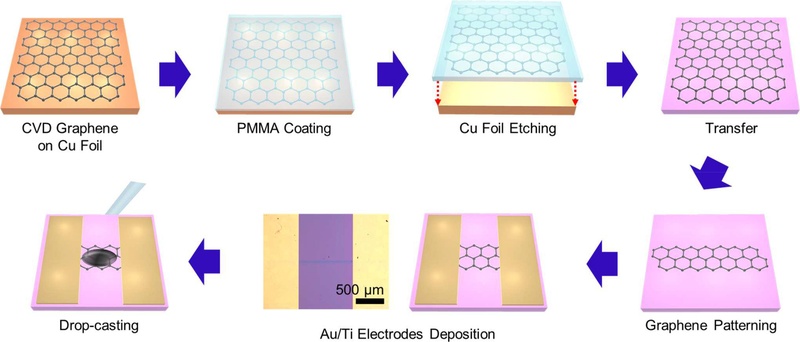
Schematic illustration of the fabrication process for the graphene-based gas sensor. A monolayer graphene film was transferred onto a SiO2/Si substrate (285 nm/525 μm) and patterned into a strip with a channel width of 100 μm. Au/Ti (3 nm/40 nm) electrodes were deposited to define the sensing area. The optical microscopy (OM) image of the patterned channel is shown. The palladium single-atom catalyst (Pd SAC) drop-casting process onto the graphene channel is illustrated, highlighting the functionalization step for gas sensing.
3.2 Pd SAC analysis
To examine the structural and functional characteristics of the Pd SAC (Pd-N-C) on graphene, a series of analyses were performed, as shown in Fig. 2. The molecular structure of the Pd-N-C catalyst is illustrated in Fig. 2(a), showing palladium atomically coordinated with nitrogen within a carbon matrix. The Pd atom centers ideally have a first coordination shell of four nitrogen atoms and are coordinated in either an in-plane or out-of-plane configuration. This structure was reported to provide isolated active sites that facilitate selective adsorption and electron transfer [22]. Raman spectroscopy (Fig. 2(b)) was employed to analyze the structural evolution of graphene before and after Pd SAC decoration. The pristine graphene exhibits characteristic G (~1580 cm-1) and 2D (~2670 cm-1) bands with a negligible D-band intensity, confirming the high-quality nature of the graphene sample. Following Pd SAC deposition, the Raman spectrum underwent a dramatic transformation, characterized by a significant surge in D-band intensity and a significant suppression of the 2D-band. This observation indicates that the atomic Pd decoration induces localized structural disorder and strong electronic interactions with the graphene lattice. The resulting increase in defect sites and the modified electronic state are expected to provide abundant active sites for gas adsorption, thereby enhancing the sensing performance.
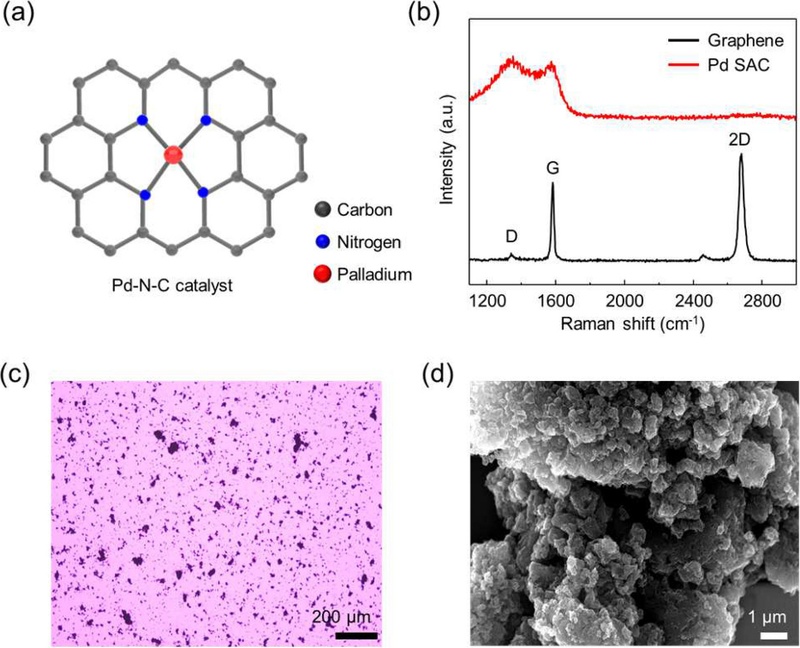
Morphological and structural characterization of the Pd SAC-decorated graphene. (a) Molecular structure of the Pd SAC used for graphene functionalization. (b) Raman spectra of pristine graphene (black) and Pd SAC on the graphene surface (red). (c) Optical microscopy image showing the uniform distribution of Pd SAC on the graphene surface. (d) Scanning electron microscopy (SEM) image confirming nanoscale dispersion of Pd sites across the graphene surface, demonstrating the atomic-level decoration.
The surface morphology of graphene after Pd SAC decoration was first examined using optical microscopy (OM, Fig. 2(c)). The image reveals a uniform distribution of dark spots across the graphene surface, corresponding to Pd single-atom clusters dispersed via drop-casting. These features indicate that the Pd SAC solution was homogeneously deposited without the formation of large aggregates.
Scanning electron microscopy (SEM, Fig. 2(d)) further confirms the successful deposition of Pd SACs on graphene. The high-resolution SEM image reveals a highly porous structure composed of irregularly shaped nanoscale features, forming a rough and interconnected surface morphology. The formation of Pd single atoms was also clearly demonstrated in our previous study [22].
3.3 Gas sensing results
The gas sensing response of the graphene-based sensor was measured toward 5 ppm NO2, 50 ppm NH3, 50 ppm H2S, 50 ppm CH3COCH3, and 50 ppm H2. Fig. 3(a) shows the gas sensing performance of the graphene sensor for three main target gases (5 ppm NO2, 50 ppm NH3, and 50 ppm H2S) before and after Pd SAC decoration. As shown in Fig. 3(b), all three gases exhibited enhanced responses after Pd SAC decoration, with H2S showing the most pronounced increase from 1.49% to 3.96%. The markedly larger response toward H2S can be attributed to the strong affinity between Pd single-atom sites and sulfur-containing species. In particular, H2S is readily activated on Pd, where the H–S bond can undergo dissociation and sulfur species can form Pd–S interactions, leading to a larger charge-transfer perturbation than NO2 or NH3 [27-29]. The NO2 response increased moderately from 15.71% to 16.42%, while the NH3 response rose slightly from 14.63% to 15.16%. These results demonstrate that the introduction of Pd SAC provides additional active sites on the graphene surface, which selectively enhance interactions with gas molecules, particularly H2S, while largely preserving the intrinsic sensing characteristics of the graphene channel.
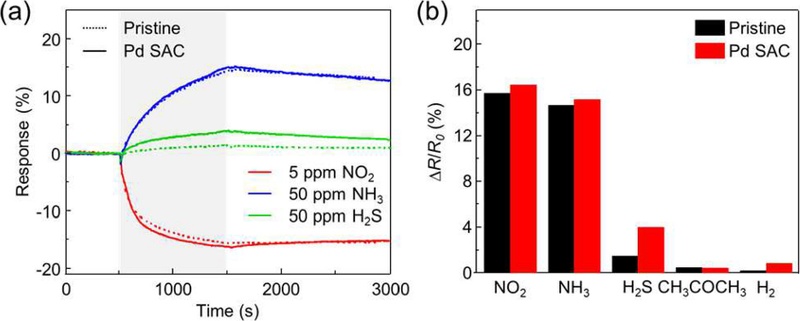
Gas sensing performance of the graphene gas sensor. (a) Dynamic response curves to three target gases (5 ppm NO2, 50 ppm NH3, and 50 ppm H2S) before and after Pd SAC decoration. (b) Comparison of sensor responses to five different gases (5 ppm NO2, 50 ppm NH3, 50 ppm H2S, 50 ppm CH3COCH3, and 50 ppm H2) with and without Pd SAC decoration.
Further analysis was conducted on the NO2 response curve, which exhibited the highest sensitivity among the target gases (Fig. 4). To quantify the dynamic response characteristics of the graphene-based sensor, the response time (t90) was defined as the time required for the sensor resistance to reach 90% of the total change upon exposure to 5 ppm NO2. The Pd SAC decoration reduced t90 from 545 s for the pristine sensor to 465 s, indicating a faster response due to the additional active sites provided by the Pd single atoms (Fig. 4(a)). The normalized response curves were further fitted to an exponential decay function, ΔR/R0(t) = exp(-t/τ) + R∞, as depicted in Fig. 4(b). The τ represents the characteristic response decay time, providing insight into the kinetics of gas adsorption. Comparison of t90 and τ values (Fig. 4(c)) demonstrates that Pd SAC decoration not only accelerates the initial response but also reduces the response decay time from 173 s to 150 s, highlighting the overall enhancement in sensor dynamics and confirming the role of Pd SAC in facilitating faster adsorption processes.
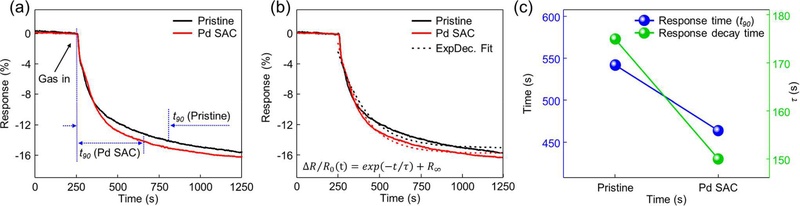
Response characteristics of the graphene-based gas sensor. (a) Dynamic response curve to 5 ppm NO2, showing the response time (t90). (b) Normalized response curves fitted to an exponential decay function for the graphene-based gas sensor. (c) Comparison of t90 and the response decay time (τ) for the graphene-based gas sensor before and after Pd SAC decoration.
4. CONCLUSIONS
We have demonstrated a graphene-based gas sensor functionalized with Pd SACs via a facile drop-casting method. Comprehensive structural and morphological characterization confirmed uniform Pd SAC deposition on the graphene surface, inducing localized defect sites and strong electronic interactions that enhance gas adsorption. Gas sensing measurements showed that Pd SAC decoration significantly improves performance, with the most pronounced enhancement for H2S, while NO2 and NH3 responses were moderately increased. Detailed analysis of the NO2 response further revealed accelerated sensor dynamics, with the response time reduced from 545 s to 465 s and the exponential decay time shortened from 173 s to 150 s, highlighting faster adsorption kinetics. These results indicate that atomically dispersed Pd sites provide additional active sites, leading to improved sensitivity and enhanced response speed of graphene-based sensors. Moreover, the facile and scalable drop-casting method suggests that this functionalization strategy could be readily applied to other sensor platforms. This work establishes Pd SAC functionalization as an effective strategy for the development of high performance gas sensors suitable for environmental monitoring and industrial applications at room temperature.
Acknowledgments
This research was supported by Development of Measurement Technology for High-Tech Strategic Industries funded by Korea Research Institute of Standards and Science (KRISS – 2026 – GP2026 - 0013) and the National Research Council of Science & Technology (NST) grant by the Korea government (MSIT) (No. CAP25031-000).
REFERENCES
-
M.V. Nikolic, V. Milovanovic, Z.Z. Vasiljevic, Z. Stamenkovic, Semiconductor gas sensors: Materials, technology, design, and application, Sensors 20 (2020) 6694.
[https://doi.org/10.3390/s20226694]

-
S.Z.N. Demon, A.I. Kamisan, N. Abdullah, S.A.M. Noor, N.A.M. Kasim, M.Z.A. Yahya, et al., Graphene-based Materials in Gas Sensor Applications: A Review, Sens. Mater. 32 (2020) 759–777.
[https://doi.org/10.18494/SAM.2020.2492]
-
Z. Xiao, L.B. Kong, S. Ruan, X. Li, S. Yu, X. Li, et al., Recent development in nanocarbon materials for gas sensor applications, Sens. Actuators B Chem. 274 (2018) 235–267.
[https://doi.org/10.1016/j.snb.2018.07.040]
-
N. Barsan, M. Schweizer-Berberich, W. Göpel, Fundamental and practical aspects in the design of nanoscaled SnO2 gas sensors: a status report, Fresenius’ J. Anal. Chem. 365 (1999) 287–304.
[https://doi.org/10.1007/s002160051490]
-
C. Wang, L. Yin, L. Zhang, D. Xiang, R. Gao, Metal oxide gas sensors: sensitivity and influencing factors, Sensors 10 (2010) 2088–2106.
[https://doi.org/10.3390/s100302088]
-
C. Kim, S.-W. Lee, J. Hwang, J.-W. Yoon, Monitoring postharvest ethylene emissions in fresh produce: potential of metal oxide semiconductor-based gas sensors, J. Sens. Sci. Technol. 34 (2025) 138–157.
[https://doi.org/10.46670/JSST.2025.34.2.138]
-
K.B. Kim, M.S. Sohn, S.-Y. Jeong, Highly selective and sensitive detection of acetone by ZnWO4-WO3 Hetero-composite spheres, J. Sens. Sci. Technol. 33 (2024) 237–241.
[https://doi.org/10.46670/JSST.2024.33.5.237]
- T.-H. Kim, K.B. Kim, J.-H. Lee, Highly Sensitive and Selective Trimethylamine Sensor Using Yolk-shell Structured Mo-doped Co3O4 Spheres, J. Sens. Sci. Technol. 28 (2019) 271–276.
-
F. Schedin, A.K. Geim, S.V. Morozov, E.W. Hill, P. Blake, M.I. Katsnelson, et al., Detection of individual gas molecules adsorbed on graphene, Nat. Mater. 6 (2007) 652–655.
[https://doi.org/10.1038/nmat1967]
-
S.S. Varghese, S. Lonkar, K. Singh, S. Swaminathan, A. Abdala, Recent Recent advances in graphene based gas sensors, Sens. Actuators B Chem. 218 (2015) 160–183.
[https://doi.org/10.1016/j.snb.2015.04.062]
-
Y. Kim, T. Kim, J. Lee, Y.S. Choi, J. Moon, S.Y. Park, et al., Tailored Graphene Micropatterns by Wafer‐Scale Direct Transfer for Flexible Chemical Sensor Platform, Adv. Mater. 33 (2021) 2004827.
[https://doi.org/10.1002/adma.202004827]
-
Y.H. Kim, J.S. Park, Y.-R. Choi, S.Y. Park, S.Y. Lee, W. Sohn, et al., Chemically fluorinated graphene oxide for room temperature ammonia detection at ppb levels, J. Mater. Chem. A 5 (2017) 19116–19125.
[https://doi.org/10.1039/C7TA05766K]
-
J. Oh, H. Kim, S. Cho, J. Sim, S. Choi, A. Kim, et al., Electrochemically chlorinated graphene for ultrafast NO2 detection at room temperature, J. Mater. Chem. A 13 (2025) 39704–39713.
[https://doi.org/10.1039/D5TA05009J]
-
T. Kuila, S. Bose, A.K. Mishra, P. Khanra, N.H. Kim, J.H. Lee, Chemical functionalization of graphene and its applications, Prog. Mater. Sci. 57 (2012) 1061–1105.
[https://doi.org/10.1016/j.pmatsci.2012.03.002]
-
N. Alzate-Carvajal, A. Luican-Mayer, Functionalized graphene surfaces for selective gas sensing, ACS Omega 5 (2020) 21320–21329.
[https://doi.org/10.1021/acsomega.0c02861]
-
T. Kim, T.H. Lee, S.Y. Park, T.H. Eom, I. Cho, Y. Kim, et al., Drastic gas sensing selectivity in 2-dimensional MoS2 nanoflakes by noble metal decoration, Acs Nano 17 (2023) 4404–4413.
[https://doi.org/10.1021/acsnano.2c09733]
-
L.-Y. Zhu, L.-X. Ou, L.-W. Mao, X.-Y. Wu, Y.-P. Liu, H.-L. Lu, Advances in noble metal-decorated metal oxide nanomaterials for chemiresistive gas sensors: overview, Nano-Micro Lett. 15 (2023) 89.
[https://doi.org/10.1007/s40820-023-01047-z]
-
Y. Kim, Y.S. Choi, S.Y. Park, T. Kim, S.-P. Hong, T.H. Lee, et al., Au decoration of a graphene microchannel for self-activated chemoresistive flexible gas sensors with substantially enhanced response to hydrogen, Nanoscale 11 (2019) 2966–2973.
[https://doi.org/10.1039/C8NR09076A]
-
Y. Kim, T. Kim, Y.-S. Choi, T.H. Lee, H. Park, S.A. Lee, et al., Voltage-dependent gas discrimination using self-activated graphene with Pt decoration, Sens. Actuators B Chem. 349 (2021) 130696.
[https://doi.org/10.1016/j.snb.2021.130696]
-
A. Kolmakov, D. Klenov, Y. Lilach, S. Stemmer, M. Moskovits, Enhanced gas sensing by individual SnO2 nanowires and nanobelts functionalized with Pd catalyst particles, Nano Lett. 5 (2005) 667–673.
[https://doi.org/10.1021/nl050082v]
-
S. Barala, A. Kumar, M. Kwoka, A. Gupta, M. Kumar, Spillover effect in Pd anchored NiO-ZnO nanostructures improves hydrogen gas sensor’s performance, Sens. Actuators B Chem. 433 (2025) 137534.
[https://doi.org/10.1016/j.snb.2025.137534]
-
E. Murphy, Y. Liu, I. Matanovic, M. Rüscher, Y. Huang, A. Ly, et al., Elucidating electrochemical nitrate and nitrite reduction over atomically-dispersed transition metal sites, Nat. Commun. 14 (2023) 4554.
[https://doi.org/10.1038/s41467-023-40174-4]
-
K. Artyushkova, A. Serov, S. Rojas-Carbonell, P. Atanassov, Chemistry of multitudinous active sites for oxygen reduction reaction in transition metal–nitrogen–carbon electrocatalysts, J. Phys. Chem. C 119 (2015) 25917–25928.
[https://doi.org/10.1021/acs.jpcc.5b07653]
-
A. Morankar, S. Deshpande, Z. Zeng, P. Atanassov, J. Greeley, A first principles analysis of potential-dependent structural evolution of active sites in Fe-NC catalysts, Proc. Natl. Acad. Sci. U.S.A. 120 (2023) e2308458120.
[https://doi.org/10.1073/pnas.2308458120]
-
T. Chu, C. Rong, L. Zhou, X. Mao, B. Zhang, F. Xuan, Progress and perspectives of single‐atom catalysts for gas sensing, Adv. Mater. 35 (2023) 2206783.
[https://doi.org/10.1002/adma.202206783]
-
G. Lei, H. Pan, H. Mei, X. Liu, G. Lu, C. Lou, et al., Emerging single atom catalysts in gas sensors, Chem. Soc. Rev. 51 (2022) 7260–7280.
[https://doi.org/10.1039/D2CS00257D]
-
B. Liu, L. Zhang, Y. Luo, L. Gao, G. Duan, The dehydrogenation of H-S bond into sulfur species on supported Pd single atoms allows highly selective and sensitive hydrogen sulfide detection, Small 17 (2021) 2105643.
[https://doi.org/10.1002/smll.202105643]
-
D.R. Alfonso, A.V. Cugini, D.C. Sorescu, Adsorption and decomposition of H2S on Pd (111) surface: a first-principles study, Catal. Today 99 (2005) 315–322.
[https://doi.org/10.1016/j.cattod.2004.10.006]
-
P. Recum, T. Hirsch, Graphene-based chemiresistive gas sensors, Nanoscale Adv. 6 (2024) 11–31.
[https://doi.org/10.1039/D3NA00423F]