
Characterization of a Modular Floor Pressure Pad Based on Thin Film Piezoresistive Sheet for Worker Safety Monitoring in Smart Factories

ⓒ The Korean Sensors Society
This is an Open Access article distributed under the terms of the Creative Commons Attribution Non-Commercial License (https://creativecommons.org/licenses/by-nc/3.0/) which permits unrestricted non-commercial use, distribution, and reproduction in any medium, provided the original work is properly cited.
Abstract
This paper presents a modular floor pressure pad system based on Velostat-1361 piezoresistive material for real-time worker presence monitoring in smart factory environments. Each module integrates an ABS plastic substrate, copper tape electrodes, and a Velostat sensing sheet. A hook-type elastic copper sheet mechanism enables horizontal 1 × N array expansion with only three signal output terminals from the central reference pad. A voltage divider circuit with a 1 kΩ resistor and an Arduino Uno ADC were used for data acquisition. Experiments in a 1 × 6 configuration under 80 kg and 40 kg loading conditions showed that all pad positions achieved a minimum detection increase rate of 168% above the no-load baseline, with no signal attenuation up to 1,550 mm from the reference pad. CV analysis confirmed signal stability within general industrial measurement criteria (CV < 15%), with the 40 kg condition approaching precision grade (CV < 10%). Notably, pads with more inter-pad junctions showed lower or comparable CV relative to the zero-junction reference pad, with Pad 4 achieving a mean CV of 5.3%, confirming that the hook-type interconnection introduces no measurable signal degradation across up to five cascaded junctions. These results validate the proposed system as a cost-effective, scalable, and reliable floor sensing solution for occupational safety in intelligent manufacturing.
Keywords:
Piezoresistive sensor, Velostat, Smart factory, Floor pressure pad, Worker safety, Modular sensing, IIoT1. INTRODUCTION
The rapid advancement of smart factory technology is transforming manufacturing paradigms through process automation and unmanned operation. However, equipment maintenance tasks continue to rely on human workers, introducing occupational safety risks that demand careful management [1,2]. Current safety management frameworks employ multi-layered approaches including ultra-wideband positioning, artificial intelligence (AI)-based camera surveillance, and industrial internet of things (IIoT) sensor networks [3-5]. Despite these measures, blind spots in worker monitoring remain inevitable in complex production layouts.
Floor-based sensing offers an intuitive and complementary approach to worker presence detection. Prior work on smart floors [6,7] and floor-based human detection [8-10] has demonstrated promising feasibility; however, existing solutions are often constrained to single-point measurement, high cost, or limited scalability. There is a clear need for an economical, modular, and easily deployable floor sensor architecture for industrial safety applications.
Piezoresistive flexible pressure sensors have been widely studied for various sensing applications [11]. Among them, Velostat—a conductive polyethylene sheet loaded with carbon black—exhibits piezoresistive behavior, with electrical resistance decreasing under applied pressure [12-14]. This property makes it well-suited for constructing low-cost pressure-sensitive floor tiles. Previous Velostat studies [12-18] have primarily focused on single-pad characterization; the challenge of scalable interconnection of multiple pads with minimal wiring has not been sufficiently addressed.
This paper proposes a modular floor pressure pad system in which a central reference pad with three output terminals can be expanded into horizontal arrays via a hook-type coupling mechanism. Inter-pad electrical connections are established purely through surface-to-surface electrode contact during mechanical assembly. Key contributions are: (1) a validated modular expansion architecture using only three output channels for up to six pads; (2) comprehensive per-pad load increase rate (variation rate) analysis across array configuration and two body-weight conditions; and (3) quantitative verification of contact resistance stability as a function of inter-pad junction count.
2. SYSTEM DESIGN
2.1 Pressure Pad Structure
Each pressure pad module consists of four components (Fig. 1): (A) Acrylonitrile Butadiene Styrene (ABS)-plastic base pad with hook-type coupling features; (B) three pairs of conductive copper tape electrodes (width 12 mm, thickness 0.1 mm) on a 310 × 310 × 5 mm ABS substrate; (C) a Velostat thin-film piezoresistive sheet; and (D) a top protective cover film. The base pad bears the full standing load, while hook structures on two corners allow adjacent pads to lock together, automatically aligning electrodes in surface contact.
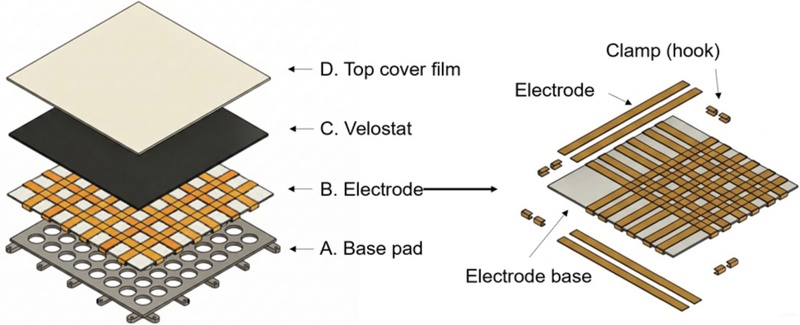
Exploded view of the modular pressure pad structure showing the four main components.
Velostat is a polymer sheet composed of polyethylene mixed with carbon black particles, and its electrical resistance changes depending on the applied pressure. The technical specifications of the Velostat (Velostat-1361, Adafruit) sheet used in this study are summarized in Table 1.

Technical specifications of the Velostat sensing sheet.
The three electrode pairs are insulated at conductor crossings with electrical tape to prevent short circuits (Fig. 2). This configuration allows a single set of three output channels on the central reference pad to sense piezoresistive changes across the entire expanded array.
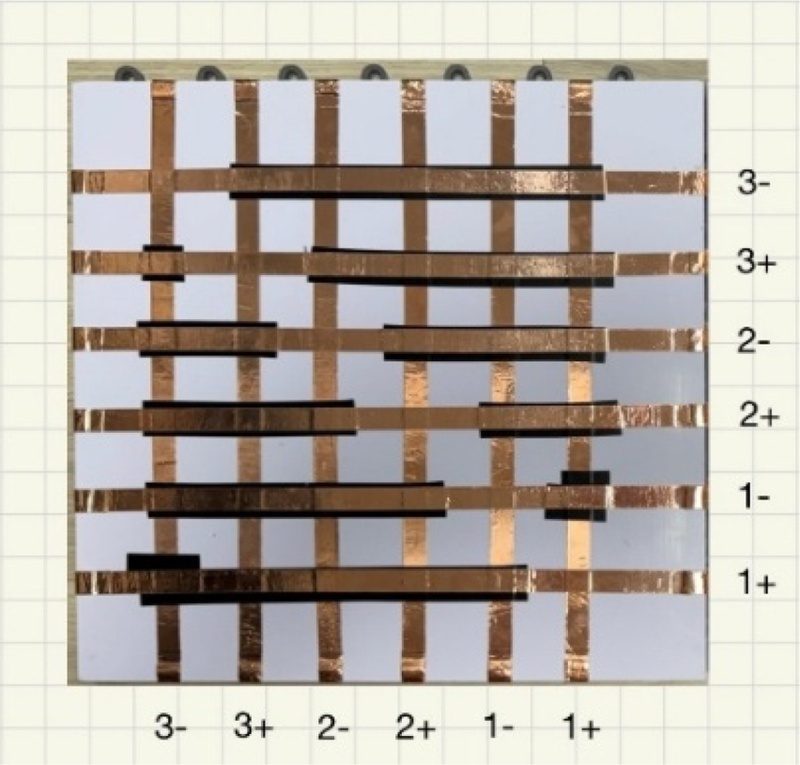
Electrode internal structure with insulation tape at conductor crossings.
2.2 Modular Expansion Mechanism
The inter-pad coupling uses an elastic copper sheet clamp that provides both mechanical locking and electrical continuity through surface-to-surface electrode contact (Fig. 3). Using this approach, the array can be expanded horizontally (1 × N) while retaining only three output terminals from the central reference pad.

Assembly of two adjacent pressure pad modules showing the hook-type coupling and electrode face-contact connection.
Fig. 4 illustrates the horizontal 1 × 6 modular expansion configuration used in the load application experiment. Six sensing pads are sequentially connected using the face-contact hook interconnection method, allowing scalable horizontal expansion. Pad 1 serves as the reference pad and includes the output cable connection. Each sensing pad has a dimension of 280 × 280 mm. The 450 mm distance indicated in the figure represents the spacing between floor tiles and is provided as a reference for scale.

Horizontal 1 × 6 expansion configuration with experimental load application setup.
3. MEASUREMENT METHODOLOGY
3.1 Sensing Circuit and Data Acquisition
Each of the three output terminals is configured as a voltage divider with a 1 kΩ fixed resistor in series with the Velostat piezoresistive element (Fig. 5). Output voltage is sampled by an Arduino Uno (analog inputs A0–A2) at 1-second intervals and logged to a PC. Sensor voltage is given by:
| (1) |
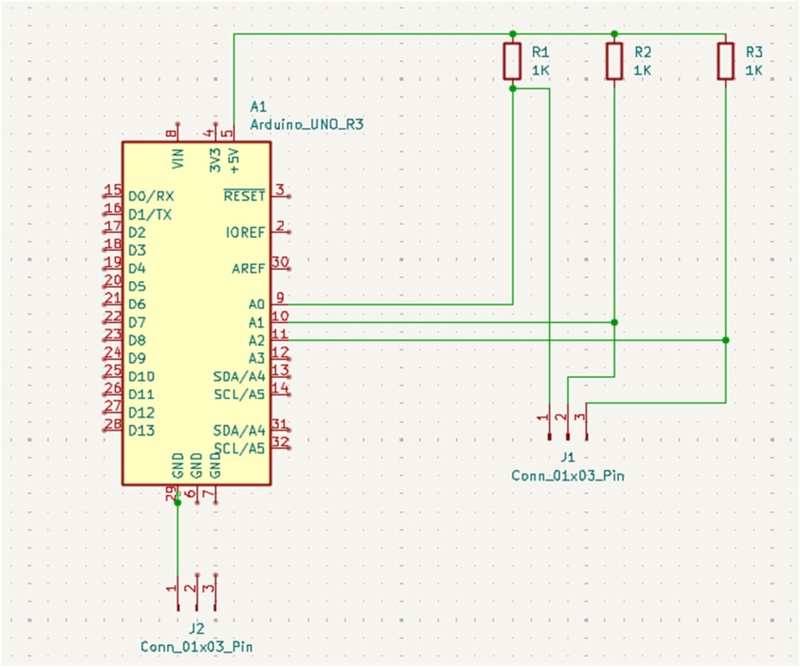
Pressure measurement circuit: voltage divider with 1 kΩ fixed resistor and Velostat as variable resistance element.
where Vinput is input voltage, Vsenser is measured sensor voltage, Rfixed is fixed resistor (1 kΩ), Rpad is resistance of the pressure pad.
The Arduino measures the sensor voltage as an analog-to-digital converter (ADC) value, which can be converted using
| (2) |
Raw ADC values (0–1023) are used directly in all analysis to maximize visualization clarity.
Combining Eqs. (1) and (2), Eq. (3) can be obtained as follows. The resistance of the pressure pad can be calculated as
| (3) |
where a fixed resistor Rfixed is connected in series with the pressure pad sensor, which functions as a variable resistor Rpad.
The load increase rate (variation rate) for each pad is defined as (Load ADC − No-load ADC) / No-load ADC × 100 (%), and the coefficient of variation (CV) is defined as (Standard Deviation / Mean) × 100 (%).
3.2 Experimental Protocol
Experiments were conducted in horizontal (1 × 6) configurations. Two body-weight conditions were applied: 80 kg (average male manufacturing worker, Korea Occupational Safety and Health Agency (KOSHA) statistics) and 40 kg (lightweight female, for minimum detection threshold verification). For horizontal configuration, pads were added one at a time outward from the reference pad; the researcher stepped onto every pad to apply load while data were simultaneously recorded. This yielded six measurements for Pad 1 (the reference) and one measurement for Pad 6 (Table 2).
Number of measurements per pad position in each expansion step.
4. RESULTS AND DISCUSSIONS
4.1 Overall No-load vs. Load Comparison
Fig. 6 shows the aggregated no-load baseline versus load comparison across all six pads in the horizontal configuration. The three channels of Pad 1 exhibit a no-load ADC baseline of 100–128. Upon load application, ADC values increase sharply across all pads. No significant signal attenuation is observed with increasing distance from the reference pad, indicating effective signal transmission through the face-contact electrode chain. The 80 kg male output exceeds the 40 kg female output by approximately 150–200 ADC counts on Channels 2 and 3, while Channel 1 shows similar values for both subjects due to differences in foot placement position.
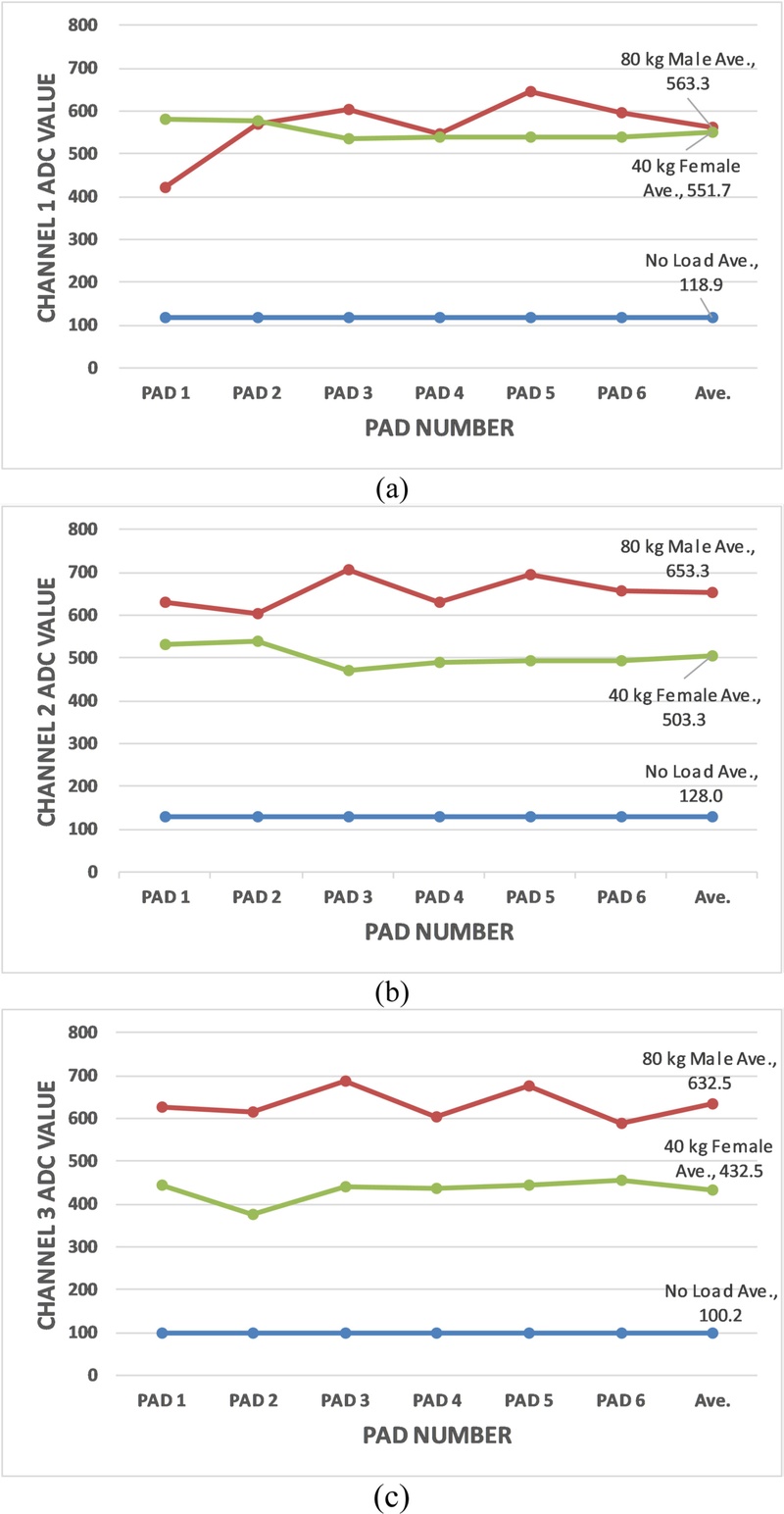
Aggregated no-load average vs. load comparison across all six pads, horizontal (1 × 6) configuration. Blue lines indicate the no-load baseline of reference Pad 1. (a) channel 1 ADC value, (b) channel 2 ADC value, and (c) channel 3 ADC value. ADC values for all pads represent the mean, and the final average value in each graph is calculated from Pad 1 through Pad 6.
4.2 Per-pad Load Increase Rate (Variation Rate) Analysis
Fig. 7 presents the per-pad load increase rate (variation rate) analysis for the horizontal 1 × 6 array. Each of the six panels (a)–(f) corresponds to Pad 1 through Pad 6, and contains three sub-plots: (left) a bar graph of absolute ADC increase from the no-load baseline as a function of the number of loaded rear pads; (middle) a line graph of the percentage increase rate relative to the same baseline (%); and (right) a box plot summarizing the ADC output range across the three measurement channels (Value 1–3) under No-Load, 80 kg male, and 40 kg female conditions.

Per-pad load increase rate (variation rate) analysis for the horizontal 1 × 6 array configuration: (a) Pad 1, (b) Pad 2, (c) Pad 3, (d) Pad 4, (e) Pad 5, and (f) Pad 6. Each panel comprises three sub-plots: (left) bar graph of absolute ADC increase from the no-load baseline as a function of the number of loaded rear pads; (middle) line graph of percentage increase rate relative to the no-load baseline (%); and (right) box plot of ADC output range distribution across three measurement channels (Value 1, Value 2, Value 3) under No-Load, 80 kg male, and 40 kg female conditions.
The bar and line plots show that the response of every pad scales with the number of loaded rear pads in the array, indicating cumulative current-path engagement rather than signal attenuation along the face-contact electrode chain. The 80 kg male condition yields percentage increase rates of up to 578% on Pad 3 (Value 3), while the 40 kg female case typically falls in the 235–385% range. The minimum percentage increase rate across the full dataset is 168% (see Table 4), corresponding to a loaded-to-baseline ratio greater than 2.5 and confirming reliable presence detection regardless of pad distance from the reference unit.
The box plots show clear separation between the loaded and unloaded distributions across all three channels and all six pads. The No-Load interquartile range remains tightly bounded between 97 and 148 ADC counts, whereas the 80 kg and 40 kg distributions occupy distinct upper bands of approximately 470–630 and 320–550 counts, respectively. On Pad 1 (Value 1) and Pad 4 (Value 1) the 40 kg distribution slightly exceeds the 80 kg distribution, reflecting natural variation in foot-placement position relative to the electrode pattern rather than any inversion in sensor sensitivity. Overall, the 40 kg female subject exhibits more compact distributions and lower inter-measurement variation than the 80 kg male on most pad positions, consistent with more repeatable foot placement. The reference Pad 1 shows the highest variability across all three channels, attributed to mechanical deformation of the ABS base plate around the epoxy-fixed output-cable connector under load.
Table 3 summarizes the CV of load increase rates per pad for the horizontal configuration. The female CV is lower than the male CV on most pads (4 out of 6), indicating higher measurement consistency, consistent with the graphical results.
CV analysis of load increase rate output for horizontal (1 × 6) array.
4.3 Comprehensive Performance Analysis
Table 4 summarizes detection increase rates across horizontal (1 × 6) configurations. The minimum detection increase rate is 168%, confirming that a detection threshold of 100% above no-load baseline provides a conservative and reliable safety criterion.
Detection increase rate summary by configuration and subject weight.
Table 5 presents the mean CV by configuration. The configuration meets general measurement repeatability criteria (CV < 15%) based on statistical quality control [19], with several approaching the precision grade (CV < 10%).
Mean CV of load increase rate signal by configuration and subject weight.
Table 6 confirms that reliable detection is maintained up to 1,550 mm from the reference pad, with increase rates above 200% at all distances.
Distance-dependent detection performance relative to the reference pad.
4.4 Contact Junction Stability Analysis
Contact resistance stability across multiple junctions is a critical factor in modular sensor design [20]. Table 7 consolidates CV values across horizontal configurations as a function of the number of inter-pad junctions. Contrary to expectation, pads with more junctions consistently exhibit lower or comparable CV relative to Pad 1 (zero junctions). Pad 4 achieves a mean CV of 5.3%—approximately three times lower than Pad 1 (17.6%). This result demonstrates that the face-contact hook interconnection does not introduce measurable contact resistance degradation under static loads, firmly establishing the scalability of the proposed architecture. The elevated CV at Pad 1 is attributed to deformation of the ABS base plate around the epoxy-fixed output cable connector.
CV (%) by pad position and junction count across horizontal configurations.
5. CONCLUSIONS
This study has demonstrated the design and experimental validation of a hook-type modular floor pressure pad system for worker presence monitoring in smart factory environments. Using Velostat thin-film piezoresistive material and face-contact copper electrode interconnections, the system achieves scalable sensing area coverage with only three signal output channels. Key findings are as follows:
(1) Universal detection performance: The 1 × 6 horizontal expansion configuration reliably detects workers weighing 40–80 kg, with minimum load increase rates exceeding 168% above the no-load baseline. Per-pad variation rate analysis confirms consistently detectable signals at every position regardless of distance from the reference unit.
(2) Signal stability: CV values are within the acceptable range for general industrial sensing (CV < 15%) in all configurations and approach precision grade (CV < 10%) in several cases. Female subjects show higher measurement consistency (lower CV) in horizontal configurations, reflecting more repeatable foot placement.
(3) Junction reliability: The face-contact hook interconnection introduces no measurable signal degradation across up to five cascaded junctions; Pad 4 achieves a mean CV of 5.3%, approximately three times better than the direct-output reference pad.
(4) Spatial coverage: Signal detection remains reliable at 1,550 mm from the reference pad, enabling full coverage of a standard 2 × 3 m equipment work zone. These signal characteristics meet the precision requirements typically employed for measurement device qualification [21], and align with sensor-based worker safety system architectures reviewed in recent surveys of human-machine collaboration [22], suggesting potential applicability to ISO 13849 Performance Level d (PLd) safety functions, subject to formal certification.
Future work will focus on three key directions. The sensing array will be extended from the current 1 × N horizontal configuration to vertical M × 1 and two-dimensional M × N grid arrays, further validating the system's robustness in two-dimensional spatial monitoring for complex industrial environments. Building on the expanded array, AI-based pressure pattern analysis will be integrated to enable context-aware situation recognition, advancing from simple presence detection toward intelligent occupational safety monitoring. Additionally, miniaturization of the pad module and signal conditioning electronics will be pursued to reduce installation footprint and support practical deployment across diverse industrial applications.
Acknowledgments
This work was supported by research grants from Daegu Catholic University in 2023. This research was supported by the Gyeongsangbuk-do RISE (Regional Innovation System & Education) project (2025-RISE-15-107).
REFERENCES
-
H.S. Kang, J.Y. Lee, S. Choi, H. Kim, J.H. Park, J.Y. Son, et al., Smart manufacturing: Past research, present findings, and future directions, Int. J. Precis. Eng. Manuf.-Green Technol. 3 (2016) 111–128.
[https://doi.org/10.1007/s40684-016-0015-5]

-
Y. Lu, Industry 4.0: A survey on technologies, applications and open research issues, J. Ind. Inf. Integr. 6 (2017) 1–10.
[https://doi.org/10.1016/j.jii.2017.04.005]
-
C.-B. Zamfirescu, B.-C. Pirvu, D. Gorecky, H. Chakravarthy, Human-centred assembly: A case study for an anthropocentric cyber-physical system, Procedia Technol. 15 (2014) 90–98.
[https://doi.org/10.1016/j.protcy.2014.09.038]
-
S. Wang, J. Wan, D. Li, C. Zhang, Implementing smart factory of Industrie 4.0: An outlook, Int. J. Distrib. Sens. Netw. 12 (2016) 3159805.
[https://doi.org/10.1155/2016/3159805]
- European Agency for Safety and Health at Work, Foresight on New and Emerging Occupational Safety and Health Risks Associated with Digitalisation by 2025, Publications Office of the European Union, Luxembourg, 2018.
-
R.J. Orr, G.D. Abowd, The smart floor: A mechanism for natural user identification and tracking, Proceedings of the CHI ’00 Extended Abstracts on Human Factors in Computing Systems, Hague, Netherlands, 2000, pp. 275–276.
[https://doi.org/10.1145/633292.633453]
- J.A. Paradiso, K.-Y. Hsiao, E. Hu, Interactive music for instrumented dancing shoes, Proceedings of the 1999 International Computer Music Conference (ICMC), Bejing China, 1999, pp. 453–456.
-
M. Valtonen, T. Vuorela, L. Kaila, J. Vanhala, Capacitive indoor positioning and contact sensing for activity recognition in smart homes, J. Ambient Intell. Smart Environ. 4 (2012) 305–334.
[https://doi.org/10.3233/AIS-2012-0158]
-
H. Rimminen, J. Lindström, M. Linnavuo, R. Sepponen, Detection of falls among the elderly by a floor sensor using the electric near field, IEEE Trans. Inf. Technol. Biomed. 14 (2010) 1475–1476.
[https://doi.org/10.1109/TITB.2010.2051956]
-
R. Vera-Rodriguez, J.S.D. Mason, J. Fierrez, J. Ortega-Garcia, Comparative analysis and fusion of spatiotemporal information for footstep recognition, IEEE Trans. Pattern Anal. Mach. Intell. 35 (2013) 823–834.
[https://doi.org/10.1109/TPAMI.2012.164]
-
Y. Jung, H. Cho, Flexible pressure sensors based on three-dimensional structure for high sensitivity, J. Sens. Sci. Technol. 31 (2022) 145–150.
[https://doi.org/10.46670/JSST.2022.31.3.145]
-
L. Yuan, H. Qu, J. Li, Velostat sensor array for object recognition, IEEE Sens. J. 22 (2022) 1692–1704.
[https://doi.org/10.1109/JSEN.2021.3132793]
-
A. Dzedzickis, E. Sutinys, V. Bucinskas, U. Samukaite-Bubniene, B. Jakstys, A. Ramanavicius, et al., Polyethylene-carbon composite (Velostat®) based tactile sensor, Polymers 12 (2020) 2905.
[https://doi.org/10.3390/polym12122905]
-
M. Kciuk, Z. Kowalik, G. Lo Sciuto, S. Sławski, S. Mastrostefano, Intelligent medical Velostat pressure sensor mat based on artificial neural network and Arduino embedded system, Appl. Syst. Innov. 6 (2023) 84.
[https://doi.org/10.3390/asi6050084]
-
M. Hopkins, R. Vaidyanathan, A.H. McGregor, Examination of the performance characteristics of Velostat as an in-socket pressure sensor, IEEE Sens. J. 20 (2020) 6992–7000.
[https://doi.org/10.1109/JSEN.2020.2978431]
-
A. Fatema, I. Kuriakose, D. Devendra, A.M. Hussain, Investigation of the mechanical reliability of a Velostat-based flexible pressure sensor, Proceedings of the 2022 IEEE International Conference on Flexible and Printable Sensors and Systems (FLEPS), Vienna, Austria, 2022, pp. 1–4.
[https://doi.org/10.1109/FLEPS53764.2022.9781575]
-
A. Fatema, S. Chauhan, M. Datta, A.M. Hussain, Investigation of the long-term reliability of a Velostat-based flexible pressure sensor array for 210 days, IEEE Trans. Device Mater. Reliab. 24 (2024) 41–48.
[https://doi.org/10.1109/TDMR.2023.3340711]
-
Y. Zhang, J. Zeng, Y. Wang, G. Jiang, Flexible three-dimensional force tactile sensor based on Velostat piezoresistive films, Micromachines 15 (2024) 486.
[https://doi.org/10.3390/mi15040486]
- D.C. Montgomery, Introduction to Statistical Quality Control, 8th ed., John Wiley & Sons, Hoboken, NJ, USA, 2019.
-
G. Hwang, S. Yun, Strain-insensitive pressure sensing mechanism enabled by dissimilar materials with highly contrasting properties, J. Sens. Sci. Technol. 34 (2025) 610–617.
[https://doi.org/10.46670/JSST.2025.34.6.610]
-
M.M. Shoukri, D. Colak, N. Kaya, A. Donner, Comparison of two dependent within subject coefficients of variation to evaluate the reproducibility of measurement devices, BMC Med. Res. Methodol. 8 (2008) 24.
[https://doi.org/10.1186/1471-2288-8-24]
-
C. Scholz, H.-L. Cao, E. Imrith, N. Roshandel, H. Firouzipouyaei, A. Burkiewicz, et al., Sensor-enabled safety systems for human-robot collaboration: A review, IEEE Sens. J. 25 (2024) 65–88.
[https://doi.org/10.1109/JSEN.2024.3496905]