
Optimized Photonic Crystal Fiber SPR Biosensor for Biosensing Application

ⓒ The Korean Sensors Society
This is an Open Access article distributed under the terms of the Creative Commons Attribution Non-Commercial License (https://creativecommons.org/licenses/by-nc/3.0/) which permits unrestricted non-commercial use, distribution, and reproduction in any medium, provided the original work is properly cited.
Abstract
This work presents numerically designed photonic-crystal-fiber-based surface plasmon resonance (SPR) biosensor. It is optimized for strong mode coupling and a pronounced resonance response. The proposed structure employs a hexagonal air-hole lattice in a silica background, incorporating a central sensing channel and an inner gold coating to support surface plasmon polariton (SPP) modes. The phase-matching wavelength is identified, and the confinement loss is evaluated. For the baseline configuration) pitch Λ = 1.5 μm, air-hole diameter d = 1.0 μm, and gold thickness tg = 60 nm(, the phase-matching point occurs near 1.40 μm, where a distinct confinement loss peak is observed. Parametric studies show that the plasmonic coating thickness and the key geometric parameters reshape the resonance depth, bandwidth, and spectral position. This provides practical tuning parameters for tailoring the sensing window. The resonance shift is further fitted using a polynomial model to extract wavelength-based sensitivity metrics from the simulated spectra.
Keywords:
Photonic crystal fiber, Surface plasmon resonance, Mode coupling, Confinement loss, Biosensor1. INTRODUCTION
Surface plasmon resonance (SPR) is one of the most important techniques in optical sensing because it is highly sensitive to changes at a metal–dielectric interface. The effect originates from the excitation of surface plasmon polariton (SPP) waves. Small variations in the surrounding medium can shift the resonance signature in wavelength or loss. This makes SPR attractive for biochemical and biosensing tasks such as biomolecular assays, medical diagnostics, and environmental monitoring [1,2].
Conventional SPR instruments are typically based on prism configurations. While effective, these setups are typically bulky and require precise alignment, limiting their integration into compact or field-deployable systems. Fiber-integrated SPR sensors address many of these issues by offering a small form factor, remote operation, and easy integration with optical systems [3].
Among fiber platforms, photonic crystal fibers (PCFs) are especially suitable for SPR implementations because their microstructured cladding enables control over guided field distribution and dispersion through geometric design. By tailoring the air-hole lattice and coating a selected region with a thin metal film, the overlap between the guided mode and the plasmonic interface can be controlled, and the phase-matching condition can be achieved in a controlled manner [4,5].
In PCF-SPR sensors, the resonance peak observed in confinement loss or transmission arises from mode coupling between the core-guided mode and the plasmonic mode when phase matching is satisfied. Accordingly, tracking the resonance wavelength provides a practical wavelength-interrogation route for monitoring changes in the surrounding analyte condition. Field-distribution maps at off-resonance and resonance wavelengths are also useful for confirming whether energy remains core-confined or is drawn toward the metal interface [4,6,7].
Early design guidelines for microstructured-fiber SPR sensors emphasized the importance of enforcing phase matching through microstructure engineering and metal placement, which has become a fundamental design principle for subsequent PCF-SPR sensors [4].
Selectively coated PCF concepts were then reported to enhance coupling by coating specific air-hole regions that act as analyte channels, demonstrating how geometric tuning can sharpen the resonance response and improve wavelength interrogation [5].
D-shaped and side-polished PCF-SPR sensors have been widely studied because polishing exposes the guided field and increases its interaction with the metal-coated interface. Gold-coated D-shaped PCF configurations reported clear resonance peaks and strong wavelength-shift behavior, highlighting the role of structural parameters in controlling resonance depth and spectral position [6].
Many FEM-based numerical studies have also focused on gold-coated PCF-SPR platforms that maintain fabrication feasibility while achieving high sensitivity through optimized geometry and coating thickness [7,8].
Beyond physical sensing, PCF platforms have been extended to biomolecular detection using surface functionalization; for example, PNA-modified PCF configurations reported for DNA detection, supporting the suitability of PCF structures for biosensing interfaces [9].
Mode-coupling strategies in PCF biosensors have also been explored to enhance sensing response by engineering controlled interaction between guided modes, which motivates coupling-driven designs in fiber biosensors [10].
Motivated by these developments, this work presents a numerical investigation of a gold coated PCF-SPR biosensor, with emphasis on mode coupling, resonance behavior, and confinement loss analysis. The study focuses on obtaining a clear resonance signature. It is understanding how key structural parameters shape the coupling strength and spectral response. It is establishing a calibration relationship suitable for wavelength interrogation biosensing.
2. SENSOR CONFIGURATION AND STRUCTURAL DESIGN
Fig. 1 illustrates the schematic cross-section of the proposed PCF-SPR structure used for numerical simulations. The structure is numerically analyzed using the finite element method (FEM), and the figure represents the simulation geometry rather than a fabricated device. The background material is silica, and the cladding is formed by a hexagonal lattice of circular air holes. The air holes in the cladding region have an initial diameter of d = 1.0 μm, while the distance between two adjacent holes is the pitch Λ = 1.5 μm. A central sensing channel is created by modifying the air-hole arrangement near the core region to enhance field penetration toward the metal interface [11,12]. To excite SPR, a gold layer of thickness tg = 60 nm is deposited on the inner boundary of the sensing channel. An outer perfectly matched layer (PML) is applied around the computational domain to absorb outgoing fields and prevent non-physical reflections in the numerical model [12,13].
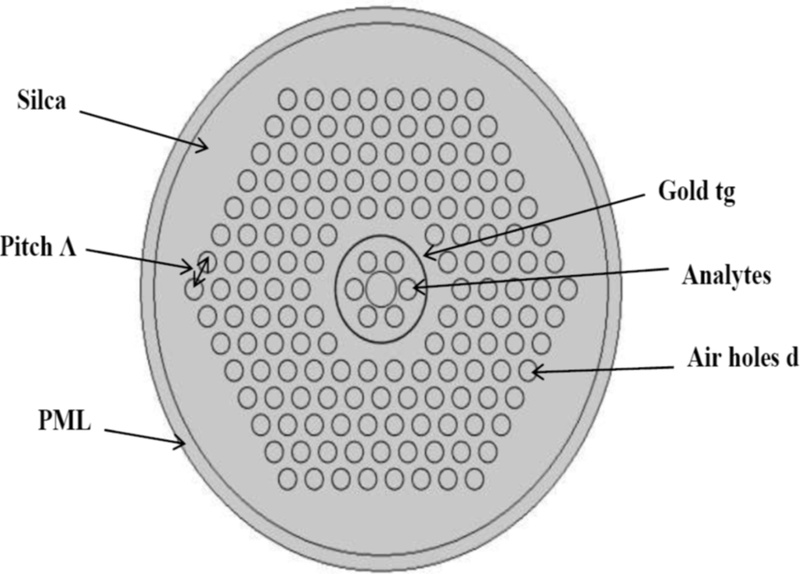
Cross-sectional schematic of the proposed PCF-SPR biosensor
3. SENSING PRINCIPLE AND OPERATING MECHANISM
In a PCF-SPR biosensor, the sensing mechanism is governed by coupling between the guided core mode and a surface plasmon polariton (SPP) mode supported at the metal-dielectric interface [1,2,4]. When the propagation constants of the two modes become comparable, phase matching occurs and strong energy transfer takes place, resulting in a sharp increase in attenuation (confinement loss) at the resonance wavelength [4,6,7]. This phenomenon is central to wavelength-interrogation SPR sensing and is well established in plasmonic sensing theory [1-3].
The complex effective refractive index of a mode can be written as:
| (1) |
where nr and ni are the real and imaginary parts, respectively [4,7]. The confinement loss (in dB/cm) is calculated from the imaginary part of the effective index as:
| (2) |
where λ is the operating wavelength in μm. This relation is commonly used in FEM-based PCF sensor modeling to convert modal attenuation into loss spectra [4,7,8].
Material dispersion of silica is considered using standard wavelength-dependent refractive-index data (often represented in Sellmeier form) because the phase-matching condition is dispersion-sensitive across the near-infrared band [14]. The gold layer is modeled using established optical constants for noble metals, which determine the metal permittivity and the SPP dispersion at the interface [15].
For wavelength interrogation, the wavelength sensitivity is defined as:
| (3) |
where ∂α(λ,na) is the resonance-wavelength shift due to a change ∂na in the surrounding medium [7,8]. In this study, a polynomial calibration is adopted to relate the resonance wavelength to the surrounding-medium variation within the investigated biosensing window, facilitating practical sensor readout.
The numerical analysis is performed using the finite element method (FEM) with perfectly matched layers (PML) to absorb outgoing radiation and suppress spurious reflections at the computational boundary. PML-based truncation is a standard approach for open electromagnetic problems and is essential for reliable confinement-loss estimation [16-18]. To ensure numerical stability, the mesh is refined near the metal–dielectric interface where the plasmonic field is strongly localized. In addition, the dispersion properties of silica and the optical constants of gold are modeled using wavelength-dependent data reported in the literature.
4. RESULTS AND DISCUSSIONS
Fig. 2 shows the modal field distributions of the proposed PCF structure. In this work, the y-polarized (vertical) fundamental mode is considered in the numerical simulations. Due to the structural symmetry of the PCF, the orthogonal polarization modes exhibit nearly identical modal characteristics. In Fig. 2(c), the guided core mode remains strongly confined within the central core, showing negligible field penetration toward the gold-coated boundary. In Fig. 2(a), the field associated with the plasmonic region appears mainly around the metal–dielectric interface with a ring-like pattern, yet it does not exhibit effective coupling with the core mode. In both cases, the interaction between the guided and plasmonic modes is weak because the phase-matching condition is not satisfied.

Electric field norm distributions of the proposed PCF-SPR biosensor at off-resonance and resonance wavelengths for different guided and plasmonic mode.
Fig. 2(b) and 2(d) show the field distributions at the resonance condition, where the phase-matching requirement is satisfied and strong mode coupling occurs. In Fig. 2(d), the guided energy is no longer confined to the core; instead, part of the optical field is transferred toward the gold-coated boundary, indicating effective energy exchange between the core mode and the plasmonic mode. In Fig. 2(b), the field becomes highly concentrated along the metal–dielectric interface, which is a clear signature of surface plasmon resonance excitation. Together, these two patterns confirm the resonance coupling mechanism and account for the pronounced peak observed in the confinement-loss spectrum at the resonance wavelength.
Overall, the field distributions clearly illustrate the transition from weak coupling at off-resonant wavelengths to strong mode coupling under resonance conditions. The evident energy transfer between the core-guided mode and the surface plasmon polariton mode further substantiates the sensing mechanism of the proposed PCF-SPR biosensor.
Fig. 3 shows the wavelength-dependent variation of the effective refractive indices of the guided core mode and the surface plasmon polariton (SPP) mode, along with the corresponding confinement loss spectrum of the proposed PCF-SPR biosensor. As the wavelength increases, the effective refractive indices of both modes decrease monotonically; however, they intersect at a specific wavelength, indicating the phase-matching condition.

Effective refractive index variation of the core and SPP modes and corresponding confinement loss spectrum of the proposed PCF-SPR biosensor as a function of wavelength
At the phase-matching wavelength of approximately 1.4 µm, the real parts of the effective refractive indices of the core mode and the SPP mode become equal. This condition enables strong mode coupling between the guided optical mode and the plasmonic mode, which is reflected a pronounced peak in the confinement loss spectrum. The sharp loss peak confirms the excitation of surface plasmon resonance and represents the optimal operating point of the sensor.
The field maps in Fig. 2 provide a direct interpretation for the trends observed in Fig. 3. Fig. 2(a) and 2(d) correspond to off-resonance wavelengths, where the optical field remains confined within the core and the plasmonic field stays near the gold interface with negligible energy exchange. In contrast, Fig. 2(b) and 2(c) represent the resonance condition at the phase-matching wavelength, where the field is redistributed between the core and the metal–dielectric boundary. This coupling confirms the excitation of surface plasmon resonance and accounts for the pronounced peak in the confinement-loss spectrum.
Fig. 4 compares the confinement-loss spectra of the proposed PCF-SPR biosensor for three gold thicknesses (tg = 60, 70, and 80 nm). In all cases, a distinct resonance peak is observed due to SPR excitation when the core-guided mode satisfies the phase-matching condition with the SPP mode at the metal–dielectric interface.

Confinement loss spectra for different gold-layer thicknesses (tg = 60, 70, and 80 nm)
The peak amplitude decreases as tg increases. The tg = 60 nm case shows the largest loss peak, indicating stronger coupling, whereas thicker gold layers (70 and 80 nm) reduce the peak because higher metal damping and weaker evanescent-field penetration limit plasmon excitation. The resonance wavelength shifts from approximately 1.40 μm to 1.50 μm as the gold thickness increases from 60 nm to 80 nm. It is confirming that the gold thickness significantly influences the phase-matching condition. These trends are consistent with the effective-index crossing and the field maps near resonance. Energy is drawn toward the gold interface, while off-resonance the field remains mainly confined in the core, leading to lower loss. In this study, the gold thickness is investigated within the range of 60–80 nm using a parametric sweep approach in which one parameter is varied while the remaining parameters are kept constant. The obtained results indicate that this thickness interval provides suitable conditions for effective plasmonic coupling between the guided core mode and the surface plasmon polariton mode. This approach is widely used in photonic crystal fiber optimization studies because it allows the physical influence of each structural parameter on the plasmonic coupling behavior to be clearly interpreted.
Fig. 5 presents the confinement-loss spectra for three values of the structural parameter d (1.0, 0.9, and 0.8). In all cases, a distinct resonance peak is observed a resonance peak associated with SPR at the metal–dielectric interface. Variations in d influence both the peak level and its spectral position. The d = 1.0 design produces the largest loss peak, indicating stronger coupling. Reducing d to 0.9 and 0.8 decreases the peak intensity, in which cases, weaker interaction between the guided field and the plasmonic layer. A shift in the resonance wavelength is also observed as d decreases. It is confirming that this parameter alters the phase matching condition. These trends indicate that d can be used to tune the resonance characteristics and, consequently, the sensing response.
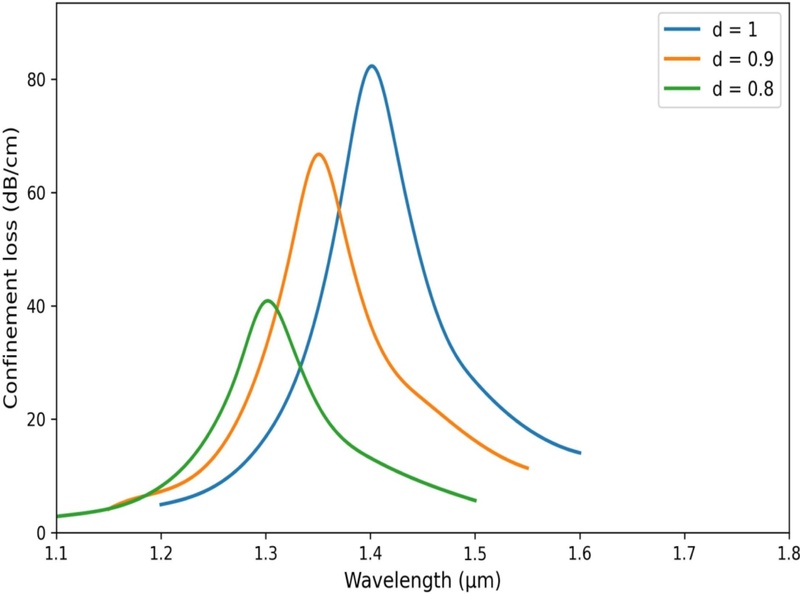
Confinement loss spectra for three values of the selected geometric parameter d (1.0, 0.9, and 0.8 in the study range)
Fig. 6 presents the confinement loss spectra for three lattice pitches, Λ = 1.5, 1.6, and 1.7 µm. In all cases, a distinct resonance peak is observed due to SPR excitation when the guided core mode satisfies the phase matching condition with the SPP mode at the metal–dielectric interface. Changing Λ alters both the peak amplitude and its spectral position. This behavior arises because the pitch modifies the modal distribution and the effective index of the guided mode, which shifts the phase-matching point and changes the coupling strength. Therefore, Λ serves as an effective design parameter for tuning the resonance response controlling the operating wavelength of the sensor.
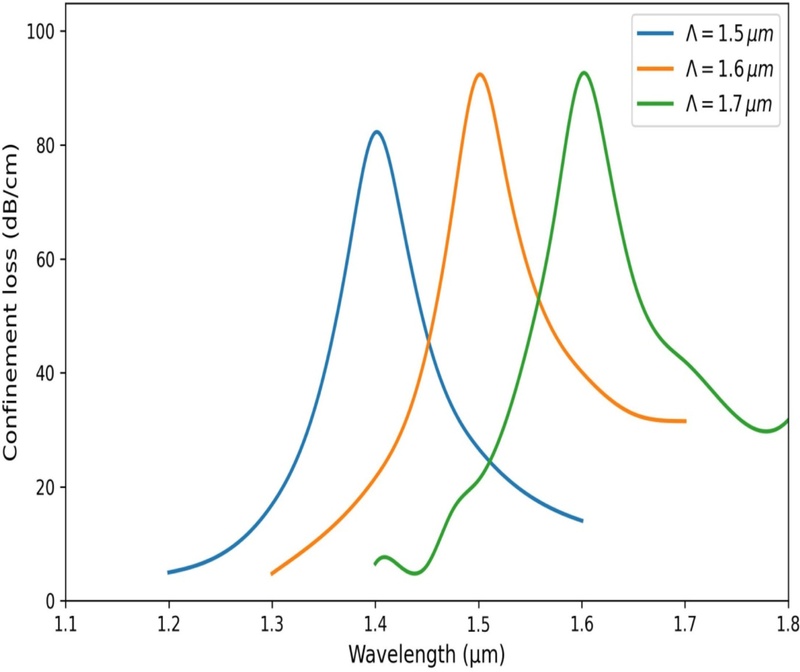
Confinement loss versus wavelength for three pitch values (Λ = 1.5, 1.6, and 1.7 μm).
Fig. 7 shows the confinement loss spectra for several analyte conditions, with each curve corresponding to a distinct refractive index. In all spectra, a resonance peak is observed, indicating SPR excitation at the metal–dielectric interface due to coupling between the guided mode and the plasmonic mode. As the analyte condition increases, the resonance wavelength shifts in a consistent manner, reflecting a change in the phase-matching condition. Variations in the peak amplitude and linewidth are also observed, indicating that the coupling strength and the field overlap at the metal–dielectric interface are affected. This systematic resonance shift provides the basis for estimating the sensor sensitivity from the resonance-wavelength displacement.
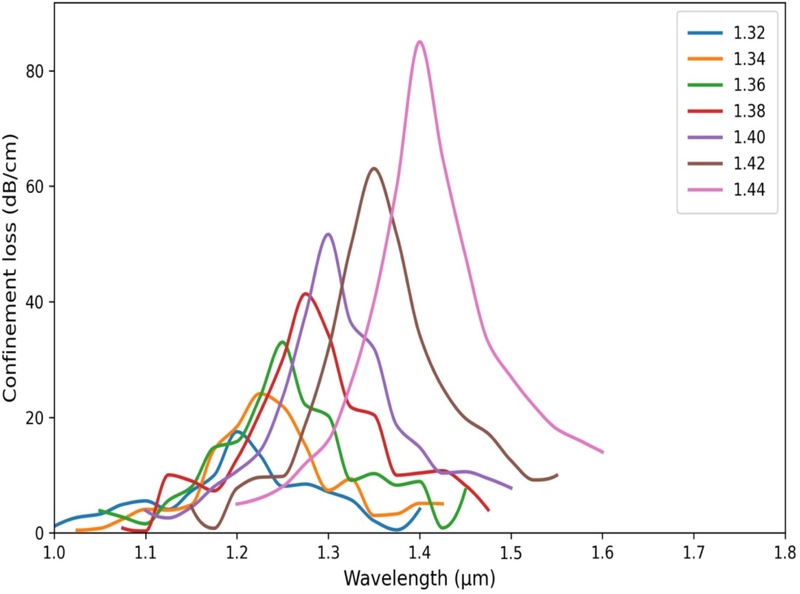
Confinement loss spectra for different analyte refractive index as a function of wavelength
Fig. 8 illustrates the variation of the resonance wavelength as a function of the analyte refractive index over the range of 1.32–1.45. In this study, the analyte is modeled as a bulk refractive-index medium, which is commonly used to represent biochemical sensing environments where small refractive-index variations occur due to biomolecular interactions near the sensing surface. The black markers denote the extracted resonance wavelengths corresponding to each refractive index value. The solid curve represents the polynomial fitting used to describe the overall trend. A clear nonlinear increase in the resonance wavelength is observed with increasing refractive index. It is indicating that changes in the surrounding medium significantly affect the phase matching condition between the guided core mode and the surface plasmon polariton mode. Accordingly, the fitted curve provides a practical calibration relationship that can be used to estimate unknown refractive-index values from measured resonance-wavelength shifts and to evaluate the sensing performance across the investigated range. This polynomial fitting serves as an empirical model describing the nonlinear relationship between the resonance wavelength and the analyte refractive index derived from the simulation results.
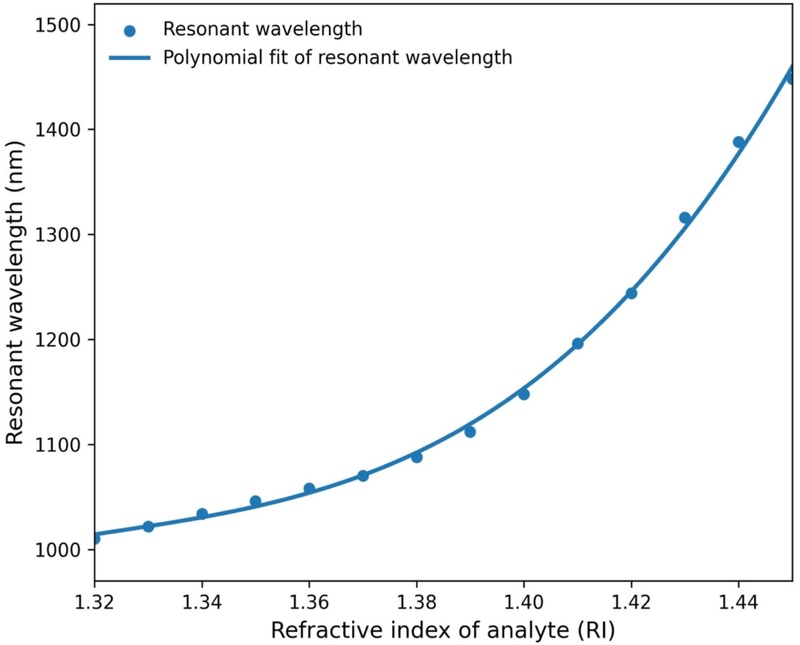
Resonant wavelength as a function of the analyte refractive index
The fitted polynomial equation is given by
where λres is the resonance wavelength (nm) and n is the analyte refractive index.
The curves depict the spectral sensitivity calculated from the resonance-wavelength shift with respect to variations in the analyte refractive index across the investigated wavelength range.
Fig. 9 shows the wavelength-dependent sensitivity of the proposed PCF-SPR biosensor for several analyte refractive-index values. The sensitivity is evaluated based on the resonance-wavelength displacement caused by refractive-index variations and is obtained according to Eq. 3. Accordingly, higher absolute sensitivity values indicate that variations in the surrounding refractive index produce larger shifts in the resonance wavelength.
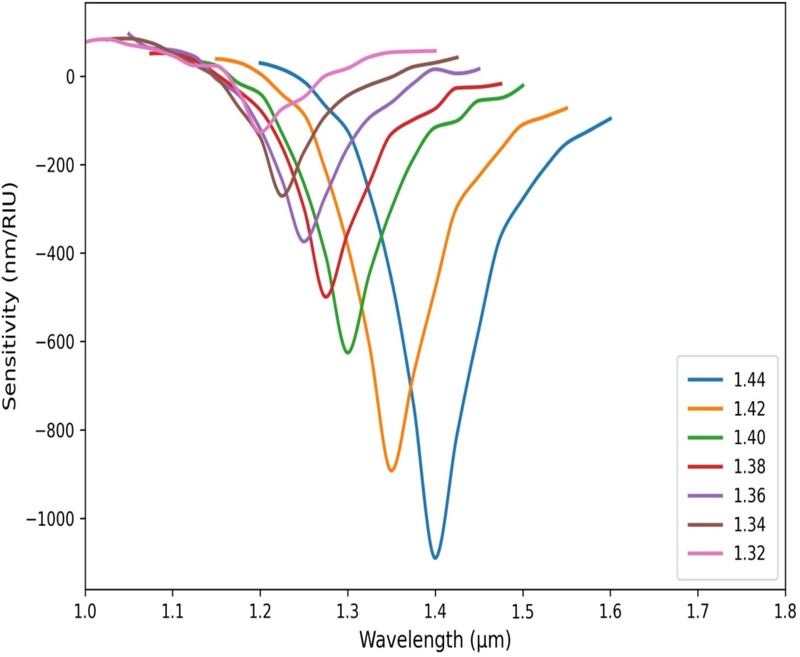
Spectral sensitivity versus wavelength for different analyte conditions
This behavior is consistent with the sensing mechanism governed by the phase-matching (mode-coupling) condition between the guided core mode and the surface plasmon polariton mode, typically expressed as
When the analyte refractive index changes, the effective index of the plasmonic mode is perturbed, which shifts the phase-matching point and consequently a displacement of λres. Therefore, the peaks and variations in the sensitivity spectra correspond to spectral regions where the phase-matching condition becomes highly responsive to refractive-index perturbations, leading to enhanced resonance-wavelength shifts. This confirms that tracking λres provides a reliable basis for quantitative refractive-index sensing within the studied range.
Although the sensitivity reaches higher values near specific resonance conditions, the sensor exhibits a consistent response across the investigated refractive-index range. Therefore, the sensing performance can be evaluated not only by the peak sensitivity but also by considering the overall response of the sensor within the entire analyte refractive-index interval.
Table 1 Comparison of the proposed sensor with reported PCF-SPR sensors in the literature, including classical PCF-SPR configurations [6-8] and recent coupled-core or multi-channel implementations [11,12]. The proposed design achieves a peak wavelength sensitivity of 30600 nm/RIU over the refractive-index range 1.33–1.41, which is suitable for many aqueous and biochemical sensing scenarios. Ref. 6 reports a high peak sensitivity but within a relatively narrow RI interval (1.33–1.34), whereas the proposed sensor maintains a strong response over a wider operating window. Refs. 11 and 12 show that multi-channel and coupled-core geometries can enhance plasmonic coupling; within this context, the proposed multi-core structure provides a competitive peak sensitivity together with a practical sensing range.

Comparison of the proposed sensor with reported PCF–SPR sensors
The reported resolution of 3.27 × 10⁻⁶ RIU in this work is lower than the values reported in the resolution values listed for Refs. [7], [8], and [12], indicating an improved capability to discriminate refractive-index variations. Amplitude-sensitivity and FOM values are included only where they are explicitly provided in the corresponding studies, since these metrics depend on resonance linewidth and depth and may vary with the adopted interrogation definition. Overall, this comparison demonstrates that the proposed design achieves a well-balanced performance in terms of peak wavelength sensitivity, operational refractive-index range, and resolution within the PCF-SPR sensing framework.
5. CONCLUSIONS
In this study, a gold-coated PCF-SPR biosensor was numerically analyzed. The sensor response is governed by phase matching between the guided core mode and the SPP mode, with resonance occurring near the effective-index crossing. The field maps confirm this mechanism by showing energy localization at the gold interface under resonance conditions.
The confinement loss spectrum exhibits a well defined resonance peak. It shifts consistently with changes in the analyte refractive index. It is enabling wavelength interrogation sensing. Based on the extracted resonance wavelengths, the achieved wavelength sensitivity ranges from about 1200 to 7200 nm/RIU with an average of approximately 3.37 × 10³ nm/RIU. A polynomial calibration relating the resonance wavelength to the analyte refractive index is also provided for practical sensing applications. Parametric results show that gold thickness and pitch significantly influence peak magnitude, spectral position, and linewidth, indicating that these parameters can be used to control coupling strength and optimize operation. Future work will focus on improving coating strategies for enhanced chemical stability and on experimental validation while considering fabrication tolerances.
Acknowledgments
The authors would like to acknowledge the University of Kerbala, College of Engineering, for its academic support.
REFERENCES
-
S.A. Maier, Plasmonics: Fundamentals and Applications, Springer, New York, 2007.
[https://doi.org/10.1007/0-387-37825-1]

-
H. Raether, Surface plasmons on gratings, in: H. Raether (Ed.), Surface plasmons on smooth and rough surfaces and on gratings, Springer Berlin, Heidelberg, 2006, pp. 91–116.
[https://doi.org/10.1007/BFb0048323]
-
C. Caucheteur, T. Guo, J. Albert, Review of plasmonic fiber optic biochemical sensors: improving the limit of detection, Anal. Bioanal. Chem. 407 (2015) 3883–3897.
[https://doi.org/10.1007/s00216-014-8411-6]
-
A. Hassani, M. Skorobogatiy, Design criteria for microstructured-optical-fiber-based surface-plasmon-resonance sensors, J. Opt. Soc. Am. B 24 (2007) 1423–1429.
[https://doi.org/10.1364/JOSAB.24.001423]
-
X. Yu, Y. Zhang, S. Pan, P. Shum, M. Yan, Y. Leviatan, et al., A selectively coated photonic crystal fiber based surface plasmon resonance sensor, J. Opt. 12 (2010) 015005.
[https://doi.org/10.1088/2040-8978/12/1/015005]
-
T. Wu, Y. Shao, Y. Wang, S. Cao, W. Cao, F. Zhang, et al., Surface plasmon resonance biosensor based on gold-coated side-polished hexagonal structure photonic crystal fiber, Opt. Express 25 (2017) 20313–20322.
[https://doi.org/10.1364/OE.25.020313]
-
M.R. Hasan, S. Akter, A.A. Rifat, S. Rana, S. Ali, A highly sensitive gold-coated photonic crystal fiber biosensor based on surface plasmon resonance, Photonics 4 (2017) 18.
[https://doi.org/10.3390/photonics4010018]
-
A. Rifat, G.A. Mahdiraji, Y. Sua, Y. Shee, R. Ahmed, D.M. Chow, et al., Surface plasmon resonance photonic crystal fiber biosensor: a practical sensing approach, IEEE Photonics Technol. Lett. 27 (2015) 1628–1631.
[https://doi.org/10.1109/LPT.2015.2432812]
-
A. Candiani, S. Giannetti, A. Bertucci, R.M. Naife, H. Al-Janabi, M. Konstantaki, et al., PNA-modified photonic crystal fibers for DNA detection, Proceedings of the 2013 Conference on Lasers and Electro-Optics - International Quantum Electronics Conference, Munich, Germany, 2013.
[https://doi.org/10.1109/CLEOE-IQEC.2013.6801518]
-
R.M. Naife, A.K. Abbas, Biosensor Based on Photonic Crystal Fibre with Mode Coupling of a Dual-Core, Proceedings of IOP Conf. Ser. Mater. Sci. Eng. 1067 (2021) 012139.
[https://doi.org/10.1088/1757-899X/1067/1/012139]
-
M.S. Hasan, M.A.E. Kalam, M. Faisal, PCF based four-channel SPR biosensor with wide sensing range, IEEE Trans. Nanobioscience 23 (2023) 233–241.
[https://doi.org/10.1109/TNB.2023.3311611]
-
M.R. Sardar, M. Faisal, Numerical analysis of highly sensitive twin-core, gold-coated, D-shaped photonic crystal fiber based on surface plasmon resonance sensor, Sensors 23 (2023) 5029.
[https://doi.org/10.3390/s23115029]
-
G. Opoku, I. Danlard, A. Dede, E.K. Akowuah, Design and numerical analysis of a circular SPR based PCF biosensor for aqueous environments, Results Opt. 12 (2023) 100432.
[https://doi.org/10.1016/j.rio.2023.100432]
-
R. Kitamura, L. Pilon, M. Jonasz, Optical constants of silica glass from extreme ultraviolet to far infrared at near room temperature, Appl. Opt. 46 (2007) 8118–8133.
[https://doi.org/10.1364/AO.46.008118]
-
R.L. Olmon, B. Slovick, T.W. Johnson, D. Shelton, S.-H. Oh, G.D. Boreman, et al., Optical dielectric function of gold, Phys. Rev. B 86 (2012) 235147.
[https://doi.org/10.1103/PhysRevB.86.235147]
-
A. Giannopoulos, Higher-order convolution PML (CPML) for FDTD electromagnetic modeling, IEEE Trans. Antennas Propag. 68 (2020) 6226–6231.
[https://doi.org/10.1109/TAP.2020.2985169]
- Ö. Özgün, M. Kuzuoğlu, MATLAB-based finite element programming in electromagnetic modeling, in: A. Lazinica (Ed.), MATLAB for Engineers – Applications in Control, Electrical Engineering, IT and Robotics, InTech, Rijeka, 2011, pp. 1–20.
- J.R. Cardoso, Electromagnetics Through the Finite Element Method: From Maxwell’s Equations to Code, CRC Press, Boca Raton, 2018.