
In memoriam: Jong-Heun Lee – A Tribute to His Contributions to the Advancement of Metal Oxide Semiconductor Gas Sensors
 ; Young Kook Moon2, +
; Young-Moo Jo3, +
; Seong-Yong Jeong4, +
; Ji-Wook Yoon5, +
; Chan Woong Na6, +
; Ho Won Jang7, +
; Hyung-Gi Byun8, +
; Young Kook Moon2, +
; Young-Moo Jo3, +
; Seong-Yong Jeong4, +
; Ji-Wook Yoon5, +
; Chan Woong Na6, +
; Ho Won Jang7, +
; Hyung-Gi Byun8, +
ⓒ The Korean Sensors Society
This is an Open Access article distributed under the terms of the Creative Commons Attribution Non-Commercial License (https://creativecommons.org/licenses/by-nc/3.0/) which permits unrestricted non-commercial use, distribution, and reproduction in any medium, provided the original work is properly cited.
Abstract
Professor Jong-Heun Lee (1965–2022) was a visionary scientist whose pioneering work laid the foundation for modern metal oxide semiconductor (MOS) gas sensors. Through decades of research, he transformed persistent limitations in the field—such as low selectivity, humidity interference, and high operating temperatures—into opportunities for innovation and discovery. As a Distinguished Professor at Korea University, he led groundbreaking investigations into nanostructure design, surface decoration, p-type oxide semiconductors, bilayer architectures, and humidity-independent sensing. His work consistently bridged the gap between fundamental understanding and practical application, influencing environmental monitoring, healthcare diagnostics, and beyond. This memorial article is a collective tribute from his students and colleagues, each reflecting on a significant theme in his research and mentorship. Through these contributions, we honor his scientific legacy, enduring mentorship, and unwavering belief that significant challenges are the starting point for great ideas. Professor Lee’s contributions continue to shape the field and inspire the next generation of materials scientists and sensor researchers.
Keywords:
Jong-Heun Lee, Gas sensors, Metal oxide semiconductors, Nanostructures, Surface decoration, P-type semiconductors, Humidity-independent sensing, Bilayer sensor architectures, Room-temperature gas sensingJong-Heun Lee 1965–2022
Contributed by Ho Won Jang
It is with deep sorrow and profound respect that we remember Professor Jong-Heun Lee (1965–2022), a towering figure in gas sensor research and a beloved mentor whose vision, creativity, and dedication left an enduring impact on the global scientific community. As a Distinguished Professor at Korea University, Professor Lee dedicated his career to advancing the frontiers of chemical gas sensing, with a particular focus on metal oxide semiconductor (MOS)-based technologies. His passing in early 2022 was a tremendous loss to his family, students, colleagues, and the wider materials and sensing community that he inspired and led with wisdom and generosity.
Professor Lee was a pioneer in the science and engineering of gas sensors, and his work laid the foundation for substantial progress in MOS-based chemical sensing over the past few decades. With an unwavering commitment to fundamental understanding and practical innovation, he tackled some of the most persistent challenges in the field—such as selectivity, long-term stability, humidity interference, and low-temperature operation—and transformed them into opportunities for discovery. His research was characterized by scientific depth, technical elegance, and, above all, relevance to real-world applications in environmental monitoring, healthcare, and safety.
This memorial compilation is a heartfelt tribute to the scientific legacy of Professor Lee, as told through the themes that defined his career and inspired generations of researchers. Each chapter reflects a cornerstone of his groundbreaking work: from the strategic design of nanostructures, which became the foundation of high-performance sensing platforms, to surface decoration strategies that not only enhanced sensor responses but also elucidated the underlying mechanisms of gas adsorption and interaction. His innovative approach to p-type MOS redefined their potential for sensing applications, transforming materials once considered less favorable into powerful, reliable components. Likewise, his development of humidity-independent MOS gas sensors addressed a long-standing challenge in the field, turning what was widely regarded as an insurmountable limitation into a remarkable achievement.
Professor Lee also introduced elegant and generalizable concepts, such as bilayer architectures, which provided a versatile means of tailoring sensor responses, and he was a strong advocate for room-temperature gas sensing, a goal that holds the promise of ultra-low-power, always-on sensing systems for the future. These contributions reflect not only his technical brilliance but also his forward-thinking mindset and his ability to inspire others to think beyond conventional boundaries.
The chapters that follow are contributed by his Ph.D. students, who were trained under his guidance and who carry forward his scientific legacy, as well as by Professor Ho Won Jang, a former mentee of Professor Lee, and Professor Hyung-Gi Byun, a longstanding and very close colleague. Together, they offer this collection as a tribute to a remarkable scientist, an inspiring mentor, and a cherished collaborator. For his students, Professor Lee was more than a teacher—he was a role model who fostered curiosity, creativity, and scientific integrity. For his colleagues, he was a trusted partner and a source of boundless ideas and encouragement. And for the broader scientific community, he was a leader who helped shape the direction of gas sensor research and inspired others to pursue excellence with purpose and passion.
Though we mourn the loss of a great mentor and friend, we find comfort in the knowledge that his contributions continue to resonate in laboratories and research publications worldwide. His innovative ideas, his rigorous approach to science, and his compassionate guidance live on in the many researchers he trained, the technologies his work helped enable, and the memories he left with all who were fortunate enough to know him. Professor Jong-Heun Lee’s legacy is etched into the very fabric of modern gas sensor research—a non-erasable memory of a scientist who devoted his life to discovery, education, and the betterment of society through science.
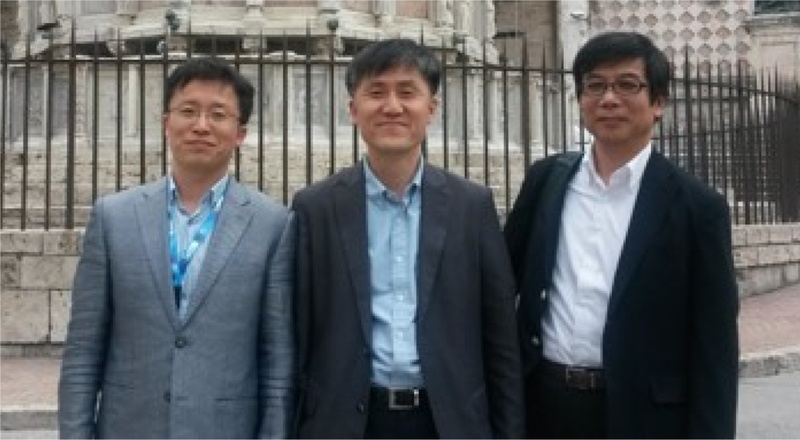
A photo taken at Perugia while attending the CIMTEC 2016 conference. Prof. Ho Won Jang, Prof. Jong-Heun Lee, and Prof. Kengo Shimanoe from the left.
Nanostructures: The Starting Point of a Great Sensor Research Journey
Contributed by Young Kook Moon and Young-Moo Jo
Gas sensors based on semiconducting metal oxides have attracted continuous interest due to their simplicity, low cost, and applicability to environmental monitoring, healthcare, and industrial safety. However, long-standing challenges such as insufficient selectivity, slow response/recovery dynamics, and humidity interference limit their practical deployment. Professor Jong-Heun Lee has played a pioneering role in overcoming these limitations. Through his systematic exploration of nanostructure engineering and catalytic/electronic surface modulation, he not only addressed fundamental bottlenecks but also provided a unifying framework that has guided the rational design of high-performance chemiresistive gas sensors for more than three decades.
One of Professor Jong-Heun Lee’s earliest and most influential contributions lies in the design of hierarchical and hollow oxide architectures, which effectively address the inherent limitations of dense or agglomerated nanoparticles, such as sluggish response kinetics and restricted gas accessibility. His group systematically demonstrated that hollow morphologies, nanoscale porous shells, and hierarchical assemblies can significantly enhance gas sensing performance by maximizing surface reactivity and facilitating rapid analyte diffusion. The landmark review article published by Lee in 2009 established the design principles and synthetic strategies for hollow and hierarchical nanostructures, and this work continues to be regarded as a cornerstone in the field, cited as a blueprint for subsequent generations of researchers [1].

A photo of Prof. Jong-Heun Lee’s former Ph.D. students: Prof. Young-Moo Jo, Dr. Young Kook Moon, Dr. Chan Woong Na, Prof. Ji-Wook Yoon, and Prof. Seong-Yong Jeong from left to right.
Representative studies include the fabrication of SnO2 hollow spheres using Ni spheres as sacrificial templates, followed by high-temperature calcination (Fig. 3(a,b)). The resulting NiO-functionalized SnO2 hollow spheres exhibited ultrafast ethanol response (2–5 s) and recovery (4–5 s) speeds (Fig. 3(c)), attributed to accelerated surface reactions promoted by the hollow SnO2 structure with a nanoscale-thick shell, and NiO decoration on the inner walls [2]. In parallel, In2O3 hollow spheres with tunable shell thicknesses (150 vs. 300 nm) revealed that thinner shells facilitated gas diffusion and adsorption, yielding a response of 137.2 toward 100 ppm ethanol, ~3.8 times higher than that of conventional nanopowders [3]. Moreover, Rh-doped In2O3 hollow spheres achieved an extraordinary ethanol response of 4,748 with superior selectivity and a reduced optimal operating temperature, arising from synergistic electronic interactions between Rh and In2O3 hollow spheres [4].
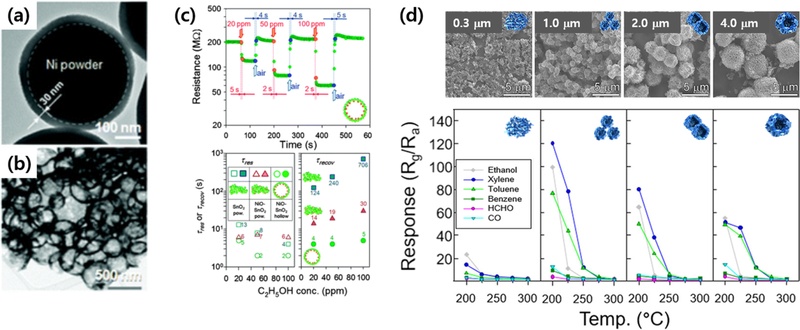
(a) TEM images of SnO2 particles with Ni sacrificial templates, and (b) NiO-functionalized SnO2 hollow sphere, (c) Gas sensing transients and corresponding response (τres) and recovery (τrecov) times of NiO-functionalized SnO2 hollow sphere to 20–100 ppm ethanol at 450°C. Adapted from Ref. [2]. (d) SEM images and gas responses of nearly monodisperse hollow hierarchical Co3O4 nanocages of tunable size (0.3–4.0 μm), synthesized from ZIF-67 rhombic dodecahedra to 5 ppm of ethanol, xylene, toluene, benzene, formaldehyde (HCHO), and carbon monoxide (CO) at 200–300°C. Adapted from Ref. [12].
Additional advances include Pt-doped SnO2 hollow nanospheres, in which the Kirkendall effect drove hollow formation. Pt incorporation dramatically enhanced ethanol sensitivity (response ~1400 to 5 ppm) through catalytic promotion of dissociation and electron depletion [5]. Similarly, Rh-doped SnO2 hollow spheres enabled ultraselective detection of trimethylamine (TMA) down to 5 ppb with negligible interference from common indoor pollutants, highlighting the catalytic role of Rh and the hollow structure of SnO2 in promoting sensitive and selective gas sensing toward TMA [6].
Beyond SnO2 and In2O3, WO3 hollow microspheres synthesized via hydrothermal carbon templating exhibited high sensitivity and selectivity toward sub-ppm NO2, outperforming both solid and nanoporous counterparts due to their enlarged surface area and hollow morphology [7]. Likewise, WO3 hollow spheres prepared by spray pyrolysis showed highly selective TMA detection, facilitated by efficient electron depletion and enhanced analyte accessibility through porous shells [8]. Likewise, hierarchical ZnO nanostructures, synthesized via room-temperature hydrolysis in biphasic systems, displayed ethanol responses up to 177.7 at 100 ppm, 7–9 times higher than those of aggregated nanoparticles, owing to their high surface area, crystallinity, and well-defined morphology [9]. Through these systematic comparative studies, Professor Lee firmly demonstrated that hollow and hierarchical strategies are not material-specific but rather universal design principles applicable across a broad spectrum of metal oxides.
For p-type oxides, hollow hierarchical Co3O4 nanostructures assembled from nanosheets exhibited ultrahigh responses and remarkable selectivity toward methylbenzenes, including toluene and xylene (Fig. 3(d)). Pd functionalization further amplified catalytic activity, while structural control of nanosheet thickness (~11 nm) enhanced charge modulation and oxygen adsorption, thereby maximizing chemiresistive variation [10]. In parallel, Cr-doped NiO hierarchical nanostructures exhibited selective detection of o-xylene and toluene with minimal cross-response to other indoor pollutants. This enhancement was attributed to a reduced hole concentration in NiO and the catalytic oxidation of methyl groups by Cr dopants [11]. In a further advance, nearly monodisperse hollow hierarchical Co3O4 nanocages of tunable size (0.3–4.0 μm) were synthesized using ZIF-67 rhombic dodecahedra as self-sacrificial templates, followed by solvothermal growth and heat treatment. Among these, ~1.0 μm nanocages exhibited outstanding sensing performance toward 5 ppm p-xylene (response = 78.6) and toluene (response = 43.8) at 225°C, coupled with unprecedented selectivity over ethanol interference. The superior performance was attributed to the highly gas-accessible hollow hierarchical morphology featuring thin shells, abundant mesopores, and a large surface area per unit volume, as well as the high intrinsic catalytic activity of Co3O4 [12].
Jong-Heun Lee fabricated a series of microreactor structures with diverse morphologies, which significantly enhanced the catalytic interactions between sensing materials and analyte gases. Representative examples include Pd-SnO2 yolk-shells [13], Pd-Co3O4 multi-shell structures [14], NiO/NiMoO4 hierarchical spheres [15], NiO/NiWO4 yolk-shell spheres [16], Sn-NiO multiroom structures [17], CoCr2O4-Cr2O3 hollow spheres [18], Nb-NiO hollow spheres [19], and Ti-NiO multiroom structures [20]. These microreactor architectures improved gas-sensing performance by increasing analyte retention time within the permeable shell, thereby reforming less reactive species (e.g., methylbenzenes) into more reactive intermediates. This process ultimately enhanced both sensitivity and selectivity. For instance, the Nb-doped NiO hollow spheres showed ultrahigh responses to 5 ppm of p-xylene (resistance ratio = 1752) and toluene (resistance ratio = 607), with negligible cross-responses to interfering gases. In contrast, pure NiO hollow spheres showed negligibly low responses to 5 ppm of all analyte gases.
These microreactor-type structures, as well as hetero-composites/junctions with sensing materials and catalysts, improved gas-sensing performance by prolonging the retention time of analytes within the permeable shells, thereby reforming less reactive species (e.g., methylbenzenes) into more reactive intermediates. This process ultimately enhanced both sensitivity and selectivity. For instance, dense SnO2 exhibited higher responses to ethanol (E) than to methylbenzenes (X, T), whereas Pd-SnO2 yolk-shell structures showed stronger responses to methylbenzenes with minimal cross-sensitivity to ethanol (Fig. 4(a)). Similarly, Pd-Co3O4 multi-shell structures (Fig. 4(b)) displayed higher gas response and selectivity toward methylbenzenes compared with pristine Pd-Co3O4 nanoparticles (Fig. 4(c)). These results suggest that both microreactor architectures and the compositional design of sensing materials are highly effective strategies for detecting low-reactivity gases using metal oxide semiconductor gas sensors.
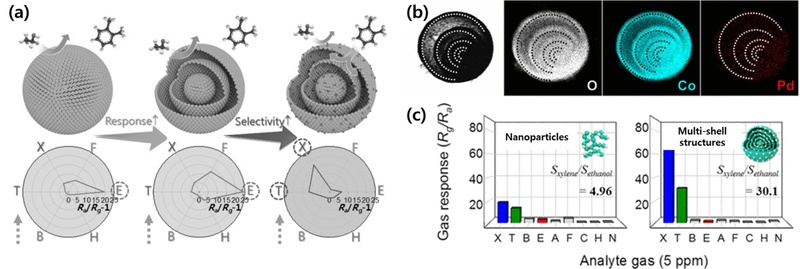
(a) Gas sensing characteristics of dense SnO2, yolk-shell SnO2, and Pd-SnO2 yolk-shell structures toward 5 ppm analyte gases at 250°C. Adapted from Ref. [13]. (b) TEM and EDS mapping images of the Pd-Co3O4 multi-shell structure. (c) Gas responses of Pd-Co3O4 nanoparticles and Pd-Co3O4 multi-shell structures toward 5 ppm analyte gases at 250°C. Analyte gases: xylene (X), toluene (T), benzene (B), ethanol (E), acetone (A), formaldehyde (F), carbon monoxide (C), hydrogen (H), and nitric monoxide (N). Adapted from Ref. [14].
These collective investigations established a strong correlation between shell thickness, porosity, and hierarchical organization, and critical gas-sensing parameters, including response magnitude, kinetics, selectivity, and operating temperature. Lee’s group not only demonstrated diverse synthetic routes—including template-assisted, hydrothermal, solvothermal, and spray pyrolysis methods—but also emphasized the pivotal role of catalytic doping in synergistically enhancing performance. Through these multifaceted contributions, Professor Jong-Heun Lee has profoundly advanced gas-sensor nanotechnology, establishing hollow, hierarchical, yolk-shell, multi-room, and multi-shell oxide nanostructures as essential paradigms for the design of next-generation sensing materials.
Beyond three-dimensional (3D) structured nanomaterials, one-dimensional (1D) nanostructures such as nanowires (NWs), nanofibers (NFs), and their networks provide continuous conduction pathways, high surface-to-volume ratios, and facile integration with microheaters, making them attractive platforms for high-performance gas sensors. Recognizing this unique potential early on, Professor Jong-Heun Lee spearheaded a series of pioneering studies that not only validated the advantages of 1D architectures but also introduced entirely new design concepts that have since become widely adopted in the field.
1D NW structures can be synthesized through several methods. For instance, CuO NWs can be grown by thermal oxidation of Cu foils, and subsequent ultrasonication can separate the CuO NWs from the Cu foil for use as gas-sensing materials. Interestingly, CuO NWs exhibit an unusual dual-mode NO2 sensing behavior: resistance increases below 5 ppm but decreases above 30 ppm, providing a novel algorithm for air quality monitoring [21]. Alternatively, an all-solution process based on refluxing can be employed to form polycrystalline SnO2 NWs. These SnO2 NWs demonstrated morphology-dependent sensitivity: thinner, longer NWs yielded higher responses, while noble-metal doping (Pd, Ag, and Ru) not only enhanced activity but also significantly shortened recovery times [22].
Among these approaches, Prof. Lee showed particular interest in chemical vapor deposition (CVD) methods, selecting them as a strategy for the synthesis of single-crystalline NWs in a uniform and controlled manner. In a typical setup, the metal source and the substrate are placed on opposite sides of a quartz tube inside a furnace. By introducing carrier gases (e.g., an Ar-O2 mixture), the thermally evaporated metal vapors are transported to the substrate and deposited. At this stage, a metallic catalyst on the substrate is required: at high temperature, the liquefied catalyst absorbs metal vapor precursors, and as these precursors become supersaturated, NWs nucleate and grow from the substrate surface. The growth direction of oxide nanowires depends on the material's growth preference. For instance, SnO2 NWs and ZnO NWs can be grown on substrates when Au catalysts are deposited. While ultrathin Au layers may be intentionally deposited to act as catalytic sites, it is noteworthy that Au itself can serve as a sensor electrode. Consequently, nanowire growth can also be directed along the electrode surface without the need for additional Au deposition. SnO2 NWs loaded with a La2O3 overlayer exhibited a ~5.5-fold enhancement in ethanol response (57.3) compared to pristine SnO2 NWs (10.5), while also enabling selective discrimination of ethanol over acetone, which is otherwise difficult due to their similar chemical nature [24]. Furthermore, NW density was tuned using PDMS guide walls, revealing a trade-off between sensitivity and kinetics: high-density networks enhanced sensitivity but reduced response/recovery speeds due to restricted gas diffusion [25].
Large-area SnO2 NW networks integrated on Al2O3 substrates with microheaters demonstrated exceptional performance, including a gas response of ~1909 toward 5 ppm NO2 at 141°C and ~300 toward 100 ppm ethanol at 240–296°C, showcasing a scalable fabrication strategy [26].
The ZnO-SnO2 core-shell NWs were synthesized by a continuous two-step vapor growth method at different synthesis temperatures (Fig. 5(a,b)). ZnO-SnO2 core-shell NWs exhibited a ~33-fold enhanced response to 10 ppm NO2 at 200°C compared with bare ZnO NWs (Fig. 5(c)). The core-shell configuration also enabled selective detection of NO2 at 200–300°C and ethanol at 400°C, owing to charge transfer across the epitaxial SnO2 shell [27]. This demonstrated Jong-Heun Lee’s forward-looking vision of heterostructure engineering in 1D systems, years before the concept became a mainstream strategy in oxide sensor research, as further elaborated in the following section.
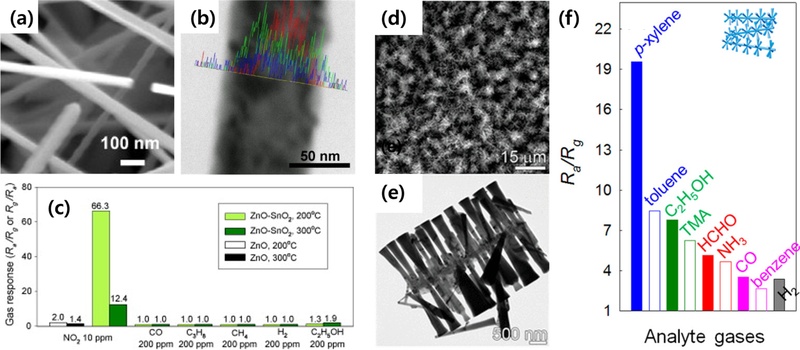
(a,b) SEM and TEM images of ZnO-SnO2 core-shell nanowires (NWs) synthesized by a vapor-growth method. (c) Gas responses of pristine ZnO NWs and ZnO-SnO2 core-shell NWs toward NO2, CO, C3H8, CH4, H2, and C2H5OH at 200 and 300°C. Adapted from Ref. [27]. (d,e) SEM and TEM images of Co-doped branched ZnO. (f) Gas responses of Co-doped branched ZnO toward xylene, toluene, C2H5OH, trimethylamine (TMA), HCHO, NH3, CO, benzene, and H2 at 400°C. Adapted from Ref. [30].
In addition, Jong-Heun Lee explored innovative doping strategies in 1D NWs to further enhance their sensing capabilities. Because the VLS mechanism dictates nanowire growth as a function of the metal precursor composition, direct tuning of precursor composition imposes limitations on the controlled growth of nanowires. Consequently, the development of creative, unconventional approaches has been essential to achieving effective doping in these systems.
For instance, the successive ionic layer adsorption and reaction (SILAR) method has been employed to fabricate Mo-doped ZnO nanowire (NW) networks. In this process, as-grown ZnO NW network substrates are successively immersed in Mo and S precursor solutions to form a MoS2 coating, followed by thermal oxidation to produce Mo-doped ZnO. Mo-doped ZnO NW networks exhibited highly selective H2S sensing (response = 14.1 to 5 ppm at 300°C), with ~8–11 times higher selectivity over other gases, while excessive MoS2 coating led to the formation of MoO3-loaded ZnO NWs, which exhibited poor sensing performance [28].
For Mg doping, different approaches have been developed; MgO particles were deposited on Au electrodes prior to ZnO growth, such that the MgO-mediated growth of ZnO yielded Mg-doped ZnO. Interestingly, the pre-deposited MgO particles induced the formation of urchin-like NW structures. These urchin-like Mg-doped ZnO NW networks showed unprecedented responses of 343 to 5 ppm ethanol at 350°C and 28.8 even at 0.25 ppm, enabled by Mg-induced carrier modulation and catalytic promotion [29].
Co-doped branched ZnO NWs were synthesized via a two-step transformation process using CVD (Fig. 5(d,e)). Initially, as-prepared ZnO NWs were converted into CoO NWs through a cation exchange reaction induced by thermal evaporation of CoCl2 powder. Subsequent Zn vapor deposition led to the formation of branched structures, as Co in the CoO NWs acted as a catalytic site for ZnO growth, thereby enabling the secondary hierarchical growth of NWs on the surface of the primary NWs. The resulting Co-doped branched ZnO NWs exhibited a high response of 19.6 toward 5 ppm xylene, along with a more than twofold higher selectivity compared to interfering gases (Fig. 5(f)) [30].
Prof. Jong-Heun Lee also focused on another type of 1D structure: nanofibers (NFs). Typically fabricated by electrospinning, NFs are produced by loading a solution containing a polymer and the desired metal salt into a syringe and applying a high voltage of ~10–20 kV across a distance exceeding several tens of cm. Under the strong electric field, a Taylor cone forms at the tip of the syringe, from which the polymer precursor is ejected in the form of fibers. The collected NF precursors on the grounded collector are subsequently calcined to yield metal oxide fibers. Because various metal salts can be employed and large-scale production is feasible, this method enables the fabrication of a wide range of metal oxide 1D NFs. Jong-Heun Lee fabricated NFs with various compositions, which exhibited highly sensitive and selective gas-sensing characteristics, including Pd-doped SnO2 [31], Co3O4 [32,33], ZnO-In2O3 composites [34], Cr2O3 [33], CuO-loaded In2O3 [35], and Fe-doped In2O3 [36]. For instance, Pd-doped SnO2 formed hollow NFs structures exhibited ultrahigh responses of 1020.6 toward 100 ppm ethanol at 330°C [31]. Similarly, ZnO-In2O3 composite NFs showed a high response of 133.9 to 5 ppm trimethylamine, with a response time of only 2 s and a recovery time of 1603 s [34].
The importance of inter-particle connectivity was systematically demonstrated using Co3O4 and Cr2O3 NFs, both of which are p-type oxide semiconductors (Fig. 6(a)). As sonication time increased, inter-particle connectivity progressively decreased, leading to a continuous decline in sensing responses and a corresponding increase in resistance [33].
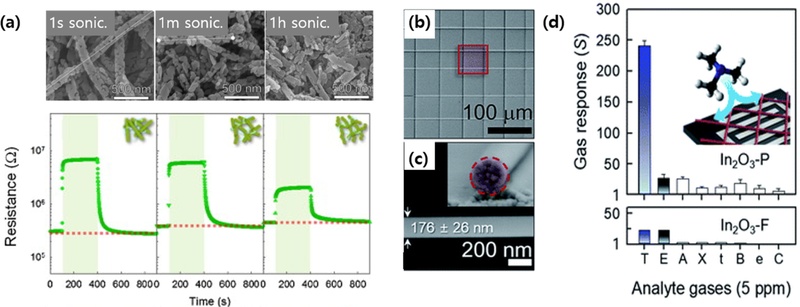
(a) SEM images and gas sensing transients of Cr2O3 nanofibers disintegrated by ultrasonic processing for 1 s, 1 min, and 1 h to 100 ppm C2H5OH at 350°C. Adapted from Ref. [33]. (b) SEM images of Co/PVP grids and (c) corresponding metal oxide patterns consisting of In2O3 nanofibers. (d) Gas responses of In2O3 nanofiber pattern toward trimethylamine (T), C2H5OH (E), NH3 (A), xylene (X), toluene (t), benzene (B), ethylene (e), and CO (C) at 350°C. Adapted from Ref. [37].
Loading and doping can be readily accomplished in NFs. By incorporating catalytic metal salts into the precursor solution, catalysts can be loaded or doped with ease. For example, CuO-loaded In2O3 NFs can detect sub-ppm levels (<0.4 ppm) of H2S at 150°C. The conversion reaction of CuO into CuS upon exposure to H2S, as shown below, markedly enhances H2S selectivity:
| (1) |
Furthermore, the formation of a p-n junction between p-type CuO and n-type In2O3 significantly amplifies the sensing response through electronic sensitization [35]. Fe-doped In2O3 NFs exhibited distinct gas-sensing properties depending on the dopant concentration. By varying the Fe concentration from 0.05 to 0.5 at.%, differentiated response patterns were obtained, and principal component analysis (PCA) enabled clear recognition of xylene, toluene, benzene, ethanol, and formaldehyde gases [36].
In addition, Prof. Lee improved a 1D single-nanofiber patterning technique, known as near-field electrospinning (NFES). This method shares the same fundamental mechanisms as conventional far-field electrospinning, except that it requires an ultra-short distance between the Taylor cone and the substrate. In this process, the probe tip is manipulated using a standard inkjet printer, enabling thin 1D nanofibers to be “written” onto substrates in a controllable, customizable manner (Fig. 6(b,c)). By systematically exploring several experimental parameters—including solution viscosity, solution conductivity, as well as tip-to-substrate distance and tip velocity—Prof. Lee advanced the development of oxide 1D nanofibers that remain continuous and unbroken even after heat treatment.
1D In2O3 NF patterns fabricated via NFES exhibited exceptionally high responses, reaching 239 toward 5 ppm trimethylamine—approximately tenfold higher than that of dense In2O3 films (Fig. 6(d)) [37]. Similarly, CuO/CuFe2O4 NF patterns exhibited bimodal sensing behavior at different operating temperatures. At 200°C, the response to 5 ppm H2S was as high as 800, whereas the response to methyl mercaptan was 100; the selectivity of H2S over methyl mercaptan was 8. However, increasing the temperature to 400°C resulted in a reversal of selectivity, with methyl mercaptan becoming favored (SMM/SH2S = 2.5) [38].
In addition, patterns composed of thin 1D nanofibers feature abundant vacant regions, enabling facile integration onto transparent substrates. For instance, SnO2 NF patterns have been directly written onto transparent glass/ITO substrates, with material activation achieved by light irradiation rather than thermal treatment [39]. This approach further extended their applicability to room-temperature sensors, which will be discussed in detail in the subsequent section.
Professor Jong-Heun Lee’s contributions to 1D nanostructures go far beyond incremental improvements: they provided new paradigms in surface functionalization, heterostructure design, and network-level integration. By introducing these strategies, his group decisively elevated 1D nanostructures from simple model systems to realistic candidates for next-generation portable and miniaturized gas sensors.
Across hollow/porous spheres, hierarchical assemblies, and 1D nanowire networks, Lee’s work consistently translated specific case studies into general rules: (i) thin, permeable structures and films accelerate analyte transport and surface redox; (ii) mesoscale hierarchy reconciles high surface area with fast gas access; (iii) selective catalytic/electronic modulation of charge depletion and reaction routes; and (iv) heterostructures (core-shell, p-n, or catalyst/oxide junctions) enable temperature-programmable selectivity. These rules established material-agnostic design principles that other groups now adopt as defaults rather than exceptions.
Surface Decoration: Enhancing Sensor Performance and Unveiling Underlying Mechanisms
Contributed by Chang Woong Na and Young-Moo Jo
Professor Jong-Heun Lee’s extensive body of work has significantly advanced the field of gas sensor technology, particularly by enhancing the selectivity and sensitivity of sensors based on metal oxide nanostructures. His foundational research began with a seminal paper on La2O3-loaded SnO2 NWs. Through solution doping and subsequent thermal treatment, La2O3 nanoparticles of approximately 100–200 nm were successfully loaded onto the surface of SnO2 NWs. Compared to bare SnO2 NWs, which exhibited a sensitivity of 10.5 to 100 ppm ethanol, the La2O3-loaded structures demonstrated a significantly enhanced response of 57.3. This result highlighted the potential of functionalizing nanostructures for improved performance [24].
A key aspect of his research is the strategic use of catalysts and electronic interactions to fine-tune sensor properties. A key strategy involves loading p-type metal oxide catalysts onto n-type metal oxide nanostructures to create p-n junctions. This approach successfully addresses two critical challenges in gas sensing. First, the catalytic effect of the p-type metal oxides enhances the sensor's selectivity for specific gases, a principle he applied to detect ethanol [24,40-42], hydrogen sulfide [28,35,43-45], trimethylamine [46,47], and methylbenzene [30,48,49].
Second, the formation of nanoscale p-n junctions leads to the expansion of the electron depletion layer within n-type nanowires, located directly under the p-type nanoclusters (Fig. 7(a)). As a result, the sensor's resistance in air (Ra) increases. This enhanced resistance makes the device more responsive to charge injections from the gas-sensing reaction, thereby enabling greater chemiresistive variation.
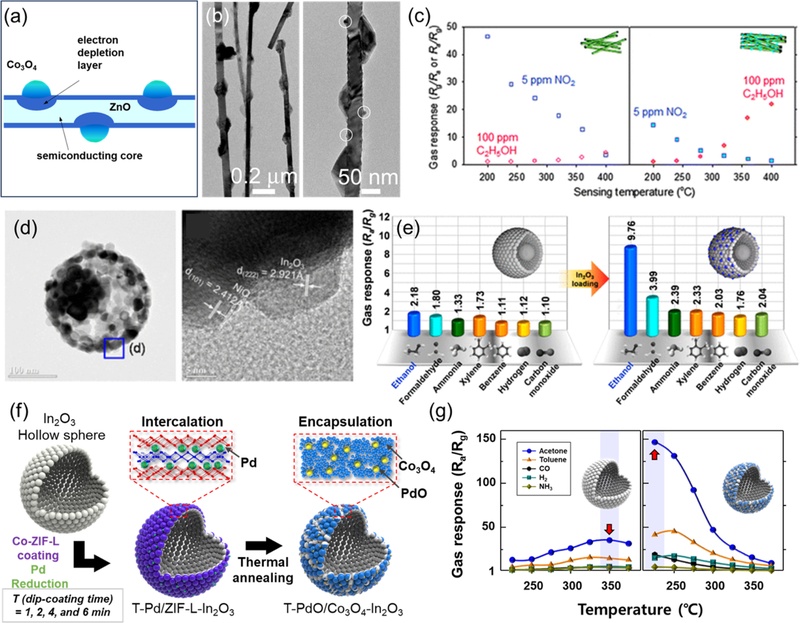
(a) Schematic diagram of the electron depletion layer in n-type oxide semiconductor nanowires decorated with p-type oxide semiconductor nanoclusters; (b) TEM images of Co3O4-decorated ZnO nanowires; (c) Gas responses of pure ZnO and Co3O4-decorated ZnO to 5 ppm of NO2 and 100 ppm of C2H5OH. Adapted from Ref. [40]. (d) TEM images of In2O3-NiO hollow spheres; (e) Gas responses of pure In2O3 and In2O3-NiO hollow spheres to 5 ppm of ethanol, formaldehyde, ammonia, o-xylene, benzene, hydrogen, and carbon monoxide at 350°C. Adapted from Ref. [50]. (f) Preparation schematic of PdO/Co3O4-In2O3 hollow spheres; (g) Gas responses of pure In2O3 and PdO/Co3O4-decorated In2O3 hollow spheres to 5 ppm of acetone, toluene, carbon monoxide (CO), hydrogen (H2), ammonia (NH3) at 225–375°C. Adapted from Ref. [58].
Prof. Lee often explained this p-n heterojunction-based electronic sensitization mechanism through simple yet powerful analogies. For instance, he likened carrier concentration to the amount of money in a wallet: when a gas interacts with a material of high carrier density, the relative change is minor—just as a wealthy person would not be greatly affected by losing a small amount of money. In contrast, for a material with a low carrier density, even a small perturbation induces a pronounced change, much like a person with little money noticing the immediate impact of theft. This analogy effectively illustrated how reduced carrier concentrations within a measurable range can enhance gas-sensing sensitivity.
For example, bare ZnO NWs exhibited higher sensitivity to 5 ppm NO2 than to 100 ppm ethanol across a wide temperature range (200–400°C). However, Co3O4-decorated ZnO NWs showed a reversed trend at higher temperatures, where ethanol sensitivity surpassed that of NO2 (Fig. 7(b,c)) [40]. The decoration of p-type Co3O4 onto the n-type ZnO surface formed p-n junctions, expanding the depletion layer and thereby improving sensitivity. Additionally, the catalytic properties of Co3O4 greatly enhanced the ethanol response. Similarly, when p-type NiO was loaded onto ZnO NWs, the response to 5 ppm ethanol at 450°C was 7.96-fold higher than that of bare ZnO NWs [41]. Furthermore, Mn3O4 was able to grow heteroepitaxially on the ZnO surface, maximizing the effect of the p-n heterojunction [42], and achieved the highest ethanol sensitivity (S ≈ 30) at 400°C for 100 ppm ethanol. Prof. Lee also confirmed that the selectivity of gas responses strongly depends on the type of surface catalyst. While bare SnO2 NWs exhibited maximum sensitivity to 200 ppm ethanol, functionalization with p-type CuO drastically reduced the ethanol response to around 10, while enhancing the response to 20 ppm H2S by 74-fold, achieving an ultrahigh sensitivity of 809 at 400°C [43].
All n-type oxide nanowires (NWs) adorned with p-type oxide semiconductor nanoclusters exhibited typical n-type sensing behavior, with resistance decreasing upon exposure to reducing gases. This outcome demonstrates that the p-type nanoparticles act as catalysts and expand the electron-depleted region around the n-type NWs. Conduction, however, is maintained through the primary n-type NWs. Additionally, the formation of nanoscale p-n junctions and the subsequent expansion of the electron depletion layer were confirmed by a roughly two-order-of-magnitude increase in sensor resistance after p-type clusters were added to the n-type oxides.
Moreover, Prof. Lee’s research confirmed that the p-n heterojunction design strategy can be extended beyond NW architectures to other structures. For instance, when CuO(p)-ZnO(n) composites were synthesized via a one-pot hydrothermal method, highly sensitive H2S sensors were obtained. The introduction of only trace amounts of CuO preserved n-type ZnO sensing behavior, characterized by a reduction in resistance upon H2S exposure. At the same time, p-type CuO formed junctions on the ZnO surface, and in conjunction with the previously described CuO-CuS transformation mechanism, the p-n heterojunction further enhanced sensitivity [44]. Spray pyrolysis was also demonstrated as an effective approach to synthesize spherical particles, enabling the simple fabrication of SnO2 hollow structures [45]. By stirring these SnO2 hollow structures in a Cu nitrate solution and then thermal treating, p-type CuO could be loaded onto the SnO2 surface. Owing to the same mechanisms described above, the H2S response at 300°C under 80% relative humidity was significantly improved, increasing from 3.14 to 22.4. Electrospun CuO-loaded In2O3 nanofibers demonstrated a similar response, achieving an extraordinarily high H2S response of 9200 at room temperature with pulse heating applied to facilitate recovery [35].
In addition to controlling the properties of n-type materials through functionalization with p-type materials, Prof. Lee's work also reported a related mechanism in which loading n-type catalysts onto p-type metal oxides increases the hole-accumulation layer, further enhancing both selectivity and sensitivity [50]. For example, when n-type In2O3 was loaded onto NiO hollow structures (Fig. 7(d)), the hole accumulation layer of p-type NiO was modulated, reducing the hole concentration. As a result, the resistance increased, yet the response to ethanol was enhanced by more than 4.5-fold (Fig. 7(e)). This creative finding demonstrated that the strategy of employing p-n junctions to enhance sensitivity through electronic sensitization can be applied in a highly versatile manner.
Beyond the p-n junction approach, Professor Lee’s research expanded to explore the use of noble-metal catalysts, including Rh [4,6,51], Pt [5,52], Ag [53-55], and Pd [56-58], to achieve exceptionally high gas-sensing performance. In one such study, Prof. Lee employed ZIF-67 as a coating template for bimetallic catalysts. ZIF-67, composed of cobalt, can be converted into Co3O4, and its abundant pores enable the incorporation of Pd metal nanoparticles. The Pd-incorporated ZIF-67 served as a bimetallic Co3O4-PdO catalyst template on the surface of In2O3 hollow spheres (Fig. 7(f)). Here, p-type Co3O4 induced sensitivity enhancement in n-type In2O3 through p-n junction formation, while PdO, acting as a noble metal catalyst, further improved both selectivity and sensitivity, resulting in a remarkably high acetone response of 146.9 at 225°C (Fig. 7(g)) [58].
A hallmark of this research is the use of unique nanostructures, such as hollow spheres and yolk-shell structures, known for their superior permeability and surface area. By ensuring uniform, discrete loading of these noble-metal catalysts, his work consistently produced sensors with world-class gas sensitivity and exceptional stability.
P-Type Metal Oxide Semiconductors: Reframing Limitations as New Opportunities
Contributed by Ji-Wook Yoon
When I first entered this field (2011), the world of MOS gas sensors revolved almost entirely around n-type materials such as SnO2, ZnO, In2O3, and WO3. Their behavior was well established: oxygen adsorption created electron-depletion layers, surface reactions followed, and the result was a pronounced resistance change. N-type MOS were the safe bet and the default choice for sensor design. In contrast, p-type materials like Co3O4, NiO, and Cr2O3 were rarely taken seriously. They were regarded as less sensitive, both from practical experience and from theoretical reports claiming that their gas response scaled only with the square root of that of n-type sensors. As a result, they were never regarded as practical alternatives. In reviews or conferences, they were mentioned as being able to detect certain gases, but always from the sidelines. At that time, very few researchers considered p-type MOS central to the design of reliable sensing devices.
Professor Jong-Heun Lee also focused on improving the performance of n-type materials in his early years of research, emphasizing the importance of highly porous nanostructures for achieving higher gas responses [1]. Yet one unsolved challenge remained: selectivity. At that time, most research focused on detecting gases such as H2, NH3, NO2, H2S, CO, and ethanol, and ethanol was the only volatile organic compound (VOC) for which reliable selectivity had been demonstrated, as evidenced by the early commercialization of alcohol detectors. Thus, achieving selectivity toward other VOCs was widely believed to be impossible. The atmosphere in the lab reflected this reality: whenever a student reported unusual selectivity to a VOC during a group meeting, our first reaction was to assume that the measurement must be wrong.
Under these circumstances, Professor Lee began to think differently, challenging what many of us had accepted without question. After hearing occasional reports in group meetings about the abnormal gas selectivity of Co3O4 and NiO (which, in truth, was not very remarkable), he revisited p-type MOS in earnest. He suggested that their strong oxygen adsorption and catalytic activity might be the source of such unusual selectivity, and therefore the key to unlocking new sensing possibilities. He spoke with conviction, urging us to search for opportunities where others saw only limitations. When we raised the issue of the low sensitivity of p-type MOS for practical use, he replied that there would be a way. For him, what many dismissed as dead ends were always new beginnings. Over my time in his lab, I watched this spirit transform the perception of p-type MOS—from “unsuitable” curiosities into promising platforms for both fundamental study and practical sensing.
The first systematic effort on p-type MOS I witnessed was led by Dr. Kwon-Il Choi, who synthesized various Co3O4 nanostructures to examine how surface area influences gas response [59]. A correlation was observed, though the effect was less pronounced than in n-type MOS, showing us that nanostructures were not a simple shortcut to achieving high gas response in p-type materials. Around the same time, I studied Co3O4 nanofibers prepared at different calcination temperatures (500–700°C) and observed an abrupt drop in gas response in the sample calcined at 700°C [32]. I initially attributed this to the formation of a few abnormally large grains, but Professor Lee suggested another possibility: that high-temperature treatment disrupted particle connectivity. To test this idea, we applied ultrasonic disintegration to nanofibers prepared at 500°C and observed a drastic decrease in gas response (Fig. 8(a)). His suggestion proved exactly right. The sharpness of his reasoning and the way he guided me to verify it through experiment left a deep impression on me, even though these findings did not yet provide a clear path to overcoming the poor reputation of p-type MOS for low sensitivity.
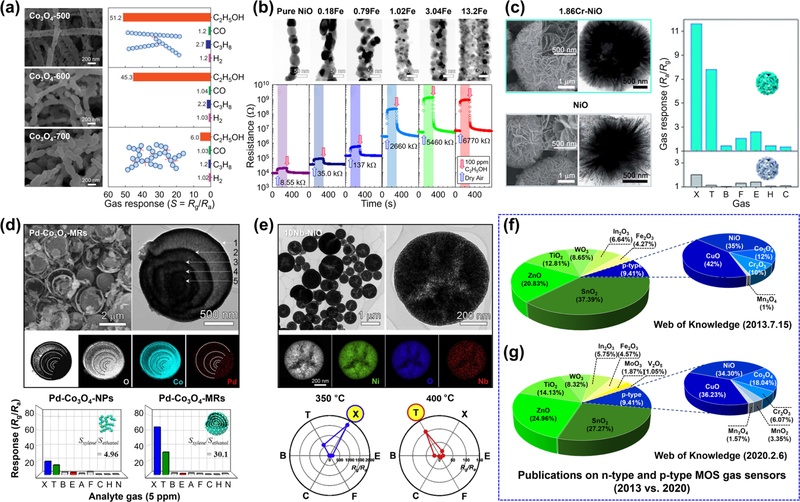
(a) SEM images of Co3O4-500, Co3O4-600, and Co3O4-700 nanofibers and their gas responses to 100 ppm C2H5OH, CO, C3H8, and H2 at 301°C. Adapted from Ref. [32]. (b) Bright field STEM images of pure NiO, 0.18 at.%, 0.79 at.%, 1.02 at.%, 3.04 at.%, and 13.2 at.% Fe-doped NiO nanofibers and their dynamic sensing transients to 100 ppm C2H5OH at 475°C. Adapted from Ref. [60]. (c) SEM and TEM images of pure and Cr-doped NiO hierarchical nanostructures, and their gas responses to 5 ppm o-xylene (X), toluene (T), benzene (B), formaldehyde (F), ethanol (E), hydrogen (H), and carbon monoxide (C) at 400°C. Adapted from Ref. [11]. (d) SEM and TEM images of Pd-Co3O4-MRs, and their gas responses to 5 ppm p-xylene (X), toluene (T), benzene (B), ethanol (E), ammonia (A), formaldehyde (F), carbon monoxide (C), hydrogen (H), and nitrogen monoxide (N) at 250°C. Adapted from Ref. [14]. (e) TEM images and elemental mapping images of 10Nb-NiO, and their gas responses to 5 ppm analyte gases at 350°C and 400°C (E: ethanol, X: p-xylene, T: toluene, B: benzene, C: carbon monoxide, F: formaldehyde). Adapted from Ref. [19]. (f) Studies on n- and p-type MOS gas sensors (internet search of Web of Knowledge on July 15, 2013). (g) Papers of n-type and p-type MOS gas sensors reported in the literature.
With these results, Professor Lee shifted the research strategy. Rather than relying only on morphology tailoring, which had driven many advances in n-type MOS, he turned to the relatively overlooked idea of electronic sensitization. The principle was straightforward: when the baseline carrier concentration is low, removing a fixed number of carriers produces a much larger change in resistance. He suggested that doping with aliovalent impurities could be a promising pathway to control the baseline carrier concentration.
At the time, I was studying NiO nanofibers as a follow-up to the Co3O4 work. Their gas response was extremely low, even after systematic tuning of morphology. Under Professor Lee’s guidance, I explored Fe doping to reduce the hole concentration in NiO and activate electronic sensitization [60]. The results were astonishing. As the Fe doping level increased, the baseline hole concentration decreased, and the gas response increased significantly at the same gas concentrations (Fig. 8(b)). At the optimal level, around 3 at.%, ethanol responses were more than 200 times greater than those of pristine NiO. Later studies confirmed that this strategy could broadly enhance the response of p-type MOS [61]. With this breakthrough, low sensitivity could no longer be regarded as a fundamental obstacle for p-type oxides. I still remember vividly when Professor Lee presented this work at an international conference and later told me, with quiet joy, that he was happy to be recognized by Professor Noriyuki Yamazoe, whom he regarded as a teacher figure.
Once we had shown that the low gas response of p-type MOS could be overcome, Professor Lee returned to the long-standing selectivity challenge. He proposed a bold idea, building on the encouraging results of the electronic sensitization mechanism: to use p-type NiO—a material with inherently low sensitivity but strong catalytic properties—as a platform and to transplant new selectivity by incorporating proper additives. Motivated by his concern for indoor air quality, he urged us to design additives for the selective detection of aromatic hydrocarbons such as benzene, toluene, and xylene (the BTX family). Dr. Hyo-Joong Kim explored Cr as an additive [11], and the resulting Cr-doped NiO showed higher sensitivity to xylene and toluene than to ethanol (Fig. 8(c)). The key was a synergistic catalytic effect between p-type NiO and Cr2O3, both active catalysts for oxidizing xylene and toluene into reactive species through reforming reactions. These reactive species then underwent secondary reactions on the sensor surface, selectively amplifying the response to these gases in concert with the electronic sensitization mechanism.
I still remember how excited Professor Lee was when these results became clear. To our knowledge, it was the first demonstration of selective detection of stable aromatic gases over ethanol. For him, it was not only a technical success but also a validation of his philosophy: by starting with NiO—regarded mainly as a catalyst and dismissed as a sensing material—he proved that what seemed like a limitation could become a new opportunity.
The natural progression of this work took us beyond doping and into the design of entire architectures. Professor Lee emphasized that achieving truly reliable selectivity required controlling not only the material composition but also the interaction of gases with the sensing interface. This drove us to pursue reactor-like structures capable of effectively retaining gases long enough to promote catalytic oxidation. Around that time, Professor Yun Chan Kang, one of his close colleagues, reported the development of yolk-shell structures with multiple shells through ultrasonic spray pyrolysis. We initiated a collaboration that enabled us to explore these effects and advance the development of high-performance xylene sensors. This research combined Pd catalysts—highly active for BTX oxidation—with carefully engineered quintuple-shelled Co3O4 microreactors designed to maximize gas retention time inside the structure [14].
These two strategies, working together, produced sensors with remarkable selectivity toward xylene (Fig. 8(d)). From a mechanistic perspective, xylene and toluene entered the shells, lingered, and were partially reformed into reactive species before reaching the sensing interface, thereby enabling extraordinary sensing performance. The responses to 5 ppm xylene and toluene reached 64.2 and 30.8, respectively, while cross-responses to ethanol and other interferents were negligible. This marked the successful development of ultraselective methylbenzene sensors that outperformed the Cr-NiO system, which had already been considered highly effective. For me, this was a vivid example of how Professor Lee thought—constantly challenging us to move beyond the notion that research was already complete—and it shaped how I approached my work ever after.
My journey with Professor Lee on p-type MOS culminated in our work on developing highly selective toluene sensors [19]. By then, I had grown accustomed to bold ideas. Yet, Professor Lee advanced an even more ambitious hypothesis: if enhanced oxidizing power was the key to detecting chemically stable species, then designing p-type oxides with even greater oxidation strength should enable the selective detection of gases even more stable than xylene, such as toluene. Dr. Tae-Hyung Kim pursued this idea with Nb-doped NiO microreactors (Fig. 8(e)). These sensors showed strong selectivity for methylbenzenes at 350°C over ethanol and, remarkably, selectivity for toluene over both ethanol and xylene at 400°C. This discrimination between xylene and toluene arose from a careful balance: oxidative consumption, which suppressed signals, and reforming reactions, which enhanced them. By tuning the sensing materials and operating temperatures, the system successfully reformed toluene into reactive species while oxidatively consuming ethanol and xylene, creating a brand-new pathway for toluene selectivity.
For me, this series of studies symbolized the culmination of years of persistence, creativity, and the refusal to accept any “limitation” as a final answer. Looking back on this sequence, I see more than technical progress—I see how Professor Jong-Heun Lee reshaped the way we, and eventually the broader community, thought about p-type metal oxide semiconductors. The broader impact is clear: in 2013, only about 9% of MOS gas sensor publications involved p-type oxides (Fig. 8(f)); by 2022, that figure had risen to 12.1% (Fig. 8(g)). I do not wish to overlook the important contributions of other researchers who also pursued p-type materials with great dedication, but I firmly believe that Professor Lee’s review (citation count: 1,902 in Web of Science, September 2025) and his pioneering experimental work provided the intellectual framework and gave researchers the confidence and justification to explore further, ultimately facilitating this expansion.
By transforming p-type oxides from overlooked curiosities into viable platforms for sensitive and selective gas sensors, Professor Jong-Heun Lee embodied his lifelong philosophy: that what seems to be a limitation can, with insight and persistence, be reframed as an opportunity. His legacy lies not only in the specific advances he achieved but also in the way he inspired us to think differently. Thanks to his vision, p-type semiconductors are no longer dismissed as irrelevant; they are now recognized as essential to the future of MOS gas sensing, especially for selective detection of volatile organic compounds in complex environments. This transformation, now evident across the entire field, is deeply rooted in his determination and creativity. I believe Professor Lee is taking pride in this progress, even now, while already looking ahead to the next ‘limitation’ to be reframed as an opportunity.
Humidity-Independent MOS Gas Sensors: Turning the Impossible into the Possible
Contributed by Ji-Wook Yoon
While working on p-type materials, I was struck by a paradox that had quietly persisted in our field for decades: the humidity dependence of MOS gas sensors. In my own experiments, I consistently observed degraded sensing performance whenever humidity was introduced, regardless of whether the sensor was n-type or p-type. Yet, to my surprise, most published studies reported results only under dry conditions, as if gases in the real world existed in isolation. But everyone knew—even I, as a new student—that this could not be the case. Humidity is everywhere: in the air we breathe and in the environment around us. It is both ever-present and highly dynamic, shifting with environmental factors such as season, time, wind, clouds, and rainfall. At 1 atm and 25°C, the water vapor concentration is about 6,280 ppm at 20% relative humidity (RH), but it rises dramatically to nearly 25,700 ppm at 80% RH. Considering that the target gas concentrations we aimed to detect were often only a few ppm—or even sub-ppm levels—these numbers were overwhelming. I frequently asked myself: how could a sensor detect just a few ppm of analyte gases in the presence of tens of thousands of ppm of water vapor? At the time, the obvious answer seemed to be that it was impossible without employing complementary systems such as humidity filters or correction modules.
However, Professor Lee quickly overturned the early and somewhat naive conclusion I had reached as a novice researcher. Just as my concern about the humidity problem was growing, Professor Lee and Dr. Hae-Ryong Kim published the paper “The Role of NiO Doping in Reducing the Impact of Humidity on the Performance of SnO2-Based Gas Sensors: Synthesis Strategies, and Phenomenological and Spectroscopic Studies” in Advanced Functional Materials [62]. As a newcomer to the group, I was unaware of this work before its publication, as it had been carried out by Dr. Kim, the most senior Ph.D. candidate on our team at the time, in collaboration with Professor Udo Weimar and Dr. Nicolae Barsan at the University of Tübingen in Germany. I still vividly remember the excitement when I saw the results: hierarchical SnO2 nanostructures doped with small amounts of NiO exhibited almost identical sensing characteristics in both dry and humid atmospheres (Fig. 9(a)). For the first time, I witnessed that a sensor’s CO response, response-and-recovery speeds, and baseline resistance could remain stable regardless of humidity, without any complementary system. It was a striking departure from what I had believed was inevitable, and one of the first clear demonstrations that the so-called “water-poisoning” effect could, in fact, be overcome through thoughtful and deliberate material design.
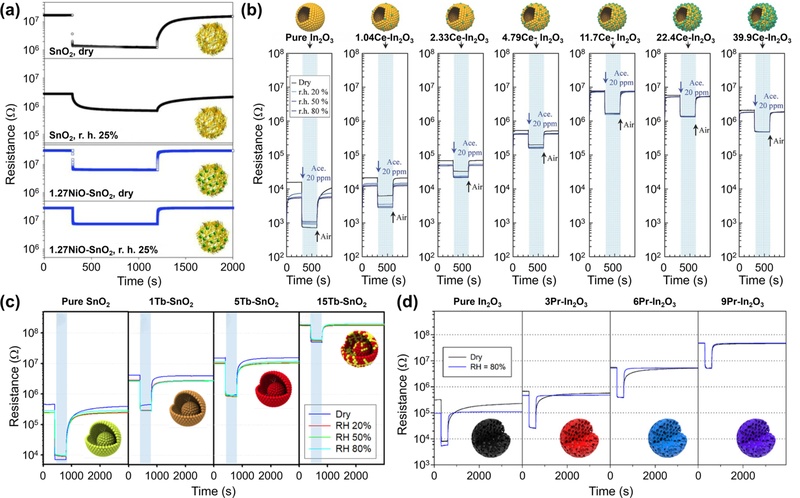
(a) Gas-sensing transients of pure-SnO2 and 1.27NiO-SnO2 hierarchical spheres in dry and 25% relative humidity (r.h.) atmospheres to 50 ppm CO at 400°C. Adapted from Ref. [62]. (b) Gas sensing transients of pure, 1.04, 2.33, 4.79, 11.7, 22.4, and 39.9Ce-In2O3 hollow spheres to 20 ppm acetone at 450°C in dry and humid conditions (r.h. = 20%, 50%, and 80%). Adapted from Ref. [64]. (c) Gas sensing transients of pure SnO2, 1Tb-SnO2, 5Tb-SnO2, and 15Tb-SnO2 sensors to 20 ppm of acetone at 450°C under dry and humid conditions (RH = 20, 50, 80%). Adapted from Ref. [65]. (d) Dynamic gas-sensing transients of pure In2O3, 3Pr-In2O3, 6Pr-In2O3, and 12Pr-In2O3 macroporous spheres to 20 ppm of acetone at 450 and 350−450°C, respectively, under dry and humid (RH = 80%) conditions. Adapted from Ref. [66].
The journey did not end with NiO doping. In subsequent research, Dr. Kwon-Il Choi carried out a more systematic examination of the role of NiO in gas sensing under humid conditions [63]. What struck me most was the conclusion that suppressing humidity dependence did not necessarily require incorporating NiO into the SnO2 lattice. His work demonstrated that even a simple physical mixture of NiO nanoparticles with SnO2 was sufficient to achieve nearly humidity-independent sensing up to 80% RH. These NiO-SnO2 composites exhibited stable CO responses and consistent baseline resistances, in sharp contrast to the strong degradation observed in pure SnO2. Spectroscopic studies revealed that NiO preferentially captured water-derived species, leaving the SnO2 surface available for the target gas reaction and thereby enabling humidity-independent sensing. This showed that NiO domains alone could adsorb water vapor and shield the SnO2 surface from moisture interference. In this way, I came to understand that the original idea of “NiO doping” had expanded into a broader “NiO-assisted” strategy to mitigate humidity-induced interference.
Building on this foundation, Professor Lee further extended the approach to CuO [45]. Under his guidance, research led by Dr. Kwon-Il Choi showed that CuO-decorated SnO2 hollow spheres exhibited humidity-independent H2S sensing. Like NiO, CuO suppressed humidity interference by preferentially interacting with water molecules and protecting the sensing surface from moisture. This provided compelling evidence that humidity independence was not unique to NiO but could also be achieved with other transition-metal oxides with high water affinity. For me, these findings were remarkable because they demonstrated that humidity-independent sensing was not an isolated success, but rather a principle that could be generalized. This research taught me that carefully selecting and engineering oxide additives, such as NiO or CuO, can provide a systematic pathway to overcome the water-poisoning effect that had long been considered unavoidable. More importantly, I came to realize that to be a sincere researcher, one must be willing to confront real challenges—even those that once seemed impossible.
This realization motivated me to search for a general strategy to select materials that could effectively reduce the humidity dependence of MOS sensors. I saw this as a significant turning point, marking my growth from a naive student into a more serious researcher. Since the earlier successes had come from NiO and CuO, I first focused on other p-type oxides, but their effects were not remarkable. Next, I turned my attention to alkali and alkaline-earth materials, inspired by their strong affinity for water vapor. Although I tested many candidates, the results were not comparable to those of NiO or CuO, and only a few showed modest potential.
Through these years of repeated failures, Professor Lee remained a patient and humble mentor. Whenever I brought him data—whether encouraging or disappointing—he would never dictate the conclusion. Instead, he would pose a question that reframed the problem, guiding me to discover the insight myself. He valued careful records of failures as much as successful results, often reminding me, “A failed experiment is not useless—it tells you that you are getting closer to the truth.” For a struggling graduate student, those words gave me the strength and confidence to persist. At that time, Professor Lee also asked me to explain the scientific basis for choosing these material groups. He emphasized that experiments without a solid theoretical foundation could not lead to meaningful progress. His advice pushed me to conduct a thorough literature review, which became the turning point for the next stage of my research—and the moment I began to see myself not only as a student but also as a material designer.
Guided by his advice, I concluded, based on a stronger theoretical foundation, that two key challenges must be addressed to overcome the humidity dependence of MOS sensors. The first is the excessive electron generation that reduces chemiresistivity upon gas exposure in humid air. The second is the formation of hydroxyl groups, which are far less reactive than the oxygen ions they displace and hinder the adsorption of oxygen species crucial for sensing. At the typical operating temperatures of 200–400°C, these effects become especially persistent, making humidity interference one of the most stubborn obstacles in the field. It became clear to me why NiO and CuO succeeded: they could mitigate both problems by preferentially adsorbing water vapor, protecting the sensing surface, and minimizing resistance changes through electronic desensitization.
Around that time, I was also taking Professor Lee’s lecture on “Ceramic Chemical Sensors,” where he explained the oxygen-pumping role of CeO2, which showed negligible electrical signal changes across varying oxygen partial pressures. After class, I returned to my desk, curious to see what had been reported about the surface chemistry of CeO2 under humid conditions. I found many studies suggesting that CeO2 could effectively scavenge hydroxyl groups. This academic background inspired me to design a CeO2-In2O3 sensor system. I hypothesized that CeO2 could electronically desensitize In2O3 against electron donation from water vapor while simultaneously removing chemically stable hydroxyl groups from the In2O3 surface under humid conditions. Both effects, I believed, would help restore the sensing surface to a state more favorable for gas detection, allowing it to behave much like it would under dry conditions.
I fabricated In2O3 hollow spheres coated with CeO2 nanoclusters, and I still remember my surprise when the sensors maintained their performance even at 80% RH [64]. I also vividly recall how delighted Professor Lee was at that moment. After recovering from the initial surprise, I had long discussions with him to understand the origin of this behavior. He suggested that the multivalent properties of CeO2 could be the key to achieving humidity-independent gas sensing. Following his guidance, I prepared CeO2 samples annealed at both high and low temperatures and found that only those with a higher Ce3+/Ce4+ ratio exhibited the desired effect. From this result, Professor Lee helped me realize that CeO2 was not simply absorbing humidity and desensitizing In2O3, but actively counteracting it through a regenerative cycle. By switching between Ce3+ and Ce4+ states, the CeO2 nanoclusters scavenged hydroxyl groups and replenished oxygen species, continuously refreshing the sensing surface during operation (Fig. 9(b)). It was in those very moments that we coined the term “dynamic self-refreshing”—a phrase that has since become widely recognized in the field.
Professor Lee, together with other students, later confirmed the generality of this strategy by extending it to other rare-earth oxides with multi-valent properties. Tb-doped SnO2 yolk-shell spheres [65] and Pr-doped In2O3 macroporous spheres [66] both exhibited humidity-independent behavior (Fig. 9(c,d)), enabled by the self-refreshing mechanism based on the redox flexibility of the Tb3+/Tb4+ and Pr3+/Pr4+ pairs. I remember feeling proud to be part of a group that, under Professor Lee’s vision, established the first comprehensive framework for designing humidity-immune chemiresistors using multivalent additives.
Looking back over this series of studies on humidity-related MOS sensors, I realize that Professor Lee’s greatest gift to me was not a particular technique or material, but a way of doing science. Through both his research vision and his everyday mentorship, he showed me that true science is about asking the questions others avoid, confronting problems that seem impossible, and pursuing them with patience and integrity. He reminded me that the true role of a scientist is not to collect easy wins, but to wrestle with the difficult problems that stand in the way of genuine progress. For him, research was never a career tool but a scholarship in its purest sense. What he always sought was to turn the impossible into the possible—and he inspired us to believe that we could do the same.
The impact of his work continues to grow. Today, humidity-independent sensors are no longer considered impossible, but are recognized as vital for applications ranging from environmental monitoring to healthcare. Breath analysis for noninvasive disease detection, for example, requires sensors that operate reliably under nearly saturated humidity. Likewise, air quality monitoring across diverse climates requires resilience to fluctuating moisture levels. Professor Lee’s pioneering ideas laid the foundation for these advances, ensuring that his influence will extend far beyond his own lifetime.
His passing leaves a void that cannot be filled. Yet his legacy endures in the pioneering insights he gave to our field and the values he instilled in us. As his student, I feel a deep responsibility to carry forward his vision. I will resist the temptation of quick or superficial results and instead walk the straight path, striving to write papers that neither my teacher nor I would be ashamed of. To me, that is the sincerest way to honor Professor Jong-Heun Lee and to ensure that his spirit continues to inspire future generations of scientists. I can only hope that Professor Lee is pleased with this, smiling as if to tell me that it is now time for him to rest—though, in truth, his presence will never fade.
Bilayer Architectures: A Generalizable Strategy for Tailoring Sensor Performance
Contributed by Seong-Yong Jeong and Young Kook Moon
Prof. Jong-Heun Lee devoted his career to pioneering semiconducting gas sensors, with a particular focus on strategies to overcome insufficient gas response and poor selectivity. Traditionally, most efforts to improve sensor performance have concentrated on modifying the surface of sensing materials. For example, approaches such as doping or decorating with catalytic additives have been widely explored. These methods were effective at enhancing the gas response but also had inherent limitations. The uniform control of catalysts is challenging and often results in particle aggregation and inconsistent catalytic activity. Moreover, catalysts typically enhance responses to multiple gases simultaneously, thereby hindering selective gas sensing. In addition, charge transfer arising from work-function differences between the catalytic and sensing materials can significantly increase the baseline resistance, sometimes to unmeasurable levels (tens of MΩ or more), complicating circuit design and hindering reliable signal measurement.
To address these challenges, Prof. Lee explored bilayer sensor architectures in which the sensing film is coated with a catalytic or molecular-sieve overlayer. In contrast to typical gas sensors that are uniformly doped/loaded with catalytic materials, the bilayer sensor can separate the sensing and catalytic reactions into independent processes, providing excellent control over gas selectivity and enabling completely new functionalities. The sensor resistance is also not substantially influenced by catalytic reactions confined to the upper overlayer.
The Cr2O3 overlayer served as a catalytic filter, selectively oxidizing highly reactive interference gases while allowing less reactive ethylene to reach the sensing region [67]. Notably, the gas response to 2.5 ppm ethylene remained similar after Cr2O3 overlayer coating (Sethylene of pure SnO2 sensor = 11.5, Sethylene of Cr2O3-coated SnO2 bilayer sensor = 12.1), whereas the responses to other reducing gases (Sinter.) were drastically reduced (from 11.6 to 3.7) at 375°C (Fig. 10(a,b)). To further validate the bilayer design, a Cr2O3-loaded SnO2 sensor was prepared by uniformly dispersing Cr2O3 nanoparticles throughout the sensing film. This sensor showed negligibly low responses to ethylene (Sethylene = 1.1) and exhibited a significantly higher baseline resistance (2.3 MΩ for the Cr2O3-loaded SnO2 sensor, 200-300 kΩ for the pure SnO2 sensor and the Cr2O3-coated SnO2 bilayer sensor) compared to both pure SnO2 and the bilayer sensor, due to excessive oxidation of ethylene and charge transfer from SnO2 to Cr2O3 arising from their work function difference. These results demonstrated that the bilayer design enabled highly selective and sensitive gas detection by suppressing cross-responses from interfering gases through oxidative filtering, without changing the intrinsic resistance of the sensing film. In addition, Prof. Lee further extended the oxidative filtering concept to the selective detection of volatile aromatic hydrocarbons (VAHs), including benzene, toluene, ethylbenzene, xylene, and styrene [68]. A bilayer sensor comprising an Rh-SnO2 sensing film with a CeO2 catalytic overlayer enabled highly discriminative and quantitative detection of VAHs, even in complex gas mixtures. The CeO2 overlayer acted as an oxidative filter, completely removing highly reactive nonaromatic interferents (e.g., ethanol, formaldehyde, and acetone) while allowing less reactive aromatic hydrocarbons to diffuse to the sensing region at the lower part of the Rh-SnO2 sensing film. This design achieved remarkably high responses to trace VAHs (sub-ppm levels) with negligible cross-interference, thereby demonstrating a generalizable and powerful strategy for exclusive VAH sensing. Mechanistic investigations using PTR-MS further confirmed that the CeO2 overlayer catalytically oxidized interfering gases (e.g., ethanol and formaldehyde), allowing VAHs to reach the Rh-SnO2 sensing layer and providing direct evidence for the oxidative filtering mechanism.
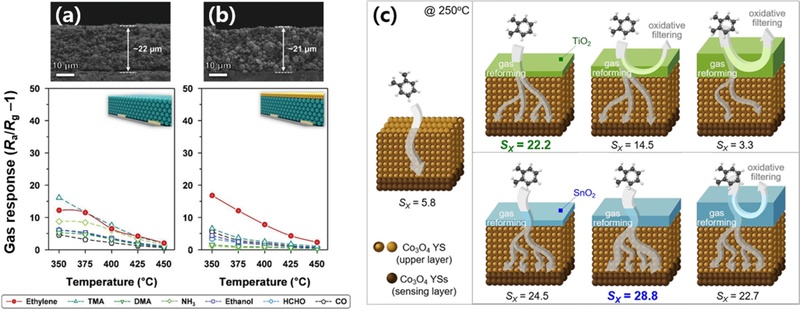
Cross-sectional SEM images and gas sensing characteristics of (a) SnO2 thick films, and (b) Cr2O3 overlayer coated SnO2 thick films toward ethylene, trimethylamine (TMA), dimethylamine (DMA), NH3, ethanol, HCHO, and CO at 350–450°C. (c) Schematic diagrams illustrating xylene reforming and oxidative filtering by the catalytic overlayer as a function of overlayer thickness. Adapted from Ref. [69].
Prof. Lee showed that catalytic overlayers in bilayer sensors can provide not only oxidative filtering but also reforming pathways that convert less reactive analytes into more reactive intermediates, thereby enabling enhanced sensor response and selectivity. Fig. 10(c) shows examples of the bilayer sensors with a catalytic reforming overlayer. One representative case is the Co3O4-based bilayer sensor with a nanoscale TiO2 or SnO2 overlayer [69]. When nanoscale TiO2 or SnO2 overlayers (coating thickness: 2-20 nm thick) were deposited on Co3O4 hollow sphere films, the responses toward less reactive methylbenzenes (i.e., xylene and toluene) were substantially enhanced, while the response to ethanol was comparable. This effect was attributed to the catalytic reforming of the less reactive methylbenzenes into more reactive species, which could more effectively participate in the sensing reaction with ionized oxygen ions at the sensor surface. Interestingly, even noble-metal overlayers such as Au were shown to act as reforming catalysts [70]. When ultrathin Au nanocluster layers (0.5-3 nm, nominal thickness) were coated on SnO2 sensing films, the responses toward methylbenzenes were markedly increased, whereas the ethanol response was reduced. The tuning of selectivity strongly depended on the Au loading, with moderate amounts promoting reforming and enhancing methylbenzene detection, whereas excessive Au coverage favored complete oxidation and thereby reduced overall gas response. These results highlighted that bilayer sensors employing catalytic reforming are not limited to oxide overlayers but are also extendable to noble metals. Another remarkable demonstration was achieved with the Rh-TiO2 overlayer-coated SnO2 bilayer sensor [71], which enabled highly selective detection of benzene among BTX gases. The catalytic Rh-TiO2 overlayer promoted the reforming of benzene into more reactive species, thereby enhancing the benzene response, while simultaneously suppressing the cross-responses to toluene and xylene. At an intermediate loading (1Rh-TiO2/SnO2 bilayer sensor), the toluene response was the largest, indicating that moderate catalytic activity most effectively promoted toluene conversion. In this condition, the response to xylene decreased because of its excessive oxidation into non-reactive products, whereas the benzene response remained limited due to insufficient catalytic promotion for reforming. At the lowest loading (0.5Rh-TiO2/SnO2 bilayer sensor), the sensor responses followed the intrinsic chemical reactivity order (xylene > toluene > benzene). Finally, a notable case was the Pd-SnO2 yolk-shell micro-reactor with a catalytic Co3O4 overlayer [57], which achieved ultrahigh selectivity toward benzene. This bilayer sensor showed an ultrahigh response of S = 88 to 5 ppm benzene, with negligible cross-responses to interfering gases (toluene, xylene, ethanol, formaldehyde, and carbon monoxide). The synergistic effect between Pd nanoparticles in the yolk-shell SnO2 sphere and the catalytic Co3O4 overlayer enabled both catalytic reforming of stable benzene molecules and oxidative removal of interfering gases. Overall, these studies firmly established that catalytic reforming overlayers in bilayer sensors provide a versatile strategy to enhance responses toward less reactive gases while simultaneously suppressing interference, thereby dramatically enhancing both gas response and selectivity in oxide semiconductor sensors.
Beyond catalytic overlayers, Prof. Lee also demonstrated that a molecular sieve overlayer (i.e., physical filter) can provide an alternative route to enhance gas selectivity, particularly for small gas molecules [72]. For example, while pure TiO2 sensors exhibited similarly high responses to both formaldehyde and ethanol (Sformaldehyde = 5041, Sethanol = 11264) under UV activation, the selectivity toward formaldehyde was almost negligible (Sformaldehyde/Sethanol = 0.4). In contrast, when a mixed matrix membrane (MMM) overlayer composed of ZIF-7 nanoparticles dispersed in a polymer matrix (PEBA) was coated on the TiO2 sensing film, the sensor enabled the exclusive detection of formaldehyde (Sformaldehyde = 1350, Sformaldehyde/Sethanol = 57.5) at room temperature. In this design, ethanol was effectively blocked by the size-selective permeation of the ZIF-7/PEBA layer, while smaller formaldehyde molecules permeated and participated in the sensing reaction. This physical sieving effect eliminated ethanol interference, enabling ultrahigh formaldehyde selectivity and response.
Another critical challenge in oxide semiconductor gas sensors is the humidity dependence of their gas-sensing characteristics, often referred to as water poisoning. Prof. Lee proposed a universal strategy to overcome this water poisoning issue by introducing a moisture-blocking Tb4O7 overlayer [73]. For instance, pure In2O3 sensors exhibited significant variations in sensor resistance (Ra) and a substantial decrease in gas response (S) under humid conditions, clearly demonstrating the water-poisoning effect in conventional oxide semiconductor sensors. In contrast, the In2O3 bilayer sensor with a Tb4O7 overlayer exhibited humidity-independent gas characteristics while maintaining its intrinsic selectivity, sensitivity, and resistance. The humidity-independent performance of the bilayer sensor was attributed to the hydrophobic nature of the Tb4O7 overlayer, which suppresses hydroxyl radical formation at the oxide surface. This strategy offered a universal and reliable approach to mitigate moisture interference across diverse oxide semiconductors, including In2O3, SnO2, ZnO, and Pd/SnO2, thereby greatly enhancing sensor robustness under real-world conditions.
For future gas-sensing systems, it is essential to employ diverse sensing materials and precisely control their selectivity and response across diverse operating conditions. Bilayer sensor architectures with catalytic overlayers, although simple in design, provide a powerful platform for robust, tunable sensing. This concept, pioneered and advanced by Prof. Lee, remains a fundamental framework that continues to inspire next-generation gas sensor research.
Room-Temperature Sensing: Always Moving Toward the Future
Contributed by Young-Moo Jo
Professor Jong-Heun Lee was always curious about new gas-sensing materials and their sensing mechanisms, aspiring to be a leading pioneer in the field of gas sensing. As a prominent figure in metal oxide semiconductor materials, he recognized one of the fundamental limitations of metal oxide semiconductor gas sensors—namely, their high-temperature operation. He understood that elevated temperatures enabled metal oxides to exhibit conductivity and catalytic activity. However, he believed that this abnormally high operating temperature (200–400°C) posed a significant obstacle to the broader application of gas sensors.
He envisioned that future applications of gas sensors—such as breath analysis for disease monitoring, healthcare, indoor and outdoor air quality monitoring, and food quality monitoring—should be seamlessly integrated into hand-held portable devices or mobile technologies. Yet, in his view, achieving such high operating temperatures necessitated either external heaters or, at a minimum, an integrated back heater. He considered this a critical design drawback, as it increased device complexity and contradicted the trend toward miniaturization. Furthermore, he noted that the energy required for heating had a severely negative impact on overall energy efficiency.
Prof. Lee also pointed out that maintaining high temperature during operation led to the degradation of surrounding components in addition to the degradation of the sensing materials themselves. For applications such as wearable sensors attached directly to the human body, he regarded such high-temperature requirements as fundamentally incompatible, rendering practical implementation nearly impossible.
To overcome these obstacles, Jong-Heun Lee drew a blueprint for the future of gas sensor applications by adopting light activation in place of conventional thermal activation. He recognized that light activation avoids degradation of surrounding components, though it still requires installing a light source. As a first step, he considered materials possessing photocatalytic properties. Going further, he sought materials that could be activated within the visible light spectrum, deliberately avoiding high-energy ultraviolet light to minimize potential harm to both human tissue and the sensing materials themselves. Among the candidates, cadmium sulfide (CdS), with its low energy bandgap of 2.4 eV, was selected for light-activated gas sensing. This bandgap closely matches the energy range of green light (2.2.5 eV), making it suitable for visible-light-driven activation [74].
To achieve high crystallinity and robust gas sensing performance, CdS nanoflakes were fabricated via chemical vapor deposition (CVD) on Si/SiO2 substrates. A green LED (500-540 nm, irradiance: 21 W/m2) was employed as the light source, and the CdS nanoflakes exhibited excellent selectivity. Furthermore, thanks to the low activation energy of CdS, even ambient light sources-such as fluorescent lamps and natural sunlight-were sufficient to activate the nanoflakes, demonstrating high gas-sensing performance.
Metal oxide semiconductors, though they typically possess a wide bandgap of approximately 3 eV due to the low valence band maximum of the O 2p orbital, are theoretically difficult to activate under visible light. However, Jong-Heun Lee recognized that the presence of abundant defect sites in these materials enables visible-light activation despite their intrinsic limitations.
His structure-oriented materials design strategies not only enhanced gas accessibility, specific surface area, and porosity but also promoted the formation of numerous defect sites. One such strategy was the adoption of the NFES technique-a specialized method capable of producing single nanofibers of structured metal oxide with systematic control over fiber number and placement [39].
Using this technique, 1D Au-SnO2 nanofibers were fabricated on ITO-integrated glass substrates and illuminated with various colors of LED light (Fig. 11(a)). Although SnO2, with a bandgap of 3.3 eV, cannot theoretically be excited by visible light, the defect-rich 1D nanofiber structure allowed activation by the red, green, and blue (RGB) colors of visible LED light. Under dark conditions, the highest response to NO2 (RNO2/Rair = 5400) was observed (Fig. 11(b)); however, the reaction was irreversible. In contrast, light activation by LEDs efficiently generated electron-hole pairs, which assisted the reverse reaction of NO2 adsorption and ionization:
| (2) |
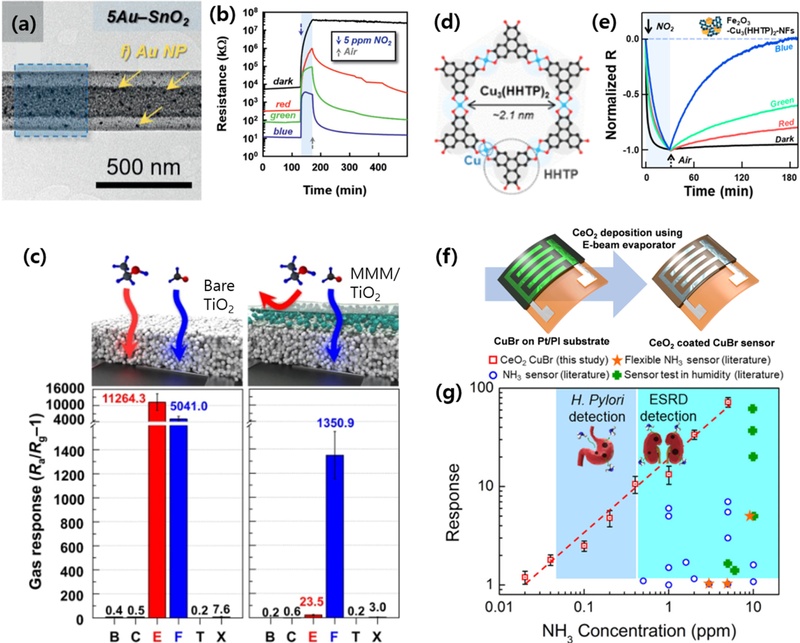
(a) TEM images of a 5Au-SnO2 single-nanofiber; (b) Sensing transients of the 5Au-SnO2 sensor to 5 ppm NO2 under different illumination conditions. Adapted from Ref. [39]; (c) Gas responses of bare TiO2 (left) and 5MMM/TiO2 sensors exposed to 5 ppm of benzene (B), carbon dioxide (C), ethanol (E), formaldehyde (F), toluene (T), and p-xylene (X) at room temperature. (d) Crystal structure of Cu3(HHTP)2; (e) Normalized sensing transients of the Fe2O3-Cu3(HHTP)2-NF sensor to 5 ppm of NO2 under different illumination conditions (dark, red, green, and blue). (f) Schematic diagram of pristine and CeO2-coated CuBr sensors; (g) NH3 responses of the sensors reported in the literature and the CuBr sensor coated with a 100 nm-thick CeO2 overlayer (the dark blue region indicates the detecting range of H. pylori infections, while the light cyan region indicates the detecting range for ESRD). Adapted from Ref. [76].
Furthermore, Au nanoparticles loaded onto the SnO2 surfaces—carefully tuned in size—induced localized surface plasmon resonance (LSPR), thereby enhancing the separation of photogenerated electron-hole pairs and improving photocatalytic activity. Interestingly, as photon energy increases across the RGB spectrum, recovery speeds accelerate, with blue light enabling fully reversible NO2 sensing. Although the responses (RNO2/Rair) decreased to 180, achieving complete reversibility at room temperature represents a significant advancement (Fig. 11(b), under blue LED). The ultrathin, 1D structural SnO2 design and room-temperature operation also allow the use of transparent ITO/glass substrates without concerns of thermal degradation, thereby opening opportunities for integration into display-integrated sensor applications such as smart glasses and windows.
Degussa P25, a well-known photocatalyst composed of a mixed phase of anatase and rutile TiO2, possesses a wide bandgap and high crystallinity. Although it cannot be activated by visible light due to the absence of defect states, it exhibits excellent photocatalytic properties under UV illumination, generating an abundance of reactive oxygen species on its surface [72]. Jong-Heun Lee focused on and utilized this exceptional photocatalytic performance (Fig. 11(c)). Bare TiO2 exhibited exclusively high responses to both ethanol (SC2H5OH = 11264.3) and formaldehyde (SHCHO = 5041.0) (Fig. 11(c), left). However, since ethanol is ubiquitous, such strong responses are not desirable for selective sensing applications. To suppress ethanol interference and further enhance formaldehyde selectivity, Lee introduced a molecular-sieving mixed matrix membrane (MMM) composed of a metal-organic framework (ZIF-7) and a polymer (Pebax® 1657 granules), which was spin-coated onto the photo-activated TiO2 sensing film.
Typically, the molecular sieving effect provided by such membranes physically hinders gas diffusion, thereby enhancing selectivity for smaller molecules but often at the expense of sensitivity. However, the inherent outstanding photocatalytic activity of TiO2 minimized this sensitivity loss, enabling the simultaneous achievement of both high sensitivity (SHCHO = 1350.9) and high selectivity (SHCHO/Sethanol = 57.5) (Fig. 11(c), right). This result successfully overcomes what is often regarded as an unavoidable trade-off in gas sensor design. Moreover, the use of the flexible polymer enabled the sensor to be implemented on flexible substrates, expanding its potential for wearable or bendable device applications.
Jong-Heun Lee recognized that selecting materials with intrinsic electrical conductivity at room temperature is essential, since conventional oxides, due to their wide band gaps, typically face great difficulty operating under ambient conditions. Thus, the exploration of emerging conductive materials became necessary. Among them, conductive metal-organic frameworks (c-MOFs) have recently attracted significant attention, and the two-dimensional Cu3(HHTP)2 (HHTP = 2,3,6,7,10,11-hexahydroxytriphenylene) MOF has been reported as one of the most robust conductive MOFs (Fig. 11(d)) [75].
This material exhibits two charge-transport pathways: a ligand-to-metal charge-transfer (LMCT) mechanism for in-plane conduction and a π–π transition mechanism for out-of-plane conduction. Notably, the LMCT pathway has a very narrow energy gap, allowing Cu3(HHTP)2 to retain electrical conductivity even at room temperature, making it a promising candidate for gas-sensing applications.
However, when exposed to acidic gases such as NO2, this c-MOF exhibits a dosimetric, irreversible sensing behavior at room temperature, limiting its practical utility. Building on earlier findings that photoactivation can generate electron-hole pairs and accelerate desorption of adsorbed gases, Lee was the first to investigate the photoactivated gas-sensing properties of c-MOFs. It was hypothesized that photoexciting the relatively larger π–π* transition gap would generate additional electron-hole pairs, thereby enhancing photoactivation efficiency. The measured energy gap of 2.75 eV matched the photon energy of visible blue light, thereby accelerating the recovery of NO2 responses under illumination.
Nevertheless, full recovery could not be achieved under moderate-intensity blue light. To further improve photoactivation efficiency even under low-intensity illumination, Lee introduced a type-II heterojunction with Fe2O3. In this staggered band alignment, the π–π* gap of Cu3(HHTP)2 lies above the bandgap of Fe2O3, enabling holes to transfer into Cu3(HHTP)2 and electrons into Fe2O3. This effective charge separation prolongs the lifetime of electron-hole pairs, significantly boosting photoactivation efficiency. As a result, the Cu3(HHTP)2/Fe2O3 heterojunction achieved complete recovery of NO2 sensing behavior under the same intensity of blue light (Fig. 11(e)).
Light activation is one of the most promising alternatives to thermal activation. However, it still requires an additional activation source. To further simplify gas sensor architectures, Jong-Heun Lee explored novel chemiresistive materials that exhibit sensing properties without external activation. Among these, CuBr emerged as a highly promising candidate due to its intrinsic electrical conductivity at room temperature (Fig. 11(f)). More importantly, Cu+ ions selectively react with NH3 to form a complex salt through the following reaction:
| (3) |
While other gases only induce redox reactions, NH3 uniquely triggers a phase transformation, leading to a dramatic increase in resistance. As a result, CuBr demonstrates ultrahigh sensitivity and selectivity toward NH3 [76].
Lee attempted to utilize CuBr as a sensing material for breath analysis, since exhaled NH3 serves as a biomarker for kidney disorders and Helicobacter pylori-induced stomach infections. To achieve stable film formation, CuBr was deposited by thermal evaporation onto polyimide substrates, which are both chemically stable and mechanically flexible, making them suitable for diverse applications, including wearable sensors. Furthermore, a thin CeO2 overlayer was applied to the film surface to mitigate the effects of humidity in exhaled breath, which typically ranges from 90–95% RH. By demonstrating sensitive detection of simulated exhaled breath from patients with H. pylori infection, which typically contains approximately 50 ppb of NH3, this approach emerges as a promising strategy for room-temperature NH3 sensing.
The Non-Erasable Memory of Professor Jong-Heun Lee
Contributed by Hyung-Gi Byun
Professor Jong-Heun Lee was not only an outstanding researcher and educator in the field of gas sensors but also my closest friend and research colleague for more than 20 years. He was a man of deep thought and meticulous care in every endeavor, yet always warm and kind to his students and to all those who worked with him.
As I write this tribute, I will not repeat his well-known academic achievements that have already been highlighted by other contributors. Instead, I wish to share my own indelible memories of the two decades I was privileged to spend with him.
He was remarkably systematic and precise in all aspects of his work, but never failed to extend kindness and warmth to others. At the many domestic and international conferences he organized, he always prioritized participants' convenience and benefit. Even when the preparations became mentally and physically exhausting, he would lighten the atmosphere with humor, often joking, “What’s wrong with professionals?” Such moments helped ensure the success of these events. Through countless conferences and workshops, he fostered international exchange, raised the global profile of the gas-sensor field, and created invaluable opportunities for both academic collaboration and personal friendships.
Among the many conferences I hosted with him, I vividly recall one particular moment: his former supervisor sat in the front row as he gave a presentation. Afterwards, he confided to me, “I’m over 50, my research is progressing well, but I still feel nervous presenting in front of my former advisor.” This humility and respect for his mentor exemplified his character. Although already a world-renowned scholar, he remained honest, modest, and dedicated, serving as a driving force in the international chemical sensors community.
For more than a decade prior to COVID-19, the KU (Korea University)-KU (Kyushu University) Workshop, initiated with Professor Shimanoe’s group at Kyushu University, provided a vital platform for students from Korea and Japan to share their research and exchange new ideas. He always invited me to participate as an observer, giving me the chance to present my thoughts on the convergence of chemical sensors, systems, and applications. Furthermore, as a key member of the GOSPEL Workshop, he played an essential role in building a global network in gas-sensor research spanning Asia and Europe. His absence leaves an enormous void, and it is difficult to imagine anyone continuing his work.
He was also extremely wise and methodical in collaborative research. When submitting papers, he clearly outlined the contributions expected of me, provided well-prepared data, and carefully ensured my meaningful involvement, particularly in data analysis. When I expressed difficulty or fatigue, he encouraged me: “You understand chemical sensors well and can analyze signals accurately.” His support motivated me to persevere, leading to deeply satisfying research outcomes [36,77]. Despite being younger than me, he often displayed a maturity and wisdom I greatly respected.

Prof. Hyung-Gi Byun and Prof. Jong-Heun Lee at the 8th GOSPEL Workshop, 2019, Ferrara, Italy.
Beyond academia, he was devoted to his family. I remember how, after an international conference, he still made time to search several shops to find the stationery his son wanted. We often spoke about family life, sometimes sharing the struggles of fatherhood. Since our family structures were similar, our conversations often provided mutual comfort and strength.
It is profoundly painful to compress the twenty years of memories I shared with him into just a few pages. Yet, as we honor his life and achievements, it is our duty to nurture and support young researchers who will follow in his footsteps. In recognition of his contributions, the Professor Jong-Heun Lee Paper Award, funded by donations from colleagues and industry, has been presented at the Korean Sensors Society conference for the past three years. This award not only commemorates his outstanding legacy but also serves as a foundation for advancing gas sensor research.
Reflecting on these unforgettable memories, I realize how many joyful and meaningful moments in my life were intertwined with his presence. Perhaps, even now, he is in heaven, exploring the mechanisms of new gas sensors. My dear friend, may you rest in peace, watching over the future generations of researchers you inspired.
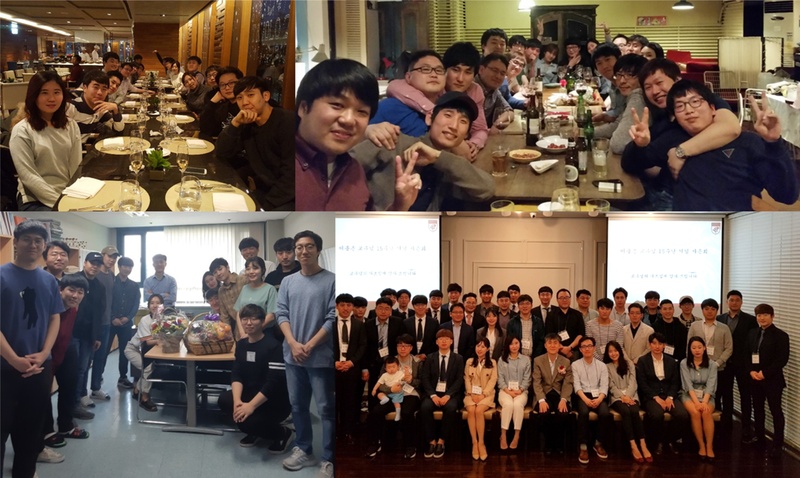
Prof. Jong-Heun Lee with his students during teacher appreciation gatherings and lab celebrations.
Closing Tribute
Contributed by Ji-Wook Yoon
On behalf of his former students—from universities, research institutes, and industries—I can say with deep conviction that we were profoundly privileged to have shared part of our lives and journeys under the mentorship of Professor Jong-Heun Lee. He was more than a brilliant scholar; he was a teacher in the truest sense—someone who shared knowledge and shaped character.
Professor Lee led by example, with quiet confidence and unwavering curiosity. He listened more than he spoke, yet when he did speak, he did so with clarity, conviction, and care. He challenged us to think more deeply, to aim higher, and to pursue work that mattered—not just for scientific progress, but for the good of others.
He never defined success by titles or publications. He measured it by how we treated people, how we handled failure, and how we kept going when things got hard. His office was where complex ideas became clear, frustrations turned into opportunities, and a simple conversation could rekindle motivation. He believed in us—even, and especially, when we didn’t believe in ourselves.
Many of us still carry his voice with us. In quiet moments of decision, in how we mentor others, in the standards we set for our work and ourselves—his influence lingers. Not just in our research, but in who we have become.
Though Professor Lee is no longer with us, his presence remains—in the lives he touched, the paths he helped shape, and the values he instilled. He taught us not just how to be better scientists but also better people.
Please rest in peace, our beloved professor.
We remember. We continue.
Acknowledgments
This research received no external funding.
REFERENCES
-
J.-H. Lee, Gas sensors using hierarchical and hollow oxide nanostructures: Overview, Sens. Actuator B Chem. 140 (2009) 319–336.
[https://doi.org/10.1016/j.snb.2009.04.026]

-
H.-R. Kim, K.-I. Choi, K.-M. Kim, I.-D. Kim, G. Cao, J.-H. Lee, Ultra-fast responding and recovering C2H5OH sensors using SnO2 hollow spheres prepared and activated by Ni templates, Chem. Commun. 46 (2010) 5061–5063.
[https://doi.org/10.1039/c0cc00213e]
-
S.-J. Kim, I.-S. Hwang, J.-K. Choi, Y.C. Kang, J.-H. Lee, Enhanced C2H5OH sensing characteristics of nano-porous In2O3 hollow spheres prepared by sucrose-mediated hydrothermal reaction, Sens. Actuator B Chem. 155 (2011) 512–518.
[https://doi.org/10.1016/j.snb.2010.12.055]
-
S.-J. Kim, I.-S. Hwang, C.W. Na, I.-D. Kim, Y.C. Kang, J.-H. Lee, Ultrasensitive and selective C2H5OH sensors using Rh-loaded In2O3 hollow spheres, J. Mater. Chem. 21 (2011) 18560–18567.
[https://doi.org/10.1039/c1jm14252f]
-
B.-Y. Kim, J.S. Cho, J.-W. Yoon, C.W. Na, C.-S. Lee, J.H. Ahn, et al., Extremely sensitive ethanol sensor using Pt-doped SnO2 hollow nanospheres prepared by Kirkendall diffusion, Sens. Actuator B Chem. 234 (2016) 353–360.
[https://doi.org/10.1016/j.snb.2016.05.002]
-
Y.H. Cho, X. Liang, Y.C. Kang, J.-H. Lee, Ultrasensitive detection of trimethylamine using Rh-doped SnO2 hollow spheres prepared by ultrasonic spray pyrolysis, Sens. Actuator B Chem. 207 (2015) 330–337.
[https://doi.org/10.1016/j.snb.2014.10.001]
-
C.-Y. Lee, S.-J. Kim, I.-S. Hwang, J.-H. Lee, Glucose-mediated hydrothermal synthesis and gas sensing characteristics of WO3 hollow microspheres, Sens. Actuator B Chem. 142 (2009) 236–242.
[https://doi.org/10.1016/j.snb.2009.08.031]
-
Y.H. Cho, Y.C. Kang, J.-H. Lee, Highly selective and sensitive detection of trimethylamine using WO3 hollow spheres prepared by ultrasonic spray pyrolysis, Sens. Actuator B Chem. 176 (2013) 971–977.
[https://doi.org/10.1016/j.snb.2012.10.044]
-
K.-M. Kim, H.-R. Kim, K.-I. Choi, H.-J. Kim, J.-H. Lee, ZnO hierarchical nanostructures grown at room temperature and their C2H5OH sensor applications, Sens. Actuator B Chem. 155 (2011) 745–751.
[https://doi.org/10.1016/j.snb.2011.01.040]
-
S.-J. Hwang, K.-I. Choi, J.-W. Yoon, Y.C. Kang, J.-H. Lee, Pure and Palladium-Loaded Co3O4 Hollow Hierarchical Nanostructures with Giant and Ultraselective Chemiresistivity to Xylene and Toluene, Chem. Eur. J. 21 (2015) 5872–5878.
[https://doi.org/10.1002/chem.201405076]
-
H.-J. Kim, J.-W. Yoon, K.-I. Choi, H.W. Jang, A. Umar, J.-H. Lee, Ultraselective and sensitive detection of xylene and toluene for monitoring indoor air pollution using Cr-doped NiO hierarchical nanostructures, Nanoscale 5 (2013) 7066–7073.
[https://doi.org/10.1039/c3nr01281f]
-
Y.-M. Jo, T.-H. Kim, C.-S. Lee, K. Lim, C.W. Na, F. Abdel-Hady, et al., Metal–Organic Framework-Derived Hollow Hierarchical Co3O4 Nanocages with Tunable Size and Morphology: Ultrasensitive and Highly Selective Detection of Methylbenzenes, ACS Appl. Mater. Interfaces 10 (2018) 8860–8868.
[https://doi.org/10.1021/acsami.8b00733]
-
Y.J. Hong, J.-W. Yoon, J.-H. Lee, Y.C. Kang, One-Pot Synthesis of Pd-Loaded SnO2 Yolk-Shell Nanostructures for Ultraselective Methyl Benzene Sensors, Chem. Eur. J. 20 (2014) 2737–2741.
[https://doi.org/10.1002/chem.201304502]
-
J.-W. Yoon, Y.J. Hong, G.D. Park, S.-J. Hwang, F. Abdel-Hady, A.A. Wazzan, et al., Kilogram-Scale Synthesis of Pd-Loaded Quintuple-Shelled Co3O4 Microreactors and Their Application to Ultrasensitive and Ultraselective Detection of Methylbenzenes, ACS Appl. Mater. Interfaces 7 (2015) 7717–7723.
[https://doi.org/10.1021/acsami.5b00706]
-
B.-Y. Kim, J.H. Ahn, J.-W. Yoon, C.-S. Lee, Y.C. Kang, F. Abdel-Hady, et al., Highly Selective Xylene Sensor Based on NiO/NiMoO4 Nanocomposite Hierarchical Spheres for Indoor Air Monitoring, ACS Appl. Mater. Interfaces 8 (2016) 34603–34611.
[https://doi.org/10.1021/acsami.6b13930]
-
T.-H. Kim, C.-H. Kwak, J.-H. Lee, NiO/NiWO4 Composite Yolk-Shell Spheres with Nanoscale NiO Outer Layer for Ultrasensitive and Selective Detection of Sub ppm-level p-Xylene, ACS Appl. Mater. Interfaces 9 (2017) 32034–32043.
[https://doi.org/10.1021/acsami.7b10294]
-
B.-Y. Kim, J.-W. Yoon, J.K. Kim, Y.C. Kang, J.-H. Lee, Dual Role of Multiroom-Structured Sn-Doped NiO Microspheres for Ultrasensitive and Highly Selective Detection of Xylene, ACS Appl. Mater. Interfaces 10 (2018) 16605–16612.
[https://doi.org/10.1021/acsami.8b02412]
-
B.-Y. Kim, J.-W. Yoon, K. Lim, S.H. Park, J.-W. Yoon, J.-H. Lee, Hollow spheres of CoCr2O4-Cr2O3 mixed oxides with nanoscale heterojunctions for exclusive detection of indoor xylene, J. Mater. Chem. C 6 (2018) 10767–10774.
[https://doi.org/10.1039/C8TC04166K]
-
T.-H. Kim, S.-Y. Jeong, Y.K. Moon, J.-H. Lee, Dual-mode gas sensor for ultrasensitive and highly selective detection of xylene and toluene using Nb-doped NiO hollow spheres, Sens. Actuator B Chem. 301 (2019) 127140.
[https://doi.org/10.1016/j.snb.2019.127140]
-
K.B. Kim, S.-Y. Jeong, T.-H. Kim, Y.C. Kang, J.-H. Lee, Methylbenzene sensors using Ti-doped NiO multiroom spheres: Versatile tunability on selectivity, response, sensitivity, and detection limit, Sens. Actuator B Chem. 308 (2020) 127730.
[https://doi.org/10.1016/j.snb.2020.127730]
-
Y.-S. Kim, I.-S. Hwang, S.-J. Kim, C.-Y. Lee, J.-H. Lee, CuO nanowire gas sensors for air quality control in automotive cabin, Sens. Actuator B Chem. 135 (2008) 298–303.
[https://doi.org/10.1016/j.snb.2008.08.026]
-
J.-H. Park, J.-H. Lee, Gas sensing characteristics of polycrystalline SnO2 nanowires prepared by polyol method, Sens. Actuator B Chem. 136 (2009) 151–157.
[https://doi.org/10.1016/j.snb.2008.10.002]
-
H.-S. Woo, C.W. Na, J.-H. Lee, Design of Highly Selective Gas Sensors via Physicochemical Modification of Oxide Nanowires: Overview, Sensors 16 (2016) 1531.
[https://doi.org/10.3390/s16091531]
-
N. Van Hieu, H.-R. Kim, B.-K. Ju, J.-H. Lee, Enhanced performance of SnO2 nanowires ethanol sensor by functionalizing with La2O3, Sens. Actuator B Chem. 133 (2008) 228–234.
[https://doi.org/10.1016/j.snb.2008.02.018]
-
I.-S. Hwang, Y.-S. Kim, S.-J. Kim, B.-K. Ju, J.-H. Lee, A facile fabrication of semiconductor nanowires gas sensor using PDMS patterning and solution deposition, Sens. Actuator B Chem. 136 (2009) 224–229.
[https://doi.org/10.1016/j.snb.2008.10.042]
-
I.-S. Hwang, S.-J. Kim, J.-K. Choi, J.-J. Jung, D.J. Yoo, K.-Y. Dong, et al., Large-scale fabrication of highly sensitive SnO2 nanowire network gas sensors by single step vapor phase growth, Sens. Actuator B Chem. 165 (2012) 97–103.
[https://doi.org/10.1016/j.snb.2012.02.022]
-
I.-S. Hwang, S.-J. Kim, J.-K. Choi, J. Choi, H. Ji, G.-T. Kim, et al., Synthesis and gas sensing characteristics of highly crystalline ZnO-SnO2 core-shell nanowires, Sens. Actuator B Chem. 148 (2010) 595–600.
[https://doi.org/10.1016/j.snb.2010.05.052]
-
H.-S. Woo, C.-H. Kwak, I.-D. Kim, J.-H. Lee, Selective, sensitive, and reversible detection of H2S using Mo-doped ZnO nanowire network sensors, J. Mater. Chem. A 2 (2014) 6412–6418.
[https://doi.org/10.1039/C4TA00387J]
-
C.-H. Kwak, H.-S. Woo, F. Abdel-Hady, A.A. Wazzan, J.-H. Lee, Vapor-phase growth of urchin-like Mg-doped ZnO nanowire networks and their application to highly sensitive and selective detection of ethanol, Sens. Actuator B Chem. 223 (2016) 527–534.
[https://doi.org/10.1016/j.snb.2015.09.120]
-
H.-S. Woo, C.-H. Kwak, J.-H. Chung, J.-H. Lee, Co-Doped Branched ZnO Nanowires for Ultraselective and Sensitive Detection of Xylene, ACS Appl. Mater. Interfaces 6 (2014) 22553–22560.
[https://doi.org/10.1021/am506674u]
-
J.-K. Choi, I.-S. Hwang, S.-J. Kim, J.-S. Park, S.-S. Park, U. Jeong, Y. C. Kang, J.-H. Lee, Design of selective gas sensors using electrospun Pd-doped SnO2 hollow nanofibers, Sens. Actuator B Chem. 150 (2010) 191–199.
[https://doi.org/10.1016/j.snb.2010.07.013]
-
J.-W. Yoon, J.-K. Choi, J.-H. Lee, Design of a highly sensitive and selective C2H5OH sensor using p-type Co3O4 nanofibers, Sens. Actuator B Chem. 161 (2012) 570–577.
[https://doi.org/10.1016/j.snb.2011.11.002]
-
J.-W. Yoon, H.-J. Kim, H.-M. Jeong, J.-H. Lee, Gas sensing characteristics of p-type Cr2O3 and Co3O4 nanofibers depending on inter-particle connectivity, Sens. Actuator B Chem. 202 (2014) 263–271.
[https://doi.org/10.1016/j.snb.2014.05.081]
-
C.-S. Lee, I.-D. Kim, J.-H. Lee, Selective and sensitive detection of trimethylamine using ZnO-In2O3 composite nanofibers, Sens. Actuator B Chem. 181 (2013) 463–470.
[https://doi.org/10.1016/j.snb.2013.02.008]
-
X. Liang, T.-H. Kim, J.-W. Yoon, C.-H. Kwak, J.-H. Lee, Ultrasensitive and ultraselective detection of H2S using electrospun CuO-loaded In2O3 nanofiber sensors assisted by pulse heating, Sens. Actuator B Chem. 209 (2015) 934–942.
[https://doi.org/10.1016/j.snb.2014.11.130]
-
C.-S. Lee, H.-Y. Li, B.-Y. Kim, Y.-M. Jo, H.-G. Byun, I.-S. Hwang, et al., Discriminative detection of indoor volatile organic compounds using a sensor array based on pure and Fe-doped In2O3 nanofibers, Sens. Actuator B Chem. 285 (2019) 193–200.
[https://doi.org/10.1016/j.snb.2019.01.044]
-
K. Lim, Y.-M. Jo, J.-W. Yoon, J.-H. Lee, Metal oxide patterns of one-dimensional nanofibers: on-demand, direct-write fabrication, and application as a novel platform for gas detection, J. Mater. Chem. A 7 (2019) 24919–24928.
[https://doi.org/10.1039/C9TA09708B]
-
K. Lim, Y.-M. Jo, S. Kim, J.-W. Yoon, S.-Y. Jeong, J.-S. Kim, et al., Selective dual detection of hydrogen sulfide and methyl mercaptan using CuO/CuFe2O4 nanopattern chemiresistors, Sens. Actuator B Chem. 348 (2021) 130665.
[https://doi.org/10.1016/j.snb.2021.130665]
-
K. Lim, Y.-M. Jo, J.-W. Yoon, J.-S. Kim, D.-J. Lee, Y.K. Moon, et al., A Transparent Nanopatterned Chemiresistor: Visible-Light Plasmonic Sensor for Trace-Level NO2 Detection at Room Temperature, Small 17 (2021) 2100438.
[https://doi.org/10.1002/smll.202100438]
-
C.W. Na, H.-S. Woo, I.-D. Kim, J.-H. Lee, Selective detection of NO2 and C2H5OH using a Co3O4-decorated ZnO nanowire network sensor, Chem. Commun. 47 (2011) 5148–5150.
[https://doi.org/10.1039/c0cc05256f]
-
C.W. Na, H.-S. Woo, I.-D. Kim, J.-H. Lee, Design of highly sensitive volatile organic compound sensors by controlling NiO loading on ZnO nanowire networks, RSC Adv. 2 (2012) 414–417.
[https://doi.org/10.1039/C1RA01001H]
-
C.W. Na, S.-Y. Park, J.-H. Chung, J.-H. Lee, Transformation of ZnO Nanobelts into Single-Crystalline Mn3O4 Nanowires, ACS Appl. Mater. Interfaces 4 (2012) 6565–6572.
[https://doi.org/10.1021/am301670x]
-
I.-S. Hwang, J.-K. Choi, S.-J. Kim, K.-Y. Dong, J.-H. Kwon, B.-K. Ju, et al., Enhanced H2S sensing characteristics of SnO2 nanowires functionalized with CuO, Sens. Actuator B Chem. 142 (2009) 105–110.
[https://doi.org/10.1016/j.snb.2009.07.052]
-
S.-J. Kim, C.W. Na, I.-S. Hwang, J.-H. Lee, One-pot hydrothermal synthesis of CuO-ZnO composite hollow spheres for selective H2S detection, Sens. Actuator B Chem. 168 (2012) 83–89.
[https://doi.org/10.1016/j.snb.2012.01.045]
-
K.-I. Choi, H.-J. Kim, Y.C. Kang, J.-H. Lee, Ultraselective and ultrasensitive detection of H2S in highly humid atmosphere using CuO-loaded SnO2 hollow spheres for real-time diagnosis of halitosis, Sens. Actuator B Chem. 194 (2014) 371–376.
[https://doi.org/10.1016/j.snb.2013.12.111]
-
H.-S. Woo, C.W. Na, I.-D. Kim, J.-H. Lee, Highly sensitive and selective trimethylamine sensor using one-dimensional ZnO-Cr2O3 hetero-nanostructures, Nanotechnology 23 (2012) 245501.
[https://doi.org/10.1088/0957-4484/23/24/245501]
-
C.-H. Kwak, H.-S. Woo, J.-H. Lee, Selective trimethylamine sensors using Cr2O3-decorated SnO2 nanowires, Sens. Actuator B Chem. 204 (2014) 231–238.
[https://doi.org/10.1016/j.snb.2014.07.084]
-
H.-S. Woo, C.-H. Kwak, J.-H. Chung, J.-H. Lee, Highly selective and sensitive xylene sensors using Ni-doped branched ZnO nanowire networks, Sens. Actuator B Chem. 216 (2015) 358–366.
[https://doi.org/10.1016/j.snb.2015.04.035]
-
H.-M. Jeong, J.-H. Kim, S.-Y. Jeong, C.-H. Kwak, J.-H. Lee, Co3O4-SnO2 Hollow Heteronanostructures: Facile Control of Gas Selectivity by Compositional Tuning of Sensing Materials via Galvanic Replacement, ACS Appl. Mater. Interfaces 8 (2016) 7877–7883.
[https://doi.org/10.1021/acsami.6b00216]
-
H.-J. Kim, H.-M. Jeong, T.-H. Kim, J.-H. Chung, Y.C. Kang, J.-H. Lee, Enhanced Ethanol Sensing Characteristics of In2O3-Decorated NiO Hollow Nanostructures via Modulation of Hole Accumulation Layers, ACS Appl. Mater. Interfaces 6 (2014) 18197–18204.
[https://doi.org/10.1021/am5051923]
-
K.-I. Choi, S.-J. Hwang, Z. Dai, Y.C. Kang, J.-H. Lee, Rh-catalyzed WO3 with anomalous humidity dependence of gas sensing characteristics, RSC Adv. 4 (2014) 53130–53136.
[https://doi.org/10.1039/C4RA06654E]
-
K.H. Lee, B.-Y. Kim, J.-W. Yoon, J.-H. Lee, Extremely selective detection of ppb levels of indoor xylene using CoCr2O4 hollow spheres activated by Pt doping, Chem. Commun. 55 (2019) 751–754.
[https://doi.org/10.1039/C8CC08186G]
-
I.-S. Hwang, J.-K. Choi, H.-S. Woo, S.-J. Kim, S.-Y. Jung, T.-Y. Seong, et al., Facile Control of C2H5OH Sensing Characteristics by Decorating Discrete Ag Nanoclusters on SnO2 Nanowire Networks, ACS Appl. Mater. Interfaces 3 (2011) 3140–3145.
[https://doi.org/10.1021/am200647f]
-
J.-W. Yoon, Y.J. Hong, Y.C. Kang, J.-H. Lee, High performance chemiresistive H2S sensors using Ag-loaded SnO2 yolk-shell nanostructures, RSC Adv. 4 (2014) 16067–16074.
[https://doi.org/10.1039/C4RA01364F]
-
P. Rai, S.M. Majhi, Y.-T. Yu, J.-H. Lee, Synthesis of plasmonic Ag@SnO2 core-shell nanoreactors for xylene detection, RSC Adv. 5 (2015) 17653–17659.
[https://doi.org/10.1039/C4RA13971B]
-
P. Rai, J.-W. Yoon, C.-H. Kwak, J.-H. Lee, Role of Pd nanoparticles in gas sensing behaviour of Pd@In2O3 yolk-shell nanoreactors, J. Mater. Chem. A 4 (2016) 264–269.
[https://doi.org/10.1039/C5TA08873A]
-
S.-Y. Jeong, J.-W. Yoon, T.-H. Kim, H.-M. Jeong, C.-S. Lee, Y.C. Kang, et al., Ultra-selective detection of sub-ppm-level benzene using Pd-SnO2 yolk-shell micro-reactors with a catalytic Co3O4 overlayer for monitoring air quality, J. Mater. Chem. A 5 (2017) 1446–1454.
[https://doi.org/10.1039/C6TA09397C]
-
Y.-M. Jo, K. Lim, H.J. Choi, J.W. Yoon, S.Y. Kim, J.-H. Lee, 2D metal-organic framework derived co-loading of Co3O4 and PdO nanocatalysts on In2O3 hollow spheres for tailored design of high-performance breath acetone sensors, Sens. Actuator B Chem. 325 (2020) 128821.
[https://doi.org/10.1016/j.snb.2020.128821]
-
K.-I. Choi, H.-R. Kim, K.-M. Kim, D. Liu, G. Cao, J.-H. Lee, C2H5OH sensing characteristics of various Co3O4 nanostructures prepared by solvothermal reaction, Sens. Actuator B Chem. 146 (2010) 183–189.
[https://doi.org/10.1016/j.snb.2010.02.050]
-
J.-W. Yoon, H.-J. Kim, I.-D. Kim, J.-H. Lee, Electronic sensitization of the response to C2H5OH of p-type NiO nanofibers by Fe doping, Nanotechnology 24 (2013) 444005.
[https://doi.org/10.1088/0957-4484/24/44/444005]
-
H.-J. Kim, J.-H. Lee, Highly sensitive and selective gas sensors using p-type oxide semiconductors: Overview, Sens. Actuator B Chem. 192 (2014) 607–627.
[https://doi.org/10.1016/j.snb.2013.11.005]
-
H.-R. Kim, A. Haensch, I.-D. Kim, N. Barsan, U. Weimar, J.-H. Lee, The Role of NiO Doping in Reducing the Impact of Humidity on the Performance of SnO2-Based Gas Sensors: Synthesis Strategies, and Phenomenological and Spectroscopic Studies, Adv. Funct. Mater. 21 (2011) 4456–4463.
[https://doi.org/10.1002/adfm.201101154]
-
K.-I Choi, M. Hübner, A. Haensch, H.-J. Kim, U. Weimar, N. Barsan, et al., Ambivalent effect of Ni loading on gas sensing performance in SnO2 based gas sensor, Sens. Actuator B Chem. 183 (2013) 401–410.
[https://doi.org/10.1016/j.snb.2013.04.007]
-
J.-W. Yoon, J.-S. Kim, T.-H. Kim, Y.J. Hong, Y.C. Kang, J.-H. Lee, A New Strategy for Humidity Independent Oxide Chemiresistors: Dynamic Self-Refreshing of In2O3 Sensing Surface Assisted by Layer-by-Layer Coated CeO2 Nanoclusters, Small 12 (2016) 4229–4240.
[https://doi.org/10.1002/smll.201601507]
-
C.-H. Kwak, T.-H. Kim, S.-Y. Jeong, J.-W. Yoon, J.-S. Kim, J.-H. Lee, Humidity-Independent Oxide Semiconductor Chemiresistors Using Terbium-Doped SnO2 Yolk-Shell Spheres for Real-Time Breath Analysis, ACS Appl. Mater. Interfaces 10 (2018) 18886–18894.
[https://doi.org/10.1021/acsami.8b04245]
-
J.-S. Kim, C.W. Na, C.-H. Kwak, H.-Y. Li, J.W. Yoon, J.-H. Kim, et al., Humidity-Independent Gas Sensors Using Pr-Doped In2O3 Macroporous Spheres: Role of Cyclic Pr3+/Pr4+ Redox Reactions in Suppression of Water-Poisoning Effect, ACS Appl. Mater. Interfaces 11 (2019) 25322–25329.
[https://doi.org/10.1021/acsami.9b06386]
-
S.-Y. Jeong, Y.K. Moon, T.-H. Kim, S.-W. Park, K.B. Kim, Y.C. Kang, et al., A New Strategy for Detecting Plant Hormone Ethylene Using Oxide Semiconductor Chemiresistors: Exceptional Gas Selectivity and Response Tailored by Nanoscale Cr2O3 Catalytic Overlayer, Adv. Sci. 7 (2020) 1903093.
[https://doi.org/10.1002/advs.201903093]
-
S.-Y. Jeong, Y.K. Moon, J. Wang, J.-H. Lee, Exclusive detection of volatile aromatic hydrocarbons using bilayer oxide chemiresistors with catalytic overlayers, Nat. Commun. 14 (2023) 233.
[https://doi.org/10.1038/s41467-023-35916-3]
-
H.-M. Jeong, S.-Y. Jeong, J.-H. Kim, B.-Y. Kim, J.-S. Kim, F. Abdel-Hady, et al., Gas Selectivity Control in Co3O4 Sensor via Concurrent Tuning of Gas Reforming and Gas Filtering using Nanoscale Hetero-Overlayer of Catalytic Oxides, ACS Appl. Mater. Interfaces 9 (2017) 41397–41404.
[https://doi.org/10.1021/acsami.7b13998]
-
Y.K. Moon, S.-Y. Jeong, Y.C. Kang, J.-H. Lee, Metal Oxide Gas Sensors with Au Nanocluster Catalytic Overlayer: Toward Tuning Gas Selectivity and Response Using a Novel Bilayer Sensor Design, ACS Appl. Mater. Interfaces 11 (2019) 32169–32177.
[https://doi.org/10.1021/acsami.9b11079]
-
Y.K. Moon, S.-Y. Jeong, Y.-M. Jo, Y.K. Jo, Y.C. Kang, J.-H. Lee, Highly Selective Detection of Benzene and Discrimination of Volatile Aromatic Compounds Using Oxide Chemiresistors with Tunable Rh-TiO2 Catalytic Overlayers, Adv. Sci. 8 (2021) 2004078.
[https://doi.org/10.1002/advs.202004078]
-
Y.K. Jo, S.-Y. Jeong, Y.K. Moon, Y.-M. Jo, J.-W. Yoon, J.-H. Lee, Exclusive and ultrasensitive detection of formaldehyde at room temperature using a flexible and monolithic chemiresistive sensor, Nat. Commun. 12 (2021) 4955.
[https://doi.org/10.1038/s41467-021-25290-3]
-
S.-Y. Jeong, Y.K. Moon, J.K. Kim, S.-W. Park, Y.K. Jo, Y.C. Kang, et al., A General Solution to Mitigate Water Poisoning of Oxide Chemiresistors: Bilayer Sensors with Tb4O7 Overlayer, Adv. Funct. Mater. 31 (2021) 2007895.
[https://doi.org/10.1002/adfm.202007895]
-
H.-Y. Li, J.-W. Yoon, C.-S. Lee, K. Lim, J.-W. Yoon, J.-H. Lee, Visible light assisted NO2 sensing at room temperature by CdS nanoflake array, Sens. Actuator B Chem. 255 (2018) 2963–2970.
[https://doi.org/10.1016/j.snb.2017.09.118]
-
Y.-M. Jo, K. Lim, J.W. Yoon, Y.K. Jo, Y.K. Moon, H.W. Jang, et al., Visible-Light-Activated Type II Heterojunction in Cu3(hexahydroxytriphenylene)2/Fe2O3 Hybrids for Reversible NO2 Sensing: Critical Role of π–π* Transition, ACS Central Sci. 7 (2021) 1176–1182.
[https://doi.org/10.1021/acscentsci.1c00289]
-
H.-Y. Li, C.-S. Lee, D.H. Kim, J.-H. Lee, Flexible Room-Temperature NH3 Sensor for Ultrasensitive, Selective, and Humidity-Independent Gas Detection, ACS Appl. Mater. Interfaces 10 (2018) 27858–27867.
[https://doi.org/10.1021/acsami.8b09169]
-
D.H. Kim, T.H. Kim, W. Sohn, J.M. Suh, Y.-S. Shim, K.C. Kwon, et al., Au decoration of vertical hematite nanotube arrays for further selective detection of acetone in exhaled breath, Sens. Actuator B Chem. 274 (2018) 587–594.
[https://doi.org/10.1016/j.snb.2018.07.159]