
Recent Research Progress of Metal Oxide Semiconductor-Based Gas Sensors for Benzene Series Compounds Detection: A Review
 ; Wei Zhao1
; Ya-Nan Li5
; Zhuo-Lin Li1
; Yi-Xi Jiang1
; Ya-Chang Xu1
; Ji-Wook Yoon3, +
; Hua-Yao Li2, 4, +
; Wei Zhao1
; Ya-Nan Li5
; Zhuo-Lin Li1
; Yi-Xi Jiang1
; Ya-Chang Xu1
; Ji-Wook Yoon3, +
; Hua-Yao Li2, 4, +
ⓒ The Korean Sensors Society
This is an Open Access article distributed under the terms of the Creative Commons Attribution Non-Commercial License (https://creativecommons.org/licenses/by-nc/3.0/) which permits unrestricted non-commercial use, distribution, and reproduction in any medium, provided the original work is properly cited.
Abstract
Benzene-series compounds—specifically benzene, toluene, ethylbenzene, xylene (BTEX), and aniline—represent a critical class of hazardous volatile organic compounds (VOCs) originating from diverse industrial processes and urban emissions. Due to their profound toxicity and documented carcinogenicity, the development of rapid, reliable, and high-performance detection platforms is imperative for environmental surveillance and the safeguarding of public health. Metal oxide semiconductor (MOS) gas sensors have emerged as leading candidates for integrated, miniaturized sensing architectures. This review systematically evaluates recent progress in MOS-based sensing technologies tailored for benzene-series detection. The advancements are highlighted in functional materials, including cation- and anion-doped oxides, p-n/n-n heterostructures, and noble-metal-functionalized surfaces, and emphasize synergistic strategies to enhance sensitivity, selectivity, and the limit of detection (LOD). Furthermore, the fundamental sensing mechanisms, structural design motifs, and catalytic enhancement effects are analyzed. Finally, we address persistent technical bottlenecks, such as cross-sensitivity and elevated operating temperatures, while proposing future trajectories involving sensor arrays and machine-learning-augmented gas identification.
Keywords:
Gas sensors, Metal oxide semiconductors, Benzene-series compounds, Aniline gas1. INTRODUCTION
Environmental air pollution stems primarily from the relentless rise in emissions of hazardous, even life-threatening, gases—most notably volatile organic compounds (VOCs), which refer to organic compounds with high saturated vapor pressure (greater than 13.33 Pa), low boiling point, low molecular weight, and high volatility at room temperature under standard conditions [1,2]. They can also be considered as any carbon compound that participates in atmospheric photochemical reactions, except for CO, CO2, H2CO3, metal carbides, metal carbonates, and ammonium carbonate [3,4]. As the main atmospheric pollutants, these substances originate from industrial complexes, mining operations, household appliances and activities, and manufacturing facilities. Rapid advances in science and technology, aimed at improving living standards while accommodating a growing global population, have fueled an unprecedented expansion of industry, thereby intensifying air pollution worldwide [5-8].
Among VOCs, benzene-series compounds such as benzene, toluene (methylbenzene), ethylbenzene, xylene (dimethylbenzene), and aniline are among the most significant groups, and they are highly toxic and carcinogenic to humans. Exposure to benzene, toluene, ethylbenzene, xylene (collectively known as BTEX), and aniline vapors may cause acute health issues like myocardial infarction, neurological impairment, cancer, and bone marrow aplasia, depending on the duration of the exposure, the concentration of the gas, and how often one is exposed [9-12]. Therefore, international organizations (the World Health Organization, WHO; the International Agency for Research on Cancer, IARC; the Occupational Safety and Health Administration, OSHA) have strictly regulated the levels of BTEX and aniline in the atmosphere and the duration of human exposure (as shown in Table 1). Therefore, during the production, storage, or use of benzene, toluene, ethylbenzene, xylene, and aniline, their leakage must be strictly monitored.

Exposure levels to the Benzene series as indicated by OSHA and NIOSH.
Common methods for detecting BTEX and aniline indoors or outdoors include gas chromatography, Raman spectroscopy, mass spectrometry, optical spectroscopy, and ion mobility spectroscopy [10,13,14]. However, the aforementioned equipment, besides being expensive, is bulky, time-consuming, and difficult to use, and requires highly skilled workers to run, making real-time monitoring and analysis difficult. To address these challenges, a growing body of research has focused on low-cost, portable gas-sensing approaches with high sensing performance for practical applications in in-situ monitoring and quantifying BTEX and aniline vapor in the environment. Gas sensors based on metal oxide semiconductor (MOS) technology, as one of the low-cost, easy-to-integrate, and miniaturizable chemiresistive sensors with good sensitivity and stability, have been widely used to detect BTEX and aniline vapor.
As mentioned above, air pollutants such as BTEX and aniline are present in human living environments at varying concentrations, some of which remain very harmful even at low levels of one billionth (ppb) and one millionth (ppm) (as shown in Table 1). Therefore, developing high-performance gas sensors has been the goal of many researchers to prevent unintentional exposure to hazardous gases and mitigate environmental pollution.
Despite the significant potential demonstrated by MOS sensors for chemiresistive gas sensing over the past few decades, several challenges persist in their application for detecting BTEX and aniline [10,15-17]. These issues include: (1) low sensitivity, limiting their effectiveness in detecting trace concentrations; (2) poor selectivity, particularly in complex gas environments where interference from other VOCs can compromise accurate detection of benzene derivatives; (3) some MOS gas-sensing materials are highly sensitive to humidity, which can degrade their gas-sensing performance towards target gases; (4) high operating temperatures increase power consumption and limit portability. These issues are largely attributed to the high chemical stability of BTEX and aniline, which makes their detection inherently challenging for conventional MOS-based sensors. All these factors limit the practical use of the MOS sensor for monitoring BTEX and aniline vapor. This review aims to report on the latest developments in MOS gas sensors for detecting benzene-series compounds.
2. BODY
2.1 Benzene gas sensors
Benzene (C6H6) is the simplest aromatic hydrocarbon, a nonpolar molecule, and a basic raw material in the petrochemical industry. It is a well-known carcinogen, and exposure to high concentrations can affect the blood, possibly leading to the development of leukemia [18,19]. Benzene has a hexagonal ring structure consisting of six carbon atoms. The C-C bonds in the ring are of a special type, known as delocalized π bonds, which give benzene its high chemical stability. Owing to the remarkably high chemical stability conferred by its delocalized π-electron system, benzene is notoriously resistant to oxidation or reduction, making its detection by conventional MOS gas sensors exceedingly challenging. Therefore, it is difficult to detect benzene vapor using traditional MOS such as SnO2, ZnO, WO3, and In2O3. However, binary metal oxides with a spinel structure (AB2O4) exhibit good benzene gas-sensing performance. Krishna et al. reported that nanoflake-structured CuFe2O4 and cotton-like porous nano-heterostructured CuCeO2 exhibit a large specific surface area and uniform porosity, resulting in enhanced gas-sensing performance for benzene detection at room temperature [20]. However, its response to benzene vapor is very low ((Rg-Ra)/Ra≈13%). Tohidi et al. reported that nanostructured thin films of Zn2SnO4 deposited by CVD showed good sensitivity to 100 ppb benzene at 290°C [21]. The gas-sensing performance of Zn2SnO4 thin films was modeled and optimized using the surface response method. However, the gas-sensing performance of this thin film toward benzene vapor, particularly its response and selectivity, still does not meet practical requirements. Lee and Fu et al. reported a MEMS-based benzene gas sensor with a self-heating WO3 thin film. In this work, a WO3 sensing layer with micro-sized grains was deposited on a quartz chip with Pt interdigitated electrodes and Pt micro-heaters by sputtering. The study found that the sensor exhibited excellent sensitivity to benzene gas at 300°C, with a limit of detection (LOD) of 0.2 ppm and a very fast response speed (35 s). However, this study did not investigate sensor selectivity, and there remain doubts about their practical applications. Zhang and Zhou et al. reported a benzene sensor based on a novel concave Cu2O octahedron, which was evaluated as an excellent sensing material for benzene vapor detection at 230°C (a response of about 9.7 at 50 ppm) [22]. Guo and Li et al. successfully synthesized a Bi-doped SnO2/rGO nanocomposite, which significantly enhanced gas-sensing performance at low temperature for benzene vapor [23]. Compared with that of the pure SnO2 and SnO2/rGO, the Bi-doped SnO2/rGO sensor exhibited high response (48.6 to 5 ppm), fast response-recovery speed (9/13 s), good stability, and selectivity to detect benzene vapor at low temperature (150°C). Beyond its impressive sensitivity, a notable advantage of this sensor is its response/recovery speed, which presented a response time of 3 s and a recovery time of 4 s for 50 ppm benzene vapor. However, the reported minimum concentration is only 5 ppm, which obviously does not meet the relevant regulations on benzene gas content in the environment.

Schematic illustration of (a) the synthetic process of bimetallic Au-Pt nanoparticle-supported ZnO porous nanobelts and (b) the fabrication of the corresponding gas-sensing device. Adapted from Ref. [29].
As mentioned above, benzene is a non-polar molecule with excellent chemical stability due to its large delocalized bonds. It is precisely this excellent chemical stability that makes it difficult to apply single-metal-oxide gas sensors for benzene detection [24-27]. To improve sensor performance, extensive research has been conducted on the use of precious-metal modifications and various metal oxide composites to construct heterojunctions that enhance benzene gas sensing. Zhang et al. investigated a benzene sensor based on a Pd-doped CaTiO3/TiO2 nanocomposite, which showed remarkable benzene sensing performance at room temperature (high response of 33.46-50 ppm benzene and a low detection limit of 100 ppb) [28]. Kim et al. reported an excellent selective-sensing sensor for benzene using SnO2-ZnO core-shell nanowires functionalized with Pd nanoparticles. It presented a high response of 71 for 100 ppb benzene vapor at 300°C. Chen and Guo developed a chemiresistive gas sensor based on bimetallic Au-Pt nanoparticle-supported ZnO porous nanobelts that displayed a high response of approximately 39-50 ppm to benzene vapor at 300°C, with satisfactory response time (~8 s) and recovery time (~30 s) [29]. This gas sensor also displays excellent selectivity, stability, repeatability, and resistance to humidity interference. Motaung et al. reported low-concentration detection of benzene using a metal-organic framework (MOF)- derived Co3O4/TiO2. heterostructures loaded with 0.5~2 wt.%Fe synthesized using the coprecipitation method [30]. The 1.0 wt.% Fe/Co3O4/TiO2 heterostructure-based sensor disclosed higher responses of ~3 toward 2 ppm benzene vapor at 175°C and was able to experimentally detect benzene vapor as low as 0.35 ppm at 175°C. The good gas-sensing performance of this sensor is mainly attributed to the loading of Fe3+ on the surface of Co3O4/TiO2, which increased the specific surface area, narrowed the band gap, and provided numerous oxygen vacancies. In addition, they also prepared a Pt-loaded NiO-CeO2 nanosheet-assembled hierarchical structure, and this composite disclosed a superior response of 2.7 to 2 ppm benzene vapor and a very low detection limit of 70 ppb at 100°C [31]. Lee et al. investigated a bi-layer sensor constructed with Ru-TiO2 as the catalytic layer and SnO2 as the sensing layer for detecting benzene vapor [32]. The sensor based on Ru-TiO2/SnO2 bi-layer exhibited a high response value of 81.4 to 5 ppm benzene vapor. Taken together, these results indicate that the synergistic effect of constructing heterojunctions and noble-metal sensitization effectively enhances the gas-sensing performance of metal oxide gas sensors towards benzene vapor. In addition, some previous works reported that the application of metal-ion-doped metal oxides effectively enhances the gas-sensing performance of sensors towards benzene vapor. However, the enhancement effect still lags behind that of the noble-metal modification method [33-35].
Sensing performance of the MOS-based sensor on Benzene vapor.
2.2 Toluene gas sensors
As an important aromatic organic compound and raw material, toluene (C7H8) is extensively used in pharmaceuticals, laboratory solvents, fuels, paint thinners, and inks. Toluene vapor rapidly targets the central nervous system, triggering acute respiratory distress, while its widespread emissions make it a global contributor to air-quality degradation. Under normal conditions, toluene is highly stable, but it can react violently with acids or oxidants. Due to the presence of a methyl group, toluene is prone to free radical or oxidation reactions. This makes it relatively easy to detect toluene vapor using MOS [47].
Given the presence of active methyl groups in toluene, some metal oxides with strong catalytic activity (e.g., Co3O4 and NiO) can be used to enhance the gas-sensing performance of MOS. Jin et al. reported a toluene sensor based on mesoporous SnO2@Co3O4 core-shell nanospheres, which exhibited an extremely high response (Rg/Ra = 10.2) to 100 ppm toluene at 300°C. The LOD reached 831 ppb [48]. The sensor's improvement in toluene performance is primarily attributed to the stable heterojunction formed between SnO2 and Co3O4. Volanti et al. investigated a sensor based on Co3O4 coating with ZIF-67 (Co3O4/ZIF-67) for detecting toluene vapor [49]. The Co3O4/ZIF-67 exhibited a high response (61.22) to 100 ppm toluene at 250°C, which is 3 times higher than that of pure Co3O4. The ZIF-67 layer also enhanced the selectivity to toluene vapor. However, the sensor's slow response and recovery times hinder its practical application. Lee et al. prepared Nb-doped NiO hollow spheres by one-pot ultrasonic spray pyrolysis. The sensor based on Nb-doped NiO hollow spheres demonstrated dual functionality for ultrasensitive, highly selective detection of p-xylene and toluene by simply modulating the sensing temperature [50]. The maximum response of the Nb-doped NiO hollow spheres to 5 ppm xylene is about 1752 at 350°C, and to 5 ppm toluene is about 103 at 400°C. The Nb-doped NiO hollow spheres can be employed to design a single-gas sensor with dual selectivity for xylene and toluene for reliable monitoring of indoor air quality. Zhang et al. prepared a rationally designed Co3O4 hierarchical structure via a hydrothermal route [51]. The sheet-shaped Co3O4 exhibited higher sensitivity (8.5 to 200 ppm), faster response-recovery speed (10/30 s), and better selectivity to toluene at 180°C. It is evident from the above introduction that, whether using cobalt oxide and nickel oxide alone or forming heterojunctions with other metal oxides, they all exhibit good gas-sensing performance for toluene. However, the high working temperature and detection concentration limits also limit its practical application. In addition, some researchers have encountered similar problems when using sulfides as sensing materials for toluene detection [52,53]. Lowering the working temperature and detecting the minimum concentration are important issues that need to be addressed at present.
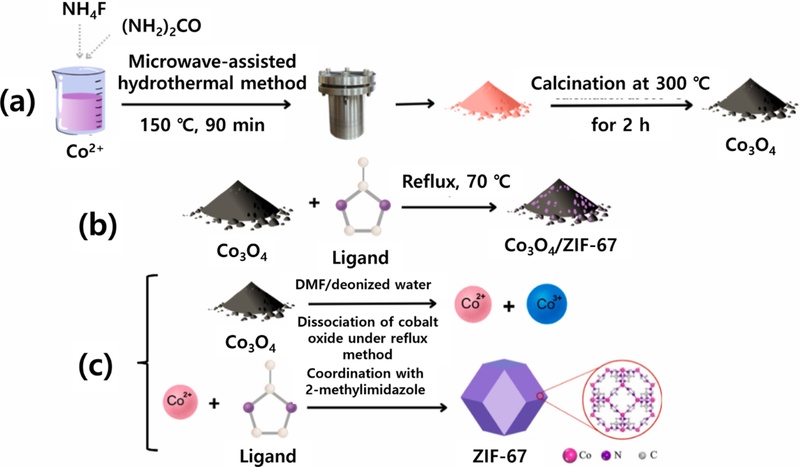
Schematic illustration of (a) the synthesis of Co3O4, (b) the synthesis procedure of Co3O4/ZIF-67, and (c) the role of ZIF-67 in the composite. Adapted from Ref. [49].
Noble metals exhibit higher catalytic activity, and their application to modify the surface of MOS can enhance MOS gas-sensing performance for toluene detection. Tatsuya Joutsuka, Yoshiteru Itagaki, et al. investigated the synergistic effects of integrating gold (Au) nanoparticles into SmFeO3 for the detection of toluene [54]. Liang et al. demonstrated a Pd nanoparticle-functionalized In2O3 nanosphere-based gas sensor for detecting benzene, toluene, and xylene gases [55]. The sensor based on 0.75 wt% Pd-In2O3 nanospheres exhibited a high response (Ra/Rg = 21) to 100 ppm toluene vapor, approximately four times better than pure In2O3 at its respective optimum operating temperature. Moreover, this sensor showed enhanced sensing performance towards toluene, including low operating temperature, exceptional selectivity, and good stability. Nehru and Kalaiselvan et al. investigated a room-temperature-operable Ag/Bi2O3 nanocomposite-based chemiresistive toluene gas sensor that exhibits a high, rapid response, good repeatability, and excellent stability to toluene vapor [56]. After Ag modification, the gas sensitivity of Ag/Bi2O3 to toluene is significantly improved at room temperature. Yuan and Lin et al. reported an aluminum-doped ZnO-supported Au nanoparticle (Au/ZnO-Al) sensor with good gas-sensing performance for toluene vapor [57]. The Au/ZnO-Al sensor showed a high response value of 18.3 towards 5 ppm toluene and can detect ppb-level toluene with a low detection limit of 1.1 ppb at 275°C. Moreover, the Au/ZnO-Al sensor enhanced toluene selectivity. Kim et al. reported a selective toluene and benzene gas sensor based on Pt- and Pd-functionalized ZnO nanowires (NW) in self-heating mode. By adjusting the sputtering process, the Pt-functionalized ZnO NW prepared showed a response of 2.86 to 50 ppm toluene at room temperature. The response of ZnO NW functionalized with Pd to 50 ppm benzene at room temperature is 2.20 [58]. This study opens a pathway to the fabrication of selective toluene and benzene gas sensors with low power consumption operating in the self-heating mode.
To improve the gas-sensing performance of MOS sensors towards toluene, bimetallic-modified MOS toluene sensors have received attention. The use of alloy nanoparticles composed of two precious metals to modify the surface of MOS materials not only enhances sensitivity but also effectively reduces operating temperature. Song et al. investigated a sensor based on Pd/Au-nanocluster-functionalized 3D SnO2 nanotube arrays that exhibited high sensitivity to formaldehyde (response of 2.55 to 1 ppm), toluene (response of 5.33 to 1 ppm), and acetone (response of 2.20 to 1 ppm) at room temperature [59]. Hahn and Kim et al. employed Au and Pd bimetallic clusters to modify the surface of a TiO2 nanohelix array, which significantly enhanced the gas-sensing performance of TiO2 towards toluene [60]. By adjusting the Au:Pd ratio, the sensor can achieve a response of up to 130000 to 100 ppm toluene with a fast recovery time (4 s) at 200°C. By incorporating single- or bimetallic metal-nanocluster-decorated sensors into a sensor array and employing a pattern recognition algorithm, they achieve successful discrimination of the target gases in real time. From the above introduction, it can be seen that metal oxide surfaces modified with precious metals exhibit better gas-sensing performance towards toluene, especially by significantly reducing the operating temperature of MOS. MOS modified with precious metals can detect toluene at room temperature, and the detection limit is also reduced. This is mainly due to the excellent catalytic effect of precious metal clusters, which allow toluene to react on the surface of metal oxides at low temperatures, altering the depletion layer and generating response signals. In addition to the above-mentioned heating-based MOS, some researchers have used light irradiation to excite MOS for toluene detection, achieving good results at room temperature [61]. Park et al. developed a porous In2O3-ZnO nanofiber-based sensor for detecting toluene vapor under ultraviolet light (UV, 365 nm) irradiation. The sensor exhibited good gas-sensing performance for toluene vapor at room temperature. Kim et al. prepared Pt and Pd-functionalized ZnO nanowires by the vapor-liquid-solid growth method [58]. The sensor based on Pt- and Pd-functionalized ZnO nanowires showed good gas-sensing performance for toluene and benzene under UV irradiation.

(a, b) SEM images, (c) cross-sectional SEM image, (d, e) TEM images, (f) high-resolution lattice fringe image, and (g) elemental mapping images of 10Nb-NiO. Gas-sensing characteristics of (h) pure NiO, (i) 1Nb-NiO, (j) 5Nb-NiO, (k) 10Nb-NiO, and (l) 20Nb-NiO sensors toward 5 ppm of various gases at 350–450°C; polar plots of gas responses of the 10Nb-NiO sensor to 5 ppm analyte gases at (m) 350°C and (n) 400°C (E: ethanol, X: p-xylene, T: toluene, B: benzene, C: carbon monoxide, F: formaldehyde). Adapted from Ref. [50].

Schematic illustration of fabrication procedure for a homogeneous Au@Pd NCs decorated TiO2 NHs gas sensor. Adapted from Ref. [60].
Sensing performance of the MOS-based sensor on Toluene vapor.
2.3 Ethylbenzene gas sensors
Ethylbenzene, also known as phenylethane, is an aromatic hydrocarbon with the molecular formula C6H5C2H5. Ethylbenzene can be used as a major raw material in the pharmaceutical industry. Ethylbenzene is highly irritating to the skin and mucous membranes, and at high concentrations it can cause anesthetic effects. Direct inhalation can cause chemical pneumonia and pulmonary edema. Long-term exposure can cause eye and upper respiratory irritation, as well as neurasthenia. In addition, its vapor can form explosive mixtures with air, posing a risk of combustion and explosion when exposed to open flames, high heat, or contact with oxidants. The presence of an ethyl group on the benzene ring of ethylbenzene activates the ring, making it more prone to chemical reactions than benzene. It is precisely because of its higher activity than benzene and toluene that it is difficult to accurately distinguish benzene, toluene, and ethylbenzene using a MOS sensor. Zhang and Wei et al. obtained MOS sensors with good gas-sensing performance for benzene series vapors by regulating the surface oxygen vacancy concentration on WO3 nanosheets [100]. The oxygen-vacancy-rich WO3 nanosheet material exhibited a relatively low working temperature of 180°C and a high sensing response (Ra/Rg = 64.15, 50.54, 58.79, and 56.26 to 50 ppm ethylbenzene, benzene, toluene, and xylene, respectively). Although the gas-sensing performance of the material is good, it also makes it difficult to distinguish ethylbenzene. Xu et al. prepared hexagonal WO3 (h-WO3) nanosheets, nanoparticles, and nanorods by a facile, low-cost, and environmentally friendly hydrothermal and sol-hydrothermal method. The sensor based on h-WO3 nanosheets showed good gas-sensing performance for benzene-series gases at 320°C [37]. At the optimal working temperature, the response values of the h-WO3 nanosheets sensor to 50 ppm BTEX vapors were 12.33, 27.73, 43.17, and 36.27, respectively. The same problem is that its response to benzene-series gases is similar, making it difficult to distinguish ethylbenzene effectively. Xu and Wang et al. used CeO2, which has strong catalytic performance, as the catalytic layer and formed a bi-layer sensor with ZnO, which has good gas-sensing performance, effectively improving the sensor's response to benzene-series gases [97]. As the CeO2 catalytic layer is located at the top of the bi-layer structure, the sensor not only significantly improves its gas-sensing performance for benzene-series gases but also effectively suppresses its responses to ethanol, acetone, and formaldehyde, thereby enhancing its selectivity to benzene-series gases. This method of leveraging catalytic properties to enhance gas-sensing performance is highly effective.
Therefore, improving the selectivity of the MOS sensor towards ethylbenzene is the most important issue to be addressed for its practical applications. Tshabalala and Motaung et al. synthesized sea-urchin-like TiO2 hierarchical spheres by the hydrothermal method [101]. After different high-temperature calcination treatments, the TiO2 phase transformed and exhibited temperature-dependent selectivity towards ethylbenzene at 75°C, with a detection limit of ~0.1 ppm, and toluene at 150°C. Research has found that the main reason for TiO2's performance is the production of sufficient, highly active oxygen on the high-energy crystal facets of TiO2 after high-temperature treatment, which plays a crucial role in dissociating gas during interaction with the sensing layer. Swart and Motaung et al. doped Co3O4-In2O3 nanorods with Sm3+ and Yb3+, and prepared composite materials for ethylbenzene, xylene, and toluene gases at different temperatures by adjusting the doping amount [102]. The sensor based on Co-In 0.25 mol.% Sm3+ displayed superior gas sensing toward ethylbenzene gas at 75°C. Precise selectivity toward xylene vapor was observed for Co-In:0.25 mol.% YbO at 100°C.
This method of regulating the selectivity of sensors for xylene and ethylbenzene at different temperatures by controlling surface defects in metal oxides is a very good solution to the problem of gas-sensing selectivity.
With the continuous development of machine learning technology, using deep learning and neural network methods to distinguish benzene-series gases based on differences in gas-response features of MOS devices to benzene, toluene, ethylbenzene, and xylene has become an efficient and accurate approach. Dong et al. achieved chemical discrimination of benzene series (toluene, xylene isomers, and ethylbenzene) using a Ti-doped Co3O4 sensor [72]. Benzene series gases exhibited distinct gas-response features due to differences in redox rates at the surface of the Ti-doped Co3O4 sensor, providing an opportunity to discriminate benzene series via algorithmic analysis. This method can achieve 100% recognition of the benzene series. Pt-decorated WO3 nanosheets with different electronic metal–support interactions are successfully prepared by finely tuning the oxygen vacancy structure of WO3 nanosheets [103]. A rich-oxygen-vacancy Pt-WO3 nanosheet-based sensor was prepared and exhibited a high response of 377.33 to 50 ppm ethylbenzene vapor at 140°C. Chen and Guo et al. successfully prepared an ultrafine Au nanoparticle-loaded porous ZnO nanobelts (Au NP-loaded porous ZnO nanobelts) [39]. The sensor based on Au NP-loaded porous ZnO nanobelts exhibited different temperature-modulated responses to BTEX gases. By employing linear discrimination and convolutional neural network analyses, highly effective BTEX identification was achieved across all investigated volatile organic compounds, a feat difficult to achieve with single chemiresistive sensors at constant working temperatures.
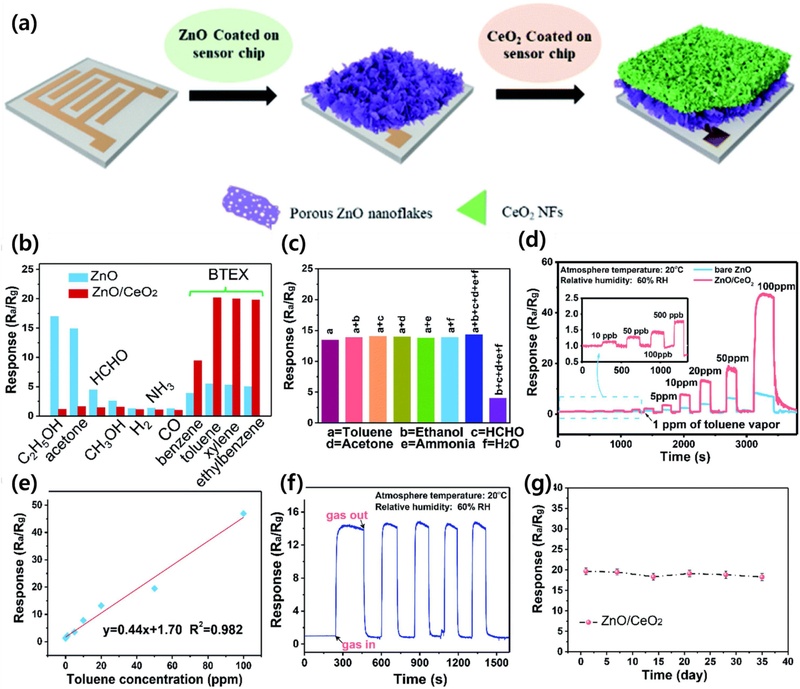
(a) Schematic illustration of the bi-layer structure of the BTEX sensor, in which an insulating CeO2 catalyst is coated onto the top-surface of the ZnO sensing layer. (b) Selectivity of ZnO-CeO2 and bare ZnO sensors towards different gases (all with identical concentrations of 50 ppm). (c) Response values of the ZnO-CeO2 sensor to a mixture of vapors (the concentrations of these gases were 20 ppm) at 200°C. (d) Response curves of the ZnO-CeO2 and bare ZnO sensors for toluene vapors with concentrations in the range of 10 ppb to 100 ppm. (e) The linear relationship between the sensing response and toluene concentration. (f) Reproducibility of the ZnO-CeO2 bi-layer sensor for 20 ppm toluene at 200°C. (g) Long-term stability testing results of the ZnO-CeO2 bi-layer sensor for 50 ppm toluene at 200°C; the time interval between two detection points is 7 days. All sensing measurements were conducted at 20°C and 60% RH. Adapted from Ref. [97].
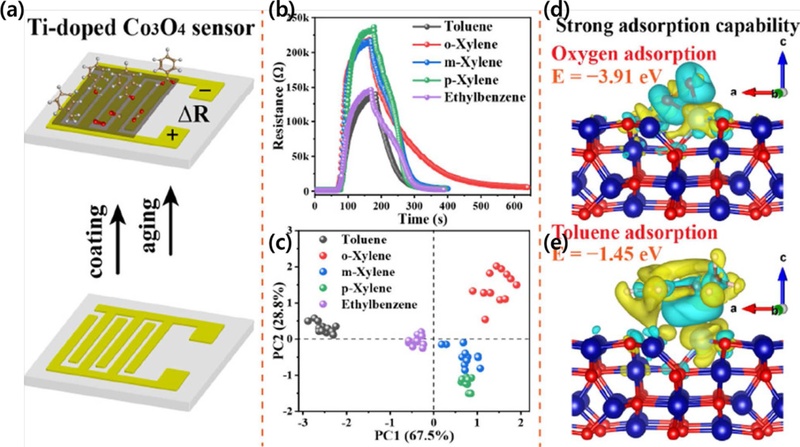
(a) Schematic illustration of the Ti-doped Co3O4 sensor. (b) Response-recovery curves of a single 3-Ti-Co3O4 sensor toward 50 ppm toluene, o-xylene, m-xylene, p-xylene, and ethylbenzene gases at 280°C. (c) PCA based on features extracted from the response-recovery curves. Adsorption configurations and charge density differences of (d) O2 and (e) Ti-doped Co3O4. Adapted from Ref. [72].
Sensing performance of the MOS-based sensor on Ethylbenzene vapor.
The main challenge in ethylbenzene vapor detection is distinguishing it from other VOCs efficiently and accurately. It is very difficult to achieve this goal through material design alone. With the continuous development of machine learning technology, based on deep learning and neural network methods, by establishing an array of sensing systems, in-depth analysis of the response characteristics of different materials and different VOCs can more efficiently and accurately achieve the goal of identifying ethylbenzene gas. And this method is also becoming a hot topic in the development of MOS sensors [13, 104-106].
2.4 Xylene gas sensors
Xylene (C8H10, dimethylbenzene) is a typical aromatic hydrocarbon with two methyl groups on its benzene ring. It is divided into three isomers: ortho-, meta-, and para-, based on the relative position of the methyl groups, but their core chemical properties are almost identical [110]. Xylene has a pungent odor and is flammable. Although it belongs to the low-toxicity class of chemicals, inhaling high concentrations over a short period can cause damage to the heart, kidneys, liver, and lungs, leading to symptoms such as headache, dizziness, nausea, vomiting, difficulty breathing, and numbness in the limbs. In severe cases, it can cause convulsions, coma, and respiratory arrest. In addition, its chronic effects on the human body mainly manifest as headaches, dizziness, fatigue, sleep disorders, decreased appetite, nosebleeds, gum bleeding, hair loss, and skin bruising. Long-term exposure may cause keratitis and chronic dermatitis, and women may experience menstrual abnormalities [110].
Motaung et al. have conducted extensive research in this field. They prepared various CuO-ZnO (0.1-1.0 wt%) heterostructures by using the hydrothermal method [111]. CuO-ZnO (1.0 wt%) disclosed an excellent selectivity towards 100 ppm of xylene and ultra-low LOD of 9.5 ppb at 100°C. The superior gas-sensing characteristics could be ascribed to the high surface area, the formation of a p-n heterojunction, the strong chemical affinity, and the catalytic performance of p-type CuO toward xylene vapor. In addition, they designed and fabricated TiO2 nanoparticles decorated with CuAg alloy nanoparticles, and the sensor based on 0.5% AgCu-loaded TiO2 displayed a remarkable response (Rg/Ra = 33.2) to 100 ppm xylene and superior selectivity at 150°C [112]. Research on spinel-structured binary metal oxide gas sensors for xylene detection has also been reported [113]. Lu and Sun et al. applied spinel-type MOS ZnCr2O4 with yolk-shell microspheres for detecting xylene vapor, which exhibited good gas-sensing performance towards xylene at 225°C [114]. The sensor based on ZnCr2O4 microspheres showed good selectivity for xylene, with a high response of 200.7 at 100 ppm. Zhang et al. synthesized a hierarchical hollow NiCo2O4 microtubule for enhanced xylene vapor sensing [115]. The NiCo2O4-based sensors not only exhibited rapid response/recovery (20/9 s) to 100 ppm xylene at a relatively low working temperature of 220°C, but also showed a low detection limit (1 ppm), high response, excellent gas selectivity, and superior long-term stability.
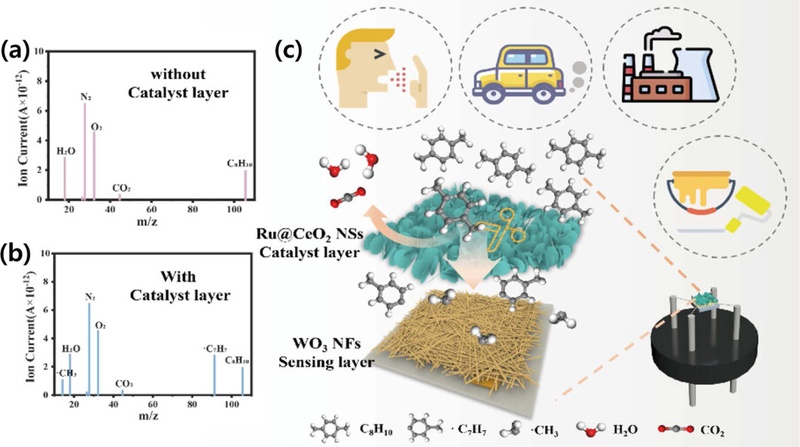
(a) Online mass spectra of mixed gases without passing through the 0.9% Ru@CeO2 layer. (b) Online mass spectra of mixed gases passing through the 0.9% Ru@CeO2 layer. (c) Gas-sensing mechanism of the WO3/Ru@CeO2 bilayer sensor. Adapted from Ref. [116].
To enhance the gas-sensing performance of MOS for xylene vapor, a special bi-layer-structured sensor that leverages the synergistic effects of catalysis and sensitivity has been developed in recent years. Wang and Ma et al. constructed catalytically sensitive synergistic bilayer sensors by using Ru@CeO2 nanosheets as the catalytic layer and WO3 nanowires as the sensitive layer [116].
The bi-layer sensor exhibited a high response of 37.04 to 5 ppm xylene, reacting significantly to low concentrations as low as 1 ppb at 160°C. This method, which leverages the synergy of catalysis and sensitivity, is highly effective at enhancing the sensor's response to xylene gas. However, the catalytic properties of Ru and CeO2 towards xylene, as well as their effectiveness towards other aromatic compounds with methyl groups, result in poor cross-selectivity. Zhang and Li et al. fabricated a bi-layer sensor consisting of an Ag@CeO2 nanosheet layer and a WO3 nanowire layer [117]. The sensor's response to 10 ppm xylene was 32.13, and it showed an exceptional response to even trace amounts, down to parts per billion (ppb). The idea of leveraging the synergistic effects of catalysis and sensitivity to enhance the gas-sensing performance of MOS gas sensors is not limited to benzene-series gases. It can be widely applied to improve the gas-sensing performance of gas sensors for other gases [118,119].
Due to xylene's relatively high chemical reactivity, numerous related studies have been conducted on MOS sensors [120-124]. As mentioned above, ethylbenzene and xylene exhibit higher activity than benzene and toluene, so the MOS sensor shows poorer selective response to ethylbenzene and xylene. Improving selectivity is a pressing challenge for xylene gas sensors. Motaung and Swart et al. developed a TiO2 nanowire with the highest concentration of oxygen vacancies and Ti3+, which could influence the dual-selectivity functionality of TiO2 nanowire toward C7H8 and C8H10 at 25 and 125°C, respectively. The sensor based on defect-rich TiO2 nanowires displayed admirable, temperature-dependent dual-functionality, selectively detecting C7H8 and C8H10 vapors with robust performance at 25 and 150°C, respectively.
Sensing performance of the MOS-based sensor on Xylene vapor.
Sensing performance of the MOS-based sensor on Aniline vapor.
2.5 Aniline gas sensors
Aniline is a vital aromatic amine compound, typically presenting as a colorless or pale-yellow liquid with a pronounced benzene-like odor [131-133]. As a typical VOC, it readily evaporates into vapor at room temperature and normal pressure. Aniline serves as a crucial chemical raw material and intermediate, boasting a broad spectrum of applications across numerous industries, including the dye, pharmaceutical, plastic, rubber, pesticide, and coatings industries [134-136]. However, aniline vapor poses substantial risks to both human health and the environment. Inhalation, skin contact, or ingestion of aniline vapor can lead to severe health consequences, such as coma, convulsions, poisoning, and even death. Additionally, some individuals may experience allergic reactions, including respiratory issues, skin itching, and eczema. From an environmental perspective, aniline vapor can contaminate air and water systems, thereby threatening the ecosystem. Its dispersal through wind or water can pollute these resources, and potential aniline leaks can further damage soil and groundwater systems, exacerbating the overall environmental impact [137-139]. Although metal oxide semiconductor (MOS) gas sensors offer the advantages of small size, fast response, and low cost, there is a fundamental bottleneck in detecting aniline: most oxides exhibit weak interactions with aniline, leading to low response values, poor selectivity, and slow response/recovery. So far, only a very small number of MOS materials have achieved effective detection [140].
Regulating the surface defects of MOS, especially oxygen vacancies, is a highly efficient method to enhance the gas sensing performance of MOS gas sensors towards aniline vapor. Chen and Zhu et al. utilized a hydrothermal method to prepare a novel ZnO precursor and focused on regulating defects by calcination at different temperatures [141]. The sensor based on ZnO nanoparticles annealing at 550°C exhibited a high response value of 69.1 to 100 ppm aniline at 217°C. Additionally, it also demonstrates good long-term stability, reproducibility, and moisture resistance. Zhang and Fang et al. investigated a 1 at% Ce-doped ZnO sensor that exhibited a high response of 15.1 to 100 ppm aniline and good selectivity at room temperature [142]. Abundant oxygen vacancies were generated in ZnO by Ce doping, thereby enhancing the sensor's gas-sensing performance for aniline vapor at room temperature. Additionally, doping and the construction of heterojunction nanostructures are effective methods to improve the gas-sensing performance of MOS gas sensors for aniline vapor. Sui and Huo fabricated a hierarchical heterostructured α-Fe2O3/α-MoO3 hollow-sphere sensor and studied its gas-sensing performance [143]. The sensor based on this hierarchical hollow sphere displayed a high response of 32.5 to 30 ppm aniline vapor and a fast response time (3.6 s) at 217°C. This heterostructured sensor not only exhibited a high response to aniline but also addressed the slow response speed of MOS gas sensors to aniline vapor. Yuan and Meng developed a novel gas sensor based on copper hydroxyfluoride-copper oxide (CuOHF)/zinc hydroxyfluoride-zinc oxide (ZHFZO) nanomaterials. They exhibited a response of 5 toward 10 ppm aniline vapor at 200°C [144]. The heterojunction composites composed of these two new materials also exhibited rapid response and recovery, with response/recovery times of 30 s. Wang et al. prepared Zn2SnO4-doped SnO2 hollow spheres by a facile one-step hydrothermal method. They fabricated a sensor based on these hollow spheres, which displayed excellent gas-sensing performance for aniline vapor (response of 4.53 at 50 ppm) at 300°C. Dong and coworkers reported preparation of ZnO-TiC composites [145]. The gas sensor fabricated by the above heterojunction composites achieved significantly higher sensitivity (232 for 100ppm aniline) at 280°C. It also displayed rapid response and recovery speed (26/5 s). Tian et al. reported the synthesis of hierarchical nanostructured rocksalt solid-solution Ni0.7Zn0.3O with hollow porous microspheres derived from Zn/Ni-based metal-organic frameworks [146]. The gas sensor based on these nanostructured Ni0.7Zn0.3O hollow spheres exhibited high sensitivity and selectivity to aniline at a low concentration of around 500 ppb at 300°C, with a rapid response/recovery speed (less than 15 s).
Luo et al. proposed a microelectromechanical systems (MEMS) gas sensor employing In2O3-decorated SnO2 nanosheets for aniline detection [147]. The results indicated that the sensor exhibited good selectivity for aniline vapor, with a response range of 7.3-70 ppm.
3. CONCLUSIONS
This review summarizes recent research on the MOS gas sensors for detecting BTEX and aniline vapors. The following conclusions and future perspectives have been drawn from a comprehensive review of MOS-based sensors for benzene-series gas detection.
Due to the presence of benzene rings, the benzene series exhibits excellent chemical stability, making them difficult to detect using MOS-based chemoresistance sensors. The main problems of MOS-based benzene-series gas sensors currently include: low sensitivity, mainly due to poor detection ability for low concentration (≤20 ppm) benzene-series gases; high working temperature, which poses safety hazards and is not conducive to the development of low-power and flexible devices; poor selectivity, which is also due to the similar chemical properties between benzene series. To address these issues, extensive research has focused on developing novel sensing materials. Precious-metal modification is an effective method for significantly enhancing the performance of MOS sensors for detecting benzene-series vapors. By modifying MOS or heterojunction nanocomposites with noble metal nanoclusters, the sensitivity of MOS can be significantly improved, and the operating temperature can be reduced. However, this method cannot address the poor selectivity of MOS sensors for detecting benzene-series gases. By leveraging the less gas-sensitive reaction characteristics of MOS to benzene-series gases and combining them with machine learning and a sensor array, the gas-sensing selectivity performance of MOS sensors to benzene-series gases can be effectively improved. We anticipate that this way of improving the selectivity and detection accuracy of MOS sensors will be an important development direction in the future.
This review summarizes recent progress and discusses future prospects for MOS gas sensors to detect benzene-series gases over the past few years. As an important chemical raw material and carcinogen, the strict monitoring and environmental testing requirements for the use of benzene derivatives will continue to increase. The detection system based on MOS sensors and deep learning will greatly advance this field.
Acknowledgments
This work was supported by the Science, Technology, and Innovation Commission of Shenzhen Municipality (No. JCYJ20240813153442055), Henan Provincial Natural Science Foundation General Project (No. 252300420391).
REFERENCES
-
D. Baskaran, D. Dhamodharan, U.S. Behera, H.-S. Byun, A comprehensive review and perspective research in technology integration for the treatment of gaseous volatile organic compounds, Environ. Res. 251 (2024) 118472.
[https://doi.org/10.1016/j.envres.2024.118472]

-
L. Zhu, D. Shen, K.H. Luo, A critical review on VOCs adsorption by different porous materials: Species, mechanisms and modification methods, J. Hazard. Mater. 389 (2020) 122102.
[https://doi.org/10.1016/j.jhazmat.2020.122102]
-
Y. Xie, S. Lyu, Y. Zhang, C. Cai, Adsorption and Degradation of Volatile Organic Compounds by Metal–Organic Frameworks (MOFs): A Review, Materials 15 (2022) 7727.
[https://doi.org/10.3390/ma15217727]
-
A.J. Li, V.K. Pal, K. Kannan, A review of environmental occurrence, toxicity, biotransformation and biomonitoring of volatile organic compounds, Environ. Chem. Ecotoxicol. 3 (2021) 91–116.
[https://doi.org/10.1016/j.enceco.2021.01.001]
-
Y. Guo, M. Wen, G. Li, T. An, Recent advances in VOC elimination by catalytic oxidation technology onto various nanoparticle catalysts: a critical review, Appl. Catal. B Environ. 281 (2021) 119447.
[https://doi.org/10.1016/j.apcatb.2020.119447]
-
U. Pöschl, M. Shiraiwa, Multiphase Chemistry at the Atmosphere–Biosphere Interface Influencing Climate and Public Health in the Anthropocene, Chem. Rev. 115 (2015) 4440–4475.
[https://doi.org/10.1021/cr500487s]
-
R. Epping, M. Koch, On-Site Detection of Volatile Organic Compounds (VOCs), Molecules 28 (2023) 1598.
[https://doi.org/10.3390/molecules28041598]
-
M. Khatib, H. Haick, Sensors for Volatile Organic Compounds, ACS Nano 16 (2022) 7080–7115.
[https://doi.org/10.1021/acsnano.1c10827]
-
Y. He, H. Qiu, W. Wang, Y. Lin, K.F. Ho, Exposure to BTEX is associated with cardiovascular disease, dyslipidemia, and leukocytosis in the national US population, Sci. Total Environ. 919 (2024) 170639.
[https://doi.org/10.1016/j.scitotenv.2024.170639]
-
Y. Bian, Y. Zhang, Y. Zhou, X.-S. Feng, BTEX in the environment: An update on sources, fate, distribution, pretreatment, analysis, and removal techniques, Chem. Eng. J. 435 (2022) 134825.
[https://doi.org/10.1016/j.cej.2022.134825]
-
C.J. Davidson, J.H. Hannigan, S.E. Bowen, Effects of inhaled combined Benzene, Toluene, Ethylbenzene, and Xylenes (BTEX): Toward an environmental exposure model, Environ. Toxicol. Pharmacol. 81 (2021) 103518.
[https://doi.org/10.1016/j.etap.2020.103518]
-
D.R. Joshi, N. Adhikari, An Overview on Common Organic Solvents and Their Toxicity, J. Pharm. Res. Int. 28 (2019) 1–18.
[https://doi.org/10.9734/jpri/2019/v28i330203]
-
M. Hashemitaheri, E. Ebrahimi, G. de Silva, H. Attariani, Optical sensor for BTEX detection: Integrating machine learning for enhanced sensing, Adv. Sens. Energy Mater. 3 (2024) 100114.
[https://doi.org/10.1016/j.asems.2024.100114]
-
H.-C. Shu, Y.-S. Chen, Z.-X. Huang, Titanium dioxide nanotube fiber used in headspace solid-phase microextraction with GC–MS for BTEX detection, J. Chin. Chem. Soc. 70 (2023) 2005–2015.
[https://doi.org/10.1002/jccs.202300276]
-
D. Zhang, Z. Yang, S. Yu, Q. Mi, Q. Pan, Diversiform metal oxide-based hybrid nanostructures for gas sensing with versatile prospects, Coord. Chem. Rev. 413 (2020) 213272.
[https://doi.org/10.1016/j.ccr.2020.213272]
-
H. Nazemi, A. Joseph, J. Park, A. Emadi, Advanced Micro-and Nano-Gas Sensor Technology: A Review, Sensors 19 (2019) 1285.
[https://doi.org/10.3390/s19061285]
-
C. Zhang, L. Qian, W. Zeng, MOS-based gas sensor in detection of volatile organic compounds: A review, Sens. Actuators A Phys. 393 (2025) 116818.
[https://doi.org/10.1016/j.sna.2025.116818]
-
T. Dunker, A.M. Ferber, H. Sagberg, K.A. Hestnes Bakke, Critical review of potential technologies for a wearable benzene sensor system, Sens. Actuators Rep. 8 (2024) 100210.
[https://doi.org/10.1016/j.snr.2024.100210]
-
W. Zhang, H. Ma, T. Li, C. He, Rational design of a novel two-dimensional porous metal-organic framework material for efficient benzene sensor, Chin. Chem. Lett. 33 (2022) 3726–3732.
[https://doi.org/10.1016/j.cclet.2021.11.002]
-
K.G. Krishna, S.R. Parne, P. Nagaraju, Room temperature benzene gas sensing with spinal copper ferrite and copper cerium oxide nanocomposite sensors, Microchem. J. 215 (2025) 114278.
[https://doi.org/10.1016/j.microc.2025.114278]
-
H. Hosseinzadeh asl, G. Tohidi, F. Movahedi, E. Hassannayebi, Optimization and modeling of Zn2SnO4 sensitivity as gas sensor for detection benzene in the air by using the response surface methodology, J. Saudi Chem. Soc. 25 (2021) 101371.
[https://doi.org/10.1016/j.jscs.2021.101371]
-
L. Wang, R. Zhang, T. Zhou, Z. Lou, J. Deng, T. Zhang, Concave Cu2O octahedral nanoparticles as an advanced sensing material for benzene (C6H6) and nitrogen dioxide (NO2) detection, Sens. Actuators B Chem. 223 (2016) 311–317.
[https://doi.org/10.1016/j.snb.2015.09.114]
-
W. Guo, Q. Zhou, J. Zhang, M. Fu, N. Radacsi, Y. Li, Hydrothermal synthesis of Bi-doped SnO2/rGO nanocomposites and the enhanced gas sensing performance to benzene, Sens. Actuators B Chem. 299 (2019) 126959.
[https://doi.org/10.1016/j.snb.2019.126959]
-
J. Huang, L. Wang, C. Gu, Z. Wang, Y. Sun, J.-J. Shim, Preparation of porous SnO2 microcubes and their enhanced gas-sensing property, Sens. Actuators B Chem. 207 (2015) 782–790.
[https://doi.org/10.1016/j.snb.2014.10.128]
-
C. Song, C. Li, Y. Yin, J. Xiao, X. Zhang, M. Song, et al., Preparation and gas sensing properties of partially broken WO3 nanotubes, Vacuum 114 (2015) 13–16.
[https://doi.org/10.1016/j.vacuum.2014.12.019]
-
L.M. Maebana, Z.P. Tshabalala, H.C. Swart, N. Leshabane, L.J.B. Erasmus, D.E. Motaung, Comparison study on ZnO and CuO gas sensing characteristics: Temperature modulated-dual selectivity towards benzene and xylene vapours, Mater. Chem. Phys. 297 (2023) 127352.
[https://doi.org/10.1016/j.matchemphys.2023.127352]
-
R. Makole, Z.P. Tshabalala, H.C. Swart, L. Coetsee-Hugo, N. Leshabane, D.E. Motaung, Fabrication of one-dimensional porous p-type Co3O4 rods-based sensors for ultra-high sensitivity and selectivity towards benzene vapour, Mater. Today Commun. 38 (2024) 108426.
[https://doi.org/10.1016/j.mtcomm.2024.108426]
-
D. Wang, D. Zhang, Q. Mi, A high-performance room temperature benzene gas sensor based on CoTiO3 covered TiO2 nanospheres decorated with Pd nanoparticles, Sens. Actuators B Chem. 350 (2022) 130830.
[https://doi.org/10.1016/j.snb.2021.130830]
-
T.-Y. Yang, G.-X. Yu, J. Liu, X. Li, L. Chen, Z. Guo, Bimetallic Au-Pt nanoparticle-supported ZnO porous nanobelts for selective gas sensing enhancement to benzene, Sens. Actuators B Chem. 426 (2025) 137125.
[https://doi.org/10.1016/j.snb.2024.137125]
-
T.J. Theka, B.R.J. Thamaga, Z.P. Tshabalala, R.G. Motsoeneng, H.C. Swart, D.E. Motaung, Fabrication of metal-organic frameworks derived Co3O4 loaded on TiO2: Influence of Fe loading on the Co3O4/TiO2 heterostructure for low-ppm benzene detection, Appl. Surf. Sci. 644 (2024) 158789.
[https://doi.org/10.1016/j.apsusc.2023.158789]
-
B.R.J. Thamaga, T.J. Theka, R.G. Motsoeneng, K.L. Morulane, J. Lemena, H.C. Swart, et al., Facile fabrication of p-n heterostructure based on Pt/NiO-CeO2 nanosheet-assembled hierarchical structures for selective detection of benzene vapour, Surf. Interfaces 61 (2025) 106131.
[https://doi.org/10.1016/j.surfin.2025.106131]
-
Y.K. Moon, S.-Y. Jeong, Y.-M. Jo, Y.K. Jo, Y.C. Kang, J.-H. Lee, Highly Selective Detection of Benzene and Discrimination of Volatile Aromatic Compounds Using Oxide Chemiresistors with Tunable Rh-TiO2 Catalytic Overlayers, Adv. Sci. 8 (2021) 2004078.
[https://doi.org/10.1002/advs.202004078]
-
V. Manikandan, A. Kadian, K. Dev, S. Annapoorni, Room temperature benzene gas sensing properties based on Sr-substituted ceria oxide nanopetals, J. Environ. Chem. Eng. 12 (2024) 112205.
[https://doi.org/10.1016/j.jece.2024.112205]
-
C. Ge, C. Xie, S. Cai, Preparation and gas-sensing properties of Ce-doped ZnO thin-film sensors by dip-coating, Mater. Sci. Eng. B 137 (2007) 53–58.
[https://doi.org/10.1016/j.mseb.2006.10.006]
-
M. Venkatraman, A. Kadian, S. Choudhary, A. Subramanian, A. Singh, S. Sikarwar, Ultra-Fast Benzene Gas (C6H6) Detection Characteristics of Cobalt-Doped Aluminum Oxide Sensors, ChemistrySelect 8 (2023) e202204531.
[https://doi.org/10.1002/slct.202204531]
-
M.-T. Ke, M.-T. Lee, C.-Y. Lee, L.-M. Fu, A MEMS-based Benzene Gas Sensor with a Self-heating WO3 Sensing Layer, Sensors 9 (2009) 2895–2906.
[https://doi.org/10.3390/s90402895]
-
D. Zhang, Y. Fan, G. Li, Z. Ma, X. Wang, Z. Cheng, et al., Highly sensitive BTEX sensors based on hexagonal WO3 nanosheets, Sens. Actuators B Chem. 293 (2019) 23–30.
[https://doi.org/10.1016/j.snb.2019.04.110]
-
F. Ren, L. Gao, Y. Yuan, Y. Zhang, A. Alqrni, O.M. Al-Dossary, et al., Enhanced BTEX gas-sensing performance of CuO/SnO2 composite, Sens. Actuators B Chem. 223 (2016) 914–920.
[https://doi.org/10.1016/j.snb.2015.09.140]
-
S.-S. Chen, X.-X. Chen, T.-Y. Yang, L. Chen, Z. Guo, X.-J. Huang, Temperature-modulated sensing characteristics of ultrafine Au nanoparticle-loaded porous ZnO nanobelts for identification and determination of BTEX, J. Hazard. Mater. 463 (2024) 132940.
[https://doi.org/10.1016/j.jhazmat.2023.132940]
-
J.-H. Kim, H.W. Kim, S.S. Kim, Ultra-sensitive benzene detection by a novel approach: Core-shell nanowires combined with the Pd-functionalization, Sens. Actuators B Chem. 239 (2017) 578–585.
[https://doi.org/10.1016/j.snb.2016.08.071]
-
Y.J. Kwon, S.-W. Choi, S.Y. Kang, M.S. Choi, J.H. Bang, S.S. Kim, et al., Enhancement of the benzene-sensing performance of Si nanowires through the incorporation of TeO2 heterointerfaces and Pd-sensitization, Sens. Actuators B Chem. 244 (2017) 1085–1097.
[https://doi.org/10.1016/j.snb.2017.01.078]
-
J.-H. Kim, A. Mirzaei, H.W. Kim, S.S. Kim, Pd-functionalized core-shell composite nanowires for self-heating, sensitive, and benzene-selective gas sensors, Sens. Actuators A Phys. 308 (2020) 112011.
[https://doi.org/10.1016/j.sna.2020.112011]
-
Y. Kang, K. Kim, B. Cho, Y. Kwak, J. Kim, Highly Sensitive Detection of Benzene, Toluene, and Xylene Based on CoPP-Functionalized TiO2 Nanoparticles with Low Power Consumption, ACS Sens. 5 (2020) 754–763.
[https://doi.org/10.1021/acssensors.9b02310]
-
L. Wang, S. Wang, M. Xu, X. Hu, H. Zhang, Y. Wang, et al., A Au-functionalized ZnO nanowire gas sensor for detection of benzene and toluene, Phys. Chem. Chem. Phys. 15 (2013) 17179–17186.
[https://doi.org/10.1039/c3cp52392f]
-
S.-Y. Jeong, J.-W. Yoon, T.-H. Kim, H.-M. Jeong, C.-S. Lee, Y.C. Kang, et al., Ultra-selective detection of sub-ppm-level benzene using Pd–SnO2 yolk–shell micro-reactors with a catalytic Co3O4 overlayer for monitoring air quality, J. Mater. Chem. A 5 (2017) 1446–1454.
[https://doi.org/10.1039/C6TA09397C]
-
D. Zhang, C. Jiang, X. Zhou, Fabrication of Pd-decorated TiO2/MoS2 ternary nanocomposite for enhanced benzene gas sensing performance at room temperature, Talanta 182 (2018) 324–332.
[https://doi.org/10.1016/j.talanta.2018.01.064]
-
T.P. Mokoena, H.C. Swart, K.T. Hillie, D.E. Motaung, Engineering of rare-earth Eu3+ ions doping on p-type NiO for selective detection of toluene gas sensing and luminescence properties, Sens. Actuators B Chem. 347 (2021) 130530.
[https://doi.org/10.1016/j.snb.2021.130530]
-
Z. Shen, X. Guo, W. Chai, D. Jin, H. Jin, Mesoporous SnO2@Co3O4 Core–Shell Nanospheres for High-Performance Toluene Gas Sensors, ACS Appl. Nano Mater. 8 (2025) 16026–16039.
[https://doi.org/10.1021/acsanm.5c02774]
-
F.C. Paciencia, R.d.S. Theodoro, G.S.M. Santos, T.M. Perfecto, D.P. Volanti, Micrometric Co3O4/ZIF-67 with high toluene detection capability, Mater. Sci. Semicond. Process. 192 (2025) 109459.
[https://doi.org/10.1016/j.mssp.2025.109459]
-
T.-H. Kim, S.-Y. Jeong, Y.K. Moon, J.-H. Lee, Dual-mode gas sensor for ultrasensitive and highly selective detection of xylene and toluene using Nb-doped NiO hollow spheres, Sens. Actuators B Chem. 301 (2019) 127140.
[https://doi.org/10.1016/j.snb.2019.127140]
-
R. Zhang, S. Gao, T. Zhou, J. Tu, T. Zhang, Facile preparation of hierarchical structure based on p-type Co3O4 as toluene detecting sensor, Appl. Surf. Sci. 503 (2020) 144167.
[https://doi.org/10.1016/j.apsusc.2019.144167]
-
R. Thayil, S.R. Parne, Tuning MoS2 nanostructures for superior room-temperature toluene sensing, Talanta Open 11 (2025) 100402.
[https://doi.org/10.1016/j.talo.2025.100402]
-
D. Wang, J. Hu, H. Xu, D. Wang, G. Li, Construction of 2D TiO2@MoS2 Heterojunction Nanosheets for Efficient Toluene Gas Detection, Chemosensors 13 (2025) 154.
[https://doi.org/10.3390/chemosensors13050154]
-
T. Joutsuka, S. Ishiguro, K. Kuryu, M. Mori, H. Aono, H. Yamaura, et al., Synergistic effects of Au nanoparticles in SmFeO3-based p-type semiconductors for ethanol and toluene detection, Sens. Actuators B Chem. 442 (2025) 138142.
[https://doi.org/10.1016/j.snb.2025.138142]
-
L. Ma, Y. Zou, Q. Feng, Z. Li, Q. Liang, G.-D. Li, Pd nanoparticles-functionalized In2O3 based gas sensor for highly selective detection of toluene, Talanta 287 (2025) 127682.
[https://doi.org/10.1016/j.talanta.2025.127682]
-
S.P. Subin David, S. Veeralakshmi, J. Sandhya, S. Nehru, S. Kalaiselvam, Room temperature operatable high sensitive toluene gas sensor using chemiresistive Ag/Bi2O3 nanocomposite, Sensor Actuat B Chem. 320 (2020) 128410.
[https://doi.org/10.1016/j.snb.2020.128410]
-
J. Hong, K. Chen, K. Yuan, M. Lin, Q. Cao, J. Lin, et al., Detection of toluene at ppb levels using Au catalyst supported on Al-doped ZnO, J. Environ. Chem. Eng. 13 (2025) 117422.
[https://doi.org/10.1016/j.jece.2025.117422]
-
J.-H. Kim, J.-H. Lee, Y. Park, J.-Y. Kim, A. Mirzaei, H.W. Kim, et al., Toluene- and benzene-selective gas sensors based on Pt- and Pd-functionalized ZnO nanowires in self-heating mode, Sens. Actuators B Chem. 294 (2019) 78–88.
[https://doi.org/10.1016/j.snb.2019.05.032]
-
J. Yan, Y. Kang, W. Fang, B. Zhu, Z. Song, Tuning Gas Sensing Properties through Metal-Nanocluster Functionalization of 3D SnO2 Nanotube Arrays for Selective Gas Detection, ACS Sens. 10 (2025) 6084–6094.
[https://doi.org/10.1021/acssensors.5c01699]
-
H. Hwang, H. Bae, E. Ahn, D. Lee, H.H. Cho, S. Cheong, et al., TiO2 Nanohelices Decorated with Homogeneous Au-Core Pd-Shell Nanocatalysts for Selective Toluene Gas Detection, Small 21 (2025) 2504976.
[https://doi.org/10.1002/smll.202504976]
-
Z. Cai, J. Park, S. Park, Porous In2O3–ZnO nanofiber-based sensor for ultrasensitive room-temperature detection of toluene gas under UV illumination, J. Mater. Res. Technol. 24 (2023) 2482–2499.
[https://doi.org/10.1016/j.jmrt.2023.03.162]
-
Y.J. Kwon, H.G. Na, S.Y. Kang, S.-W. Choi, S.S. Kim, H.W. Kim, Selective detection of low concentration toluene gas using Pt-decorated carbon nanotubes sensors, Sens. Actuators B Chem. 227 (2016) 157–168.
[https://doi.org/10.1016/j.snb.2015.12.024]
-
J.-H. Kim, H. Park, A. Mirzaei, M.G. Hahm, S. Ahn, M. Halik, et al., How femtosecond laser irradiation can affect the gas sensing behavior of SnO2 nanowires toward reducing and oxidizing gases, Sens. Actuators B Chem. 342 (2021) 130036.
[https://doi.org/10.1016/j.snb.2021.130036]
-
L. Wang, J. Deng, Z. Lou, T. Zhang, Nanoparticles-assembled Co3O4 nanorods p-type nanomaterials: One-pot synthesis and toluene-sensing properties, Sens. Actuators B Chem. 201 (2014) 1–6.
[https://doi.org/10.1016/j.snb.2014.04.074]
-
Q. Qi, T. Zhang, L. Liu, X. Zheng, Synthesis and toluene sensing properties of SnO2 nanofibers, Sens. Actuators B Chem. 137 (2009) 471–475.
[https://doi.org/10.1016/j.snb.2008.11.042]
-
C. Dong, X. Liu, X. Xiao, S. Du, Y. Wang, Monodisperse ZnFe2O4 nanospheres synthesized by a nonaqueous route for a highly selective low-ppm-level toluene gas sensor, Sens. Actuators B Chem. 239 (2017) 1231–1236.
[https://doi.org/10.1016/j.snb.2016.09.122]
-
H. Zhang, J. Hu, M. Li, Z. Li, Y. Yuan, X. Yang, et al., Highly efficient toluene gas sensor based on spinel structured hollow urchin-like core-shell ZnFe2O4 spheres, Sens. Actuators B Chem. 349 (2021) 130734.
[https://doi.org/10.1016/j.snb.2021.130734]
-
Y.-L. Zhang, C.-W. Jia, R.-N. Tian, H.-T. Guan, G. Chen, C.-J. Dong, Hierarchical flower-like NiFe2O4 wit h core–shell structure for excellent toluene detection, Rare Met. 40 (2021) 1578–1587.
[https://doi.org/10.1007/s12598-020-01547-6]
-
S. Liu, Z. Wang, H. Zhao, T. Fei, T. Zhang, Ordered mesoporous Co3O4 for high-performance toluene sensing, Sens. Actuators B Chem. 197 (2014) 342–349.
[https://doi.org/10.1016/j.snb.2014.03.007]
-
X. Ding, D. Zeng, S. Zhang, C. Xie, C-doped WO3 microtubes assembled by nanoparticles with ultrahigh sensitivity to toluene at low operating temperature, Sens. Actuators B Chem. 155 (2011) 86–92.
[https://doi.org/10.1016/j.snb.2010.11.030]
-
Z. Cao, W. Wang, H. Ma, L. Xiao, J. Li, Y. Sun, et al., Porous Mn-doped Co3O4 nanosheets: Gas sensing performance and interfacial mechanism investigation with In situ DRIFTS, Sens. Actuators B Chem. 353 (2022) 131155.
[https://doi.org/10.1016/j.snb.2021.131155]
-
Z. Cao, Y. Ge, W. Wang, J. Sheng, Z. Zhang, J. Li, et al., Chemical Discrimination of Benzene Series and Molecular Recognition of the Sensing Process over Ti-Doped Co3O4, ACS Sens. 7 (2022) 1757–1765.
[https://doi.org/10.1021/acssensors.2c00685]
-
Z. Li, S. Li, Z. Song, X. Yang, Z. Wang, H. Zhang, et al., Influence of Nickel Doping on Ultrahigh Toluene Sensing Performance of Core-Shell ZnO Microsphere Gas Sensor, Chemosensors 10 (2022) 327.
[https://doi.org/10.3390/chemosensors10080327]
-
T. Wang, S. Liu, P. Sun, Y. Wang, K. Shimanoe, G. Lu, Unexpected and enhanced electrostatic adsorption capacity of oxygen vacancy-rich cobalt-doped In2O3 for high-sensitive MEMS toluene sensor, Sens. Actuators B Chem. 342 (2021) 129949.
[https://doi.org/10.1016/j.snb.2021.129949]
-
K. Suematsu, K. Watanabe, A. Tou, Y. Sun, K. Shimanoe, Ultraselective Toluene-Gas Sensor: Nanosized Gold Loaded on Zinc Oxide Nanoparticles, Anal. Chem. 90 (2018) 1959–1966.
[https://doi.org/10.1021/acs.analchem.7b04048]
-
H. Peng, Y. Liu, Y. Shen, L. Xu, J. Lu, M. Li, et al., Highly Sensitive and Selective Toluene Gas Sensors Based on ZnO Nanoflowers Decorated with Bimetallic AuPt, Molecules 29 (2024) 1657.
[https://doi.org/10.3390/molecules29071657]
-
K. Zhang, X. Yang, Y. Wang, Y. Bing, L. Qiao, Z. Liang, et al., Pd-loaded SnO2 ultrathin nanorod-assembled hollow microspheres with the significant improvement for toluene detection, Sens. Actuators B Chem. 243 (2017) 465–474.
[https://doi.org/10.1016/j.snb.2016.11.153]
-
F. Li, C. Li, L. Zhu, W. Guo, L. Shen, S. Wen, et al., Enhanced toluene sensing performance of gold-functionalized WO3·H2O nanosheets, Sens. Actuators B Chem. 223 (2016) 761–767.
[https://doi.org/10.1016/j.snb.2015.10.005]
-
N.-H. Kim, S.-J. Choi, D.-J. Yang, J. Bae, J. Park, I.-D. Kim, Highly sensitive and selective hydrogen sulfide and toluene sensors using Pd functionalized WO3 nanofibers for potential diagnosis of halitosis and lung cancer, Sens. Actuators B Chem. 193 (2014) 574–581.
[https://doi.org/10.1016/j.snb.2013.12.011]
-
Y. Zhang, D. Li, L. Qin, D. Liu, Y. Liu, F. Liu, et al., Preparation of Au-loaded TiO2 pecan-kernel-like and its enhanced toluene sensing performance, Sens. Actuators B Chem. 255 (2018) 2240–2247.
[https://doi.org/10.1016/j.snb.2017.09.023]
-
L. Qiao, Y. Bing, Y. Wang, S. Yu, Z. Liang, Y. Zeng, Enhanced toluene sensing performances of Pd-loaded SnO2 cubic nanocages with porous nanoparticle-assembled shells, Sens. Actuators B Chem. 241 (2017) 1121–1129.
[https://doi.org/10.1016/j.snb.2016.10.024]
-
S. Zhang, Y. Wang, F. Qu, T. Thomas, M. Yang, In2O3 nanocubes modified with RuO2 for detection of TXM vapors containing benzyl group, Sens. Actuators B Chem. 338 (2021) 129731.
[https://doi.org/10.1016/j.snb.2021.129731]
-
Z. Lou, J. Deng, L. Wang, L. Wang, T. Fei, T. Zhang, Toluene and ethanol sensing performances of pristine and PdO-decorated flower-like ZnO structures, Sens. Actuators B Chem. 176 (2013) 323–329.
[https://doi.org/10.1016/j.snb.2012.09.027]
-
L. Liu, Y. Zhang, G. Wang, S. Li, L. Wang, Y. Han, et al., High toluene sensing properties of NiO–SnO2 composite nanofiber sensors operating at 330°C, Sens. Actuators B Chem. 160 (2011) 448–454.
[https://doi.org/10.1016/j.snb.2011.08.007]
-
H. Shan, C. Liu, L. Liu, J. Zhang, H. Li, Z. Liu, et al., Excellent Toluene Sensing Properties of SnO2–Fe2O3 Interconnected Nanotubes, ACS Appl. Mater. Interfaces 5 (2013) 6376–6380.
[https://doi.org/10.1021/am4015082]
-
J. Li, L. Wang, H. Liu, J. Zhao, X. Li, H. Wei, et al., Synthesis and enhanced toluene gas sensing properties of 1-D α-MoO3/Fe2(MoO4)3 heterostructure, J. Alloys Compd. 694 (2017) 939–945.
[https://doi.org/10.1016/j.jallcom.2016.10.142]
-
Y. Zeng, T. Zhang, L. Wang, M. Kang, H. Fan, R. Wang, et al., Enhanced toluene sensing characteristics of TiO2-doped flowerlike ZnO nanostructures, Sens. Actuators B Chem. 140 (2009) 73–78.
[https://doi.org/10.1016/j.snb.2009.03.071]
-
S. Wei, Y. Zhang, M. Zhou, Toluene sensing properties of SnO2–ZnO hollow nanofibers fabricated from single capillary electrospinning, Solid State Commun. 151 (2011) 895–899.
[https://doi.org/10.1016/j.ssc.2011.03.031]
-
Y. Bing, C. Liu, L. Qiao, Y. Zeng, S. Yu, Z. Liang, et al., Multistep synthesis of non-spherical SnO2@SnO2 yolk-shell cuboctahedra with nanoparticle-assembled porous structure for toluene detection, Sens. Actuators B Chem. 231 (2016) 365–375.
[https://doi.org/10.1016/j.snb.2016.03.048]
-
J. Shi, J. Xiong, L. Qiao, C. Liu, Y. Zeng, Facile MOF-on-MOF isomeric strategy for ZnO@Co3O4 single-shelled hollow cubes with high toluene detection capability, Appl. Surf. Sci. 609 (2023) 155271.
[https://doi.org/10.1016/j.apsusc.2022.155271]
-
L. Nie, G. Fan, A. Wang, L. Zhang, J. Guan, N. Han, et al., Finely dispersed and highly toluene sensitive NiO/NiGa2O4 heterostructures prepared from layered double hydroxides precursors, Sens. Actuators B Chem. 345 (2021) 130412.
[https://doi.org/10.1016/j.snb.2021.130412]
-
H. Gao, L. Zhao, L. Wang, P. Sun, H. Lu, F. Liu, et al., Ultrasensitive and low detection limit of toluene gas sensor based on SnO2-decorated NiO nanostructure, Sens. Actuators B Chem. 255 (2018) 3505–3515.
[https://doi.org/10.1016/j.snb.2017.09.184]
-
J.M. Suh, Y.-S. Shim, D.H. Kim, W. Sohn, Y. Jung, S.Y. Lee, et al., Synergetically Selective Toluene Sensing in Hematite-Decorated Nickel Oxide Nanocorals, Adv. Mater. Technol. 2 (2017) 1600259.
[https://doi.org/10.1002/admt.201600259]
-
C. Wang, X. Cheng, X. Zhou, P. Sun, X. Hu, K. Shimanoe, et al., Hierarchical α-Fe2O3/NiO Composites with a Hollow Structure for a Gas Sensor, ACS Appl. Mater. Interfaces 6 (2014) 12031–12037.
[https://doi.org/10.1021/am501063z]
-
A. Hermawan, Y. Asakura, M. Inada, S. Yin, A facile method for preparation of uniformly decorated-spherical SnO2 by CuO nanoparticles for highly responsive toluene detection at high temperature, J. Mater. Sci. Technol. 51 (2020) 119–129.
[https://doi.org/10.1016/j.jmst.2020.02.041]
-
T. Liu, Z. Yu, Y. Liu, J. Gao, X. Wang, H. Suo, et al., Gas sensor based on Ni foam: SnO2-decorated NiO for Toluene detection, Sens. Actuators B Chem. 318 (2020) 128167.
[https://doi.org/10.1016/j.snb.2020.128167]
-
D. Wang, Y. Yin, P. Xu, F. Wang, P. Wang, J. Xu, et al., The catalytic-induced sensing effect of triangular CeO2 nanoflakes for enhanced BTEX vapor detection with conventional ZnO gas sensors, J. Mater. Chem. A 8 (2020) 11188–11194.
[https://doi.org/10.1039/D0TA01708F]
-
J.-H. Kim, S.S. Kim, Realization of ppb-Scale Toluene-Sensing Abilities with Pt-Functionalized SnO2–ZnO Core–Shell Nanowires, ACS Appl. Mater. Interfaces 7 (2015) 17199–17208.
[https://doi.org/10.1021/acsami.5b04066]
-
W. Liu, L. Xu, K. Sheng, X. Zhou, X. Zhang, C. Chen, et al., Facile synthesis of controllable TiO2 composite nanotubes via templating route: Highly sensitive detection of toluene by double driving from Pt@ZnO NPs, Sens. Actuators B Chem. 273 (2018) 1676–1686.
[https://doi.org/10.1016/j.snb.2018.07.083]
-
X.-Y. Yang, J.-Y. Yuan, L.-J. Yue, K.-F. Xie, F.-L. Gong, S.-Z. Wei, et al., Electronic and surface structure engineering of oxygen vacancies-riched WO3 nanosheets toward highly efficient BTEX sensing, Sens. Actuators B Chem. 405 (2024) 135357.
[https://doi.org/10.1016/j.snb.2024.135357]
-
Z.P. Tshabalala, T.P. Mokoena, K.T. Hillie, H.C. Swart, D.E. Motaung, Improved BTEX gas sensing characteristics of thermally treated TiO2 hierarchical spheres manifested by high-energy {001} crystal facets, Sens. Actuators B Chem. 338 (2021) 129774.
[https://doi.org/10.1016/j.snb.2021.129774]
-
R. Makole, H.C. Swart, M.-M. Duvenhage, D.E. Motaung, Selectivity towards xylene and ethylbenzene detection induced by synergistic effects of Sm3+ and Yb3+ on p-n heterostructure nanorods of Co3O4-In2O3, Surf. Interfaces 51 (2024) 104637.
[https://doi.org/10.1016/j.surfin.2024.104637]
-
X.-Y. Yang, J.-Y. Yuan, L.-J. Yue, F.-L. Gong, K.-F. Xie, S.-Z. Wei, et al., Oxygen Vacancy Enabled Electronic Structure Engineering of Pt-WO3 Nanosheets toward Highly Efficient BTEX Sensing, ACS Sens. 9 (2024) 4107–4118.
[https://doi.org/10.1021/acssensors.4c01050]
-
J. Liu, J. Sun, L. Zhu, J. Zhang, X. Yang, Y. Zhang, et al., Advancements and Strategies for Selectivity Enhancement in Chemiresistive Gas Sensors, Nanomaterials 15 (2025) 1381.
[https://doi.org/10.3390/nano15171381]
-
A. Turlybekuly, Y. Shynybekov, B. Soltabayev, G. Yergaliuly, A. Mentbayeva, The Cross-Sensitivity of Chemiresistive Gas Sensors: Nature, Methods, and Peculiarities: A Systematic Review, ACS Sens. 9 (2024) 6358–6371.
[https://doi.org/10.1021/acssensors.4c02097]
-
H. Mei, J. Peng, T. Wang, T. Zhou, H. Zhao, T. Zhang, et al., Overcoming the Limits of Cross-Sensitivity: Pattern Recognition Methods for Chemiresistive Gas Sensor Array, Nano-Micro Lett. 16 (2024) 269.
[https://doi.org/10.1007/s40820-024-01489-z]
-
J. Gounder Thangamani, S.K. Khadheer Pasha, Hydrothermal synthesis of copper (׀׀) oxide-nanoparticles with highly enhanced BTEX gas sensing performance using chemiresistive sensor, Chemosphere 277 (2021) 130237.
[https://doi.org/10.1016/j.chemosphere.2021.130237]
-
H. Qin, Y. Cao, J. Xie, H. Xu, D. Jia, Solid-state chemical synthesis and xylene-sensing properties of α-MoO3 arrays assembled by nanoplates, Sens. Actuators B Chem. 242 (2017) 769–776.
[https://doi.org/10.1016/j.snb.2016.11.081]
-
F. Zhang, X. Wang, J. Dong, N. Qin, J. Xu, Select ive BTEX sensor based on a SnO2/V2O5 composite, Sens. Actuators B Chem. 186 (2013) 126–131.
[https://doi.org/10.1016/j.snb.2013.05.086]
-
M. Hjiri, Strategies to detect xylene gas using chemoresistive gas sensors: An overview, J. Ind. Eng. Chem. 139 (2024) 56–73.
[https://doi.org/10.1016/j.jiec.2024.05.009]
-
L.M. Maebana, R.G. Motsoeneng, Z.P. Tshabalala, H.C. Swart, F.R. Cummings, M. Jozela, et al., Low-operational temperature for selective detection of xylene gas using a p-n CuO-ZnO heterostructure-based sensor, J. Alloys Compd. 960 (2023) 170683.
[https://doi.org/10.1016/j.jallcom.2023.170683]
-
P.J. Maake, T.P. Mokoena, A.S. Bolokang, N. Hintsho-Mbita, J. Tshilongo, F.R. Cummings, et al., Fabrication of AgCu/TiO2 nanoparticle-based sensors for selective detection of xylene vapor, Mater. Adv. 3 (2022) 7302–7318.
[https://doi.org/10.1039/D2MA00587E]
-
S. Tripathy, J. Rodrigues, N.G. Shimpi, Hydrothermal–Ultrasonication Synthesis of NiFe2O4 Nanospheres for Temperature-Controlled Xylene Gas Sensor, Chemistry Select 10 (2025) e202500146.
[https://doi.org/10.1002/slct.202500146]
-
L. Zhao, C. Zhou, Y. Zhou, T. Wang, F. Liu, X. Yan, et al., Simple preparation of yolk-shell ZnCr2O4 microspheres and their application to xylene gas sensor, Sens. Actuators B Chem. 390 (2023) 133929.
[https://doi.org/10.1016/j.snb.2023.133929]
-
L. Du, X. Song, X. Liang, Y. Liu, M. Zhang, Formation of NiCo2O4 hierarchical tubular nanostructures for enhanced xylene sensing properties, Appl. Surf. Sci. 526 (2020) 146706.
[https://doi.org/10.1016/j.apsusc.2020.146706]
-
R. Qin, Q. Yuan, J. Yu, J. Hu, W. Zhang, Y. Wang, et al., WO3/Ru@CeO2 Bilayer Gas Sensor for ppb-Level Xylene Detection Based on a Catalytic-Sensitive Synergistic Mechanism, ACS Appl. Mater. Interfaces 17 (2025) 16920–16931.
[https://doi.org/10.1021/acsami.4c23012]
-
D. Wang, R.-J. Qin, J.-J. Yu, J.-W. Hu, W.-H. Zhang, H. Xu, et al., Bilayer cascade of WO3 nanofibers/Ag@CeO2 nanosheets for ppb-level xylene detection under the catalysis-gas sensitivity synergistic mechanism, Rare Met. 44 (2025) 4868–4880.
[https://doi.org/10.1007/s12598-025-03286-y]
-
H.-Y. Li, Z.-X. Cai, J.-C. Ding, X. Guo, Gigantically enhanced NO sensing properties of WO3/SnO2 double layer sensors with Pd decoration, Sens. Actuators B Chem. 220 (2015) 398–405.
[https://doi.org/10.1016/j.snb.2015.05.091]
-
K. Tian, K. Yang, W. Zhao, Z.-X. Li, Y.-J. Zheng, Z.-Z. Dong, et al., Revealing the gas sensing enhancement mechanism of NiO/WO3 bilayer gas sensors to triethylamine via GC–MS, Microchem. J. 209 (2025) 112853.
[https://doi.org/10.1016/j.microc.2025.112853]
-
J. Cao, S. Wang, J. Li, Y. Xing, X. Zhao, D. Li, Porous nanosheets assembled Co3O4 hierarchical architectures for enhanced BTX (Benzene, Toluene and Xylene) gas detection, Sens. Actuators B Chem. 315 (2020) 128120.
[https://doi.org/10.1016/j.snb.2020.128120]
-
W. Jiang, L. Meng, S. Zhang, X. Chuai, Z. Zhou, C. Hu, et al., Design of highly sensitive and selective xylene gas sensor based on Ni-doped MoO3 nano-pompon, Sens. Actuators B Chem. 299 (2019) 126888.
[https://doi.org/10.1016/j.snb.2019.126888]
-
M. Zhou, X. Li, Q. Wang, In Situ Growth of Nanorod-Assembled SnWO4 via AACVD for ppb Level Xylene Gas Sensor, J. Electron. Mater. 54 (2025) 348–360.
[https://doi.org/10.1007/s11664-024-11609-5]
-
Z. Yuan, M. Zhang, X. Luo, F. Meng, In/Cu Co-Doped Porous Co3O4 Nanosheets for Enhanced Xylene Detection, IEEE Sens. J. 25 (2025) 9323–9330.
[https://doi.org/10.1109/JSEN.2025.3534991]
-
O. Mnethu, S.S. Nkosi, I. Kortidis, D.E. Motaung, R.E. Kroon, H.C. Swart, et al., Ultra-sensitive and selective p-xylene gas sensor at low operating temperature utilizing Zn doped CuO nanoplatelets: Insignificant vestiges of oxygen vacancies, J. Colloid Interface Sci. 576 (2020) 364–375.
[https://doi.org/10.1016/j.jcis.2020.05.030]
-
F. Li, S. Guo, J. Shen, L. Shen, D. Sun, B. Wang, et al., Xylene gas sensor based on Au-loaded WO3·H2O nanocubes with enhanced sensing performance, Sens. Actuators B Chem. 238 (2017) 364–373.
[https://doi.org/10.1016/j.snb.2016.07.021]
-
L. Sui, X. Zhang, X. Cheng, P. Wang, Y. Xu, S. Gao, et al., Au-Loaded Hierarchical MoO3 Hollow Spheres with Enhanced Gas-Sensing Performance for the Detection of BTX (Benzene, Toluene, And Xylene) And the Sensing Mechanism, ACS Appl. Mater. Interfaces 9 (2017) 1661–1670.
[https://doi.org/10.1021/acsami.6b11754]
-
Z. Shen, X. Zhang, X. Ma, R. Mi, Y. Chen, S. Ruan, The significant improvement for BTX (benzene, toluene and xylene) sensing performance based on Au-decorated hierarchical ZnO porous rose-like architectures, Sens. Actuators B Chem. 262 (2018) 86–94.
[https://doi.org/10.1016/j.snb.2018.01.205]
-
H. Gao, J. Guo, Y. Li, C. Xie, X. Li, L. Liu, et al., Highly selective and sensitive xylene gas sensor fabricated from NiO/NiCr2O4 p-p nanoparticles, Sens. Actuators B Chem. 284 (2019) 305–315.
[https://doi.org/10.1016/j.snb.2018.12.152]
-
H. Gao, Q. Yu, K. Chen, P. Sun, F. Liu, X. Yan, et al., Ultrasensitive gas sensor based on hollow tungsten trioxide-nickel oxide (WO3-NiO) nanoflowers for fast and selective xylene detection, J. Colloid Interface Sci. 535 (2019) 458–468.
[https://doi.org/10.1016/j.jcis.2018.10.010]
-
L. Hu, F. Jia, S. Wang, X. Shao, X. Wang, Y. Sun, et al., The nano-composite of Co-doped g-C3N4 and ZnO sensors for the rapid detection of BTEX gases: stability studies and gas sensing mechanism, J. Mater. Sci. 56 (2021) 5041–5052.
[https://doi.org/10.1007/s10853-020-05614-2]
-
Y. Shi, K. Zhang, Determination of Aniline in Soil by ASE/GC-MS, Molecules 27 (2022) 2092.
[https://doi.org/10.3390/molecules27072092]
-
D. Das, C. Bhan, C. Mukherjee, A.K. Golder, Improved selectivity of electrochemical aniline sensing using one-dimensional silver nanorods with high aspect ratio synthesized by ascorbic acid assisted method, Anal. Chim. Acta 1310 (2024) 342697.
[https://doi.org/10.1016/j.aca.2024.342697]
-
W. Zhang, W. Wang, S. Liu, N. Tian, Q. Sun, Z. Wu, Highly sensitive detection toward aniline vapor promoted by heterojunction between covalent organic frameworks and biocarbon, Appl. Surf. Sci. 649 (2024) 159114.
[https://doi.org/10.1016/j.apsusc.2023.159114]
-
H. Modick, T. Weiss, G. Dierkes, S. Koslitz, H.U. Käfferlein, T. Brüning, et al., Human metabolism and excretion kinetics of aniline after a single oral dose, Arch. Toxicol. 90 (2016) 1325–1333.
[https://doi.org/10.1007/s00204-015-1566-x]
-
G. Luongo, F. Iadaresta, E. Moccia, C. Östman, C. Crescenzi, Determination of aniline and quinoline compounds in textiles, J. Chromatogr. A 1471 (2016) 11–18.
[https://doi.org/10.1016/j.chroma.2016.09.068]
-
A.J. Jadhav, V.C. Srivastava, Adsorbed solution theory-based modeling of binary adsorption of nitrobenzene, aniline and phenol onto granulated activated carbon, Chem. Eng. J. 229 (2013) 450–459.
[https://doi.org/10.1016/j.cej.2013.06.021]
-
S. Han, Y. Cheng, S. Liu, C. Tao, A. Wang, W. Wei, et al., Selective Oxidation of Anilines to Azobenzenes and Azoxybenzenes by a Molecular Mo Oxide Catalyst, Angew. Chem. Int. Ed. 133 (2021) 6452–6455.
[https://doi.org/10.1002/ange.202013940]
-
Y. Ma, M. Li, Y. Huo, Y. Zhou, Q. Gu, N. Wen, et al., Combination of oxidative and reductive effects of phenolic compounds on the degradation of aniline disinfection by-products by free radicals, J. Hazard. Mater. 479 (2024) 135686.
[https://doi.org/10.1016/j.jhazmat.2024.135686]
-
W. Han, H. Hao, Q. Zhang, Z. Shao, Activated biochar loaded CuAl-layered double hydroxide composite for the removal of aniline aerofloat in wastewater: Synthesis, characterization, and adsorption mechanism, J. Environ. Chem. Eng. 11 (2023) 109293.
[https://doi.org/10.1016/j.jece.2023.109293]
-
L. Du, P. Xiao, Y. Liu, C. Zhai, D. Wang, M. Zhang, Designed synthesis of yolk-shell WO3 microspheres for enhanced phenylamine sensing performance at room temperature, J. Alloys Compd. 828 (2020) 154463.
[https://doi.org/10.1016/j.jallcom.2020.154463]
-
M.-C. Zhu, G.-L. Chen, K. Song, J.-J. Xin, Novel zinc oxide sensor with oxygen vacancies (VO) and interstitial zinc (VZni) self-compensating effect for high aniline response, Mater. Sci. Eng. B 314 (2025) 118065.
[https://doi.org/10.1016/j.mseb.2025.118065]
-
Y.-H. Zhang, M.-X. Peng, L.-J. Yue, J.-L. Chen, F.-L. Gong, K.-F. Xie, et al., A room-temperature aniline sensor based on Ce doped ZnO porous nanosheets with abundant oxygen vacancies, J. Alloys Compd. 885 (2021) 160988.
[https://doi.org/10.1016/j.jallcom.2021.160988]
-
L. Sui, W. Zhang, P. Wang, B. Zhao, H. Wu, D. Zhao, et al., A fast response ppb-level aniline gas sensor based on hierarchical hollow spheres of α-Fe2O3/α-MoO3 heterostructure, Sens. Actuators B Chem. 346 (2021) 130519.
[https://doi.org/10.1016/j.snb.2021.130519]
-
Z. Liao, N. Chu, Z. Yuan, R. Zhang, H. Zhu, Y. Shen, et al., Aniline compounds drug detection using novel gas sensor based on CuOHF-CuO/ZnOHF-ZnO nanomaterials, Sens. Actuators B Chem. 404 (2024) 135231.
[https://doi.org/10.1016/j.snb.2023.135231]
-
H.-D. Dong, J.-P. Zhao, M.-X. Peng, Y.-H. Zhang, Design of Schottky barriers in ZnO–TiC interface and its application in high sensitivity detection of aniline, J. Mater. Sci. Mater. Electron. 33 (2022) 458–467.
[https://doi.org/10.1007/s10854-021-07319-x]
-
K. Tian, X.-Y. Yang, X.-N. Ren, Y.-X. Huang, H.-Y. Li, Y.-H. Gui, Metal–Organic Framework-Derived Hierarchical Nanostructured Ni0.7Zn0.3O Hollow Porous Microspheres for Selective and Sensitive aniline Sensing, ACS Appl. Nano Mater. 6 (2023) 5508–5516.
[https://doi.org/10.1021/acsanm.3c00010]
-
W. Luo, J. Li, M. Li, MEMS Gas Sensors Based on In2O3-Decorated SnO2 Nanosheets for Aniline Detection, IEEE Sens. J. 24 (2024) 29669–29677.
[https://doi.org/10.1109/JSEN.2024.3441052]
-
F. Gong, Y. Wang, L. Gong, Y. Sun, P. Wang, Y. Zhang, et al., An in situ “detector/conductor” strategy to construct hollow MoO3/MoO2 nanoreactor for aniline detection, Mater. Lett. 304 (2021) 130636.
[https://doi.org/10.1016/j.matlet.2021.130636]
-
J. Yang, S. Wang, L. Zhang, R. Dong, Z. Zhu, X. Gao, Zn2SnO4-doped SnO2 hollow spheres for phenylamine gas sensor application, Sens. Actuators B Chem. 239 (2017) 857–864.
[https://doi.org/10.1016/j.snb.2016.08.074]

Kuan Tian is a lecturer in School of Material and Chemical Engineering, Zhengzhou University of Light Industry. He received his B.S. degrees from Hubei University of Technology in 2004 and 2008, and his Ph.D. degree in materials science and engineering from Huazhong University of Science and Technology (HUST) in 2013. He worked as postdoctoral researcher in HUST between February 2014 to May 2017. He studied at School of Integrated Circuits, HUST as a visiting scholar from June 2025. His research interests include nanomaterials, gas sensors and metal oxide semiconductors.

Wei Zhao is a graduate student in School of Material and Chemical Engineering, Zhengzhou University of Light Industry. Her current research topic is metal oxides nanomaterials and gas sensors.

Ya-Nan Li is a pharmacist of traditional Chinese medicine at Anyang Hospital of Traditional Chinese Medicine. She received her Bachelor of Science degree from Henan University of Chinese Medicine and has the professional title of Associate Chief Pharmacist (Chinese Medicine). Her work primarily focuses on gas sensor applied in Chinese Medicine and clinical pharmacy practice.

Zhou-Lin Li is undergraduate student in School of Material and Chemical Engineering, Zhengzhou University of Light Industry. Her current research topic is sensing nanomaterials.

Yi-Xi Jiang is an undergraduate student in School of Material and Chemical Engineering, Zhengzhou University of Light Industry. Her current research topic is preparing nanomaterial and gas sensor.

Ya-Chang Xu is a graduate student in School of Material and Chemical Engineering, Zhengzhou University of Light Industry (ZZULI). He received his B.S degree from ZZULI. His current research topic is metal oxides nanomaterials and gas sensing mechanism.

Ji-Wook Yoon has been an Associate Professor in the Division of Advanced Materials Engineering at Jeonbuk National University since 2019. He earned his BS and MS/Ph.D. integrated degrees from Korea University in 2011 and 2017, respectively. He then worked as a research associate at ETH Zürich, Switzerland (2017–2018) and as a research professor at Korea University (2018–2019). His research focuses on the design and synthesis of oxide-based nanomaterials for use in chemical sensors, dielectrics, and batteries. For more information, please visit http://sseljbnu.dothome.co.kr/

Hua-Yao Li is a Professor at the School of Integrated Circuits, Huazhong University of Science and Technology (HUST), Wuhan, China. He received his B.S. and Ph. D. degree in Material Science from HUST, in June 2006 and June 2013, respectively. He worked as postdoctoral researcher in Korea University (Jong-Heun Lee’s group) between March 2016 and June 2018. His research interests include room temperature gas sensors and photo-electrical properties of metal oxide semiconductors, as well as intelligent artificial olfactory. Till now, he has published ~50 SCI papers and 10 patents, such as Advanced Science, Chemical Engineering Journal, Advanced Intelligent System, and Sensors and Actuators B. He was invited to make several oral presentations at international conferences, including the International Meeting on Chemical Sensors (IMCS), Global Congress on Innovation in Materials (GCIM), and China Gas Sensor Conference of China (GSC). He won the “Outstanding Contribution in Reviewing” Prize of Sensor and Actuator B: Chemical, First Prize in the 2025 China Instrument Society -Science and Technology Progress Award.