
MXene-Integrated Paper and Cellulose-Based Substrates for Flexible Resistive Tactile Sensors: A Mini Review

ⓒ The Korean Sensors Society
This is an Open Access article distributed under the terms of the Creative Commons Attribution Non-Commercial License (https://creativecommons.org/licenses/by-nc/3.0/) which permits unrestricted non-commercial use, distribution, and reproduction in any medium, provided the original work is properly cited.
Abstract
Paper-based and cellulose-based substrates have emerged as attractive platforms for flexible tactile sensors owing to their cost-effectiveness, lightweight nature, porosity, mechanical compliance, breathability, and environmental compatibility. When combined with highly conductive and solution-processable Ti3C2Tx MXene, porous paper networks can become pressure-responsive conductive structures for resistive tactile sensing. This mini-review summarizes the recent progress in MXene-integrated paper-based and cellulose-based substrates for flexible resistive tactile sensors. First, the key performance metrics and representative MXene-paper sensor systems are overviewed. MXene-coated paper substrates are then discussed, with an emphasis on how tissue paper, cellulose paper, airlaid paper, filter paper, dust-free paper, and mulberry paper influence conductive-network formation and pressure-dependent resistance modulation. MXene-secondary-material hybrid and modified MXene-paper systems are subsequently reviewed as options for tuning interfacial resistance, conductive pathways, stability, and sensing performance. Device-level applications, including tactile mapping, wearable physiological monitoring, human–machine interfaces, information input, electronic skin, and sleep monitoring, are also described. Finally, the challenges related to MXene stability, susceptibility to humidity, reproducibility, standardized evaluation, scalable manufacturing, and system integration are discussed, along with future development perspectives.
Keywords:
MXene, Ti3C2Tx, Paper electronics, Cellulose substrate, Resistive tactile sensors, Flexible pressure sensors1. INTRODUCTION
Paper electronics have emerged as a promising platform for next-generation flexible and wearable devices because of the cost-effectiveness, lightweight nature, mechanical flexibility, porosity, breathability, and environmental degradability of paper [1-3]. Unlike conventional polymer substrates, paper possesses a hierarchically entangled fiber network that can serve as not only a passive support but also an active structural component for mechanical sensing. Specifically, the porous and compressible architecture of paper enables pressure-induced changes in inter-fiber contact, conductive-pathway formation, and interfacial resistance; thus, paper is an attractive material for resistive tactile sensors [2,3].
Resistive tactile sensors convert external pressure, touch, or mechanical deformation into resistance changes through variations in conductive networks. Paper-based resistive sensors have therefore been developed by integrating conductive nanomaterials, such as graphene, carbon nanotubes, metal nanowires, conducting polymers, and two-dimensional materials, onto cellulose fibers [2-4]. The sensing performance of these devices is strongly governed by how the conductive phase is distributed on or within the paper network. A suitable combination of conductive nanomaterials and paper substrates can ensure high sensitivity, mechanical compliance, and scalable fabrication while maintaining the intrinsic advantages of paper-based electronics.
Among the various conductive nanomaterials available, MXenes have attracted significant attention for flexible tactile sensors because of their metallic conductivity, hydrophilic surface terminations, solution processability, large specific surface area, and compatibility with low-temperature coating or printing processes [5-7]. Specifically, Ti3C2Tx MXene can be readily deposited onto paper fibers to form continuous conductive networks. Under external pressure, MXene-coated paper structures exhibit resistance changes mainly through contact-resistance modulation, percolation-pathway variation, and the reconfiguration of interfacial conductive networks, rather than through intrinsic piezoresistivity alone. These features render MXene-paper systems highly suitable for flexible resistive tactile sensors.
Recent studies have introduced diverse MXene-integrated paper and cellulose-based tactile sensors fabricated using tissue paper, cellulose paper, airlaid paper, filter paper, printing paper, dust-free paper, and mulberry paper substrates [8-21]. In addition to pure MXene-coated paper sensors, MXene-secondary-material hybrid systems incorporating MoS2xSe2(1-x), SnS, Te nanowires, MoSe₂, graphene, and Bi have been reported to improve sensitivity, sensing range, stability, oxidation resistance, and application-specific performance [15-18,20,21]. Atomic layer–infiltrated MXene has also been explored as a modified MXene network for improving piezoresistive performance [19]. These advances indicate that MXene-paper tactile sensors are evolving from simple pressure-responsive sheets toward wearable healthcare devices, electronic skins, human–machine interfaces, information input systems, and sleep-monitoring platforms.
As schematically summarized in Fig. 1, MXene-integrated paper-based resistive tactile sensors exploit the complementary features of paper substrates and Ti3C2Tx MXene. The porous and compressible cellulose fiber network provides a flexible structural platform, while solution-processable MXene nanosheets form conductive coatings on paper fibers. Under an applied pressure, the MXene-coated fiber network is compressed, generating more conductive pathways and reducing the overall resistance. This mini-review focuses on MXene-integrated paper and cellulose-based substrates for flexible resistive tactile sensors. The reviewed literature is grouped into studies on MXene-coated paper sensors, MXene-secondary-material hybrid and modified MXene-paper sensors, and structurally designed devices for tactile applications. Based on this classification, we discuss how MXene network formation, hybrid material design, and paper-based structural engineering influence sensing performance and real-world applicability. Finally, we summarize the key challenges, including those related to stability, reproducibility, susceptibility to humidity, and device integration, before outlining future perspectives.
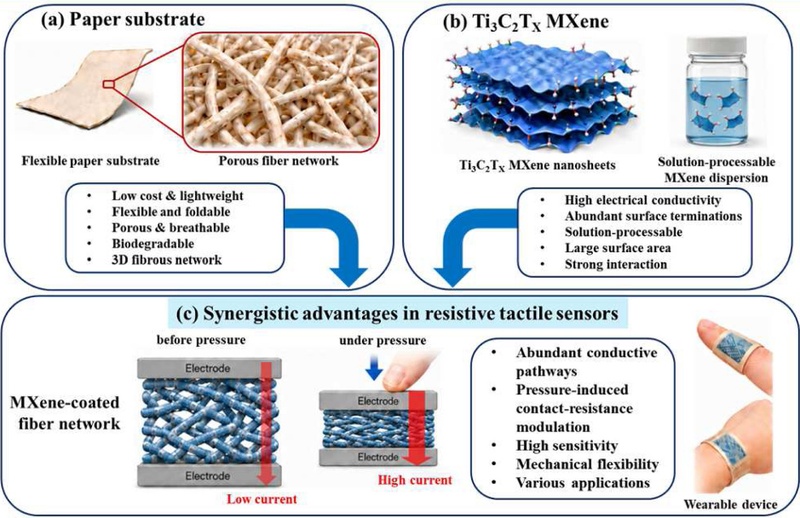
Synergistic design concept for MXene-integrated paper-based resistive tactile sensors. (a) Paper substrates provide lightweight, flexible, porous, biodegradable, and three-dimensional fibrous networks. (b) Ti3C2Tx MXene provides high electrical conductivity, hydrophilic surface terminations, solution processability, a large surface area, conformal coating capability, and strong interaction with cellulose fibers. (c) The integration of MXene with paper produces a conductive fibrous network for resistive tactile sensing, where applied pressure compresses the network, creates more conductive pathways, and reduces resistance.
2. OVERVIEW AND PERFORMANCE METRICS OF MXENE-PAPER RESISTIVE TACTILE SENSORS
The MXene-paper resistive tactile sensors reviewed herein are based on paper or cellulose-derived fibrous substrates combined with Ti3C2Tx MXene conductive networks. Unless otherwise noted, MXene refers to Ti3C2Tx MXene throughout this review. The reviewed substrates include tissue paper, cellulose paper, airlaid paper, filter paper, dust-free paper, and mulberry paper. These substrates differ in fiber diameter, porosity, thickness, compressibility, and surface roughness, which strongly influence pressure-induced contact formation and resistance modulation. The active sensing layers can be broadly divided into MXene-coated paper networks and hybrid MXene-paper networks, with secondary materials, such as MoS2xSe2(1-x), SnS, Te nanowires, MoSe₂, graphene, or Bi, being introduced to tune the conductive pathways and interfacial resistance.
Among the performance parameters of resistive tactile sensors, sensitivity and sensing range are the most commonly used metrics for comparing pressure-sensing capability. Sensitivity represents the slope of the electrical response with respect to the applied pressure and is usually calculated from the relative change in resistance or current. Because many paper-based sensors exhibit nonlinear responses over a broad pressure range, sensitivity is often reported across multiple pressure regions. The sensing range indicates the pressure window over which the sensor provides a measurable and reproducible response. Porous paper networks often demonstrate high sensitivity in the low-pressure region because even a small deformation can substantially increase the inter-fiber contact and produce more conductive pathways. At higher pressures, the network becomes more compacted, with sensitivity generally decreasing as further structural deformation is restricted.
Electrode configuration is another important design factor in MXene-paper resistive tactile sensors. Planar shunt-type structures employ in-plane or coplanar electrodes, where the MXene-paper sensing layer electrically bridges adjacent electrodes and the current mainly flows laterally through the conductive network. Under pressure, the formation of additional conductive pathways and the shortening of percolation paths reduce the lateral resistance. These structures are advantageous for simple fabrication, thin device layouts, single-side wiring, and array integration, but their response can be strongly affected by electrode spacing, coating uniformity, and local in-plane current distribution. In contrast, sandwich-type structures employ out-of-plane electrode configurations, where the MXene-paper sensing layer is placed between top and bottom electrodes and the current flows in the through-thickness direction. In this configuration, external pressure directly compresses the porous fibrous network, increases interlayer and fiber-to-fiber contacts, and decreases the through-thickness resistance. Sandwich-type devices generally provide strong vertical pressure coupling and high sensitivity, but they may require more careful electrode alignment, encapsulation, and control of hysteresis caused by repeated compression.
Table 1 summarizes the sensing materials, paper types, fabrication methods, sensitivity values, and sensing ranges of the MXene-paper resistive tactile sensors reviewed herein. The reported values should be compared carefully because the pressure range, device geometry, electrical readout mode, and sensitivity calculation method differ among the reviewed studies.

Summary of MXene-integrated paper-based resistive tactile sensors.
3. MXENE-COATED PAPER SUBSTRATES FOR RESISTIVE TACTILE SENSING
The most straightforward strategy for constructing MXene-paper resistive tactile sensors is the direct integration of Ti3C2Tx MXene nanosheets with paper substrates. In this configuration, the paper substrate is not merely a passive support but functions as a porous and compressible structural scaffold. When MXene nanosheets are coated onto cellulose fibers, conductive pathways are formed throughout the fibrous network. Under an applied pressure, the paper structure is compressed, which increases inter-fiber contact and MXene-to-MXene electrical connections, thereby reducing the electrical resistance. Therefore, the sensing response of MXene-coated paper sensors is governed by both the electrical conductivity of MXene and the deformation behavior of the paper network. Fig. 2 summarizes representative MXene-coated paper substrates and structural architectures reported for resistive tactile sensing. An early example in which tissue paper was used as a flexible and porous scaffold for MXene nanosheets, demonstrated that a lightweight paper network can be converted into a pressure-responsive conductive sensing layer through a simple MXene coating [8]. As shown in Fig. 2(b), MXene nanosheets can decorate cellulose fibers while preserving the tissue paper’s open fibrous structure, thus allowing pressure-induced contact modulation within the conductive network. Additionally, cellulose and filter paper substrates have been used as relatively uniform fibrous scaffolds for solution-processed MXene deposition [11,12]. These substrates provide interconnected cellulose fibers and accessible surface area for MXene attachment, enabling the formation of continuous conductive networks. Compared with loosely packed paper structures, cellulose and filter paper offer a more uniform fiber morphology, which can be advantageous for ensuring reproducible coating and stable resistance modulation. Airlaid paper further expands the structural design space of MXene-coated paper sensors by providing a thicker, more porous, and highly compressible fibrous network [10]. A comparison between pristine and MXene-coated airlaid paper highlights how MXene deposition transforms an insulating paper scaffold into a conductive pressure-sensitive layer while maintaining its deformable porous architecture. Such a structure is advantageous for achieving pressure-dependent resistance changes over a broad deformation range. Alternative paper substrates have also been explored to improve mechanical compliance and application-specific structural characteristics. MXene-modified dust-free paper provides a breathable and deformable scaffold, in which MXene networks are formed on the paper fibers [14]. Although the sensing principle remains based on pressure-induced resistance modulation, the use of dust-free paper illustrates that the paper substrate can be selected according to mechanical softness, breathability, and device integration requirements. Apart from varying the paper type, the paper substrate can be structurally engineered to tune the sensing behavior further. Stacked mulberry paper coated with MXene is a representative example, in which a multilayer paper architecture and long-fiber morphology are exploited to enhance pressure-dependent contact modulation [13]. Specifically, the sensor response is influenced by not only the MXene-coated fiber contacts within each layer but also the layer-to-layer compression and contact formation across the stacked paper sheets.
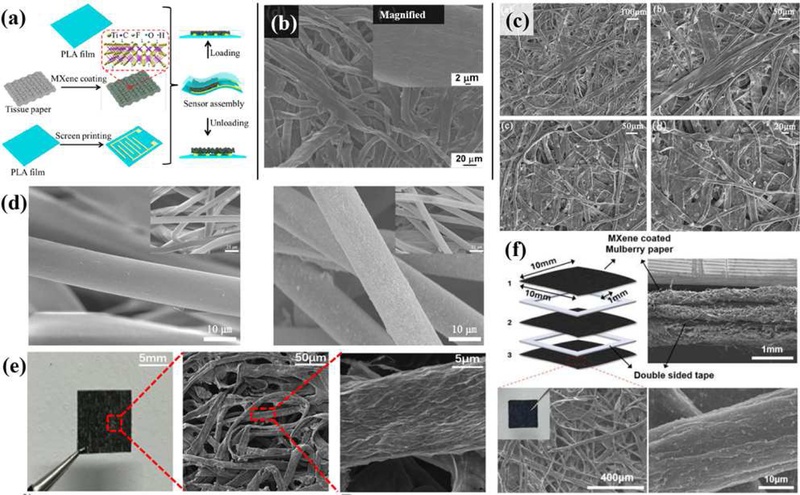
MXene-coated paper substrates and structural architectures for resistive tactile sensing. (a, b) Fabrication concept and morphology of Ti3C2Tx MXene-coated tissue paper pressure sensors. Adapted from Ref. [8]. (c) MXene-coated filter paper morphology for wide-range wearable pressure detection. Adapted from Ref. [12]. (d) Pristine and MXene-coated airlaid paper morphology for foldable pressure sensing. Adapted from Ref. [10]. (e) MXene-modified dust-free paper structure for breathable piezoresistive pressure sensors. Adapted from Ref. [14]. (f) Stacked mulberry paper architecture coated with MXene for pressure-dependent contact modulation. Adapted from Ref. [13].
4. MXENE-SECONDARY-MATERIAL HYBRID AND MODIFIED MXENE-PAPER SUBSTRATES FOR ENHANCED SENSOR PERFORMANCE
Although pure Ti3C2Tx MXene-coated paper sensors provide flexible and pressure-responsive conductive networks, their sensing performance can be limited by MXene restacking, uncontrolled interfacial resistance, environmental instability, and the trade-off between sensitivity and sensing range. In this section, the term “hybrid MXene-paper system” refers specifically to paper-based sensors in which Ti3C2Tx MXene is hybridized with secondary functional materials, such as MoS2xSe2(1-x), SnS, Te nanowires, MoSe2, graphene, or Bi, or modified through atomic layer infiltration. In these systems, paper or cellulose substrates serve as fibrous structural scaffolds, while the secondary materials are introduced into the MXene network to tune conductive-pathway connectivity, interlayer spacing, interfacial resistance, and mechanical deformation.
Fig. 3 summarizes representative hybrid and modified MXene-paper systems for enhanced resistive tactile sensing. As shown in Fig. 3(a), Ti3C2Tx/MoS2xSe2(1-x) nanohybrid multilayer structures were fabricated on cellulose paper through sequential solution-based deposition [15]. In this structure, the cellulose paper acts as a flexible fibrous substrate, while the MXene/chalcogenide hybrid layer serves as the pressure-sensitive conductive network. This 2D/2D hybrid design combines the high conductivity of MXene with the interfacial modulation capability of transition-metal chalcogenides, providing a strategy to tune charge transport and resistance variation under external pressure. SnS/Ti3C2Tx nanohybrid sensors constitute another example of chalcogenide/MXene hybridization. As illustrated in Fig. 3(b), the layered SnS structure combined with Ti3C2Tx MXene enables pressure-induced modulation of interlayer spacing and interfacial resistance [16]. Under compression, the distance between the conductive layers decreases, which facilitates charge transport and improves the electrical response. This mechanism indicates that secondary layered materials can be utilized to engineer the interfacial resistance of MXene-based conductive networks. Unlike the layered SnS/MXene structure, TeNW/Ti3C2Tx nanohybrids represent a one-dimensional/two-dimensional hybrid morphology. Fig. 3(c) shows the field-emission scanning electron microscopy (FE-SEM) morphology of TeNW/Ti3C2Tx nanohybrids, where one-dimensional Te nanowires are integrated with two-dimensional MXene nanosheets [17]. This morphology can provide additional conductive bridges and junctions within the MXene network, thereby facilitating charge transport during mechanical compression. Therefore, TeNW/Ti3C2Tx represents a distinct hybrid strategy based on 1D/2D conductive-network modulation. MoSe2/Ti3C2Tx nanohybrids represent another example of 2D chalcogenides being used for cellulose paper–based pressure sensing. As shown in Fig. 3(d), the MoSe2/Ti3C2Tx hybrid exhibits a nanostructured morphology in which MoSe2 and Ti3C2Tx components form an interconnected hybrid structure [18]. Such a morphology can contribute to pressure-dependent conductive-network formation by increasing the number of interfacial contact sites and modulating charge transport pathways. Together with Ti3C2Tx/MoS2xSe2(1-x) and SnS/Ti3C2Tx systems, this example shows that chalcogenide/MXene hybridization can be an effective technique for tuning the electrical interfaces of MXene-paper tactile sensors. Modification of the MXene network itself has also been explored to improve sensor performance. Qi et al. compare untreated MXene and atomic layer–infiltrated MXene sensors, showing that the modified MXene exhibits higher sensitivity and faster response/recovery behavior [19]. This result indicates that post-treatment of MXene can improve tactile sensing by modifying the interlayer structure and electron transport pathways, without necessarily introducing a conventional nanosheet or particulate additive. Such modified MXene systems are useful for understanding how interlayer spacing, defect passivation, and conductive linkage influence resistance-based tactile sensing. Finally, MXene/Bi tissue-paper sensors represent a metal-containing hybrid strategy. The observed morphology verifies the coexistence of MXene and bismuth crystalline domains, confirming the formation of MXene/Bi nanohybrids [21]. In this system, layered Bi can help suppress MXene restacking, facilitate interfacial electron transfer, and improve the pressure-dependent connectivity of conductive pathways within the tissue-paper network. This example expands the hybrid design space beyond chalcogenide/MXene systems, toward MXene/metal-based composite conductive networks.
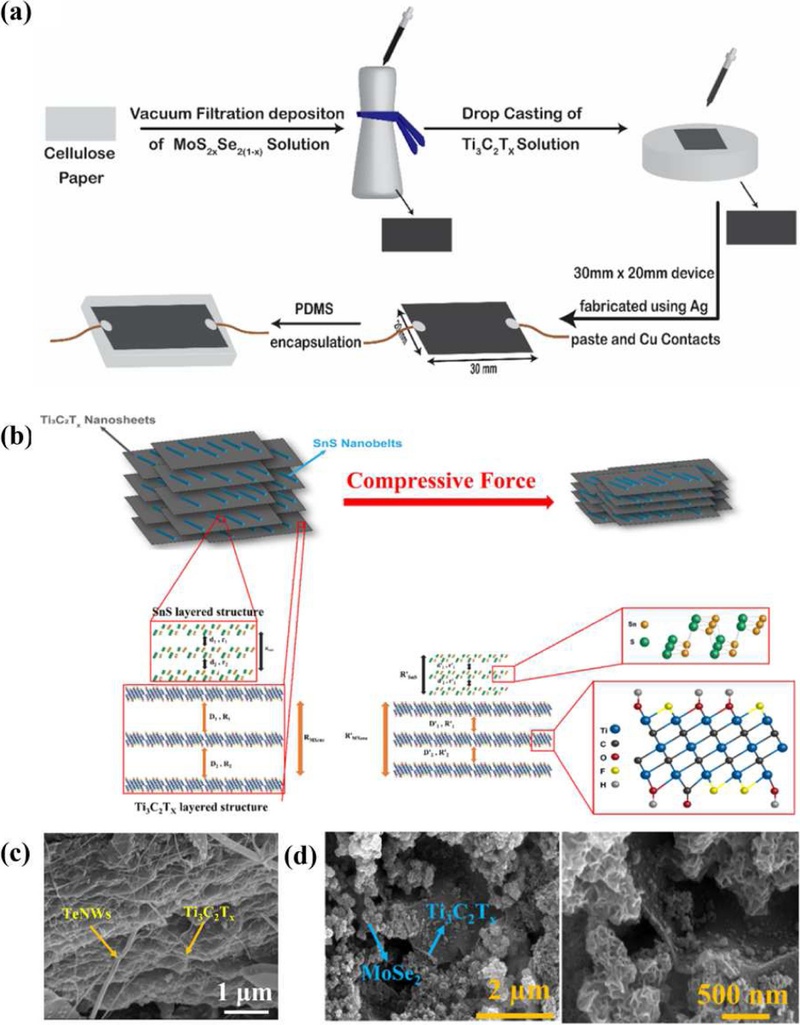
Hybrid and modified MXene-paper substrates for enhanced resistive tactile sensing. (a) Fabrication of nanohybrid multilayer Ti3C2Tx/MoS2xSe2(1-x) on cellulose paper. Adapted from Ref. [15]. (b) SnS/Ti3C2Tx nanohybrid sensing mechanism based on pressure-induced interlayer and interfacial resistance modulation. Adapted from Ref. [16]. (c) FESEM morphology of TeNW/Ti3C2Tx nanohybrids, showing the integration of one-dimensional Te nanowires with two-dimensional MXene nanosheets. Adapted from Ref. [17]. (d) MoSe2/Ti3C2Tx nanohybrid morphology for cellulose paper–based pressure sensing. Adapted from Ref. [18].
In addition to the representative examples shown in Fig. 3, graphene/MXene-coated cellulosic paper sensors have also been reported as binary conductive-filler systems for constructing stable conductive networks and achieving multifunctional sensing [20]. Overall, hybrid and modified MXene-paper substrates provide a broader design space than pure MXene-coated paper systems. Secondary materials, such as MoS2xSe2(1-x), SnS, Te nanowires, MoSe₂, graphene, and Bi, as well as atomic-layer infiltration, can be utilized to tune interfacial resistance, conductive-pathway formation, structural stability, and pressure-induced deformation. These examples indicate that the performance of MXene-paper resistive tactile sensors should be optimized by not only selecting an appropriate conductive material but also engineering the interfaces among the MXene, the secondary components, and the cellulose fiber networks.
5. DEVICE INTEGRATION AND APPLICATION TRENDS
Beyond material design and sensing-layer optimization, MXene-paper resistive tactile sensors have been increasingly developed to enhance device-level integration and practical applicability. The intrinsic flexibility, lightweight nature, porosity, and processability of paper substrates allow MXene-coated fibrous networks to be assembled into wearable patches, sensor arrays, human–machine interfaces, and healthcare-monitoring platforms. Fig. 4 summarizes representative device-level demonstrations of MXene-paper tactile sensors, including tactile mapping, physiological monitoring, sign-to-text translation, Morse-code input, large-area electronic skin, and sleep-monitoring systems. Fig. 4(a) shows an example of an early MXene/tissue paper pressure sensor integrated into a sensor array for spatial tactile mapping [8]. This device showed that beyond single-point pressure detection, MXene-paper sensors can provide position-dependent pressure information. The array response confirmed the potential of MXene-coated paper networks as soft tactile elements for electronic skin and human–machine interfacing. In addition to such tissue-paper arrays, MXene-coated airlaid paper sensors have also been proposed for electronicskin applications, where the foldable and compressible airlaid paper network supports pressure-responsive resistance modulation [10]. Wearable physiological monitoring represents another important application. MXene/tissue paper sensors were integrated into wearable and wireless monitoring platforms to detect physiological signals, such as ECG and pulse signals, as shown in Fig. 4(b) [9]. This demonstration highlights the compatibility of MXene-paper sensors with skin-mounted devices and wireless readout systems. Other MXene-coated paper sensors have also been used to monitor human motions, such as finger bending, wrist movement, joint motion, and larger body movements [11-13,21]. These applications indicate that MXene-paper tactile sensors can detect both subtle physiological signals and relatively large mechanical deformations. Fig. 4(c) shows a human–machine interface application of SnS/Ti3C2Tx nanohybrid paper sensors [16]. In this system, finger gestures generate distinguishable electrical signals that are converted into text output, which represents sign-to-text translation. This example indicates that MXene-paper tactile sensors can function as interactive input devices rather than simple pressure detectors. By converting mechanical deformation into recognizable signal patterns, such sensors can support wearable communication interfaces and assistive technologies. Information input and personal safety applications have also been demonstrated using TeNW/Ti3C2Tx nanohybrid pressure sensors. As shown in Fig. 4(d), short and long tactile inputs were encoded as Morse-code patterns, enabling message transmission and safety-related signaling [17]. This application is distinct from conventional motion monitoring because the tactile sensor acts as an intentional information input interface. It also shows that MXene-paper sensors can be combined with simple electronic circuits or mobile interfaces for interactive communication systems. Large-area electronic skin represents a further step toward integrated tactile systems. Fig. 4(e) shows an MXene/MoSe₂ nanohybrid matrix sensor designed for artificial electronic skin applications [18]. Compared with single sensing elements, matrix-type devices enable distributed pressure detection over larger areas, which is important for artificial skin, robotic interfaces, and spatial tactile recognition. Together with the earlier MXene/tissue paper array shown in Fig. 4(a), this example underscores the progression of MXene-paper sensors from small tactile arrays to larger integrated sensing matrices. MXene-modified paper sensors have been integrated into daily-use healthcare platforms as well. Fig. 4(f) shows a MXene-modified dust-free paper pressure sensor embedded in an airbag pillow for sleep monitoring [14]. The device was used to detect snoring-related pressure signals and identify abnormal long-snoring events, demonstrating that MXene-paper sensors can be incorporated into soft objects used in daily life. This approach extends the utility of MXene-paper tactile sensors beyond skin-attached wearable patches toward environment-integrated healthcare devices. Additionally, MXene-based cellulose or filter paper sensors have been used for human motion detection and wide-range pressure monitoring [11,12], while stacked mulberry paper coated with MXene has been employed for pressure detection over a broad sensing range [13]. Graphene/MXene-coated cellulosic paper sensors have also been reported as bifunctional devices responding to both pressure and temperature, extending the applicability of MXene-paper platforms toward multifunctional wearable monitoring [20]. MXene/Bi tissue paper sensors have been utilized for various wearable applications, including screen tapping, push-up motion, finger and wrist bending, pronunciation monitoring, and wrist pulse detection [21]. Overall, the application trend of MXene-paper resistive tactile sensors is shifting from material-level pressure sensing toward integrated systems. Whereas early studies focused on sensitive pressure detection using MXene-coated paper substrates, recent research has increasingly emphasized sensor arrays, wearable physiological monitoring, human–machine interfaces, information input, multifunctional sensing, and daily-life healthcare devices. This transition indicates that future development should consider not only sensing-layer performance but also device architecture, readout integration, signal reliability, environmental stability, user comfort, and application-specific packaging.
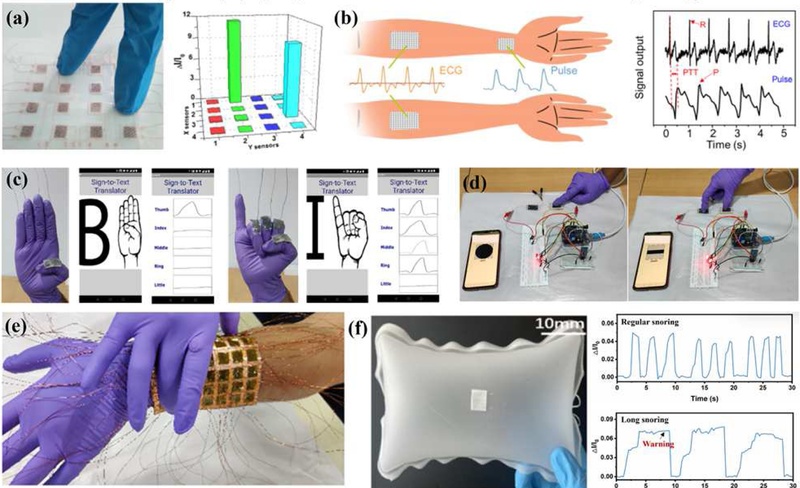
Device integration and application trends related to MXene-paper resistive tactile sensors. (a) Tactile mapping using MXene/tissue paper sensor array. Adapted from Ref. [8]. (b) Wearable physiological monitoring based on MXene/tissue paper sensors, including ECG and pulse signal detection. Adapted from Ref. [9]. (c) Human–machine interface demonstration using SnS/Ti3C2Tx nanohybrid paper sensors for sign-to-text translation. Adapted from Ref. [16]. (d) Morse code–based tactile input and personal safety demonstration using TeNW/Ti3C2Tx nanohybrid pressure sensors. Adapted from Ref. [17]. (e) Large-area MXene/MoSe2 nanohybrid matrix sensor for artificial electronic skin applications. Adapted from Ref. [18]. (f) MXene-modified paper–based pressure sensor integrated into an airbag pillow for sleep monitoring. Adapted from Ref. [14].
6. CHALLENGES AND OUTLOOK
Despite the rapid progress in the development of MXene-integrated paper-based resistive tactile sensors, several challenges remain before these devices can be translated into practical and reliable wearable sensing systems. These challenges are associated with not only the intrinsic properties of MXene but also the environmental sensitivity of paper substrates, device-to-device reproducibility, performance evaluation standards, and system-level integration. One of the major challenges is the long-term stability of Ti3C2Tx MXene under ambient and humid conditions. While Ti3C2Tx MXene is highly attractive for paper-based sensors because of its high conductivity, hydrophilic surface terminations, and solution processability, these hydrophilic surface terminations can render MXene vulnerable to water uptake and oxidative degradation. Oxidation can reduce the electrical conductivity of MXene, alter its surface chemistry, and compromise the stability of the conductive network. This issue is particularly important for paper-based tactile sensors because paper substrates can absorb moisture and expose MXene-coated fibers to humid environments. Therefore, future studies should systematically evaluate sensor performance under controlled humidity, temperature, and long-term storage conditions. Strategies such as the incorporation of antioxidant additives, surface passivation, polymer or elastomer encapsulation, hybridization with oxidation-resistant materials, and optimized storage or processing may be required to improve operational stability [22,23]. The second challenge is the mechanical sensitivity of the paper substrate itself and its susceptibility to humidity. While paper-based and cellulose-based substrates provide porosity, flexibility, biodegradability, and compressibility, they are also sensitive to environmental moisture and repeated mechanical deformation. Humidity can alter the stiffness, swelling behavior, and fiber-to-fiber contacts within the paper network, which may result in baseline drift or unwanted resistance changes. Repeated pressure loading can also induce fiber rearrangement, plastic deformation, or partial delamination of the MXene coating from cellulose fibers. These effects are closely related to sensor hysteresis, drift, and long-term reliability. Future work should therefore consider paper engineering as seriously as MXene engineering. Control of fiber density, thickness, porosity, surface roughness, wet strength, and encapsulation should be optimized to maintain stable mechanical deformation and reversible resistance modulation. Long-term durability should also be considered separately from short-term cyclic repeatability. Several recent MXene-paper tactile sensors have demonstrated repeated loading/unloading, bending, or wearable motion monitoring over repeated loading cycles [12-14,20,21]. However, the test conditions, cycle numbers, loading amplitudes, environmental humidity, and post-cycling signal drift are not yet standardized. In practical wearable or daily-use applications, the sensing layer can be exposed to repeated compression, bending, sweat, moisture, friction, and mechanical abrasion for extended periods. These conditions may accelerate MXene oxidation, weaken MXene–cellulose adhesion, induce partial coating delamination, and cause irreversible rearrangement of the paper fiber network. Therefore, future studies should evaluate long-term durability using application-relevant protocols, including extended cyclic loading, bending/folding tests, storage stability, humidity exposure, washability or abrasion tests when applicable, and signal drift analysis after repeated use. Reproducibility and scalable manufacturing are also important requirements. Most MXene-paper tactile sensors are fabricated using simple solution-based methods, such as dip-coating, vacuum filtration, drop-casting, and spray-coating. Although these methods are attractive because of their cost-effectiveness and compatibility with paper substrates, they can also introduce variations in MXene loading, coating uniformity, drying morphology, and local conductive-pathway distribution. Such variations can lead to device-to-device differences in initial resistance, sensitivity, sensing range, and response stability. To ensure practical utility, future studies should report not only the best-performing device but also statistical distributions of sensor performance across multiple samples. Scalable processes, such as roll-to-roll coating, screen printing, inkjet printing, or controlled filtration, may be useful for improving manufacturing reproducibility.
Another key challenge is the lack of standardized performance evaluation protocols. As summarized in Table 1, the reported sensitivities and sensing ranges vary widely among existing MXene-paper tactile sensors. However, direct comparison is difficult because sensitivity is calculated over different pressure regions, with some studies focusing on relative resistance variations while others report relative current changes. Additionally, device geometry, electrode configuration, preload, loading rate, substrate thickness, and pressure calibration methods differ among studies. Consequently, the highest reported sensitivity does not necessarily indicate the best overall sensor performance. Future reports should clearly define the sensitivity calculation method, pressure range, loading/unloading protocol, response and recovery time criteria, hysteresis, drift, detection limit, and cyclic stability test conditions. Standardized reporting would allow for more meaningful comparison among MXene-coated, hybrid MXene-paper, and structurally engineered paper sensors. The balance between sensitivity and sensing range also remains a central design issue. Porous paper networks often achieve high sensitivity in low-pressure regions because small deformations can rapidly increase conductive contacts. However, once the paper network becomes compressed, further deformation is limited, which reduces the sensitivity. Some sensors achieve very high sensitivity in a narrow pressure window, whereas others provide a broad sensing range with lower sensitivity. Hence, future designs should pursue application-specific optimization rather than maximizing a single metric. For pulse monitoring or subtle touch detection, low-pressure sensitivity and signal stability are critical. For motion detection, posture analysis, or object interaction, a wider pressure range and mechanical robustness may be more important. Hybridization, multilayer paper structures, and controlled porosity represent promising routes for balancing sensitivity, sensing range, and durability. System-level integration is another important direction. Many studies have demonstrated sensors designed for human motion detection, tactile mapping, electronic skin arrays, sign-to-text translation, Morse-code input, and sleep monitoring. However, apart from a sensitive material layer, practical wearable systems require stable electrodes, robust encapsulation, low-noise readout circuits, wireless data transmission capability, efficient power management, and signal-processing electronics, as well as conformity to the human body or soft objects. For array-type electronic skins, crosstalk, pixel-to-pixel variation, wiring complexity, and multiplexed readout should be addressed, while healthcare applications demand long-term wearability, breathability, washability, skin compatibility, and data reliability. Furthermore, integration with machine learning or pattern-recognition algorithms may improve the interpretation of complex tactile signals from sensor arrays and wearable systems [24].
Finally, the sustainability of MXene-paper tactile sensors should be evaluated more carefully. Paper substrates are often described as low-cost, biodegradable, and eco-friendly. Nevertheless, the overall sustainability of the device depends on the complete material system, including the MXene synthesis, etchants, solvents, electrodes, encapsulation layers, adhesives, and electronic components. Future studies should distinguish between biodegradable sensing layers and fully degradable devices. To realize environmentally responsible paper-based tactile sensors, MXene synthesis and processing should be combined with greener etching routes, recyclable or degradable electrodes, minimal polymer encapsulation, and lifecycle-aware device design. Hence, the future development of MXene-paper resistive tactile sensors will require simultaneous advances in material stability, paper-substrate engineering, scalable fabrication, standardized performance evaluation, and device-level integration. Rather than focusing only on higher sensitivity, researchers should aim to develop reliable, reproducible, environmentally stable, and application-specific tactile sensing platforms. The combination of Ti3C2Tx MXene with engineered paper substrates remains a promising route toward lightweight, flexible, breathable, and low-cost tactile sensors for wearable electronics, electronic skin, human–machine interfaces, and healthcare monitoring.
Acknowledgments
This research was supported by Kyungpook National University Research Fund, 2023.
REFERENCES
-
D. Tobjörk, R. Österbacka, Paper Electronics, Adv. Mater. 23 (2011) 1935–1961.
[https://doi.org/10.1002/adma.201004692]

-
L.-Q. Tao, K.-N. Zhang, H. Tian, Y. Liu, D.-Y. Wang, Y.-Q. Chen, et al., Graphene-Paper Pressure Sensor for Detecting Human Motions, ACS Nano 11 (2017) 8790–8795.
[https://doi.org/10.1021/acsnano.7b02826]
-
T. Yang, J.M. Mativetsky, Paper-Based Mechanical Sensors Enabled by Folding and Stacking, ACS Appl. Mater. Interfaces 11 (2019) 26339–26345.
[https://doi.org/10.1021/acsami.9b06071]
-
Z. Duan, Y. Jiang, Q. Huang, S. Wang, Q. Zhao, Y. Zhang, et al., Facilely constructed two-sided microstructure interfaces between electrodes and cellulose paper active layer: eco-friendly, low-cost and high-performance piezoresistive sensor, Cellulose 28 (2021) 6389–6402.
[https://doi.org/10.1007/s10570-021-03913-8]
-
M. Naguib, M. Kurtoglu, V. Presser, J. Lu, J. Niu, M. Heon, et al., Two-Dimensional Nanocrystals Produced by Exfoliation of Ti3AlC2, Adv. Mater. 23 (2011) 4248–4253.
[https://doi.org/10.1002/adma.201102306]
-
M. Alhabeb, K. Maleski, B. Anasori, P. Lelyukh, L. Clark, S. Sin, et al., Guidelines for Synthesis and Processing of Two-Dimensional Titanium Carbide (Ti3C2Tx MXene), Chem. Mater. 29 (2017) 7633–7644.
[https://doi.org/10.1021/acs.chemmater.7b02847]
-
Y.-Z. Zhang, K.H. Lee, D.H. Anjum, R. Sougrat, Q. Jiang, H. Kim, et al., MXenes stretch hydrogel sensor performance to new limits, Sci. Adv. 4 (2018) eaat0098.
[https://doi.org/10.1126/sciadv.aat0098]
-
Y. Guo, M. Zhong, Z. Fang, P. Wan, G. Yu, A Wearable Transient Pressure Sensor Made with MXene Nanosheets for Sensitive Broad-Range Human–Machine Interfacing, Nano Lett. 19 (2019) 1143–1150.
[https://doi.org/10.1021/acs.nanolett.8b04514]
-
L. Yang, H. Wang, W. Yuan, Y. Li, P. Gao, N. Tiwari, et al., Wearable Pressure Sensors Based on MXene/Tissue Papers for Wireless Human Health Monitoring, ACS Appl. Mater. Interfaces 13 (2021) 60531–60543.
[https://doi.org/10.1021/acsami.1c22001]
-
D.-J. Yao, Z. Tang, L. Zhang, Z.-G. Liu, Q.-J. Sun, S.-C. Hu, et al., A highly sensitive, foldable and wearable pressure sensor based on MXene-coated airlaid paper for electronic skin, J. Mater. Chem. C 9 (2021) 12642–12649.
[https://doi.org/10.1039/D1TC02458B]
-
A. Li, J. Xu, D. Xu, Z. Zhang, D. Cao, J. Li, et al., High-performance, breathable, and degradable fully cellulose-based sensor for multifunctional human activity monitoring, Chem. Eng. J. 505 (2025) 159564.
[https://doi.org/10.1016/j.cej.2025.159564]
-
C. Wei, Y. Xu, Y. Hu, Q. Zhang, N. Wei, W. Zeng, et al., Ti3C2Tx MXene paper-based flexible wearable pressure sensor with wide pressure detection range for human motion detection, J. Alloys Compd. 1017 (2025) 179126.
[https://doi.org/10.1016/j.jallcom.2025.179126]
-
S. Lee, C. Won, J. Ahn, B. Heo, K. Bae, J. Kim, et al., Stacked Mulberry Paper Coated with MXene for Highly Sensitive Pressure Detection with Wide Sensing Range, Proceedings of the 2025 IEEE 38th International Conference on Micro Electro Mechanical Systems (MEMS), Kaohsiung, Taiwan, 2025, pp. 869–872.
[https://doi.org/10.1109/MEMS61431.2025.10917445]
-
Y. Zhang, B. Zhang, Y. Lv, P. Wang, T. Liu, C. Meng, Flexible and breathable MXene-modified paper-based piezoresistive pressure sensors integrated into airbag pillow for sleep monitoring, Soft Sci. 5 (2025) 17.
[https://doi.org/10.20517/ss.2024.68]
-
K. Kamath, V. Adepu, V. Mattela, P. Sahatiya, Development of Ti3C2Tx/MoS2xSe2(1–x) Nanohybrid Multilayer Structures for Piezoresistive Mechanical Transduction, ACS Appl. Electron. Mater. 3 (2021) 4091–4104.
[https://doi.org/10.1021/acsaelm.1c00583]
-
V. Adepu, A. Kunchur, M. Tathacharya, V. Mattela, P. Sahatiya, SnS/Ti3C2Tx (MXene) Nanohybrid-Based Wearable Electromechanical Sensors for Sign-to-Text Translation and Sitting Posture Analysis, ACS Appl. Electron. Mater. 4 (2022) 1756–1768.
[https://doi.org/10.1021/acsaelm.2c00026]
-
V. Adepu, M. Tathacharya, R. CS, V. Mattela, P. Sahatiya, TeNWs/Ti3C2Tx Nanohybrid-Based Flexible Pressure Sensors for Personal Safety Applications Using Morse Code, ACS Appl. Nano Mater. 5 (2022) 18209–18219.
[https://doi.org/10.1021/acsanm.2c04088]
-
V. Adepu, C. Yoo, Y. Jung, P. Sahatiya, Large area matrix of MXene/MoSe2 nanohybrid-based flexible piezoresistive pressure sensors for artificial e-skin application, Appl. Phys. Lett. 122 (2023) 263505.
[https://doi.org/10.1063/5.0142329]
-
Z. Qi, T. Zhang, X.-D. Zhang, Q. Xu, K. Cao, R. Chen, MXene-based flexible pressure sensor with piezoresistive properties significantly enhanced by atomic layer infiltration, Nano Mater. Sci. 5 (2023) 439–446.
[https://doi.org/10.1016/j.nanoms.2022.10.003]
-
T. Zhang, Y. Zhao, Q. Long, X. Zhu, L. He, Z. Li, et al., Graphene/MXene/Cellulose cellulosic paper-based flexible bifunctional sensors utilizing molecular bridge strategy with tunable piezoresistive effect for Temperature-Pressure sensing, Chem. Eng. J. 497 (2024) 154972.
[https://doi.org/10.1016/j.cej.2024.154972]
-
L. Wang, Y. Guo, C. Wei, Q. Zhang, N. Wei, W. Zeng, High-performance flexible tactile pressure sensor via MXene/Bi/tissue paper composite films for wearable electronics, Colloids Surf. B Biointerfaces 262 (2026) 115503.
[https://doi.org/10.1016/j.colsurfb.2026.115503]
-
T. Habib, X. Zhao, S.A. Shah, Y. Chen, W. Sun, H. An, et al., Oxidation stability of Ti3C2Tx MXene nanosheets in solvents and composite films, npj 2D Mater. Appl. 3 (2019) 8.
[https://doi.org/10.1038/s41699-019-0089-3]
-
A. Iqbal, J. Hong, T.Y. Ko, C.M. Koo, Improving oxidation stability of 2D MXenes: synthesis, storage media, and conditions, Nano Converg. 8 (2021) 9.
[https://doi.org/10.1186/s40580-021-00259-6]
-
W. Yang, F. Liu, Y. Lin, J. Wang, C. Zhang, H. Cheng, et al., MXene-based flexible sensors for wearable applications, Soft Sci. 5 (2025) 33.
[https://doi.org/10.20517/ss.2025.12]

Yunsung Kang received the B.S. and Ph.D. degrees in mechanical engineering from Yonsei university, Seoul, South Korea in 2013 and 2021, respectively. He joined Kyungpook National University, South Korea in 2023, where he is currently an assistant professor with the department of precision mechanical engineering. His research interests include the development of novel MEMS and nanomaterial-based micromachining for physical/chemical sensors and actuators.