
CuO-decorated SnO2 Nanowires Modified Femtosecond Laser for H2S Detection
ⓒ The Korean Sensors Society
This is an Open Access article distributed under the terms of the Creative Commons Attribution Non-Commercial License (https://creativecommons.org/licenses/by-nc/3.0/) which permits unrestricted non-commercial use, distribution, and reproduction in any medium, provided the original work is properly cited.
Abstract
Femtosecond laser (fs-laser) processing has emerged as a powerful tool for tailoring surface properties of metal oxides, yet its application in gas sensing remains relatively unexplored. In this work, fs-laser irradiation was employed to engineer the surface of CuO-decorated SnO2 nanowires for improved H2S gas sensing. Structural and morphological analyses confirmed that the nanowire framework was preserved after fs-laser treatment, while X-ray photoelectron spectroscopy revealed noticeable modifications in surface oxygen species and defect-related states. The formation of CuO on the SnO2 surface enabled the creation of CuO–SnO2 p–n heterojunctions, which play a key role in modulating the charge transport behavior. Gas sensing measurements toward H2S demonstrated that the fs-laser treated CuO-decorated SnO2 NWs exhibited higher responses compared to untreated counterparts at 150°C, the optimal operating temperature. The response to 10 ppm H2S increased from 1.12 for pristine SnO2 NWs to 1.42 for Cu-decorated SnO2 NWs, 1.72 for fs-laser treated SnO2 NWs, and 5.38 for the fs-laser treated CuO-decorated SnO2 NWs. The corresponding response and recovery time toward 10 ppm H2S at this temperature was 462 s and 850 s, respectively. The enhanced sensing performance is attributed to the combined effects of fs-laser-induced surface defects and the heterojunctions between CuO and SnO2. Furthermore, the well-known chemical interaction between CuO and H2S, involving the conversion of CuO to CuS, is considered to contribute to the pronounced resistance modulation. This study highlights that fs-laser surface engineering provides a simple and effective route to improve the H2S sensing characteristics of metal oxide nanowires, offering insights into defect-mediated gas sensing mechanisms and practical sensor design.
Keywords:
SnO2 nanowires, CuO nanostructure, Gas sensor, Heterojunction, H2S detection1. INTRODUCTION
Hydrogen sulfide (H2S) is a hazardous and corrosive gas frequently encountered in petroleum refining, wastewater treatment, and chemical industries [1,2]. Due to its toxicity and potential to cause severe health and safety issues, reliable detection of H2S is essential for environmental monitoring and industrial safety. Chemiresistive gas sensors based on semiconductor metal oxides have been widely adopted for this purpose because of their simplicity, low fabrication cost, and compatibility with miniaturized devices [3,4]. However, achieving high sensitivity and selectivity toward H2S still requires precise control over the surface and interfacial properties of sensing materials.
While extensive research has focused on developing new sensing materials, increasing attention is now being directed toward process-based approaches that modify surface states without fundamentally altering the material system. Such approaches are attractive because they can enhance sensing performance while maintaining the advantages of well-established materials. In chemiresistive sensors, surface defects, oxygen-related species, and interfacial charge distribution critically influence gas adsorption and electron transfer processes [5-7]. Therefore, engineering these surface features through controllable processing methods represents a promising route to improve sensing characteristics.
Femtosecond (fs) laser processing has emerged as a powerful tool for surface engineering due to its ultrashort pulse duration and highly localized energy deposition [8-10]. Unlike conventional thermal or chemical treatments, fs-laser irradiation can induce non-equilibrium structural and chemical modifications with minimal heat-affected zones. This enables precise tuning of surface morphology, defect states, and chemical composition. Fs-laser techniques have been successfully applied in micro/nanostructuring, surface texturing, and functional modification of various materials [11-13]. Nevertheless, their use as a post-treatment strategy for gas sensing materials remains relatively underexplored.
In the context of gas sensing, modifying surface defects and hetero-interfaces is particularly important because these factors govern adsorption–desorption kinetics and resistance modulation. SnO2 NWs represent a well-established sensing platform with stable baseline characteristics, making them suitable for process-oriented studies. Furthermore, the incorporation of copper oxide species on SnO2 is known to introduce p–n heterojunctions and strong chemical interactions with H2S [14,15]. However, most previous studies have emphasized compositional modification rather than process-induced surface engineering.
In this work, we focus on femtosecond laser irradiation as a surface engineering process to tailor the sensing properties of CuO-decorated SnO2 NWs. Rather than developing a new material system, this study investigates how fs-laser processing alters surface states and defect chemistry, and how these changes influence H2S sensing behavior. By comparing untreated and fs-laser treated samples, the role of process-induced surface modification is systematically evaluated. This process-centered approach provides insights into how advanced laser processing can be utilized to tune gas sensing performance without complex material redesign, offering a practical pathway for sensor optimization.
2. EXPERIMENTAL
2.1 Materials
High-purity tin (Sn) powder (≥99.9%) was used as the source material for nanowire growth. Silicon (Si) substrates were employed as growth substrates, and a thin gold (Au) layer served as the catalyst for vapor–liquid–solid (VLS) growth. Argon (Ar, ≥99.999%) and oxygen (O2, ≥99.999%) gases were used as carrier and reactive gases, respectively, during the growth process. All chemicals and gases were of analytical grade and used as received without further purification. Deionized (DI) water and ethanol were used for substate cleaning prior to catalyst deposition.
A high-purity copper (Cu) target (≥99.99%) was used as the source material for the deposition of the copper component, which was introduced to form the catalytic p-type CuO species responsible for heterojunction formation and H2S chemical sensitization.
2.2 Synthesis of SnO2 NWs
SnO2 NWs were synthesized using a catalyst-assisted vapor–liquid–solid (VLS) growth process in a horizontal tube furnace. Prior to growth, Si substrates were sequentially cleaned with acetone, ethanol, and DI water under ultrasonication and then dried under a nitrogen stream. A thin Au catalyst layer was deposited onto the cleaned Si substrates by sputtering.
For nanowire growth, high-purity Sn powder was placed in an alumina boat and positioned at the center of the quartz tube, while the Au-coated Si substrates were located downstream. The system was purged with inert gas to remove residual air before heating. The furnace was then heated to the growth temperature under a controlled Ar/O2 gas flow. During heating, Sn vapor was generated and transported to the substrate region, where Au–Sn liquid alloy droplets formed and served as catalytic sites for nanowire growth. In the presence of oxygen, Sn vapor reacted to form SnO2, leading to the nucleation and elongation of SnO2 NWs via the VLS mechanism.
After growth, the furnace was naturally cooled to room temperature under inert gas flow. The as-grown SnO2 NWs were directly used for subsequent surface modification and gas sensing experiments without further treatment. The synthesized material was denoted as pristine SnO2 NWs.
2.3. Formation of Cu on the SnO2 NWs
Cu was sputtered onto the synthesized SnO2 NWs using a DC sputtering system operated at 10 mA for 1 min, corresponding to a nominal thickness of 3 nm. The resulting samples were denoted as Cu-decorated SnO2 NWs.
2.4. Femtosecond Laser Irradiation
Femtosecond laser irradiation was employed as a post-treatment to modify the surface states of the CuO-decorated SnO2 nanowires. The laser system operated at a wavelength of 1030 nm, with a pulse duration of 33.6 fs, a repetition rate of 5 kHz, and a pulse energy of 1.2 mJ. The focused laser beam was scanned across the sample surface at a scanning speed of 1.5 mm s⁻¹ using a galvanometer scanner to ensure uniform irradiation. The pulse energy was controlled using a half-wave plate and a polarizing beam splitter. All laser-treated specimens were processed in the same batch using an identical fixed scan program.
A galvanometer scanner was used to scan the focused laser beam across the sample surface, enabling uniform irradiation. The ultrashort pulse duration allowed localized energy deposition with minimal thermal diffusion, thereby inducing surface defect formation and modification of oxygen-related species without damaging the nanowire framework.
Such fs-laser treatment is known to introduce defect sites and alter surface chemistry, which can enhance gas adsorption and charge transfer during sensing. The resulting samples were denoted as fs-laser treated CuO-decorated SnO2 NWs, while the pristine SnO2 NWs subjected to the same fs-laser treatment were denoted as fs-laser treated SnO2 NWs.
2.5. Materials characterization
The morphologies of the synthesized nanostructures were characterized using field-emission scanning electron microscopy (FE-SEM; Regulus 8220, Hitachi Ltd., Japan) and transmission electron microscopy (TEM; Talos F200X, Thermo Fisher Scientific, USA). Elemental compositions and spatial distributions were examined by energy-dispersive X-ray spectroscopy (EDS) coupled with high-angle annular dark-field scanning TEM (HAADF-STEM). The crystalline phases and structural properties of the samples were analyzed using X-ray diffraction (XRD; Empyrean, PANalytical, Netherlands). Surface chemical states and elemental valence information were investigated by X-ray photoelectron spectroscopy (XPS; NEXSA, Thermo Fisher Scientific, USA).
2.6. Gas sensing measurements
The synthesized nanostructures were dispersed in deionized water and drop-cast onto alumina substrates patterned with Au interdigitated electrodes. After drying under ambient conditions, the devices were installed in a sealed test chamber for gas sensing measurements. Target gases were introduced by diluting certified high-purity gases with synthetic air using mass flow controllers, and the total gas flow rate was maintained at 500 sccm throughout the measurements.
The electrical resistance of the sensors was continuously monitored in air (Ra) and in the presence of target gases (Rg). The sensor response was defined as Ra/Rg for reducing gases and Rg/Ra for oxidizing gases. Each sensing cycle consisted of 500 s exposure to the target gas followed by 1000 s recovery in air. The response time and recovery time were defined as the time required for the resistance to reach 90% of the total change upon gas exposure and to return to 90% of the baseline resistance after gas removal, respectively.
3. RESULTS AND DISCUSSIONS
3.1 Morphological and chemical studies
Fig. 1 shows the morphological and compositional characteristics of the SnO2 NWs before and after Cu decoration and fs laser irradiation. The pristine SnO2 NWs (Fig. 1(a)) exhibit a typical one-dimensional morphology with smooth surfaces and uniform diameters. After Cu decoration (Fig. 1(b)), the overall nanowire structure is preserved, while small nanoparticles are observed on the nanowire surface, indicating successful decoration of Cu-based species without altering the NW framework.
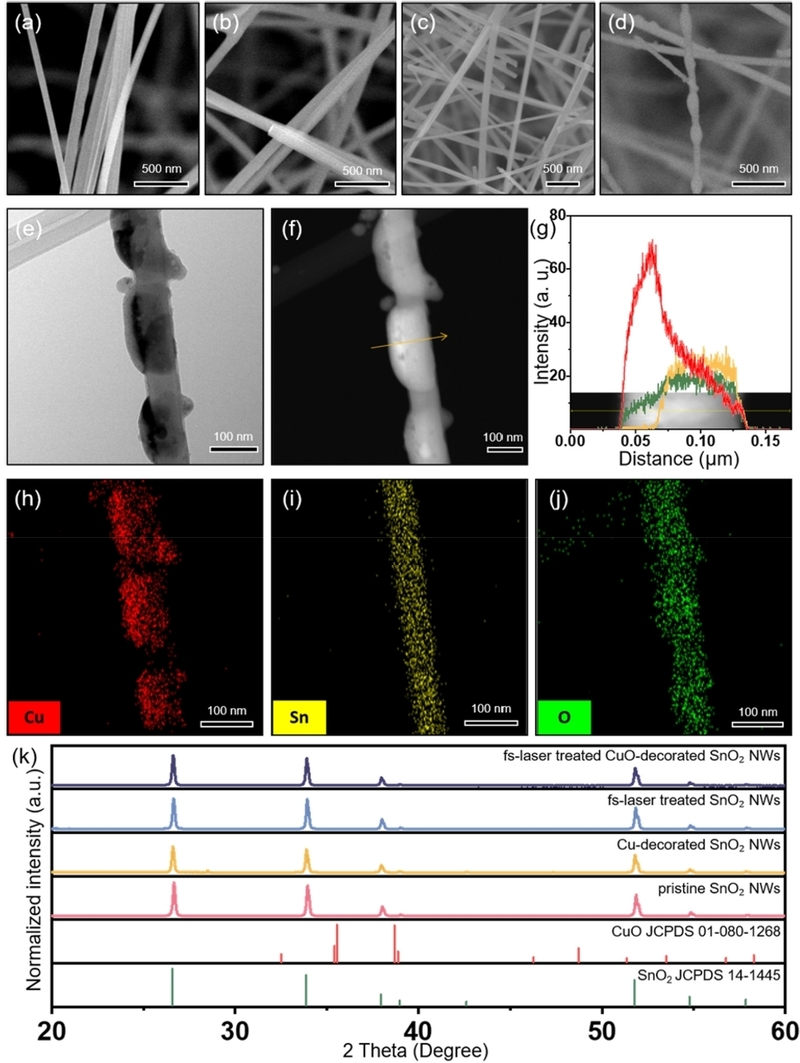
Structural characterization of SnO2-based NWs. (a-d) SEM images of (a) pristine SnO2 NWs, (b) Cu-decorated SnO2 NWs, (c) fs-laser treated SnO2 NWs, (d) fs-laser treated CuO-decorated SnO2 NWs. (e) TEM image of fs-laser treated CuO-decorated SnO2 NWs. (f, g) HAADF-STEM image and EDS line profile of fs-laser treated CuO-decorated SnO2 NWs. (h–j) TEM-EDS mapping of (h) Cu, (i) Sn, (j) O in fs-laser treated CuO-decorated SnO2 NWs. (k) XRD spectra of pristine SnO2 NWs, Cu-decorated SnO2 NWs, fs-laser treated SnO2 NWs, and fs-laser treated CuO-decorated SnO2 NWs.
Following fs-laser irradiation (Fig. 1(c,d)), the nanowire morphology remains largely intact, suggesting that the ultrashort laser pulses did not induce significant thermal damage or melting of the structures. However, a slightly roughened surface texture can be discerned, which is commonly associated with localized surface modification induced by fs-laser processing. Such surface perturbations are known to influence defect formation and surface reactivity.
The TEM image of the fs-laser treated CuO-decorated SnO2 NWs sample (Fig. 1(e)) confirms the crystalline nanowire structure and the presence of surface-attached nanoparticles. The HAADF-STEM image (Fig. 1(f)) further reveals clear contrast between the nanowire body and the decorated particles due to Z-contrast. The line profile (Fig. 1(g)) and elemental mapping (Fig. 1(h–j)) demonstrate that Sn and O are uniformly distributed along the nanowire, while Cu is localized on the surface, verifying successful surface decoration rather than bulk incorporation.
X-ray diffraction patterns of the samples are presented in Fig. 1(k). All major diffraction peaks can be indexed to the tetragonal rutile structure of SnO2 [16], indicating that the crystalline phase of SnO2 is well preserved after Cu decoration and femtosecond laser treatment. No noticeable peak shift or broadening is observed, suggesting that the bulk crystal structure of SnO2 remains stable during the surface modification processes.
Distinct diffraction peaks corresponding to CuO are not clearly detected. This can be attributed to the low loading amount and high dispersion of Cu-based species on the nanowire surface, which may fall below the detection limit of conventional XRD. Similar observations have been reported in previous studies where surface-decorated metal oxides with low content or nanoscale dispersion were not readily detectable by XRD [17].
Nevertheless, the presence of CuO species is supported by XPS analysis, which reveals characteristic Cu2+ features and satellite peaks. Therefore, the combined XRD and XPS results suggest that CuO is present primarily as highly dispersed surface species rather than as a bulk crystalline phase.
The surface chemical states were further analyzed by XPS (Fig. 2). The survey spectra confirm the presence of Sn, O, and Cu elements. The Sn 3d spectra (Fig. 2(b,c)) display two characteristic peaks corresponding to Sn4+, consistent with the SnO2 phase. The Sn 3d peaks of the fs-laser treated CuO-decorated SnO2 NWs are shifted toward lower binding energy, indicating modified surface electronic states of SnO2 induced by the interaction with CuO.
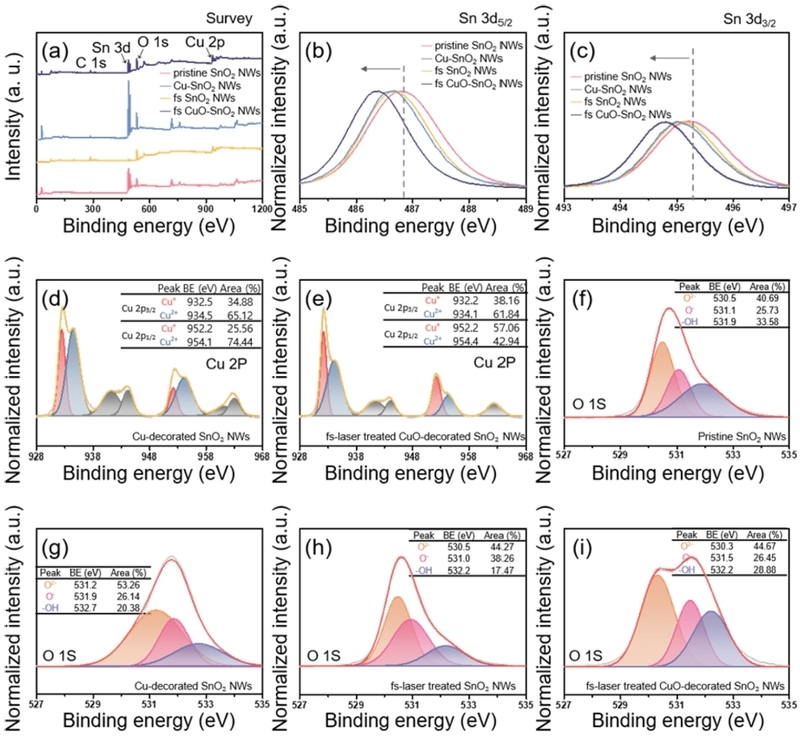
XPS analysis of pristine SnO2 NWs, Cu-decorated SnO2 NWs, fs-laser treated SnO2 NWs, and fs-laser treated CuO-decorated SnO2 NWs. (a) Survey spectra of all samples. (b, c) Sn 3d, (d, e) Cu 2p, an d (f–i) O 1s.
Meanwhile, the O 1s spectra can be deconvoluted into lattice oxygen (O2-), defect-related oxygen, and surface hydroxyl species [18]. The relative fraction of defect-related oxygen shows variations after fs-laser irradiation, suggesting that the laser treatment modifies the surface defect chemistry. Such defect states are generally considered active sites for gas adsorption and charge transfer, and therefore can influence sensing behavior [19].
The Cu 2p spectra exhibit features characteristic of oxidized copper species, including satellite peaks associated with Cu2+, indicating that Cu is predominantly present as CuO on the SnO2 surface. The formation of CuO–SnO2 interfaces is important for establishing p–n heterojunctions, which can modulate the depletion layer and charge transport properties of the sensor [20,21].
Overall, the morphological and chemical analyses indicate that fs-laser irradiation primarily modifies the surface states without destroying the nanowire architecture, while Cu decoration introduces catalytically active CuO species. These features are expected to collectively influence the H2S sensing performance discussed in the following section.
3.2. Gas sensing studies
The H2S sensing performances of the sensors based on pristine SnO2 NWs, Cu-decorated SnO2 NWs, fs-laser treated SnO2 NWs, and fs-laser treated CuO-decorated SnO2 NWs were systematically evaluated. Fig. 3(a,d,g,j) present the dynamic responses toward 10 ppm H2S at different operating temperatures of 100, 150, 200, and 300°C, respectively. All sensors exhibit a typical decrease in resistance upon exposure to H2S, confirming their n-type sensing behavior toward reducing gases.
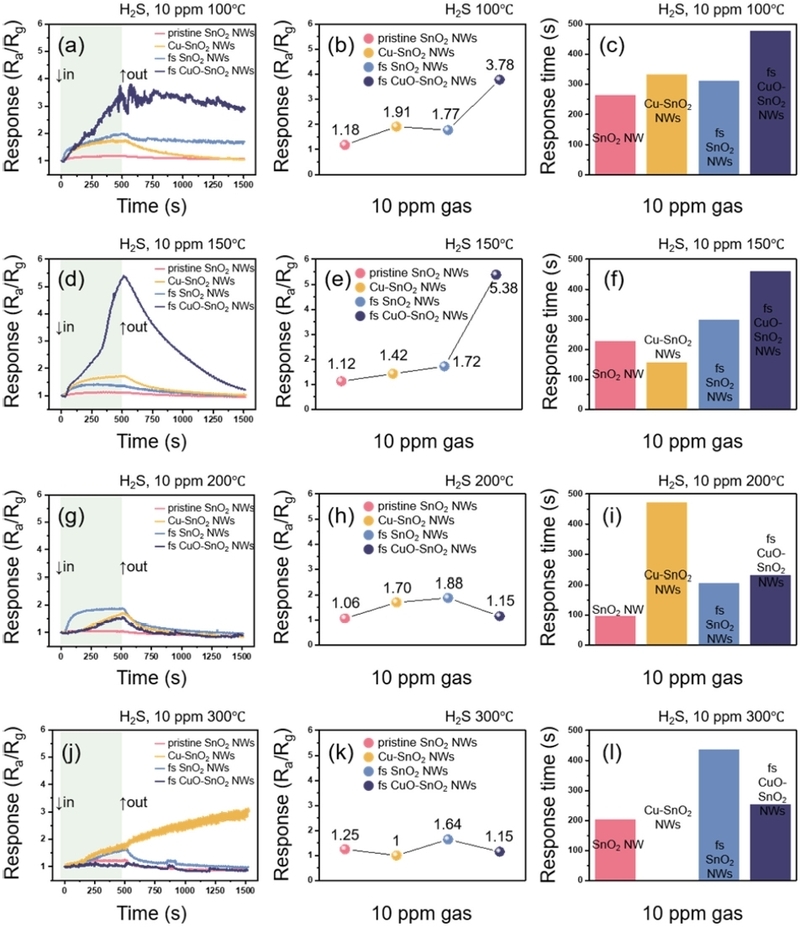
Gas-sensing performance of SnO2 NW-based sensors toward 10 ppm H2S at different operating temperatures. (a–c) Dynamic response curves, response values, and response and recovery times at 100°C; (d–f) 150°C; (g–i) 200°C; and (j–l) 300°C.
Among the tested devices, the fs-laser treated CuO-decorated SnO2 NWs sensor shows the highest response at 150°C, which is identified as the optimal operating temperature.
The enhanced response at this temperature suggests a balanced condition between adsorption and desorption kinetics of H2S molecules. At lower temperatures, insufficient activation of surface reactions likely limits the response, whereas at higher temperatures, accelerated desorption reduces gas–surface interaction time.
Fig. 3(b,e,h,k) present the responses of the four sensors toward 10 ppm H2S at 100, 150, 200, and 300°C, respectively, and the corresponding response and recovery times are summarized in Fig. 3(c,f,i,l). At the optimal operating temperature of 150°C, the fs-laser treated CuO-decorated SnO2 NWs sensor exhibits a response of 5.38, with response and recovery times of approximately 462 s and 850 s, respectively.
The concentration-dependent responses measured at 150°C are shown in Fig. 4(a–e) and Fig. 5. The response increases monotonically with H2S concentration from 2 to 10 ppm, demonstrating reliable concentration-dependent behavior. Even at low concentrations, measurable responses are observed, indicating good sensitivity.

Gas-sensing performance of SnO2 NW-based sensors at 150°C. (a–d) Dynamic resistance responses of pristine SnO2 NWs, Cu-decorated SnO2 NWs, fs-laser treated SnO2 NWs, and fs-laser treated CuO-decorated SnO2 NWs sensors toward various H2S concentrations, respectively. (e) Variation in the responses of the sensors with increasing H2S concentration. (f, g) Response and recovery times of the fs-laser treated CuO-decorated SnO2 NWs sensor as a function of H2S concentration. (h–k) Dynamic responses of the fs-laser treated CuO-decorated SnO2 NWs sensor toward 10 ppm ethanol, toluene, ammonia, and benzene, respectively. (l) Selectivity toward various gases at 150°C.

Dynamic responses of pristine SnO2 NWs, Cu-decorated SnO2 NWs, fs-laser treated SnO2 NWs, and fs-laser treated CuO-decorated SnO2 NWs sensors toward different H2S concentrations at 150°C. (a–d) 2 ppm, (e–h) 4 ppm, (i–l) 6 ppm, and (m–p) 8 ppm H2S.
Selectivity is a critical factor for practical gas sensors. As shown in Fig. 4(h–l), the fs-laser treated CuO-decorated SnO2 NWs sensor exhibits a significantly higher response to H2S compared to other interfering gases such as 10 ppm ethanol, toluene, ammonia, and benzene. This selective behavior is commonly associated with the strong chemical affinity between CuO and H2S.
The improved H2S sensing performance can be understood by considering both heterojunction and chemical interaction effects. The CuO–SnO2 interface forms a p–n heterojunction, which modulates the depletion layer and enhances resistance variation upon gas exposure. More importantly, CuO can react with H2S to form copper sulfide species, which possess higher electrical conductivity. This reaction leads to a pronounced change in the local electronic structure and contributes to large resistance modulation. After removal of H2S, reoxidation of copper sulfide in air allows the sensor to recover its baseline resistance [22-24].
In addition, fs-laser irradiation likely increases surface defect density and modifies oxygen-related species, as suggested by XPS analysis. These defect sites can promote adsorption and charge transfer processes, further amplifying the sensing response. Therefore, the superior performance of the fs-laser treated CuO-decorated SnO2 NWs sensor can be attributed to the combined effects of heterojunction modulation, chemical interaction with H2S, and defect-assisted surface reactions [25,26].
4. CONCLUSIONS
In this study, fs-laser irradiation was employed as a surface engineering process to modify CuO-decorated SnO2 NWs for H2S gas sensing. The fs-laser treatment preserved the nanowire morphology while altering the surface chemical states and defect-related oxygen species. CuO species were successfully introduced onto the SnO2 NWs surface, forming CuO–SnO2 heterojunctions.
Gas sensing measurements demonstrated that the fs-laser treated CuO-decorated SnO2 NWs exhibited improved responses toward H2S compared to pristine and CuO-decorated SnO2 NW. The optimal performance was observed at 150°C, where a response of 5.38 was achieved toward 10 ppm H2S. At this temperature, the response increased monotonically with the H2S concentration, from 1.68 at 2 ppm to 2.02, 2.47, and 4.12 at 4, 6, and 8 ppm, respectively. The corresponding response and recovery time toward 10 ppm H2S was 462 s and 850 s, respectively. The enhanced sensing behavior is attributed to the combined effects of p–n heterojunction modulation and the reversible chemical interaction between CuO and H2S, along with defect-assisted surface reactions induced by fs-laser processing.
These results indicate that femtosecond laser irradiation can serve as an effective post-treatment strategy to tune the surface states of metal oxide nanostructures and improve gas sensing performance without altering the bulk structure. This process-oriented approach provides a feasible route for performance optimization of chemiresistive gas sensors.
Acknowledgments
This research was supported by the National Research Foundation of Korea (NRF) grant funded by the Ministry of Science and ICT (MSIT) (RS-2021-NR060108). This study was funded by the Korea Institute of Industrial Technology (KITECH) (No. UR260049, Development of Shape Demonstration Technology for Electrostatic Chuck Lift Pins through Control of Sintering Behavior of TiC Powders Produced by Self-Propagating High-Temperature Synthesis (SHS)).
REFERENCES
-
J. Lee, N.G. Do, D.H. Jeong, D.G. Jung, H.K. An, S.H. Kong, et al., Polyester (PET) Fabric dyed with Lead (II) acetate-based Colorimetric Sensor for Detecting Hydrogen Sulfide (H2S), J. Sens. Sci. Technol. 29 (2020) 360–364.
[https://doi.org/10.46670/JSST.2020.29.5.360]

-
D.H. Jeong, B. Maeng, J. Lee, S.B. Cho, H.K. An, D. Jung, Fabrication of High-Performance Colorimetric Fiber-Type Sensors for Hydrogen Sulfide Detection, J. Sens. Sci. Technol. 31 (2022) 168–174.
[https://doi.org/10.46670/JSST.2022.31.3.168]
-
J. Kwon, High-Sensitivity NO2 Gas Sensor Based on PbS Quantum Dots with WO3 Nanoparticle Catalytic Layer, J. Sens. Sci. Technol. 34 (2025) 645–650.
[https://doi.org/10.46670/JSST.2025.34.6.645]
-
S. Lee, H.W. Jang, α-Fe2O3 nanostructure-based gas sensors, J. Sens. Sci. Technol. 30 (2021) 210–217.
[https://doi.org/10.46670/JSST.2021.30.4.210]
-
S. Giri, B. Mahata, P.K. Guha, P. Banerji, Hierarchical ZnO Nanoflowers with Tunable Defect Chemistry for Highly Selective Formaldehyde Detection: Elucidating Structure-Property-Kinetics Relationships, ACS Appl. Electron. Mater. 8 (2026) 5562–5574.
[https://doi.org/10.1021/acsaelm.6c00798]
-
M. Ma, L. Lv, K. Yao, N. Nan, L. Cui, C. Li, et al., In situ synthesized oxygen-vacancy-rich CuO nanosheet arrays for low-temperature ppb-level NO2 sensing, J. Mater. Chem. A 14 (2026) 28517–28528.
[https://doi.org/10.1039/D5TA10392D]
-
L. Zhang, F. Gu, Z. Wang, The interface effect of MOF-derived Pr6O11/SnO2 composite materials enhances oxygen vacancies for achieving highly sensitive detection of n-butanol gas, J. Mater. Chem. C 14 (2026) 12697–12707.
[https://doi.org/10.1039/D6TC00778C]
-
Z. Kamali Khanghah, A. Butler, A. Reicks, J. Parmar, E. Schubert, C. Zuhlke, et al., Advanced Emissivity Tuning Via Femtosecond Laser Surface Engineering, Adv. Opt. Mater. 14 (2026) e02035.
[https://doi.org/10.1002/adom.202502035]
-
A.I. Khudiar, M.K. Mohsen, A.M. Oufi, Laser-induced oxygen vacancies for enhanced gas sensing in zinc oxide thick films, Radiat. Phys. Chem. 238 (2026) 113187.
[https://doi.org/10.1016/j.radphyschem.2025.113187]
-
A. Lys, I. Gnilitskyi, E. Coy, M. Jancelewicz, M. Bechelany, I. Iatsunskyi, Hierarchically Structured Ti-TiO2 Membranes Fabricated by Femtosecond Laser Ablation and Atomic Layer Deposition for Enhanced Photoelectrochemical Water Splitting, ACS Appl. Mater. Interfaces 17 (2025) 43390–43402.
[https://doi.org/10.1021/acsami.5c07488]
-
K. Sugioka, Y. Cheng, Ultrafast lasers—reliable tools for advanced materials processing, Light Sci. Appl. 3 (2014) e149.
[https://doi.org/10.1038/lsa.2014.30]
-
S. Yan, D. Guo, E.A. Baranova, A. Merati, C.-H. Yim, Y. Abu-Lebdeh, et al., Ultrafast Laser Texturing of Ceramic Electrolytes toward Solid-State Battery Application, ACS Appl. Energy Mater. 8 (2025) 11404–11412.
[https://doi.org/10.1021/acsaem.5c01575]
-
K. Yu, H. Shi, P. Zhang, Z. Yu, H. Yan, Q. Lu, Micro/nanoengineering of functionalized metal surfaces based on short/ultra-short-pulsed lasers: a review, J. Mater. Sci. 59 (2024) 1819–1866.
[https://doi.org/10.1007/s10853-023-09319-0]
-
B. Zhang, M. Chen, Z. Zhang, C. Zhang, N. Luo, B. Zhang, et al., Enhancing H2S sensing performance via acid-etching engineering of Pt/SnO2/CuO nanoflower heterojunctions, Microchem. J. 227 (2026) 118783.
[https://doi.org/10.1016/j.microc.2026.118783]
-
S. Ruksana, A. Kumar, S. Lakshmy, K.R. Kishore, C.S. Sharma, M. Kumar, et al., Highly Efficient CuO-Anchored SnO2 Nanofiber for Low-Concentration H2S Gas Sensors, ACS Appl. Eng. Mater. 2 (2024) 431–442.
[https://doi.org/10.1021/acsaenm.3c00743]
-
J.H. Lee, W.H. Jo, H. Lim, J.H. So, H.G. Bae, J.H. Chung, et al., Role of TiO2 Decoration on SnO2 Nanorods for Highly Sensitive and Selective Acetone Detection, J. Sens. Sci. Technol. 33 (2024) 318–325.
[https://doi.org/10.46670/JSST.2024.33.5.318]
-
J. Shin, S.W. Choi, C. Kim, J. Park, J.W. Roh, J.Y. Hwang, et al., Characterization and H2S gas sensing characteristics of Au-decorated ZnO nanorods prepared by a two-step wet method, J. Alloys Compd. 1021 (2025) 179655.
[https://doi.org/10.1016/j.jallcom.2025.179655]
-
M. Jiao, X. Chen, B. Deng, K. Mao, C. Wen, Multi-gas recognition based on ZnO–Au–SnO2 heterostructure gas sensors and one-dimensional convolutional neural networks, Talanta 307 (2026) 129904.
[https://doi.org/10.1016/j.talanta.2026.129904]
-
H. Liu, Z. Cui, S. Zhong, W. Kuang, J. Wei, J. Zhou, et al., Hydrogen Spillover Synergistically Enhances Electrocatalytic Nitrate Reduction to Ammonia on SnO2-CuO Heterointerfaces, Small 22 (2026) e74149.
[https://doi.org/10.1002/smll.74149]
-
S.M. Ingole, A.C. Molane, U.J. Patel, S.L. Patil, M. Selvaraj, M.A. Assiri, et al., Development of SnO2/CuO heterostructure sensor for detection of toxic NO2 gas, Inorg. Chem. Commun. 182 (2025) 115402.
[https://doi.org/10.1016/j.inoche.2025.115402]
-
H. Ren, J. Wan, H. Pan, J. Huang, Facile synthesis of porous SnO2@CuO nanosheets with highly sensitive performance of VOCs, Mater. Res. Bull. 185 (2025) 113313.
[https://doi.org/10.1016/j.materresbull.2025.113313]
-
D.V. Rupnar, D. Goyal, P. Sarawade, N.S. Ramgir, Development of a high-performance chemiresistive H2S sensor based on sandwich type SnO2: CuO film realized using hybrid PVD approach, Interactions 246 (2025) 88.
[https://doi.org/10.1007/s10751-025-02303-x]
-
K.R. Park, H.B. Cho, J. Lee, Y. Song, W.B. Kim, Y.H. Choa, Design of highly porous SnO2-CuO nanotubes for enhancing H2S gas sensor performance, Sens. Actuators B Chem. 302 (2020) 127179.
[https://doi.org/10.1016/j.snb.2019.127179]
-
M.K. Verma, V. Gupta, A highly sensitive SnO2–CuO multilayered sensor structure for detection of H2S gas, Sens. Actuators B Chem. 166–167 (2012) 378–385.
[https://doi.org/10.1016/j.snb.2012.02.076]
-
J.H. Kim, A. Mirzaei, S.S. Kim, C. Park, Pt nanoparticle decoration on femtosecond laser-irradiated SnO2 nanowires for enhancing C7H8 gas sensing, Sens. Actuators B Chem. 379 (2023) 133279.
[https://doi.org/10.1016/j.snb.2022.133279]
-
H. Park, J. Kim, S. Ahn, A. Mirzaei, J.H. Kim, C. Park, CuO nanoparticles-decorated femtosecond laser-irradiated WS2–WO3 heterojunctions to realize selective H2S gas sensor, Sens. Actuators B Chem. 427 (2025) 137167.
[https://doi.org/10.1016/j.snb.2024.137167]