
Hydrovoltaic-Driven Self-Powered Sensors for IoT and Healthcare Applications: A Review
 ; Subeen Park1, 3
; Soo Young Kim2
; Jeong Gon Son1, 3, +
; Ji-Soo Jang4, +
; Sunghoon Hur1, 5, +
ⓒ The Korean Sensors Society
This is an Open Access article distributed under the terms of the Creative Commons Attribution Non-Commercial License (https://creativecommons.org/licenses/by-nc/3.0/) which permits unrestricted non-commercial use, distribution, and reproduction in any medium, provided the original work is properly cited.
Abstract
Self-powered sensors capable of operating without external batteries are essential for realizing autonomous, sustainable sensing platforms required by the Internet of Things (IoT) and healthcare technologies. Among various ambient energy harvesting strategies, hydrovoltaic technology converts solid-water interactions into electricity through interfacial charge redistribution, electrical double layer formation, and ion transport. Harnessing the ubiquitous moisture across natural, biological, and human-centered environments, this mechanism provides a compelling route for self-powered sensing. Given their fundamental dependence on interfacial parameters like surface functional group density, moisture levels, and ionic composition, hydrovoltaic systems exhibit an intrinsic coupling of energy harvesting and active sensing capabilities. This review outlines recent advancements in hydrovoltaic sensors, categorizing them into physical (humidity, strain, and pressure) and chemical (ion, gas, and molecular) sensing platforms based on their material compositions and underlying transduction mechanisms. Furthermore, we evaluate their emerging applications in IoT-based distributed networks and continuous healthcare monitoring, followed by a critical assessment of the current challenges and future trajectories for translating these technologies into robust, autonomous sensing systems.
Keywords:
Self-powered sensor, Hydrovoltaic, IoT sensor, Healthcare monitoring1. INTRODUCTION
Sensors are devices that convert external physical and chemical stimuli into electrical signals, serving as essential components for acquiring environmental information and processing it within electronic systems [1-5]. By detecting diverse stimuli such as light, pressure, motion, strain, acceleration, humidity, and temperature, sensors have been widely employed in industrial process control, environmental monitoring, healthcare, wearable electronics, and Internet of Things (IoT)-based distributed sensor networks [6-16]. Most sensors require external power sources or batteries for stable operation, which imposes critical limitations on their deployment in off-grid environments and large-scale sensing systems where power infrastructure is restricted. The dependence on external power sources introduces additional system and maintenance requirements, presenting a challenge for the long-term operation of distributed IoT sensing platforms.
To overcome these limitations, extensive research has been directed toward self-powered sensing platforms driven by ambient energy harvesting, as a complementary strategy to low-power sensor architectures that minimize energy consumption [17-20]. By directly converting environmental energy into electricity, energy harvesting approaches can reduce reliance on external power infrastructures.
Various energy harvesting strategies, including photovoltaic [21-23], piezoelectric [24-28], triboelectric [29-33], thermoelectric [34-36], and pyroelectric [37,38] systems, have been explored for self-powered sensing. Although each approach offers distinct advantages depending on the target applications, energy harvesting systems are generally associated with specific environmental or input requirements, such as mechanical deformation, light illumination, and temperature gradient. Therefore, the practical applicability of energy harvesting-based sensors is strongly influenced by the environmental availability of the energy source. In this context, hydrovoltaic energy harvesting offers a distinctive route for electricity generation by harnessing water, one of the most abundant and readily available resources on Earth [39-41]. The ability to generate electrical outputs from diverse physical states of water, including droplets, humidity, and vapor, provides a compelling basis for the development of self-powered sensing platforms. Notably, modern sensing technologies primarily target natural, biological, and human-centered environments, where the widespread presence of water offers a broadly accessible energy input.
Hydrovoltaic phenomena arise from the interaction between solid surfaces and liquid. Solid-liquid contact, moisture adsorption, evaporation, or ion transport facilitates an imbalance in interfacial charge distribution, resulting in an electrical potential difference [42-47]. These electrical responses are closely related to interfacial charge redistribution and ion transport process, including electrical double layer (EDL) formation, ion diffusion and moisture gradient. As a result, a hydrovoltaic system can convert interfacial potential differences or ionic concentration gradients into measurable voltage and current signals by adapting conductive materials [48-50]. Accordingly, the magnitude and behavior of the resulting electrical output are highly sensitive to local environmental factors, including the density of surface functional groups, the amount or state of moisture at the interface, the type and concentration of ions, and humidity or temperature gradients within the device. Consequently, the electrical output of a hydrovoltaic device is not merely a product of energy harvesting but can act as an active signal, reflecting the type and intensity of the surrounding environmental stimulus. These characteristics enables hydrovoltaic phenomena to serve as the operating principle of self-powered sensing, in which electrical signals are spontaneously generated in response to these external changes without requiring an external power source [51-53]. However, in order to accurately interpret signals and translate them into practical sensing applications, a thorough understanding of the physicochemical properties of hydrovoltaic materials and their corresponding sensing mechanism is required.
In this review, we systematically summarize recent advances in hydrovoltaic sensors, focusing on their materials and sensing mechanisms, and further classify representative examples into physical and chemical stimulus-responsive sensors (Fig. 1). Through this analysis, we aim to provide a deeper understanding of the design principles underlying hydrovoltaic sensors and perspectives that may guide future development toward practical applications, including IoT and healthcare monitoring systems.
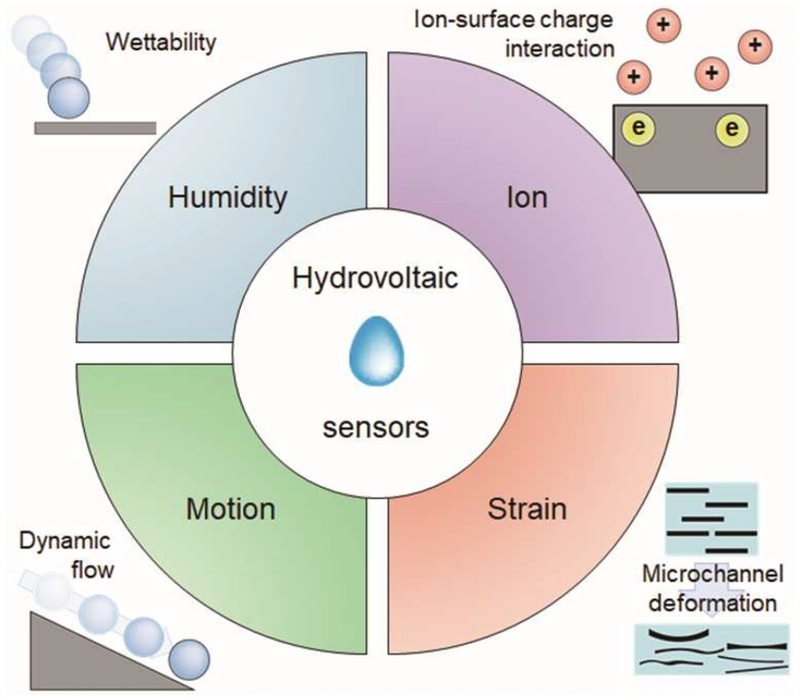
Classification and key factors of hydrovoltaic sensors.
2. SELF-POWERED HYDROVOLTAIC SENSORS
2.1 Hydrovoltaic physical sensors
Hydrovoltaic physical sensors transduce external physical or environmental stimuli into electrical signals modulated by solid-liquid interfacial interactions, ion transport, conductive pathways and moisture gradient within hydrovoltaic devices. In these systems the sensing response is governed not only by the intrinsic electrical properties of the active materials, but also by the interaction between the device and water molecules, as well as the dynamic behavior of water on the device.
Conductive materials used in hydrovoltaic devices can be broadly classified into oxide, biomaterials, carbon-based, and conductive polymers [54-56]. Depending on their structural and physicochemical properties, external stimuli such as strain and motion can alter the internal capillary channels, conductive networks, interfacial contact, or charge transport pathways, resulting in changes in hydrovoltaic performance. Furthermore, water molecules can interact with the conductive layer of supporting substrate through adsorption, hydration, surface charging, and EDL formation. These interactions affect water penetration, diffusion, evaporation, and ion transport, thereby modulating the generated voltage and current.
External environmental factors such as temperature, relative humidity (RH), and airflow can further influence the hydrovoltaic response by changing the evaporation rate and the spatial distribution of water within the device. The resulting moisture gradient can drive water and ion transport, leading to measurable variations in electrical output. Therefore, hydrovoltaic physical sensors can operate as self-powered sensing platforms by converting physical or environmental stimuli into electrical signals. Based on these principles, recent studies can be categorized into strain, motion, and humidity sensors.
The mechanism of hydrovoltaic sensor is governed by humidity dependent water adsorption, hydration, and ion transport within the active material. In general, the sensing layer is designed to contain abundant hydrophilic functional groups, such as hydroxyl, carboxyl, or amine groups, which can interact with water molecules through hydrogen bonding and facilitate ion dissociation and transport. When the surrounding RH increases, water molecules are progressively adsorbed onto the surface and penetrate into the internal micro/nanochannels of the active layer. This hydration process can induce swelling, enhance ionic dissociation, and ion migration, thereby altering the local ion concentration, interfacial potential, and EDL structure.
These changes directly modulate the spontaneous direct current (DC) output of hydrovoltaic devices. At low humidity, limited water adsorption restricts ion dissociation and charge transport, resulting in a relatively weak voltage or current response. As humidity increases, the expanded hydration network provides continuous pathways for ion migration and strengthens charge separation at the solid-liquid interface. Consequently, the generated voltage and current can increase systematically with RH that can be converted into measurable electrical signals without an external power supply. By calibrating the relationship between RH and electrical response, hydrovoltaic devices can function as self-powered humidity sensors [57-59].
Lei et al. proposed a sandwich structure potentiometric humidity sensor (Fig. 2(a))[60]. The device was fabricated with reduced graphene oxide (rGO), graphene oxide (GO), and foamed metal nickel (Nifm). The abundant oxygen-rich functional groups in the GO layer facilitate hydration. Density functional theory (DFT) calculations showed that hydration in GO significantly reduces the adsorption energy of protons, thereby enhancing H+ mobility and ionic conductivity. In addition, asymmetrical architecture of rGO/GO/Nifm induces electrical potential difference, which can serve as a galvanic cell altering solid and liquid electrolytes.
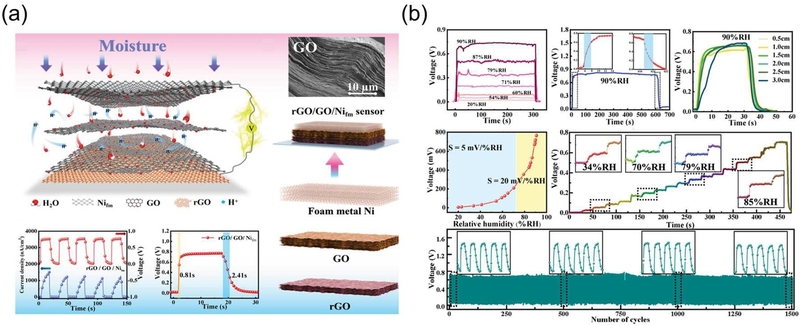
Hydrovoltaic humidity sensors. (a) Schematic of sandwich structure potentiometric humidity sensor. (b) Sensing performance of the sensor under humid conditions. Adapted from Ref. [60].
As a result, the device generated an open-circuit voltage (VOC) of up to 0.77 V at 90% RH and exhibited rapid response and recovery times of 0.8 and 2.4 s, respectively (Fig. 2(b)). The sensor also showed linear sensitivities of 5 mV/% RH in the 20-70% RH range and 20 mV/% RH in the 70-90% RH range. Moreover, the device maintained a stable voltage response over more than 1500 humidity cycles and high humidity exposure for over 600 s. These results demonstrate that the asymmetric rGO/GO/Nifm architecture can serve as a self-powered platform for humidity monitoring and respiration-related moisture sensing.
Li et al. introduced a polydopamine (PDA) based moisture power generator as a humidity-responsive platform for self-powered wearable sensing [61]. A porous PDA film with micropores of approximately 1 μm in average diameter was formed on a PET substrate by spray printing, and a gradient PDA (g-PDA) structure with an asymmetric distribution of hydroxyl groups was subsequently introduced through electrochemical polarization. Upon moisture absorption, the oxygen-rich functional groups in the g-PDA film undergo ionization, generating an asymmetric ion distribution between mobile H+ ions and locally confined anions bound to the PDA skeleton. The hydroxyl group gradient promotes directional H+ migration, resulting in a potential difference and voltage generation.
Based on this mechanism, the g-PDA device exhibited rapid moisture response and high output performance. When the RH changed from 5% to 55%, the voltage reached a stable state within 0.22 s and recovered within 0.26 s after moisture removal. In addition, the output voltage increased from approximately 0.14 V to 0.52 V as ΔRH increased from 30% to 90%, demonstrating its capability for self-powered humidity sensing. The device also retained approximately 98% of its initial voltage after 1000 bending cycles at 120˚, confirming its mechanical durability. These results suggest that g-PDA based hydrovoltaic devices can serve as flexible and self-powered wearable humidity sensors capable of monitoring local moisture variations at the skin-device interface.
The fundamental transduction mechanism of hydrovoltaic strain sensors is governed by the geometric deformation of internal conductive pathways and the subsequent variations in electrical resistance under physical elongation. For instance, when tensile stress is applied to an elastic fabric coated with carbon nanomaterials, the internal micro/nanochannels undergo elongation, accompanied by localized cracking and interfacial slippage. These structural alternations directly lead to an increase in the internal electrical resistance of the device, which scales proportionally with the applied strain. The elevated resistance intrinsically affects the DC power generation dynamics driven by water molecule diffusion and ion transport.
Specifically, mechanical stretching locally amplifies the moisture concentration gradient and expands the effective evaporation area, which can result in an augmented VOC. Conversely, the short-circuit current (ISC) exhibits an immediate decline due to its acute sensitivity to the increased internal resistance. By continuously monitoring these distinct variations in the spontaneously generated power, the magnitude of the applied mechanical strain can be accurately quantified, thereby enabling the device to function as a highly sensitive, self-powered strain sensors [62-64].
Luo et al. introduced a highly stretchable fiberform hydrovoltaic generator as a self-powered strain sensing platform (Fig. 3(a))[65]. The device, denoted as MC-FHPG, was fabricated by loading oxidized multiwalled carbon nanotubes (o-MWCNT) and oxidized carbon black (o-CB) onto discarded mask strap fibers. The mask strap substrate provides microscale capillary channels between yarns, while the o-MWCNT/o-CB network forms nanoscale water diffusion pathways and conductive networks on the fiber surface. When water is supplied to one end of the fiber, capillary driven water transport along the charged carbon surface induces an EDL at the solid-liquid interface and generates a spontaneous hydrovoltaic current. This current provides the electrical signal for strain sensing without an external power source.
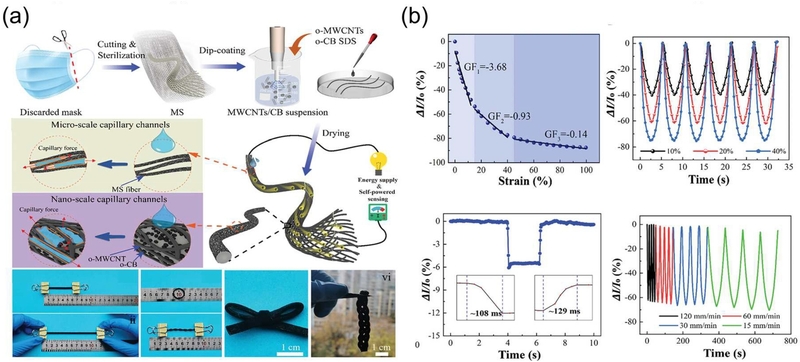
Hydrovoltaic strain sensors. (a) Schematic illustration of MC-FHPG strain sensor. (b) Strain-dependent current response and sensing performance of MC-FHPG. Adapted from Ref. [65].
The strain sensing performance of the MC-FHPG was evaluated by monitoring the variation in the current under tensile deformation (Fig. 3(b)). The relative current response can be divided into three distinct linear regions across the 0-100% strain range, corresponding to gauge factors of -3.68, -0.93, and -0.14 for 0-15%, 15-45%, and 45-100% strain, respectively. This negative current originates from increase of the internal resistance induced by strain, which suppresses ISC during stretching. Repeated stretching tests at 10%, 20%, and 40% strain produced reproducible current modulations with strain-dependent amplitudes, confirming the capability of the device to resolve different deformation levels. Moreover, the device exhibited fast dynamic response and recovery times of 108 and 129 ms under a transient strain of 1%, respectively. As a proof-of-concept demonstration, the MC-FHPG was mounted on a finger joint, where progressive finger bending from 15˚ to 90˚ produced a corresponding decrease in the output current. This result highlights the applicability of fiberform hydrovoltaic generators as a stretchable self-powered strain sensors for wearable motion tracking.
Wen et al. reported a self-gradient hydrogel-based moisture-induced electric generator (SHMEG) as a climate-adaptive stretchable platform for self-powered wearable sensing (Fig. 4(a))[66]. The device was fabricated by applying a pre-gel solution composed of polyacrylamide (PAM), glycerol, and NaCl onto a CB-loaded knitted fabric, followed by self-diffusion and thermal gelation to form a concentration-gradient hydrogel structure. The CB-loaded fabric provides a negatively charged and porous interface for ion adsorption, while the hydrogel maintains hygroscopicity, moisture retention, ionic conductivity, and mechanical stretchability. The spontaneous formation of ion and water concentration gradients establishes an EDL gradient at the hydrogel-carbon interface. This interfacial gradient promotes directional ion transport and enables sustained hydrovoltaic output.
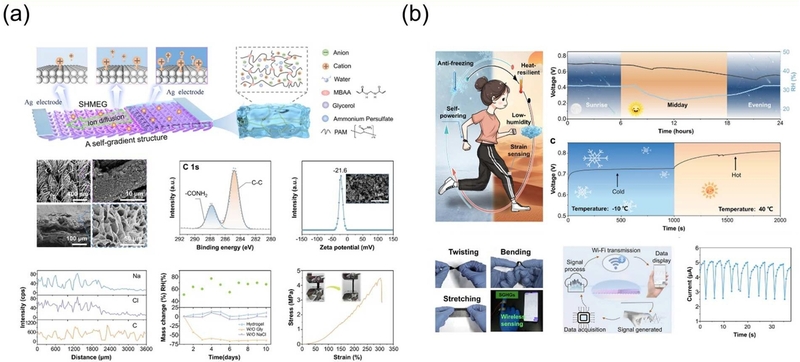
Climate-adaptive hydrovoltaic strain sensors. (a) Fabrication and surface characterization of SHMEG (b) Climate-adaptive output and wearable sensing performance of the SHMEG. Adapted from Ref. [66].
Based on this mechanism, the SHMEG exhibited stable and climate-adaptive power generation performance (Fig. 4(b)). The device generated a sustained VOC of approximately 0.75 V for 140 h and ISC of 15 ̄μA at around 75% RH under room temperature. Due to the combined effects of glycerol and NaCl, the hydrogel achieved moisture retention and anti-freezing characteristics. In addition, its high stretchability of up to 300% enabled wearable sensing applications. During stretching and finger bending, the output current decreased with increasing internal resistance, allowing mechanical deformation to be tracked through the self-powered electrical signal. The device was further integrated with a wireless sensing system for real-time finger-motion monitoring, suggesting its potential as a climate-adaptive self-powered platform for wearable strain sensing.
Unlike strain sensors, which primarily quantify uniaxial tensile deformation, mechanical sensors can be designed to detect more complex stimuli, including pressure, bending, sliding, and tapping. This broader sensing capability is achieved by tailoring the device architecture so that mechanical inputs modulate liquid motion, water distribution, ion transport pathways, and interfacial contact. For example, pressure-induced deformation and displacement of droplets within confined microfluidic channels can alter the flow velocity and solid-liquid contact area, producing corresponding changes in the flow-induced voltage. These structural and functional design strategies enable mechanical stimuli with different intensity, frequency, and repetitive pattern to produce distinguishable self-generated electrical responses.
Hydrovoltaic pressure and motion sensing can therefore be broadly implemented through several strategies. Direct mechanical modulation of the liquid phase represents a primary strategy for hydrovoltaic pressure and motion sensing. In this configuration pressing, bending or sliding changes the position, shape, velocity, or contact area of liquid, resulting in interfacial charge redistribution and alter the generated voltage. Complex mechanical stimuli can be detected by coupling hydrovoltaic generation with an auxiliary transduction mechanism. Moisture-induced actuation can be monitored through the voltage generated during water redistribution, whereas mechanoluminescent materials convert pressure of sliding into optical signals that subsequently modulate the hydrovoltaic output. This approach enables hydrovoltaic devices to detect pressure and dynamic motion beyond conventional strain sensing [67-70].
Kong et al. presented a flexible self-powered pressure sensor based on graphene microfluidic channel (GMC) structure [71]. The device was fabricated by assembling monolayer graphene on PDMS and SiO2 substrate to form a confined microchannel with inlet and outlet. Two graphene/PDMS layers and terminal electrodes defined the channel geometry, while the graphene surface provides a solid-liquid interface for droplet-based charge redistribution. When external pressure was applied, deformation of the flexible channel induced displacement and accelerated motion of the confined droplet along the graphene surface. This pressure-dependent droplet motion altered the charge distribution at the EDL and generated a corresponding flow-induced voltage, enabling the direct conversion of mechanical pressure into self-powered electrical signal.
Based on this mechanism, the GMC pressure sensor exhibited distinguishable voltage responses over a broad pressure range from 0.254 to 26.85 kPa. The relative voltage change showed two linear response regions, with sensitivities of 17.36 kPa-1 in the low-pressure range of 0-7 kPa and 5.15 kPa-1 in the high-pressure range of 13-26 kPa. The corresponding coefficients of determination were 0.997 and 0.991, respectively. Under loading and unloading at 2.138 kPa, the sensor exhibited response and recovery times of 36.4 and 239.2 ms. These results demonstrate that mechanically regulated droplet displacement within the flexible GMC can provide quantitative and rapid self-powered pressure sensing.
Zhang et al. presented a self-powered mechanoluminescent hydrovoltaic patch for multidimensional pressure and motion sensing [72]. The device consisted of a porous PAN/ZnS:Cu@TiO2/Au active layer positioned between flexible PET films and carbon electrodes. Sweat or water vapor transported through the porous substrate generated a baseline hydrovoltaic output, while the mechanoluminescent layer converted externally applied bending, pressing, sliding and tapping into an additional optical stimulus. Under mechanical deformation, piezoelectric polarization in ZnS:Cu promoted carrier detrapping and green-light emission. The emitted light was subsequently absorbed by Au nanoparticles, generating energetic carriers that were transferred to TiO2 and promoted photocatalytic reactions. This process disturbed the interfacial ion equilibrium and increased the hydrovoltaic potential, allowing mechanical stimuli to be converted into the voltage response.
Based on this coupled transduction mechanism, light stimulation increased both the voltage and current outputs of the patch, supporting the photo-assisted enhancement of hydrovoltaic generation. The mechanoluminescent-hydrovoltaic coupling enabled the patch to distinguish mechanical inputs through changes in signal amplitude and waveform to monitor motions at the neck, wrist, elbow, and knee. The device was further applied to Morse-code communication by assigning arm bending and finger tapping to distinct code elements. Voltage sequences corresponding to “HELP ME”, “DANGER”, and “SAFE” were successfully generated, demonstrating the potential of the self-powered wearable motion and pressure sensors.
2.2 Hydrovoltaic chemical sensors
Hydrovoltaic chemical sensors are devices in which power generation characteristics are modulated by chemical interactions with target ions or molecules, rather than being determined solely by the intrinsic electrical properties of the conductive materials or their interactions with water [73,74]. Hydrovoltaic chemical sensors respond to changes in chemical environment, including pH, ion concentration, and the presence of specific ionic or molecular species. These chemical factors regulate the hydrovoltaic output by altering surface charge, interfacial ion distribution, and charge transport at the solid-liquid interface.
When a hydrovoltaic device comes into contact with water or an aqueous solution, surface functional groups such as hydroxyl, carboxyl, sulfonic acid, and amine groups can undergo protonation or deprotonation depending on the pH of the solution. These acid-base equilibria alter the surface charge density of the solid, thereby affecting the formation of the EDL, ion distribution, ion transport, and interfacial potential. In addition, ions present in the solution can directly influence the structure of the EDL, which is primarily governed by factors such as the Debye length (λD), Boltzmann distribution, and ionic strength [76]. These components are dependent on the ion concentrations, valence and species.
Therefore, changes in the ionic composition of the solution can modify charge screening, ion distribution, and potential gradients at the solid-liquid interface, ultimately regulating the hydrovoltaic output. For example, Zhou et al. developed a flexible hydrovoltaic sensor employing carboxyl-functionalized nylon nanofibers (Fig. 5(a)), in which evaporation driven transport of dissociated protons and nanochannel size control enabled tunable ion-sensitive windows for trace-ion detection (Fig. 5(b))[75].
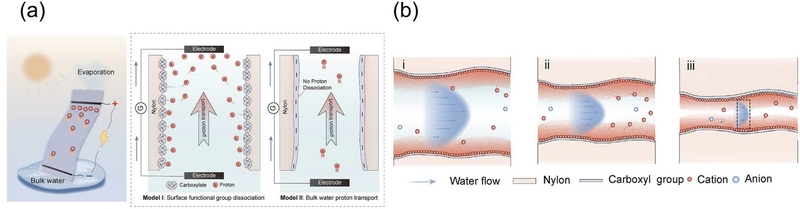
Representative hydrovoltaic chemical sensing mechanism. (a) Evaporation-driven ion-to-electron conversion mechanism. (b) Nanochannel size-dependent ion transport mechanism. Adapted from Ref. [75].
Furthermore, specific molecules or chemical species can interact with surface functional groups of conductive materials through adsorption, hydrogen bonding, coordination, acid-base interactions, or redox-related interactions. These interactions can alter surface charge, electrical conductivity, ion mobility, water adsorption, and diffusion behavior, thereby affecting the voltage and current. Consequently, Hydrovoltaic chemical sensors can serve as self-powered chemical sensing platforms for detecting pH, ion concentration, specific ionic species, and molecular analytes.
Hydrovoltaic ion sensors utilize ion-dependent modulation of hydrovoltaic output in charged micro/nanochannels. In hydrovoltaic devices, a potential difference can be generated by asymmetric water transport, ion transport, and ion distribution at the solid-liquid interface. When an ion concentration gradient or asymmetric ion distribution is formed across the device, ion diffusion and migration contribute to charge separation, thereby modulating the generated voltage. In this process, micro/nanochannels serve as confined transport pathways that regulate both water flow and ion migration. Surface charges on the channel walls interact electrostatically with dissolved ions, leading to preferential transport of counterion and partial exclusion of coion. This ion selective transport can induce ion separation and alter the interfacial potential difference. Therefore, changes in ion concentration, ion species, valence, and ion transport resistance can be reflected in the generated VOC and ISC, enabling self-powered ion sensing.
In this context, the λD provides an important parameter for understanding ion sensing behavior. At low ion concentrations, λD is relatively large, and EDL overlap within confined nanochannels can be maintained, allowing strong ion selectivity and efficient charge separation. As the ion concentration increases, enhanced charge screening compresses the EDL and can weaken ion selectivity within the nanochannels. This reduced ion selectivity suppresses ion separation and interfacial potential formations, thereby decreasing the generated VOC [75,77,78].
Wang et al. proposed a stretchable hydrovoltaic device utilizing silk fibroin (SF)-coated PU/PAN composite nanofibers (SF@PPN) for ion sensing (Fig. 6(a))[79]. In this device, mechanical deformation regulates the nanochannel size of SF@PPN over a wide range, from 150 nm to 1.25 μm. This strain-dependent modulation of nanochannel dimensions directly affects water flux and ion selectivity. In this system, the carboxyl and amide groups of SF formed hydrogen bonds with the PPN network. SF dip coating combined with oxygen plasma treatment shifted the zeta potential from -12 to -55 mV, indicating an increase in the negative surface charge of the channel walls. Mechanical strain induced fiber drafting and local densification of the SF layer, thereby regulating the pore dimensions relative to the λD. When the pore size became comparable or smaller than λD, EDL overlap was enhanced, promoting selective ion transport through the nanochannels results in the change of generated voltage.
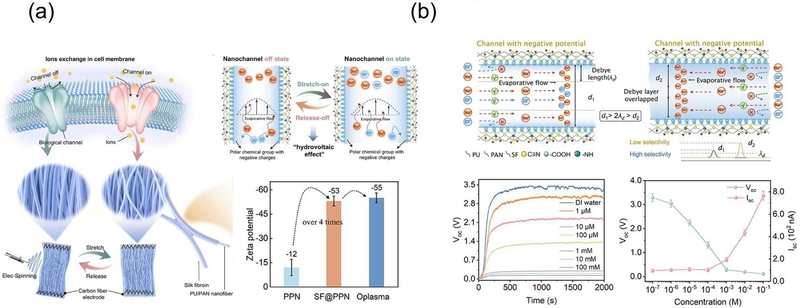
Hydrovoltaic ion sensors. (a) Schematic illustration of the strain-programmable SF@PPN device. (b) Ion-selective transport mechanism and ion sensing performance of the SF@PPN sensor. Adapted from Ref. [79].
A decrease in nanochannel promotes EDL overlap and improves ion selectivity while simultaneously restricting water transport (Fig. 6(b)). Conversely, larger nanochannels allow higher water flux by reducing flow resistance but weaken EDL overlap and thus lower ion selectivity. The authors verified these characteristics through real-time diffusion experiments and VOC-strain measurements, with in-situ XPS and TOF-SIMS analyses, thereby clarifying the correlation between nanochannel size, water flux, and ion selectivity.
The SF@PPN device also exhibited a broad ion concentration sensing ranging from 10-7 to 10-1 M for NaCl solutions. As the ion concentration increased, the real-time voltage curve showed a series of progressively lower plateaus, with VOC decreasing from approximately 3.3 V to 83 mV. However, a single VOC value provides limited information for distinguishing sensing responses associated with different ionic species and concentrations. To overcome this limitation, the authors constructed multidimensional ion-response surfaces using strain-dependent VOC values obtained at different ion concentrations. A convolutional neural network (CNN) was subsequently applied to extract subtle features from these response surfaces and classify six ionic species, including Na+, K+, Mg2+, Ca2+, Al3+, and Fe3+. In parallel, Frechet-distance-based analysis was employed to compare the strain-dependent response curve of an unknown sample with reference curves within the response-surface dataset, enabling the simultaneous identification of ion species and concentration. This approach demonstrates that converting a single hydrovoltaic output into multidimensional response patterns, followed by algorithm-assisted analysis, can distinguish coupled sensing information that cannot be readily resolved from a single voltage signal. Such multidimensional signal-processing strategies may also provide a useful framework for separating target-specific responses from variations induced by environmental parameters, such as humidity, temperature and evaporation conditions.
Ge et al. presented a SF-modified nylon-6,6 nanofiber (NNF) in which the nanochannel size was systematically regulated by varying the number of SF dip coating cycles, thereby controlling the effective fiber diameter and interfiber spacing (Fig. 7(a))[80]. The introduction of carboxyl and amide groups from SF shifted the zeta potential from -10.9 to -38.4 mV, indicating an increase in the negative surface charge of the nanochannel walls. This surface and structural modification provided an optimized balance between EDL overlap and evaporation-driven water transport. The optimized SF@NNF-based device generated a high VOC of 4.82 V in deionized water and exhibited a broad NaCl concentration sensing range from 10-7 to 100 M, with a maximum sensitivity of 1.37 V dec-1 (Fig. 7(b)). The concentration-dependent voltage response was attributed to changes in the λD and electrostatic screening within the nanochannels. As the ion concentration increased, enhanced charge screening reduced ion selectivity and produced a corresponding decrease in VOC. Based on this response, the device was integrated into a wearable configuration to monitor electrolyte levels in human sweat in real time. The sensor also exhibited distinct voltage responses to LiCl, NaCl, and KCl, as well as NaCl, MgCl2, and AlCl3, indicating that ion size and valence influence charge screening and ion transport within the nanochannels. These characteristics further demonstrated the application of the SF@NNF hydrovoltaic device to trace ion monitoring in marine salt-spray environments.
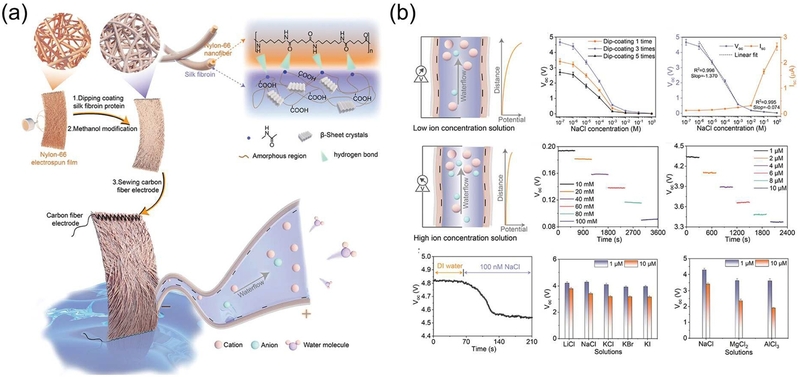
Hydrovoltaic ion sensors. (a) Fabrication and nanochannel regulation of SF@NNF ion sensor. (b) Ion sensing voltage response of the SF@NNF device. Adapted from Ref. [80].
Hydrovoltaic gas sensors detect gaseous analytes through changes induced in the aqueous phase or at the hydrated solid-liquid interface. When a gas reaches the sensing layer, it dissolves in the adsorbed water film or supplied liquid can alter the pH, ionic composition, conductivity, or surface chemistry through acid-base reactions, redox reactions, or adsorption. These changes affect the protonation state, surface charge, zeta potential, EDL structure, and ion transport within the device. The resulting modulation of evaporation driven charge separation is reflected in changes in VOC and ISC. In several systems, direct adsorption of gas molecules onto the active material can also alter its electronic or surface properties and contribute to the sensing response.
The gas response is influenced by the solubility of the analyte, its reaction with the sensing surface, and its transport through the water layer. Porous and hydrophilic structures are generally employed to maintain water transport and provide sufficient interfacial area for gas interaction. Target-selective functional groups or receptors can improve both selectivity and sensitivity by promoting preferential analyte binding and enhancing the resulting modulation of the hydrovoltaic output. Depending on the device configuration, gaseous analytes can be detected directly at a hydrated sensing interface or first collected in water and subsequently analyzed through the resulting hydrovoltaic response.
Zhang et al. developed a photoelectrochemically enhanced hydrovoltaic formaldehyde (HCHO) sensor consisting of an NH2-MIL-125/TiO2 nanotube active layer and a porous cellulose fiber coated with PEDOT:PSS and rGO [81]. The negatively charged TiO2 nanochannels supported evaporation driven proton transport and streaming potential generation, while the NH2-MIL-125/TiO2 heterostructure promoted photoinduced charge separation under illumination. The resulting photoelectrochemical water splitting reaction consumed interfacial H3O+ during hydrogen evolution, perturbing the ionic equilibrium and enhancing the hydrovoltaic output. HCHO reacted with the amino groups of NH2-MIL-125 through Schiff-base formation, altering the surface charge and photoelectrochemical activity and consequently decreasing both VOC and ISC.
The sensor exhibited a linear response to HCHO over the concentration range from 10-8 to 10-6 M, with a detection limit of 5.2 × 10⁻⁹ M. The sensor showed negligible interference from methanol and formic acid, confirming its selectivity toward HCHO. The active layer also retained its morphology and crystal structure after exposure to HCHO-containing solutions, demonstrating finite structural stability. For practical analysis, HCHO released from filtered and unfiltered cigarettes was collected in water and quantified using the sensor. The unfiltered cigarette exhibited an HCHO concentration approximately twice that of the filtered cigarette, demonstrating the capability of the device to differentiate HCHO emission levels from practical gas sources.
Zhong et al. reported a rainwater evaporation-driven gas sensor based on a nanoporous carbon film deposited on an Al2O3 substrate with multiwalled carbon nanotube (MWCNT) electrodes [82]. The device was integrated with a water reservoir that collects rainwater and continuously supply it to the porous carbon layer through capillary transport. Evaporation driven water flow through the negatively charged nanochannels resulted in EDL formation and preferential transport of H3O+ counterions, thereby generating a streaming potential between electrodes. Adsorption of gas molecules altered the zeta potential of the porous carbon, which subsequently modulated the ion distribution and hydrovoltaic output.
The sensor produced gas-dependent voltage response toward oxygen, ethanol, ammonia, methane, and carbon monoxide. The response to oxygen increased from approximately 5% at a concentration of 40% to 17.1% at 100%. In contrast, ethanol decreased the response by 3.27% at 200 ppm and 27.15% at 850 ppm, while ammonia produced decreased output of 7.23% at 50 ppm and 44.82% at 800 ppm. These gas-dependent responses enabled the recognition of different gas species and concentrations. The oxygen-dependent electrical output was further utilized for capacitor charging and LED operation, demonstrating a proof-of-concept visual indicator for real time air quality monitoring.
Molecular sensors selectively detect target analytes, including biomolecules, organic compounds, and other chemical species by converting specific molecular interactions into measurable electrical signals. In self-powered hydrovoltaic molecular sensors, water-mediated interfacial processes generate a spontaneous voltage and current. Specific interactions between target molecules and the sensing material can modulate this hydrovoltaic output, allowing the presence and concentration of molecular analytes to be determined without an external power source.
A molecular sensor generally consists of a recognition element and a transduction element. The recognition element selectively interacts with the target analyte through binding, adsorption, or chemical reactions and can include such as antibodies, enzymes, proteins, functional receptors, or metal-organic frameworks (MOFs). The transduction element, such as an electrode, semiconductor, conductive polymer, or porous carbon structure, converts the molecular recognition into a measurable signal. Interaction with the target molecule can alter the surface charge, interfacial potential, electrical conductivity, water adsorption, ion mobility, or mass of the sensing material. In hydrovoltaic molecular sensors, these physicochemical changes regulate interfacial charge separation and ion transport, resulting in analyte-dependent variations in the generated voltage and current.
Bian et al. constructed a self-powered electrochemical sensing platform based on a ZnO/Ce-MOF heterostructure [83]. Vertically aligned ZnO nanowire arrays were grown on a glass substrate and coated with amino-functionalized Ce-BTC to form a porous ZnO/Ce-MOF composite, after which a lincomycin (LIN)-specified DNA aptamer was immobilized on the surface. Upon contact with water, positively charged ZnO/Ce-MOF surface formed an EDL, while evaporation driven water transport through the nanowire and MOF nanochannels induced directional ion migration and generated a streaming potential. The vertically aligned ZnO arrays and porous Ce-MOF network provided continuous pathways for water and ion transport, thereby enhancing the hydrovoltaic output. In addition, the energy band alignment between ZnO and Ce-MOF generated a built-in electric field that promoted photocarrier separation under Xe lamp illumination. The resulting hydrovoltaic-photoelectric coupling increased the ISC by approximately 10.9-fold compared with that generated solely by the hydrovoltaic effect.
Based on this enhanced electrical output, the ZnO/Ce-MOF platform was employed for the aptamer-based detection of LIN. Immobilization of the negatively charged aptamer reduced interfacial charge transfer, while subsequent formation of the aptamer-LIN complex introduced additional steric hinderance and further decreased ISC. The sensor exhibited a linear response over the LIN concentration range from 10-15 to 10-9 M, with a detection limit of 0.2 fM. The non-target antibiotics, including norfloxacin, kanamycin, tetracycline, ciprofloxacin, and chloramphenicol, produced only negligible changes in ISC. By contrast, a marked decrease in ISC was observed for both LIN and the antibiotic mixture containing LIN, demonstrating the high selectivity of the aptamer-functionalized sensor toward LIN.
Zhang et al. reported an enantioselective hydrovoltaic sensing device based on a porous carbon film (PCF) deposited on a Kapton substrate [84]. The PCF consisted of randomly stacked carbon nanoparticles with diameters of approximately 50 nm, forming interconnected nanochannels with characteristic sizes of 100-200 nm. These porous channels supported capillary water transport and evaporation-induced streaming potential generation, enabling continuous electrical output without an external power source. The PCF surface was subsequently functionalized through sequential modification with (3-aminopropyl)triethoxysilane (APTES), glutaraldehyde (GA), bovine serum albumin (BSA), and o-phenylenediamine (OPD). BSA provided a chiral recognition environment with different binding affinities for L-arginine (L-Arg) and D-arginine (D-Arg), while OPD participated in the subsequent chemical amplification process. Following Arg adsorption, H2O2 treatment induced NO formation, which reacted with the amino groups of OPD to form benzotriazole derivates. This reaction reduced the positive surface charge of the sensing layer and modified the EDL structure and H3O+ transport assisted with water flow. The difference in surface coverage between L-Arg and D-Arg produced distinct changes in surface charge, thereby enhancing the recognition through the hydrovoltaic voltage response.
Based on this recognition and amplification mechanism, the sensor generated distinguishable voltage responses to the two arginine enantiomers. Before chemical amplification, the difference in output voltage between L-Arg and D-Arg was approximately 0.13 V. Following the H2O2/OPD reaction, this voltage difference increased to 0.32 V, corresponding to an approximately 2.5-fold enhancement in enantiomeric recognition. The response to L-Arg reached approximately 68%, compared with 26% for D-Arg, while the responses to the other tested chiral interferents remained substantially lower than that of L-Arg. In addition, five independently prepared sensors exhibited closely distributed response values of approximately 7% under the same measurement condition, indicating finite device reproducibility. These results demonstrate that the combination of BSA mediated chiral recognition and surface charge amplification enable the selective conversion of enantiomer adsorption into measurable hydrovoltaic voltage signals.
3. IoT AND HEALTHCARE APPLICATION OF HYDROVOLTAIC SENSORS
3.1 IoT applications
Large-scale IoT networks require sensing nodes to remain operational for extended periods with minimal maintenance. This requirement is difficult to meet in off-grid or infrastructure-limited environments, where wired power is often unavailable and periodic battery replacement is impractical. Hydrovoltaic sensors provide a suitable approach for autonomous IoT systems by utilizing locally available water sources, including atmospheric moisture, vapor, droplets, and environmental water to generate electrical signals. Changes at the solid-liquid interface directly modulate the generated voltage and current, enabling the hydrovoltaic output to serve as the sensing signals. Hydrovoltaic devices can therefore integrate energy harvesting and signal generation within a single sensing platform. This dual-functionality can simplify sensor configuration and facilitate the deployment of low-maintenance nodes in distributed IoT networks.
For practical IoT applications, however, self-powered sensing should be distinguished from fully autonomous operation of the entire IoT node. Although hydrovoltaic devices can generate sensing signals without an external bias, additional power is required for data processing and wireless communication. Therefore, particularly for devices with relatively low current outputs, the generated energy may need to be accumulated in capacitors or other energy storage devices for intermittent data transmission. For example, Li et al. demonstrated capacitor-based energy storage and Bluetooth-based signal transmission using a wearable hydrovoltaic sensing system [51], while Wen et al. integrated series-connected moisture-induced generators with energy storage devices and a Wi-Fi-based sensing platform [66].
Agricultural environments represent a promising application for demonstrating the potential of hydrovoltaic sensors in IoT-based environmental monitoring (Fig. 8(a)). Smart agriculture systems continuously collect cultivation-related parameters, including soil moisture, atmospheric humidity, temperature, light intensity, and gas composition. Continuous remote monitoring reduces the need for manual inspection and supports data-driven regulation of cultivation conditions. In agricultural environments, moisture supplied by irrigation, soil water, and plant transpiration provides a readily available energy source for hydrovoltaic sensors. Variations in moisture content and the surrounding chemical environment can simultaneously modulate the generated electrical output, enabling relevant agricultural parameters to be monitored without an external power source. Within this context, Zhang et al. integrated a humidity sensor with an IoT communication systems for real-time monitoring of soil moisture, ambient temperature, and light intensity. The device exhibited a linear increase in current from 2.6 to 76.1 μA over the RH range of 33-91%, demonstrating the feasibility of integrating hydrovoltaic sensing with smart agriculture platforms [85]. Hydrovoltaic systems can also detect gaseous species associated with agricultural environments. Yun et al. developed a gas-responsive hydrovoltaic generator which electrical output was modulated by capturing NOx and CO2. The device further generated electricity using NOx released during agricultural microbial decomposition, indicating its potential as a platform for monitoring agricultural gas emissions while simultaneously harvesting energy from the captured gases [86].
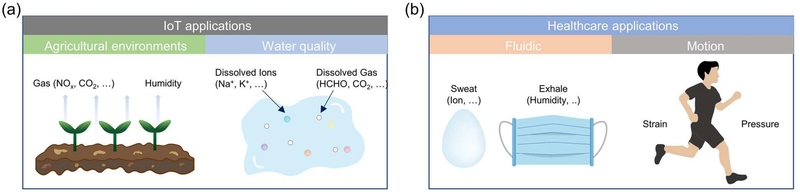
Recent and future application of hydrovoltaic sensors. (a) IoT-based agricultural and water quality hydrovoltaic sensors. (b) Healthcare monitoring hydrovoltaic sensors.
Another representative application of hydrovoltaic IoT sensor is water quality monitoring. Hydrovoltaic devices can continuously generate electrical signals while remaining in contact with aqueous environments, making them suitable for sensing systems that operate directly in rivers, seawater, wastewater, or other water sources. As discussed, charged nanochannels can convert changes in ion concentration, valence, and species into variation in generated power, while receptor-functionalized interfaces enable the selective detection of specific molecular analytes. Hydrovoltaic IoT sensors can further detect gaseous pollutants dissolved in water by converting the resulting changes in solution into electrical signals. These capabilities provide a basis for monitoring variations in salinity, ionic composition, dissolved contaminants, and target molecules without an external power source. As an illustrative example, Zhang et al. employed wastewater for hydrovoltaic power generation which its output power altered with the varying pH according to the type of the wastewater [87]. Integration with wireless communication systems may further enable continuous and distributed water quality monitoring in marine, freshwater, and wastewater environments.
3.2 Healthcare applications
Healthcare monitoring represents another promising application area for hydrovoltaic sensors (Fig. 8(b)). Continuous monitoring of physiological conditions and physical activities can facilitate early detection of health-related changes and provide useful information for disease prevention and long-term management [88]. The human body continuously generates and transports moisture in the form of sweat, skin moisture, exhaled water vapor, and various body fluids, which can serve as local energy sources for hydrovoltaic sensing. Furthermore, variations in moisture content, electrolyte composition, specific biomolecules, and mechanical deformation alter the interfacial state of the device and modulate the generated voltage and current. These changes can be converted into sensing signals that reflect physiological conditions and motions. This characteristic supports the development of wearable healthcare sensing platforms capable of monitoring respiration, sweat, strain, and motion without an external power [89,90].
A representative approach for hydrovoltaic healthcare monitoring is to utilize body fluids and respiratory moisture as both sensing media and local energy sources. Biofluids, including sweat, tears, and saliva, contain electrolytes, metabolites, and various biomarkers that reflect physiological conditions, while water vapor released during respiration provides information on breathing cycles and local humidity variations (Fig. 9(a)). Changes in ion concentration and species, selective molecular binding, and moisture content can regulate interfacial charge, EDL structure, and ion transport within hydrovoltaic sensors, thereby modulating the generated voltage and current. Accordingly, variations in the amount and chemical composition of body fluids can be converted into self-generated electrical signals for continuous physiological monitoring without an external power (Fig. 9(b)). These characteristics support the development of wearable platforms for hydrovoltaic healthcare sensors.
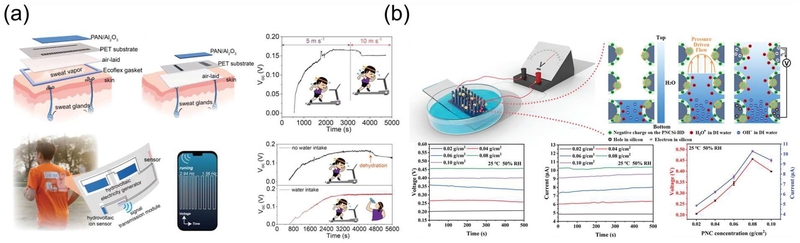
Hydrovoltaic devices for self-powered biofluid sensing. (a) Flexible hydrovoltaic coating for wearable sweat monitoring and wireless signal transmission. Adapted from Ref. [51]. (b) Hydrovoltaic nanogenerator for sweat electrolyte analysis based on electrolyte-dependent ion transport and electrical output. Adapted from Ref. [78].
Another important application involves wearable sensors capable of detecting mechanical stimuli, including strain, pressure, and motion. These devices generate electrical output using sweat, skin moisture, or ambient humidity, while variations in conductive pathways, water distribution, interfacial contact, and ion transport induced by mechanical deformation serve as sensing signals. Bending, stretching, and motion of the body modulate the amplitude or waveform of the generated voltage and current, enabling continuous monitoring of joint movements at the fingers, wrist, elbows, and knees. For example, Jiang et al. proposed a hydrovoltaic pressure sensor based on the ion transport modulation (Fig. 10(a)), which utilizes tear fluid for intraocular pressure monitoring (Fig. 10(b)) [91]. With appropriate structural design and sensitivity, hydrovoltaic sensors may further detect subtle movement and pressure variations associated with physiological signals, providing a promising platform for healthcare monitoring sensors.
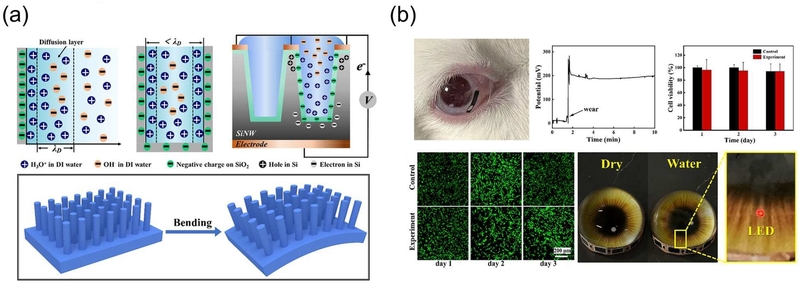
Self-powered hydrovoltaic strain sensing for wearable healthcare applications. (a) Deformation-dependent modulation of ion transport and hydrovoltaic potential in the microstructured sensing layer. (b) Ocular application of the self-powered hydrovoltaic strain sensor. Adapted from Ref. [91].

Representative hydrovoltaic sensors for healthcare applications.
4. CONCLUSIONS
Hydrovoltaic technology offers a sustainable route for self-powered sensing by generating electrical signals from asymmetric interfacial wetting. Generated voltage and current can be modulated by physical and chemical stimulations. Physical stimuli can regulate the distribution of water, conductive pathways, and interfacial contact, whereas chemical analytes alter surface charge, EDL structure and ion transport. From these characteristics, hydrovoltaic devices can operate without external power supplies, making them promising candidates for autonomous sensing systems, wearable electronics, IoT networks, and continuous healthcare monitoring.
Despite these advantages, the practical implementation of hydrovoltaic sensors remains limited by the strong coupling between the generated output and surrounding environmental conditions. Hydrovoltaic output is governed not only by the intended stimulus but also by interfering factors including moisture content, temperature, evaporation rate, ionic composition, and the mechanical state of the device. Consequently, similar changes in voltage or current may originate from distinct physicochemical processes. For example, mechanical deformation during strain sensing can alter conductive pathways and internal resistance while simultaneously affecting water distribution, effective evaporation area, and nanochannel dimensions. Changes in nanochannel structure may further regulate EDL overlap and ion-selective transport, resulting in electrical responses that reflect the combined contributions of resistance variations and interfacial ion transport. Therefore, decoupling various factors remains an important challenge for the quantitative interpretation of hydrovoltaic sensing signals. Accordingly, future studies should incorporate signal-processing and machine-learning strategies to distinguish target-induced responses from environmental fluctuations. Multidimensional data analysis combined with differential or reference-channel configurations may further improve the quantitative reliability of hydrovoltaic sensing under dynamically changing conditions.
Furthermore, long-term stability is another important consideration for the practical implementation of hydrovoltaic sensors, as continuous exposure to water or biofluids can lead to excessive wetting, interfacial degradation, and deterioration of the functional layer. To address these issues, several studies have employed selective encapsulation using PDMS, Ecoflex, or polyurethane films while maintaining exposed active regions for controlled water transport and evaporation [51,65,75,79]. Strong interfacial binding between functional materials has also been introduced to enhance device stability under prolonged aqueous exposure. Nevertheless, systematic investigations of long-term biofouling and functional group leaching remain limited and should be further addressed to enable reliable operation in harsh aqueous environments.
Future research should therefore focus on both mechanistic control and device-level reliability. From a materials perspective, rational interface engineering, selective functionalization, and the incorporation of target-specific receptors are required to enhance selectivity toward desired physical or chemical stimuli. Recent studies in hydrovoltaic power generation focused on separating and controlling the individual processes involved in hydrovoltaic power generation. Further advances in hydrovoltaic sensing will require a more quantitative understanding of these coupled interfacial processes with rational material selection, surface functionalization, and controlled water and ion transport. These approaches should be combined with scalable fabrication, environmental compensation, and standardized evaluation to improve output stability, target selectivity, and device reproducibility.
Acknowledgments
This work is funded by Korea Institute of Science and Technology (KIST) Institutional Program (26Z9052) and supported by a National Research Foundation of Korea (NRF) grant funded by the Korean government Ministry of Science and ICT (MSIT) (Nos.RS-2025-25429261).
REFERENCES
-
T.Q. Trung, N.E. Lee, Flexible and stretchable physical sensor integrated platforms for wearable human-activity monitoring and personal healthcare, Adv. Mater. 28 (2016) 4338–4372.
[https://doi.org/10.1002/adma.201504244]

-
A. Inobeme, A. Natarajan, S. Pradhan, C.O. Adetunji, A.I. Ajai, J. Inobeme, et al., Chemical sensor technologies for sustainable development: recent advances, classification, and environmental monitoring, Adv. Sensor Res. 3 (2024) 2400066.
[https://doi.org/10.1002/adsr.202400066]
-
M. Amjadi, K.U. Kyung, I. Park, M. Sitti, Stretchable, skin-mountable, and wearable strain sensors and their potential applications: a review, Adv. Funct. Mater. 26 (2016) 1678–1698.
[https://doi.org/10.1002/adfm.201504755]
-
G.B. Nam, H.W. Jang, Recent advances and challenges of two-dimensional MXene-based chemoresistive gas sensors, J. Sens. Sci. Technol. 34 (2025) 375–386.
[https://doi.org/10.46670/JSST.2025.34.4.375]
-
S. Anwar, Design of Ultra-Sensitive metamaterial sensor device f or environmental sensing, Trans. Electr. Electron. Mater. 25 (2024) 722–731.
[https://doi.org/10.1007/s42341-024-00555-y]
-
J. Gubbi, R. Buyya, S. Marusic, M. Palaniswami, Internet of Things (IoT): A vision, architectural elements, and future directions, Future Gener. Comput. Syst. 29 (2013) 1645–1660.
[https://doi.org/10.1016/j.future.2013.01.010]
-
M. Mayer, A.J. Baeumner, A megatrend challenging analytical chemistry: biosensor and chemosensor concepts ready for the internet of things, Chem. Rev. 119 (2019) 7996–8027.
[https://doi.org/10.1021/acs.chemrev.8b00719]
-
R.A. Potyrailo, Multivariable sensors for ubiquitous monitoring of gases in the era of internet of things and industrial internet, Chem. Rev. 116 (2016) 11877–11923.
[https://doi.org/10.1021/acs.chemrev.6b00187]
-
Q. Jiang, M.F. Antwi-Afari, S. Fadaie, H.-Y. Mi, S. Anwer, J. Liu, Self-powered wearable Internet of Things sensors for human-machine interfaces: A systematic literature review and science mapping analysis, Nano Energy 131 (2024) 110252.
[https://doi.org/10.1016/j.nanoen.2024.110252]
-
J. Kim, A.S. Campbell, B.E.-F. de Ávila, J. Wang, Wearable biosensors for healthcare monitoring, Nat. Biotechnol. 37 (2019) 389–406.
[https://doi.org/10.1038/s41587-019-0045-y]
-
H.S. Suhail, A.R. Abdulridha, Preparation and characterization of thin films bismuth (III) oxide/zinc oxide nanostructures prepared by thermal evaporation technique as gas sensor applications, Trans. Electr. Electron. Mater. 25 (2024) 1–14.
[https://doi.org/10.1007/s42341-023-00490-4]
-
I. Myeong, Y.G. Song, Review of Ionic-Motion-based Chemimemristive Gas Sensors using Metal-Oxide Semiconductors, J. Sens. Sci. Technol. 34 (2025) 721–728.
[https://doi.org/10.46670/JSST.2025.34.6.721]
-
W. Gao, S. Emaminejad, H.Y.Y. Nyein, S. Challa, K. Chen, A. Peck, et al., Fully integrated wearable sensor arrays for multiplexed in situ perspiration analysis, Nature 529 (2016) 509–514.
[https://doi.org/10.1038/nature16521]
-
Y.Y. Broza, X. Zhou, M. Yuan, D. Qu, Y. Zheng, R. Vishinkin, et al., Disease detection with molecular biomarkers: from chemistry of body fluids to natureinspired chemical sensors, Chem. Rev. 119 (2019) 11761–11817.
[https://doi.org/10.1021/acs.chemrev.9b00437]
-
S. Srivastava, T. Sharma, M. Deshwal, Parametric optimization for highly sensitive ZnO based NOX gas sensor, Trans. Electr. Electron. Mater. 25 (2024) 434–441.
[https://doi.org/10.1007/s42341-024-00521-8]
-
J.-W. An, H.W. Jang, J.-S. Jang, Sniffing Disease: Chemiresistive Metal-Oxide Electronic Noses for Noninvasive Disease Diagnosis, J. Sens. Sci. Technol. 34 (2025) 729–749.
[https://doi.org/10.46670/JSST.2025.34.6.729]
-
X. Zhao, H. Askari, J. Chen, Nanogenerators for smart cities in the era of 5G and Internet of Things, Joule 5 (2021) 1391–1431.
[https://doi.org/10.1016/j.joule.2021.03.013]
-
Z. Huo, Y. Wei, Y. Wang, Z.L. Wang, Q. Sun, Integrated self‐powered sensors based on 2D material devices, Adv. Funct. Mater. 32 (2022) 2206900.
[https://doi.org/10.1002/adfm.202206900]
-
C. Jiang, X. Li, S.W.M. Lian, Y. Ying, J.S. Ho, J. Ping, Wireless technologies for energy harvesting and transmission for ambient self-powered systems, ACS Nano 15 (2021) 9328–9354.
[https://doi.org/10.1021/acsnano.1c02819]
-
T. Zhong, H. Li, T. Zhao, H. Guan, L. Xing, X. Xue, Selfpowered/self-cleaned atmosphere monitoring system from combining hydrovoltaic, gas sensing and photocatalytic effects of TiO2 nanoparticles, J. Mater. Sci. Technol. 76 (2021) 33–40.
[https://doi.org/10.1016/j.jmst.2020.11.002]
-
X. Hu, X. Li, G. Li, T. Ji, F. Ai, J. Wu, et al., Recent progress of methods to enhance photovoltaic effect for self‐powered heterojunction photodetectors and their applications in inorganic low‐dimensional structures, Adv. Funct. Mater. 31 (2021) 2011284.
[https://doi.org/10.1002/adfm.202011284]
-
M.Z. Qamar, Z. Khalid, R. Shahid, W.C. Tsoi, Y.K. Mishra, A.K.K. Kyaw, et al., Advancement in indoor energy harvesting through flexible perovskite photovoltaics for self-powered IoT applications, Nano Energy 129 (2024) 109994.
[https://doi.org/10.1016/j.nanoen.2024.109994]
-
Y. Kim, S. Lee, J.G. Song, K.Y. Ko, W.J. Woo, S.W. Lee, et al., 2D transition metal dichalcogenide heterostructures for p‐and n‐type photovoltaic self‐powered gas sensor, Adv. Funct. Mater. 30 (2020) 2003360.
[https://doi.org/10.1002/adfm.202003360]
-
Z.L. Wang, J. Song, Piezoelectric nanogenerators based on zinc oxide nanowire arrays, Science 312 (2006) 242–246.
[https://doi.org/10.1126/science.1124005]
-
X. Cao, Y. Xiong, J. Sun, X. Zhu, Q. Sun, Z.L. Wang, Piezoelectric nanogenerators derived self‐powered sensors for multifunctional applications and artificial intelligence, Adv. Funct. Mater. 31 (2021) 2102983.
[https://doi.org/10.1002/adfm.202102983]
-
D. Gui, Y. Gao, X. Mi, B. Yao, Z. Zhang, Y. Xu, et al., Advancements in enhancement strategies for piezoelectric nanogenerator output performance and their applications in self-powered sensors, ACS Sens. 10 (2025) 6292–6315.
[https://doi.org/10.1021/acssensors.5c00050]
-
Z. Ghemari, S. Belkhiri, Exploring Novel Piezoelectric Materials with Enhanced Thermal Stability for HighPerformance Sensors, Trans. Electr. Electron. Mater. 26 (2025) 289–304.
[https://doi.org/10.1007/s42341-025-00600-4]
-
S.-M. Chang, C.Y. Kang, S. Hur, Short Review of 3D Printed Piezoelectric Sensors, J. Sens. Sci. Technol. 31 (2022) 279–285.
[https://doi.org/10.46670/JSST.2022.31.5.279]
-
F.-R. Fan, Z.-Q. Tian, Z.L. Wang, Flexible triboelectric generator, Nano Energy 1 (2012) 328–334.
[https://doi.org/10.1016/j.nanoen.2012.01.004]
-
Y. Yang, X. Guo, M. Zhu, Z. Sun, Z. Zhang, T. He, et al., Triboelectric nanogenerator enabled wearable sensors and electronics for sustainable internet of things integrated green earth, Adv. Energy Mater. 13 (2023) 2203040.
[https://doi.org/10.1002/aenm.202203040]
-
F. Yi, Z. Zhang, Z. Kang, Q. Liao, Y. Zhang, Recent advances in triboelectric nanogenerator‐based health monitoring, Adv. Funct. Mater. 29 (2019) 1808849.
[https://doi.org/10.1002/adfm.201808849]
-
I.-Y. Suh, S.-W. Kim, Triboelectric energy harvesting for self-powered antibacterial applications, J. Sens. Sci. Technol. 32 (2023) 213–218.
[https://doi.org/10.46670/JSST.2023.32.4.213]
-
Z.L. Wang, Triboelectric nanogenerators as new energy technology for self-powered systems and as active mechanical and chemical sensors, ACS Nano 7 (2013) 9533–9557.
[https://doi.org/10.1021/nn404614z]
-
Y. Jia, Q. Jiang, H. Sun, P. Liu, D. Hu, Y. Pei, et al., Wearable thermoelectric materials and devices for self‐powered electronic systems, Adv. Mater. 33 (2021) 2102990.
[https://doi.org/10.1002/adma.202102990]
-
M. Li, J. Chen, W. Zhong, M. Luo, W. Wang, X. Qing, et al., Large-area, wearable, self-powered pressure–temperature sensor based on 3D thermoelectric spacer fabric, ACS Sens. 5 (2020) 2545–2554.
[https://doi.org/10.1021/acssensors.0c00870]
-
N. Dhariwal, P. Yadav, Akanksha, S. Bisht, R. Chandra, O. Thakur, et al., Beyond heat harvesting: Thermoelectric materials and hybrid devices for smart sensing and sustainable technologies, Adv. Energy Mater. 15 (2025) 2502895.
[https://doi.org/10.1002/aenm.202502895]
-
Y. Yang, Y. Zhou, J.M. Wu, Z.L. Wang, Single micro/nanowire pyroelectric nanogenerators as self-powered temperature sensors, ACS Nano 6 (2012) 8456–8461.
[https://doi.org/10.1021/nn303414u]
-
S. Sahare, P. Ghoderao, M.K. Sharma, M. Solovan, R. Aepuru, M. Kumar, et al., Pyro-phototronic effect: An effective route toward self-powered photodetection, Nano Energy 107 (2023) 108172.
[https://doi.org/10.1016/j.nanoen.2023.108172]
-
Z. Zhang, X. Li, J. Yin, Y. Xu, W. Fei, M. Xue, et al., Emerging hydrovoltaic technology, Nat. Nanotechnol. 13 (2018) 1109–1119.
[https://doi.org/10.1038/s41565-018-0228-6]
-
J. Xu, P. Wang, Z. Bai, H. Cheng, R. Wang, L. Qu, et al., Sustainable moisture energy, Nat. Rev. Mater. 9 (2024) 722–737.
[https://doi.org/10.1038/s41578-023-00643-0]
-
L. Wang, W. Zhang, Y. Deng, Advances and challenges for hydrovoltaic intelligence, ACS Nano 17 (2023) 14229–14252.
[https://doi.org/10.1021/acsnano.3c02043]
-
G. Xue, Y. Xu, T. Ding, J. Li, J. Yin, W. Fei, et al., Water-evaporation-induced electricity with nanostructured carbon materials, Nat. Nanotechnol. 12 (2017) 317–321.
[https://doi.org/10.1038/nnano.2016.300]
-
J. Yin, X. Li, J. Yu, Z. Zhang, J. Zhou, W. Guo, Generating electricity by moving a droplet of ionic liquid along graphene, Nat. Nanotechnol. 9 (2014) 378–383.
[https://doi.org/10.1038/nnano.2014.56]
-
F. Zhao, Y. Liang, H. Cheng, L. Jiang, L. Qu, Highly efficient moisture-enabled electricity generation from graphene oxide frameworks, Energy Environ. Sci. 9 (2016) 912–916.
[https://doi.org/10.1039/C5EE03701H]
-
X. Wang, F. Lin, X. Wang, S. Fang, J. Tan, W. Chu, et al., Hydrovoltaic technology: from mechanism to applications, Chem. Soc. Rev. 51 (2022) 4902–4927.
[https://doi.org/10.1039/D1CS00778E]
-
H. Lim, M.S. Kim, Y. Cho, J. Ahn, S. Ahn, J.S. Nam, et al., Hydrovoltaic electricity generator with hygroscopic materials: a review and new perspective, Adv. Mater. 36 (2024) 2301080.
[https://doi.org/10.1002/adma.202301080]
-
J. Yin, J. Zhou, S. Fang, W. Guo, Hydrovoltaic energy on the way, Joule 4 (2020) 1852–1855.
[https://doi.org/10.1016/j.joule.2020.07.015]
-
T.G. Yun, J. Bae, A. Rothschild, I.-D. Kim, Transpiration driven electrokinetic power generator, ACS Nano 13 (2019) 12703–12709.
[https://doi.org/10.1021/acsnano.9b04375]
-
H. Su, A. Nilghaz, D. Liu, L. Dai, J. Tian, J.M. Razal, et al., Harnessing the power of water: A review of hydroelectric nanogenerators, Nano Energy 116 (2023) 108819.
[https://doi.org/10.1016/j.nanoen.2023.108819]
-
D. Shen, W.W. Duley, P. Peng, M. Xiao, J. Feng, L. Liu, et al., Moisture‐enabled electricity generation: from physics and materials to self‐powered applications, Adv. Mater. 32 (2020) 2003722.
[https://doi.org/10.1002/adma.202003722]
-
L. Li, Z. Zheng, C. Ge, Y. Wang, H. Dai, L. Li, et al., A flexible tough hydrovoltaic coating for wearable sensing electronics, Adv. Mater. 35 (2023) 2304099.
[https://doi.org/10.1002/adma.202304099]
-
C. Ge, M. Wang, Y. Zhou, Y. Wang, F. Zhao, C. Zhou, et al., Ion transport-triggered rapid flexible hydrovoltaic sensing, Nat. Commun. 16 (2025) 8110.
[https://doi.org/10.1038/s41467-025-63549-1]
-
S. Lal, S.K. Batabyal, E. Wang, B. Hwang, Photo-sensitive hydrovoltaic energy harvester with fire-sensing functionality, Chem. Eng. J. 505 (2025) 159281.
[https://doi.org/10.1016/j.cej.2025.159281]
-
Z. Liu, C. Liu, Z. Chen, H. Huang, Y. Liu, L. Xue, et al., Recent advances in two-dimensional materials for hydrovoltaic energy technology, Exploration 3 (2023) 20220061.
[https://doi.org/10.1002/EXP.20220061]
-
P. Guan, R. Zhu, G. Hu, R. Patterson, F. Chen, C. Liu, et al., Recent development of moisture-enabled-electric nanogenerators, Small 18 (2022) 2204603.
[https://doi.org/10.1002/smll.202204603]
- Q. Hu, Y. Ma, G. Ren, B. Zhang, S. Zhou, Water evaporation–induced electricity with Geobacter sulfurreducens biofilms, Sci. Adv. 8 (2022) eabm8047.
-
Q. Ni, Q. Lou, C. Shen, G. Zheng, R. Song, J. Hao, et al., Sensitive humidity sensor based on moisture-driven energy generation, Nano Res. 17 (2024) 5578–5586.
[https://doi.org/10.1007/s12274-024-6499-3]
-
P.W. Sayyad, B. Hedau, E.-H. Kim, J. Kim, T.-J. Ha, Moisture electric generators with Ti3C2Tx–gelatin nanocomposites driven by the hydrovoltaic effect for self-powered flexible humidity sensors, J. Mater. Chem. A 14 (2026) 5007–5017.
[https://doi.org/10.1039/D5TA08538A]
-
A. Guchait, S. Pramanik, D.K. Goswami, S. Chattopadhyay, T. Mondal, Elastomeric ionic hydrogel-based flexible moisture-electric generator for next-generation wearable electronics, ACS Appl. Mater. Interfaces 16 (2024) 46844–46857.
[https://doi.org/10.1021/acsami.4c11907]
-
D. Lei, Q. Zhang, N. Liu, T. Su, L. Wang, Z. Ren, et al., Self-powered graphene oxide humidity sensor based on potentiometric humidity transduction mechanism, Adv. Funct. Mater. 32 (2022) 2107330.
[https://doi.org/10.1002/adfm.202107330]
-
L. Li, Z. Chen, M. Hao, S. Wang, F. Sun, Z. Zhao, et al., Moisture-driven power generation for multifunctional flexible sensing systems, Nano Lett. 19 (2019) 5544–5552.
[https://doi.org/10.1021/acs.nanolett.9b02081]
-
W. He, P. Li, H. Wang, Y. Hu, B. Lu, C. Weng, et al., Robustly and intrinsically stretchable ionic gel-based moisture-enabled power generator with high human body conformality, ACS Nano 18 (2024) 12096–12104.
[https://doi.org/10.1021/acsnano.3c08543]
-
M. Liu, Y. Yao, X. He, Z. Li, Y. Liu, H. Tao, et al., Biomass Based Moisture-Triggered Hybrid Actuator and Electric Generator with Self-Powered Motion Tracking Capability, Nano Lett. 25 (2025) 9318–9326.
[https://doi.org/10.1021/acs.nanolett.5c01624]
-
Q. Huang, Y. Jiang, Z. Duan, Y. Wu, Z. Yuan, J. Guo, et al., Ion gradient induced self-powered flexible strain sensor, Nano Energy 126 (2024) 109689.
[https://doi.org/10.1016/j.nanoen.2024.109689]
-
G. Luo, J. Xie, J. Liu, Y. Luo, M. Li, Z. Li, et al., Highly stretchable, knittable, wearable fiberform hydrovoltaic generators driven by water transpiration for portable self-power supply and self-powered strain sensor, Small 20 (2024) 2306318.
[https://doi.org/10.1002/smll.202306318]
-
X. Wen, Z. Sun, Y. Cho, M.S. Kim, K. Qin, Q. Zhou, et al., Climate-Adaptive High-Performance Moisture-Induced Electric Generator Utilizing Electric Double-Layer Gradient, Adv. Funct. Mater. 35 (2025) e06700.
[https://doi.org/10.1002/adfm.202506700]
-
Y. Li, S. Tian, X. Chen, Y. Liao, F. Jiang, J. Ye, et al., A high-current and tunable moisture-enabled electric generator for wireless wearable electronics, J. Mater. Chem. A 12 (2024) 33039–33052.
[https://doi.org/10.1039/D4TA05041J]
-
X. Pan, Q. Wang, L. Jin, Y. Ni, F. Rosei, Integrated paper-hydrogel structure for spontaneous and ultra-durable eco-friendly electricity generation, Nano Energy 136 (2025) 110730.
[https://doi.org/10.1016/j.nanoen.2025.110730]
-
Q. Hu, M. Hong, Z. Wang, X. Lin, W. Wang, W. Zheng, et al., Microbial biofilm-based hydrovoltaic pressure sensor with ultrahigh sensitivity for self-powered flexible electronics, Biosens. Bioelectron. 275 (2025) 117220.
[https://doi.org/10.1016/j.bios.2025.117220]
-
Q. Huang, Y. Jiang, Z. Duan, Y. Wu, Z. Yuan, M. Zhang, et al., Ion gradient induced self-powered flexible pressure sensor, Chem. Eng. J. 490 (2024) 151660.
[https://doi.org/10.1016/j.cej.2024.151660]
-
H. Kong, P. Si, M. Li, X. Qiu, J. Liu, X. Wang, et al., Enhanced electricity generation from graphene microfluidic channels for self-powered flexible sensors, Nano Lett. 22 (2022) 3266–3274.
[https://doi.org/10.1021/acs.nanolett.2c00168]
-
Z. Zhang, Y. Tian, S. Wang, Z. Gao, Y.-Y. Song, L.-P. Mei, et al., A Self-Powered Wearable Mechanoluminescent-Hydrovoltaic Patch for Multimodal Sensing Application and Energy Harvesting, Anal. Chem. 98 (2026) 2098–2107.
[https://doi.org/10.1021/acs.analchem.5c05546]
-
S. Jiao, Y. Jin, E. Lichtfouse, X. Zhou, Hydrovoltaic technologies for self-powered sensing and pollutant removal in water and wastewater: a review, Environ. Chem. Lett. 23 (2025) 961–976.
[https://doi.org/10.1007/s10311-025-01836-5]
-
K. Zhao, S. Li, M. Kwon, G. Kim, E. Shin, G. Zan, et al., Hydrovoltaic electricity generators: a comprehensive overview of chemical and architectural designs, Chem. Rev. 126 (2026) 4237–4317.
[https://doi.org/10.1021/acs.chemrev.5c00945]
-
Y. Zhou, C. Ge, J. Ma, M. Wang, Y. Wang, F. Zhao, et al., Flexible Hydrovoltaic Devices With Controllable Ion-Sensitive Windows for Trace-Ion Variation Sensing, Adv. Funct. Mater. 36 (2026) e30597.
[https://doi.org/10.1002/adfm.202530597]
-
C. Zhang, M.F. Calegari Andrade, Z.K. Goldsmith, A.S. Raman, Y. Li, P.M. Piaggi, et al., Molecular-scale insights into the electrical double layer at oxide-electrolyte interfaces, Nat. Commun. 15 (2024) 10270.
[https://doi.org/10.1038/s41467-024-54631-1]
-
Z. Zhang, Y. Tian, S. Wang, M. Li, Z. Gao, P. Song, et al., Integrated Wearable Sensors Based on Sweat-Driven Hydrovoltaic Chips for Metabolite and Electrolyte Monitoring, Anal. Chem. 97 (2025) 13282–13291.
[https://doi.org/10.1021/acs.analchem.5c01296]
-
X. Huangfu, Y. Guo, S.M. Mugo, Q. Zhang, Hydrovoltaic Nanogenerators for Self-Powered Sweat Electrolyte Analysis, Small 19 (2023) 2207134.
[https://doi.org/10.1002/smll.202207134]
-
M. Wang, C. Ge, F. Wen, X. Luo, Y. Wang, Y. Zhou, et al., A Flexible Hydrovoltaic Device with Strain-Induced Ion Selectivity, Adv. Funct. Mater. 35 (2025) 2508734.
[https://doi.org/10.1002/adfm.202508734]
-
C. Ge, Y. Wang, M. Wang, Z. Zheng, S. Wang, Y. Kong, et al., Silk fibroin-regulated nanochannels for flexible hydrovoltaic ion sensing, Adv. Mater. 36 (2024) 2310260.
[https://doi.org/10.1002/adma.202310260]
-
Z. Zhang, J. Guo, J. Zhao, Y. Tian, Z. Gao, P. Song, et al., Integrating photoelectrochemical feature on a hydrovoltaic chip with high-salinity adaption as a self-powered device for formaldehyde monitoring, ACS Sens. 9 (2024) 2520–2528.
[https://doi.org/10.1021/acssensors.4c00240]
-
T. Zhong, H. Guan, Y. Dai, H. He, L. Xing, Y. Zhang, et al., A self-powered flexibly-arranged gas monitoring system with evaporating rainwater as fuel for building atmosphere big data, Nano Energy 60 (2019) 52–60.
[https://doi.org/10.1016/j.nanoen.2019.03.041]
-
Y. Bian, D. Jiang, H. Ding, X. Du, X. Shan, W. Wang, et al., Hydrovoltaic–photoelectric coupling strategy triggered a robust output signal for high-performance self-powered electrochemical sensing, Anal. Chem. 96 (2024) 18708–18717.
[https://doi.org/10.1021/acs.analchem.4c03477]
-
Z. Zhang, H. He, J. Guo, C. Zhao, Z. Gao, Y.-Y. Song, Water evaporation-driven arginine enantiomer recognition on a self-powered flexible chip with high specificity, Anal. Chem. 95 (2023) 8128–8136.
[https://doi.org/10.1021/acs.analchem.3c01378]
-
R. Zhang, X. Chen, Z. Wan, M. Yin, L. Ma, X. Xiao, Moisture electricity generation based self-powered humidity sensor for smart agriculture, Mater. Today Chem. 42 (2024) 102416.
[https://doi.org/10.1016/j.mtchem.2024.102416]
-
T.G. Yun, Y. Lee, J. Shin, D.H. Lee, M.T. Hong, S. Lee, et al., Electrical power generation from asymmetric greenhouse gas capture, Energy Environ. Sci. 19 (2026) 2149–2160.
[https://doi.org/10.1039/D5EE06789H]
-
K. Zhang, X. Li, C. Yan, R. Shi, Z. Fang, S. Zhou, et al., All-wood-based ionic power generator with dual functions for alkaline wastewater reuse and energy harvesting, ACS Nano 18 (2024) 10259–10269.
[https://doi.org/10.1021/acsnano.4c00990]
-
B.K. Jung, Y. Yang, S.J. Oh, Advances in Non-Interference Sensing for Wearable Sensors: Selectively Detecting Multi-Signals from Pressure, Strain, and Temperature, J. Sens. Sci. Technol. 32 (2023) 340–351.
[https://doi.org/10.46670/JSST.2023.32.6.340]
-
L. Zhan, J. Lv, S. Chen, A. Gupta, Y. Xin, F. Jiang, et al., Moisture-triggered hybrid soft actuator and electric generator for self-sensing wearables and adaptive human-environment interaction, Nano Energy 132 (2024) 110410.
[https://doi.org/10.1016/j.nanoen.2024.110410]
-
D. Shen, M. Xiao, Y. Xiao, G. Zou, L. Hu, B. Zhao, et al., Self-powered, rapid-response, and highly flexible humidity sensors based on moisture-dependent voltage generation, ACS Appl. Mater. Interfaces 11 (2019) 14249–14255.
[https://doi.org/10.1021/acsami.9b01523]
-
J. Jiang, Y. Shi, T. Wei, B. Zhang, J. Zhai, Y. Gao, et al., Deformation-Modulated Hydrovoltaic Effect for Continuous Self-Powered Strain Sensing, Adv. Funct. Mater. 36 (2026) e30280.
[https://doi.org/10.1002/adfm.202530280]

Minwoo Lee received his B.S. degree in Department of Materials Chemistry and Engineering from Konkuk University in 2023. Since then, he is now a Ph.D. candidate under the co-guidance of Dr. Sunghoon Hur in Korea Institute of Science and Technology (KIST), Prof. Ji-Soo Jang in Sungkyunkwan University, and Prof. Soo Young Kim in Korea University. His current research interest includes hydrovoltaic power generation, solid-liquid interface, membrane distillation and water purification systems.

Subeen Park received her B.S. degree in Department of Materials Science and Engineering from Sungshin Women University in 2026. Since then, she is now a M.S. candidate under the co-guidance of Dr. Sunghoon Hur in Korea Institute of Science and Technology (KIST), and Prof. Jeong Gon Son in KU-KIST Graduate School of Converging Science and Technology at Korea University. Her current research interest includes gas capture and electricity generator and pressure driven thermal switch.

Jeong Gon Son is a Principal Research Scientist and the Head of the Electronic and Hybrid Materials Research Center at the Korea Institute of Science and Technology (KIST). He is also a Professor and Associate Dean of the KU-KIST Graduate School of Converging Science and Technology at Korea University. He received his B.S. degree in Chemical Engineering and Ph.D. degree in Nanoscience and Technology from Seoul National University in 2003 and 2009, respectively, and subsequently worked as a postdoctoral associate at Massachusetts Institute of Technology (MIT). His current research interests include polymer nanostructure control, block copolymer self-assembly, stretchable energy and electronic devices, thermal interface materials, and liquid-metal-based hybrid materials.

Ji-Soo Jang is an Assistant Professor in the Department of Nano Engineering at the SKKU Advanced Institute of Nano Technology (SAINT), Sungkyunkwan University (SKKU). Prior to joining SKKU, he served as a Senior Research Scientist at the Korea Institute of Science and Technology (KIST) and worked as a Postdoctoral Associate in the Department of Chemical and Environmental Engineering at Yale University. He received his B.S. degree in Materials Science and Engineering from Hanyang University in 2014 and his M.S. and Ph.D. degrees in Materials Science and Engineering from the Korea Advanced Institute of Science and Technology (KAIST) in 2016 and 2020, respectively. His research interests include chemical sensors, functional membranes, environmentally sustainable nanomaterials, energy harvesting, and energy and environmental technologies.

Sunghoon Hur is a Senior Research Scientist at the KIST, an Assistant Professor in Division of Energy & Environment Technology, University of Science and Technology (UST), and an Adjunct Professor in the KIST-SKKU Carbon Neutral Research Center at Sungkyunkwan University (SKKU). He received his B.S. degree in Mechanical Engineering from Pohang University of Science and Technology (POSTECH) in 2014, and received his M.S. and Ph.D. degree in Mechanical Engineering from University of Michigan in 2016, and 2019, respectively. For more information, please visit the website: https://www.thehurlab.com/.