
Material Design Strategies for Metal Oxide Semiconductor-Based Formaldehyde Gas Sensors: A Review

ⓒ The Korean Sensors Society
This is an Open Access article distributed under the terms of the Creative Commons Attribution Non-Commercial License (https://creativecommons.org/licenses/by-nc/3.0/) which permits unrestricted non-commercial use, distribution, and reproduction in any medium, provided the original work is properly cited.
Abstract
Developing high-performance metal oxide semiconductor (MOS)-based chemiresistive formaldehyde (HCHO) sensors has attracted considerable attention because indoor HCHO exposure poses severe health risks, including respiratory irritation and carcinogenic effects. However, practical deployment remains hindered by critical bottlenecks: resolving trace-level HCHO (sub-ppm to ppb levels) required by safety standards, high operating temperatures that increase power consumption, poor selectivity against interfering volatile organic compounds (VOCs) such as ethanol, and humidity dependence in gas-sensing performance. This review comprehensively summarizes recent materials and interfacial engineering strategies designed to address these performance challenges. First, strategies to enhance sensing response, including defect engineering (oxygen vacancy formation), interfacial engineering (p–n, n–n, and p–p heterojunctions), and noble-metal catalytic dual-sensitization, are discussed for amplifying baseline resistance modulation and accelerating reaction kinetics. Second, carbonaceous/MXene composites and photo-assisted activation are evaluated as non-thermal excitation approaches to enable efficient room-temperature operation. Finally, functional overlayer architectures, utilizing chemical conversion (e.g., acidic zeolite dehydration) and physical sieving (e.g., MOF-based membranes), are introduced to achieve exceptional HCHO selectivity. Overall, this review serves as a practical guide for researchers in designing advanced MOS-based sensing materials for high-performance HCHO detection.
Keywords:
Gas sensors, Oxide semiconductors, Formaldehyde (HCHO), Sensitivity, Selectivity1. INTRODUCTION
Formaldehyde (HCHO) is one of the most hazardous indoor air pollutants, continuously emitted from pressed-wood building materials, adhesives, paints, and various combustion processes [1]. Prolonged exposure to HCHO, even at trace levels, induces severe eye and respiratory irritation, central nervous system disorders, and long-term health risks [2]. Consequently, the International Agency for Research on Cancer (IARC) classification of HCHO as carcinogenic to humans (Group 1) underscores the potential risks associated with long-term exposure [3]. To mitigate exposure hazards, international regulatory bodies have established strict limits; the World Health Organization (WHO) recommends an indoor-air guideline of 0.1 mg m−3 averaged over 30 min, while the National Institute for Occupational Safety and Health (NIOSH) specifies a recommended exposure limit of 0.016 ppm as a time-weighted average and a 15 min ceiling of 0.1 ppm [4,5]. Meeting these rigorous safety standards requires gas-sensing platforms capable of continuous, real-time monitoring with sub-ppm to ppb-level detection limits, high selectivity, and rapid dynamic response kinetics.
Metal oxide semiconductor (MOS)-based chemiresistive sensors have been widely investigated for HCHO detection owing to their fast response/recovery kinetics, simple configuration, and compatibility with miniaturized devices [6,7]. The core sensing mechanism relies on surface redox reactions between target gas molecules and pre-chemisorbed oxygen species (O2−, O−) [8]. In n-type MOS, the extraction of conduction band electrons by adsorbed oxygen creates an electron depletion layer (EDL). Upon exposure to reducing HCHO, oxidation of the gas releases trapped electrons back into the semiconductor surface, decreasing resistance. Conversely, in p-type oxides, this electron release induces electron–hole recombination within the hole accumulation layer (HAL), producing a resistance increase [9]. However, these simple gas sensing mechanisms often cause MOS sensors to suffer from intrinsic bottlenecks, including low response to ppb-level HCHO, high operating temperatures (200–400°C) that drive up power consumption, and poor target selectivity against ubiquitous volatile organic compounds (VOCs) such as ethanol [10-12], and performance degradation induced by ambient humidity.
This review systematically organizes recent developments in MOS-based HCHO sensors according to three key performance objectives: response enhancement, room-temperature operation, and selectivity control. First, response enhancement is achieved through targeted surface and interfacial engineering [13,14]. Defect engineering via oxygen vacancies increases active adsorption sites and lowers reaction barriers, while heterojunctions (p–n, n–n, and p–p) amplify resistance modulation through interfacial potential barriers. Additionally, noble-metal catalysts accelerate oxidation kinetics via chemical spillover and/or electronic Schottky effects. Second, room-temperature operation is enabled by non-thermal excitation strategies that replace thermal activation. Composite architectures incorporating carbonaceous materials or 2D MXenes establish low-resistance charge transport networks, whereas photo-activation via light irradiation photogenerates charge carriers to accelerate HCHO oxidation [15]. Finally, selectivity control over interfering VOCs (e.g., ethanol) is achieved using functional overlayers categorized into two mechanisms: Chemical conversion layers (e.g., HZSM-5) that dehydrate ethanol into less-reactive ethylene, and physical sieving membranes (e.g., ZIF-7/PEBA) that exclude bulky molecules by pore size. Evaluating these reported performances provides a comprehensive blueprint for designing next-generation HCHO sensing materials.
2. DESIGN PRINCIPLES GOVERNING HIGH-PERFORMANCE HCHO SENSING MATERIALS
2.1 Strategies for Designing Highly Sensitive HCHO Sensors
Oxygen vacancies are widely recognized as highly active surface sites that enhance HCHO sensing through two complementary pathways (Fig. 1(a)) [16,17]. They provide favorable sites for the adsorption and activation of oxygen molecules, thereby promoting the formation of reactive chemisorbed oxygen species (e.g., O2− and O−), which readily oxidize HCHO into CO2 and H2O [18]. In addition, oxygen vacancies provide preferential adsorption sites for HCHO, facilitating its subsequent oxidation (Fig. 1(a)) [19,20]. During this surface redox process, charge transfer between the adsorbed species and the semiconductor modulates the surface carrier concentration, leading to changes in the electron depletion layer of n-type oxides or the hole accumulation layer of p-type oxides. Consequently, oxygen vacancies accelerate the surface reaction kinetics and significantly improve HCHO sensing performance [21].
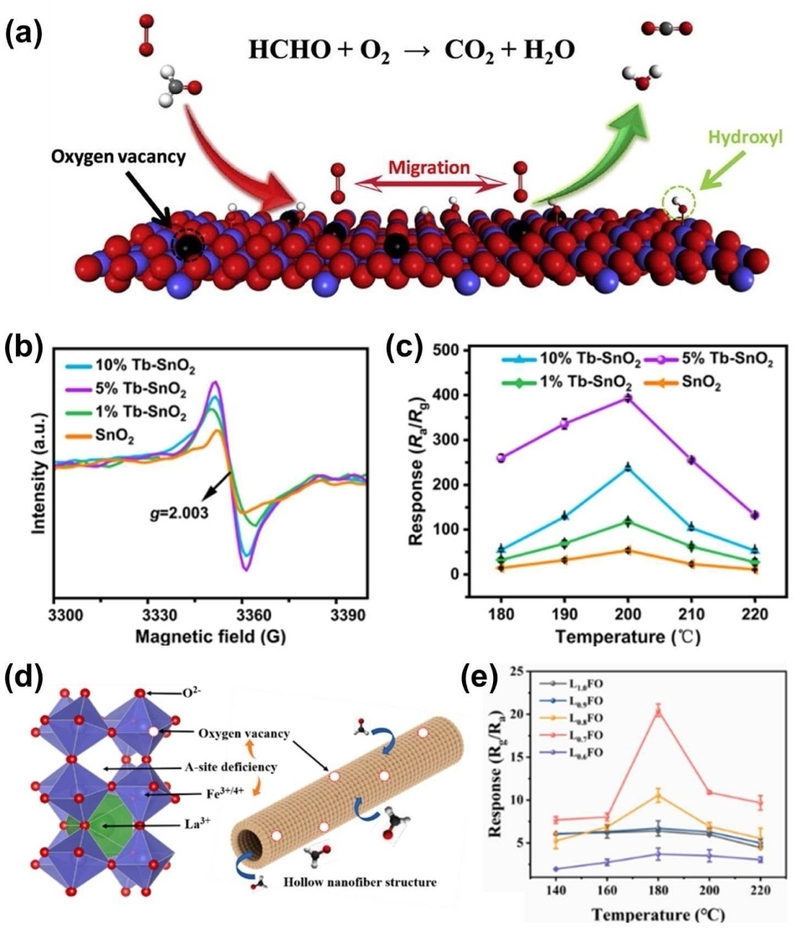
Oxygen-vacancy engineering for enhanced HCHO sensing. (a) Schematic illustration of HCHO adsorption and oxidation mediated by oxygen vacancies. Adapted from Ref. [17]. (b) EPR spectra and (c) HCHO responses of pristine and Tb-doped SnO2 sensors. Adapted from Ref. [22]. (d) Schematic illustration of oxygen-vacancy formation in A-site-deficient LaFeO3 hollow nanofibers and (e) their HCHO responses. Adapted from Ref. [23].
Chu et al. investigated the incorporation of Tb ions to regulate the oxygen vacancy concentration in MOF-derived SnO2 [22]. The charge and ionic-radius mismatch between Tb3+ ions and Sn4+ induced lattice distortion and facilitated the removal of lattice oxygen during calcination. As shown in Fig. 1(b), the EPR signal at g = 2.003, assigned to singly ionized oxygen vacancies, reached its maximum intensity for the 5 at% Tb-SnO2, confirming the highest oxygen vacancies concentration. Consequently, the 5 at% Tb-SnO2 sensor exhibited the highest response of 394 to 10 ppm. HCHO at 200°C, which was 7.38 times higher than that of pristine SnO2 (Fig. 1(c)). The enhanced HCHO response of Tb-SnO2 was attributed to the increased oxygen-vacancy concentration, which accelerated the surface reaction kinetics. In addition, the reversible Tb3+/Tb4+ redox couples suppressed the occupation of active sites by water molecules, enabling a high response of 209.3 to 10 ppm HCHO at 80% RH. This result highlights the critical need to design surface active sites capable of resisting water poisoning, as competitive adsorption of ambient moisture remains a ubiquitous hurdle across most MOS sensing matrices.
On the other hand, Zhu et al. generated oxygen vacancies in LaFeO3 through A-site non-stoichiometry without introducing external dopants [23]. A-site-deficient LaxFeO3 hollow nanofibers were synthesized by electrospinning (Fig. 1(d)). The deficiency of La induced charge compensation through the partial oxidation of Fe3+ to Fe4+ and the formation of oxygen vacancies. The increased EPR intensity and defect-related Raman bands confirmed the successful formation of oxygen vacancies. Consequently, the La0.7FeO3 sensor exhibited the highest response of 20.4 to 100 ppm HCHO at 180°C (Fig. 1(e)). The enhanced response of La0.7FeO3 was attributed to the synergistic effects of the increased oxygen-vacancy concentration, the increased Fe4+/Fe3+ ratio, and the high-surface-area hollow nanofiber structure.
These examples demonstrate that oxygen vacancies can be effectively introduced through either aliovalent cation incorporation or non-stoichiometric defect engineering, providing versatile routes to improve HCHO sensing performance.
The electronic band structure of a sensing layer can be effectively modified by two semiconducting oxides with different Fermi levels. Upon contact, electrons redistribute across the interface until Fermi-level equilibrium is established, resulting in interfacial band bending and formation of carrier-depletion or accumulation regions [24]. This interfacial charge redistribution modifies the local carrier concentration and baseline resistance of the sensing layer [25]. During HCHO sensing, the associated charge transfer further perturbs the interfacial carrier distribution, thereby amplifying the resistance change and enhancing the sensing performance [26]. Representative p–n, n–n, and p–p heterojunctions are schematically illustrated in Fig. 2.
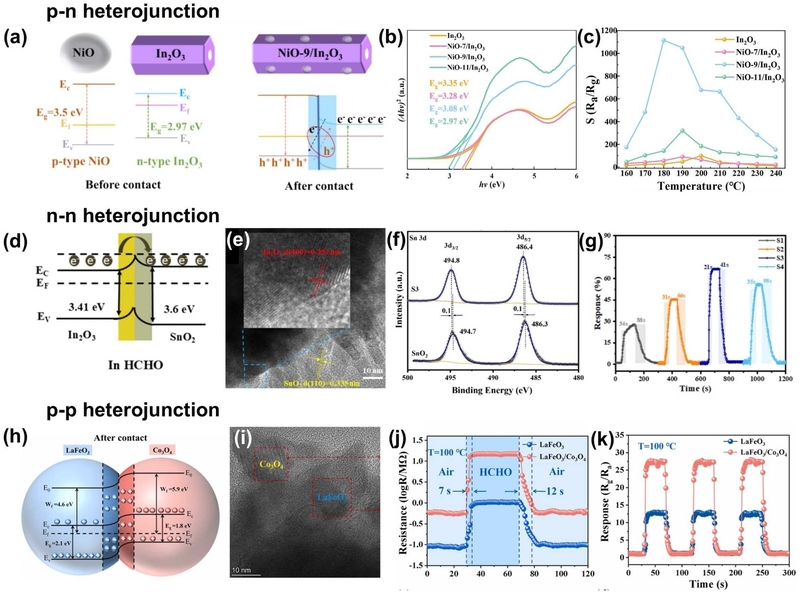
Heterojunction engineering for enhanced HCHO gas sensing. (a–c) p–n heterojunction (NiO/In2O3): (a) Band alignment and charge transfer mechanism in NiO/In2O3. (b) Tauc plots showing optical band gaps (Eg). (c) Temperature-dependent response. Adapted from Ref. [27]. (d–g) n–n heterojunction (SnO2/In2O3): (d) Energy-band diagram under HCHO atmosphere. (e) HRTEM image of the heterointerface. (f) Sn 3d XPS spectra comparing pristine SnO2 and the composite (S3). (g) Dynamic HCHO response for various Sn: In ratios (S1–S4). Adapted from Ref. [28]. (h–k) p–p heterojunction (LaFeO3/Co3O4): (h) Equilibrium band alignment and hole transfer. (i) HRTEM image of Co3O4 nanoparticles on LaFeO3. (j) Transient resistance response in air and HCHO at 100°C. (k) Cyclic response demonstrating sensor repeatability. Adapted from Ref. [29].
The p–n heterojunction reported by Kong et al. was constructed by anchoring p-type NiO nanoparticles onto n-type In2O3 microtubes [27]. This configuration represents a widely adopted strategy in oxide chemiresistors, where n-type oxides serve as electron transport frameworks, while p-type oxide nanoparticles can provide additional catalytic sites and induce interfacial charge redistribution through p–n junction formation. The difference in Fermi levels drives electron transfer from In2O3 to NiO, followed by band bending and the formation of an interfacial depletion region (Fig. 2(a)). Optical absorption analysis using Tauc plots revealed a gradual narrowing of the optical bandgap with increasing NiO loading, while the accompanying XPS binding-energy shifts provided evidence of interfacial electronic interaction (Fig. 2(b)). Consequently, the NiO-9/In2O3 sensor, exhibiting an intermediate bandgap of 3.08 eV, achieved the highest response of 1115.41 to 10 ppm HCHO at 180°C, whereas both lower and higher NiO loading resulted in inferior sensing performance (Fig. 2(c)). The superior response at the optimized NiO loading was attributed to the synergistic effects of electronic modulation arising from the NiO/In2O3 p–n heterointerface and catalytic activity of NiO nanoparticles, which facilitated HCHO oxidation and enhanced the modulation of the interfacial potential barrier.
In addition to p–n systems, constructing n–n heterojunctions represents another effective approach for HCHO sensing at room temperature, combining the intrinsic sensing characteristics of two n-type oxides while maintaining efficient electron transport networks. For example, Liu et al. integrated n-type SnO2 nanoparticles with n-type In2O3 microspheres to form an n–n heterojunction framework (Fig. 2(d)) [28]. High-resolution TEM and XPS analyses confirmed the formation of a well-defined heterointerface accompanied by interfacial charge transfer, which established an electron depletion layer in SnO2 and an accumulation layer in In2O3. Dynamic response measurements revealed that the HCHO response was significantly enhanced at an optimized SnO2/In2O3 ratio compared to pristine In2O3, indicating that the optimized heterointerface contributed to the enhanced sensing performance through interfacial electronic modulation (Fig. 2(e–g)). The enhanced sensing performance was therefore associated with interfacial electron redistribution across the SnO2/In2O3 heterointerface as well as with the intrinsic surface reactivity of the oxides. Unlike p–n heterojunctions, which primarily rely on modulation of the built-in potential barrier, n–n heterojunctions provide efficient electron transport while simultaneously combining the intrinsic gas-sensing characteristics of two n-type oxides.
Chen et al. explored p–p heterojunctions by integrating two p-type oxides, LaFeO3 and Co3O4, within a nanofiber architecture [29]. Based on the DFT-calculated work functions, electrons transfer from LaFeO3 to Co3O4, forming a hole-accumulation region in LaFeO3 and a hole-depletion region in Co3O4 (Fig. 2(h)). High-resolution TEM confirmed the successful establishment of this p–p heterointerface (Fig. 2(i)). Unlike n-type sensing, exposure to reducing HCHO gas leads to an increase in resistance, as the released electrons recombine with holes and decrease the majority carrier concentration in the p-type matrix (Fig. 2(j)). The interfacial electric field at the p–p heterointerface amplifies this resistance change by regulating hole redistribution and charge transport across the interface. Consequently, the optimized LaFeO3/Co3O4 sensor exhibited a significantly higher and more reproducible HCHO response compared to pristine LaFeO3 at a lower operating temperature of 100°C (Fig. 2(k)). Overall, these examples demonstrate that heterojunction formation enhances HCHO sensing primarily through interfacial charge redistribution and amplification of the electrical response. Selective HCHO detection, however, is closely associated with the surface affinity and catalytic activity of the constituent oxides, which promote preferential HCHO oxidation. Thus, combining selective surface chemistry with interfacial electronic modulation can improve both HCHO sensitivity and selectivity.
Noble-metal functionalization significantly improves MOS-based HCHO sensing performance through chemical and/or electronic sensitization. Chemical sensitization accelerates O2 dissociation and HCHO oxidation via spillover effects, whereas electronic sensitization modifies interfacial carrier distribution through charge transfer between the noble metal and semiconductor oxide [30]. Depending on the relative work function of the metal oxides and noble metal, interfacial charge transfer can generate a Schottky barrier or modify the local carrier charge concentration near the interface [31]. These effects depend strongly on various parameters of the noble-metal catalysts, such as particle size, loading, exposed crystal facets, oxidation state, and interfacial structure [32,33].
The influence of catalyst dimensions is clearly illustrated by the Pd/SnO2 system reported by Li et al., in which the HCHO response varied with both the size and exposed facet of the Pd nanocrystals [34]. Fig. 3(a) depicts the dual role of Pd nanoparticles, where Pd promotes HCHO oxidation through catalytic sensitization while interfacial charge transfer between Pd and SnO2 induces Schottky barrier formation. The size dependence of HCHO sensing performance in Pd/SnO2 sensors further supports these sensitization effects (Fig. 3(b)). Specifically, 3 nm Pd nanoparticles produced a higher response than 20 and 50 nm Pd nanocubes, because smaller particles provide more accessible catalytic sites and a higher density of Pd/SnO2 interfacial junctions, thereby enhancing both surface oxidation kinetics and electronic sensitization. In addition to particle size, the exposed crystal facet played a crucial role. Among Pd nanoparticles with a similar size, the response followed the order of Pd(100) > Pd(110) > Pd(111), consistent with the DFT-calculated preference for HCHO adsorption on the Pd(100) facet. This example highlights that noble-metal optimization requires balancing catalytic accessibility and interfacial electronic interaction.
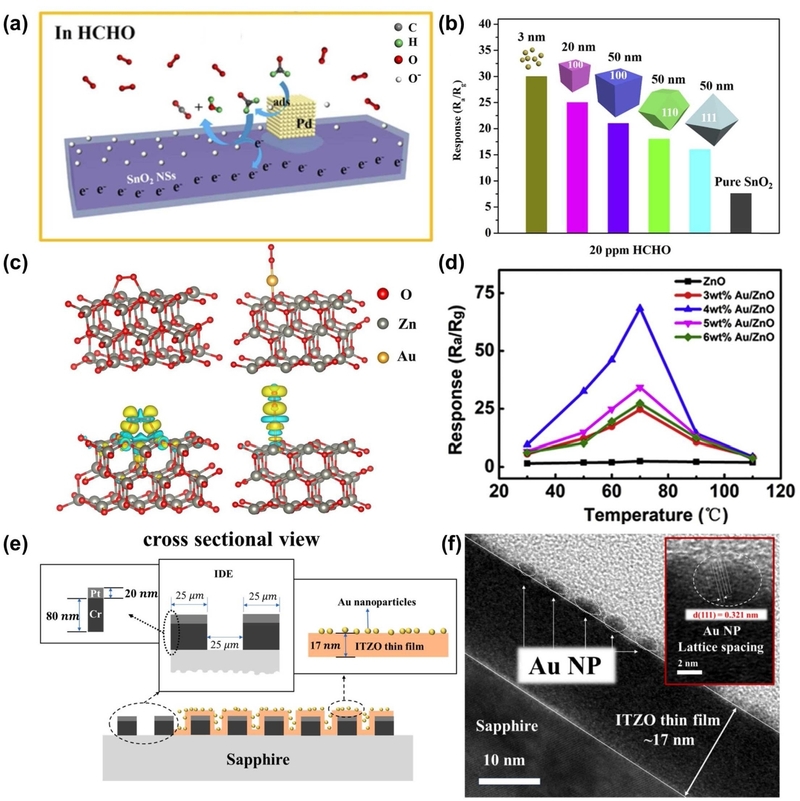
Noble-metal sensitization of MOS-based HCHO sensors. (a) Schematic illustration of Pd-mediated chemical and electronic sensitization and (b) effects of Pd particle size and exposed facet on the HCHO response of Pd/SnO2 sensors. Adapted from Ref. [34]. (c) Calculated O2 adsorption configurations and charge-density differences and (d) Responses of Au-loaded ZnO sensors. Adapted from Ref. [35]. (e) Device configuration and (f) cross-sectional TEM image of an Au-decorated ITZO thin-film sensor. Adapted from Ref. [36].
On the other hand, Au-loaded ZnO nanorod arrays demonstrated enhanced HCHO sensing through the combined effects of oxygen activation and interfacial electronic modulation (Fig. 3(c)) [35]. DFT calculations showed that Au enhanced the adsorption of reactive oxygen species, while XPS analyses provided evidence of charge redistribution at the Au/ZnO interface. Consequently, the sensing response exhibited a distinct maximum at an optimized Au loading (Fig. 3(d)). At lower Au loadings, the limited number of Au sites restricted the available catalytic interfaces, whereas excessive Au loading promoted nanoparticle aggregation and reduced the effective modulation of the sensor resistance. These results highlight the importance of optimizing noble-metal loading to balance catalytic activity and interfacial electronic effects.
Noble-metal functionalization has also been extended to planar thin-film architecture by depositing Au nanoparticles directly onto a sputtered ITZO sensing film [36]. A 17 nm ITZO layer was sputtered over Cr/Pt interdigitated electrodes and subsequently decorated with thermally evaporated Au nanoparticles (Fig. 3(e)). Cross-sectional TEM confirmed intimate contact between the Au nanoparticles and ITZO layer, with an Au(111) lattice spacing of 0.321 nm (Fig. 3(f)). The resulting sensor exhibited a response of 47.5 to 20 ppm HCHO at 250°C, compared with 1.05 for bare ITZO, and achieved a detection limit of 40 ppb. This example demonstrates that noble-metal sensitization can be extended from nanostructured oxides to planar thin-film sensing architectures.
For practical MOS sensor applications, however, maintaining the structural stability of noble-metal nanoparticles under elevated operating temperatures is as important as maximizing their catalytic activity. Strong metal–support interactions (SMSI) can stabilize noble-metal nanoparticles on oxide supports by suppressing their migration and aggregation, thereby helping preserve active metal–oxide interfaces during operation [37,38]. Thus, effective noble-metal engineering requires not only high catalytic activity but also stable interfacial structures that maintain electronic and catalytic functionality over repeated sensing cycles. Future development will likely focus on precisely anchoring minimal, structurally stable noble-metal populations at electronically active sites rather than simply increasing the overall metal loading.
2.2 Strategies for Room-Temperature HCHO Detection
Traditional MOS generally require elevated operating temperatures (typically 200–400°C) to overcome activation energy barriers for surface redox reactions, which inevitably leads to high power consumption and limits their integration into portable devices. To address these thermal constraints, carbonaceous frameworks and two-dimensional (2D) MXenes are widely incorporated to complement MOS sensing layers by coupling active surface chemistry with highly efficient charge transport networks [39]. MOS nanoparticles provide chemisorbed oxygen and reactive sites for HCHO oxidation, while carbonaceous materials such as rGO primarily provide interconnected conductive networks, highly accessible surface areas, and functional groups, and metallic MXenes offer highly conductive pathways and tunable surface terminations that facilitate interfacial charge redistribution [40]. These electronically active components efficiently transduce surface reaction-induced charge variations into measurable resistance changes, enabling HCHO sensing at reduced operating temperatures or even at room temperature. Thus, carbonaceous and MXene components serve not merely as passive supports but as active transduction networks that couple MOS surface reactions with efficient electrical signal conversion.
For instance, Kashyap et al. fabricated an rGO–SnO2 composite where SnO2 nanoparticles were uniformly anchored onto rGO sheets (Fig. 4(a)) [41]. The work-function difference between SnO2 and rGO drives interfacial charge transfer, resulting in charge redistribution at the SnO2/rGO interface. Upon HCHO exposure, the resulting charge perturbation is efficiently transduced through the conductive rGO network, leading to a significantly enhanced room-temperature response compared with pristine rGO or bare SnO2, together with excellent cycling stability (Fig. 4(b)).
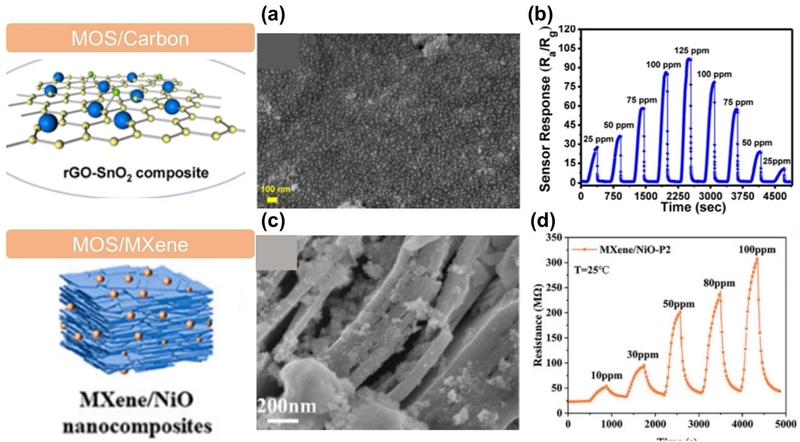
Carbonaceous- and MXene-based composites for room-temperature HCHO sensing. (a) Morphology of an rGO–SnO2 composite and (b) its dynamic responses to different HCHO concentrations at room temperature. Adapted from Ref. [41]. (c) Morphology of an MXene/NiO composite and (d) its room-temperature resistance responses to different HCHO concentrations. Adapted from Ref. [42].
Similarly, combining p-type oxides with metallic MXenes provides another route for interfacial charge modulation [42]. For example, dispersing p-type NiO nanoparticles onto MXene flakes induces charge redistribution at the MXene/NiO interface (Fig. 4(c)). This redistribution enhances oxygen chemisorption and amplifies resistance modulation via electron–hole recombination during HCHO exposure, enabling reliable room-temperature HCHO detection across a broad concentration range (Fig. 4(d)). These results demonstrate that highly conductive MXenes can complement the surface reactivity of NiO by facilitating efficient charge transport and signal transduction at room temperature.
Photoactivation provides an alternative energy source to drive oxygen chemisorption and surface redox reactions, enabling MOS sensors to detect HCHO at room temperature without thermal activation [43]. Under light irradiation (e.g., UV), photogenerated charge carriers facilitate the activation of surface oxygen species and subsequent HCHO oxidation, while the associated charge transfer modulates the carrier concentration and resistance of the oxide [44]. However, excessive illumination can disturb the balance between oxygen adsorption and desorption, emphasizing the need to optimize the irradiation intensity [45].
To enhance this photo-assisted effect, heterojunction and catalyst engineering are frequently integrated with photoactive frameworks [46]. For instance, a porous SnO2@TiO2 core–shell architecture exhibited a dramatically enhanced room-temperature HCHO response under UV illumination compared to dark conditions (Fig. 5(a–c)) [47]. The photoactive TiO2 generated charge carriers under UV irradiation, while the SnO2/TiO2 heterointerface promoted charge separation and carrier transport, thereby facilitating the generation of reactive oxygen species and subsequent HCHO oxidation.
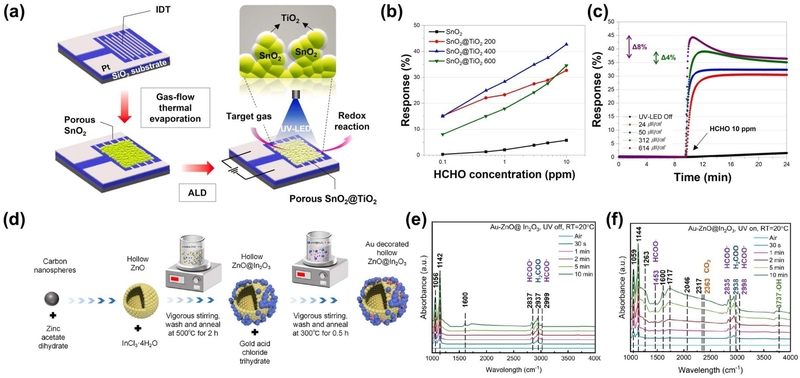
Photo-assisted HCHO sensing at room temperature. (a) Fabrication process of gas sensors and schematics of UV-assisted sensing configuration, (b) concentration-dependent responses, and (c) dynamic responses under different UV intensities of porous SnO2@TiO2 sensors. Adapted from Ref. [47]. (d) Synthesis of hollow Au–ZnO@In2O3 nanospheres and in situ DRIFTS spectra obtained (e) without and (f) with UV irradiation during HCHO exposure. Adapted from Ref. [48].
Photoactivation can also directly influence the surface reaction kinetics and oxidation pathways of HCHO. In a hollow Au-ZnO@In2O3 nanosphere system, in situ DRIFTS analysis revealed that room-temperature oxidation remains incomplete in the dark, whereas UV irradiation drives the full sequential oxidation of adsorbed HCHO through dioxymethylene (H2COO) and formate (HCOO-) intermediates to final CO2 and H2O products (Fig. 5(d–f)) [48]. These findings demonstrate that photoactivation not only enables room-temperature operation by supplying photonic energy for surface reactions, but also promotes the oxidation of HCHO through accelerated reaction pathways.
Despite these advancements in room-temperature HCHO detection, the intrinsic humidity-dependence of MOS gas sensors remains a critical challenge that must be addressed. This issue becomes considerably more severe under room-temperature operation compared to elevated temperatures. At lower operating temperatures, the thermal energy is insufficient to facilitate the desorption of hydroxyl groups (OH−) formed by ambient water molecules. Consequently, the accumulation of strongly chemisorbed hydroxyl species irreversibly blocks active reaction sites and impedes target gas adsorption, leading to severe baseline drift and degraded sensing response in humid environments. In addition to humidity interference, achieving reliable selectivity against ubiquitous co-existing VOCs (e.g., ethanol and acetone) and sufficient sensitivity toward regulatory sub-ppm or ppb levels remains a formidable challenge at room temperature. Because non-thermal activation often lacks the chemical specificity to distinguish molecules with similar adsorption or redox characteristics, further innovations in tailored surface chemistry are imperative for practical room-temperature deployment.
2.3 Achieving High Selectivity toward HCHO over Interfering Gases
In conventional metal oxide chemiresistors, gas selectivity is largely governed by the surface reactivity of the sensing material. Accordingly, attempts to improve selectivity through compositional modification or catalyst loading are frequently accompanied by changes in gas response and sensing kinetics [13,49]. Functional overlayers provide a means of controlling HCHO selectivity without changing the underlying sensing material. In this configuration, the gas mixture first passes through a catalytic overlayer, where interfering gases are selectively converted. Subsequently, the resulting gas mixture reacts with the underlying oxide sensing layer. This approach enables selective and sensitive detection of the target gas by tailoring the overlayer without modifying the underlying sensing material [50].
Catalytic overlayers have been widely employed to improve the selectivity of metal oxide gas sensors by either reforming less reactive analytes into more reactive species or selectively filtering highly reactive interfering gases before they reach the sensing layer [51-53]. However, this strategy is considerably more challenging for HCHO sensing because ethanol, one of the most ubiquitous VOC interferents in indoor environments, exhibits surface reactivity comparable to that of HCHO on most oxide semiconductors. Consequently, conventional catalytic filtering can be insufficient to effectively discriminate between these two highly reactive molecules.
To overcome this limitation, Kim et al. developed an HZSM-5/In2O3 bilayer sensor in which an acidic HZSM-5 overlayer selectively altered the reaction pathway of ethanol before it reached the sensing layer [54]. The bilayer consisted of an approximately 8 μm-thick 23HZSM-5 overlayer deposited on a 5 μm In₂O₃ sensing layer (Fig. 6(a)). The bare In₂O₃ sensor exhibited substantial responses to both HCHO and ethanol, resulting in poor discrimination between the two gases. In contrast, the acidic 23HZSM-5 overlayer markedly suppressed the ethanol response while preserving the HCHO response (Fig. 6(b)). This selectivity enhancement was attributed to the dehydration of reactive ethanol into less reactive ethylene within the acidic 23HZSM-5 overlayer [55]. In comparison, 318HZSM-5 provided substantially weaker ethanol suppression. The different sensing behaviors of the two bilayer sensors suggest that selective HCHO detection was governed primarily by acidic ethanol conversion rather than diffusion restriction through the zeolite layer. This bilayer sensor provides a practical route for controlling the gas composition before the sensing reaction by altering the converting pathway via an acidic overlayer, transforming a reactive interferent into a less reactive molecule without modifying the oxide sensing material.
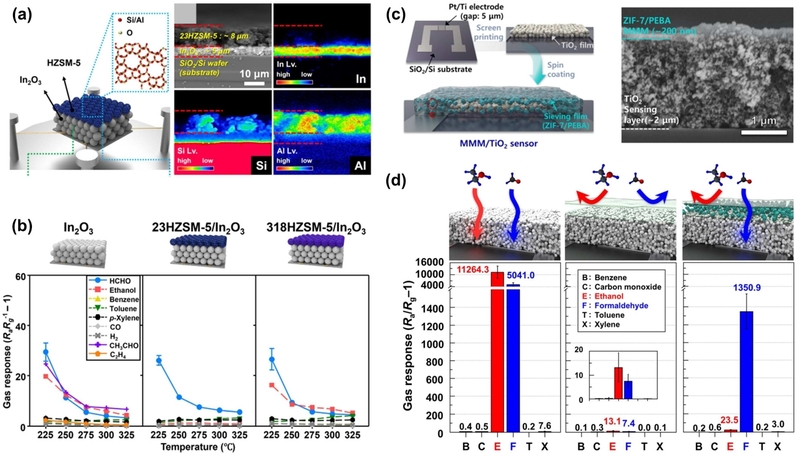
Functional overlayers for selective HCHO detection. (a, b) Chemically converting overlayer: (a) Bilayer structure and elemental distributions, and (b) gas responses of bare In2O3 and HZSM-5/In2O3 sensors at different temperatures. Adapted from Ref. [54]. (c, d) Molecular sieve overlayer: (c) Fabrication and cross-sectional structure of the ZIF-7/PEBA-coated TiO2 sensor and (d) comparison of its responses to HCHO and interfering gases. Adapted from Ref. [60].
In contrast to chemical conversion, physical filtering controls gas selectivity through size-dependent molecular transport. Among various physical filtering approaches, conformal MOF overlayers have emerged as one of the most widely adopted strategies for achieving molecular sieving [56]. Owing to their tunable pore apertures and high crystallinity, MOF shells deposited on metal oxide nanostructures selectively hinder the diffusion of bulky interfering VOCs while allowing smaller HCHO molecules to reach the sensing layer. Consequently, numerous studies have reported enhanced HCHO selectivity using MOF-coated oxide nanostructures [57]. However, continuous MOF thin films are prone to microcracks and grain-boundary defects during fabrication, which can create non-selective diffusion pathways and diminish the molecular-sieving effect [58]. To address this limitation, mixed-matrix membranes incorporating MOF particles into a polymer matrix have been developed to improve structural integrity while preserving size-selective transport [59]. Jo et al. developed an approximately 200 nm thick ZIF-7/PEBA mixed-matrix membrane on a 2 μm TiO2 sensing film (Fig. 6(c)) [60]. Under UV illumination at 23°C, the bare TiO2 sensor exhibited high responses of 11264.3 and 5041.0 toward 5 ppm ethanol and HCHO, respectively, while showing negligible responses to the other tested gases (Fig. 6(d)). These results indicate that photoactivation effectively suppressed interference from less reactive gases but was insufficient to discriminate between ethanol and HCHO. When coated with a pure PEBA layer, the permeation of both gases was severely restricted, reducing the responses to ethanol and HCHO to 13.1 and 7.4, respectively. In contrast, incorporating 5 wt% ZIF-7 into the PEBA matrix selectively restored HCHO diffusion, increasing the HCHO response to 1350.9 while maintaining a low ethanol response of 23.5. Consequently, the HCHO-to-ethanol selectivity reached 57.4, demonstrating that the mixed-matrix molecular-sieving overlayer effectively suppressed ethanol transport while preserving high HCHO sensitivity.
3. CONCLUSIONS AND FUTURE PERSPECTIVES
MOS-based chemiresistors offer great promise for continuous HCHO monitoring; however, practical deployment requires addressing insufficient sub-ppm sensitivity, high operating temperatures, severe VOC cross-sensitivity, and ambient humidity-induced degradation. Recent strategies focus on defect engineering, heterojunctions, and noble-metal catalysts to amplify response; carbon/MXene composites and photo-activation for room-temperature operation; and functional overlayers for selective conversion or molecular sieving. Consequently, successful sensor design hinges on regulating defect density via stoichiometric/aliovalent doping, enhancing catalytic dispersion and stability, and selecting materials with matched bandgaps and Fermi levels to establish favorable interfacial band alignment tailored for HCHO detection. Furthermore, hybridizing sensing materials with carbonaceous/MXene networks to lower operating temperatures, alongside employing chemistry-specific catalytic overlayers or kinetic diameter-matched molecular sieves (e.g., MOFs), is critical to preventing malfunction of the HCHO sensor via achieving high selectivity. These integrated strategies pave the way for highly sensitive, low-power, humidity-resilient, and highly selective real-world indoor air quality sensors.
Despite these significant advancements, several issues must be addressed to transition from laboratory-scale prototypes to commercialized HCHO monitoring platforms. First, long-term baseline drift remains a pervasive obstacle, as metal oxide sensors are highly vulnerable to baseline drift and active-site poisoning induced by ambient hydroxyl species (OH⁻) and/or interfering reactive gases. In typical indoor environments, ubiquitous background VOCs (e.g., ethanol, acetone, and toluene) often exist at elevated concentrations ranging from several hundred ppb to ppm levels, tens to hundreds of times higher than the sub-ppm or low-ppb thresholds required for hazardous HCHO detection [61]. This massive concentration disparity severely exacerbates competitive adsorption, active-site poisoning, and non-linear baseline drift. To address these degradation mechanisms, adopting protective functional overlayers can effectively block or reform poisoning species before they reach the sensing surface. Concurrently, developing deep learning-driven compensation algorithms provides a powerful data-driven pathway to dynamically calibrate environmental fluctuations, correct non-linear baseline drift, and mitigate sensor signal degradation.
Second, practical real-world deployment necessitates low-power system-level integration. While room-temperature material strategies effectively eliminate heater power consumption, they often suffer from sluggish recovery kinetics and limited sub-ppm response under ambient conditions. To bridge the gap between low energy consumption and uncompromising sensing performance, future efforts should prioritize coupling MOS sensing nanostructures with energy-efficient micro-platforms, such as micro-LED arrays for photoactivation or MEMS micro-heaters for localized thermal activation. Realizing these integrated platforms requires meticulous optimization of the sensing film architecture, thickness, and material composition to maximize interfacial energy coupling and transduction efficiency. Furthermore, implementing dynamic operating modes, such as pulsed thermal heating or pulsed light illumination, can drastically minimize power consumption while generating distinctive transient response patterns [62,63], which provide abundant chemical feature fingerprints to further improve target gas discrimination.
Finally, real indoor environments present complex dynamic matrices with diverse co-existing VOC interferents and fluctuating humidity. To achieve zero-false-alarm monitoring, future research should focus on constructing versatile multi-sensor electronic noses (E-noses) by synergistically combining diverse MOS sensing materials with tailored functional overlayers [64,65]. Integrating these heterogeneous sensor arrays with advanced machine learning-assisted pattern recognition algorithms will enable the effective deconvolution of cross-reactive signals, classification of complex gas mixtures, and reliable, real-time HCHO quantification in practical field conditions.
Addressing these challenges through cooperative materials innovation and system-level engineering will accelerate the realization of reliable, maintenance-free indoor air quality monitoring systems.
Acknowledgments
This study was supported by the Fundamental Research Program of the Korea Institute of Materials Science (Grant No. PNKA920).
REFERENCES
- United States Environmental Protection Agency, What should I know about formaldehyde and indoor air quality? https://www.epa.gov/indoor-air-quality-iaq/what-should-i-know-about-formaldehyde-and-indoor-air-quality, , 2025 (accessed 7 August 2026).
- U.S. Environmental Protection Agency, IRIS Toxicological Review of Formaldehyde (Inhalation) CASRN 50-00-0, Report No. EPA/635/R-24/162aF, U.S. Environmental Protection Agency, Washington, DC, 2024.
- IARC Working Group on the Evaluation of Carcinogenic Risks to Humans, Formaldehyde, 2-Butoxyethanol and 1-tert-Butoxypropan-2-ol, IARC Monographs on the Evaluation of Carcinogenic Risks to Humans, vol. 88, International Agency for Research on Cancer, Lyon, France, 2006.
- World Health Organization Regional Office for Europe, WHO guidelines for indoor air quality: selected pollutants, World Health Organization Regional Office for Europe, Copenhagen, Denmark, 2010.
- National Institute for Occupational Safety and Health, Formaldehyde. https://www.cdc.gov/niosh/npg/npgd0293.html, , 2019 (accessed 7 August 2026).
-
S.H. Kim, Y. Kim, H.S. Choi, J.J. Kim, J.M. Baik, Smart Metal Oxide Gas Sensors with Catalytic and Artificial Intelligence-Driven Selectivity, J. Sens. Sci. Technol. 34 (2025) 208–223.
[https://doi.org/10.46670/JSST.2025.34.3.208]

- Y.H. Kim, W.T. Koo, J.S. Jang, I.D. Kim, Review of Metal Oxide-based Formaldehyde Gas Sensor to Measure Indoor Air Quality, J. Sens. Sci. Technol. 28 (2019) 377–384.
-
Z. Han, Y. Qi, Z. Yang, H. Han, Y. Jiang, W. Du, et al., Recent advances and perspectives on constructing metal oxide semiconductor gas sensing materials for efficient formaldehyde detection, J. Mater. Chem. C 8 (2020) 13169–13188.
[https://doi.org/10.1039/D0TC03750H]
-
H.-J. Kim, J.-H. Lee, Highly sensitive and selective gas sensors using p-type oxide semiconductors: Overview, Sens. Actuators B Chem. 192 (2014) 607–627.
[https://doi.org/10.1016/j.snb.2013.11.005]
-
P.M. Bulemo, D.-H. Kim, H. Shin, H.-J. Cho, W.-T. Koo, S.-J. Choi, et al., Selectivity in chemiresistive gas sensors: strategies and challenges, Chem. Rev. 125 (2025) 4111–4183.
[https://doi.org/10.1021/acs.chemrev.4c00592]
-
H. Chai, Z. Zheng, K. Liu, J. Xu, K. Wu, Y. Luo, et al., Stability of metal oxide semiconductor gas sensors: A review, IEEE Sens. J. 22 (2022) 5470–5481.
[https://doi.org/10.1109/JSEN.2022.3148264]
-
K.B. Kim, Y.K. Moon, Y.-M. Jo, S.-Y. Jeong, J.-W. Yoon, C.W. Na, et al., In memoriam: Jong-Heun Lee–A Tribute to His Contributions to the Advancement of Metal Oxide Semiconductor Gas Sensors, J. Sens. Sci. Technol. 35 (2026) 191–215.
[https://doi.org/10.46670/JSST.2026.35.3.191]
-
K.B. Kim, M.S. Sohn, S. Min, J.W. Yoon, J.S. Park, J. Li, et al., Highly selective and reversible detection of simulated breath hydrogen sulfide using Fe-doped CuO hollow spheres: Enhanced surface redox reaction by multi-valent catalysts, Small 20 (2024) 2308963.
[https://doi.org/10.1002/smll.202308963]
-
J.-Y. Jeon, D.-G. Shin, Y.K. Moon, Enhanced acetone detection in high-humidity environments using Cr-doped ε-WO3 spheres, J. Sens. Sci. Technol. 33 (2024) 255–258.
[https://doi.org/10.46670/JSST.2024.33.5.255]
-
K. Lee, I. Park, Advancements in Photoactivated Gas Sensors: A Review, J. Sens. Sci. Technol. 33 (2024) 359–365.
[https://doi.org/10.46670/JSST.2024.33.5.359]
-
M. Al-Hashem, S. Akbar, P. Morris, Role of Oxygen Vacancies in Nanostructured Metal-Oxide Gas Sensors: A Review, Sens. Actuators B Chem. 301 (2019) 126845.
[https://doi.org/10.1016/j.snb.2019.126845]
-
J. Deng, W. Song, L. Chen, L. Wang, M. Jing, Y. Ren, et al., The effect of oxygen vacancies and water on HCHO catalytic oxidation over Co3O4 catalyst: A combination of density functional theory and microkinetic study, Chem. Eng. J. 355 (2019) 540–550.
[https://doi.org/10.1016/j.cej.2018.08.195]
-
S.A. Tawfik, H. Tran, M.J. Spencer, Improving sensing of formaldehyde using ZnO nanostructures with surface-adsorbed oxygen, Nanoscale Adv. 4 (2022) 546–561.
[https://doi.org/10.1039/D1NA00804H]
-
Y. Sun, S. Sun, Y. Zheng, Z. Zhang, T. Hou, H. Du, et al., The role of oxygen vacancies on SnO2 in improving formaldehyde competitive adsorption: A DFT study with an experimental verification, Appl. Surf. Sci. 570 (2021) 151110.
[https://doi.org/10.1016/j.apsusc.2021.151110]
-
L.-m. Liu, J. Zhao, Effects of Oxygen Vacancy on the Adsorption of Formaldehyde on Rutile TiO2(110) surface, Chin. J. Chem. Phys. 30 (2017) 312–318.
[https://doi.org/10.1063/1674-0068/30/cjcp1703049]
-
L. Guo, S. Zhao, G. Yang, L. Gao, Y. Wu, X. Zhang, Oxygen vacancies assisted LaFeO3 derived from metal organic frameworks endows a practical HCHO sensor with excellent sensing characteristics, J. Ind. Eng. Chem. 126 (2023) 501–509.
[https://doi.org/10.1016/j.jiec.2023.06.038]
-
N. Chu, Z. Wang, F. Gu, Oxygen Vacancies Enabled MOF-Derived Tb–SnO2 Compound for a High-Response, Low Detection Limit, and Humidity-Tolerant Chemiresistive Gas Sensor of Formaldehyde, ACS Appl. Electron. Mater. 7 (2025) 3041–3054.
[https://doi.org/10.1021/acsaelm.5c00212]
-
L. Zhu, J. Wang, J. Liu, X. Chen, Z. Xu, Q. Ma, et al., Designing highly sensitive formaldehyde sensors via A-site cation deficiency in LaFeO3 hollow nanofibers, Appl. Surf. Sci. 590 (2022) 153085.
[https://doi.org/10.1016/j.apsusc.2022.153085]
-
K.X. Steirer, K.L. Ou, N.R. Armstrong, E.L. Ratcliff, Critical Interface States Controlling Rectification of Ultrathin NiO–ZnO p–n Heterojunctions, ACS Appl. Mater. Interfaces 9 (2017) 31111–31118.
[https://doi.org/10.1021/acsami.7b08899]
-
R. Vishnuraj, M. Aleem, K.G. Nair, B. Pullithadathil, 1D aligned, n–p and n–n type ZnO heterojunction nanofibers for NO2 sensors: exploration of conduction mechanism using in situ impedance spectroscopy, Mater. Adv. 4 (2023) 3010–3025.
[https://doi.org/10.1039/D2MA01095J]
-
C. Lou, C. Yang, W. Zheng, X. Liu, J. Zhang, Atomic layer deposition of ZnO on SnO2 nanospheres for enhanced formaldehyde detection, Sens. Actuators B Chem. 329 (2021) 129218.
[https://doi.org/10.1016/j.snb.2020.129218]
-
D. Kong, B. Hong, J. Xu, X. Peng, J. Li, H. Chen, et al., P–n heterojunction construction and interfacial interaction mechanism: NiO/In2O3 formaldehyde gas sensors with excellent sensitivity and selectivity, Appl. Surf. Sci. 688 (2025) 162442.
[https://doi.org/10.1016/j.apsusc.2025.162442]
-
M. Liu, Q. Sun, Y. Zhu, P. Hu, Z. Wu, Highly selective room-temperature formaldehyde gas sensor based on SnO2 nanoparticle-modified In2O3 microspheres, Appl. Surf. Sci. 695 (2025) 162856.
[https://doi.org/10.1016/j.apsusc.2025.162856]
-
B. Sun, R. Chen, M. Liu, Q. Xie, P. Song, LaFeO3/Co3O4 nanofibers with p-p heterojunction for enhanced formaldehyde sensing performance at low temperature, Sens. Actuators B Chem. 447 (2026) 138923.
[https://doi.org/10.1016/j.snb.2025.138923]
-
M.S. Barbosa, P.H. Suman, J.J. Kim, H.L. Tuller, M.O. Orlandi, Investigation of electronic and chemical sensitization effects promoted by Pt and Pd nanoparticles on single-crystalline SnO nanobelt-based gas sensors, Sens. Actuators B Chem. 301 (2019) 127055.
[https://doi.org/10.1016/j.snb.2019.127055]
-
B. Zhang, S. Zhang, Y. Xia, P. Yu, Y. Xu, Y. Dong, et al., High-Performance Room-Temperature NO2 Gas Sensor Based on Au-Loaded SnO2 Nanowires under UV Light Activation, Nanomaterials 12 (2022) 4062.
[https://doi.org/10.3390/nano12224062]
-
D. Koziej, M. Hübner, N. Barsan, U. Weimar, M. Sikora, J.-D. Grunwaldt, Operando X-ray absorption spectroscopy studies on Pd-SnO2 based sensors, Phys. Chem. Chem. Phys. 11 (2009) 8620–8625.
[https://doi.org/10.1039/b906829e]
-
C. Liu, Q. Kuang, Z. Xie, L. Zheng, The effect of noble metal (Au, Pd and Pt) nanoparticles on the gas sensing performance of SnO2-based sensors: a case study on the {221} high-index faceted SnO2 octahedra, CrystEngComm 17 (2015) 6308–6313.
[https://doi.org/10.1039/C5CE01162K]
-
G. Li, Y. Fan, Q. Hu, D. Zhang, Z. Ma, Z. Cheng, et al., Morphology and size effect of Pd nanocrystals on formaldehyde and hydrogen sensing performance of SnO2 based gas sensor, J. Alloys Compd. 906 (2022) 163765.
[https://doi.org/10.1016/j.jallcom.2022.163765]
-
J. Huang, H. Liang, J. Ye, D. Jiang, Y. Sun, X. Li, et al., Ultrasensitive formaldehyde gas sensor based on Au-loaded ZnO nanorod arrays at low temperature, Sens. Actuators B Chem. 346 (2021) 130568.
[https://doi.org/10.1016/j.snb.2021.130568]
-
P.-C. Yao, P.-Y. Chu, D.-H. Shih, W.-C. Liu, Formaldehyde gas sensing properties of a sputtered indium tin zinc oxide thin film decorated with evaporated gold nanoparticles, Sens. Actuators B Chem. 412 (2024) 135824.
[https://doi.org/10.1016/j.snb.2024.135824]
-
Y. Ou, B. Wang, N. Xu, Q. Song, T. Liu, H. Xu, et al., Strong Metal–Support Interaction Induces Dual Reaction Sites for Ultrasensitive and Stable NO2 Detection in Extreme Environments, Adv. Funct. Mater. 35 (2025) 2416605.
[https://doi.org/10.1002/adfm.202416605]
-
H. Wang, L. Wang, D. Lin, X. Feng, Y. Niu, B. Zhang, et al., Strong metal–support interactions on gold nanoparticle catalysts achieved through Le Chatelier's principle, Nat. Catal. 4 (2021) 418–424.
[https://doi.org/10.1038/s41929-021-00611-3]
-
S.J. Kim, H.-J. Koh, C.E. Ren, O. Kwon, K. Maleski, S.-Y. Cho, et al., Metallic Ti3C2Tx MXene Gas Sensors with Ultrahigh Signal-to-Noise Ratio, ACS Nano 12 (2018) 986–993.
[https://doi.org/10.1021/acsnano.7b07460]
-
M. Liu, P. Song, D. Liang, Y. Ding, Q. Wang, 3D porous Ti3C2Tx MXene/rGO/SnO2 aerogel for formaldehyde detection at room temperature, J. Alloys Compd. 925 (2022) 166664.
[https://doi.org/10.1016/j.jallcom.2022.166664]
-
A. Kashyap, B. Chakraborty, M.S. Siddiqui, H. Tyagi, H. Kalita, Selective and Sensitive Detection of Formaldehyde at Room Temperature by Tin Oxide Nanoparticles/Reduced Graphene Oxide Composite, ACS Appl. Nano Mater. 6 (2023) 7948–7959.
[https://doi.org/10.1021/acsanm.3c01183]
-
B. Huang, X. Tong, X. Zhang, Q. Feng, M.N. Rumyantseva, J. Prakash, et al., MXene/NiO Composites for Chemiresistive-Type Room Temperature Formaldehyde Sensor, Chemosensors 11 (2023) 258.
[https://doi.org/10.3390/chemosensors11040258]
-
L. Liu, X. Li, P.K. Dutta, J. Wang, Room temperature impedance spectroscopy-based sensing of formaldehyde with porous TiO2 under UV illumination, Sens. Actuators B Chem. 185 (2013) 1–9.
[https://doi.org/10.1016/j.snb.2013.04.090]
-
J. Zhang, B. Huang, X. Li, C. Yang, W. Zhao, X. Xie, et al., Fluorinated TiO2 Hollow Spheres for Detecting Formaldehyde under UV Irradiation, Materials 17 (2024) 904.
[https://doi.org/10.3390/ma17040904]
-
Y. Wang, X. Lai, B. Liu, Y. Chen, Y. Lu, F. Wang, et al., UV-induced desorption of oxygen at the TiO2 surface for highly sensitive room temperature O2 sensing, J. Alloys Compd. 793 (2019) 583–589.
[https://doi.org/10.1016/j.jallcom.2019.04.231]
-
S. Zhang, L. Zhao, B. Huang, X. Li, UV activated formaldehyde sensing properties of hollow TiO2@SnO2 heterojunctions at room temperature, Sens. Actuators B Chem. 319 (2020) 128264.
[https://doi.org/10.1016/j.snb.2020.128264]
-
H.-K. Chang, D.-S. Ko, D.-H. Cho, S. Kim, H.-N. Lee, H.S. Lee, et al., Enhanced response of the photoactive gas sensor on formaldehyde using porous SnO2@TiO2 heterostructure driven by gas-flow thermal evaporation and atomic layer deposition, Ceram. Int. 47 (2021) 5985–5992.
[https://doi.org/10.1016/j.ceramint.2020.10.172]
-
L. Zhao, S. Sun, S. Zhang, X. Li, UV activated formaldehyde gas sensing based on gold decorated ZnO@In2O3 hollow nanospheres at room temperature, Sens. Actuators B Chem. 417 (2024) 136149.
[https://doi.org/10.1016/j.snb.2024.136149]
-
K.-I. Choi, M. Hübner, A. Haensch, H.-J. Kim, U. Weimar, N. Barsan, et al., Ambivalent effect of Ni loading on gas sensing performance in SnO2 based gas sensor, Sens. Actuators B Chem. 183 (2013) 401–410.
[https://doi.org/10.1016/j.snb.2013.04.007]
-
S.Y. Jeong, Y.K. Moon, J.K. Kim, S.W. Park, Y.K. Jo, Y.C. Kang, et al., A General Solution to Mitigate Water Poisoning of Oxide Chemiresistors: Bilayer Sensors with Tb4O7 Overlayer, Adv. Funct. Mater. 31 (2021) 2007895.
[https://doi.org/10.1002/adfm.202007895]
-
Y.K. Moon, S.Y. Jeong, Y.M. Jo, Y.K. Jo, Y.C. Kang, J.H. Lee, Highly Selective Detection of Benzene and Discrimination of Volatile Aromatic Compounds Using Oxide Chemiresistors with Tunable Rh-TiO2 Catalytic Overlayers, Adv. Sci. 8 (2021) 2004078.
[https://doi.org/10.1002/advs.202004078]
-
Y.K. Moon, J.H. Kim, S.-Y. Jeong, S.M. Lee, S.J. Park, T.H. Kim, et al., Exclusive detection of ethylene using metal oxide chemiresistors with a Pd–V2O5–TiO2 yolk–shell catalytic overlayer via heterogeneous Wacker oxidation, J. Mater. Chem. A 11 (2023) 666–675.
[https://doi.org/10.1039/D2TA08425B]
-
K.B. Kim, M.S. Sohn, I.-S. Hwang, D.J. Yoo, H. Jeong, Y.C. Kang, et al., Selective methanol detection in adulterated alcoholic beverages using a chemiresistive sensor-embedded analyzer, Sens. Actuators B Chem. 445 (2025) 138561.
[https://doi.org/10.1016/j.snb.2025.138561]
-
K.B. Kim, M.S. Sohn, I.-S. Hwang, D.J. Yoo, S.-Y. Jeong, Y.C. Kang, et al., Mitigating alcohol inhibition of oxide chemiresistors: bilayer sensors with HZSM-5 zeolite overlayers, Nat. Commun. 16 (2025) 5121.
[https://doi.org/10.1038/s41467-025-60500-2]
-
T.K. Phung, L.P. Hernández, A. Lagazzo, G. Busca, Dehydration of ethanol over zeolites, silica alumina and alumina: Lewis acidity, Brønsted acidity and confinement effects, Appl. Catal. A Gen. 493 (2015) 77–89.
[https://doi.org/10.1016/j.apcata.2014.12.047]
-
M.S. Yao, W.X. Tang, G.E. Wang, B. Nath, G. Xu, MOF Thin Film-Coated Metal Oxide Nanowire Array: Significantly Improved Chemiresistor Sensor Performance, Adv. Mater. 28 (2016) 5229–5234.
[https://doi.org/10.1002/adma.201506457]
-
H. Tian, H. Fan, M. Li, L. Ma, Zeolitic Imidazolate Framework Coated ZnO Nanorods as Molecular Sieving to Improve Selectivity of Formaldehyde Gas Sensor, ACS Sens. 1 (2016) 243–250.
[https://doi.org/10.1021/acssensors.5b00236]
-
S. Qiu, M. Xue, G. Zhu, Metal–organic framework membranes: from synthesis to separation application, Chem. Soc. Rev. 43 (2014) 6116–6140.
[https://doi.org/10.1039/C4CS00159A]
-
G. Liu, V. Chernikova, Y. Liu, K. Zhang, Y. Belmabkhout, O. Shekhah, et al., Mixed matrix formulations with MOF molecular sieving for key energy-intensive separations, Nat. Mater. 17 (2018) 283–289.
[https://doi.org/10.1038/s41563-017-0013-1]
-
Y.K. Jo, S.-Y. Jeong, Y.K. Moon, Y.-M. Jo, J.-W. Yoon, J.-H. Lee, Exclusive and ultrasensitive detection of formaldehyde at room temperature using a flexible and monolithic chemiresistive sensor, Nat. Commun. 12 (2021) 4955.
[https://doi.org/10.1038/s41467-021-25290-3]
-
Z. Pei, K.E. Kelly, Laboratory Cross-Sensitivity Evaluation of Low-Cost Electrochemical Formaldehyde Sensors, Sensors 25 (2025) 3096.
[https://doi.org/10.3390/s25103096]
-
Y.K. Moon, K.B. Kim, S.-Y. Jeong, J.-H. Lee, Designing oxide chemiresistors for detecting volatile aromatic compounds: recent progresses and future perspectives, Chem. Commun. 58 (2022) 5439–5454.
[https://doi.org/10.1039/D2CC01563C]
-
G.B. Nam, J.-E. Ryu, T.H. Eom, S.J. Kim, J.M. Suh, S. Lee, et al., Real-Time Tunable Gas Sensing Platform Based on SnO2 Nanoparticles Activated by Blue Micro-Light-Emitting Diodes, Nano-Micro Lett. 16 (2024) 261.
[https://doi.org/10.1007/s40820-024-01486-2]
-
K.B. Kim, Y.K. Moon, T.H. Kim, B.H. Yu, H.Y. Li, Y.C. Kang, et al., Highly selective and sensitive detection of carcinogenic benzene using a raisin bread-structured film comprising catalytic Pd-Co3O4 and gas-sensing SnO2 hollow spheres, Sens. Actuators B Chem. 386 (2023) 133750.
[https://doi.org/10.1016/j.snb.2023.133750]
-
Y.K. Moon, S.-Y. Jeong, Y.C. Kang, J.-H. Lee, Metal oxide gas sensors with Au nanocluster catalytic overlayer: toward tuning gas selectivity and response using a novel bilayer sensor design, ACS Appl. Mater. Interfaces 11 (2019) 32169–32177.
[https://doi.org/10.1021/acsami.9b11079]

Myung Sung Sohn is currently pursuing an M.S./Ph.D integrated degree in the Department of Materials Science and Engineering at Korea University. He received his B.S. degree in Materials Science and Engineering from Ajou University, Korea, in 2022. His current research focuses on the synthesis of aerosol-derived metal oxide powders and their application in chemiresistive gas sensors.

Young Kook Moon is a senior researcher in the Nanomaterials Division at the Korea Institute of Materials Science (KIMS), where he has been working since December 2022. He received his B.S. and Ph.D. from Korea University in 2018 and 2023, respectively. His research focuses on the synthesis of nanostructured materials and their applications in gas sensors, thermal management, and oxide electrolytes.