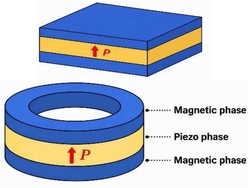
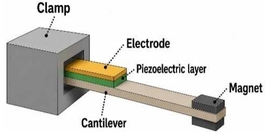
Brief Review on Magnetic Sensing by Magnetoelectric Materials Based on Recent Reports

ⓒ The Korean Sensors Society
This is an Open Access article distributed under the terms of the Creative Commons Attribution Non-Commercial License (https://creativecommons.org/licenses/by-nc/3.0/) which permits unrestricted non-commercial use, distribution, and reproduction in any medium, provided the original work is properly cited.
Abstract
The emergence of laminated magnetoelectric (ME) materials in the early 21st century sparked widespread research interest in developing high-sensitivity magnetic sensors. This review article briefly discusses the necessity of magnetic field sensing and evaluates traditional sensing methods, including their working mechanisms, sensitivities, and limitations. The review begins with an overview of single-phase and various composite-based ME systems, highlighting how the development of laminated composites transformed the paradigm of magnetic field sensing through simple and direct measurements. Recently reported ME materials and their standard figure of merit (FOM), the magnetoelectric voltage coefficient (αME)-defined as the effectiveness of generating a voltage signal in response to an applied magnetic field are tabulated. Furthermore, ME system-based magnetic sensors and the efficient energy-harnessing magneto-mechano-electric (MME) approach based on electromechanical resonance are introduced, alongside their respective ME coefficients. Given the extensive literature on ME and MME magnetic sensing, this review focuses specifically on research articles published recently, detailing the strategies and techniques employed to achieve high ME coefficients and sensor parameters.
Keywords:
Magnetoelectric, Magnetic sensor, Magneto-Mechano-Electric, Energy conversion, ME Sensing1. INTRODUCTION
The emergence of artificial intelligence, the automation of technologies, the rapid growth of big data, and proliferation of sensors have become essential in our daily lives. Today, each person uses electronic systems containing numerous sensors that collect mountains of data, and processing this data requires a huge amount of energy. This drives the need to develop sensors that might be self-powered (without an external power supply), miniaturized for integration into various structures, and importantly cost effective [1]. Among many physical sensing parameters, pressure, force, rotation, movement tracking, and non-contact proximity sensing are detected based on various mechanisms [2-5]. The magnetic field is one such physical parameter playing an important role in our daily lives that needs to be detected and harnessed. Magnetic fields help us in navigation and interaction with digital devices, and can even be used to power devices [6]. Magnetic fields have been widely sensed by various techniques, such as flux magnetometers, which are used to determine the direction and strength of static and low frequency magnetic fields with moderate sensitivity at room temperature. These devices operate using a ferromagnetic core, a drive winding with an excitation coil, and a sense winding with a pickup coil [7,8]. The Nuclear Magnetic Resonance (NMR) magnetometer is a scalar system used to determine magnetic field strength that operates across a wide temperature range. Under a polarizing magnetic field, atomic hydrogen nuclei in a proton rich medium-possessing a net spin that acts as tiny magnetic moments-align along the field; following RF perturbation at the Larmor frequency, these magnetic moments precess, inducing an electric current in the receiver coil that enables the magnetic field strength to be determined with high precision [9,10]. The optically pumped magnetometers (OPM) are highly sensitive magnetic field sensing devices. They operate by aligning the atomic spins of the alkali metal atoms using laser light; upon the application of an external magnetic field, these spins precess at the Larmor frequency.
This precession is detected by a second laser, allowing for the precise calculation of magnetic field strength [11,12]. The Superconducting Quantum Interference Device (SQUID) is an ultrasensitive magnetic sensing system operating at cryogenic temperatures. It functions via a superconducting loop with weak insulation barriers forming the Josephson junctions. Under a constant current, an external magnetic flux induces a phase difference, leading to an oscillating critical screening current based on the magnetic flux quantum. This converts minute magnetic field variations into easily readable voltage outputs, serving as a sensitive readout for magnetic field strength [13,14].
The differences in their working mechanisms, sensitivities and other parameters were summarized in Table. 1 and Fig. 1. These magnetometer techniques have been developed over time to detect weak magnetic signals with high sensitivity. However, their large size and high cost stand as major barriers for numerous practical applications [15]. Consequently, there is a strong demand for an emerging magnetic field sensor with low power consumption, compact volume, and low cost while maintaining high sensitivity for the magnetic field sensing applications. This quest had been successfully addressed by laminated magnetoelectric (ME) composites composed of bonded piezoelectric and magnetostrictive materials [16]. Utilizing these materials, ME sensors and Magneto-Mechano-Electric (MME) energy conversion based magnetic field sensors have fulfilled expectations through adaptable structural designs and miniaturized profiles, overcoming the limitations of conventional, high cost, and bulky commercial magnetic field sensors. In-situ grown eutectic piezoelectric and ferrite composite materials, which emerged in the 1970s as initial ME composites, laid the foundation for the development of numerous ME composites and devices over subsequent decades [17,18]. Early ME composites were extensively studied in the form of particulate composites featuring 0-3 connectivity of the piezoelectric and magnetostrictive phases. However, they faced inherent limitations in achieving superior ME coupling properties for potential applications and suffered from property inconsistency depending on the fabrication process. These drawbacks were overcome with the emergence of 2-2 type ME composites based on the two-dimensional planar coupling of piezoelectric and magnetostrictive layers, first reported by Ryu et al. in 2001 [19,20]. This structural innovation enhanced the ME properties of the materials by 2 to 3 orders of magnitude, triggering extensive research into various practical applications, including sensors, passive components, transducers, low frequency antennas, and energy harvesting.

Comparison between the different magnetometers used in magnetic field sensing
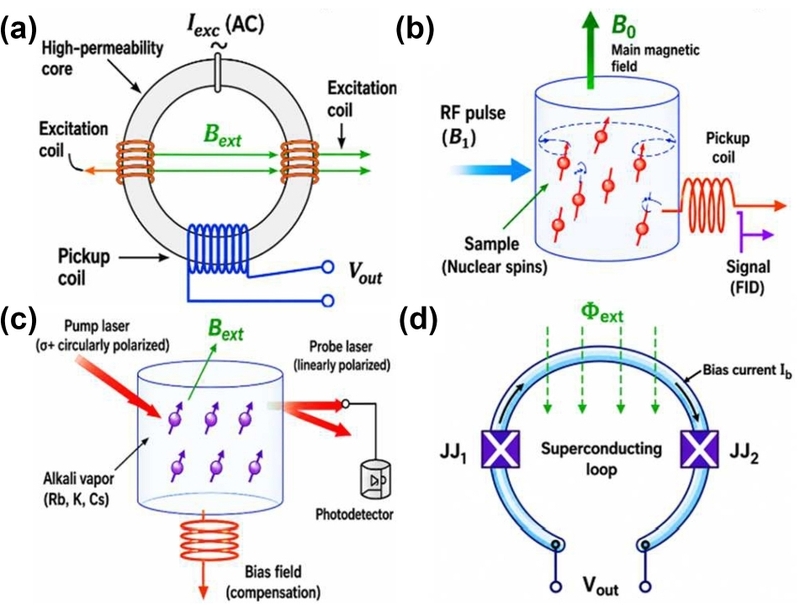
Schematic diagram of working mechanisms of different magnetometers. (a) Fluxgate magnetometer, (b) NMR Magnetometer, (c) Optically Pumped Magnetometer, and (d) SQUID. In the figure, B - magnetic field, JJ - Josephson’s junction and FID - free induction decay.
The performance of ME composites is defined by the ME voltage coefficient, denoted as αME, which indicates the efficiency of converting a magnetic field into an electric signal. In recent decades, the strong ME coupling in piezoelectric magnetostrictive 2-2 laminated composites has led to rapid growth in research and development on ME materials, devices, and their potential applications [1,21]. The magnetic field sensor based on ME composites was first introduced at the 4th international conference of Magnetoelectric Interaction Phenomena in Crystals (MEIPIC-4) in 2001. The presented ME sensor was fabricated using modified Pb(Zr,Ti)O3 (PZT) with nickel-zinc ferrite particulate composites, exhibiting a sensitivity of 0.06 mV/Oe [22]. The successive improvement in device design (specifically the connectivity of constituent materials), materials selection, and composite bonding techniques led to a significant enhancement in ME voltage coefficients and sensor sensitivity, ultimately reaching the fT (10-15 Tesla) range at room temperature, a performance level comparable to high cost cryogenic systems like SQUID [20,23].
Piezoelectric materials such as lead-based Pb(Mg1/3Nb2/3)O3-PbTiO3 (PMN-PT), PZT, and lead-free lithium niobite (LiNbO3), coupled with magnetostrictive materials such as Nickel, Metglas (amorphous FeSiB alloy), Terfenol-D and Galfenol, are commonly employed owing to their strong ME effect [24-29]. Comprehensive review articles cover these ME materials from fundamental physics to their device applications in various fields [1,23,30]. This review article focuses on ME materials and MME energy conversion mechanisms with particular emphasis on recently reported ME materials and MME based magnetic field sensors. Furthermore, practical applications of magnetic sensors in high temperature sensing and current sensing are discussed. Finally, the perspectives and future outlooks are provided to conclude the article.
2. ME AND MME CONVERSION
2.1 ME Materials
Multiferroic materials are defined as systems exhibiting at least two primary order parameters among ferromagnetism, ferroelectricity, and ferroelasticity. These materials hold great promise for multifunctional device applications across numerous fields. ME materials are based on the coupling between ferroelectric and ferromagnetic orderings in single phase or composite systems. Magnetic and electric ordering can be polarized as linear or non-linear functions in response to applied external fields, as shown in Fig. 2. The direct ME (DME) effect refers to a change in electric polarization (P) induced by an applied magnetic field (H), whereas the converse ME (CME) effect refers to a change in the magnetization (M) induced by an applied electric field (E). In ME materials, the electric polarization and magnetization can be mutually controlled by applying the respective conjugate field [31,32].
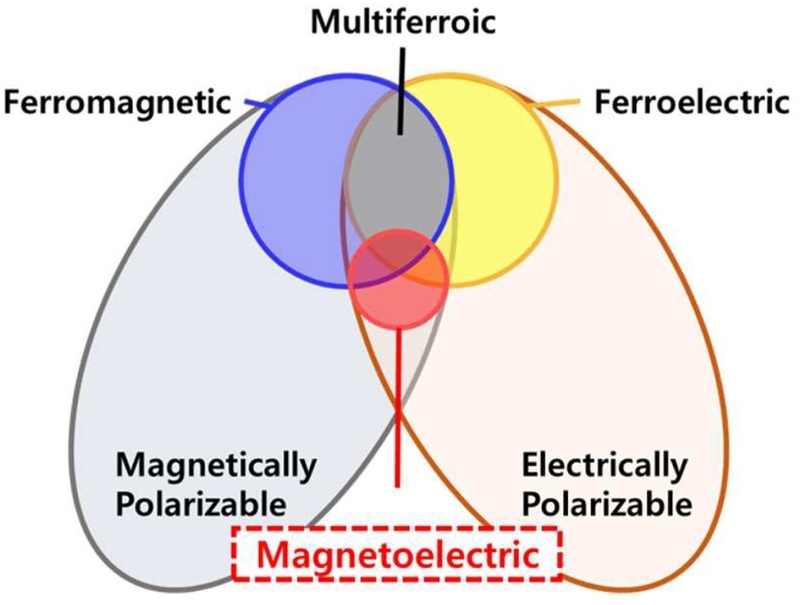
Multiferroic and magnetoelectric materials relation.
ME materials can be classified into a few categories based on their structural connectivity and performance. Initially, single phase ME materials, such as Cr2O3, BiFeO3 etc., began to attract attention in the early 1960s due to the scientific interest in the coexistence of magnetic and electric orderings in a single phase system. However, their low Curie temperature and extremely weak ME voltage coefficients led to the development of particulate ME composites and nanocomposites starting in the early 1970s [33-37]. These composites were prepared by simply mixing ferromagnetic and ferroelectric particles to form a 0-3 connectivity. However, their random distribution resulted in inefficient strain/stress transfer. Furthermore, high leakage current due to the low electrical resistivity of the magnetic particles led to low ME voltage coefficients in systems such as (NiZnCu)Fe2O4-Pb(Zr,Ti)O3 (NFO-PZT) and CoFe2O3-BaTiO3 (CFO-BT) [17,38-40]. Nanocomposites exhibited relatively improved ME coupling properties, due to the dense packing of nanoscale particles and effectiveness in stress transfer, and the incorporation of polymer matrices enabled flexible ME composites. A breakthrough in ME materials occurred with the introduction of 2-2 laminated ME composites in the early 21st century. Specifically, a laminated Terfenol-D/PZT/Terfenol-D ME composite introduced in 2001 achieved an unprecedented ME voltage coefficient reaching nearly 5 V/cm·Oe, paving the path for future high-performance ME composites [19,23,38]. The pursuit of emerging ME systems with excellent ME voltage coefficients and miniaturization capabilities continues to expand for biomedical and environmental sensing applications. This section summarizes some of the recently reported single phase and composite ME systems as tabulated in Table. 2.
Recently reported magnetoelectric materials and their ME coefficients.
As is well established and known, in single phase materials, intrinsic symmetry coupling is always weak at atmospheric temperature, causing the low electric and magnetic ordering, resulting in giving the weakest ME coupling coefficients [41-43]. To fabricate the flexible ME sensor with the improved magnetic-mechanical interaction, the ferromagnetic shape memory alloy (FSMA; Ni-Mn-In) was introduced with +q11 (piezomagnetic coefficient) attached over the flexible Ni foil with -q11, achieving the expected qij grading as reported by Diksha et al. These structures create a controlled bending movement and cancel out asymmetric bending related strain in the structure. Due to the interaction strengthening between mechanical and magnetic layers, the overall magnetoelectric voltage coefficient was improved [47]. The fabricated Ni/FSMA/PMN-PT ME heterostructure benefits from the q-grading, resulting in the improved ME output of 3.7 V/Oe∙cm, with the enhanced magnetic field sensitivity of ~ 0.74 mV/Oe, over the non-graded Ni/PMN-PT with 1 V/Oe∙cm.
2.2 Magneto-Mechano- Electric (MME) Conversion
A laminated ME composite consists of physically separated but laminate bonded layers of the ferromagnetic (magnetostrictive) and ferroelectric (piezoelectric) materials, showing significantly higher ME voltage coefficients than pure single phase systems [30]. Although composite-type ME materials exhibit higher ME voltage coefficients and room-temperature viability compared to single-phase materials, superior properties are often required for integration into various practical devices. A decade back, Ryu et al. proposed a magneto-mechano-electric (MME) energy conversion technology based on ME composites that dramatically enhances ME coupling performance under resonant conditions [51,52]. By applying a deformation torque alongside the magnetostrictive strain, induced by magnetic field oscillation at the electromechanical resonance frequency during the implementation of simple ME materials into device architectures, this approach transfers significantly amplified stress to the piezoelectric phase, thereby generating an extraordinarily high electrical output. In addition, the magnitude of the output voltage from the MME device is linearly proportional to the strength of the applied magnetic field. Owing to these outstanding characteristics, extensive research is actively underway for applications in magnetic field sensors and magnetic energy harvesting technologies [30,51].
The mechanism underlying the superior performance of laminated ME composites can be discussed based on the MME energy conversion. Under an external magnetic field, the magnetostrictive (or magnetic) constituent materials in the ME composite undergo mechanical deformation or vibration. This strain/stress is transferred to the elastically coupled piezoelectric (or triboelectric) constituent material, resulting in the generation of the electric output and functioning as an MME energy conversion unit. The lab scale measurement setup used for the MME energy conversion is schematically illustrated in Fig. 3. The function generator aids in creating the signal with wave shape and frequency control. This low-power signal is then amplified by a bipolar amplifier, which drives the Helmholtz coil to create the stable magnetic field. The magnetostrictive material undergoes the bending and vibration, which transfer the mechanical stress to the attached piezoelectric layer, thus generating the electrical output through the piezoelectric effect. In real time, the stray magnetic field acts as the source to impact on the magnetostrictive layer; the created mechanical stress transfers to the piezoelectric layer, to generate the electrical output, which thus acts as a sensor signal. In this way, the MME can work as an energy conversion unit, i.e., a magnetic energy harvester and a magnetic field sensor.
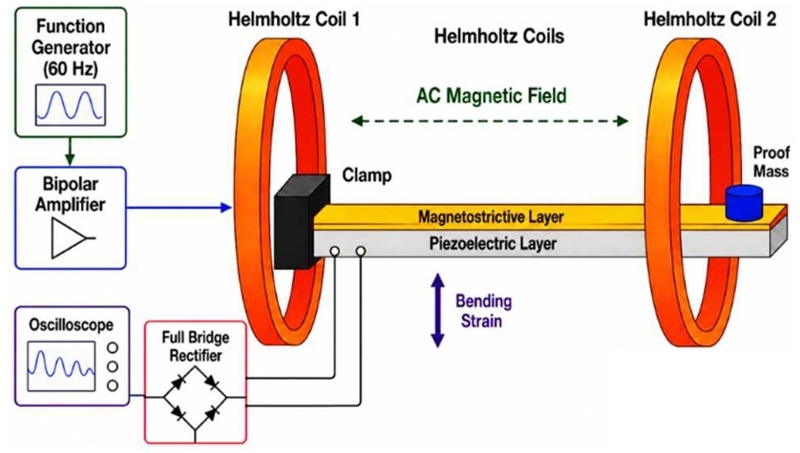
Schematic diagram of the typical MME energy conversion measurement setup. Helmholtz coils in the drawing are employed strictly as a characterization tool to apply a precise magnetic field to MME devices and are not incorporated into practical device implementations. Upon applying an external magnetic field, the voltage generated across the piezoelectric material-induced by both the ME effect and the torque from the magnetic proof mass-is measured, with the magnitude of the output voltage being linearly proportional to the strength of the applied magnetic field.
Dong et al. reported notable works on MME energy conversion and its output enhancements over the years. The MME coupling equivalent circuit was reported in 2014, providing a basis for the MME composite cantilever for low frequency ME coupling [53]. In 2014, piezoelectric macro fiber composite (MFC)/nickel laminates were used in fabrication of the MME and delivered the electrical output of 20 V with the power of 6 µW [54], and in 10 years, by 2024 the peak output power reached 98.5 mW by fabricating the novel T-shaped MME energy harvesters, which is 262% higher than the state of the art results at the time [55]. The magnetoelectric flux gate sensor (MEFGS), which was reported in 2018, experimentally achieved the high ME coupling coefficient of 5700 V/cm∙Oe, paving the way for practical applications in a real environment [56]. To power the IoT devices, the MME device size is also required to be smaller for effective implementation and better adaptability. However, the size reduction of MME devices faces difficulties with the lowered MME coupling efficiency of a cantilever setup with reduced space. The optimization strategy introduced to improve the output power density involves modifying the relative position of the neutral axis, and flexural rigidity of piezoelectric phases. This change achieved the power density of 0.73 mW/cm3∙Oe2 at a low magnetic field of 1 Oe at 50 Hz with the device volume of 0.97 cm3 [57]. Another strategy of introducing nonlinear dynamics, to widen and flatten the potential well, enhanced power density to 0.92 mW/cm3∙Oe2 with the device size (0.928 cm3) matching the button cell batteries, under the weak magnetic field of 1 Oe at 50 Hz [58] initiating the way for self-powered wireless sensor networks (WSN).
3. MAGNETIC SENSORS WITH ME COMPOSITES
The two kinds of magnetic sensors are discussed here, based on magnetoelectric materials. The first one is the magnetoelectric (ME) sensors and the other one is Magneto-Mechano-Electric (MME) Sensors. The ME sensors are made of single phase ME materials or laminated ME composites consisting of magnetostrictive and piezoelectric layers. Upon interaction with the magnetic field, the magnetostrictive layer containing magnetic domains reorients and exerts strain on the piezoelectric layer, generating the sensing voltage. Even though the resonance frequency operation of ME sensors will boost their sensitivity, the ME composites’ high resonance, in the range of 10 kHz to 1 MHz depending on the device geometry and vibration mode, led to a huge mismatch to the practical magnetic sensing application requirements.
On the other hand, MME sensors are generally fabricated using a cantilever beam with a magnetic tip mass. Tuning the geometry and reducing stiffness helps lower the resonance frequency to the sub-1 kHz range, making them suitable for low-frequency magnetic field sensing and harvesting applications, such as electric power grid monitoring (50/60 Hz). In MME sensors, the presence of magnetostrictive material helps us to improve performance and sensitivity by acting as an additional mechanical amplification mode, but it is discretionary. Upon application of the magnetic field, the tip mass working as a mechanical lever creates the visibly high deformation of the cantilever beam due to the magnetic torque acting on its magnetic moment, creating and applying the huge strain on the piezoelectric layer, delivering the enhanced voltage output and high sensitivity. The differences between the ME and MME sensors in terms of device structure, mechanical amplification mode, impact of torque, working mechanism, pros and cons were tabulated and presented in Table 3.
Comparison table between the ME and MME sensors with their pros and cons.
3.1 ME sensors
The operation of ME sensors is simple and straightforward. An external magnetic field induces deformation in the magnetostrictive layers, which transfers mechanical stress to the piezoelectric layers. This generates an output voltage signal as the ME sensor output that is directly proportional to the applied magnetic field strength, even without any mechanical resonance optimization. Research articles on ME sensors published recently are tabulated and presented in Table. 4.
Recently reported ME and MME sensors and their sensing properties (* NEB: Noise Equivalent Bandwidth)
To improve the sensitivity of ME sensors, numerous approaches have been implemented, including modifications to the ME composite lamination process and alterations to the crystalline structure of the magnetostrictive or piezoelectric layers. The low ME voltage coefficient at bending vibration frequencies has long been viewed as a major barrier for the ME sensors operating at low frequencies. To overcome these limitations, Zhang et al. proposed a vacuum packing technique [59]. By applying vacuum packaging to PVDF polymer/Metglas laminated ME composites, the structural stiffness was reduced, which shifted the dominant vibration mode from longitudinal to bending. This modification lowered both the resonance frequency and the required DC bias field of the composites, leading to a significant improvement in αME, up to ~493.7 V/cm∙Oe, approximately 2.5 times higher than that of conventionally packaged ones. Furthermore, this treatment improved the sensitivity to 2522.33 mV/Oe at 10.59 kHz with excellent linearity (R2 = 0.99). The vacuum-packed samples also exhibited an impressive limit of detection (LoD) of 0.4 nT for an AC magnetic field and 2.4 nT for a DC magnetic field. In summary, this simple packaging technique effectively reduces structural stiffness, enhances the ME voltage coefficient, and lowers both the resonance frequency and DC bias field strength, providing a promising route toward ultra-sensitive magnetic field sensors. Crystallization of the magnetostrictive layer is another approach, to improve the ME coupling coefficients. The FeNiBSi annealing treatment at a high temperature of 450°C aids in creating the dual architecture with α-Fe nanocrystals, embedded on the surface of an amorphous matrix. The simple annealing process ends up improving the ME coefficient to 41.5 V/cm∙Oe, which is 4 times higher compared to the untreated one. On the application of magnetic anomaly detection, it increased 25-fold compared to the non-annealed sample, denoting the importance of the crystalline properties of the magnetostrictive layer, to achieve a high magnetoelectric coefficient [70]. Similarly, heat-treated Metglas ribbons with Mn-doped PMN-PT resulted in the ME coefficient of 4.26 × 10⁴ V/cm∙Oe at a resonance of 16.2 kHz. The performance improvement was ascribed to the enhanced nano crystallization of the Metglas, resulting in the higher piezomagnetic coefficient, high density of induced magnetic flux, and low loss [61].
To detect the low frequency magnetic field, researchers implemented frequency and amplitude modulation [62,63]. The resonance enhanced magnetoelectric coupling effect and high sensitivity for the magnetic field detection make the ME sensors very popular. However, the sensitivity drops rapidly away from the resonance frequency, making it difficult to utilize them for a wide range of frequencies. Numerous reports are there on changing the material combination and device structure modification, to increase the ME sensors’ low frequency sensitivity. Sun et al. reported the frequency conversion method, by characterizing the amplitude and frequency of the magnetic or electric modulation field and studied its effect on the sensing performance. The standard ME bulk composite sensor made by bonding the PZT-5H and Metglas by epoxy resin was studied by the electric frequency conversion (EFC) techniques and magnetic frequency conversion (MFC), to show the connection between low frequency magnetic field detection and its gain of mechanical resonance. The MFC and EFC approaches delivered ~ 2 orders of magnitude of improvement in both sensitivity and noise density at low frequency. The limit of detection (LOD) at 10 Hz was reported as 200 pT with a magnetic flux concentrator (MFC) and 340 pT with an electric flux concentrator (EFC), demonstrating robust capabilities for weak magnetic field detection in the low frequency range from 1 to 100 Hz. Sun et al. utilized a Metglas/quartz/Metglas laminated ME sensor to evaluate the frequency modulation technique, successfully detecting low-frequency magnetic field signals and reaching an LOD of 10 pT at 1 Hz [43,44]. Current detection represents another promising application of ME composites. Qiao et al. reported a Metglas/Ni/PZT composite for weak current sensing, achieving a detection limit of 0.43 µA with a sensitivity of 111 mV/A. This weak current sensing capability was enabled by matching the second-order resonant frequency of the cantilever-based device with the characteristic signal frequency [49]. For high-current applications, a Terfenol-D/PZT/Terfenol-D laminate was reported for 8/20 μs lightning current detection, delivering a sensitivity of 6.8 mV/A across a current range of 500 A to 9 kA [46]. Similarly, Lu et al. developed a FeGa/PZT ME composite for high-speed lightning current detection, achieving a sensitivity of 1.36 mV/A in the 500 A to 9 kA range [48]. By fabricating a split-core ME sensor, Lu et al. further achieved a sensitivity of 52.79 mV/A over a current range of 10 A to 1000 A [47]. These recent studies demonstrate the strong potential and suitability of ME sensors for high-speed current sensing across a wide dynamic range [45].
The impact of the piezoelectric vibration mode on the coupling coefficients and sensitivity of ME composites was studied by fabricating composites with PMN-PZT single crystals and Ni foils. Their ME properties were evaluated in the 31, 32, and 36 modes, which depend on the crystal orientation of the PMN-PZT single crystal. At resonance conditions, the ME properties for all three modes were similar, but in the off resonance there was a noticeable change in sensitivity, with 2 nT in the 36 mode and in the other modes it was 5 nT. The detection limit was further reduced to 2 pT by fabricating the laminated Metglas/36-mode PMN-PZT single crystal composite at resonance conditions of 103 kHz with the ME coefficient of 140 V/cm·Oe. These works establish the importance of piezoelectric materials’ vibration mode to achieve better sensitivity and ME coupling coefficients in the laminated ME composites[73,74].
The effect of the interfacial bonding layer was systematically investigated by evaluating the impact of various adhesive interlayers on the ME coupling coefficients in ME sensors. Laminated ME composites were fabricated using Mn-doped Gen-III PMN–PZT single crystals as the piezoelectric layer and Ni sheets as the magnetostrictive layer, bonded with four distinct epoxy adhesives: 3M DP460 (3M Scotch-Weld), Stycast 2850FT (Henkel Loctite), Duralco 4461 (Cotronics Corporation), and EPO-TEK 301 (Epoxy Technology). Among these, Duralco 4461 exhibited the lowest viscosity, yielding a thin interfacial bond-line thickness of 18.8 µm. Combined with a moderate Young's modulus, this thin enhanced layer enabled the composite to achieve the highest off-resonance ME coefficient of 0.72 V/cm·Oe and a resonant ME coefficient of 60 V/cm·Oe, outperforming the other three epoxy adhesives [56]. The critical role of the interfacial bonding layer was further clarified by recent work on PMN–PZT/Ni composites prepared via an adhesive-free approach, in which Ni was directly electroplated onto PMN–PZT single crystals. The off-resonance ME coefficient for this direct-electroplated composite was reported to be approximately 6.9 V/cm·Oe, nearly ten times higher than that of the Duralco 4461 epoxy-bonded composite. At resonance, the adhesive-free ME laminate delivered an exceptionally high ME coefficient of 1419 V/cm·Oe, representing a 23-fold increase compared to the epoxy-bonded composite, as shown in Fig. 4. Notably, Stycast 2850FT exhibited a lower ME coefficient despite its high Young's modulus, establishing that the thickness of the interfacial epoxy film exerts a far greater influence on ME coupling coefficients than the Young's modulus of the adhesive. Furthermore, the remarkably high resonant ME coefficient of 1419 V/cm·Oe demonstrates that the epoxy-free sample produces a substantial voltage variation with respect to a unit magnetic field, underscoring its high sensitivity even to ultralow magnetic fields [54]. This capability was confirmed by determining the minimum detectable AC magnetic field at the anti-resonance frequency. Electroplated laminates fabricated with electroplating durations of 1, 2, 4, and 6 h exhibited detection limits of 10, 8.3, 7.6, and 6.3 pT, respectively (Fig. 5). The noise density spectrum measured over a broad frequency range remained in the order of 10-13 to 10-11 T/√Hz at the anti-resonance frequency, indicating that these low detection limits are stable and governed by the intrinsic noise floor of the device. Consequently, these findings clearly demonstrate that epoxy-free, direct-bonding strategies are superior for realizing high-performance, ultralow-field ME sensors.
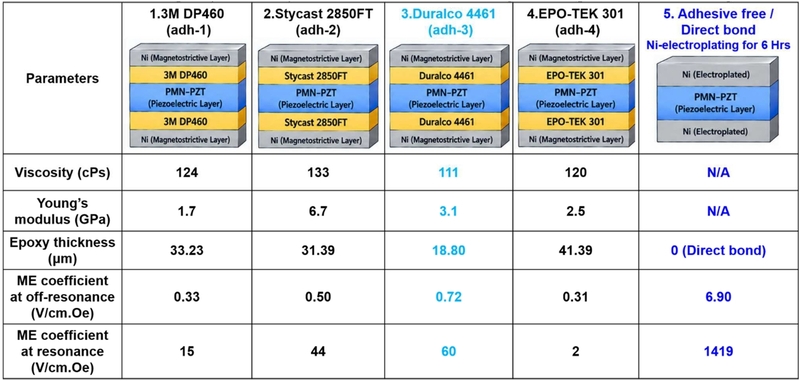
Schematic diagram illustrating the effect of Viscosity and Young’s modulus on the adhesive thickness, and its impact on the ME coupling coefficient.
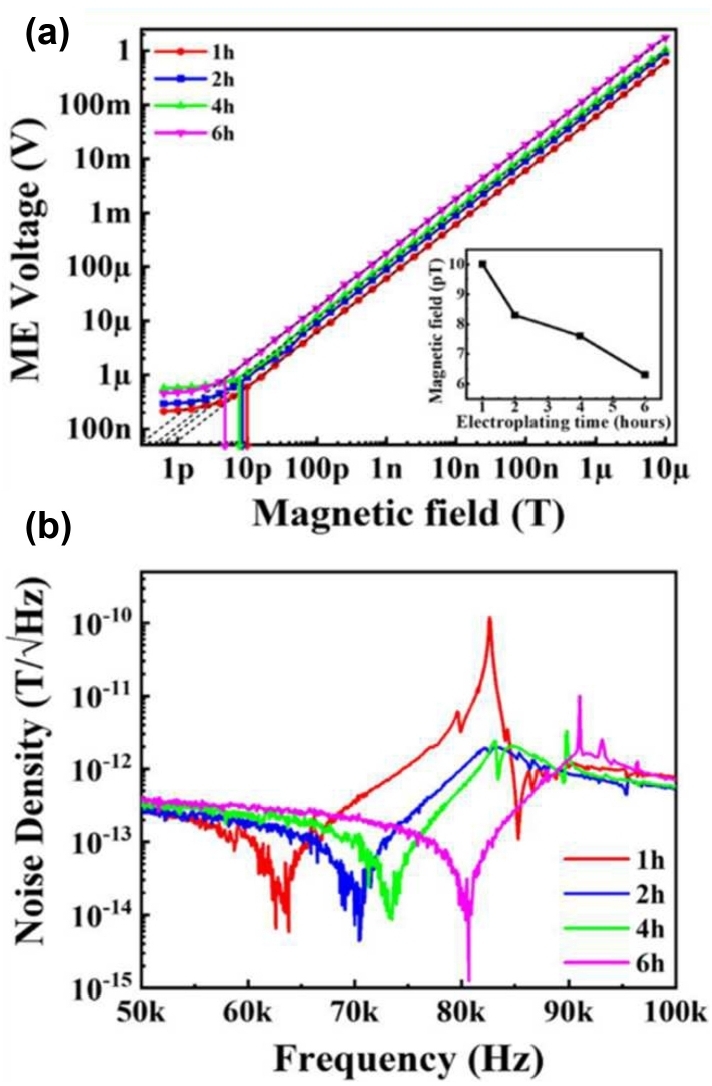
Magnetic field detection performance of electroplated Ni/PMN-PZT/Ni laminates: (a) induced ME voltage as a function of AC magnetic field amplitude at the anti-resonance frequency, used to determine the magnetic field detection limit for samples electroplated for 1, 2, 4, and 6 h; (b) corresponding noise density spectra measured over a broad frequency range, showing the intrinsic noise characteristics of the laminates. Adapted from Ref. [49]
ME sensors are increasingly deployed in industrial environments to detect weak magnetic field under high-temperature conditions. Consequently, maintaining stable sensor performance at elevated operating temperatures is essential. Yuan et al. reported a BS–PT ceramics/Terfenol-D alloy composite evaluated across a broad temperature range, which exhibited an ME coefficient of 2.008 V/cm·Oe at 20°C and maintained 0.906 V/cm·Oe at 350°C. The sensor achieved a magnetic field detection limit of 42 nT throughout the 20–350°C range, indicating its capability to detect weak magnetic fields under harsh conditions [55]. Similarly, Zhao et al. reported a flexible ME sensor based on PZT/Metglas operating over a temperature range of 20–350°C [54]. The device demonstrated an ME coefficient of 104 V/cm·Oe at 25°C, which dropped to 39.7 V/cm·Oe at 330°C, while maintaining a detection accuracy of approximately 0.3 nT, highlighting its strong potential for harsh-environment sensing applications. Beyond direct magnetic field detection, the capability of ME sensors to serve as a unified platform for monitoring multiple parameters, such as current and temperature, further enhances their value for multifunctional device applications.
3.2 MME Sensors
Although MME devices have drawn significant attention due to their higher energy conversion efficiency compared to simple planar ME composite structures, they also hold immense potential for magnetic sensor applications. Although research in this area remains limited, future investigations into their application as sensor devices are expected to expand rapidly. Herein, we focus exclusively on the recent research findings on magnetic sensors utilizing MME structures reported by Mahesh et al. [15]. The resonant condition-based MME energy conversion sensors deliver huge sensitivity in general. To improve ME sensitivity and lower the LoD, Mahesh et al. implemented a flash photon annealing (FPA) treatment on an amorphous Metglas (FeBSi) alloy. As illustrated in Fig. 6, the high-temperature, short-duration annealing process tailored the magnetostrictive and mechanical properties of Metglas without causing severe structural damage. The ultra-fast flash annealing, which lasted for only 300 µs on the amorphous Metglas, induced partial nanocrystallization within the amorphous Metglas surface. This structural modification enhanced magnetic flux density, improved the soft magnetic properties, and boosted the mechanical quality factor (Qm) of Metglas without inducing brittleness. Consequently, these property improvements led to a 47% increment of the αME under resonance conditions and a 52% increment under off-resonance conditions for the fabricated Metglas/Mn-PMN-PZT SFC composites. Furthermore, the proposed FPA treatment improved the LOD by an order of magnitude (from 5 pT to 0.5 pT), demonstrating a viable strategy for designing magnetic sensors capable of detecting extremely low frequency magnetic fields. The sensitivity of an ME sensor majorly depends on the intrinsic properties of the constituent layers and their interfacial bonding.
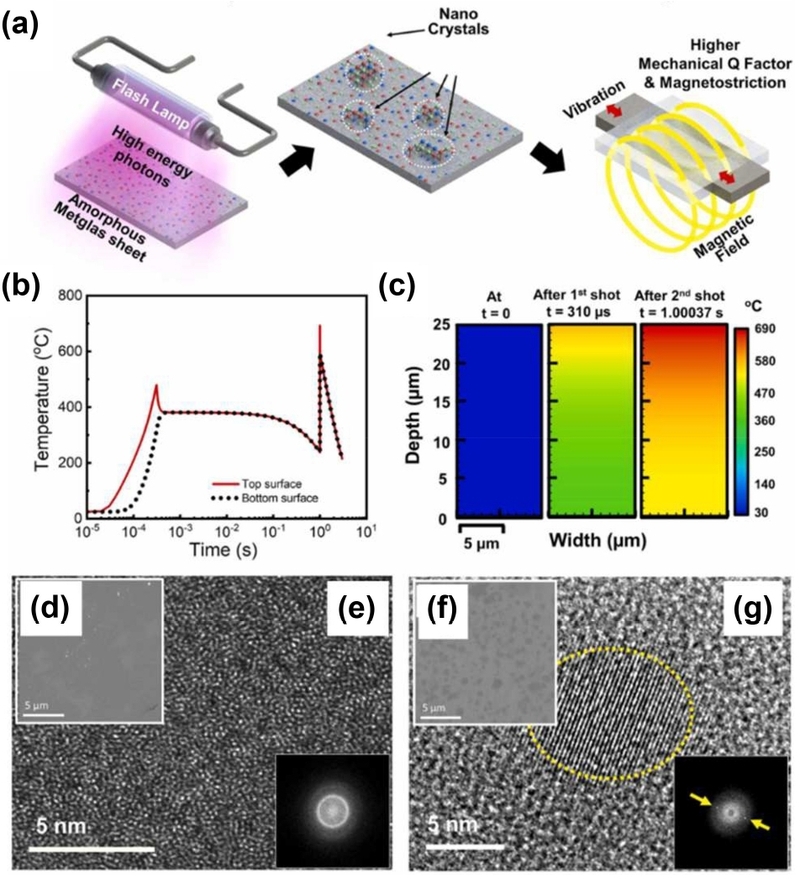
Schematic illustration of the FPA concept and the FPA effect on material properties. (a) Schematic illustration of flash photon annealing induced Metglas nanocrystallization and property enhancement in nanocrystalline Metglas. (b) Numerically estimated temperature profile and (c) distribution contours in the 2-D domain of the Metglas during the various stages of FPA annealing. Microstructural features of pristine Metglas [(d) and (e)] and FPA Metglas [(f) and (g)]. (e) and (g) present the HRTEM images of the pristine Metglas and FPA Metglas respectively, whereas the top insets and bottom insets represent the corresponding SEM images and FFT patterns, respectively. Adapted from Ref. [15].
4. PERSPECTIVES
A. Adhesive layers, thermal mismatch:
In laminated magnetoelectric (ME) composites, the piezomagnetic strain generated by the magnetostrictive layer must be effectively transferred to the piezoelectric layer to maximize energy conversion and electrical output. However, the organic epoxy bonding layer introduces energy transfer loss and thermal expansion mismatch, which degrades overall performance and dampens mechanical stress transfer. Despite these recent findings, many research studies still rely on various epoxy adhesives for device fabrication rather than adopting epoxy-free, direct-bonding approaches. Consequently, interfacial coupling efficiency remains one of the least investigated aspects among parameter optimization strategies in recent literature.
B. Lead-free materials:
Another critical insight from recent studies is that most reported ME composites remain heavily reliant on lead-based materials. Although lead-free alternatives currently exhibit relatively lower piezoelectric performance, greater research efforts should be directed toward developing lead-free ME composites. Given the toxicity, carcinogenicity, and increasingly stringent global environmental regulations surrounding lead, exploring promising lead-free compositions near the morphotropic phase boundary (MPB) is crucial for realizing high-performance, eco-friendly ME devices.
C. Exploring the alternative piezoelectric materials:
The emergence of high piezoelectric performance in newly developed high-entropy systems (HES) and hybrid organic-inorganic perovskites (HOIPs) holds great promise for next-generation magnetoelectric (ME) materials. For instance, the KNN-based high-entropy system KNNS–BNKZ––AS(AgSbO3) exhibits an outstanding piezoelectric coefficient d33 of ~600 pC/N. Furthermore, HOIP-based lead-free solid solutions engineered near a morphotropic phase boundary (MPB), (TMFM)xTMCM1-xCdCl3, reportedly deliver an exceptionally high d33 of 1540 pC/N. These high-performance lead-free systems pave the way for developing advanced ME composites suited for high-sensitivity ME sensors and MME energy conversion devices.
D. Design of sensor and LOD:
From a noise-reduction and signal-conditioning perspective, future research on ME and MME magnetic sensors should prioritize lowering the overall equivalent magnetic noise density (Ne) through integrated circuit-level strategies to push the LOD into the femtotesla (fT) regime. Since devices utilizing MME structures can also generate voltage from external mechanical vibrations, a vibration-insensitive device design is essential for effective noise mitigation.
Because low-frequency 1/f flicker noise and dielectric loss noise severely impair sensor resolution in DC to sub-hertz applications, implementing advanced frequency up-conversion and active modulation techniques, such as magnetic or mechanical modulation that shifts low-frequency target signals to the low-noise, high-Q resonance band, is essential. Additionally, developing custom ultra-low-noise front-end charge amplifiers (ASIC/Readout ICs) with precise impedance matching, dynamic offset cancellation, and adaptive filtering will be critical. The seamless co-design of low-loss magnetoelectric elements and dedicated, ultra-low-noise readout electronics represents a vital pathway toward realizing practical, high-precision biomagnetic sensing systems.
5. CONCLUSIONS
This review surveys recently reported magnetoelectric (ME) materials and their coupling coefficients for sensing applications, focusing on both direct ME sensors and magneto-mechano-electric (MME) energy-harvesting-based sensors. Specifically, it summarizes key strategies implemented to enhance the magnetoelectric voltage coefficient. These approaches include tailoring piezoelectric properties via crystallographically oriented single crystals, macro-fiber composites (MFCs), and single-crystal fiber composites; modifying cantilever structural geometries; and optimizing bonding interlayers or applying direct-deposition/electroplating techniques. By synergizing highly oriented piezoelectric media, optimized device geometries, low-loss bonding interlayers, and highly crystalline magnetostrictive layers, high ME coupling coefficients can be achieved in both direct and converse modes. Ultimately, these strategies significantly boost magnetic field sensitivity, paving the way for high-performance ME materials in multifunctional device applications.
Acknowledgments
The authors acknowledge the support from the National Research Foundation of Korea (RS-2024-00448865) and the Technology Innovation Development (R&D) Program for Small and Medium-sized Enterprises (RS-2025-25465526).
REFERENCES
-
B. Luo, A. Will-Cole, C. Dong, Y. He, X. Liu, H. Lin, et al., Magnetoelectric microelectromechanical and nanoelectromechanical systems for the IoT, Nat. Rev. Electr. Eng. 1 (2024) 317–334.
[https://doi.org/10.1038/s44287-024-00044-7]

-
N.P. Maria Joseph Raj, A. KS, G. Khandelwal, S.-J. Kim, Method for fabricating highly crystalline polyvinylidene fluoride for piezoelectric energy-harvesting and vibration sensor applications, Sustain. Energy Fuels 6 (2022) 674–681.
[https://doi.org/10.1039/D1SE01139A]
-
N.P.M.J. Raj, N.R. Alluri, G. Khandelwal, S.-J. Kim, Ferroelectric flexible composite films based on morphotropic phase boundary for self-powered multisensors, Chem. Eng. J. 414 (2021) 128840.
[https://doi.org/10.1016/j.cej.2021.128840]
- M.-H. Kang, Performance analysis of an anisotropic magnetoresistive sensor-based vehicle detector, Trans. Korean Inst. Electr. Eng. 58 (2009) 598–604.
-
A.K. Das, P. Mishra, S.S. Biswal, A. Tripathy, S. Bhuyan, Processing and Development of Lead Free Bi(Ni₂/₃Nb₁/₃)O₃ Ferroelectric Material for Thermal Sensing Electronic Device, Trans. Electr. Electron. Mater. 27 (2026) 156–164.
[https://doi.org/10.1007/s42341-025-00646-4]
-
V. Pasku, A. De Angelis, G. De Angelis, D.D. Arumugam, M. Dionigi, P. Carbone, et al., Magnetic field-based positioning systems, IEEE Commun. Surv. Tutor. 19 (2017) 2003–2017.
[https://doi.org/10.1109/COMST.2017.2684087]
-
H. Auster, K. Glassmeier, W. Magnes, O. Aydogar, W. Baumjohann, D. Constantinescu, et al., The THEMIS fluxgate magnetometer, Space Sci. Rev. 141 (2008) 235–264.
[https://doi.org/10.1007/s11214-008-9365-9]
-
B. Ando, A. Ascia, S. Baglio, A. Bulsara, V. In, N. Pitrone, et al., Residence times difference fluxgate magnetometer for magnetic biosensing, Proceedings of the AIP Conference, 2008, vol. 1025, pp. 139–149.
[https://doi.org/10.1063/1.2956810]
-
I. Savukov, S. Seltzer, M. Romalis, Detection of NMR signals with a radio-frequency atomic magnetometer, J. Magn. Reson. 185 (2007) 214–220.
[https://doi.org/10.1016/j.jmr.2006.12.012]
-
R. Prigl, U. Haeberlen, K. Jungmann, G. Zu Putlitz, P. Von Walter, A high precision magnetometer based on pulsed NMR, Nucl. Instrum. Methods Phys. Res. A 374 (1996) 118–126.
[https://doi.org/10.1016/0168-9002(96)37493-7]
-
K. Kim, S. Begus, H. Xia, S.-K. Lee, V. Jazbinsek, Z. Trontelj, et al., Multi-channel atomic magnetometer for magnetoencephalography: A configuration study, NeuroImage 89 (2014) 143–151.
[https://doi.org/10.1016/j.neuroimage.2013.10.040]
-
E. Alexandrov, Recent progress in optically pumped magnetometers, Phys. Scr. 2003 (2003) 27–30.
[https://doi.org/10.1238/Physica.Topical.105a00027]
-
T. Ryhänen, H. Seppä, R. Ilmoniemi, J. Knuutila, SQUID magnetometers for low-frequency applications, J. Low Temp. Phys. 76 (1989) 287–386.
[https://doi.org/10.1007/BF00681735]
-
J. Clarke, R.H. Koch, The impact of high-temperature superconductivity on SQUID magnetometers, Science 242 (1988) 217–223.
[https://doi.org/10.1126/science.242.4876.217]
-
M. Peddigari, K. Woo, S.-D. Kim, M.S. Kwak, J.W. Jeong, J.-H. Kang, et al., Ultra-magnetic field sensitive magnetoelectric composite with sub-pT detection limit at low frequency enabled by flash photon annealing, Nano Energy 90 (2021) 106598.
[https://doi.org/10.1016/j.nanoen.2021.106598]
-
D.R. Patil, S.H. Park, S. Patil, A. Kumar, J. Ryu, Enhanced magnetoelectric coupling in stretch-induced shear mode magnetoelectric composites, J. Korean Ceram. Soc. 58 (2021) 700–705.
[https://doi.org/10.1007/s43207-021-00144-2]
-
A. Van Run, D. Terrell, J. Scholing, An in situ grown eutectic magnetoelectric composite material: part 2 physical properties, J. Mater. Sci. 9 (1974) 1710–1714.
[https://doi.org/10.1007/BF00540771]
- J. Van Suchtelen, Product properties: a new application of composite materials, Philips Res. Rep. 27 (1972) 28–37.
-
J. Ryu, S. Priya, K. Uchino, H.-E. Kim, Magnetoelectric effect in composites of magnetostrictive and piezoelectric materials, J. Electroceram. 8 (2002) 107–119.
[https://doi.org/10.1023/A:1020599728432]
-
J. Ryu, A.V. Carazo, K. Uchino, H.-E. Kim, Magnetoelectric properties in piezoelectric and magnetostrictive laminate composites, Jpn. J. Appl. Phys. 40 (2001) 4948.
[https://doi.org/10.1143/JJAP.40.4948]
-
P. Martins, S. Lanceros-Méndez, Polymer-based magnetoelectric materials, Adv. Funct. Mater. 23 (2013) 3371–3385.
[https://doi.org/10.1002/adfm.201202780]
-
M. Bichurin, R. Petrov, O. Sokolov, V. Leontiev, V. Kuts, D. Kiselev, et al., Magnetoelectric magnetic field sensors: A review, Sensors 21 (2021) 6232.
[https://doi.org/10.3390/s21186232]
-
D.R. Patil, Z. Chu, S. Dong, K.H. Kim, H. Song, D.-Y. Jeong, et al., Progress, challenges, and perspectives of magnetoelectric composites and devices based on relaxor-PT single crystals, Appl. Phys. Rev. 12 (2025) 011310.
[https://doi.org/10.1063/5.0220827]
-
D.R. Patil, S.H. Park, G.-T. Hwang, J. Ryu, Study of magnetoelectric coupling in magnetoelectric laminates fabricated using 15-mode PMN-PZT single crystals, J. Korean Ceram. Soc. 59 (2022) 322–328.
[https://doi.org/10.1007/s43207-021-00172-y]
-
E.-G. Lee, S.-J. Kim, J.-G. Lee, A Study on the Magnetoelectric Effect in Lanthanum Modified BiFeO₃−PbTiO₃ Ceramics, J. Korean Ceram. Soc. 44 (2007) 308–312.
[https://doi.org/10.4191/KCERS.2007.44.6.308]
-
N. Sonchaopri, W. Somsri, S. Chootin, N. Vittayakorn, S. Pinitsoontorn, A. Rittidech, et al., Phase formation, electric and magnetic properties of multiferroic 0.7Ba₀.₉Ca₀.₁TiO₃-0.3Ni₀.₆Zn₀.₄Fe₂O₄ composites ceramics synthesized by the solid-state combustion technique, J. Korean Ceram. Soc. 62 (2025) 208–220.
[https://doi.org/10.1007/s43207-024-00461-2]
- K.H. Shin, K.I. Arai, G.S. Gong, Smart Actuators Composed of Piezoelectric Ceramics and Highly Magnetostrictive films, Trans. Korean Inst. Electr. Eng. 49 (2000) 289–293.
-
J.-H. Ryu, S. Priya, K. Uchino, H.-E. Kim, D. Viehland, High magnetoelectric properties in 0.68Pb(Mg₁/₃Nb₂/₃)O₃-0.32PbTiO₃ single crystal and Terfenol-D laminate composites, J. Korean Ceram. Soc. 39 (2002) 813.
[https://doi.org/10.4191/KCERS.2002.39.9.813]
- D.-H. Lee, S.-H. Lee, S.-P. Nam, Y.-H. Lee, Piezoelectric Properties of lead free (Na₀.₄₄K₀.₅₂)Nb₀.₈₄O₃-Li₀.₀₄(Sb₀.₀₆Ta₀.₁)O₃ Ceramics with ZnO Addition, Trans. Korean Inst. Electr. Eng. 59 (2010) 2021–2025.
-
S. Pattipaka, J. Jeong, H. Choi, J. Ryu, G.-T. Hwang, Magneto-mechano-electric (MME) composite devices for energy harvesting and magnetic field sensing applications, Sensors 22 (2022) 5723.
[https://doi.org/10.3390/s22155723]
-
J. Gao, Z. Jiang, S. Zhang, Z. Mao, Y. Shen, Z. Chu, Review of magnetoelectric sensors, Actuators 10 (2021) 109.
[https://doi.org/10.3390/act10060109]
-
Z. Chu, M. PourhosseiniAsl, S. Dong, Review of multi-layered magnetoelectric composite materials and devices applications, J. Phys. D: Appl. Phys. 51 (2018) 243001.
[https://doi.org/10.1088/1361-6463/aac29b]
-
G. Catalan, J.F. Scott, Physics and applications of bismuth ferrite, Adv. Mater. 21 (2009) 2463–2485.
[https://doi.org/10.1002/adma.200802849]
- D. Astrov, Magnetoelectric effect in chromium oxide, Sov. Phys. JETP 13 (1961) 729–733.
-
S. Pattanayak, R. Choudhary, Effect of Rare-earth Modification on Structural, Ferroelectric and Ferromagnetic Properties of BiFeO₃ Ceramics at Room Temperature, Trans. Electr. Electron. Mater. 26 (2025) 955–966.
[https://doi.org/10.1007/s42341-025-00639-3]
-
S. Pattanayak, R. Choudhary, Development of Structural and Electrical Properties in PVDF-Bi₁₋ₓDyₓFeO₃ Ceramic Composites, Trans. Electr. Electron. Mater. 27 (2026) 825–837.
[https://doi.org/10.1007/s42341-026-00706-3]
-
S. Joshi, A. Shukla, N. Kumar, R. Choudhary, Exploring the Structure, Morphology, Dielectric, and magnetic characteristics of bismuth ferrite with Gd and Ti substitutions, Trans. Electr. Electron. Mater. 26 (2025) 874–889.
[https://doi.org/10.1007/s42341-025-00632-w]
-
S. Priya, R. Islam, S. Dong, D. Viehland, Recent advancements in magnetoelectric particulate and laminate composites, J. Electroceram. 19 (2007) 149–166.
[https://doi.org/10.1007/s10832-007-9042-5]
-
J. Van den Boomgaard, D. Terrell, R. Born, H. Giller, An in situ grown eutectic magnetoelectric composite material: Part I Composition and unidirectional solidification, J. Mater. Sci. 9 (1974) 1705–1709.
[https://doi.org/10.1007/BF00540770]
-
H.S. Ahmed, S.A. Hussen, A.M. Mohammad, Tailoring the Magnetic and Dielectric Behavior of ZCFO/BT Nanocomposite Materials: Synthesis, Characterization, and Prospects, Trans. Electr. Electron. Mater. (2026) 1–18.
[https://doi.org/10.1007/s42341-026-00723-2]
-
F.Y. Gao, X. Peng, X. Cheng, E. Viñas Boström, D.S. Kim, R.K. Jain, et al., Giant chiral magnetoelectric oscillations in a van der Waals multiferroic, Nature 632 (2024) 273–279.
[https://doi.org/10.1038/s41586-024-07678-5]
-
D. Szalbot, J.A. Bartkowska, J. Makowska, M. Chrunik, K. Osińska, M. Adamczyk-Habrajska, Dielectric Properties and Magnetoelectric Effect of Bi₇Fe₃Ti₃O₂₁ Ceramic Material Doped with Gadolinium Ions, Appl. Sci. 14 (2024) 3920.
[https://doi.org/10.3390/app14093920]
-
S. Guchhait, H. Aireddy, N.S. Kander, A.K. Das, Electric field control of magnetization in polycrystalline ZnO film, J. Appl. Phys. 134 (2023) 134102.
[https://doi.org/10.1063/5.0156392]
-
T. Usami, S. Fujii, S. Yamada, Y. Shiratsuchi, R. Nakatani, K. Hamaya, Giant magnetoelectric effect in an L2₁-ordered Co₂FeSi/Pb(Mg₁/₃Nb₂/₃)O₃-PbTiO₃ multiferroic heterostructure, Appl. Phys. Lett. 118 (2021) 142402.
[https://doi.org/10.1063/5.0044094]
-
S. Fujii, T. Usami, Y. Shiratsuchi, A.M. Kerrigan, A.M. Yatmeidhy, S. Yamada, et al., Giant converse magnetoelectric effect in a multiferroic heterostructure with polycrystalline Co2FeSi, NPG Asia Mater. 14 (2022) 43.
[https://doi.org/10.1038/s41427-022-00389-1]
-
B. He, Y. He, W. Wang, Y. Sun, S. Kong, J. Huang, et al., Strain-coupled, crystalline polymer-inorganic interfaces for efficient magnetoelectric sensing, Science 389 (2025) 623-631.
[https://doi.org/10.1126/science.adt2741]
-
D. Arora, P. Kumar, S. Singh, A. Goswami, D. Kaur, Flexible magnetoelectric sensor and nonvolatile memory based on magnetization-graded Ni/FSMA/PMN-PT multiferroic heterostructure, Appl. Phys. Lett. 122 (2023) 263501.
[https://doi.org/10.1063/5.0146498]
-
E.V. Bolotina, D. Savelev, L. Fetisov, A.V. Turutin, I.V. Kubasov, A. Temirov, et al., Significant enhancement of magnetoelectric effect in Metglas-langatate-Metglas monolithic structure through annealing, J. Phys. D: Appl. Phys. 58 (2025) 365003.
[https://doi.org/10.1088/1361-6463/adfb87]
-
R. Kim, D. Baek, B. Dursun, D. Hur, K. Nakamura, H. Song, et al., Enhancing magnetoelectric coupling in Ni/PMN-PZT/Ni laminates by Ni electroplating, Appl. Phys. Lett. 128 (2026) 032901.
[https://doi.org/10.1063/5.0308076]
-
Y. Sun, X. Zhang, S. Wu, N. Jiang, X. Zhuang, B. Yan, et al., Resonant Magnetoelectric Coupling of Fe-Si-B/Pb(Zr,Ti)O3 Laminated Composites with Surface Crystalline Layers, Sensors 23 (2023) 9622.
[https://doi.org/10.3390/s23249622]
-
J. Ryu, J.-E. Kang, Y. Zhou, S.-Y. Choi, W.-H. Yoon, D.-S. Park, et al., Ubiquitous magneto-mechano-electric generator, Energy Environ. Sci. 8 (2015) 2402-2408.
[https://doi.org/10.1039/C5EE00414D]
-
J. Kaarthik, N.P.M.J. Raj, G.-T. Hwang, W.H. Yoon, J. Ryu, J. Jang, Geometry-engineered trapezoidal cantilever MME generators: Electromechanical coupling optimization for robust magnetic energy conversion, Sens. Actuators A Phys. 406 (2026) 117881.
[https://doi.org/10.1016/j.sna.2026.117881]
-
G. Liu, S. Dong, A magneto-mechano-electric coupling equivalent circuit of piezoelectric bimorph/magnets composite cantilever, J. Appl. Phys. 115 (2014) 084112.
[https://doi.org/10.1063/1.4867177]
-
R.C. Kambale, J.-E. Kang, W.-H. Yoon, D.-S. Park, J.-J. Choi, C.-W. Ahn, et al., Magneto-mechano-electric (MME) energy harvesting properties of piezoelectric macro-fiber composite/Ni magnetoelectric generator, Energy Harvest. Syst. 1 (2014) 3-11.
[https://doi.org/10.1515/ehs-2013-0026]
-
Z. Yu, J. Yang, L. Xu, J. Chang, Z. Li, X. Yuan, et al., Giant tridimensional power responses in a T-shaped magneto-mechano-electric energy harvester, Energy Environ. Sci. 17 (2024) 1426-1435.
[https://doi.org/10.1039/D3EE03634K]
-
Z. Chu, H. Shi, X. Gao, J. Wu, S. Dong, Magnetoelectric coupling of a magnetoelectric flux gate sensor in vibration noise circumstance, AIP Adv. 8 (2018) 015203.
[https://doi.org/10.1063/1.5012061]
-
Y. Xu, X. He, X. Liang, H. Huang, J. Wu, D. Ju, et al., Multiple-coupling optimization strategy for significantly enhancing the output power density of a compact magneto-mechano-electric energy harvester, Energy Environ. Sci. 18 (2025) 8339-8351.
[https://doi.org/10.1039/D5EE01346A]
- Y. Xu, J. Wu, X. He, B. Ge, X. Liu, X. Liang, et al., Wide-Stable Dynamics Enabling Ultra-High Power Density in Compact Magneto-Mechano-Electric Energy Harvesters for Self-Powered Smart Grid Monitoring, Adv. Energy Mater. (2026) e71352.
-
X. Zhang, S. Yang, S. Fan, Y. Li, Z. Han, X. Wang, et al., Low-frequency and high-sensitivity PVDF/Metglas magnetoelectric sensor based on bending vibration mode, ACS Appl. Electron. Mater. 6 (2024) 1590-1599.
[https://doi.org/10.1021/acsaelm.3c01395]
-
H. Palneedi, D.R. Patil, S. Priya, K. Woo, J. Ye, Y.M. Woo, et al., Intense pulsed light thermal treatment of Pb(Zr,Ti)O3/metglas heterostructured films resulting in extreme magnetoelectric coupling of over 20 V cm-1 Oe-1, Adv. Mater. 35 (2023) 2303553.
[https://doi.org/10.1002/adma.202303553]
-
T. Deng, Z. Chen, W. Di, R. Chen, Y. Wang, L. Lu, et al., Significant improving magnetoelectric sensors performance based on optimized magnetoelectric composites via heat treatment, Smart Mater. Struct. 30 (2021) 085005.
[https://doi.org/10.1088/1361-665X/ac0858]
-
C. Sun, W. Yang, Y. He, C. Dong, L. Chen, Z. Chu, et al., Low-frequency magnetic field detection using magnetoelectric sensor with optimized metglas layers by frequency modulation, IEEE Sens. J. 22 (2022) 4028-4035.
[https://doi.org/10.1109/JSEN.2022.3143350]
-
X. Sun, J. Wu, X. Liang, Y. Du, Y. Xu, Y. Qu, et al., Effects of amplitude and frequency of the modulation field on the sensitivity for low-frequency magnetic field in magnetoelectric sensors, IEEE Sens. J. 23 (2023) 12695-12701.
[https://doi.org/10.1109/JSEN.2023.3268741]
-
Z. Chu, J. Cui, Y. Wang, Z. Du, M. PourhosseiniAsl, N. Li, et al., Multilayered magnetoelectric composites for precise and wide-range current sensing, Appl. Phys. Lett. 124 (2024) 252907.
[https://doi.org/10.1063/5.0217772]
-
H. Zhou, C. Xu, C. Lu, X. Jiang, Z. Zhang, J. Wang, et al., Investigation of transient magnetoelectric response of magnetostrictive/piezoelectric composite applicable for lightning current sensing, Sens. Actuators A Phys. 329 (2021) 112789.
[https://doi.org/10.1016/j.sna.2021.112789]
-
C. Lu, H. Zhou, L. Li, A. Yang, C. Xu, Z. Ou, et al., Split-core magnetoelectric current sensor and wireless current measurement application, Measurement 188 (2022) 110527.
[https://doi.org/10.1016/j.measurement.2021.110527]
-
C. Lu, H. Zhou, G. Wu, X. Xiao, Z. Zhang, J. Wang, et al., Cylindrical magnetoelectric FeGa/PZT composite for lightning current sensing applications, Smart Mater. Struct. 32 (2023) 055011.
[https://doi.org/10.1088/1361-665X/acc772]
-
J. Qiao, J. Wu, F. Fan, X. Liang, G. Wang, Y. Du, et al., Highly sensitive magnetoelectric sensor for characteristic current detection in smart grid, IEEE Trans. Instrum. Meas. 74 (2025) 1-11.
[https://doi.org/10.1109/TIM.2025.3545839]
-
A.V. Turutin, E.A. Skryleva, I.V. Kubasov, F.O. Milovich, A.A. Temirov, K.V. Raketov, et al., Magnetoelectric MEMS magnetic field sensor based on a laminated heterostructure of bidomain lithium niobate and metglas, Materials 16 (2023) 484.
[https://doi.org/10.3390/ma16020484]
-
Z. Xu, Z. Huang, R. Li, Y. Zhang, X. Ma, F. Xu, et al., Enhanced transient excitation nonlinear magnetoelectric response in FeNiBSi/PZT/FeNiBSi laminate composites by nano-crystallization, J. Alloys Compd. 1073 (2026) 189021.
[https://doi.org/10.1016/j.jallcom.2026.189021]
-
L.Y. Fetisov, M. Dzhaparidze, D. Savelev, D.A. Burdin, A.V. Turutin, V.V. Kuts, et al., Magnetoelectric effect in amorphous ferromagnetic FeCoSiB/Langatate monolithic heterostructure for magnetic field sensing, Sensors 23 (2023) 4523.
[https://doi.org/10.3390/s23094523]
-
Y. Li, Z. Xu, X. Li, J. Su, Y. Zhang, Q. Gao, et al., Layer Number Engineering of Metglas in PZT/Metglas Laminated Magnetoelectric Sensors: Balancing High Coupling Coefficient and Ultra-Low Detection Limit, Phys. Status Solidi RRL 20 (2026) e70179.
[https://doi.org/10.1002/pssr.70179]
-
S. Park, M. Peddigari, J. Ryu, Magnetic-field sensitivity of PMN-PZT/Ni magnetoelectric composite with piezoelectric single crystal mode changes, J. Sens. Sci. Technol. 29 (2020) 45–50.
[https://doi.org/10.5369/JSST.2019.29.1.45]
-
S. Park, M. Peddigari, G.-T. Hwang, W.-H. Yoon, A. Kumar, J. Ryu, Face-shear 36-mode magnetoelectric composites with piezoelectric single crystal and Metglas laminate, Appl. Phys. Lett. 115 (2019) 102901.
[https://doi.org/10.1063/1.5120092]
-
Z. Zhao, X. Zhao, Y. Liu, H. Wu, Y. Xing, Y. Ding, et al., High-precision and flexible magnetoelectric sensor operated at 25–330°C, APL Mater. 11 (2023) 111115.
[https://doi.org/10.1063/5.0173604]
-
G. Yuan, R. Xu, H. Wu, Y. Xing, C. Yang, R. Zhang, et al., High-temperature multiferroic magnetoelectric sensors, Appl. Phys. Lett. 121 (2022) 192903.
[https://doi.org/10.1063/5.0124352]

Dr. Nirmal Prashanth Maria Joseph Raj is a postdoctoral researcher in the School of Materials Science and Engineering at Yeungnam University. He received his PhD from Jeju National University in 2021. His research interest includes functional materials for energy conversion and storage applications.

Prof. Jungho Ryu is currently working as a full-time professor at the School of Materials Science and Engineering at Yeungnam University. He received the B.S. and M.S. degrees in materials science and engineering from Yeungnam University, Korea in 1996 and 1998, respectively. He was awarded his Ph.D. degree from the school of materials science and engineering at Seoul National University, Korea in 2001 on Magnetoelectric composite materials. During his Ph.D. and later in his post-doctoral tenure (2001-2003), he studied magnetoelectric composites and piezoelectric materials at the Pennsylvania State University, USA. After being awarded his Ph.D. degree, Dr. Ryu became a post-doctoral researcher at this center continuing his work on high power piezoelectric materials. Prior to joining Yeungnam University in 2018 as a faculty member, he was a senior engineer and project leader at Samsung Electro-Mechanics Co. Ltd, Korea (2003~2006) and a principal Researcher at Korea Institute of Materials Science (KIMS), Korea (2006-2018). His current research interests include the development and processing of the piezoelectric and ferroelectric devices, energy harvesting, ceramic processing, smart actuators, and functional thin/thick ceramic film fabrication through the aerosol deposition technique. He has authored over 350 publications in peer-reviewed international journals and >130 patents in magnetoelectric and piezoelectric materials and devices, and functional ceramic films. The total number of citations on his research articles is over 21,000 and his h index is over 67. (As of Aug. 2026)