
Screen-Printed Ag2Te-Based Short-Wave Infrared (SWIR) Sensor

ⓒ The Korean Sensors Society
This is an Open Access article distributed under the terms of the Creative Commons Attribution Non-Commercial License (https://creativecommons.org/licenses/by-nc/3.0/) which permits unrestricted non-commercial use, distribution, and reproduction in any medium, provided the original work is properly cited.
Abstract
Recent advances in smart factories, autonomous drones, and industrial robotic systems have significantly increased the demand for short-wave infrared (SWIR) sensors operating in the eye-safe wavelength region. Although PbS quantum dots (QDs)-based sensors have demonstrated excellent infrared sensing performance, their practical applications are limited by environmental regulations owing to the presence of toxic lead (Pb). In this study, a lead-free single-layer SWIR sensor was developed using Ag2Te quantum dots as the photoactive material. Ag2Te QDs exhibiting a distinct absorption peak at 1607 nm were successfully synthesized and incorporated into a composite ink containing PCBM as the electron-transport material and P3HT as the hole-transport material. The composite ink was directly screen-printed onto interdigitated electrodes to fabricate a simplified single-layer sensor. Optical characterization confirmed the successful synthesis of highly crystalline Ag2Te QDs with strong absorption in the SWIR region, while the optimized composite composition promoted efficient charge separation and carrier transport. Under infrared illumination, the optimized device exhibited a photoresponse of 214.7%, a responsivity of 0.793 A/W, and response and recovery times of approximately 0.35 s. These results demonstrate that the Ag2Te–PCBM–P3HT composite provides an environmentally friendly, low-cost, and scalable platform for high-performance SWIR sensors with strong potential for applications in smart factories, autonomous drones, industrial automation, and next-generation infrared sensing systems.
Keywords:
Quantum dots, Ag2Te, SWIR, Photodetector1. INTRODUCTION
Recently, with the advancement of technologies in smart factories, industrial robots, drones, and unmanned vehicles, the demand for infrared-based sensors has been continuously increasing. These systems utilize various optical sensors to perceive the surrounding environment in real time and detect objects; in particular, short-wavelength infrared (SWIR) sensors are attracting attention as a next-generation optical sensor technology because they enable stable object recognition even in low-light environments or in the presence of fog, smoke, and dust. SWIR light provides superior image quality due to lower scattering and higher transmittance compared to near-infrared (NIR), and wavelengths above 1400 nm are classified as an "eye-safe" region that does not reach the human retina. Accordingly, the application of SWIR sensors is expanding in fields such as smart factory automation inspection systems, drone-based remote monitoring systems, logistics automation robots, and distance measurement sensors. Currently, commercial SWIR sensors are primarily fabricated using semiconductors based on InGaAs, Ge, and HgCdTe [1-4]. While these sensors offer high sensitivity and excellent stability, they have limitations in terms of high manufacturing costs due to the need for complex epitaxial growth processes and expensive manufacturing equipment, as well as the requirement for cooling devices to reduce thermal noise generated during room-temperature operation. To address these issues, research on solution-processable quantum dots (QDs)-based SWIR sensors is actively underway. In particular, PbS and PbSe QDs are widely utilized in SWIR sensor research due to their excellent light absorption and wavelength tuning characteristics [5-12]. However, Pb-based QDs contain harmful heavy metals, posing limitations in terms of environmental and human safety, and making it difficult to comply with the European Union's RoHS regulations [13]. Recently, to resolve these problems, research on eco-friendly lead-free QDs materials has been increasing, and Ag2Te QDs are attracting attention as a representative alternative material [13,14]. Ag2Te QDs enable the realization of an eye-safe SWIR region through particle size control and exhibit infrared absorption characteristics similar to those of Pb-based QDs. Furthermore, they do not contain harmful heavy metals such as lead (Pb) and mercury (Hg), making them suitable for the realization of eco-friendly optoelectronic devices [20-25]. Conventional Ag2Te-based sensors have been fabricated using a multilayer structure of P3HT/Ag2Te/ZnO. However, multilayer solution processing can lead to increased process complexity and interfacial degradation issues caused by interlayer dissolution. Therefore, a new device structure is required that can ensure excellent photoresponse characteristics while simplifying the structure. In this study, Ag2Te QDs, PCBM, and P3HT were prepared as a single composite ink, and a single-layer SWIR sensor was fabricated using a screen printing process [19]. With this strategy, we aimed to simplify the process and reduce manufacturing costs while simultaneously securing excellent infrared sensing performance.
2. EXPERIMENTAL
2.1 Synthesis of Ag2 Te QDs
Ag2Te QDs were prepared using a colloidal synthesis method utilizing AgI-OLAm (silver iodide–oleylamine) precursors and TeO2-DDT (tellurium oxide–dodecanethiol) precursors [13,14]. First, the Ag precursor solution was prepared by mixing 5 mmol of AgI with 5 mL of OLAm and stirring at 50°C for 1 hour. The Te precursor solution was prepared by mixing 1.25 mmol of TeO2 with 5 mL of DDT and stirring at 115°C for 30 minutes. Subsequently, 15 mL of OLA and 7.5 mL of 1-octadecene (ODE) were added to a three-necked flask, and vacuum degassing was performed at 120°C for 15 minutes to remove moisture and oxygen from the reaction solution. Afterward, the reaction temperature was raised to 180°C under an argon atmosphere. This temperature was selected to provide a reproducible nucleation rate while allowing the subsequent growth of Ag2Te QDs with the targeted particle size. After reaching the set temperature, 2 mL of AgI-OLAm solution was injected into the flask and reacted for approximately 10 minutes, after which 5 mL of TeO2-DDT solution was rapidly added. Immediately after the precursor was injected, the solution turned a deep black color, indicating that the nucleation and growth of Ag2Te QDs had begun. The reaction was maintained for 30 minutes and then naturally cooled to room temperature. To remove residual precursors and impurities from the synthesized solution, it was washed with a mixture of methanol and toluene in a 3:1:1 ratio. Subsequently, the Ag₂Te QDs powder was recovered by centrifugation at 3000 rpm for 10 minutes. The finally obtained Ag2Te QDs were redispersed in hexane, a non-polar solvent, to prepare an Ag2Te QDs solution with a concentration of 30 mg/mL.
2.2 Preparation of Ag2Te QDs Composite paste
Ag2Te QDs composite inks were prepared using conductive polymers to enhance charge transport characteristics. PCBM ([6,6]-phenyl-C61-butyric acid methyl ester) was used as the electron-transport material, and P3HT (poly(3-hexylthiophene)) was applied as the hole-transport material [7,8]. Based on 1 mL of an Ag2Te QDs solution with a concentration of 30 mg/mL, PCBM and P3HT were mixed according to the compositional ratios shown in Table 1. To verify the sensor characteristics with varying compositions, composite inks were prepared under conditions where the total content of PCBM and P3HT was greater than, equal to, or less than the Ag2Te QDs content. In addition, to compare the effect of the charge transport layer, an Ag2Te QDs paste without PCBM and P3HT was also prepared. To ensure viscosity suitable for the screen printing process, 15 mg of ethyl cellulose was added as a rheology modifier [19]. Subsequently, the mixed solution was stirred at 60°C for 3 hours, and then stirred for an additional 12 hours at room temperature to prepare a uniform Ag2Te QDs composite ink.

Mixing ratio of Ag2Te QDs and electron/hole extraction layers.
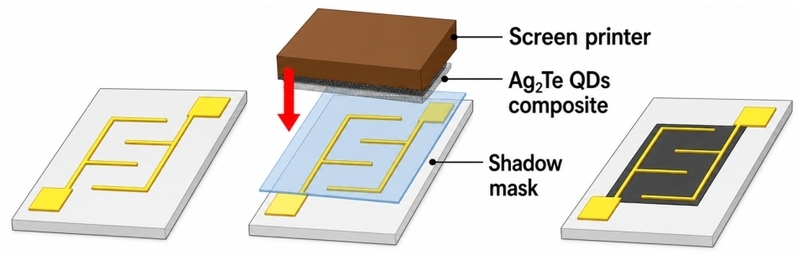
Schematic diagram of the fabrication of a SWIR sensor based on Ag2Te QDs composite.
2.3 Fabrication of Ag2Te QDs–Based SWIR Sensors
A SWIR sensor was fabricated using a screen printing process. An alumina substrate measuring 5 × 5 mm2 was used, and the substrate was sequentially cleaned using acetone, methanol, and isopropyl alcohol (IPA) to remove surface impurities. On the cleaned substrate, interdigitated electrodes (IDEs) were formed using a screen printing process with silver (Ag) paste.
Subsequently, the prepared Ag2Te QDs composite ink was printed onto the IDE electrodes using a shadow mask designed to have an active region of 3 × 3 mm2. Each sample was fabricated under identical process conditions according to its composition ratio, and heat treatment was performed at 95°C for 30 minutes to remove residual solvent after printing. Finally, a single-layer SWIR sensor with a sensing region of 9 mm² was fabricated.
3. RESULTS AND DISCUSSIONS
3.1 Characteristics of the synthesized Ag2Te QDs
The optical and structural characteristics of the synthesized Ag2Te QDs were investigated by absorbance spectroscopy and X-ray diffraction (XRD). As shown in Fig. 2(a), the Ag2Te QDs exhibited a pronounced absorption peak centered at approximately 1607 nm, with a full width at half maximum (FWHM) of approximately 100 nm [13,14]. The narrow absorption bandwidth indicates that the synthesized Ag2Te QDs possess wavelength-selective absorption in the short-wave infrared (SWIR) region, demonstrating their suitability as an active material for 1607 nm SWIR sensors. Since the 1607 nm wavelength lies within the eye-safe infrared region, the synthesized Ag2Te QDs are expected to be applicable to optical sensing systems for smart factories, industrial automation, autonomous drones, and remote monitoring applications.
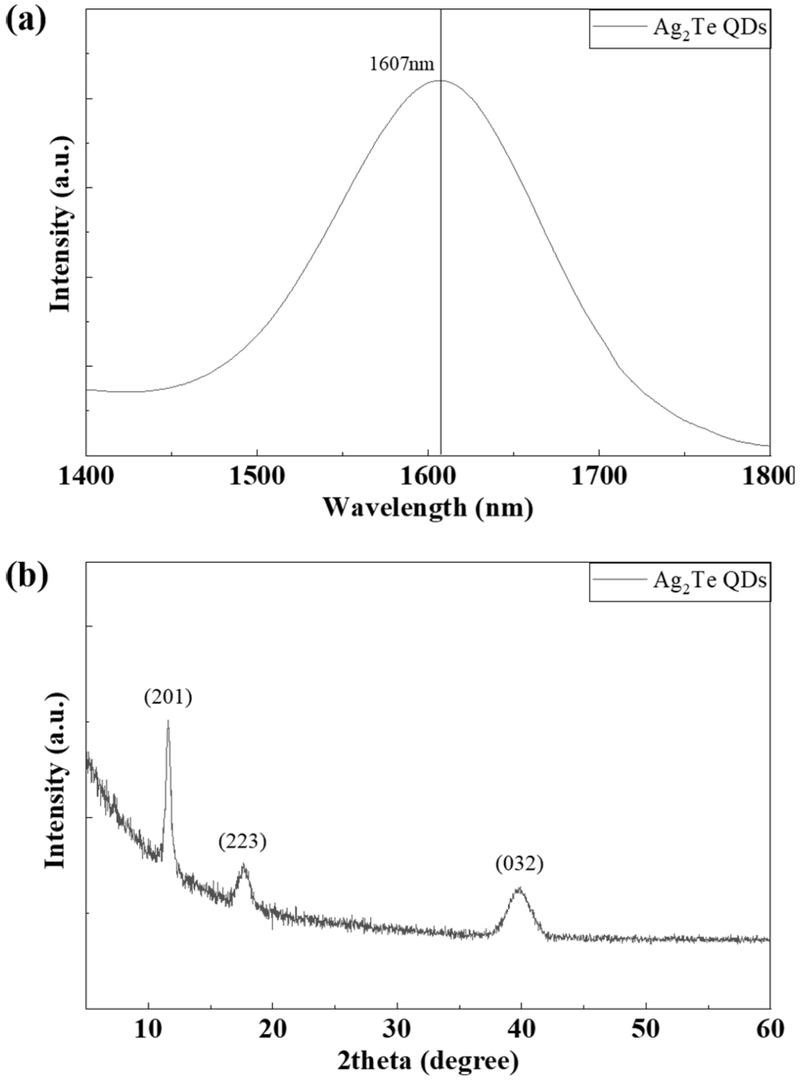
(a) Absorbance and (b) XRD analysis characteristics of synthesized Ag2Te QDs.
To examine the crystal structure of the synthesized QDs, a thin film was prepared by spin-coating an Ag2Te QDs solution (30 mg mL⁻¹) onto a 15 × 15 mm² glass substrate at 1500 rpm for 30 s, followed by thermal annealing at 95°C for 30 min. The XRD pattern shown in Fig. 2(b) exhibits well-defined diffraction peaks corresponding to the (201), (223), and (032) crystallographic planes of Ag2Te [13,14]. These diffraction peaks agree well with the standard crystal structure reported in previous studies, indicating the successful formation of highly crystalline Ag2Te quantum dots without detectable impurity phases. The excellent crystallinity is expected to facilitate efficient carrier transport within the quantum dot layer, thereby contributing to the enhanced photoresponse characteristics of the fabricated SWIR sensors.
3.2 Characteristics of the fabricated SWIR Sensors
The photoresponse characteristics of the fabricated Ag2Te QDs-based SWIR sensors were evaluated in a dark optical chamber. Each device was measured at an applied bias of 3 V using a source meter unit (B2902A, Keysight). A Thorlabs SLS201L/M tungsten-halogen light source was used, and the incident optical power at 1607 nm was measured to be 4.6 μW. The photoresponse was calculated using Eq. (1) and the responsivity was calculated using Eq. (2)
| (1) |
| (2) |
where Ilight and Idark denote the photocurrent under illumination and in the dark, respectively, and Pin is the incident optical power (4.6 μW at 1607 nm). The response and recovery times were determined from the 0 – 90% rising edge and the 100 – 10% falling edge of the photocurrent transient.
Sample 1 exhibited a photocurrent variation of 0.80 μA, a photoresponse of 33.3%, and a responsivity of 0.174 A/W. The response and recovery times were 5.54 s and 5.88 s, respectively. Excessive PCBM and P3HT reduced the effective Ag2Te QDs fraction and increased carrier recombination [12,20]. Sample 2 exhibited the best performance with a photocurrent variation of 3.65 μA, a photoresponse of 214.7%, a responsivity of 0.793 A/W, and response/recovery times of 0.35 s/0.35 s. The optimized PCBM/P3HT composition enabled efficient charge separation and balanced carrier transport [15,21]. Sample 3 exhibited a photoresponse of 11.5% and a responsivity of 0.076 A/W. Although the transient response remained relatively fast (0.36/0.37 s), the reduced PCBM content limited electron extraction. Sample 4 exhibited a photoresponse of 11.5%, a responsivity of 0.076 A/W, and slower response/recovery times of 4.59 s and 4.57 s because dedicated charge transport materials were absent [20,21]. Quantitatively, the photoresponse of Sample 2 was approximately 6.4 times higher than that of Sample 1 and 18.7 times higher than those of Samples 3 and 4, while its responsivity was approximately 4.6 and 10.4 times higher, respectively. In addition, its response time was approximately 16 times shorter than that of Sample 1 and 13 times shorter than that of Sample 4, quantitatively supporting the enhanced charge separation and transport achieved by the optimized composition. Overall, Sample 2 showed the highest photoresponse and responsivity together with the fastest transient characteristics, indicating that the Ag2Te QDs:PCBM:P3HT composition of 30:30:15 mg provides the optimum balance between infrared absorption and charge transport.
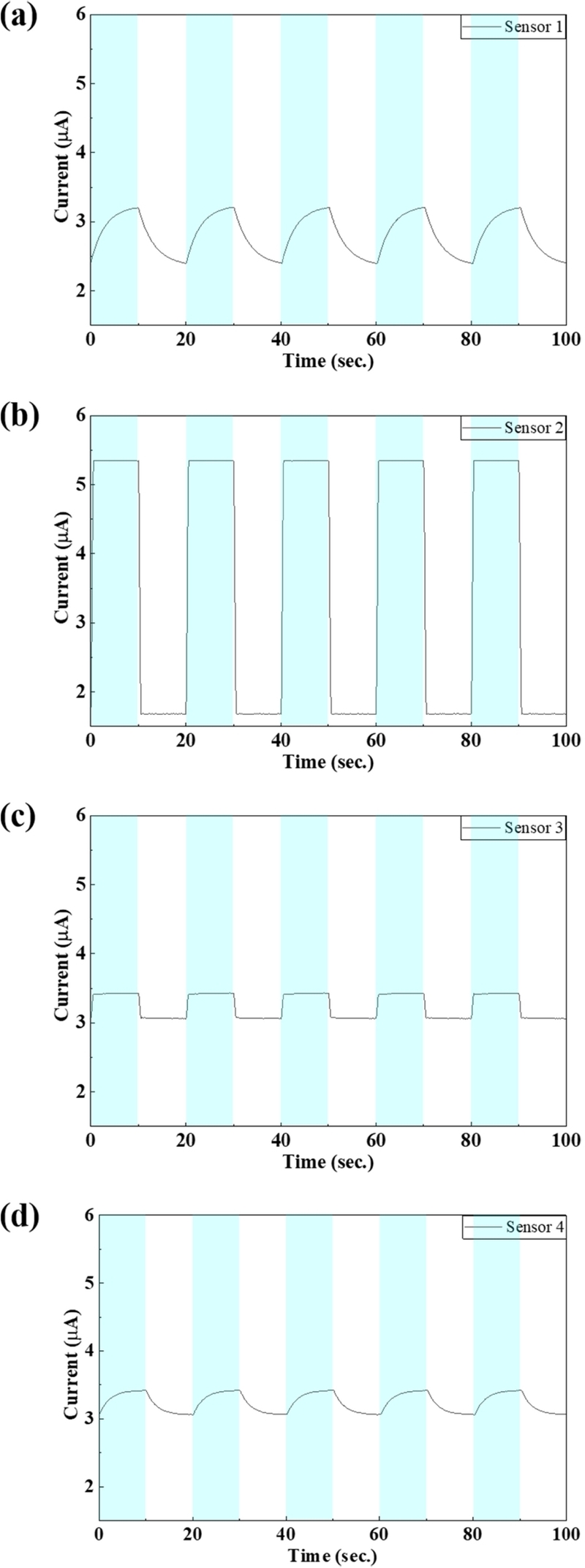
(a), (b), (c) and (d) Current properties of SWIR sensors according to Ag2Te QDs composite conditions
Response characteristics of the fabricated SWIR sensors.
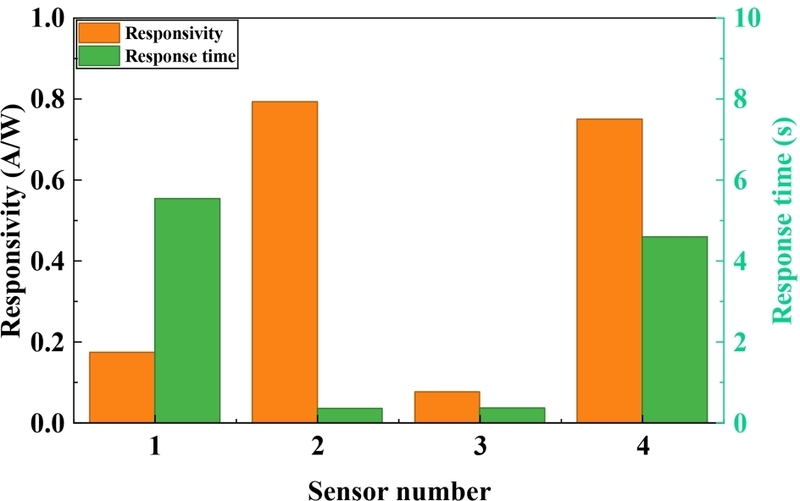
Responsivity and response time characteristics of the fabricated SWIR sensors.
4. CONCLUSIONS
In this study, a single-layer SWIR sensor based on a lead-free Ag2Te QDs composite was successfully fabricated using a solution-processable screen-printing technique. Ag2Te QDs exhibiting a distinct absorption peak at 1607 nm were successfully synthesized, and their high crystallinity was confirmed by X-ray diffraction analysis. To improve charge transport within the active layer, PCBM and P3HT were incorporated as electron- and hole-transport materials, respectively, to form a printable Ag2Te QDs composite ink. Among the fabricated devices, the optimized composition of Ag2Te QDs:PCBM:P3HT = 30:30:15 mg exhibited the best overall performance, achieving a photoresponse of 214.7%, a responsivity of 0.793 A/W, and rapid response/recovery times of approximately 0.35/0.35 s under 1600 nm infrared illumination. The improved performance is attributed to the optimized balance between infrared absorption and charge transport, which effectively promoted charge separation while suppressing carrier recombination. Compared with conventional multilayer quantum dot sensors, the proposed single-layer architecture simplifies the fabrication process by eliminating multiple coating steps while maintaining stable photoresponse characteristics. In addition, the screen-printing process offers excellent compatibility with large-area and low-cost manufacturing, making the proposed device attractive for practical production. The proposed Ag2Te QDs composite provides a promising lead-free alternative to conventional Pb-based QDs sensors while maintaining excellent SWIR detection performance. Although the proposed device demonstrated promising SWIR sensing performance, further studies are needed to evaluate its long-term stability and performance under various operating conditions. Future work will focus on optimizing the material composition and device structure to improve sensitivity, reliability, and practical applicability. Furthermore, the combination of environmentally friendly materials and scalable fabrication technology suggests considerable potential for future applications in non-destructive inspection, industrial process monitoring, agricultural and food quality inspection, and wearable or flexible infrared sensing systems, where low-cost, lightweight, and large-area SWIR sensors are increasingly required.
Acknowledgments
This research received no external funding.
REFERENCES
-
L. Ding, R. Xie, D. Wu, X. Zhang, J. Gao, Z. Dai, et al., MOCVD growth of high-performance extended short-wave infrared photodetectors, AIP Adv. 15 (2025) 115117.
[https://doi.org/10.1063/5.0292865]

-
W. Meng, X. Jiang, M. Guo, Z. Wang, Y. Diao, Z. Huang, et al., High-speed low-noise InGaAs/InP PIN photodetectors on a Si platform achieved by oxygen plasma activation bonding, Opt. Lett. 50 (2025) 3549–3552.
[https://doi.org/10.1364/OL.559090]
-
J. Zhang, W. Wang, H. Ye, R. Huang, C. Liu, W. Zhao, et al., Ultra-broadband ultraviolet–visible light–short wavelength infrared InGaAs focal plane arrays via n-InP contact layer removal, Sensors 24 (2024) 1521.
[https://doi.org/10.3390/s24051521]
-
A. Hamdoh, Y. Gao, O. Spies, N. Brock, L. Jiang, S. Pau, Short-wave infrared (SWIR) polarization imaging using division-of-focal-plane imaging polarimeter, Sci. Rep. 15 (2025) 22577.
[https://doi.org/10.1038/s41598-025-06757-5]
-
J.B. Kwon, S.W. Kim, B.H. Kang, S.H. Yeom, W.H. Lee, D.H. Kwon, et al., Air-stable and ultrasensitive solution-cast SWIR photodetectors utilizing modified core/shell colloidal quantum dots, Nano Converg. 7 (2020) 28.
[https://doi.org/10.1186/s40580-020-00238-3]
-
J.B. Kwon, S.W. Kim, J.S. Lee, C.E. Park, O.S. Kim, B. Xu, et al., Uncooled short-wave infrared sensor based on PbS quantum dots using ZnO NPs, Nanomaterials 9 (2019) 926.
[https://doi.org/10.3390/nano9070926]
-
J.B. Kwon, M. Han, D.G. Jung, S.H. Kong, D. Jung, High Sensitivity Shortwave Infrared Photodetector Based on PbS QDs Using P3HT, Nanomaterials 11 (2021) 2683.
[https://doi.org/10.3390/nano11102683]
-
J.B. Kwon, Y. Ha, S. Choi, D. Jung, Development of a highly reliable PbS QDs-based SWIR photodetector based on metal oxide electron/hole extraction layer formation conditions, Nanomaterials 15 (2025) 1107.
[https://doi.org/10.3390/nano15141107]
-
J.B. Kwon, Y. Ha, S. Choi, D.G. Jung, H.K. An, S.H. Kong, et al., Solution-processed NO2 gas sensor based on poly(3-hexylthiophene)-doped PbS quantum dots operable at room temperature, Sci. Rep. 14 (2024) 20600.
[https://doi.org/10.1038/s41598-024-71453-9]
- S. Choi, J.B. Kwon, Y. Ha, D. Jung, Short-wave infrared photodetector based on PbS quantum dots for eye-safe LiDAR sensors, J. Korean Phys. Soc. 83 (2023) 455–463.
-
E. Heves, Y. Gurbuz, PbS colloidal quantum dot photodiodes for SWIR detection, Procedia Eng. 47 (2012) 1426–1429.
[https://doi.org/10.1016/j.proeng.2012.09.425]
-
H.-C. V. Tran, E. Jang, J. Kim, M. Choi, Y. Park, H. Jeong, et al., Enhanced SWIR photodetection in colloidal quantum dot photodiodes via tunneling current suppression, ACS Appl. Mater. Interfaces 17 (2025) 15666–15674.
[https://doi.org/10.1021/acsami.4c22853]
-
Y. Wang, H. Wu, C. Rodà, L. Peng, N. Taghipour, M. Dosil, et al., Shortwave infrared light detection and ranging using silver telluride quantum dots, Adv. Mater. 37 (2025) e2500977.
[https://doi.org/10.1002/adma.202500977]
-
H.-N. Kim, D. Yoo, A. Sharma, M.-J. Choi, Continuous monomer supply for highly monodisperse Ag2Te colloidal quantum dots for SWIR photodetectors, Mater. Horiz. 12 (2025) 6342–6348.
[https://doi.org/10.1039/D5MH00600G]
-
F. Fang, Y. Tang, H. Tang, Y. Song, Q. Chen, L. Rao, et al., Interface-enhanced PbS quantum dot short-wave infrared photodetector toward instant smoke detection applications, ACS Appl. Electron. Mater. 7 (2025) 7368–7376.
[https://doi.org/10.1021/acsaelm.5c01168]
-
M. Vafaie, J.Z. Fan, A.M. Najarian, O. Ouellette, L.K. Sagar, K. Bertens, et al., Colloidal quantum dot photodetectors with 10-ns response time and 80% quantum efficiency at 1,550 nm, Matter 4 (2021) 1042–1053.
[https://doi.org/10.1016/j.matt.2020.12.017]
-
S. Chang, J. Jin, J. Kyhm, T.H. Park, J. Ahn, S.-Y.L. Park, et al., SWIR imaging using PbS QD photodiode array sensors, Opt. Express 30 (2022) 20659–20665.
[https://doi.org/10.1364/OE.459090]
-
S. Li, Z. Wang, B. Robertz, D. Neumaier, O. Txoperena, A. Maestre, et al., Graphene–PbS quantum dot hybrid photodetectors from 200 mm wafer-scale processing, Sci. Rep. 15 (2025) 14706.
[https://doi.org/10.1038/s41598-025-96207-z]
-
Q. Wang, C. You, Q. Yan, Q. Xie, W. Deng, M. Liu, et al., Size-controllable fabrication of PbS quantum dots for NIR– SWIR photodetectors with extended wavelengths, J. Mater. Chem. C 12 (2024) 19595–19602.
[https://doi.org/10.1039/D4TC03229B]
- M. Yang, H. Liu, S. Wen, Y. Du, F. Gao, Optimizing the infrared photoelectric detection performance of PbS quantum dots through solid-state ligand exchange.
-
G. Kara, S. Bolat, K. Sharma, M. J. Grotevent, D. N. Dirin, D. Bachmann, et al., Conformal integration of an inkjetprinted PbS QDs–graphene IR photodetector on a polymer optical fiber, Adv. Mater. Technol. 8 (2023) 2201922.
[https://doi.org/10.1002/admt.202201922]
-
A. Vahl, J. Carstensen, S. Kaps, O. Lupan, T. Strunskus, R. Adelung, et al., Concept and modelling of memsensors as two terminal devices with enhanced capabilities in neuromorphic engineering, Sci. Rep. 9 (2019) 4361.
[https://doi.org/10.1038/s41598-019-39008-5]
-
L. Meng, T. Zeng, Y. Jin, Q. Xu, X. Wang, Surfacemodified substrates for quantum dot inks in printed electronics, ACS Omega 4 (2019) 4161–4168.
[https://doi.org/10.1021/acsomega.9b00195]
-
T. Jia, Y. Hong, Z. Wei, B. Mu, X. Yu, Two-step ligandexchange- assisted charge transfer in graphene/PbS quantum dots hybrid near-infrared photodetector, ACS Appl. Electron. Mater. 6 (2024) 2066–2074.
[https://doi.org/10.1021/acsaelm.4c00164]
- IEC 60825-1, Safety of Laser Products – Part 1: Equipment Classification and Requirements, third ed., International Electrotechnical Commission, Geneva, Switzerland, 2014.
-
J. Kwon, Single-Layer SWIR Photodetector with a PbS Quantum Dot–Polymer Composite, J. Sens. Sci. Technol. 34 (2025) 618–622.
[https://doi.org/10.46670/JSST.2025.34.6.618]
-
J. Kwon, High-Sensitivity NO2 Gas Sensor Based on PbS Quantum Dots with WO3 Nanoparticle Catalytic Layer, J. Sens. Sci. Technol. 34 (2025) 645–650.
[https://doi.org/10.46670/JSST.2025.34.6.645]