
Development of Ambipolar Organic Transistors
 ; Jae Won Park1 ; Swarup Biswas1 ; Hyeok Kim1, +
ⓒ The Korean Sensors Society
This is an Open Access article distributed under the terms of the Creative Commons Attribution Non-Commercial License(https://creativecommons.org/licenses/by-nc/3.0/) which permits unrestricted non-commercial use, distribution, and reproduction in any medium, provided the original work is properly cited.
Abstract
Recent advancements in wearable and flexible electronic devices have increased the demand for lightweight and mechanically flexible organic field-effect transistors (OFETs). OFETs offer key advantages over conventional inorganic counterparts, including low-temperature processing, cost-effectiveness, and mechanical conformability. Among the various types of OFETs, ambipolar OFETs are particularly promising because they can reduce the number of fabrication steps and associated costs. These devices transport both electrons and holes within a single channel, which simplifies circuit design and enables complementary logic with fewer components. However, these devices still face challenges owing to the imbalance in electron and hole transport. This imbalance often leads to asymmetric electrical characteristics and reduced overall performance, which limit the practical application of ambipolar OFETs in integrated circuits. Overcoming this issue requires careful material selection, interface engineering, and device architecture optimization. This review highlights the significance of ambipolar OFETs, discusses their fabrication methods, and outlines strategies by which to improve ambipolar performance.
Keywords:
Ambipolar organic transistor, Charge transport, Phototransistor, Memory device, Organic inverter, Flexible electronics1. INTRODUCTION
Organic transistors have recently gained significant attention in fields including displays, sensors, and RFID systems owing to their flexibility, light weight, and low fabrication costs [1-6]. Organic semiconductors composed of donor and acceptor structures are particularly suitable for large-area processing because of their solution-processable nature and potential for high performance [7]. Both p-type and n-type semiconductors that are essential for constructing CMOS circuits, which are fundamental in digital electronics, have been extensively studied. Ambipolar OFETs offer a promising alternative that enables the fabrication of CMOS circuits with fewer processing steps and lower costs. These advantages have led to growing interest in and active research on the development of such devices.
Despite these benefits, the development of this technology faces significant challenges in achieving balanced charge transport. Conventional ambipolar transistors employ mixed donor and acceptor materials to form bulk heterojunctions. However, achieving a balance between the hole and electron transport via phase separation and morphological control remains challenging. Numerous studies have focused on addressing these challenges.
This review explains the principles of ambipolar charge transport, describes three representative methods for fabricating ambipolar devices, and outlines their advantages and disadvantages. Finally, recent studies aimed at achieving balanced charge transport are reviewed, and both the current state and future directions of this research field are discussed.
2. STRUCTURE AND WORKING PRINCIPLE OF AMBIPOLAR OFETs
2.1 Structure of OFETs
The OFETs discussed in the previous section consisted of a gate electrode, insulating layer, organic semiconductor, source electrode, and drain electrode. This structure is identical to that of a conventional inorganic semiconductor-based transistor, except that this structure employs organic semiconductors. OFETs are typically categorized into four types, as shown in Fig. 1: top-gate bottom contact (TGBC), top-gate top contact (TGTC), bottom-gate top contact (BGTC), and bottom-gate bottom contact (BGBC).
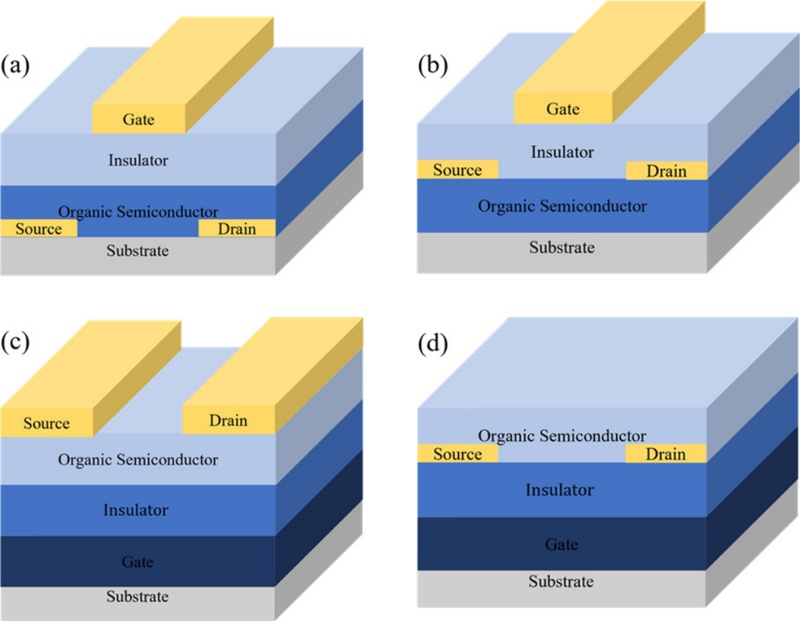
Structure of OFETs: (a) top-gate bottom-contact, (b) top-gate top-contact, (c) bottom-gate top-contact, and (d) bottom-gate bottom-contact.
The top-gate structure is stable because the insulating layer serves as a passivation layer that protects the organic semiconductors. However, the direct deposition of an inorganic insulator on an organic semiconductor is technically challenging. In contrast, the bottom-gate structure enables performance enhancement through the surface treatment of the insulating layer. The source and drain electrodes were in contact with the organic semiconductor. If the electrode is positioned above the semiconductor, it is referred to as top contact, and if it is positioned below, it is referred to as bottom contact.
Top-contact configurations offer the advantage of low contact resistance, which results in superior device performance. A bottom-contact structure is beneficial for design purposes because it allows device scaling through patterning.
When fabricating OFETs, the substrate plays a crucial role in enabling flexible devices or utilizing transparent substrates. Flexible plastic substrates, such as PI, are used for flexible devices, and paper is also used as a substrate [8,9]. Glass was used to fabricate the transparent transistors.
Inorganic materials, such as SiO2 and Al2O3, are used as insulators, as are organic insulating materials, such as Poly(methyl methacrylate) (PMMA), polyvinylpyrrolidone (PVP), and Poly(vinyl alcohol) (PVA) [10-12]. In some cases, crosslinking is used to achieve higher capacitance values and thinner layers [13-15].
Organic semiconductors (OSCs) possess a conjugated molecular structure comprising alternating π and σ bonds. This arrangement allows the organic materials to conduct electric currents. OSCs are fabricated from small molecules via thermal deposition based on their conjugated molecular structures. Additionally, a variety of polymers based on donor–acceptor systems can be easily fabricated using solution processes. This feature enables the processing of organic semiconductors at low temperatures and in solutions.
Recently, several researchers reported vertical OFETs based on vertical structures [16,17]. Vertical OFETs have been proposed to overcome the performance limitations of horizontal OFETs. The structure of a vertical OFET is shown in Fig. 2. Unlike conventional organic transistors, the channel length of vertical organic transistors can be controlled by adjusting the thickness of the semiconductor film. This tunability enhances the electrical properties of the device.
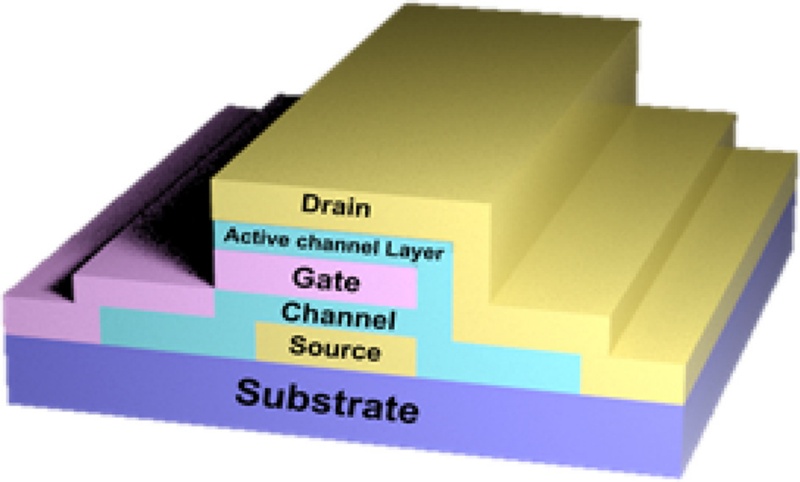
Structure of vertical organic transistors.
In addition, ongoing research has been conducted to utilize dual-gate OFETs to achieve higher performance. In this structure, which features both a bottom gate and top gate, higher currents can be achieved, compared with single-gate structures, as illustrated in Fig. 3. This dual-gate approach provides a unique means of fine-tuning device characteristics and enhancing overall device performance [18].
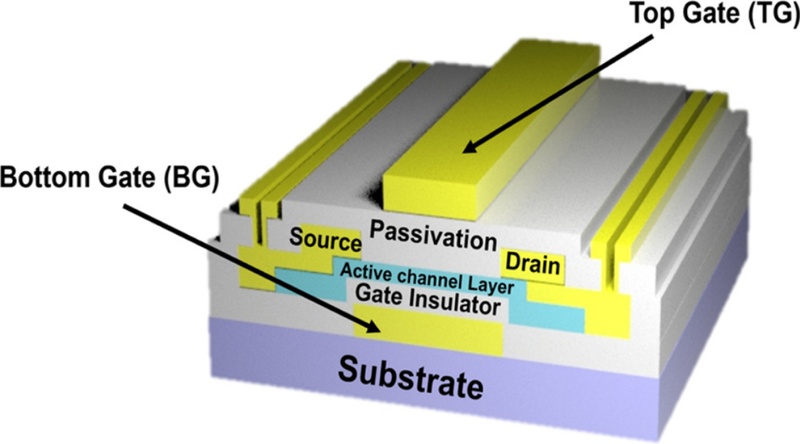
Structure of organic dual gate transistors.
2.2 Working principles of ambipolar organic transistors
In ambipolar OFETs, the energy alignment between the highest occupied molecular orbital (HOMO) and lowest unoccupied molecular orbital (LUMO) of the organic semiconductor (OSC) as well as the work functions of the electrodes play critical roles. In organic transistors, charges flow from the source to the drain through the HOMO and LUMO of the OSC. Therefore, the relationship between these energy levels significantly influences the transistor polarity.
Ambipolar OFETs operate by applying voltage to the gate. When a voltage is applied to the gate, polarization occurs in the insulating layer, resulting in the accumulation of charges at the interface between the OSC and insulator, which forms a channel that allows charges to flow. At this time, the charges move through the OSC HOMO and LUMO via a hopping mechanism.
When a positive voltage is applied to the gate and equally positive voltages are applied to both the source and drain, electrons form a channel and move through the LUMO, leading to an n-type operation. Conversely, when a negative voltage is applied to the gate and the source and drain are also negatively biased, the holes form a channel, and charge transport occurs through the HOMO level, resulting in p-type operation. However, in conventional OFETs, the accumulation of minority carriers is difficult. However, ambipolar devices overcome this limitation through various methods that enable them to operate efficiently in both nand p-type modes by facilitating the movement and accumulation of electrons and holes under different biasing conditions.
In an ambipolar organic transistor, the transfer curve shown in Fig. 5 reveals that at a high gate to source voltage (VGS), most carriers contribute to charge transport. However, at a low VGS, both majority and minority carriers coexist, which prevents the drain-to-source current (IDS) from dropping entirely and causes it to increase. The output curve exhibits similar behavior; at a low VGS, the coexistence of carriers yields diode-like characteristics, whereas at a high VGS, transistor characteristics emerge [19].
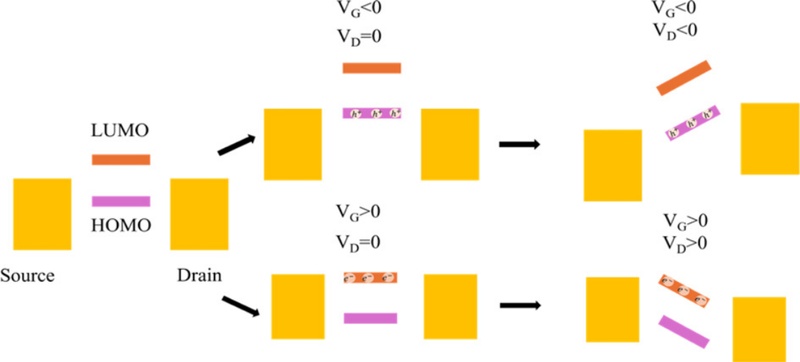
Working principle of ambipolar organic transistors.
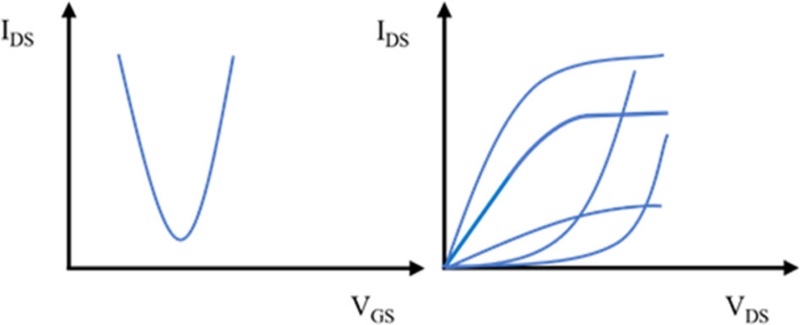
Electrical properties of ambipolar OFETs.
3. FABRICATION METHOD OF AMBIPOLAR OFETs
There are three methods for creating ambipolar OFETs. The first involves mixing two different organic semiconductors. The bulk heterojunction (BHJ) method, which combines donors and acceptors, can be easily manufactured using solution processes, which thereby reduces fabrication costs. However, BHJs have problems balancing the hole and electron mobilities. In addition, controlling the film morphology when the two materials are mixed can be challenging.
Another method is the bilayer technique, which involves the sequential stacking of p- and n-type materials. However, this approach has the drawback of potentially damaging the underlying layer during the stacking of each type through solution processes, which limits the benefits of organic semiconductors.
The latter method uses a single material. Recent research has focused on developing single materials based on donor-acceptor conjugated molecules to create ambipolar organic transistors. Unlike previous BHJ and bilayer methods (which suffer from thermally unstable morphologies and thin-film-related problems), the single-material approach is ideal for achieving a stable morphology and electrical properties.
3.1 Bulk heterojunction method
Kim et al. developed an ambipolar organic transistor using the BHJ method by combining SBT-14 and DTTRQ. The research team synthesized a bithiophene-based, solution-processable p-type semiconducting SBT series. Among these, SBT-14 with tetradecyl thioalkyl chain substituents (eSC14H29) exhibited promising p-type characteristics, with hole mobilities reaching 0.30 cm2/Vs. This group blended it with an n-type semiconductor material, namely, DTTRQ (C11), to create a BHJ. The ambipolar OFETs were fabricated using a top-contact/bottom-gate (TG/BG) structure. These researchers coated an organic semiconductor via a solution process after treating a highly n-doped silicon wafer with a thermally grown 300 nm oxide using a PS-brush. The electron and hole mobilities were 0.7 and 0.21 cm2/Vs, respectively, which indicates ambipolarity [20] (Fig. 7).
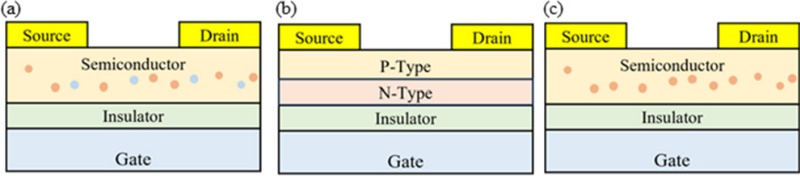
Ambipolar channel structures. (a) bulk heterojunction. (b) bilayer heterostructure and (c) single component method.
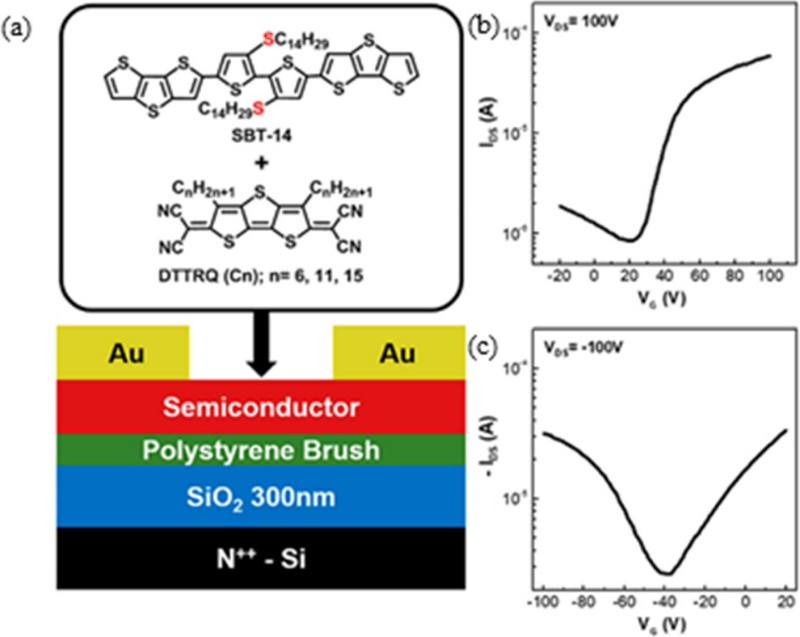
Ambipolar BHJ transistor performance. (a) Device structure of bulk heterojunction ambipolar transistors used in this study, with molecular structures of SBT-14 and four DTTRQs. (b) n-channel and (c) p-channel transfer characteristics of BHJ ambipolar transistors based on blends of SB.
Chu et al. developed a method for preparing M-BTDT by blending a soluble BTDT derivative, namely, 2-(4-n-octylphenyl) benzo[d,d']thieno[3,2-b;4,5-b']dithiophene (OP-BTDT), with P-BTDT. They then blended M-BTDT (P-BTDT:OP-BTDP) with C60 to create a BHJ that enabled balanced hole (0.03 cm²/Vs) and electron (0.02 cm²/Vs) mobilities as well as indicated the ambipolar characteristic of the organic transistor [21] (Fig. 8).
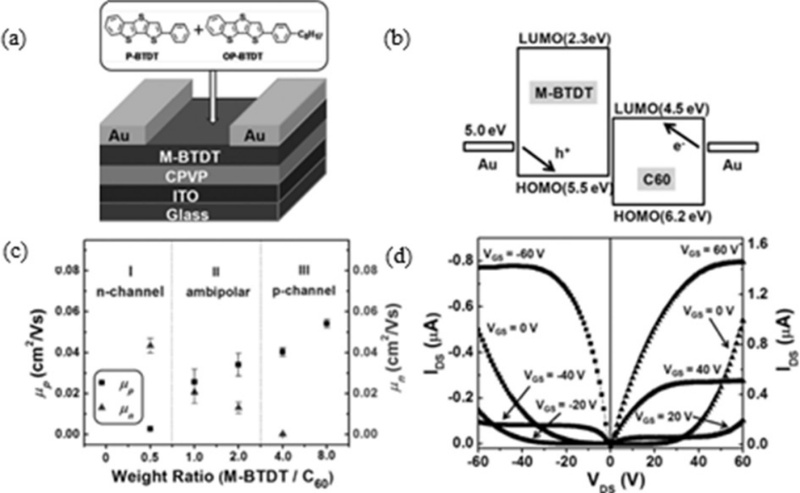
M-BTDT/C60 Blend-Based Ambipolar Transistor Characteristics. (a) Device structure, (b) energy level diagram of M-BTDT/C60 blends with Au electrodes when no biases are applied. (c) Hole and electron mobilities in BHJ ambipolar organic transistors, plotted with respect to the M-BTDT to C60 weight ratio. The BHJ devices operated in three modes: n-channel (region 1), ambipolar (region 2), and p-channel (region 3). (d) Output characteristics of an ambipolar organic transistor featuring a BHJ with an M-BTDT to C60 weight ratio of 1:1, operated under both positive and negative biases. Reprinted with permission from Ref. [22], Copyright (2014) Wiley Online Library.
3.2 Bilayer heterostructure method
A semiconductor structure based on a bilayer enables the physical separation of the conduction channels for holes and electrons. The formation of the bottom layer directly influences the quality of the heterojunction, which in turn affects the transport characteristics of the corresponding carrier type in the top layer [22]. High-performance ambipolar organic transistors can be achieved through an appropriate combination of materials and optimized deposition conditions. Wang et al. fabricated high-mobility ambipolar organic field-effect transistors with a nonplanar heterojunction structure based on a BGTC configuration. They used a highly n-doped Si wafer with a 300 nm layer of SiO2 and cleaned the substrate prior to deposition. A PMMA dielectric was employed to promote the microstructural growth of organic semiconductors and provide a high-quality dielectric with fewer-OH groups, which could otherwise trap electrons. DFH-4T and DNTT films (average thickness of approximately 30 nm) were deposited onto the substrate at 50°C under high vacuum conditions (<10-6 mbar) at a rate of 0.1 Å/s. The source/drain electrodes were fabricated using Au, Ag, Al, and LiF/Al. When DFH-4T/DNTT was used with Ag source/drain electrodes, the mobilities for the holes and electrons were 1.1 cm2/Vs and 1.0 cm2/Vs, respectively, indicating balanced ambipolarity [23] (Fig. 9).
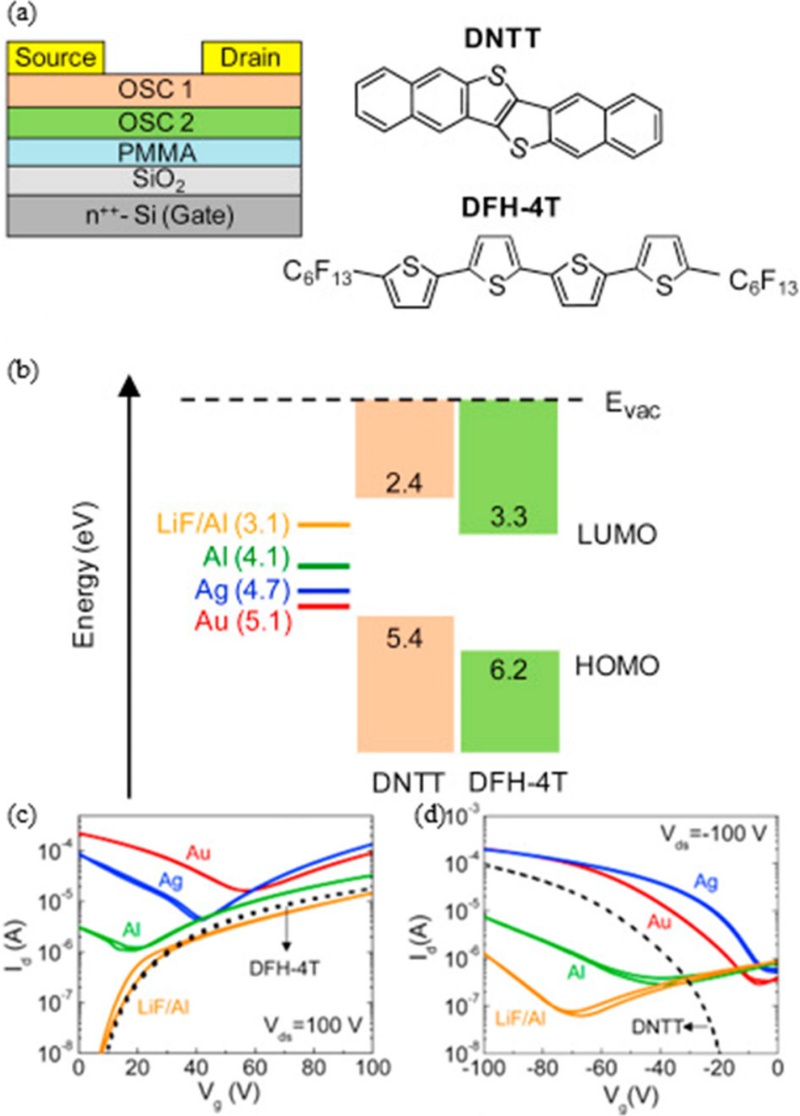
Ambipolar charge transport in bilayer DNTT/DFH-4T OFETs. (a) Schematic illustration of a bottom-gate, top-contact OFET with bilayer organic semiconductors (OSCs), referred to here as OSC2/OSC1. The chemical structures of DNTT and DFH-4T are also shown. (b) Energy level diagram of DNTT, DFH-4T, and the corresponding electrodes. Transfer characteristics of (c) DFH-4T/DNTT and (d) DNTT/DFH-4T bilayer OFETs along with single-component devices. The gate dielectric consists of 300 nm thermally grown SiO2 spin-coated with 200 nm PMMA (capacitance = 6.4 nF cm−2). In panels (c) and (d), single-component DFH-4T OFETs with LiF/Al electrodes and DNTT OFETs with Au electrodes are shown for comparison (dashed lines). Reprinted with permission from Ref. [23], Copyright (2015) Elsevier.
3.3 Single component method
Molecular doping and semiconductor blending are associated with thermodynamically unstable morphologies, which make reproducibility and uniformity difficult to achieve [24-26]. Jeon et al. developed ambipolar transistors using DPP copolymers. Transistors were fabricated using PDPADPP, which is a newly synthesized polymer that was derived from DPP. When subjected to various annealing conditions at a temperature of 240°C, these researchers observed hole mobilities of approximately 0.065 cm²/Vs and electron mobilities of approximately 0.116 cm²/Vs [27] (Fig. 10).
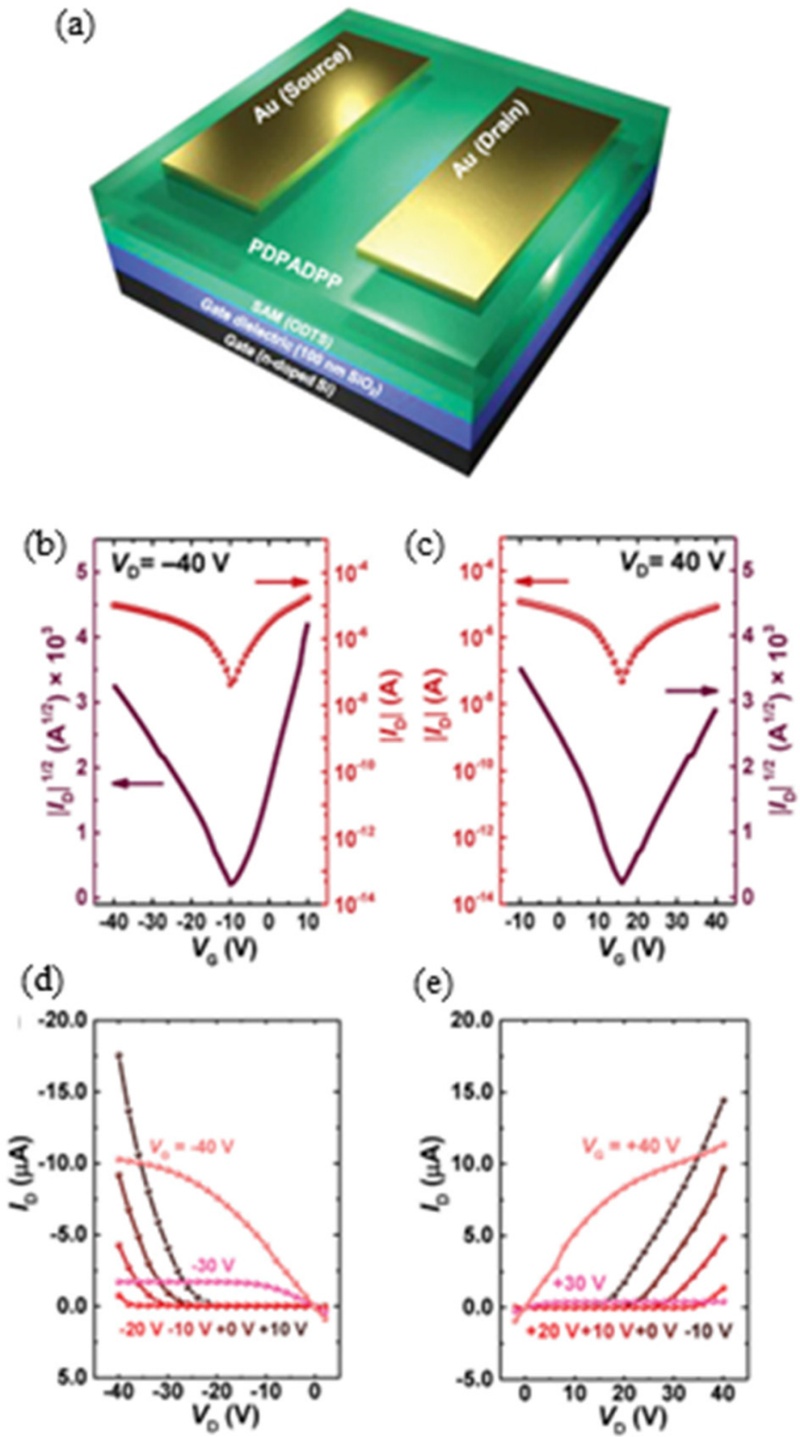
Electrical performance of PDPADPP organic transistors. (a) Schematic of the OFET device with the PDPADPP film fabricated in this study. (b) Transfer characteristics (VD = -40 V) and (d) output characteristics of the OFETs. (c) Transfer characteristics (VD = 40 V) and (e) output characteristics of the OFETs. Reprinted with permission from Ref. [27], Copyright (2024) Wiley Online Library.
3.4 Method to enhance ambipolarity
The demand for ambipolar OFETs is increasing rapidly; however, the discrepancy between electron and hole mobilities limits the application of CMOS organic integrated circuits. Various approaches have been explored to address these issues. Kwak et al. achieved a balance between electron and hole mobilities by applying self-assembled monolayers (SAMs) as the source and drain. Gold was used for the source and drain electrodes on a glass substrate. To make the source and drain compatible with the HOMO and LUMO levels of the organic semiconductor PNDI-TVT, the researchers treated them with PFBT SAM. The organic semiconductor PNDI-TVT and insulator PMMA were spin-coated, and this was followed by gate deposition. The work function of Au, that is, 4.64 eV, increased to 5.30 eV after the simple SAM treatment. The HOMO (5.55 eV) and LUMO (4.13 eV) energy levels of PNDI-TVT imply that the hole mobility of the semiconducting layer was enhanced by adjusting the work function of the Au electrode via the SAM treatment. This modification resulted in improved device performance, with hole and electron mobilities of 0.44 and 0.29 cm2/Vs, respectively, demonstrating the effectiveness of the SAM treatment [28].
Moreover, a research team led by Pisula enabled balanced charge transport through polymer pre-aggregation. The researchers dissolved P3HT in toluene at a concentration of 6 mg/ml and left it to aggregate in the dark at room temperature for 24 h. In the next step, pre-aggregated P3HT was added to PCBM to create a solution, which was then used to fabricate devices using the P3HT: PCBM bulk heterojunction. The OFET with layers composed of aggregated P3HT and non-aggregated PCBM exhibited average mobilities of μh = 0.008 cm²/Vs and μe = 0.011 cm²/Vs for holes and electrons, respectively, which indicates symmetric ambipolar transport. This demonstrates that pre-aggregating the conjugated polymer prior to manufacturing the binary blend enhanced the ambipolarity [29] (Fig. 12).
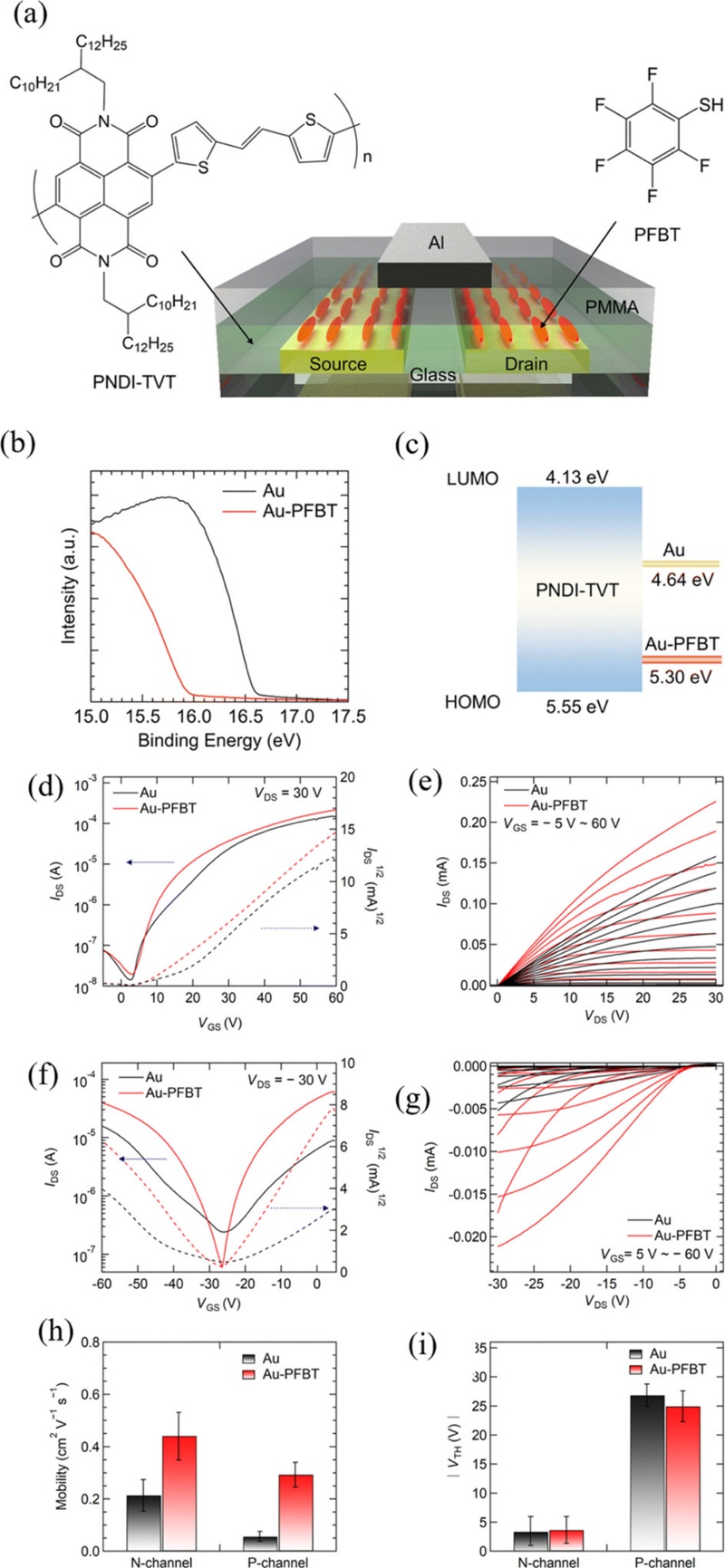
PFBT SAM-modified ambipolar OTFTs based on PNDI-TVT. (a) Device structure of the TG/BC ambipolar OTFT with the PFBT SAM treatment. (b) UPS spectra of the Au electrodes with and without the PFBT SAM treatment. (c) Energy level diagram of PNDI-TVT with the Au electrodes, with and without the PFBT SAM treatment. Transfer characteristics, corresponding output characteristics of the (d, e) n-channel and (f, g) p-channel of the PNDI-TVT ambipolar OTFTs, and their performance parameters in terms of the (h) mobility and (i) threshold voltage, on average. Reprinted with permission from Ref. [28], Copyright (2023) Royal Society of Chemistry.
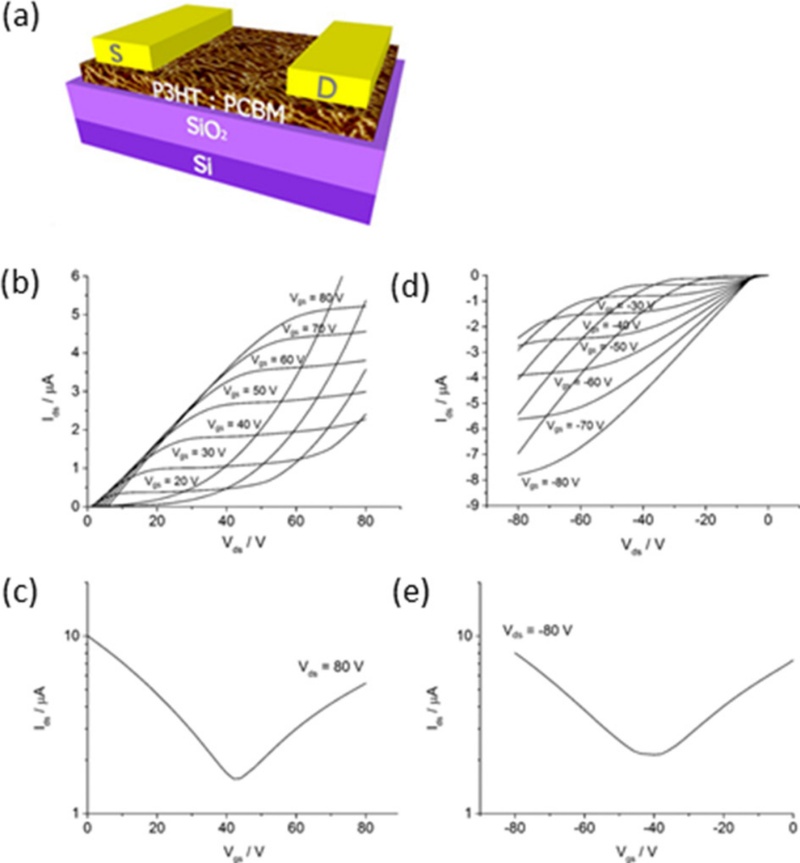
OFET characteristics with PCBM and pre-aggregated P3HT films. (a) Device structure, output, and transfer characteristics of OFETs with PCBM and pre-aggregated P3HT active films in the (b, c) n-type and (d, e) p-type operation modes. Reprinted with permission from Ref. [28], Copyright (2017) ACS Publications.
4. APPLICATION OF AMBIPOLAR ORGANIC TRANSISTORS
4.1 Ambipolar organic phototransistors
Kim et al. synthesized a PDPP-8OBT-NDI polymer and observed broadband optical absorption up to 1100 nm. The synthesized material had a HOMO level of -5.09 eV and LUMO level of -3.89 eV, which facilitated charge injection when using an Ag electrode, which thereby improved ambipolarity. PMMA and PVA were used as the insulation layers of the device. This structure enabled the device to effectively perform NIR sensing in both the p-channel and n-channel operation modes. Flexible devices were developed using polyethylene naphthalate (PEN) film substrates. In these flexible devices, analyses of the output and transfer curves under illumination at a wavelength of λ = 905 nm in the NIR region showed improved performance, confirming strong ambipolar behavior. The stability in both the p- and n-channels was also verified through optical on/off modulation in the same wavelength range, which indicated its potential application in various ambipolar NIR OPTRs, including LiDAR systems [30] (Fig. 13).
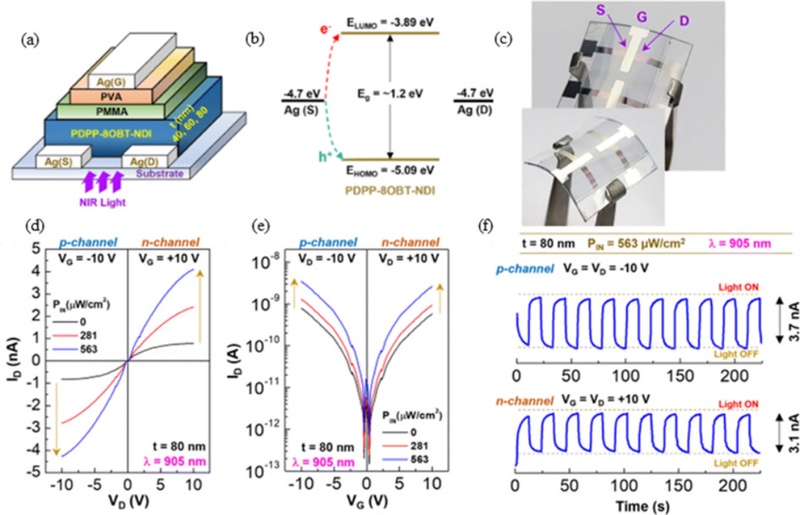
NIR phototransistor characteristics of flexible PDPP-8OBT-NDI devices. (a) Device structure for the OPTRs with the polymeric triple layers PVA, PMMA, and PDPP-8OBT-NDI. (b) Simplified energy band diagram of the PDPP8OBT-NDI film with respect to the Ag source/drain electrodes. EHOMO and ELUMO stand for the HOMO and LUMO energy levels. (c) Photographs for the bent flexible OPTRs. (d) output and (e) transfer curves according to the incident NIR light intensity (PIN) at λ = 905 nm. (f) Photocurrent response to repeated optical on/off modulations of the NIR light (λ = 905 nm). Reprinted with permission from Ref. [30], Copyright (2023) Royal Society of Chemistry.
4.2 Ambipolar memory organic transistor
Sonar et al. successfully synthesized dual-acceptor polymers and fabricated ambipolar OFETs with good memory characteristics. The dual-acceptor polymers were DPP-based copolymers synthesized by polymerizing DPP with BTz and ffBTA to form pDPPy-BTz and pDPPy-ffBTA. When used as organic semiconductor layers in OFETs, both formulations exhibited excellent ambipolar properties and were suitable for use in flash-memory devices. PVA was used as a charge-trapping layer to enhance the memory window by effectively trapping both types of charge carriers. The endurance and data retention capabilities of these memory transistors were evaluated to confirm their operational stability and reliability [31] (Fig. 14).
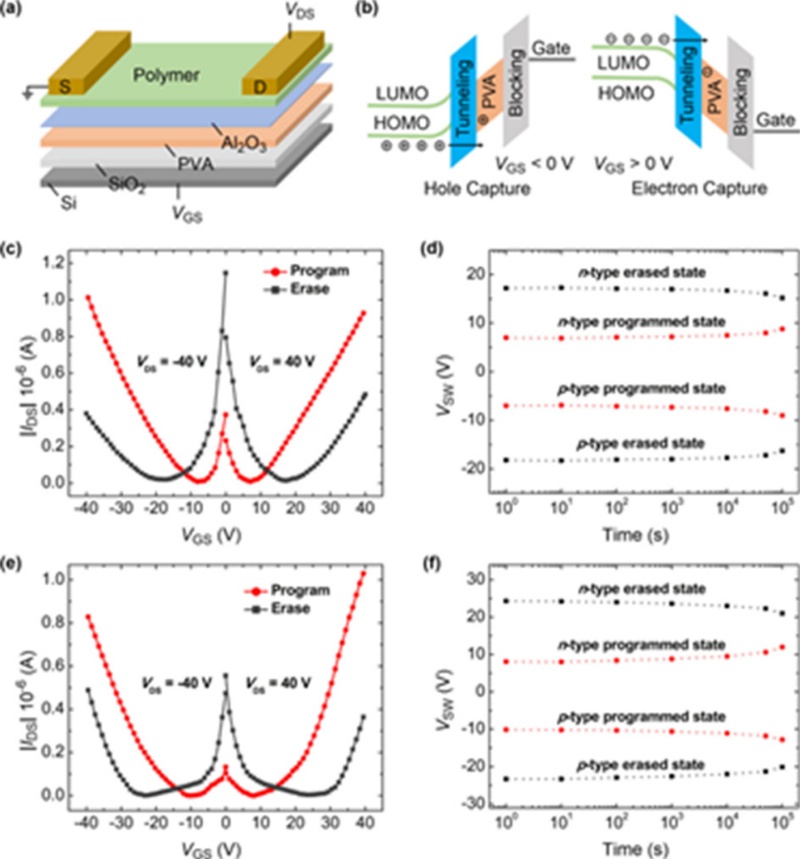
Charge trapping and retention in ambipolar polymer flash memories. (a) Three-dimensional configuration of the ambipolar flash memory. (b) Schematic illustrating the energy level alignment of an ambipolar flash memory operated in the hole- or electron-trapping mode. (c, e) Representative transfer characteristics and (d, f) data retention capabilities of ambipolar flash memories, based on (c, d) pDPPy-BTz and (e, f) pDPPy-ffBTA. Reprinted with permission from Ref. [31], Copyright (2020) ACS Publications.
Lu et al. developed an ambipolar polymer blend transistor with an improved switching-off capability. The organic transistor based on PDPP-4FTVT with polystyrene (PS) showed saturated field-effect hole and electron mobilities, as extracted from the linear range of (IDS)1/2 versus VGS plots of 0.7 and 1.8 cm²/Vs, respectively. Compared with unipolar transistors, which have only one charge, ambipolar transistors can reversibly trap both holes and electrons, making them favorable for switching device states and realizing flash-type memories. The group demonstrated multilevel, nonvolatile memory with three states in both the p- and n-types. They obtained three states for each type, all of which were reversibly switchable. By applying different voltages to the drain and gate, they obtained states of “0”, “1” and “2”. The proportion of each state was 102. When the voltage was applied in reverse, the device returned to its initial state. Different memory states were maintained for more than 104 s at room temperature [32] (Fig. 15).
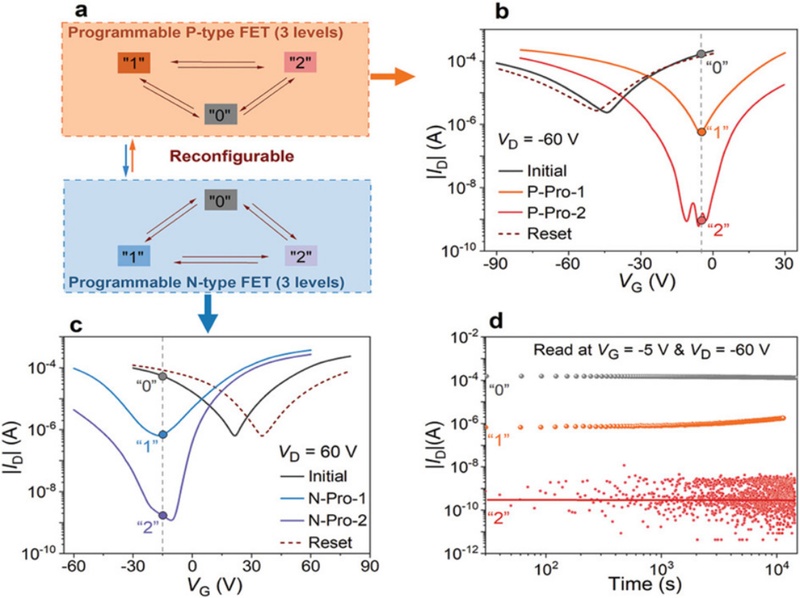
Ambipolar transistor for multi-level nonvolatile memory applications. (a) Schematic illustration of the ambipolar transistor used for reconfigurable multi-level nonvolatile memory. (b) Transfer characteristics of the ambipolar transistor after the P-Pro-1 (VG = 80 V and VD = 0 V), P-Pro-2 (VG = 20 V and VD = −60 V), and rest (VG = −60 V and VD = 0 V) processes. (c) Transfer characteristics after the N-Pro-1 (VG = −90 V and VD = 0 V), N-Pro-2 (VG =−20 V and VD = 60 V), and reset (VG = 80 V and VD = 0 V) processes. (d) Retention characteristics of the three-level memory states. Reprinted with permission from Ref. [32], Copyright (2021) Wiley Online Library.
4.3 Ambipolar organic inverter
Hu et al. developed an ambipolar organic inverter with a bilayer structure. The insulating layer used a hafnium–aluminum binary metal oxide (HAO), which is a high-k dielectric material (k = 5.2), for low-power operations. The HAO was fabricated on a substrate via spin coating. The SAMs were treated with an ODPA solution to achieve high performance. Organic semiconductor layer p–n heterojunctions (C6-DPA as a p-type semiconductor and TFT-CN as an n-type semiconductor) were fabricated using two-dimensional molecular crystals (2DMCs). The fluorescence image of the p–n heterojunction of the 2DMCs exhibited a uniform color change, indicating good uniformity.
Furthermore, from the AFM images, the thickness of the organic semiconductor layer was measured to be 10.7 nm, which is consistent with the sum of the 2DMC thicknesses of C6-DPA (8.9 nm) and TFT-CN (1.8 nm). This group also examined the electrical properties and found a balanced mobility of 0.64 cm²/Vs in holes and 0.36 cm²/Vs in electrons. These researchers also fabricated a CMOS inverter using this method and obtained a signal gain of 172 at 4 V [33] (Fig. 16).
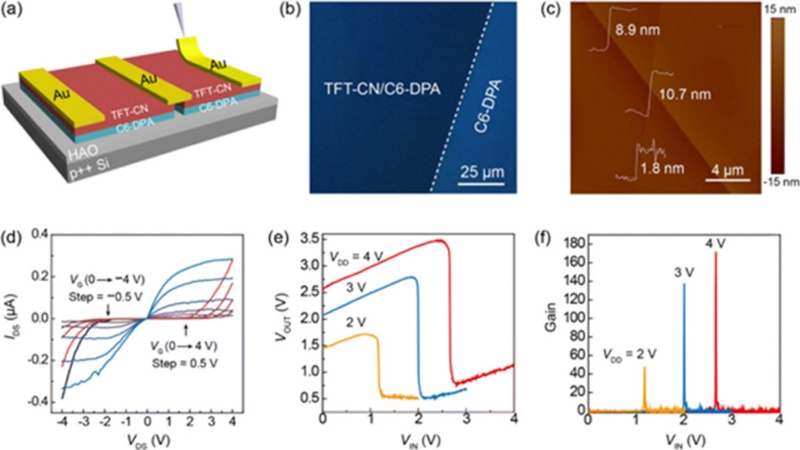
2DMC p–n heterojunction ambipolar OFETs for complementary-like inverter applications. (a) Schematic diagram of a complementary-like inverter based on a dual-channel p–n heterojunction composed of 2DMCs. (b) Fluorescence image of the p–n heterojunction in the 2DMCs. (c) AFM image of the same p–n heterojunction of 2DMCs. (d) Typical output curves of the ambipolar OFET composed of 2DMC p–n heterojunctions. (e) Transfer characteristics of the complementary-like inverter based on the ambipolar OFET. (f) Voltage gain of the complementary-like inverter based on the ambipolar OFET. Reprinted with permission from Ref. [33] Copyright (2023) Royal Society of Chemistry.
5. CONCLUSIONS
Despite their advantages in reducing processing steps and costs for applications such as CMOS circuits, ambipolar OFETs continue to face challenges owing to imbalanced charge transport. Extensive studies have been conducted to overcome these limitations.
This review presents the three main fabrication methods for ambipolar organic devices: the bulk heterojunction method, which involves mixing donor and acceptor materials; the bilayer method, which sequentially stacks p- and n-type materials; and the single-component method. Each of these approaches has distinct advantages and disadvantages. In addition, effective strategies for achieving balanced charge transport, such as thermal treatment and the use of SAM-modified electrodes, are demonstrated. These advances enable the application of ambipolar organic circuits in a wide range of technologies, including ambipolar organic phototransistors, memory devices, and artificial synapses. Some ambipolar organic circuits are already being adopted in industrial applications.
Based on these developments, clear directions for future research have emerged. Continued research aimed at improving the performance and stability of ambipolar systems is expected to expand their applicability to diverse fields.
Acknowledgments
This work was supported by the 2022 sabbatical year research grant of the University of Seoul.
References
-
J. Jang, S.H. Han, High-performance OTFT and its application, Curr. Appl. Phys. 6 (2006) e17–e21.
[https://doi.org/10.1016/j.cap.2006.01.004]

-
D. Elkington, N. Cooling, W. Belcher, P.C. Dastoor, X. Zhou, Organic thin-film transistor (OTFT)-based sensors, Electronics 3 (2014) 234–254.
[https://doi.org/10.3390/electronics3020234]
-
K. Nomoto, N. Hirai, N. Yoneya, N. Kawashima, M. Noda, M. Wada, et al., A high-performance short-channel bottom-contact OTFT and its application to AM-TN-LCD, IEEE Trans. Electron Devices 52 (2005) 1519–1526.
[https://doi.org/10.1109/TED.2005.850954]
-
G. Gelinck, T.D. Anthopoulos, Organic transistors in optical displays and microelectronic applications, Adv. Mater. 22 (2010) 3778–3798.
[https://doi.org/10.1002/adma.200903559]
-
J.H. Kim, J.H. Bae, I.H. Lee, M.H. Kim, Low-voltage Organic Thin-film Transistors with Polymeric High-k Gate Insulator on a Flexible Substrates, J. Sens. Sci. Technol. 24 (2015) 165–168.
[https://doi.org/10.5369/JSST.2015.24.3.165]
-
C. Lee, J. Jang, Optoelectronic Properties of Sol-gel Processed SnO2 Thin Film Transistors, J. Sens. Sci. Technol. 29 (2020) 328–331.
[https://doi.org/10.46670/JSST.2020.29.5.328]
-
J. Jang, S.H. Seo, J. Kong, J.K. Shin, Effects of Transfer Gate on the Photocurrent Characteristics of Gate/Body-Tied MOSFECT-Type Photodetecotr, J. Sens. Sci. Technol. 31 (2022) 12–15.
[https://doi.org/10.46670/JSST.2022.31.1.12]
-
Y.H. Kim, D.G. Moon, J.I. Han, Organic TFT array on a paper substrate, IEEE Electron Device Lett. 25 (2004) 702–704.
[https://doi.org/10.1109/LED.2004.836502]
-
Y. Fujisaki, H. Koga, Y. Nakajima, M. Nakata, H. Tsuji, T. Yamamoto, et al., Transparent nanopaper-based flexible organic thin-film transistor array, Adv. Funct. Mater. 24 (2014) 1657–1663.
[https://doi.org/10.1002/adfm.201303024]
-
T.S. Huang, Y.K. Su, P.C. Wang, Study of organic thin film transistor with polymethylmethacrylate as a dielectric layer, Appl. Phys. Lett. 91 (2007) 092116.
[https://doi.org/10.1063/1.2775333]
-
C.A. Lee, D.W. Park. S.H. Jin, I.H. Park, J.D. Lee, B.G. Park, Hysteresis mechanism and reduction method in the bottom-contact pentacene thin-film transistors with cross-linked poly (vinyl alcohol) gate insulator, Appl. Phys. Lett. 88 (2006) 252102.
[https://doi.org/10.1063/1.2213969]
-
H.S. Byun, Y.X. Xu, C.K. Song, Fabrication of high performance pentacene thin film transistors using poly (4-vinylphenol) as the gate insulator on polyethyleneterephthalate substrates, Thin solid films 493 (2005) 278–281.
[https://doi.org/10.1016/j.tsf.2005.07.200]
-
S. Otep, K. Ogita, N. Yomogita, K. Motai, Y. Wang, Y.-C. Tseng, et al., T. Mori, T. Michinobu, Cross-linking of poly (arylenebutadiynylene) s and its effect on charge carrier mobilities in thin-film transistors, Macromolecules 54 (2021) 4351–4362.
[https://doi.org/10.1021/acs.macromol.1c00008]
-
D.W. Park, C.A. Lee, K.D. Jung, B.G. Park, H. Shin, J.D. Lee, Low hysteresis pentacene thin-film transistors using SiO2/cross-linked poly (vinyl alcohol) gate dielectric, Appl. Phys. Lett. 89 (2006) 263507.
[https://doi.org/10.1063/1.2424666]
-
C.B. Park, K.D. Jung, S.H. Jin, B.G. Park, J.D. Lee, Pentacene-based thin film transistors with improved mobility characteristics using hybrid gate insulator, J. Inf. Disp. 6 (2005) 16–18.
[https://doi.org/10.1080/15980316.2005.9651973]
-
D. Hu, X. Wang, H. Chen, T. Guo, High performance flexible nonvolatile memory based on vertical organic thin film transistor, Adv. Funct. Mater. 27 (2017) 1703541.
[https://doi.org/10.1002/adfm.201703541]
-
X. Yin, J. Yang, H. Wang, Vertical phase separation structure for high-performance organic thin-film transistors: mechanism, optimization strategy, and large-area fabrication toward flexible and stretchable electronics, Adv. Funct. Mater. 32 (2022) 2202071.
[https://doi.org/10.1002/adfm.202202071]
-
G.H. Gelinck, E. Van Veenendaal, R. Coehoorn, Dual-gate organic thin-film transistors, Appl. Phys. Lett. 87 (2005) 073508.
[https://doi.org/10.1063/1.2031933]
-
E.C.P. Smits, T.D. Anthopoulos, S. Setayesh, E.V. Veenendaal, R. Coehoorn, P.W.M. Blom, et al., Ambipolar charge transport in organic field-effect transistors, Phys. Rev. B 73 (2006) 205316.
[https://doi.org/10.1103/PhysRevB.73.205316]
-
D. Ho, S. Vegiraju, D. Choi, C.H. Cho, G. Kwon, P.C. Huang, et al., Solution-processable small molecules for bulk heterojunction ambipolar thin-film transistors and complementary-like inverters, Dyes Pigm. 163 (2019) 725–733.
[https://doi.org/10.1016/j.dyepig.2018.12.054]
-
S.S. Cheng, P.Y. Huang, M. Ramesh, H.C. Chang, L.M. Chen, C.M. Yeh, et al., Solution-Processed Small-Molecule Bulk Heterojunction Ambipolar Transistors, Adv. Funct. Mater. 24 (2014) 2057–2063.
[https://doi.org/10.1002/adfm.201303378]
-
J.W. Shi, H.B. Wang, D. Song, H.K. Tian, Y.H. Geng, D.H. Yan, n-Channel, Ambipolar, and p-Channel Organic Heterojunction Transistors Fabricated with Various Film Morphologies, Adv. Funct. Mater. 17 (2007) 397–400.
[https://doi.org/10.1002/adfm.200600950]
-
J.F. Chang, W.R. Chen, S.M. Huang, Y.C. Lai, X.Y. Lai, Y.W. Yang, et al., High mobility ambipolar organic field-effect transistors with a nonplanar heterojunction structure, Org. Electron. 27 (2015) 84–91.
[https://doi.org/10.1016/j.orgel.2015.09.008]
-
U.K. Aryal, J. Lee, K. Kranthiraja, S.S. Reddy, V.G. Sree, T. Park, et al., The effect of irregularity from asymmetric random π-conjugated polymers on the photovoltaic performance of fullerene-free organic solar cells, Polym. Chem. 10 (2019) 4407–4412.
[https://doi.org/10.1039/C9PY00461K]
-
Y. Zhu, A. Gadisa, Z. Peng, M. Ghasemi, L. Ye, Z. Xu, et al., Rational strategy to stabilize an unstable high-efficiency binary nonfullerene organic solar cells with a third component, Adv. Energy Mater. 9 (2019) 1900376.
[https://doi.org/10.1002/aenm.201900376]
-
J. Kim, D. Khim, J.S. Yeo, M. Kang, K.J. Baeg, D.Y. Kim, Polymeric p–n heterointerface for solution-processed integrated organic optoelectronic systems, Adv. Opt. Mater. 5 (2017) 1700655.
[https://doi.org/10.1002/adom.201700655]
-
S. Xuyao, S.B. Kim, H. Jung, J. Kim, J. Mo, Y.J. Jeong, et al., Well-Balanced Ambipolar Charge Transport of Diketopyrrolepyrrole-Based Copolymers: Organic Field-Effect Transistors and High-Voltage Logic Applications, Macromol. Rapid Commun. 45 (2024) 2300271.
[https://doi.org/10.1002/marc.202300271]
-
Y.J. Kim, S. Biswas, J.H. Song, S. Song, Y.H. Kim, H. Kim, et al., Solution-processed ambipolar organic thin-film transistors and inverters in a single substrate through self-assembled monolayer-treated, J. Mater. Chem. C 11 (2023) 11920–11927.
[https://doi.org/10.1039/D3TC02318D]
-
L. Janasz, A. Luczak, T. Marszalek, B.G.R. Dupont, J. Jung, J. Ulanski, et al., Balanced ambipolar organic field-effect transistors by polymer preaggregation, ACS Appl. Mater. Interfaces 9 (2017) 20696–20703.
[https://doi.org/10.1021/acsami.7b03399]
-
Y. Cho, T. Kim, W. Lee, H. Kim, Y. Kim, NIR-sensing ambipolar organic phototransistors with conjugated terpolymer layers based on diketopyrrolopyrrole-benzothiadiazole-naphthalenediimide comonomer units, J. Mater. Chem. C 11 (2023) 2970–2976.
[https://doi.org/10.1039/D2TC04889B]
-
Q. Liu, Y. Wang, Y. Ren, A. Kohara, H. Matsumoto, Y. Chen, et al., Diketopyrrolopyrrole-based dual-acceptor copolymers to realize tunable charge carrier polarity of organic field-effect transistors and high-performance nonvolatile ambipolar flash memories, ACS Appl. Electron. Mater. 2 (2020) 1609–1618.
[https://doi.org/10.1021/acsaelm.0c00169]
-
P. Wei, X, Wang, X. Li, S. Han, N. Qiao, P. Zhang, et al., Reconfigurable Multifunctional Ambipolar Polymer-Blend Transistors with Improved Switching-Off Capability, Adv. Funct. Mater. 31 (2021) 2103369.
[https://doi.org/10.1002/adfm.202103369]
-
C. Ma, B. Li, Y. Zhang, J. Wang, Y. Liu, L. Sun, et al., Low-voltage organic single-crystal field-effect transistors and inverters enabled by a solution processable high-k dielectric, J. Mater. Chem. C 11 (2023) 6580–6587.
[https://doi.org/10.1039/D3TC00246B]

Hyeok Kim is a Professor in the School of Electrical and Computer Engineering at the University of Seoul (UoS), where he also serves as the President of Institute of Information Technology and the director of Center for Smart Sensor Systems of Seoul (CS4). He performed research focused on organic electronic devices, such as field-effect transistors and diodes, during his Ph.D. at the University of Paris 7 under the supervision of Professor Gilles Horowitz. Afterward, he joined the Samsung Advanced Institute of Technology (SAIT) and later led the sensor research team at the Korea Institute of Industrial Technology (KITECH). Prior to joining UoS, he was with the Department of Electrical Engineering at Gyeongsang National University in Jinju, Korea. His research interests include flexible optoelectronic devices and nanogenerators.

HwaPyeong Noh received his M.S. degree in 2024 from the School Electrical and Computer Engineering at the University of Seoul, South Korea, where he also completed his B.S. degree. His graduate research focused on the development of high-performance phototransistors utilizing organic semiconductors. In particular, he studied the optimization of bulk-heterojunction structures through control of donor–acceptor ratios, aiming to improve photoresponsivity and broadband light detection. His research interests include organic optoelectronic devices and their applications in flexible and low-power sensing technologies.

Seungyeon Koh received her M.S. degree in 2025 from the School of Electrical and Computer Engineering at the University of Seoul. During her graduate studies, she focused on the development of organic ambipolar transistors and their application in logic circuit design. Her research emphasized optimizing device architecture and material composition to achieve balanced hole and electron transport, contributing to the stable operation of inverters. She is particularly interested in the integration of organic semiconductors for flexible and low-power electronic systems.

Yongju Lee is currently pursuing a dual Ph.D. degree between the University of Seoul and University Paris Cité. His research focuses on organic semiconductor-based photodetectors and their applications, including multi-wavelength phototransistors and self-powered sensors. Through this joint program, he collaborates with international research teams to advance the stability and performance of organic electronic devices.