
Soft Conductive Nanocomposites for Skin-interfaced Physiological Monitoring
 ; Geonwoo Yoo1
; Seon Min Kim1
; Je Yoon Seong1 ; Ji Hun Roh1 ; Minje Seong2
; Sun Hong Kim1, +
; Geonwoo Yoo1
; Seon Min Kim1
; Je Yoon Seong1 ; Ji Hun Roh1 ; Minje Seong2
; Sun Hong Kim1, +
ⓒ The Korean Sensors Society
This is an Open Access article distributed under the terms of the Creative Commons Attribution Non-Commercial License(https://creativecommons.org/licenses/by-nc/3.0/) which permits unrestricted non-commercial use, distribution, and reproduction in any medium, provided the original work is properly cited.
Abstract
The rising demand for personalized healthcare has accelerated the development of skin-interfaced sensors that are capable of real-time physiological monitoring, early disease detection, and individualized health management. These devices enable the continuous and high-fidelity tracking of diverse physiological signals, such as cardiac activity, muscle contractions, respiration, and temperature, by closely conforming to the complex and dynamic surface of the human skin. However, conventional sensors fabricated from rigid and brittle materials have poor conformability, mechanical mismatch, and reduced user comfort, thus leading to unreliable signal acquisition and limited long-term usability. Soft conductive nanocomposites have emerged as a promising alternative to conventional sensors. The nanocomposites provide tunable electrical conductivity, mechanical compliance, and biocompatibility by integrating conductive nanofillers into stretchable elastomeric matrices. The filler composition, dispersion, and microstructure of these materials can be optimized to closely match the mechanical properties of the skin while maintaining stable electrical performance under deformation. This review provides a comprehensive overview of recent advances in soft conductive nanocomposites for skin-interfaced physiological monitoring, organized by widely used nanoscale and microscale fillers including metallic, carbon-based, liquid metal, and ionic materials. Furthermore, this review examines how conductive fillers affect the percolation behavior and electromechanical performance of conductive nanocomposites. We highlight representative applications in monitoring the electrical and mechanical form of physiological signals. Finally, we present future research directions aimed at advancing these materials toward next-generation wearable and biointegrated electronics for personalized healthcare.
Keywords:
Soft conductive nanocomposite, Soft integrated electronics system, Physiological monitoring, Percolation1. INTRODUCTION
The increasing interest in personalized healthcare has led to significant demand for real-time physiological monitoring, early disease detection, and individualized health management.
This demand has driven substantial progress in the development of skin-interfaced sensors, which enable the continuous and high-fidelity monitoring of essential physiological parameters including cardiac activity, muscle contractions, respiratory patterns, and body temperature [1]. The effectiveness of these sensors is largely attributable to their ability to closely conform to the complex and dynamic surface of the human skin. Conformal contact can minimize the effects of motion artifacts and enhance signal fidelity, thereby allowing for precise, long-term, and unobtrusive monitoring. As a result, skin-interfaced sensors have the potential to improve personalized healthcare by facilitating remote patient monitoring, reducing the frequency of hospital visits, and empowering individuals to proactively manage their health through real-time feedback.
However, achieving these benefits remains challenging owing to the intrinsic limitations of conventional electronic materials, particularly their mechanical and functional mismatch with the soft and dynamic properties of the human skin. Commercially available sensors are typically fabricated from rigid and brittle materials such as metals, silicon, and ceramics. They exhibit excellent electrical performance but poor conformability to the soft, stretchable, and dynamic surface of the human skin owing to their inherent stiffness. This mechanical mismatch generally leads to discomfort, skin irritation, unreliable signal acquisition, and device failure under prolonged use or significant deformation [2-4].
These limitations have led to research on alternative materials that can be seamlessly integrated with the human body to ensure comfort and high-quality data acquisition. Soft conductive nanocomposites have emerged as a promising solution for skin-interfaced physiological monitoring. These materials typically consist of a soft and stretchable elastomeric matrix such as a silicon elastomer, polyurethane (PU), or hydrogels embedded with nanoscale conductive fillers or conducting polymers [5-7]. The inclusion of these nanofillers imparts electrical conductivity to the otherwise insulating elastomer while preserving or even enhancing its mechanical softness, stretchability, and biocompatibility. The composition and microstructure of these nanocomposites can be precisely tuned to closely match the mechanical properties of the human skin, thereby enabling the close and stable contact that is essential for high-fidelity physiological signal monitoring.
Skin-interfaced devices based on conductive composite materials can provide stable electrical performance for a variety of applications. These include monitoring physiological signals, such as electrocardiograms (ECGs), electromyograms (EMGs), and electroencephalograms, and detecting mechanical stimuli such as strain, pressure, and motion. Optimizing skin-interfaced systems require a critical balance between electrical conductivity and mechanical compliance because excessive filler concentrations may enhance conductivity at the expense of flexibility and softness. In addition, robust skin adhesion, minimal interfacial impedance, and reliable operation under mechanical deformation and environmental stressors are imperative for long-term functionality.
In this review, we systematically examine state-of-the-art soft conductive nanocomposites for skin-interfaced physiological monitoring (Fig. 1). We begin by classifying nanocomposites based on the types of conductive nanofillers, which play an important role in determining the percolation behavior of composites. Thereafter, we examine how these types influence the electrical, mechanical, and biological performance of the resulting materials (Table 1). We highlight recent advances in skin-interfaced sensors based on these materials for physiological signals obtained from the human body. Finally, we outline the current challenges and propose the directions of future research for realizing the potential of soft conductive nanocomposites in wearable and biointegrated electronics, with a focus on advancing personalized healthcare.
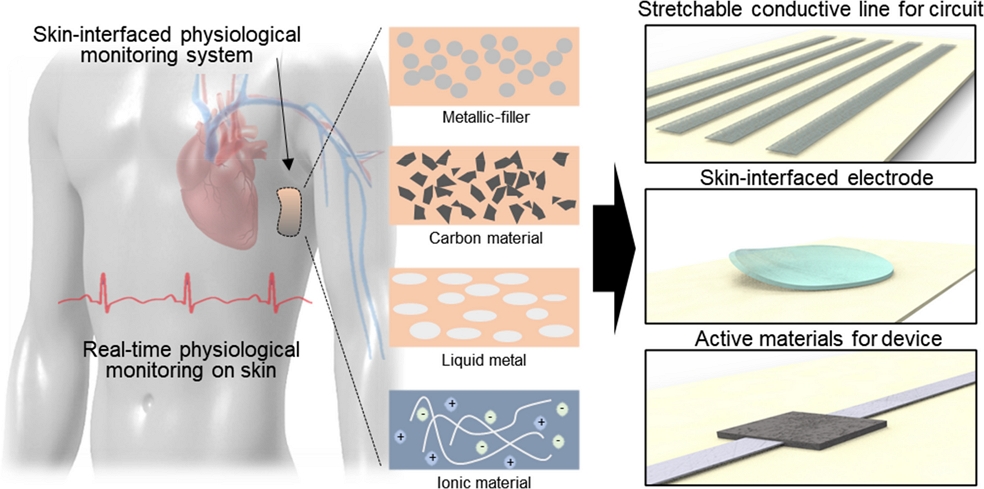
Schematic of physiological monitoring system based on nanocomposite materials Physiological monitoring system that can detect health-related information from human body, and different types of conductive composite materials (metallic fillers, carbon materials, LMs, and ionic materials) used to create stretchable conductive line, skin-interfaced electrode, and sensitive materials used for sensors.

Comparison of soft conductive nanocomposites with different types of filler materials
2. NANOSCALE AND MICROSCALE CONDUCTIVE FILLERS FOR CONDUCTIVE NANOCOMPOSITES
Conductive nanocomposites are an emerging class of advanced materials that can be meticulously engineered by integrating nanoscale fillers into a polymeric matrix. This synergistic combination fundamentally alters microscopic dynamic processes, thereby yielding materials with significantly enhanced mechanical, thermal, electrical, optical, electrochemical, and catalytic properties that are considerably better than those of their individual constituent components. The remarkable impact of these materials arises from the extremely large surface area of nanoscale reinforcements. Even a small amount of these fillers can significantly improve the macroscale properties of composites. Nanoscale fillers are essential for imparting specific functionalities, particularly electrical conductivity, to inherently insulating polymer matrices. Conductive nanocomposites are widely used in a diverse array of high-value applications, including soft robotics [8], soft bioimplantable devices [9], and skin-interfaced systems [10]. A critical and rapidly expanding area is their application in skin-integrated electronics, specifically in high-quality biological signal sensing. Soft conductive nanocomposites are highly advantageous for long-term high-fidelity physiological signal recordings because they effectively mitigate the mechanical mismatch that is typically encountered between rigid conventional electronic devices and delicate biological tissues. Their unique ability to maintain seamless connectivity and electrical conduction, even under mechanical deformation, is essential for the efficient acquisition and noise-free transportation of physiological signals. A fundamental challenge in the development of these advanced materials is the precise control of nanofiller assembly and formation of a percolated network within elastic matrices. The assembly process directly governs the electrical properties of the resulting nanocomposites.
Consequently, a thorough understanding and deliberate manipulation of the filler distribution and geometry are important for optimizing the performance of these composites, particularly for highly sensitive applications such as long-term physiological signal sensing.
This section presents a comprehensive overview of recent advances in conductive nanocomposites consisting of widely used nanoscale and microscale fillers, with a focus on enhancing the electrical performance under dynamic conditions. It discusses the mechanisms by which various filler types and morphologies affect the electrical conductivity and mechanical integrity of the composites. This section also reviews the advantages and challenges associated with different conductive fillers and provides practical guidelines for material selection, strategies for efficient percolation networks, and fabrication techniques for high-performance stretchable conductive materials for highly efficient skin-interfaced systems.
2.1 Metallic-filler-based nanocomposites
Metallic fillers with diverse dimensions, such as metallic nanoparticles, nanoflakes, and nanowires, exhibit unique features that can form conductive networks in a polymer matrix. Metallic nanomaterials are promising candidates for conductive nanocomposites because they exhibit a high intrinsic conductivity of up to ~106 S·cm-1. The electrical performance of conductive nanocomposites is governed not only by the intrinsic conductivity of metallic fillers but also by their spatial distribution and interfacial contact characteristics, which is referred to as the “percolation network” within a polymer matrix. This section discusses soft conductive nanocomposites comprising various types of metallic nanofillers to examine the influence of the nanofiller morphology and polymer type on the electrical and mechanical properties of the composites. Among various conductive fillers, silver (Ag) is a promising candidate for conductive nanocomposites owing to its high electrical conductivity (~ 6 × 10⁵ S cm-1) and relatively low cost. Kim et al. have reported an ultrastretchable conductive composite printed on a low-modulus substrate (Fig. 2 (a)) [11]. Two-dimensional Ag flakes are embedded in an elastomer to form a percolation network and achieve superior conductivity. A novel strategy for fabricating highly stretchable and printable conductors has been demonstrated through a transfer printing method that utilizes water-soluble tape to integrate Ag ink patterns onto low-modulus hybrid substrates composed of a thin Ecoflex elastomer layer (~30 μm) and tough hydrogel. This approach enables the fabrication of soft electronics with mechanical properties that are similar to those of biological tissues because the overall elastic modulus of the hybrid film is similar to that of the hydrogel layer. Note that printed conductors exhibit outstanding stretchability, and they can sustain up to 1,780% tensile strain without failure (Fig. 2 (b)). Compared with conventional methods that rely on elastomeric stamps or sacrificial layers, this transfer process is significantly simpler and more compatible with low-modulus substrates. The compatibility with hydrogel-based and skin-like materials represents a critical advancement in the development of next-generation wearable and biointegrated devices in terms of enhancing comfort and functionality for on-skin applications. Matsuhisa et al. have used a similar material system but different approach to develop a printable elastic conductor with a high initial conductivity of 738 S·cm-1. The conductor reliably maintains a conductivity of 182 S·cm-1 under 215% strain (Fig. 2 (c)) [12]. This is achieved through the formation of a surfactant-assisted percolation network within the conductive nanocomposite. Note that a self-assembly process, which is induced by phase separation between 4-methyl-2-pentanone and a water-based fluorinated surfactant, leads to the formation of a surface-localized Ag layer and the plasticization of the polymer matrix. This enhances mechanical stretchability and provides stable electrical performance (Fig. 2 (d)). This dual mechanism significantly enhances the stretchability of the resulting elastic conductive composite. Xu et al. have fabricated a highly conductive and stretchable conductor by incorporating Ag nanowires (AgNWs) into a polydimethylsiloxane (PDMS) surface layer. AgNWs are drop casted onto a substrate, followed by pouring liquid PDMS over the AgNW film. Finally, the conductor is peeled off the substrate to complete the process. The scanning electron microscopy (SEM) images of the surface of the conductor after stretching demonstrate its structural stability and excellent stretchability (Fig. 2 (e)). The fabricated conductor exhibits a high conductivity of 8,130 S·cm-1 before stretching. Moreover, the resistance remains stable under repeated stretching, and a high conductivity of 5,285 S·cm-1 is maintained. Additionally, it shows reliable performance in terms of the resistance level under different levels of strain (Fig. 2 (f)) [13].
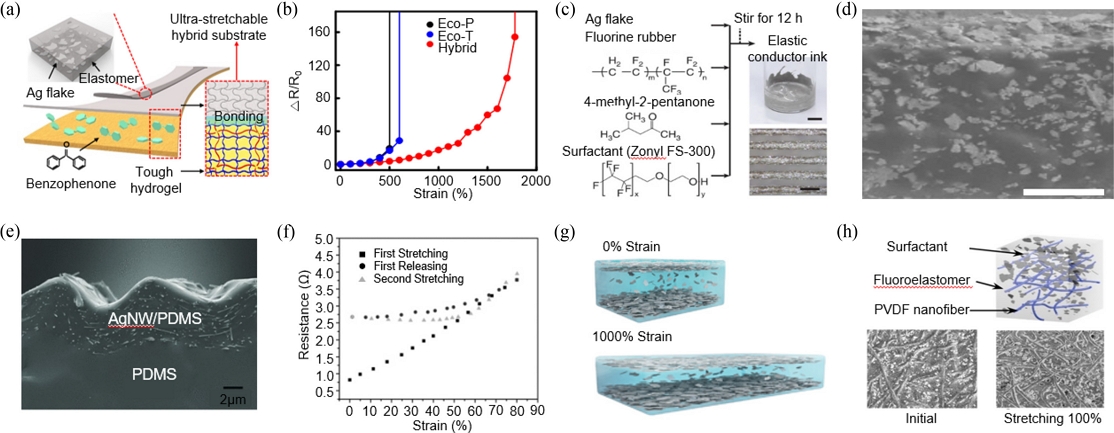
Metallic-filler-based nanocomposite materials (a) Schematic of the elastic Ag conductor, adapted from Ref. [11]. (b) Relative resistance changes over initial resistance (R/R0) for the ECO-P, ECO-T, and hybrid substrate conductors. (c) Schematics of composition of the elastic conductor ink (scale bar: 10 mm, top right). Photograph of printed conductor with high resolution scale (scale bar: 100 μm), adapted from Ref. [12]. (d) Cross-sectional SEM image of the elastic conductor with surfactant (scale bars: 10 μm). (e) Sliced sectional SEM image of the AgNW/PDMS layer, adapted from Ref. [13]. (f) Change in resistance of AgNW/PDMS conductor under tensile strain of up to 90%. (g) Reorganization of Ag flakes in viscoelastic composite under 0% and 1000% strain, adapted from Ref. [14]. (h) Top: NF-reinforced elastic conductor consisting of Ag flakes, fluoroelastomer, and PVDF NFs. Bottom: SEM images of conductive composite at 0% and 100% strain (scale bars: 10 μm), adapted from Ref. [15].
As conductive composites are strongly influenced by the properties of the polymer, controlling percolation through the mechanical behavior of the polymer can be an effective approach. For example, Wang et al. have designed highly stretchable viscoelastic conductors that can maintain high conductivity under cyclic deformation. When a viscoelastic polymer matrix embedded with conductive fillers undergoes repeated tensile deformation, the dynamic vertical movement of Ag flakes enhances electrical conductivity (Fig. 2 (g)) [14]. The inverse relationship between electrical conductivity and mechanical properties has been a major challenge in the development of composites. To address these trade-offs, Jin et al. have developed a three-phase separation structure using polyvinylidene fluoride (PVDF) nanofibers (NFs) (Fig. 2 (h)) [15]. PVDF acts as a filtration layer, leading to the formation of Ag-rich regions on the top surface of the composite and enhancing cyclic stability by suppressing crack formation.
2.2 Carbon-filler-based nanocomposites
Carbon-based nanomaterials, including graphene, carbon black (CB), and carbon nanotubes (CNTs), have attracted significant attention as functional fillers for electrically conductive polymer composites because of their unique combination of a high aspect ratio, large specific surface area, and intrinsic electrical conductivity. These properties enable the efficient formation of percolated conductive networks at relatively low loading levels, thereby reducing the electrical percolation threshold and minimizing the degradation of mechanical properties due to a high filler content. The presence of delocalized π-electron systems facilitates efficient charge transport across the composite matrix, and their intrinsic mechanical flexibility and chemical stability support the development of soft, lightweight, and deformable electronic systems. Intrinsically soft and stretchable materials typically contain solvents that limit their long-term stability.
To overcome these limitations, Xu et al. have developed a solvent-free, ultrasoft, and conductive bottlebrush elastomer (BBE) composite using commercially available PDMS monomers (MCR-M11) and crosslinkers (DMS-R22). Azobisisobutyronitrile is used for thermal crosslinking, and single-walled CNTs (SWCNTs) are incorporated as conductive fillers at concentrations of up to 0.6 wt% (Fig. 3 (a)) [16]. The resulting SWCNT/BBE composite exhibits an ultralow Young’s modulus (2.98–10.65 kPa) and high electrical conductivity (up to 13.78 S·m-1) along with excellent conformability, adhesion to various substrates, environmental stability, and biocompatibility. In addition, an integrated ultrasoft electronic device composed of the conductive SWCNT/BBE and nonconductive pure PDMS BBE has been demonstrated (Fig. 3 (b)). To simultaneously achieve good electrical performance and mechanical properties, a latex–graphene oxide (GO) composite is fabricated by combining GO with synthetic polymer latex. This forms a segregated network structure that allows for a low percolation threshold and the localization of conductive pathways (Fig. 3 (c), left) [17]. When the structure is annealed at temperatures below 150°C, the in situ reduction of GO generates sp² carbon structures and polymer decomposition produces phenolic crosslinkers, resulting in highly conductive networks. Atomic force microscopy (AFM) images show individual polymer spheres before reduction, which completely coalesce after reduction (Fig. 3 (c), right). This composite achieves a high conductivity of approximately 10³ S·m-1 at a GO content of only 0.5 wt%. It exhibits a sharp transition from nonconductive to conductive states owing to an explosive percolation mechanism (Fig. 3 (d)). To realize printable and stretchable conductors, van Hazendonk et al. have developed a screen-printable ink based on thermoplastic PU (TPU) and graphene nanoplatelets (GNPs) (Fig. 3 (e)). Graphite is exfoliated in a mixed solvent of ethyl acetate (EtAc) and isopropanol (IPA) using high-shear mixing, and ethyl cellulose (EC) is added to improve exfoliation efficiency. Then, a skin-compatible TPU binder is introduced, and the solvent is replaced with high-boiling propylene glycol ethers that are suitable for printing [18]. The ink shows excellent thixotropic recovery owing to the formation of a jammed particle network. This enables the printed conductors to maintain a low sheet resistance (34 Ω/□∙mm) and electrical conductivity under a strain of up to 100% without postprocessing. Note that the conductors maintain electrical stability after 1000 cyclic stretch tests at 20% strain, as shown by the plateaued gauge factor between cycles 983 and 1000 (Fig. 3 (f)). Hybrid fillers composed of CNTs and graphene are developed to further enhance the dispersion and conductivity of carbon nanomaterials. π–π interactions are utilized to form 1D–2D interconnections that reduce contact resistance and increase the Brunauer–Emmett–Teller surface area (Fig. 3 (g)) [19]. The conductivity of these hybrids is up to three times that of CNT-only systems at equivalent loadings, and the optimal performance is obtained at a CNT-to-graphene mass ratio of 9:1. The resulting composites show stable conductivity under 60% strain owing to efficient percolation networks. Furthermore, the simple fabrication using only sonication and stirring makes this approach suitable for scalable wearable applications such as stretchable electrodes. As a design example of a dual-sensing material, Yang et al. have introduced a composite sensor that can simultaneously and independently detect temperature and strain. The sensor is fabricated by infusing poly(3,4-ethylenedioxythiophene): polystyrene sulfonate (PEDOT:PSS) into porous laser-induced graphene, where PEDOT:PSS enhances the conductive area and π–π interactions, thereby improving charge transport (Fig. 3 (h)) [20]. This sensor achieves high temperature sensitivity down to 0.5°C and shows stable operation over a wide temperature range (10–100°C). Moreover, it shows a linear response a strain of 0.05% to 45%, thus making it highly suitable for wearable health monitoring and safety systems (Fig. 3 (i)). To demonstrate the potential of CB composites as sensor materials, Zhang et al. have developed a flexible and porous TPU/CB multimodal sensor that can detect multiple stimuli including strain, pressure, and humidity. The porous TPU/CB film (TCF), which exhibits excellent breathability and conformability, is fabricated by dissolving TPU particles and subsequently adding conductive CB to the solution. The porous structure is formed through phase separation, which is facilitated by the high solubility of water in N,N-dimethylformamide, and the interaction with ambient water vapor. The TCF film shows high stretchability because of this porous architecture, and hence, it can withstand knotting, twisting, and bending (Fig. 3 (j)) [21]. Furthermore, the relative resistance–strain curve of the TCF-10 sensor demonstrates reliable operation over a w ide strain range of 0% to 240% (Fig. 3 (k)).
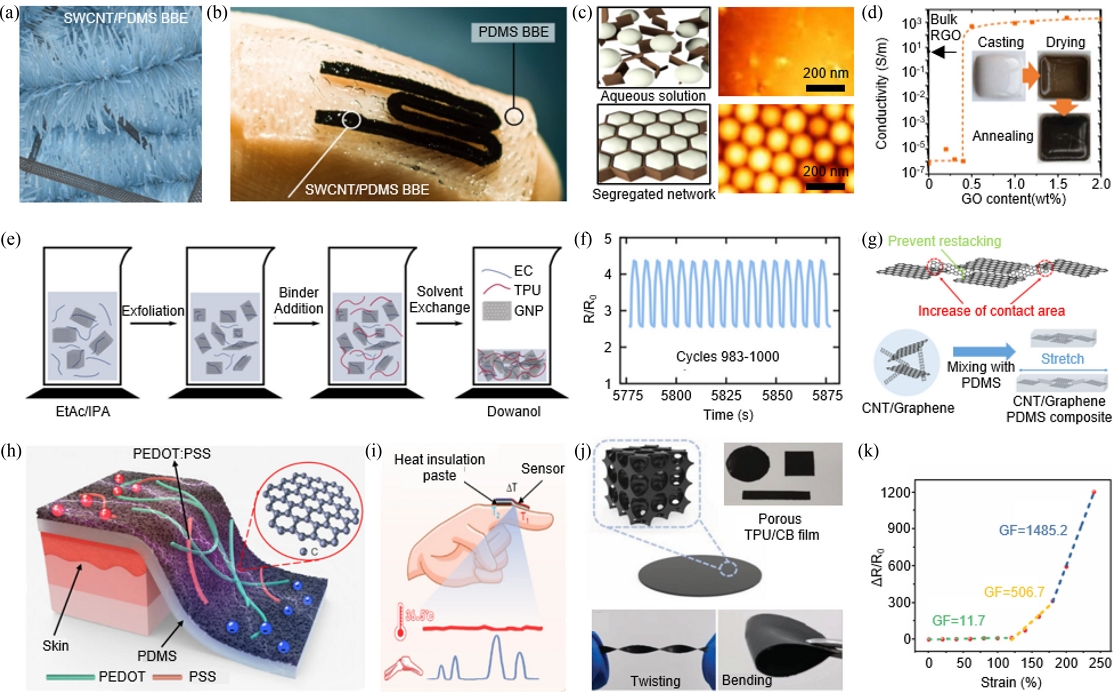
Carbon-based nanocomposite materials (a) Photograph of the nanometer-scale composition of SWCNT/PDMS BBEs, adapted from Ref. [16]. (b) Ultrasoft electronic composed of the conductive SWCNT/BBE and nonconductive pure PDMS BBE. (c) Left: Schematic of the formation of a latex–GO composite system. Top right: AFM images of a composite film after heating above the Tg of the polymer. Bottom right: AFM images of a dried composite film, adapted from Ref. [17]. (d) Relationship between conductivity and GO content in the latex–GO composites. Inset: Photographs of the sample at each process. (e) Schematic of fabrication of conductive composite based on GNPs, adapted from Ref. [18]. (f) Change in resistance of printed composite in cyclic stretching test. (g) Top: Schematic of interactions between graphenes and CNTs. Bottom: Schematic of fabrication of CNT/graphene/PDMS nanocomposites, adapted from Ref. [19]. (h) Illustration of the self-powered sensors based on porous graphene foams, adapted from Ref. [20]. (i) Illustration of in situ monitoring of wound healing. (j) Schematic and photographs of structure of flexible porous TCFs, adapted from Ref. [21]. (k) Change in resistance of TCF under tensile strain ranging from 0% to 240%.
2.3 Liquid-metal-based nanocomposites
Liquid metals (LMs) have attracted significant attention because of their potential applications in stretchable electronics owing to their unique combination of metallic conductivity and fluid-like deformability. However, they have limitations such as leakage, biocompatibility, and mechanical instability under deformation. This has led to the development of diverse LM-based composites and fabrication strategies. To address these limitations, Dong et al. have developed printable and stretchable LM electrode arrays. Conventional fabrication approaches typically rely on complex processes and cleanroom facilities, which result in high production costs. In contrast, the proposed stretchable electrode arrays (SEAs) are fabricated via screen printing using an LM–polymer-based conductor. To improve signal stability and recording quality, recording sites are coated with platinum after spin coating a PDMS encapsulation layer (Fig. 4 (a)) [22]. The impedance of the LM electrodes negligibly changes over a strain of 20%–100% owing to the increased effective surface area (Fig. 4 (b)). In another example, a LM–elastomer composite (LMEA) is developed by dispersing magnetized supercooled gallium droplets embedded with iron particles into an elastomer matrix (Fig. 4 (c)) [23]. Under external stimuli, these droplets solidify and expand volumetrically, thus forming conductive pathways and reducing resistance from over 200 MΩ to below 10 Ω. In particular, porous eutectic gallium–indium (EGaIn) composites have been introduced to reduce LM consumption and improve reliability under strain. These composites leverage solvent-evaporation-induced phase separation to self-organize EGaIn particles onto pore surfaces, which then collapse and sinter to form conductive networks (Fig. 4 (d)) [24]. This approach reduces the percolation threshold (~0.07) compared with nonporous systems (~0.39), thereby achieving equivalent conductivity (2 × 10⁵ S·m-1) with only one-third the EGaIn content. Moreover, the porous architecture provides damping effects that preserve conductivity under mechanical deformation by facilitating the reorientation of conductive pathways. To demonstrate the critical role of composite materials in motion-free long-term monitoring, Li et al. have developed a motion-unrestricted dynamic electrocardiogram (MU-DCG) system featuring a pressure-activated flexible socket composed of PDMS, an LM, and PU (Fig. 4 (e)). The socket forms microconductive LM channels under pressure. It maintains stable performance with resistance variations of less than 20 Ω even when it is stretched up to 80 mm, thereby significantly outperforming conventional interconnects (Fig. 4 (f)) [25]. As a complementary approach, Seo et al. have achieved the in situ sintering of LM particles (LMPs) with thin oxide shells by employing an amine-based ligand synthesized via the ring opening of N-methyl-2-pyrrolidone under high-temperature sonication. These ligands stabilize the dispersion of LMPs and decompose during solvent evaporation, thereby enabling sintering and polymer encapsulation (Fig. 4 (g)) [26]. The resulting Langmuir–Blodgett (LB) LMPs demonstrate cyclic stability and maintain electrical resistance under repeated strain, in contrast to typical theoretical predictions (Fig. 4 (h)). These diverse yet complementary strategies highlight the versatility and promise of LM-based conductors in achieving robust, stretchable, and biocompatible electronic systems that are suitable for next-generation wearable and implantable applications.
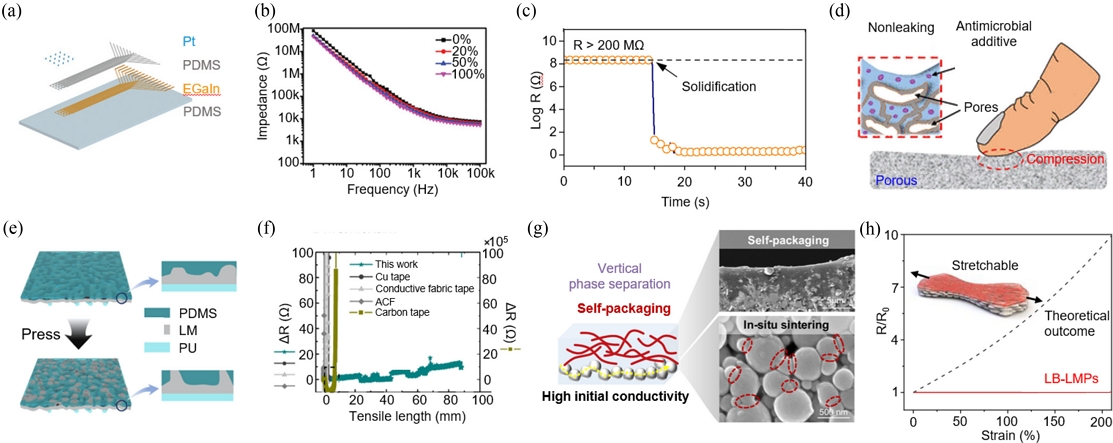
LM-based nanocomposite materials (a) Schematic of SEA fabricated via screen printing, adapted from Ref. [22]. (b) Change in impedance of LM electrodes under 20%, 50%, and 100% strain. (c) Electrical resistance of LMEA during the phase transition of gallium, adapted from Ref. [23]. (d) Leakage resistance of porous EGaIn composites under mechanical deformation, adapted from Ref. [24]. (e) Formation of microconductive LM channels in flexible skin sockets under pressure, adapted from Ref. [25]. (f) Comparison of resistance variation for different connection methods during strain tests. (g) Schematic and SEM images of in situ sintering and self-packaging through the vertical phase separation of LB LMPs within polymer matrix, adapted from Ref. [26]. (h) Relative resistance change (R/R0) for LB LMPs under uniaxial strain.
2.4 Ionic-filler-based nanocomposites
Ionic fillers, particularly ionic liquids (ILs), have emerged as functional additives for soft and ionically conductive nanocomposites. ILs are room-temperature molten salts composed of organic cations and various anions that exhibit inherently high ionic conductivity, low volatility, and wide electrochemical stability windows. These unique physicochemical properties make ILs particularly suitable for integration with conductive polymers and dispersion within organic and inorganic matrices. Furthermore, their excellent miscibility and tunable interfacial interactions enable the fabrication of composites with enhanced electrochemical performances and sensing capabilities. As a result, IL-based composites have been extensively explored for applications in stretchable sensors, soft actuators, and bioelectronic interfaces. However, the relatively high viscosity of ILs typically leads to increased stiffness of the composite matrix. Recent studies have attempted to address this challenge by engineering microstructures, optimizing filler–matrix interactions, and designing hybrid systems to preserve or enhance stretchability while maintaining high ionic transport characteristics.
This section reviews the representative strategies aimed at overcoming various limitations and advancing the multifunctional integration of IL-based soft electronic materials. Organic thermoelectric materials, particularly conductive polymers such as PEDOT, have promising applications in wearables owing to their inherently low thermal conductivity and high electrical conductivity. Among them, PEDOT:PSS is known for its aqueous solution processability. However, its poor mechanical properties, specifically a high Young’s modulus and low stretchability (ε ≈5%), hinder its applications in wearable systems, which must withstand the large strain caused by human motion. To address this issue, Kim et al. have introduced a water-borne PU (WPU) matrix to enhance flexibility and stretchability. Although WPU improves mechanical compliance by uniformly dispersing a soft phase within the PEDOT domain, it disrupts conductive pathways and degrades electrical performance. Tricyanomethanide (TCM), which is an IL, is added as a percolation-inducing dopant to overcome these limitations (Fig. 5 (a)) [27]. TCM weakens the Coulombic interactions between PEDOT⁺ and PSS⁻ via ionic screening and intercalation, thus promoting the rearrangement of PEDOT chains into compact interconnected domains and significantly enhancing conductivity. As shown in Fig. 5 (b), the TCM-based composite maintains a lower resistance under strain compared with dimethyl sulfoxide (DMSO)-based systems, thus confirming improved mechanical–electrical synergy. ILs have also been applied to other polymer systems to develop stretchable and conductive elastomers. Shi et al. have synthesized an ionic conducting elastomer (ICE) via a salt-in-polymer strategy using lithium bis(trifluoromethanesulfonyl)imide (LiTFSI) as the electrolyte salt and a monomer mixture of butyl acrylate(BA), poly(ethylene glycol) diacrylate (PEGDA), and a photoinitiator (Fig. 5 (c)) [28]. After UV-induced curing, the ICE films exhibit excellent ionic conductivity, transparency, and thermal stability. The ionic conductivity of the ICE films increases with temperature owing to enhanced polymer chain and ion mobility (Fig. 5 (d)).
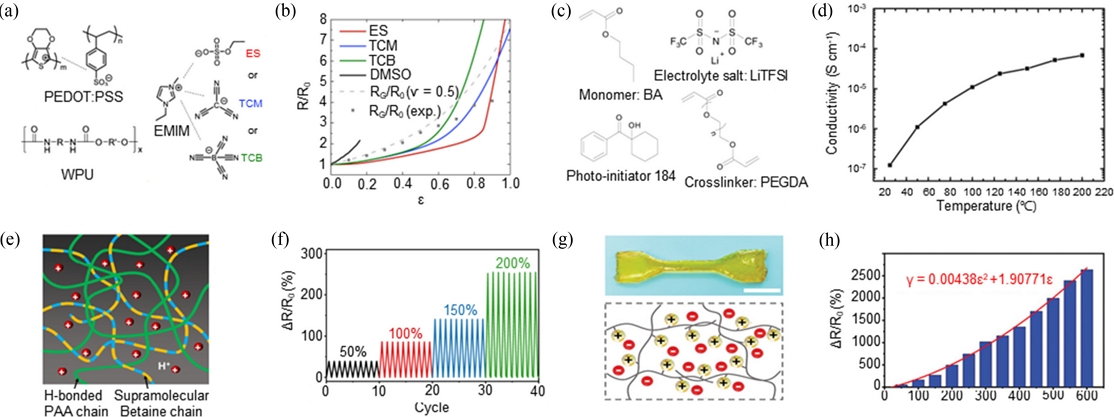
Ionic nanocomposite materials (a) Chemical structures of PEDOT:PSS, WPU, and various types of ILs, adapted from Ref. [27]. (b) Relative resistance change under tensile strain for elastomers containing different ILs. (c) Chemical structures of ionic conducting elastomer precursors, adapted from Ref. [28]. (d) Electrical conductivity as a function of testing temperature. (e) Schematic of the structure of PAA–betaine elastomer, adapted from Ref. [29]. (f) Relative resistance at strain of 50%, 100%, 150%, and 200% for ten cycles each. (g) Schematic of PIL–Zn(0.1) elastomer, adapted from Ref. [30]. (h) Relative resistance change for PIL–Zn(0.1) with tensile strength.
To improve ionic conduction, Zhang et al. have developed a dual-network proton-conductive elastomer using hydrogen-bonded polyacrylic acid (PAA) and supramolecular zwitterionic betaine (Fig. 5 (e)) [29]. This system forms stronger PAA–betaine bonds under strain, resulting in strain-stiffening behavior and providing stable and repeatable resistance responses over multiple strain cycles (Fig. 5 (f)). To address the limitations of solvent-containing gels, Li et al. have introduced a solvent-free linear polyionic liquid (PIL) elastomer composed of halometallate-based IL monomers ([BVIM][ZnxBry]), which form reversible supramolecular networks via Zn²⁺ halide coordination and hydrogen bonding (Fig. 5 (g)) [30]. These PIL elastomers exhibit high mechanical robustness without chemical crosslinkers and act as multifunctional stretchable sensors. Their relative resistance response under strain fits a parabolic model (γ = 0.00438ε² + 1.90771ε); thus, they exhibit predictable electromechanical behavior (Fig. 5 (h)). These IL-based strategies demonstrate the convergence of mechanical adaptability and electrical functionality, thereby paving the way for the development of advanced wearable thermoelectric and sensing materials.
3. SKIN-INTERFACED PHYSIOLOGICAL MONITORING SYSTEM BASED ON CONDUCTIVE NANOCOMPOSITES
The emerging paradigm of personalized healthcare and the proliferation of wearable technologies has increased the demand for next-generation physiological monitoring platforms that provide high fidelity, adaptability, and continuous data acquisition. Conventional wearable sensors, which are typically based on rigid electronic materials, have significant limitations in achieving long-term high-fidelity physiological signal recordings owing to the inherent mechanical mismatch between stiff devices and soft dynamic biological tissues. This can cause discomfort, signal degradation, and tissue damage, thereby hindering continuous and accurate health monitoring. In response to these challenges, soft conductive nanocomposites have emerged as a groundbreaking solution because they provide mechanical compliance, electrical functionality, and biocompatibility, which are essential for seamless integration with biological tissues.
Sensors developed using soft conductive nanocomposites can be used to detect a wide range of diseases by measuring the physiological signals of users. For example, skin-interfaced electronics integrated with ECG and EMG sensors can detect common arrhythmias, such as ventricular fibrillation, by monitoring cardiac signals and blood pressure [31]. Furthermore, complex diseases, such as sleep apnea, dysphagia, and Parkinson’s disease, can be detected by measuring subtle physiological signals using advanced sensors [32]. For instance, Kang et al. have developed soft skin-interfaced mechanoacoustic sensors that enable real-time monitoring and feedback of the respiratory and swallowing cycles in patients with dysphagia. These wireless integrated sensors are mounted on the neck, and they can detect normal cardiac signals. Additionally, two three-axis accelerometers embedded in dual inertial measurement units positioned at different locations allow for the reliable detection of respiratory and swallowing vibrations. They also enable differential signal detection to distinguish physiological signals from similar noise caused by daily activities [33].
This section provides the foundation for an in-depth examination of the role of conductive nanocomposites in various skin-interfaced physiological monitoring systems. It highlights how conductive composite materials have improved skin-interfaced physiological monitoring systems, thus enabling more accurate and comprehensive health assessments. The following sections present detailed case studies of key sensor types, including electrocardiographic sensors for cardiac monitoring, electromyographic sensors for muscle activity detection, and strain sensors for tracking body motion. This shows the broad potential of nanocomposite-based devices as interfacial materials in personalized healthcare applications. Subsequently, specific cases are discussed to illustrate the application of conductive composites in the fabrication of stretchable circuits, which are essential components of various wearable electronic systems. On this basis, recent studies on the role of conductive composites in the realization of wearable wireless systems are reviewed.
3.1 Soft sensors based on conductive nanocomposites
The emergence of flexible and stretchable electronics has drawn significant attention to the development of soft sensors that can conform to dynamic and irregular surfaces such as the human skin, internal organs, and soft robotic interfaces. Among various strategies, soft conductive composite-based sensors have attracted considerable interest owing to their mechanical compliance, tunable sensitivity, and facile fabrication processes. Soft electrodes play a critical role in the design of soft physiological sensor systems because they directly interface with biological tissues and act as the primary medium for acquiring physiological signals. Therefore, the formation of a stable and low-impedance bio-abiotic interface is essential for ensuring the high-fidelity signal transduction and long-term reliability the sensor systems.
Moreover, ensuring robust and durable adhesion between soft electronic devices and the skin remains a critical challenge for reliable long-term operation [34].
Conductive hydrogels are promising materials for epidermal sensors owing to their similarity to biological tissues. For instance, Li et al. have reported a highly stretchable, self-healing, degradable, and biocompatible nanocomposite hydrogel comprising a conformal MXene (Ti₃C₂Tₓ network interpenetrated with a hydrogel matrix of PAA and amorphous calcium carbonate [35]. When this MXene–hydrogel electrode is directly applied to the skin, it forms a stable low-impedance bio-abiotic interface that enables high-fidelity electrophysiological signal acquisition (Fig. 6 (a)). Owing to their intrinsic softness and excellent conformability, the hydrogel electrodes maintain close skin contact even under motion and provide consistent ECG waveforms with clear QRS complexes (Fig. 6 (b)). Although the electrodes maintain conformal contact with the skin, various types of dynamic motion can degrade soft materials. Kim et al. have demonstrated a kirigami-patterned stretchable electronic textile that exhibits electrical recoverability and minimal change in resistance under severe deformation. A mechanically and electrically durable stretchable electronic textile (MED-ET) has been fabricated via a soaking process. The MED-ET improves conductivity and enables the formation of stretchable wiring on textile substrates. Moreover, the integration of tough self-healing conductive composites with textiles can provide long-term durability for electronics (Fig. 6 (c)) [36]. For instance, a micro light-emitting diode (micro-LED) interconnected with the MED-ET maintains its electrical recoverability even after repeated scratching (Fig. 6 (d)). Yang et al. have designed an adhesive dry electrode using tannic acid, polyvinyl alcohol, and PEDOT:PSS (TPP). This electrode shows superior stretchability (~200%) and adhesiveness (0.59 N/cm) and ensures long-term skin recording (Fig. 6 (e)) [37]. A metal–polymer electrode array patch has been fabricated by integrating an LM circuit. This patch shows better conformability compared with commercial arrays, resulting in a higher signal-to-noise ratio and more stable surface EMG (sEMG) recordings during muscle movements (Fig. 6 (f)). The sEMG is recorded from the biceps of five subjects during five sessions of isometric and dynamic tasks. In recent years, soft materials, such as hydrogels and conductive polymers, have been widely employed owing to their intrinsic softness and biocompatibility. As the electrical conductivity of hydrogels is inherently limited, achieving reliable signal transmission typically requires the integration of an external conductive layer or coating, such as metallic films, carbon-based materials, or conductive polymers, onto the hydrogel surface. This multilayer approach introduces several inefficiencies. It complicates the fabrication process, increases the overall thickness and rigidity of the interface, and creates potential delamination issues at the material boundaries during mechanical deformation or prolonged use.
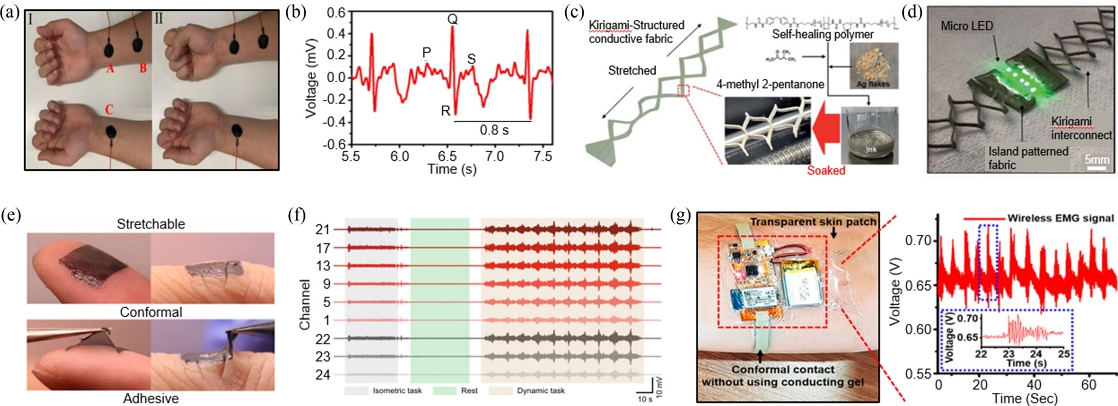
Soft electrodes based on conductive composites (a) Schematic of the setup for measuring EMG signals using conductive MXene nanocomposite hydrogel: (Ⅰ) original and (Ⅱ) after making a fist, adapted from Ref. [35]. (b) ECG signals. (c) Highly stretchable kirigami-structured conductive fabric coated with self-healing conductive composite, adapted from Ref. [36]. (d) Photograph of micro-LED integrated with kirigami-structured conductive fabric using island patterned design. (e) Photographs of the TPP electrodes conformally attached to the skin, adapted from Ref. [37]. (f) sEMG signals in 5 kg load session in various states. (g) Photograph of a flexible wireless EMG system using a self-healing conductor as an interconnection (left). Wirelessly measured EMG signal recorded by self-healing conductor (right), adapted from Ref. [38].
To solve these issues, Kim et al. have reported an ultrastretchable and self-healable nanocomposite conductor based on autonomously reconstructed percolative pathways, which enables EMG modules to be directly attached to the skin (Fig. 6 (g)) [38]. The encapsulated nanocomposite conductor exhibits outstanding electrical performance, with an average conductivity of 2,578 S·cm-1 (maximum of 3086 S·cm-1) under extreme tensile strain of up to 3,500%. This is due to the strain-adaptive behavior of the self-healing polymer matrix, which facilitates efficient energy dissipation and promotes the self-alignment and dynamic rearrangement of Ag flakes assisted by in-situ Ag nanoparticles. This electrode enables the efficient and direct transduction of physiological signals from the skin interface to the electronic circuitry.
3.2 Stretchable circuit based on conductive composites
A key challenge in the development of soft systems is the fabrication of circuit components that maintain stable electrical conductivity under repeated and complex mechanical deformations, including uniaxial and biaxial stretching, bending, and twisting. Achieving such mechanical–electrical durability requires the careful integration of materials that combine high deformability with reliable charge transport characteristics. Conductive composites integrated with various printing technologies have emerged as a highly adaptable and scalable solution for creating mechanically compliant circuit architectures. As functional ink materials, these conductive composites provide tunable electrical and mechanical properties through careful control of the filler morphology, rheology, and interactions within a matrix. Recent developments in stretchable circuits based on conductive composites have demonstrated strategies for material selection, structural design, and processing methods that enhance the durability and functional performance under mechanical deformation. For instance, Kim et al. have developed a strain-invariant stretchable wireless system, which can be conformally attached to the skin without severe performance degradation (Fig. 7 (a)) [39]. The system comprises physiological sensors, electronic circuits, and wireless components, such as a Bluetooth antenna and wireless charging coil operating at 2.4 GHz and 13.56 MHz, respectively. All the components are integrated within a dielectroelastic elastomer (DEE), which exhibits physically tunable dielectric properties that effectively mitigate the frequency shifts typically induced at radio-frequency (RF) interfaces. Within this framework, all circuit elements, including conductive interconnects, are directly fabricated on the DEE substrate via the screen printing of a Ag-flake-based conductive nanocomposite. Note that the conductive interconnects, which function as transmission lines in RF electronics, exhibit strain-invariant performance under mechanical deformation owing to the stable interfacial adhesion between the composite and electronic components (Fig. 7 (b)). A critical challenge associated with the scalable integration of electronic components into soft materials is the minimization of the mechanical mismatch between rigid chips and soft substrates. To address this issue, Lopes et al. have introduced a polymer–gel (Pol–Gel) method, which is a simple yet versatile technique that enables self-soldering, self-encapsulation, and self-healing. This technique allows for the low-cost, scalable, and rapid fabrication of hybrid microchip-integrated ultrastretchable circuits (Fig. 7 (c)) [40]. The fabrication process involves: printing, component placement, and Pol–Gel treatment. The Pol–Gel transition induced by exposing the polymer to solvent vapor enables reversible switching between the polymer and gel states. Styrene–isoprene block copolymers act as the substrate and elastomeric matrix because of their optical transparency, excellent elasticity, and strong adhesion in the gel state. During gelation, the microchip is encapsulated by the adhesive polymer from five sides, while the conductive ink forms robust contact with chip pads, facilitating “self-soldering” integration. This results in exceptional mechanical resilience, with a strain tolerance exceeding 500% for integrated microchips and up to ~1,200% for printed interconnects. In addition, conductivity increases by two times through enhanced filler percolation and substrate crack healing (Fig. 7 (d)). Diverse soft circuits can be realized by replacing rigid metal lines with conductive composites in conventional circuits. For example, a room-temperature-processable stretchable conductive composite (RTPSC) has been developed by integrating electrical interconnections with stretchable printed circuit boards (S-PCBs) (Fig. 7 (e)) [41]. This approach demonstrates reliable electrical interfacing between rigid chips and S-PCBs. Kim et al. have presented a bioinspired stretchable sensory-neuromorphic system that integrates stretchable mechanoreceptors with neuromorphic synaptic devices. The conductivity–strain behavior of the stretchable conductive composites depends on the solvent used during fabrication, and the composites prepared using methyl isobutyl ketone (MIBK) exhibit the best combination of conductivity and stretchability (Fig. 7 (f)) [42]. The integrated system effectively mimics biological sensing, learning, and feedback processes by combining stretchable mechanoreceptors, neuromorphic processing units, and actuators (Fig. 7 (g)).
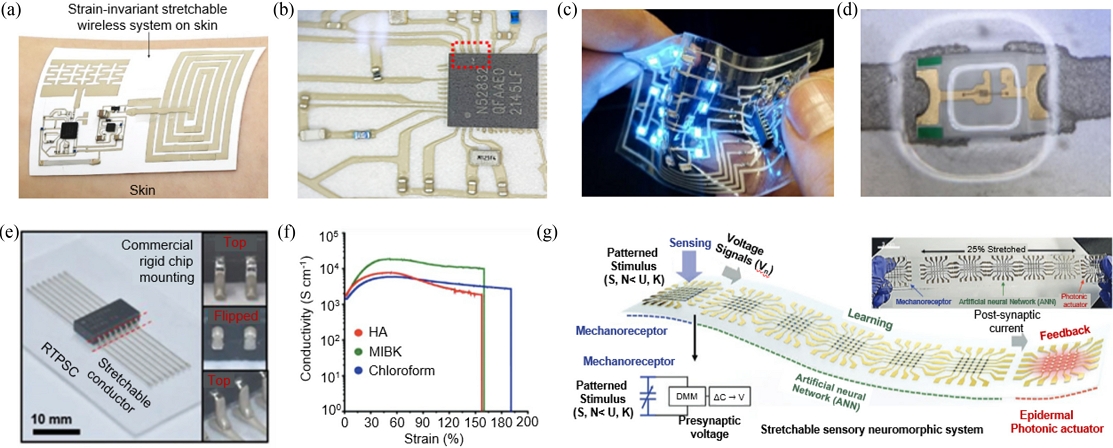
Stretchable circuit based on conductive composites (a) Photograph of strain-invariant stretchable wireless system on skin, adapted from Ref. [39]. (b) Optical microscopy image obtained after stretching the stretchable circuit. (c) Flexible circuit with integrated sensors, microprocessor, and LED display, adapted from Ref. [40]. (d) Top view of a self-encapsulated circuit fabricated using Pol–Gel method. (e) Photographs of three different methods of mounting RTPSCs, adapted from Ref. [41]. (f) Conductivity–strain graph showing different conductivity changes for printable elastic conductor fabricated using diverse organic solvents including hexyl acetate (HA), MIBK, and chloroform, adapted from Ref. [42]. (g) Schematic of structure of stretchable sensory neuromorphic system (SSNS) in normal state and optical image of SSNS under stretching.
3.3 Soft wireless components based on conductive composites
The integration of the wireless functionality into soft electronic systems is essential for achieving untethered operation in applications such as wearable health monitors, soft robotics, and implantable medical devices. Conductive composites play an important role in such systems because most wireless components, such as antennas, coils, and transmission lines, rely on conductive structures with diverse geometries. In particular, conductive composites facilitate the fabrication of stretchable wireless components capable of withstanding mechanical deformation, including bending, twisting, and stretching, without significant degradation in signal integrity or power transfer efficiency. For instance, Li et al. have fabricated an ultrastretchable conductor by depositing a crumpled-textured coating composed of 2D Ti3C2Tₓ nanosheets (MXene) combined with SWCNTs onto latex to create high-performance wearable antennas and electromagnetic interference shields. The wavy MXene structure accommodates strain and enables the device to maintain conductivity and functionality during stretching (Fig. 8 (a)) [43]. Additionally, the relationship between the reflection coefficient (S₁₁) and frequency of the MXene-based antenna under uniaxial strain demonstrates mechanical stability against deformation while preserving its electromagnetic performance (Fig. 8 (b)).

Soft wireless components based on conductive composites (a) Schematic and photographs of the stretchable S-MXene dipole antenna and measurement set up, adapted from Ref. [43]. (b) Experimental and simulated data of S11 of antenna under uniaxial strain of 0% to 150%. (c) Fabrication of Ag NF electrode with net structure motivated by biology, adapted from Ref. [44]. (d) Schematic of the exploded view of the stretchable transparent wireless devices.
Zhang et al. have demonstrated highly stretchable transparent wireless electronics composed of Ag NF coils and functional electronic components for power transfer and information communication (Fig. 8 (c)) [44]. Ag NFs composed of polyvinyl alcohol cores coated with Ag are engineered to mimic the two-dimensional ramified structures found in natural systems such as leaf venation and silk fibers. Ag NFs are fabricated via electrospinning and embedded in an elastomeric PDMS matrix. NF networks are precisely patterned using photolithography and wet etching to form highly stretchable and conductive electrode arrays suitable for flexible electronic applications. The transparent stretchable Ag NF spiral coil can be integrated with miniature electronic components (1.6 mm × 1.2 mm × 0.45 mm) and further assembled into multifunctional wireless electronic systems for power transfer and data communication (Fig. 8 (d)). PDMS acts as the substrate, dielectric, and encapsulation layer and efficiently dissipates strain energy because of its optical transparency and mechanical stretchability. An island–bridge structural design is adopted to accommodate rigid components with high stiffness, thereby reducing mechanical stress under applied deformation. Furthermore, a wireless LED module is fabricating by combining lithography and three-dimensional printing. This module shows wireless power transmission while being conformally attached to the curved surface of a plant.
4. CONCLUSIONS
Wearable devices for recording physiological signals require materials with mechanical properties that closely match those of the human skin. Soft nanocomposites, with their inherently low Young’s moduli compared with conventional rigid electronic materials, provide excellent conformability to the complex curvilinear surface of the human body. This mechanical compliance reduces interface-induced artifacts and skin irritation, which are commonly observed in rigid electronics during prolonged wear. The performance and characteristics of soft nanocomposites significantly vary depending on the type of conductive nanofiller, which includes carbon-based nanomaterials, metallic-filler-based nanomaterials, LMs, and ionic materials. These fillers have been successfully embedded into soft elastomeric or hydrogel matrices and customized for wearable sensors for detecting electrophysiological signals, strain, pressure, and other physiological information. Nevertheless, achieving an optimal balance between good electrical performance and mechanical softness remains challenging. Although high concentrations of nanofillers are beneficial for improving electrical pathways, they can degrade the inherent softness and stretchability of the composite matrix. Additionally, the viscoelastic nature of polymeric matrices typically results in electrical and mechanical hysteresis, which deteriorates sensor performance during cyclic or long-term operation. Several key strategies must be adopted to overcome these limitations and enhance the practical applicability of soft nanocomposites for on-skin physiological signal monitoring. In this review, we examine the representative types of conductive fillers and discuss their specific roles in determining the electrical and mechanical properties of nanocomposites. In addition, we examine their integration into the critical electronic components of wearable physiological monitoring systems. The trade-offs between conductivity, mechanical compliance, and long-term durability can be optimized by advancing materials engineering and device design strategies for each filler type. Furthermore, the convergence of emerging technologies, including scalable fabrication and system-level integration, will enable the development of next-generation biointegrated electronics. These soft nanocomposite-based systems are expected to play an increasingly important role in achieving high-fidelity health monitoring and personalized medical care.
Acknowledgments
This work was supported by the Department of Chemical Engineering at University of Seoul.
References
-
T. Kim, I. Park, Skin-interfaced wearable biosensors: A mini-review, J. Sens. Sci. Technol. 31 (2022) 71–78.
[https://doi.org/10.46670/JSST.2022.31.2.71]

-
S. Lee, K. Pak, J.C. Yang, S. Park, Development of stretchable electronics using geometric strategies and applications, J. Sens. Sci. Technol. 32 (2023) 370–377.
[https://doi.org/10.46670/JSST.2023.32.6.370]
-
D. Jung, H. Ju, Strategy for enhancing functional density of stretchable electronics by self-sensing interconnects, J. Sens. Sci. Technol. 33 (2024) 344–352.
[https://doi.org/10.46670/JSST.2024.33.5.344]
-
B.K. Jung, Y. Yang, S.J. Oh, Advances in non-interference sensing for wearable sensors: selectively detecting multi-signals from pressure, strain, and temperature, J. Sens. Sci. Technol. 32 (2023) 340–351.
[https://doi.org/10.46670/JSST.2023.32.6.340]
-
M. Seong, K. Sun, S. Kim, H. Kwon, S.-W. Lee, S.C. Veerla et al., Multifunctional magnetic muscles for soft robotics, Nat. Commun. 15 (2024) 7929.
[https://doi.org/10.1038/s41467-024-52347-w]
-
H. Zhang, P.R. Patel, Z. Xie, S.D. Swanson, X. Wang, N.A. Kotov, Tissue-compliant neural implants from microfabricated carbon nanotube multilayer composite, ACS Nano 7 (2013) 7619–7629.
[https://doi.org/10.1021/nn402074y]
-
S.H. Jeon, H. Min, J. Son, T.K. Ahn, C. Pang, Highly sensitive stretchable electronic skin with isotropic wrinkled conductive network, J. Sens. Sci. Technol. 33 (2024) 7–11.
[https://doi.org/10.46670/JSST.2024.33.1.7]
-
E.J. Markvicka, M.D. Bartlett, X. Huang, C. Majidi, An autonomously electrically self-healing liquid metal-elastomer composite for robust soft-matter robotics and electronics, Nat. Mater. 17 (2018) 618–624.
[https://doi.org/10.1038/s41563-018-0084-7]
-
S.-H. Sunwoo, S.I. Han, D. Jung, M. Kim, S. Nam, H. Lee, et al., Stretchable low-impedance conductor with Ag-Au-Pt core-shell-shell nanowires and in situ formed Pt nanoparticles for wearable and implantable device, ACS Nano 17 (2023) 7550–7561.
[https://doi.org/10.1021/acsnano.2c12659]
-
D. Jung, Y. Kim, H. Lee, S. Jung, C. Park, T. Hyeon et al., Metal-like stretchable nanocomposite using locally-bundled nanowires for skin-mountable devices, Adv. Mater. 35 (2023) 2303458.
[https://doi.org/10.1002/adma.202303458]
-
S.H. Kim, S. Jung, I.S. Yoon, C. Lee, Y. Oh, J.-M. Hong, Ultrastretchable conductor fabricated on skin-like hydrogel-elastomer hybrid substrates for skin electronics, Adv. Mater. 30 (2018) 1800109.
[https://doi.org/10.1002/adma.201800109]
-
N. Matsuhisa, M. Kaltenbrunner, T. Yokota, H. Jinno, K. Kuribara, T. Sekitani, et al., Printable elastic conductors with a high conductivity for electronic textile applications, Nat. Commun. 6 (2015) 7461.
[https://doi.org/10.1038/ncomms8461]
-
F. Xu, Y. Zhu, Highly conductive and stretchable silver nanowire conductors, Adv. Mater. 24 (2012) 5117–5122.
[https://doi.org/10.1002/adma.201201886]
-
T. Wang, Q. Liu, H. Liu, B. Xu, H. Xu, Printable and highly stretchable viscoelastic conductors with kinematically reconstructed conductive pathways, Adv. Mater. 34 (2022) 2202418.
[https://doi.org/10.1002/adma.202202418]
-
H. Jin, M.O.G. Nayeem, S. Lee, N. Matsuhisa, D. Inoue, T. Yokota, et al., Highly durable nanofiber-reinforced elastic conductors for skin-tight electronic textiles, ACS Nano 13 (2019) 7905–7912.
[https://doi.org/10.1021/acsnano.9b02297]
-
P. Xu, S. Wang, A. Lin, H.-K. Min, Z. Zhou, W. Dou, et al., Conductive and elastic bottlebrush elastomers for ultrasoft electronics, Nat. Commun. 14 (2023) 623.
[https://doi.org/10.1038/s41467-023-36214-8]
-
M. Meloni, M.J. Large, J.M. González Domínguez, S. Victor-Román, G. Fratta, E. Istif, et al., Explosive percolation yields highly-conductive polymer nanocomposites, Nat. Commun. 13 (2022) 6872.
[https://doi.org/10.1038/s41467-022-34631-9]
-
L.S. van Hazendonk, A.M. Pinto, K. Arapov, N. Pillai, M.R.C. Beurskens, J.-P. Teunissen, et al., Printed stretchable graphene conductors for wearable technology, Chem. Mater. 34 (2022) 8031–8042.
[https://doi.org/10.1021/acs.chemmater.2c02007]
-
J.Y. Oh, G.H. Jun, S. Jin, H.J. Ryu, S.H. Hong, Enhanced electrical networks of stretchable conductors with small fraction of carbon nanotube/graphene hybrid fillers, ACS Appl. Mater. Interfaces 8 (2016) 3319–3325.
[https://doi.org/10.1021/acsami.5b11205]
-
L. Yang, X. Chen, A. Dutta, H. Zhang, Z. Wang, M. Xin, et al., Thermoelectric porous laser-induced graphene-based strain-temperature decoupling and self-powered sensing, Nat. Commun. 16 (2025) 792.
[https://doi.org/10.1038/s41467-024-55790-x]
-
X. Zhang, J. Li, J. Lin, W. Li, W. Chu, M. Zhang, et al., Highly stretchable electronic-skin sensors with porous microstructure for efficient multimodal sensing with wearable comfort, Adv. Mater. Interfaces 10 (2023) 2201958.
[https://doi.org/10.1002/admi.202201958]
-
R. Dong, L. Wang, C. Hang, Z. Chen, X. Liu, L. Zhang, et al., Printed stretchable liquid metal electrode arrays for in vivo neural recording, Small 17 (2021) 2006612.
[https://doi.org/10.1002/smll.202006612]
-
H. Wang, B. Yuan, X. Zhu, X. Shan, S. Chen, W. Ding, et al., Multi-stimulus perception and visualization by an intelligent liquid metal-elastomer architecture, Sci. Adv. 10 (2024) eadp5215.
[https://doi.org/10.1126/sciadv.adp5215]
-
Y. Xu, Y. Su, X. Xu, B. Arends, G. Zhao, D.N. Ackerman, et al., Porous liquid metal-elastomer composites with high leakage resistance and antimicrobial property for skin-interfaced bioelectronics, Sci. Adv. 9 (2023) eadf0575.
[https://doi.org/10.1126/sciadv.adf0575]
-
D. Li, T.-R. Cui, J.-H. Liu, W.-C. Shao, X. Liu, Z.-K. Chen, et al., Motion-unrestricted dynamic electrocardiogram system utilizing imperceptible electronics, Nat. Commun. 16 (2025) 3259.
[https://doi.org/10.1038/s41467-025-58390-5]
-
H. Seo, G.-H. Lee, J. Park, D.-Y. Kim, Y. Son, S. Kim, et al., Self-packaged stretchable printed circuits with ligand-bound liquid metal particles in elastomer, Nat. Commun. 16 (2025) 4944.
[https://doi.org/10.1038/s41467-025-60118-4]
-
N. Kim, S. Lienemann, I. Petsagkourakis, D.A. Mengistie, S. Kee, T. Ederth, et al., Elastic conducting polymer composites in thermoelectric modules, Nat. Commun. 11 (2020) 1424.
[https://doi.org/10.1038/s41467-020-15135-w]
-
L. Shi, T. Zhu, G. Gao, X. Zhang, W. Wei, W. Liu, et al., Highly stretchable and transparent ionic conducting elastomers, Nat. Commun. 9 (2018) 2630.
[https://doi.org/10.1038/s41467-018-05165-w]
-
W. Zhang, B. Wu, S. Sun, P. Wu, Skin-like mechanoresponsive self-healing ionic elastomer from supramolecular zwitterionic network, Nat. Commun. 12 (2021) 4082.
[https://doi.org/10.1038/s41467-021-24382-4]
-
L. Li, X. Wang, S. Gao, S. Zheng, X. Zou, J. Xiong, et al., High-toughness and high-strength solvent-free linear poly(ionic liquid) elastomers, Adv. Mater. 36 (2024) 2308547.
[https://doi.org/10.1002/adma.202308547]
-
Y. Kim, J. Song, S. An, M. Shin, D. Son, Soft liquid metal-based conducting composite with robust electrical durability for a wearable electrocardiogram sensor, Polymer 14 (2022) 3409.
[https://doi.org/10.3390/polym14163409]
-
J. Liu, H. Wang, T. Liu, Q. Wu, Y. Ding, R. Ou, et al., Multimodal hydrogel-based respiratory monitoring system for diagnosing obstructive sleep apnea syndrome, Adv. Funct. Mater. 32 (2022) 2204686.
[https://doi.org/10.1002/adfm.202204686]
-
Y.J. Kang, H.M. Arafa, J.-Y. Yoo, C. Kantarcigil, J.-T. Kim, H. Jeong, et al., Soft skin-interfaced mechano-acoustic sensors for real-time monitoring and patient feedback on respiratory and swallowing biomechanics, Npj Digit. Med. 5 (2022) 147.
[https://doi.org/10.1038/s41746-022-00691-w]
-
Y.-S. Kim, J. Kim, R. Chicas, N. Xiuhtecutli, J. Matthews, N. Zavanelli, et al., Soft wireless bioelectronics designed for real-time, continuous health monitoring of farmworker, Adv. Healthcare Mater. 11 (2022) 2200170.
[https://doi.org/10.1002/adhm.202200170]
-
X. Li, L. He, Y. Li, M. Chao, M. Li, P. Wan, et al., Healable, degradable, and conductive MXene nanocomposite hydrogel for multifunctional epidermal sensors, ACS Nano 15 (2021) 7765–7773.
[https://doi.org/10.1021/acsnano.1c01751]
-
S.H. Kim, Y. Kim, H. Choi, J. Park, J.H. Song, H.W. Baac, et al., Mechanically and electrically durable, stretchable electronic textiles for robust wearable electronics, RSC Adv. 11 (2021) 22327–22333.
[https://doi.org/10.1039/D1RA03392A]
-
S. Yang, J. Cheng, J. Shang, C. Hang, J. Qi, L. Zhong, et al., Stretchable surface electromyography electrode array patch for tendon location and muscle injury prevention, Nat. Commun. 14 (2023) 6494.
[https://doi.org/10.1038/s41467-023-42149-x]
-
S.H. Kim, H. Seo, J. Kang, J. Hong, D. Seong, H.-J. Kim, et al., An ultrastretchable and self-healable nanocomposite conductor enabled by autonomously percolative electrical pathways, ACS Nano 13 (2019) 6531–6539.
[https://doi.org/10.1021/acsnano.9b00160]
-
S.H. Kim, A. Basir, R. Avila, J. Lim, S.W. Hong, G. Choe, et al., Strain-invariant stretchable radio-frequency electronics, Nature 629 (2024) 1047.
[https://doi.org/10.1038/s41586-024-07383-3]
-
P.A. Lopes, B.C. Santos, A.T. de Almeida, M. Tavakoli, Reversible polymer-gel transition for ultra-stretchable chip-integrated circuits through self-soldering and self-coating and self-healing, Nat. Commun. 12 (2021) 4666.
[https://doi.org/10.1038/s41467-021-25008-5]
-
D. Cho, D. Jang, C. Chae, S.H. Kim, T. Kim, S.Y. Lee, et al., Room-temperature processable stretchable conductive composite material for electrical interfacing in stretchable printed circuit boards, Adv. Electron. Mater. 11 (2025) 2400668.
[https://doi.org/10.1002/aelm.202400668]
-
S.H. Kim, G.W. Baek, J. Yoon, S. Seo, J. Park, D. Hahm, et al., A bioinspired stretchable sensory-neuromorphic system, Adv. Mater. 33 (2021) 2104690.
[https://doi.org/10.1002/adma.202104690]
-
Y. Li, X. Tian, S.-P. Gao, L. Jing, K. Li, H. Yang, et al., Reversible crumpling of 2D titanium carbide (MXene) nanocoatings for stretchable electromagnetic shielding and wearable wireless communication, Adv. Funct. Mater. 30 (2020) 1907451.
[https://doi.org/10.1002/adfm.201907451]
-
Y. Zhang, Z. Huo, X. Wang, X. Han, W. Wu, B. Wan, et al., High precision epidermal radio frequency antenna via nanofiber network for wireless stretchable multifunction electronics, Nat. Commun. 11 (2020) 5629.
[https://doi.org/10.1038/s41467-020-19367-8]

Min Jae Ahn is currently pursuing a B.S. degree in Chemical Engineering at University of Seoul, Seoul, Korea. His current research focuses on the development of soft and stretchable conductors.

Sun Hong Kim is an Assistant Professor of Chemical Engineering, University of Seoul, Seoul, Korea. He received his B.S. degree in Chemical and Biomolecular Engineering at Sogang University, Seoul, Korea, in 2013, and his M.S. and Ph.D degrees in Chemical Engineering and Electrical and Computer Engineering from Seoul National University, Seoul, Korea, in 2015 and 2022, respectively. He completed his postdoctoral fellowship at Northwestern University in 2025. His research focuses on the development of advanced electronic systems and wearable healthcare devices based on soft electronic nanomaterials. For more information, please visit http://sites.google.com/view/sunhongkimlab.