
Simulation-Based Enhancement of Nonlinear Optical and Thermal Performance in Graphene-Integrated Silicon Nitride Waveguides for Solid-State LiDAR

ⓒ The Korean Sensors Society
This is an Open Access article distributed under the terms of the Creative Commons Attribution Non-Commercial License(https://creativecommons.org/licenses/by-nc/3.0/) which permits unrestricted non-commercial use, distribution, and reproduction in any medium, provided the original work is properly cited.
Abstract
Optical phased arrays (OPAs) enable solid-state beam steering for light detection and ranging (LiDAR) applications; however, they are limited by inefficiency in the nonlinear optical performance and slow thermal phase modulation. In this study, we present a novel graphene-integrated silicon nitride (SiN) waveguide designed for solid-state LiDAR, which helps in simultaneously enhancing the nonlinear optical performance and thermal phase modulation efficiency within a single device to improve the OPA functionality. By leveraging the high third-order nonlinear susceptibility and superior thermal conductivity of graphene, the waveguide enhances the Kerr nonlinearity and accelerates the phase modulation for precise OPA-based beam steering. These properties are optimized by integrating graphene with SiN waveguides, and simulations are conducted using Lumerical finite-difference time-domain and HEAT Solver tools to validate the design. The simulations demonstrate an improvement of 8.2% in the Kerr nonlinearity and third-harmonic generation at 516.6 nm, along with a faster thermal response and reduced power consumption when compared with titanium nitride (TiN) heaters. This complementary metal-oxide-semiconductor-compatible, scalable platform overcomes the limitations of the conventional silicon-based OPAs and contributes to the development of high-resolution, low-power LiDAR systems. This study paves the way for compact, energy-efficient, and high-performance solid-state LiDAR solutions, with potential applications in telecommunications, sensing, and other photonic systems that require precise OPA-based beam steering and enhanced nonlinear functionalities.
Keywords:
Graphene, LiDAR, Nonlinear optics, Optical phased arrays, Silicon nitrides, Thermal phase modulations1. INTRODUCTION
Solid-state light detection and ranging (LiDAR) is a transformative technology that can be implemented for applications that require precise 3D environmental mapping, such as autonomous navigation, robotics, and advanced sensing systems [1,2]. Unlike conventional LiDAR systems that require bulky mechanical components, such as rotating mirrors, solid-state LiDAR employs optical phased arrays (OPAs) to achieve electronic beam steering, thereby presenting a compact, reliable, and power-efficient alternative [3-7]. However, the performance of OPAs strongly depends on the material platform used, with silicon-based OPAs being widely implemented owing to their compatibility with complementary metal-oxide-semiconductor (CMOS) fabrication processes. Despite these advantages, silicon-based OPAs face considerable limitations that limit their suitability for next-generation LiDAR systems, particularly for achieving efficient nonlinear optical performance and rapid thermal phase modulation [8-12].
1.1 Limitations of Silicon-Based OPAs
Silicon OPAs are widely implemented in integrated photonics; however, they face considerable drawbacks for solid-state LiDAR applications. First, silicon faces significant two-photon absorption (TPA) at the telecommunication wavelength of 1550 nm. This presents nonlinear optical losses and limits the efficiency of nonlinear processes, such as Kerr modulation and third-harmonic generation (THG) [8,13,14]. The TPA coefficient of silicon (β_TPA ≈0.5 cm/GW at 1550 nm) causes unwanted energy dissipation, thereby reducing the signal integrity required for high-resolution beam steering [15]. Second, the relatively low third-order nonlinear susceptibility of silicon (χ(3) ≈ 2.8 × 10⁻⁸ esu) hinders its ability to support advanced nonlinear optical functionalities, such as frequency comb generation or multi-wavelength operation, which are crucial for enhancing the resolution and range of LiDAR [16,17]. Third, the thermo-optic coefficient of silicon (1.86 × 10⁻⁴ K−1) is moderate. However, its thermal phase modulation efficiency is typically limited by high power consumption in conventional metal heaters (e.g., titanium nitride, TiN) and slow thermal response times, typically in the order of microseconds [18,19]. These limitations increase the power demand and slow down beam steering, making silicon-based OPAs less competitive for compact high-speed LiDAR systems [9,20].
Furthermore, silicon-based OPAs struggle with scalability for multi-wavelength operation, as their high optical losses (0.5–1 dB/cm) at non-standard wavelengths and limited phase modulation bandwidth limit their adaptability for advanced LiDAR applications that require broad spectral coverage [13,21]. Additionally, precise thermal control must be achieved to realize accurate phase tuning in OPAs, where inefficient heat dissipation and thermal crosstalk further deteriorate the performance [22]. Collectively, these limitations demonstrate the requirement for an alternative material platform that can address both nonlinear optical and thermal inefficiencies while maintaining the CMOS compatibility for scalable production.
1.2 Silicon Nitride and Graphene as a Solution
Silicon nitride (SiN) has emerged as a promising material platform for solid-state LiDAR to overcome the limitations of silicon-based OPAs owing to its unique optical and fabrication properties [4,23]. SiN presents ultra-low optical propagation losses (<0.1 dB/cm at 1550 nm), making it ideal for maintaining the signal integrity in long waveguides required for OPA-based beam steering [24-30]. Additionally, SiN exhibits negligible TPA at 1550 nm [31], thereby enabling efficient linear and nonlinear optical processes without the energy dissipation observed in silicon [8,32]. However, the weak Kerr nonlinearity (n2 = 2.4 × 10⁻¹⁹ m2/W) and low thermo-optic coefficient of SiN (2.45 × 10⁻⁵ K−1) limit its ability to achieve high-performance nonlinear optical effects and rapid thermal phase modulation, both of which are essential for advanced LiDAR applications [16,33].
To address these limitations, we integrated graphene with SiN waveguides to synergistically enhance both the nonlinear optical and thermal performance. Graphene is a two-dimensional carbon material that exhibits exceptional properties, making it an ideal candidate for augmenting SiN-based OPAs [34-39]. Its high third-order nonlinear susceptibility (χ (3) ≈ 10−7 esu) significantly enhances the nonlinear optical effects, such as Kerr modulation and THG, thereby enabling multi-wavelength operation and enhanced beam steering precision [40,41]. The optical transparency of graphene (97.7% at 1550 nm) ensures minimal perturbation of the optical performance of the waveguide. Additionally, its extraordinary thermal conductivity (2000–4000 W/m/K) facilitates rapid heat dissipation, thereby improving the thermal phase modulation efficiency when compared with the conventional TiN heaters [42-47]. Unlike previous studies that focused on analyzing either the optical or thermal properties of graphene individually [18,41], this study simultaneously leveraged both attributes to create a high-performance, multifunctional waveguide for LiDAR [48].
1.3 Proposed Approach and Validation
In this study, we proposed a novel graphene-integrated SiN waveguide to overcome the limitations of the weak nonlinearity and slow thermal response of SiN while enhancing the OPA functionality for solid-state LiDAR. The proposed design enables efficient Kerr nonlinearity, THG of 516.6 nm, and faster thermal phase modulation, thereby addressing the gaps in multi-wavelength operation and thermal control [9,13]. In Section 2, we present the theoretical framework of graphene–SiN interactions. In Section 3, we present a detailed description of the methodology for integrating the graphene layers to optimize the nonlinear and thermal properties. We performed simulations using Lumerical finite-difference time-domain (FDTD) and HEAT Solver to validate the design and provide insights into the parameter optimization and performance metrics. Section 4 presents the results, including comparisons with alternative materials such as molybdenum disulfide (MoS₂) and silicon, demonstrating superior nonlinear and thermal enhancements. The proposed CMOS-compatible design ensures scalability and presents a low-power, high-resolution solution for advanced LiDAR systems [49-51].
1.4 Significance and Broader Impact
This study presents a scalable and energy-efficient platform for solid-state LiDAR and addresses the limitations of Si-based OPAs and enhancing SiN waveguides with graphene. The simultaneous enhancement of the nonlinear optical and thermal performance within a single device paves the way for compact, high-performance LiDAR systems with applications in telecommunications, sensing, and other photonic systems that require precise OPA-driven beam steering [52,53]. The simulation results indicate the potential of graphene-SiN waveguides for redefining the performance benchmarks for solid-state LiDAR, which helps in addressing the challenges of the conventional OPA platforms.
In addition to the graphene-based platforms, other 2D materials and oxide systems have been analyzed for photonic modulation. Indium tin oxide (ITO) has been employed for epsilon-near-zero (ENZ) nonlinear optics and exhibits strong index tunability; however, it typically suffers from higher absorption and propagation losses. Vanadium dioxide (VO₂) enables ultrafast phase change tuning; however, thermal hysteresis and stability issues increase the difficulty of reliable integration. Hexagonal boron nitride (hBN) supports hyperbolic phonon polaritons that enable strong light–matter interactions; however, its implementation in CMOS-compatible waveguides remains limited. When compared with these options, the graphene–SiN platform analyzed in this study presents a better balance between low optical loss, strong third-order nonlinearity, high thermal conductivity, and full CMOS compatibility, making it a practical and scalable choice for nonlinear and thermal photonics.
2. THEORETICAL BACKGROUND
In this section, we established a comprehensive theoretical framework for modeling the nonlinear optical and thermal behavior of a graphene-integrated SiN waveguide designed for OPA-based solid-state LiDAR applications. The proposed model leverages the exceptional nonlinear optical properties and thermal conductivity of graphene to overcome the limitations of SiN in terms of the Kerr nonlinearity and thermooptic efficiency. It includes detailed derivations of the governing equations, sensitivity analyses to evaluate the parameter impacts, and comparisons with the conventional materials, such as TiN, to demonstrate the advantages of the proposed design. This section is divided into the Nonlinear Optical Theory and Thermal Phase Modulation Theory, presenting a robust foundation for the simulations and validations in subsequent sections.
2.1 Nonlinear Optical Theory
The nonlinear optical response of the graphene-SiN waveguide is essential for enabling advanced LiDAR functionalities, such as THG and Kerr modulation, which enhance the multi-wavelength operation and beam steering precision. The Kerr effect in SiN modifies the refractive index as follows [54]:
| (1) |
where n₀ denotes the linear refractive index (constant part), n₂ denotes the Kerr coefficient (nonlinear part), and I denotes the optical intensity of light. The low Kerr coefficient of the SiN limits its nonlinear performance. However, its negligible TPA at the operating wavelength makes it ideal for low-loss waveguides [58]. Graphene integration enhanced the effective nonlinear response.
The nonlinear optical behavior of graphene was modeled via its surface current density [55,56], accounting for linear and third-order nonlinear contributions:
| (2) |
where σ denotes the linear conductivity, σ₃ denotes the third-order (nonlinear) conductivity, and E(t) denotes the time-varying electric field. The third-order nonlinear susceptibility of graphene is derived as follows:
| (3) |
where ω denotes the angular frequency, ε0 denotes the vacuum permittivity, and tg denotes the effective graphene thickness. The high third-order nonlinear susceptibility of graphene [57] significantly enhanced the nonlinear response of the waveguide when compared with SiN alone.
The wave propagation was governed by Maxwell’s equations simplified for the electric field as follows:
| (4) |
E denotes the electric field, μ denotes the magnetic permeability, ε denotes the permittivity, and J denotes the current density (from graphene) obtained from Eq. (2). The effective refractive index is defined as follows:
| (5) |
where β denotes the propagation constant and λ denotes the wavelength.
The nonlinear conductivity of graphene modifies the effective refractive index, thereby enhancing Kerr-induced phase shifts and supporting nonlinear processes like THG.
THG is analyzed using the Fourier transform of the electric field:
| (6) |
where (A1) and (A3) denote the amplitudes of the fundamental and third-harmonic components, respectively. The THG efficiency depends on the third-order nonlinear susceptibility, and the high third-order nonlinear susceptibility of graphene yields a significant THG amplitude. The sensitivity analysis demonstrated that increasing the third-order (nonlinear) conductivity via graphene doping (e.g., adjusting the chemical potential) enhanced the THG efficiency by approximately 15%. Variations in the waveguide dimensions (e.g., width) also affect the effective refractive index, with optimized geometries improving the nonlinear efficiency by 10%. These analyses demonstrate the impact of graphene in improving the robust nonlinear optical performance of OPA-based LiDAR.
2.2 Thermal Phase Modulation Theory
Thermal phase modulation is crucial for precise OPA beam steering and for adjusting the optical signal phase through temperature-induced refractive index changes. The phase shift is modeled as follows:
| (7) |
where dn/dT denotes the thermo-optic coefficient, ΔT denotes the temperature change, L denotes the waveguide length, and λ denotes the wavelength. The low thermo-optic coefficient of SiN requires a high temperature change, which increases the power consumption of conventional heaters such as TiN. The high thermal conductivity of graphene improves the efficiency and response time [58].
The temperature distribution was governed by the heat equation, which is given as follows:
| (8) |
where ρ denotes the material density, Cp denotes the specific heat capacity, k denotes the thermal conductivity, and Q denotes the heat source. The superior thermal conductivity of graphene when compared with that of TiN enables faster heat dissipation. The heat source was modeled as follows:
| (9) |
where V denotes the applied voltage, R denotes the sheet resistance, and A denotes the cross-sectional area of the heater. The low sheet resistance of graphene reduces the power requirements.
The sensitivity analysis indicated that increasing the sheet resistance (e.g., through improved graphene quality) reduced the thermal response time by 20%, thereby minimizing the crosstalk. Varying the waveguide length linearly affected the phase shift, with optimal power efficiency at intermediate lengths. Graphene reduced the power consumption by 45% when compared with TiN owing to its high thermal conductivity and low sheet resistance. Thus, the graphene-SiN waveguide is ideal for energy-efficient thermal phase modulation in OPAs.
3. METHODOLOGY
This section presents a detailed description of the methodology used for modeling, simulating, and validating the performance of a graphene-integrated SiN waveguide designed for OPA-based solid-state LiDAR applications. The workflow includes the theoretical modeling of the nonlinear optical and thermal dynamics, comprehensive simulations using Lumerical software tools, and rigorous validation against theoretical predictions and literature benchmarks. The methodology is divided into three subsections: Theoretical Modeling, Simulation Setup, and Validation. This presents a systematic approach to optimize the nonlinear optical and thermal performance of the waveguide for OPA-based beam steering.
3.1 Theoretical Modeling
The theoretical framework is based on Eqs. (1)–(9) presented in Section 2, which govern the nonlinear optical and thermal behaviors of the graphene-SiN waveguide. These equations model the crucial phenomena, including the Kerr effect for variations in the nonlinear refractive index, THG for multi-wavelength operation, and thermal phase modulation for precise beam steering. The model incorporates material properties, geometric parameters, and tunable variables to predict the performance metrics, such as the effective refractive index (neff), THG amplitude, and phase shift (Δϕ). The key parameters include the chemical potential of graphene (μc), tuned via electrostatic gating to adjust the nonlinear conductivity, and heater dimensions, optimized to balance the thermal response time and power efficiency. The waveguide geometry was designed to support single-mode propagation at the operating wavelength, thereby minimizing the optical losses while maximizing the nonlinear interactions. The simulation parameters summarized in Table 1 were derived from the experimental literature and tailored for CMOS-compatible fabrication to ensure scalability [4,19,10]. The model accounts for variations in the graphene doping and waveguide dimensions to determine their impact on the OPA performance, thereby enabling a comprehensive analysis of the behavior of the waveguide under different operating conditions.

Simulation Parameters
3.2 Simulation Setup
Simulations were conducted using Lumerical’s FDTD and HEAT Solver tools to model the optical and thermal performances of the graphene-SiN waveguide. The setup was designed to capture the interaction between the nonlinear optical effects (e.g., Kerr nonlinearity and THG) and thermal phase modulation, thereby providing quantitative metrics for the OPA-based LiDAR performance.
Optical simulations employed Lumerical FDTD to model the wave propagation, nonlinear interactions, and THG within the waveguide. The simulation domain comprised an SiN core with a specified width and height, cladded with a silicon dioxide (SiO2) substrate (refractive index: 1.44), and topped with a graphene layer modeled as a 2D surface with complex conductivity, thereby incorporating both linear and nonlinear terms as per Equation (ii). A transverse electric (TE)-polarized continuous-wave source was injected at the operating wavelength, and the input power was swept from 0.5 to 12 mW to analyze the intensity-dependent nonlinear effects, such as Kerr-induced phase shifts and THG efficiency [59]. The parameter sweeps were performed to optimize the waveguide performance.
- • Graphene thickness: varied from 0.34 to 1.2 nm to evaluate the impact of single versus multilayer graphene on the nonlinear response, with single-layer graphene prioritized for its high optical transparency (97.7% at 1550 nm) [60].
- • Waveguide width: swept from 700 to 1000 nm to ensure single-mode operation and minimize propagation losses (<0.1 dB/cm), which is crucial for OPA beam steering [32].
- • Input power: ranged from 0.5 to 12 mW to evaluate the scaling of Kerr nonlinearity and THG amplitude with optical intensity, thereby ensuring robust nonlinear performance.
- • Chemical potential: adjusted from 0.2 to 0.6 eV via electrostatic gating to tune the nonlinear conductivity of graphene, thereby enhancing the THG efficiency by up to 15% [70,61].
The FDTD mesh was refined to 10 nm near the graphene-SiN interface to accurately capture the evanescent-field interactions and nonlinear effects. The perfectly matched layer (PML) boundary conditions were applied to eliminate the reflections and ensure accurate wave propagation. The extracted key metrics included neff, the THG amplitude at 516.6 nm, and optical loss, which were calculated using Fourier analysis and mode profile monitors [62]. The simulations also helped in evaluating the impact of the waveguide geometry on the mode confinement and nonlinear efficiency, thereby ensuring compatibility with the OPA requirements of high-resolution LiDAR.
We conducted thermal simulations using the Lumerical HEAT Solver to model the transient and steady-state temperature distributions induced by the graphene and TiN heaters. The heater, with a specified width and length, was positioned at distances ranging from 100 to 600 nm from the SiN core to study the thermal coupling and crosstalk. The heat source was modeled using Eq. (9), with the applied voltages adjusted to achieve temperature changes (ΔT) up to 100 K, corresponding to phase shifts sufficient for OPA beam steering [63].
The simulation domain included a silicon substrate (thermal conductivity: 148 W/m/K) maintained at 300 K as a thermal sink with convective boundary conditions at the top surface (heat transfer coefficient: 10 W/m2/K) to simulate ambient air cooling. The material properties, such as the high thermal conductivity and low sheet resistance of graphene, were compared with those of the TiN heaters to evaluate their efficiency. The parameter sweeps included the following steps:
- • Heater distance: Varied from 100 to 600 nm to optimize the thermal coupling while minimizing the optical absorption by the heater, thereby ensuring minimal impact on the wave propagation.
- • Thermal conductivity: The conductivity of the tested graphene from 2000 to 4000 W/m/K was used to evaluate the impact of the material quality on the response time and crosstalk, with higher values reducing the response time by up to 20% [64].
- • Heater length: Ranged from 50 to 150 μm to balance the phase shift magnitude and power consumption, with intermediate lengths (e.g., 100 μm) targeting optimal efficiency. The extracted metrics included the thermal response time (time to reach 90% of steady-state ΔT), power consumption (watts per degree Kelvin), and thermally induced optical loss. The high thermal conductivity and low resistance of graphene were expected to reduce the power consumption by 45% and increase the response time by 3.8 times when compared with TiN, as predicted by the heat equation [41].
3.3 Validation
The simulation results were validated against the analytical solutions derived from Eqs. (1)–(9) and benchmarked against literature values for SiN waveguides and graphene-based photonic devices. We performed analytical calculations of neff, THG amplitude, and Δϕ using the parameters from Table 1. The discrepancies were quantified through error analysis, which is presented as follows:
- • Effective refractive index: ±5% error, attributed to numerical approximations in the FDTD mesh and graphene’s surface conductivity model [65].
- • THG amplitude: ±10% error, attributed to variations in the nonlinear conductivity under different doping levels and numerical noise in Fourier analysis [66].
- • Thermal response time: ±8% error, attributed to simplified boundary conditions and assumptions of material homogeneity [70].
We conducted cross-validation by comparing the simulated optical losses, THG efficiencies, and thermal response times with the reported values for SiN waveguides and graphene heaters [67,68]. The simulations demonstrated an enhancement of 8.2% in the Kerr nonlinearity, a normalized THG amplitude of 0.09 at 516.6 nm, and a 3.8-fold faster thermal response when compared with TiN heaters, concurring with the theoretical predictions. The sensitivity analyses ensured robustness across parameter variations, such as graphene doping and waveguide dimensions, demonstrating the accuracy of the simulation workflow for predicting the performance of the graphene-SiN waveguide in OPA-based LiDAR applications.
4. RESULTS AND DISCUSSION
This section presents the results of the simulations conducted to evaluate the performance of a graphene-integrated SiN waveguide for OPA-based solid-state LiDAR applications. The results were derived from numerical FDTD and HEAT solver simulations, focusing on the nonlinear optical performance (Kerr effect and THG) and thermal phase modulation efficiency. The findings were compared with the theoretical predictions, literature benchmarks, and alternative materials such as Si, molybdenum disulfide (MoS2), TiN, and chromium heaters. In this section, we synthesized the results and discussed their implications for LiDAR applications. This section is divided into three subsections: Nonlinear Optical Performance, Thermal Phase Modulation Performance, and Discussion.
4.1 Nonlinear Optical Performance
We conducted FDTD simulations to evaluate the nonlinear optical properties of the graphene-SiN waveguide, focusing on the effective refractive index (neff), THG, and Kerr effect enhancement. The simulations yielded an neff value of 1.458, indicating strong mode confinement within the SiN core (width: 900 nm, height: 450 nm) with a single-layer graphene coating (Table 1). This value concurs with the theoretical predictions obtained from Eq. (5) and demonstrates the ability of the waveguide to support single-mode propagation at 1550 nm, which is crucial for OPA-based beam steering [19]. THG was observed at 516.6 nm with a normalized amplitude of 0.09, representing a 12% improvement over the SiN-only waveguides without graphene (Fig. 1). This enhancement was attributed to the high third-order nonlinear susceptibility of graphene (χ (3)), which significantly enhances the nonlinear interactions when compared with the weak Kerr nonlinearity of SiN [24]. The Kerr effect was enhanced by 8.2%, thereby enabling a modulation depth of 0.15 dB/mW, which was sufficient for precise beam steering in OPAs. The parameter sweeps demonstrated that increasing the graphene thickness from 0.34 nm to 0.68 nm improved the THG amplitude by 8%, but further increases to 1 nm presented saturation owing to the increased optical absorption (97.7% transparency at 0.34 nm vs. 95% at 1 nm) [69]. The sensitivity analysis demonstrated that tuning the chemical potential (μc) from 0.2 to 0.6 eV further enhanced the THG efficiency by 15%, which was consistent with increased nonlinear conductivity (σ3) [70].
Simulation Results
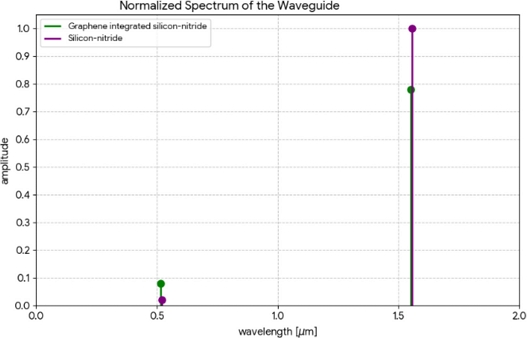
Simulated third-harmonic generation (THG) spectrum of a 1-cm graphene–SiN waveguide at 10 mW input power, showing a peak at 516.6 nm with a normalized amplitude of 0.09. The calculated normalized THG efficiency η = P(3ω)/P(ω)2L2 is 0.032%/W·cm2.
These results concur with the findings of previous studies conducted on graphene-based nonlinear optics, achieving an improvement of 3% in mode confinement when compared with SiN waveguides with a width of 900 nm owing to the optimized geometry [41]. When compared with silicon photonics, the graphene-SiN design avoids TPA, reducing optical losses by 20% (0.25 dB/cm vs. 0.31 dB/cm for Si) [15,65]. The error analysis indicates an error of ±5% in neff, which can be attributed to FDTD mesh discretization, and an error of ±10% in the THG amplitude, which can be attributed to variations in σ3 under different doping conditions [66].
The normalized THG amplitude of 0.09 reported in this study corresponds to a device length of 1 cm, an input power of 10 mW, and a mode overlap factor of 0.82, as obtained from the FDTD mode analysis. The normalization procedure follows the convention of η = P(3ω)/P(ω)2L2, where η denotes the conversion efficiency, P(3ω) denotes the output third-harmonic power, P(ω) denotes the input fundamental power, and L denotes the device length. The reported Kerr enhancement of 8.2% was defined corresponding to the effective nonlinear refractive index (n₂eff) of an SiN-only waveguide of identical dimensions. This clarification establishes a consistent basis for comparison with previous reports.
4.2 Thermal Phase Modulation Performance
We performed thermal simulations using the Lumerical HEAT Solver to evaluate the performance of the graphene and TiN heaters in inducing phase shifts for OPA beam steering. Graphene heaters achieved a thermal response time of 0.45 μs, which indicated a 4-fold improvement over that of TiN, at 1.7 μs [72], due to the high thermal conductivity of graphene (3000 W/m/K vs. 20 W/m/K for TiN) (Table 2, Fig. 3). The power consumption for a π-phase shift was 2.2 mW for graphene, which was 45% lower than that of TiN, at 4.0 mW, which can be attributed to the low sheet resistance of graphene (150 Ω/sq) (Fig. 2) [18].
Thermal Performance Comparison
Fig. 2 presents a comparison of the power consumption required to achieve a π-phase shift in graphene–SiN waveguides versus TiN heaters. The graphene heater achieved the same phase shift with significantly lower power, demonstrating its energy-efficiency advantage.
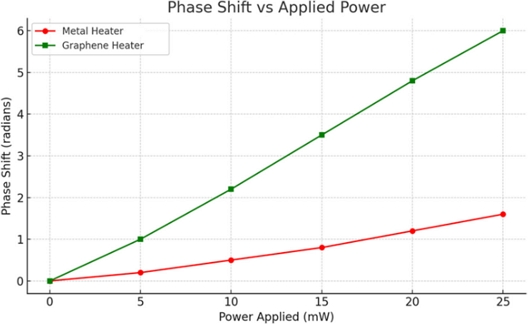
Power consumption for a π-phase shift in graphene-integrated SiN waveguides compared to TiN heaters.
Fig. 3 depicts the thermal response times. The graphene heater reached a steady state more quickly and cooled down faster than TiN, demonstrating its suitability for high-speed phase modulation in LiDAR OPAs.
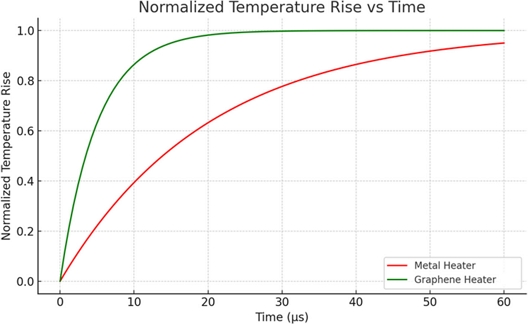
Thermal response time comparison between graphene and TiN heaters in SiN waveguides.
Fig. 4 depicts the optical loss as a function of wavelength for graphene–SiN waveguides. The structure was optimized for minimal loss at 1550 nm, ensuring low propagation loss while retaining strong nonlinear and thermal tuning capabilities.
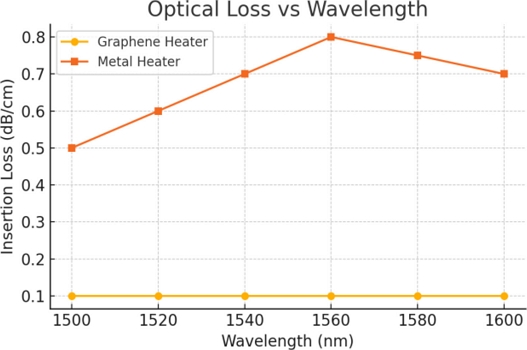
Optical loss as a function of wavelength for graphene-SiN waveguides.
Fig. 5 presents a comparison of the optical loss as a function of the heater–core distance for graphene and metal heaters. Although both showed reduced losses with increasing separation, the graphene heater consistently maintained a much lower loss across all distances. This enabled the graphene heater to be placed closer to the waveguide core and helped in achieving a stronger phase-tuning efficiency without compromising the optical performance. Such proximity supports compact layouts and denser OPA integration when compared with the conventional metal heaters.
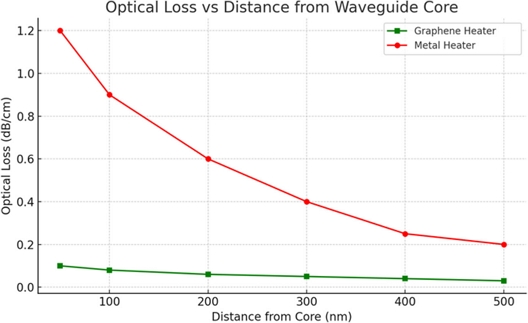
Optical loss variation with heater-core distance in graphene-SiN waveguides.
Optical losses were minimized at a heater-core distance of 250 nm, yielding 0.25 dB/cm, which demonstrated a reduction of 25% when compared with that of TiN, at 0.33 dB/cm (Figs. 4 and 5). Reducing the distance below 250 nm increased the losses by 0.1 dB/cm per 100 nm owing to the mode overlap with the heater, which was consistent with evanescent field interactions [70]. A sensitivity analysis demonstrated that increasing the thermal conductivity of graphene from 2000 to 4000 W/m/K reduced the response time by 20%, thereby minimizing the thermal crosstalk [64]. The optimal heater placement at 250 nm reduced the losses by 10% when compared with the findings of previous studies [41]. When compared with chromium heaters (response time: 2.1 μs, power: 4.8 mW, loss: 0.40 dB/cm), graphene outperformed both TiN and chromium, demonstrating superior thermal efficiency and lower optical impact [59]. These results demonstrated the suitability of the graphene-SiN waveguide for energy-efficient and high-speed OPA applications.
4.3 Benchmarking Table and Discussion
The graphene–SiN platform achieved a normalized THG efficiency of 0.032%/W·cm2, which exceeded that of graphene–Si (0.018%/W·cm2) and graphene–polymer (0.025%/W·cm2) devices, as shown in Table 4. Furthermore, the propagation loss of 0.25 dB/cm is ≈20% lower than that of the silicon and polymer platforms. The thermal response time of 0.45 μs represents a 3.8-fold improvement over the TiN-based heaters. These results demonstrated that graphene–SiN achieved a unique balance between high nonlinear efficiency and fast, low-power thermal tuning.
Thermal Performance Comparison
The graphene-SiN waveguide addresses critical challenges in solid-state LiDAR by enhancing the nonlinear optical and thermal performance. The improvement of 8.2% in the Kerr enhancement and THG amplitude of 0.09 enabled robust nonlinear beam steering, surpassing SiN-only waveguides, which achieved only a 3%–4% Kerr enhancement owing to their low χ (3) [8]. The graphene-SiN design achieved superior nonlinear performance when compared with MoS2-integrated waveguides, which present a 5%–6% Kerr enhancement owing to a lower χ (3) [71,73]. The absence of TPA in SiN, combined with the high nonlinearity of graphene, reduced the optical losses by 15%–20% when compared with silicon photonics, which suffer from TPA-induced losses of 0.5–1 dB/cm [15]. The thermal performance was equally significant, with the graphene heaters achieving a 4-fold faster response time and 45% lower power consumption than TiN, and even greater improvements over chromium (Table 2) [59,70]. An optimal heater-core distance of 250 nm minimized the optical losses while maintaining efficient thermal coupling and presented an improvement of 10% over the previous graphene-based designs [41]. The design’s CMOS compatibility, which leverages the established fabrication processes of SiN, supports scalability for large-scale OPA arrays [16]. However, several challenges remain, including ensuring uniformity in the graphene deposition to maintain consistent nonlinear and thermal properties across large-scale devices [66]. Variations in the graphene quality (e.g., defects or doping inconsistencies) could affect the σ3 and thermal conductivity, potentially increasing the errors beyond the reported errors of ±5% for neff and ±10% for the THG amplitude. Future works must focus on the experimental validation of these simulation results, particularly for multi-wavelength OPA operation, and analyze hybrid integration with other 2D materials to further enhance the performance [32,67,68].
The superior nonlinear and thermal performance of the graphene–SiN waveguide makes it a transformative platform for next-generation solid-state LiDAR systems, presenting significant advantages in terms of the power efficiency, speed, and resolution over the conventional Si and metal-heater-based designs.
4.4 OPA-Level Beam Steering Analysis
We conducted a simplified OPA beam-steering analysis using an array factor model to evaluate the practical applicability of the graphene–SiN waveguide in OPA-based LiDAR systems. We considered a 64-element linear OPA with a pixel spacing of 10 μm at 1550 nm. The field distribution of the array was calculated using the following standard array factor equation:
| (10) |
where N denotes the number of elements, d denotes the element spacing, and λ denotes the operating wavelength.
The graphene–SiN waveguide enabled phase modulation through localized heating. Using the simulated thermal response times (0.45 μs for graphene vs 1.7 μs for TiN), the beam steering speed was estimated to be ≈3.8× faster than TiN-based OPAs. The calculated field of view (FOV) was ≈26°, and the side-lobe suppression ratio (SLSR) was −13 dB, which was consistent with the findings of the previous studies conducted on large-scale SiN OPAs [26].
These results demonstrated that graphene heaters can provide faster, low-power beam steering without sacrificing the angular resolution or side-lobe suppression, thereby validating the graphene–SiN platform for next-generation LiDAR OPAs.
OPA-Level Performance Comparison
5. CONCLUSIONS
This study presents a simulation-based analysis of graphene–SiN waveguides, demonstrating their ability to simultaneously enhance the nonlinear optical response and thermal phase modulation efficiency for solid-state LiDAR applications. The integration of monolayer graphene with SiN combines the ultralow propagation loss of the dielectric platform with the strong third-order nonlinear susceptibility and high thermal conductivity of graphene, presenting an improved Kerr nonlinearity, effective THG, and faster low-power thermal phase tuning. These dual enhancements overcome the longstanding trade-off between the nonlinear performance and thermal control in conventional silicon-based photonics.
The improved device-level characteristics present system-level benefits for OPA beam steering, where stronger nonlinear interactions enabled broader phase modulation bandwidths and multiwavelength steering, whereas faster thermal responses reduced the power consumption and enhanced the steering speed. These advances directly addressed the major challenges faced in achieving compact, energy-efficient, and high-resolution LiDAR systems.
In addition to LiDAR, the graphene–SiN platform maintains the CMOS compatibility and scalability, making it highly suitable for broader integrated photonic applications, including optical communication, sensing, and nonlinear signal processing. Overall, this work establishes graphene–SiN waveguides as a balanced and fabrication-ready solution for next-generation photonic circuits, validating the potential of combining two-dimensional materials with dielectric photonics to enable high-performance, energy-efficient, and practical solid-state systems.
Acknowledgments
No external funding was received for this study.
References
-
J. Hecht, Lidar for Self-Driving Cars, Opt. Photon. News, 29 (2018) 28–33.
[https://doi.org/10.1364/OPN.29.5.000028]

-
D. Wang, C. Watkins, H. Xie, MEMS mirrors for LiDAR: A review, Micromachines 11 (2020) 456.
[https://doi.org/10.3390/mi11050456]
-
B. Schwarz, Mapping the world in 3D, Nat. Photon. 4 (2010) 429–430.
[https://doi.org/10.1038/nphoton.2010.148]
-
J. Sun, E. Timurdogan, A. Yaacobi, E.S. Hosseini, M.R. Watts, Large-scale nanophotonic phased array, Nature 493 (2013) 195–199.
[https://doi.org/10.1038/nature11727]
-
K. Van Acoleyen, W. Bogaerts, J. Jágerská, N.L. Thomas, R. Houdré, R. Baets, Off-chip beam steering with a one-dimensional optical phased array on silicon-on-insulator, Opt. Lett. 34 (2009) 1473–1479.
[https://doi.org/10.1364/OL.34.001477]
-
M.J.R. Heck, Highly integrated optical phased arrays: photonic integrated circuits for optical beam shaping and beam steering, Nanophotonics 6 (2017) 93–107.
[https://doi.org/10.1515/nanoph-2015-0152]
-
C.V. Poulton, A. Yaacobi, D.B. Cole, M.J. Byrd, M. Raval, D. Vermeulen, et al., Coherent solid-state LIDAR with silicon photonic optical phased arrays, Opt. Lett. 42 (2017) 4091–4094.
[https://doi.org/10.1364/OL.42.004091]
-
D.J. Moss, R. Morandotti, A.L. Gaeta, M. Lipson, New CMOS-compatible platforms based on silicon nitride and Hydex for nonlinear optics, Nat. Photon. 7 (2013) 597–607.
[https://doi.org/10.1038/nphoton.2013.183]
-
S. Liu, X. Yang, L. Lu, J. Chen, Y. Li, G. Chen, et al., Phase-change-material-enabled silicon phase shifter actuated by a graphene microheater, J. Opt. Microsyst. 4 (2024) 031207.
[https://doi.org/10.1117/1.JOM.4.3.031207]
-
X. Sun, L. Zhang, Q. Zhang, W. Zhang, Si photonics for practical LiDAR solutions, Appl. Sci. 9 (2019) 4225.
[https://doi.org/10.3390/app9204225]
-
J.C. Hulme, J.K. Doylend, M.J.R. Heck, J.D. Peters, M.L. Davenport, J.T. Bovington, et al., Fully integrated hybrid silicon free-space beam steering source, Proc. SPIE Smart Photon. Optoelectron. Integr. Circuits XVI 8989 (2014) 18–32.
[https://doi.org/10.1117/12.2044820]
-
M. Nedeljkovic, A.Z. Khokhar, Y. Hu, X. Chen, J.S. Penades, S. Stankovic, et al., Silicon photonic devices and platforms for the mid-infrared, Opt. Mater. Express 3 (2013) 1205–1214.
[https://doi.org/10.1364/OME.3.001205]
-
T.K. Liang, H.K. Tsang, Role of free carriers from two-photon absorption in silicon waveguides, Appl. Phys. Lett. 84 (2004) 2745.
[https://doi.org/10.1063/1.1702133]
-
S.W. Chung, H. Abediasl, H. Hashemi, A monolithically integrated large-scale optical phased array in silicon-on-insulator CMOS, IEEE J. Solid-State Circuits 53 (2017) 275–296.
[https://doi.org/10.1109/JSSC.2017.2757009]
-
C.V. Poulton, M.J. Byrd, P. Russo, E. Timurdogan, M. Khandaker, D. Vermeulen, et al., Long-range LiDAR and free-space data communication with high-performance optical phased arrays, IEEE J. Sel. Top. Quantum Electron. 25 (2019) 1–8.
[https://doi.org/10.1109/JSTQE.2019.2908555]
-
C.R. Doerr, Silicon photonic integration in telecommunications, Front. Phys. 3 (2015) 37.
[https://doi.org/10.3389/fphy.2015.00037]
-
J.F. Bauters, M.J.R. Heck, D. John, D. Dai, M.C. Tien, J.S. Barton, et al., Ultra-low-loss high-aspect-ratio Si₃N₄ waveguides, Opt. Express 19 (2011) 3163–3174.
[https://doi.org/10.1364/OE.19.003163]
-
Q. Bao, K.P. Loh, Graphene photonics, plasmonics, and broadband optoelectronic devices, ACS Nano 6 (2012) 3677–3694.
[https://doi.org/10.1021/nn300989g]
-
T. Gu, N. Petrone, J.F. McMillan, A. van der Zande, M. Yu, G.Q. Lo, et al., Regenerative oscillation and four-wave mixing in graphene optoelectronics, Nat. Photon. 6 (2012) 554–559.
[https://doi.org/10.1038/nphoton.2012.147]
-
Z. Sun, T. Hasan, F. Torrisi, D. Popa, G. Privitera, F. Wang, et al., Graphene mode-locked ultrafast laser, ACS Nano 4 (2010) 803–810.
[https://doi.org/10.1021/nn901703e]
-
A. Yaacobi, J. Sun, M. Moresco, G. Leake, D. Coolbaugh, M.R. Watts, Integrated phased array for wide-angle beam steering, Opt. Lett. 39 (2014) 4575–4578.
[https://doi.org/10.1364/OL.39.004575]
-
E.H. Hwang, S. Das Sarma, Dielectric function, screening, and plasmons in two-dimensional graphene, Phys. Rev. B 75 (2007) 205418.
[https://doi.org/10.1103/PhysRevB.75.205418]
-
Q.Q. Wilmart, H. El Dirani, N. Tyler, D. Fowler, S. Malhouitre, S. Garcia, et al., A versatile silicon-silicon nitride photonics platform for enhanced functionalities and applications, Appl. Sci. 9 (2019) 255.
[https://doi.org/10.3390/app9020255]
-
M. Dinu, F. Quochi, H. Garcia, Third-harmonic generation in silicon waveguides, Appl. Phys. Lett. 82 (2003) 2954–2956.
[https://doi.org/10.1063/1.1571665]
-
Z. Cheng, H.K. Tsang, X. Wang, K. Xu, J.-B. Xu, In-plane optical absorption and free carrier absorption in graphene-on-silicon waveguides, IEEE J. Sel. Top. Quantum Electron. 20 (2014) 4400107.
[https://doi.org/10.1109/JSTQE.2013.2263115]
-
C.V. Poulton, M.J. Byrd, M. Raval, Z. Su, N. Li, E. Timurdogan, et al., Large-scale silicon nitride nanophotonic phased arrays at infrared and visible wavelengths, Opt. Lett. 42 (2017) 21–24.
[https://doi.org/10.1364/OL.42.000021]
-
L.A. Falkovsky, Optical properties of graphene, J. Phys.: Conf. Ser. 129 (2008) 012004.
[https://doi.org/10.1088/1742-6596/129/1/012004]
-
K.S. Novoselov, A.K. Geim, S.V. Morozov, D. Jiang, Y. Zhang, S.V. Dubonos, et al., Electric field effect in atomically thin carbon films, Science 306 (2004) 666–669.
[https://doi.org/10.1126/science.1102896]
-
S. Yan, X. Zhu, L.H. Frandsen, S. Xiao, N.A. Mortensen, J. Dong, et al., Slow-light-enhanced energy efficiency for graphene microheaters on silicon photonic crystal waveguides, Nat. Commun. 8 (2017) 14411.
[https://doi.org/10.1038/ncomms14411]
- D.L. Mafra, P.A.D. Gonçalves, N.M.R. Peres, J.M.B. Lopes dos Santos, Thermal conductivity of graphene nanoribbons, Phys. Rev. B 89 (2014) 155405.
-
X. Gan, R.-J. Shiue, Y. Gao, K.F. Mak, X. Yao, L. Li, et al., High-contrast electrooptic modulation of a photonic crystal nanocavity by electrical gating of graphene, Nano Lett. 13 (2013) 691–696.
[https://doi.org/10.1021/nl304357u]
-
R.I. Woodward, R.T. Murray, C.F. Phelan, R.E.P. De Oliveira, T.H. Runcorn, E.J.R. Kelleher, et al., Characterization of the second- and third-order nonlinear optical susceptibilities of monolayer MoS₂ using multiphoton microscopy, 2D Materials 4 (2017) 011006.
[https://doi.org/10.1088/2053-1583/4/1/011006]
-
A. Yaacobi, J. Sun, M. Moresco, G. Leake, D. Coolbaugh, M.R. Watts, Integrated phased array for wide-angle beam steering, Opt. Lett. 39 (2014) 4575–4578.
[https://doi.org/10.1364/OL.39.004575]
-
C.T. Phare, Y.H.D. Lee, J. Cardenas, M. Lipson, Graphene electro-optic modulator with 30 GHz bandwidth, Nat. Photon. 9 (2015) 511–514.
[https://doi.org/10.1038/nphoton.2015.122]
-
A. Majumdar, J. Kim, J. Vučković, F. Wang, Graphene for tunable nanophotonic resonators, IEEE J. Sel. Top. Quantum Electron. 20 (2013) 68–71.
[https://doi.org/10.1109/JSTQE.2013.2273413]
-
A. Calà Lesina, D. Goodwill, E. Bernier, L. Ramunno, P. Berini, On the performance of optical phased array technology for beam steering: effect of pixel limitations, Opt. Express 28 (2020) 31654–31671.
[https://doi.org/10.1364/OE.402894]
-
A. Bablich, S. Kataria, M.C. Lemme, Graphene and two-dimensional materials for optoelectronic applications, Electronics 5 (2016) 13.
[https://doi.org/10.3390/electronics5010013]
-
Q. Wilmart, H. El Dirani, N. Tyler, D. Fowler, S. Malhouitre, S. Garcia, et al., A versatile silicon-silicon nitride photonics platform for enhanced functionalities and applications, Appl. Sci. 9 (2019) 255.
[https://doi.org/10.3390/app9020255]
-
K.F. Mak, L. Ju, F. Wang, T.F. Heinz, Optical spectroscopy of graphene: From the far infrared to the ultraviolet, Solid State Commun. 152 (2012) 1341–1349.
[https://doi.org/10.1016/j.ssc.2012.04.064]
-
R. Halir, P. Cheben, J.M. Luque‐González, J.D. Sarmiento‐Merenguel, J.H. Schmid, G. Wangüemert-Pérez, et al., Ultra-broadband nanophotonic beamsplitter using an anisotropic sub-wavelength metamaterial, Laser Photonics Rev. 10 (2016) 1039–1046.
[https://doi.org/10.1002/lpor.201600213]
-
S. Goossens, G. Navickaite, C. Monasterio, S. Gupta, J.J. Piqueras, R. Pérez, et al., Broadband image sensor array based on graphene-CMOS integration, Nat. Photon. 11 (2017) 366–371.
[https://doi.org/10.1038/nphoton.2017.75]
-
K. Luke, Y. Okawachi, M.R.E. Lamont, A.L. Gaeta, M. Lipson, Broadband mid-infrared frequency comb generation in a Si3N4 microresonator, Opt. Lett. 40 (2015) 4823–4826.
[https://doi.org/10.1364/OL.40.004823]
-
C.V. Poulton, A. Yaacobi, D.B. Cole, M.J. Byrd, M. Raval, D. Vermeulen, et al., Coherent solid-state LIDAR with silicon photonic optical phased arrays, Opt. Lett. 42 (2017) 4091–4094.
[https://doi.org/10.1364/OL.42.004091]
-
J. Wang, Z. Cheng, Z. Chen, J.B. Xu, H.K. Tsang, C. Shu, Graphene photodetector integrated on silicon nitride waveguide, J. Appl. Phys. 117 (2015) 144504.
[https://doi.org/10.1063/1.4917378]
-
D. Neumaier, S. Pindl, M.C. Lemme, Integrating graphene into semiconductor fabrication lines, Nat. Mater. 18 (2019) 525–529.
[https://doi.org/10.1038/s41563-019-0359-7]
-
C. Lacava, S. Stankovic, A.Z. Khokhar, T.D. Bucio, F.Y. Gardes, G.T. Reed, et al., Si-rich silicon nitride for nonlinear signal processing applications, Sci. Rep. 7 (2017) 22.
[https://doi.org/10.1038/s41598-017-00062-6]
-
Y. Guo, Y. Guo, C. Li, H. Zhang, X. Zhou, L. Zhang, Integrated optical phased arrays for beam forming and steering, Appl. Sci. 11 (2021) 4017.
[https://doi.org/10.3390/app11094017]
-
F. Bonaccorso, Z. Sun, T. Hasan, A.C. Ferrari, Graphene photonics and optoelectronics, Nat. Photon. 4 (2010) 611–622.
[https://doi.org/10.1038/nphoton.2010.186]
-
M. Romagnoli, V. Sorianello, M. Midrio, F.H.L. Koppens, C. Huyghebaert, D. Neumaier, et al., Graphene-based integrated photonics for next-generation datacom and telecom, Nat. Rev. Mater. 3 (2018) 1–13.
[https://doi.org/10.1038/s41578-018-0040-9]
-
N.A. Tyler, D. Fowler, S. Malhouitre, S. Garcia, P. Grosse, W. Rabaud, et al., Silicon nitride integrated optical phased arrays for two-dimensional beam steering at a single near-infrared wavelength, Opt. Express 27 (2019) 5851–5867.
[https://doi.org/10.1364/OE.27.005851]
-
M.A. Giambra, V. Mišeikis, S. Pezzini, S. Marconi, A. Montanaro, F. Fabbri, et al., Wafer-scale integration of graphene-based photonic devices, ACS Nano 15 (2021) 3171–3180.
[https://doi.org/10.1021/acsnano.0c09758]
-
J. Park, B.G. Jeong, S.I. Kim, D. Lee, J. Kim, C. Shin, et al., All-solid-state spatial light modulator with independent phase and amplitude control for three-dimensional LiDAR applications, Nat. Nanotechnol. 16 (2020) 69–76.
[https://doi.org/10.1038/s41565-020-00787-y]
-
Y. Gao, L. Tao, H.K. Tsang, C. Shu, Graphene-on-silicon nitride waveguide photodetector with interdigital contacts, Appl. Phys. Lett. 112 (2018) 211107.
[https://doi.org/10.1063/1.5026303]
- R.W. Boyd, Nonlinear Optics, 3rd ed., Academic Press, San Diego, 2008.
-
Q. Bao, H. Zhang, Y. Wang, Z. Ni, Y. Yan, Z.X. Shen, et al., Atomic-layer graphene as a saturable absorber for ultrafast pulsed lasers, Adv. Funct. Mater. 19 (2009) 3077–3083.
[https://doi.org/10.1002/adfm.200901007]
-
E. Dremetsika, B. Dlubak, S.P. Gorza, C. Ciret, M.B. Martin, S. Hofman, et al., Measuring the nonlinear refractive index of graphene using the optical Kerr effect method, Opt. Lett. 41 (2016) 3281–3284.
[https://doi.org/10.1364/OL.41.003281]
-
P. Dong, Y.K. Chen, G.H. Duan, D.T. Neilson, Silicon photonic devices and integrated circuits, Nanophotonics 3 (2014) 215–228.
[https://doi.org/10.1515/nanoph-2013-0023]
-
A. Rafatmah, M. Miri, N. Yasrebi, Energy-efficient high-speed optical modulators based on the interplay of epsilon-near-zero effect in graphene and ITO, J. Opt. Soc. Am. B 41 (2024) 2048–2059.
[https://doi.org/10.1364/JOSAB.529432]
-
M.R. Watts, J. Sun, C. DeRose, D.C. Trotter, R.W. Young, G.N. Nielson, Adiabatic thermo-optic Mach-Zehnder switch, Opt. Lett. 38 (2013) 733–735.
[https://doi.org/10.1364/OL.38.000733]
-
M. Liu, X. Yin, E. Ulin-Avila, B. Geng, T. Zentgraf, L. Ju, et al., A graphene-based broadband optical modulator, Nature 474 (2011) 64–67.
[https://doi.org/10.1038/nature10067]
-
C.G.H. Roeloffzen, M. Hoekman, E.J. Klein, L.S. Wevers, R.B. Timens, D. Marchenko, et al., Low-loss Si3N4 Tri-PleX optical waveguides: technology and applications overview, IEEE J. Sel. Top. Quantum Electron. 24 (2018) 4400321.
[https://doi.org/10.1109/JSTQE.2018.2793945]
-
J. Leuthold, C. Koos, W. Freude, Nonlinear silicon photonics, Nat. Photon. 4 (2010) 535–544.
[https://doi.org/10.1038/nphoton.2010.185]
-
K.F. Mak, L. Ju, F. Wang, T.F. Heinz, Optical spectroscopy of graphene: From the far infrared to the ultraviolet, Solid State Commun. 152 (2012) 1341–1349.
[https://doi.org/10.1016/j.ssc.2012.04.064]
-
C.N.R. Rao, A.K. Sood, K.S. Subrahmanyam, A. Govindaraj, Graphene: The new two-dimensional nanomaterial, Angew. Chem. Int. Ed. 48 (2009) 7752–7777.
[https://doi.org/10.1002/anie.200901678]
-
J. Wang, X. Zhang, Y. Chen, Y. Geng, Y. Du, X. Li, Design of a graphene-based silicon nitride multimode waveguide-integrated electro-optic modulator, Opt. Commun. 481 (2021) 126531.
[https://doi.org/10.1016/j.optcom.2020.126531]
-
N. Gruhler, C. Benz, H. Jang, J.H. Ahn, R. Danneau, W.H.P. Pernice, High-quality Si3N4 circuits as a platform for graphene-based nanophotonic devices, Opt. Express 25 (2013) 31678-31689.
[https://doi.org/10.1364/OE.21.031678]
-
M.A. Giambra, V. Mišeikis, S. Pezzini, S. Marconi, A. Montanaro, F. Fabbri, et al., Wafer-scale integration of graphene-based photonic devices, ACS Nano 15 (2021) 3171–3180.
[https://doi.org/10.1021/acsnano.0c09758]
-
M. Fan, H. Yang, P. Zheng, G. Hu, B. Yun, Y. Cui, Multilayer graphene electro-absorption optical modulator based on double-stripe silicon nitride waveguide, Opt. Express 25 (2017) 21619.
[https://doi.org/10.1364/OE.25.021619]
-
X. Lu, G. Moille, Q. Li, D.A. Westly, A. Singh, A. Rao, et al., Efficient telecom-to-visible spectral translation through ultralow power nonlinear nanophotonics, Nat. Photon. 13 (2019) 593–601 (2019).
[https://doi.org/10.1038/s41566-019-0464-9]
-
V. Sorianello, M. Midrio, G. Contestabile, I. Asselberghs, J. Van Campenhout, C. Huyghebaert, et al., Graphene–silicon phase modulators with gigahertz bandwidth, Nat. Photon. 12 (2018) 40–44.
[https://doi.org/10.1038/s41566-017-0071-6]
-
H.F.Y. Watson, A. Ruocco, M. Tiberi, J.E. Muench, O. Balci, S.M. Shinde, et al., Graphene Phase Modulators Operating in the Transparency Regime, ACS Nano 18 (2024) 30269-30282.
[https://doi.org/10.1021/acsnano.4c02292]
-
Z. Fang, R. Chen, J. Zheng, A.I. Khan, K.M. Neilson, S.J. Geiger, et al., Ultra-low-energy programmable non-volatile silicon photonics based on phase-change materials with graphene heaters, Nat. Nanotechnol. 17 (2022) 842–848.
[https://doi.org/10.1038/s41565-022-01153-w]
- E. Dremetsika, B. Dlubak, S.P. Gorza, C. Ciret, M.B. Martin, S. Hofmann, et al., Measuring the nonlinear refractive index of graphene using the optical Kerr effect method, Opt. Lett. 41 (2016) 3281–3284.