
Strain-Insensitive Pressure Sensing Mechanism Enabled by Dissimilar Materials with Highly Contrasting Properties
ⓒ The Korean Sensors Society
This is an Open Access article distributed under the terms of the Creative Commons Attribution Non-Commercial License (https://creativecommons.org/licenses/by-nc/3.0/) which permits unrestricted non-commercial use, distribution, and reproduction in any medium, provided the original work is properly cited.
Abstract
Stretchable pressure sensors face a critical challenge where mechanical strain interferes with pressure sensing accuracy, limiting their practical deployment in wearable electronics and soft robotics. This paper presents a novel strain-insensitive pressure sensing mechanism enabled by dissimilar materials with highly contrasting properties. The sensor employs a highly stretchable elastomer as the overall substrate and CNT-dispersed elastomer with relatively higher modulus at sensing points, creating a configuration where strain occurs only in the periphery while sensing regions remain mechanically stable. Liquid metal electrodes enable signal transmission without distortion under mechanical deformation. Material characterization revealed that liquid metal exhibits negligible resistance changes under strain, while CNT-based conductive polymers demonstrate significant piezoresistive responses to pressure. Performance evaluation under simultaneous strain and pressure conditions verified consistent piezoresistive properties regardless of applied strain levels, validating the strain-insensitive mechanism. The fabrication process utilizes simple molding, coating, and patterning techniques with readily available materials, making it highly suitable for mass production. This approach enables accurate pressure measurements in dynamic environments while maintaining excellent mechanical robustness, opening pathways for advanced tactile sensing applications in prosthetics, human-machine interfaces, and soft robotics, where both spatial resolution and strain insensitivity are essential.
Keywords:
Pressure sensing mechanism, Strain-insensitivity, Liquid metal, Carbon nanotube, Conductive elastomer1. INTRODUCTION
The rapid advancement of wearable electronics and soft robotics has created an unprecedented demand for stretchable pressure sensors that can seamlessly integrate with curved, dynamic surfaces [1,2]. Stretchable pressure sensors play a pivotal role in offering numerous advantages over their rigid counterparts in terms of comfort, wearability, and conformity to deformable surfaces [3-5]. These adaptive sensors are essential for applications ranging from wearable health monitoring and prosthetic electronic skins to technologies such as soft robotics and human–machine interaction [4-6].
Owing to the significant demand for stretchable pressure sensors, various sensing mechanisms have been developed, including piezoresistive approaches [5,7,8]. However, existing stretchable pressure sensors have an inherent limitation: stretching interference with pressure sensing accuracy [3,9]. When human bodies and soft robots perform movements with substantial deformations generated on their skin, longitudinal strain always causes normal compression, similar to the deformation from normal pressure. This phenomenon significantly complicates the application of such sensors for quantitative pressure measurements under various strain states [3,10,11]. Therefore, one of the most critical challenges in enabling the practical deployment of stretchable pressure sensors is strain-insensitivity or strain-unperturbed sensing where both pressure and strain are simultaneously present [10,11].
Researchers have developed various strategies to mitigate strain interference in pressure sensors, each with distinct advantages and limitations. One prominent approach involves structural design modifications, such as implementing serpentine electrode patterns or specialized microarchitectures that can accommodate strain while minimizing its impact on pressure sensing. These geometric solutions work by redistributing mechanical stress and maintaining relatively stable electrical pathways during deformation [6,12,13]. Another significant solution category focuses on material engineering approaches. Researchers have explored strain-insensitive conductive materials, including liquid metal composites, hierarchical conductive networks, and specialized polymer blends, to maintain stable electrical properties under mechanical deformation [3,14-16]. Pre-strain methods, where sensors are fabricated under initial tension to reduce sensitivity to subsequent strain variations, have also been employed [17]. Advanced fabrication strategies have emerged as another approach for achieving strain insensitivity. These include creating rigid sensing islands embedded in soft substrates, implementing dual-layer sensing architectures, and developing composite structures that physically separate pressure-sensitive regions from strain-affected areas [18]. Multi-modal sensing approaches have also been investigated, where separate sensors for strain and pressure are integrated to enable signal compensation and independent measurement capabilities [10,11,19].
Despite such innovative research, current strain-insensitive pressure sensor technologies face significant barriers to practical commercialization. A major challenge lies in the complex fabrication processes required for many advanced designs, which limit scalability and increase manufacturing costs, thereby making widespread adoption difficult. These intricate manufacturing steps are not only expensive but also hinder mass production and standardization [20]. Therefore, there is a critical need to develop sensors that can be easily manufactured using simple fabrication processes. The development of straightforward and cost-effective manufacturing approaches is essential for the practical implementation and widespread deployment of strain-insensitive pressure sensors in real-world applications.
To address these limitations, this paper proposes a strain-insensitive pressure sensing mechanism enabled by dissimilar materials with highly contrasting properties. The core innovation lies in utilizing materials with dramatically different elastic moduli, electrical conductivities, and electromechanical coupling behaviors to create a sensing architecture in which strain-induced effects are inherently suppressed. We employed highly soft polydimethylsiloxane (PDMS) to construct the overall structure while positioning a conductive polymer composite consisting of CNT-dispersed PDMS with a relatively higher modulus at the sensing points. In this configuration, when the entire structure is stretched, strain occurs only in the periphery composed of soft PDMS, while mechanical deformation does not occur at the sensing points made of relatively rigid materials. Consequently, stretching deformation has no effect on the electromechanical properties of the sensing points. Conversely, because the sensing points are also composed of conductive elastomers, when pressure is applied to these regions, a reduction in thickness occurs in the vertical direction. In this case, the resistance of the sensing points decreases as the distance between the top and bottom surfaces decreases. In this study, to read these strain-insensitive piezoresistive characteristics without signal distortion due to deformation, liquid metal was applied to both surfaces of the sensor and used as signal electrodes. Although liquid metal electrodes are also placed on the soft PDMS where strain occurs, they do not cause signal distortion under mechanical deformation because the resistance change is negligible, even when strain occurs. Furthermore, although the proposed sensor utilizes dissimilar materials, its fabrication process is very simple, making it suitable for future practical applications. This study analyzed the material selection methodology for the proposed strain-insensitive pressure sensor and evaluated whether it possesses characteristics suitable for sensor development. In addition, a straightforward fabrication process is described. Finally, the performance of the fabricated sensor was evaluated, and the superiority of this technology is discussed.
2. DESIGN CONCEPT OF STRAIN-INDEPENDENT PRESSURE SENSOR
2.1 Fundamental operating principles
The sensor developed in this study consists of a highly stretchable elastomer that forms the overall structure, a high-modulus conductive elastomer that constitutes the pressure-sensing component, and liquid metal electrodes for electrical signal transmission. The structure of the strain-insensitive pressure sensing mechanism is shown in Fig. 1. First, the conductive elastomer is interfaced with a highly stretchable elastomer in the region where sensing is desired. Because both conductive and highly stretchable elastomers are composed of silicone, they can maintain stable bonding, even when stretching occurs. The conductive elastomer consists of a silicone elastomer with dispersed carbon nanotubes (CNTs) and possesses a relatively higher modulus compared to the highly stretchable elastomer. Additionally, liquid metal electrodes are positioned on the top and bottom surfaces of the conductive elastomer and are utilized for signal transmission to measure the resistance of the conductive elastomer. In this case, the resistance between the top and bottom surfaces of the conductive elastomer is expressed by Eq. (1). The resistance of the liquid metal electrodes is negligible compared to that of the conductive elastomer because of its significantly lower value [21].
| (1) |
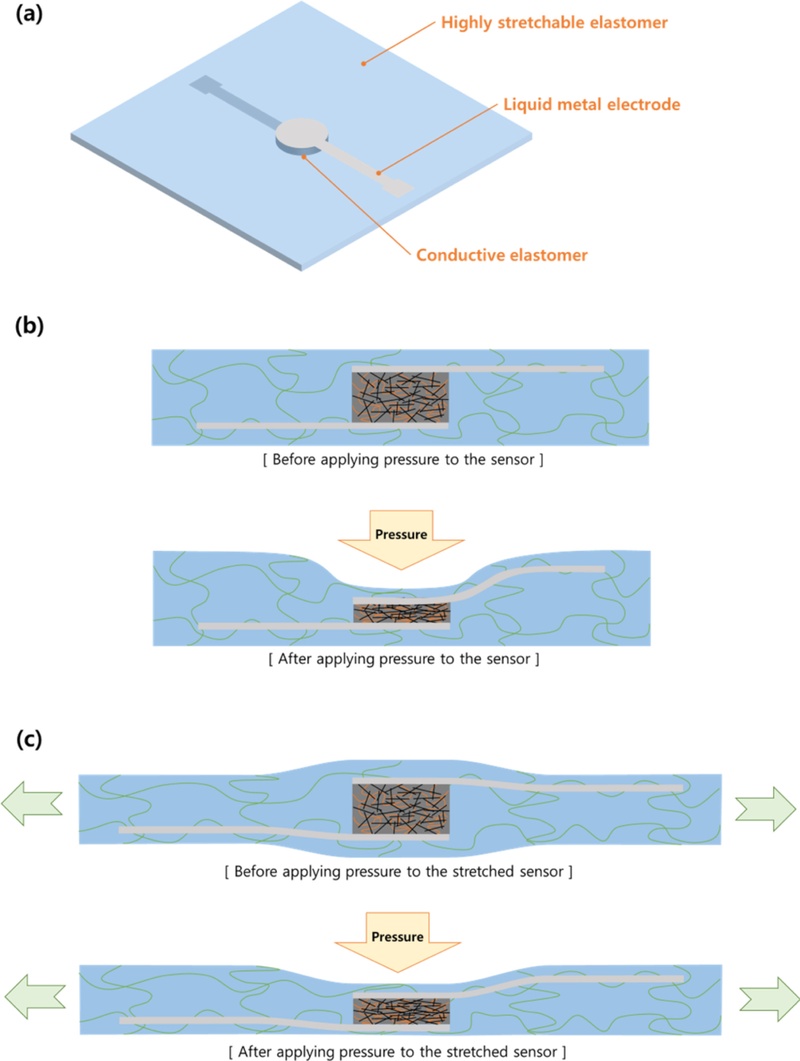
Working principle of the strain-insensitive pressure sensing mechanism. (a) Structure of the sensor. (b) Pressure sensing mechanism without stretching. (c) Pressure sensing mechanism with stretching.
where R is the resistance of the conductive elastomer, ρ is its resistivity, t is its thickness, and A is its area.
The operating principle of the strain-insensitive pressure sensing mechanism is illustrated in Fig. 1. First, when pressure is applied to the sensing area without strain, the thickness of the conductive elastomer decreases. In this case, the resistance between the top and bottom surfaces decreases according to Eq. (1). In contrast, when the overall structure of the sensor is stretched, no deformation occurs in the sensing area, which possesses a relatively high modulus, while strain occurs in the remaining regions composed of low-modulus and highly stretchable elastomer. Therefore, because the mechanical deformation in the sensing area is minimal, a negligible change in resistance occurs. When pressure is applied while the sensor is stretched, a change in resistance occurs as the thickness of the sensing area decreases, similar to the situation without stretching. This resistance change signal can be transmitted by the liquid metal. Because liquid metal exhibits minimal resistance change under mechanical deformation, it can transmit signals without distortion. This strain-insensitive pressure sensing mechanism is made possible by using two elastic materials with contrasting mechanical properties, combined with a liquid metal that possesses electrically contrasting characteristics to the conductive elastomer. The strain-insensitive pressure sensor fabricated based on this operating principle is shown in Fig. 2.
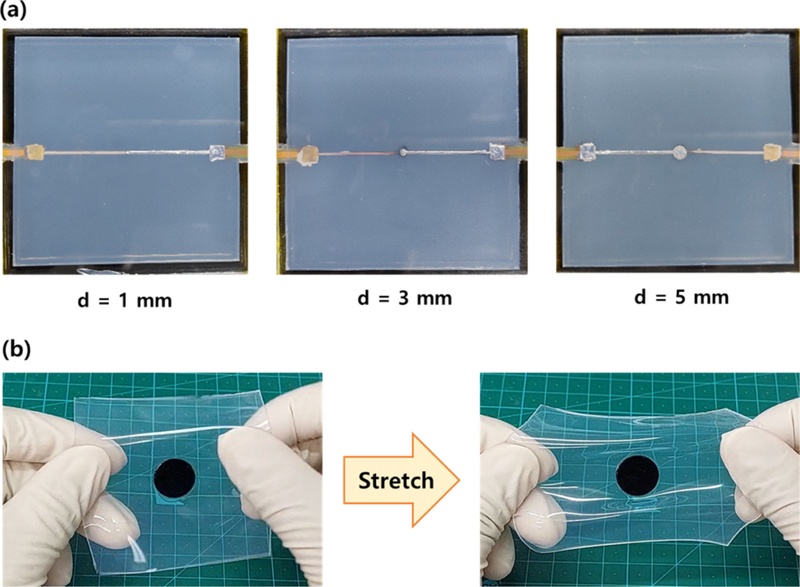
Fabricated strain-insensitive pressure sensor. (a) Fabricated sensor with various dimensions. (b) Strain-insensitive property of sensing area.
2.2 Fabrication methodology
The fabrication process of the strain-insensitive pressure sensor is illustrated in Fig. 3. First, a mold was fabricated to cure a highly stretchable elastomer. At this stage, the mold should be designed to create an empty space in the sensing area, and in this study, the mold was fabricated with a thickness of 1 mm. The size of the sensing area can be adjusted according to the sensor’s application. Next, the pre-polymer of the highly stretchable elastomer was stirred, degassed, poured into the mold, and bar-coated. After curing the polymer for 1 h, the cured, highly stretchable elastomer was detached from the mold and placed on a glass substrate. To fabricate a conductive polymer that fills the empty sensing area, CNTs and a silicone pre-polymer with a relatively high modulus were prepared. In this study, 5 wt% CNTs were added to the silicone pre-polymer and stirred. After sufficient mixing, the mixture was vacuum-degassed, used to fill the sensing area, and bar-coated. The conductive polymer was cured at 100°C for 1 h. The mechanical moduli of the highly stretchable and conductive elastomers used in this study are listed in Table 1 [22,23].
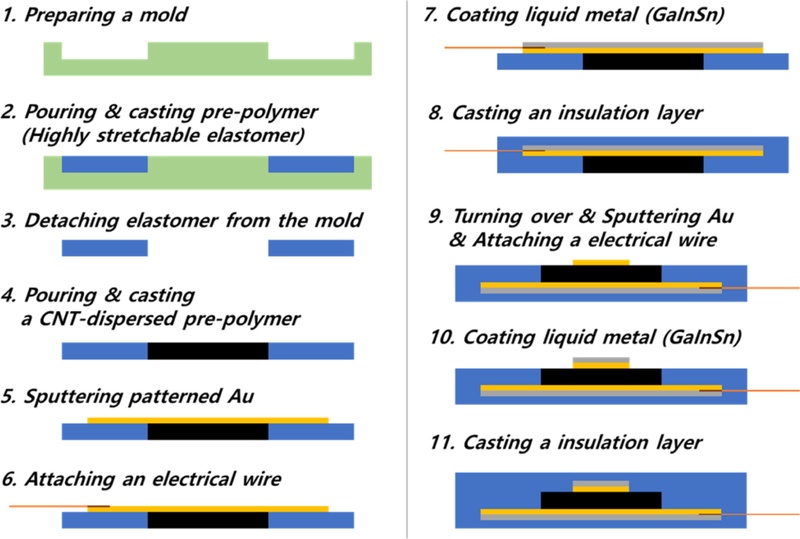
Fabrication process of the strain-insensitive pressure sensor

Mechanical moduli of the elastomeric materials
After the conductive polymer is cured, liquid metal electrodes for signal transmission must be patterned on both the top and bottom surfaces. However, because silicone elastomers have extremely low surface energy, they exhibit poor adhesion with liquid metal. Therefore, a process was conducted in which Au was first coated as an intermediate layer for adhesion, followed by coating the liquid metal on top. For Au coating, a shadow mask suitable for the sensing area and electrode width of 1 mm was fabricated and placed on the sample. Subsequently, Au was coated to a thickness of 50 nm using a sputtering machine. After removing the shadow mask, connection wires for interfacing with external electronic systems were attached to the Au electrodes using silver paste. Subsequently, the shadow mask was repositioned according to the pattern, and GaInSn liquid metal electrodes were applied using a brush. Finally, the shadow mask was removed, and an insulation layer was added by blade-casting the pre-polymer of the highly stretchable elastomer to a thickness of 1 mm. The same electrode patterning and insulation layer coating were then repeated on the opposite side to complete sensor fabrication.
This fabrication process is very simple because it enables the implementation of a strain-insensitive pressure-sensing mechanism without requiring special chemical treatments or complex electrode patterning processes. Additionally, because the materials used are not diverse, low-cost fabrication is possible. Therefore, even if this approach is adopted in future manufacturing processes, it can be considered highly viable.
3. CHARACTERIZATION OF STRAIN-INDEPENDENT PRESSURE SENSOR
3.1 Strain-resistance relationships of various conductive materials
To understand the electromechanical properties of the materials used in the strain-insensitive pressure sensing mechanism, we tested the relationship between the strain and resistance of various electrode materials. We tested Au as a conventional metal electrode, CNT as a conductive polymer filler, and GaInSn as a highly stretchable electrode. The tests were conducted by coating each material onto a highly stretchable elastomer, applying strain, and measuring the corresponding resistance. The sample electrodes were coated at a width of 5 mm and length of 50 mm, and the resistance change between both ends of the electrodes was measured while stretching up to 100% strain. The experimental setup is shown in Fig. 4.
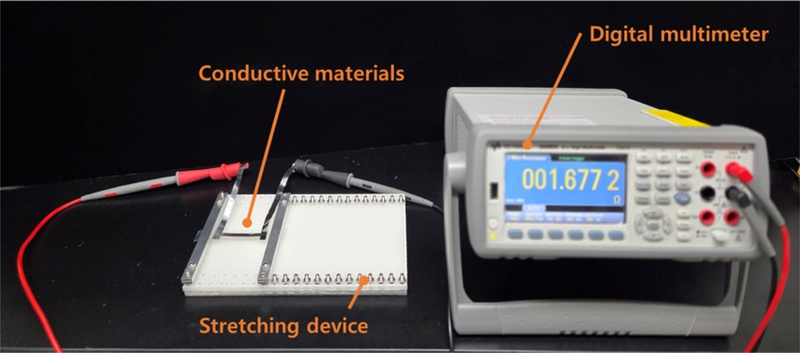
Experimental setup for strain-resistance characterization of various conductive materials
The electrode conditions and resistance changes according to strain for various conductive materials are shown in Fig. 5. As can be seen from the experimental results, Au does not possess stretchability. Many disconnected regions occurred as tensile strain was applied, resulting in a rapid increase in resistance. Additionally, CNT electrodes, which possess stretchability based on a nano mesh structure, showed no electrode damage owing to tensile strain. However, resistance gradually increases as the strain increases. This phenomenon is commonly observed in nano conductive materials, where the number of electrical connections decreases as tensile strain occurs [24]. Finally, in the case of liquid metal used as the signal transmission electrode, the resistance change was minimal, even when tensile strain was applied. This is because the intrinsic resistance of liquid metal is very low, and even when deformation occurs owing to tensile strain, the conductive path is continuously maintained. Therefore, no significant change in resistance occurred. This means that the influence of the liquid metal electrode resistance on the conductive polymer resistance was negligible. Therefore, it can be concluded that it is highly desirable to use CNT, which exhibits high resistance change with mechanical deformation, as a filler in conductive polymers. Moreover, it is appropriate to use liquid-metal electrodes, which can maintain a very low resistance even under stretching conditions, as signal transmission electrodes.
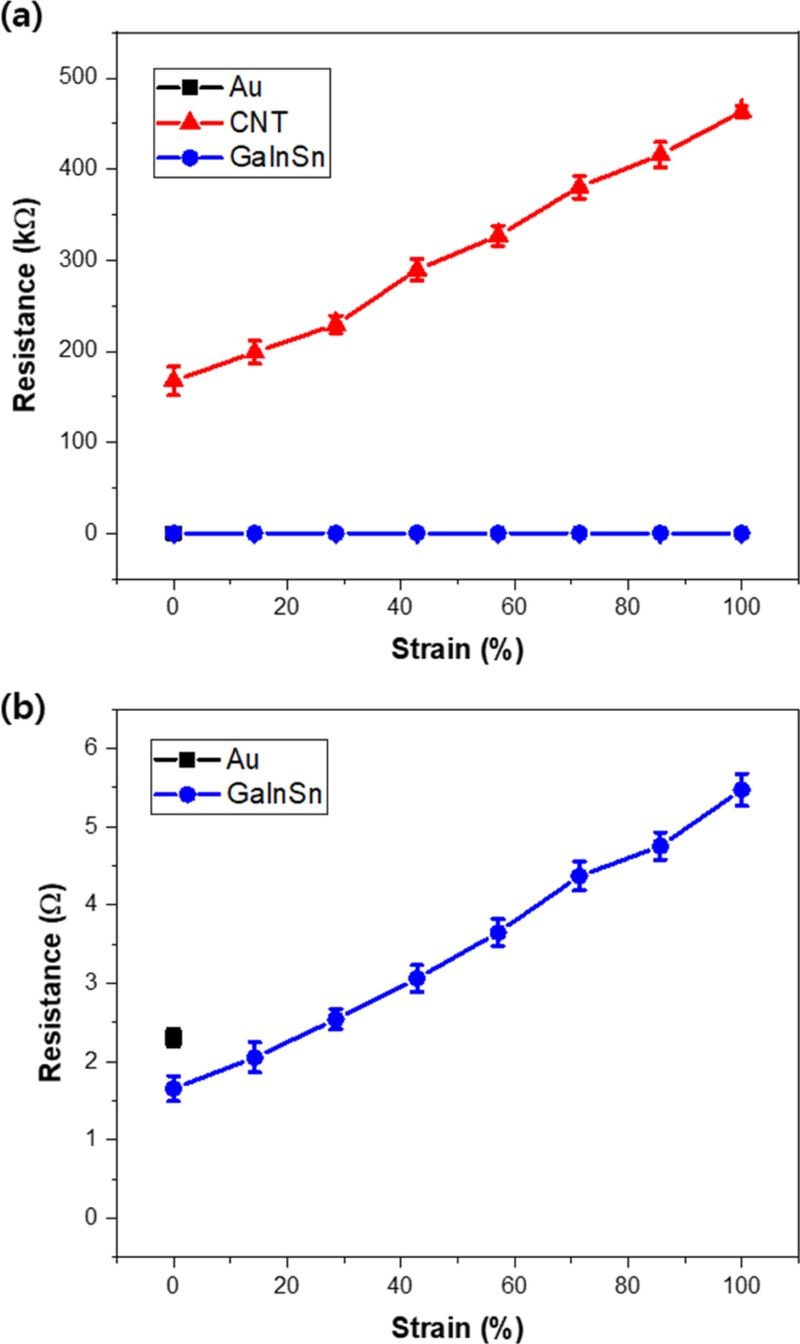
Strain-resistance relationships of various conductive materials. (a) Experimental results for Au, CNT, and GaInSn. (b) Enlargement of the results for GaInSn.
3.2 Performance evaluation under strain and pressure conditions
Samples implementing the strain-insensitive pressure sensing mechanism were fabricated according to the method shown in Fig. 3, and a performance evaluation was conducted. The sensing areas of the samples were fabricated at various sizes, with diameters of 1, 3, and 5 mm. The resistance changes in the fabricated samples were measured based on the strain and pressure in the test bed, as shown in Fig. 6. The sample was held by clamps so that strain could be applied in constant steps. In addition, while the sample was under constant strain, a contactor attached to the load cell pressed the pressure sensor. The contactor was cylindrical with a diameter of 5 mm and made of PE material. The load cell was connected to a motor stage to move only in the vertical direction. Furthermore, the resistance of the conductive polymer under strain and pressure conditions was measured using a digital multimeter (DMM).
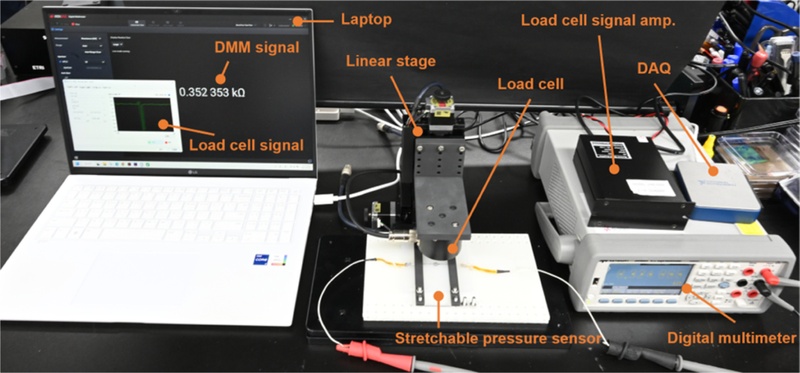
Experimental setup for performance evaluation of the straininsensitive pressure sensing mechanism
The effectiveness of the proposed strain-insensitive pressure sensing mechanism is demonstrated through the experimental results presented in Fig. 7. In the experiment, strains of 0%, 33.3%, and 66.6% were applied to the samples, and changes in the resistance were observed when additional pressure was applied in each situation. As shown in Fig. 7, there was no difference in the piezoresistive properties depending on strain for each sample. Although tensile strain occurred in the liquid metal as each sample was stretched, the resistance change of the liquid metal was extremely minimal and did not affect the sensor resistance. Furthermore, even when the sample was stretched, no mechanical deformation occurred in the sensing area with a relatively high modulus; therefore, it did not affect the sensor resistance. In contrast, when pressure was applied, the thickness of the conductive polymer was directly reduced, resulting in a corresponding decrease in resistance. Therefore, it was demonstrated that the developed pressure sensor does not respond to strain but shows resistance changes only in response to pressure.
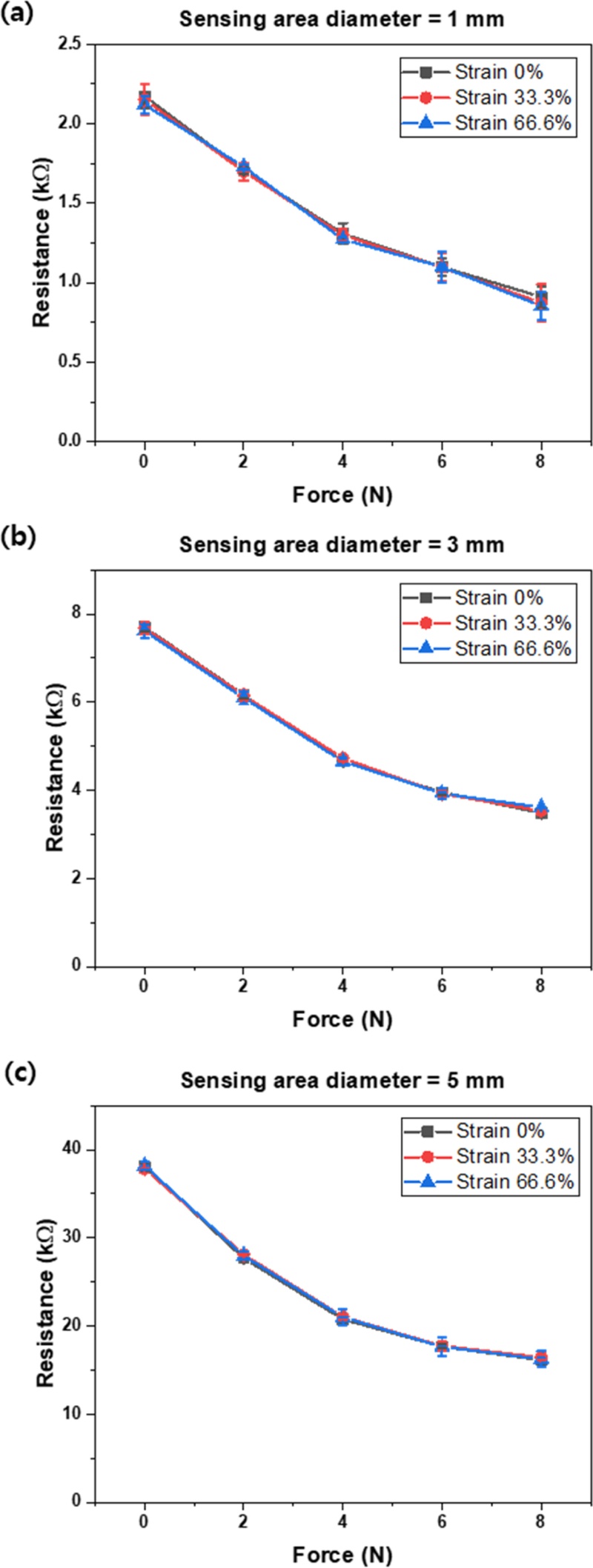
Strain-insensitive pressure sensing performance with various sensing area diameters: (a) 1 mm. (b) 3 mm. (c) 5 mm.
An additional finding from the experimental results shown in Fig. 7 is that the resistance of the conductive polymer decreases as pressure is applied. As explained earlier, this occurs because the thickness of the conductive polymer decreases owing to pressure, and the resistance decreases according to Eq. (1). Additionally, the smaller the diameter of the conductive polymer, the higher the intrinsic resistance. This is also due to Eq. (1), where a smaller area results in a higher resistance. These results support the successful fabrication of the sensor based on fundamental principles.
4. DISCUSSION AND CONCLUSIONS
This study successfully developed a strain-insensitive pressure sensing mechanism using dissimilar materials with highly contrasting properties. The core innovation lies in the strategic utilization of materials with significantly different elastic moduli, electrical conductivities, and electromechanical coupling behaviors. This approach creates a sensing architecture in which strain-induced effects are inherently suppressed while maintaining high pressure sensitivity.
The proposed sensing mechanism employs a simple yet effective design principle based on the mechanical property contrast between a highly stretchable elastomer substrate and relatively rigid CNT-dispersed elastomer sensing points. When the entire sensor structure is subjected to tensile strain, deformation occurs primarily at the periphery, which is composed of a stretchable elastomer, while the sensing points with higher moduli remain mechanically stable. This fundamental design approach ensures that stretching deformation has a minimal effect on the electromechanical properties of the sensing regions. Conversely, when pressure is applied to the sensing points, thickness reduction occurs in the vertical direction, leading to measurable resistance changes.
To validate this operating principle, a comprehensive characterization was conducted on various conductive materials, including Au, CNT, and GaInSn. The experimental results clearly demonstrate that liquid metal electrodes exhibit negligible resistance changes under mechanical deformation, making them ideal for signal transmission without distortion. By contrast, CNT showed significant resistance variations with mechanical deformation, confirming their suitability as pressure-sensitive elements. The strain resistance relationship analysis provided crucial insights into the material selection criteria for achieving optimal strain-insensitive performance.
Performance evaluation under simultaneous strain and pressure conditions demonstrated the effectiveness of the proposed mechanism. Sensors with sensing areas of different diameters were tested under various strain levels while applying controlled pressure loads. The experimental results conclusively showed that the piezoresistive properties remained consistent regardless of the applied strain, thereby verifying the strain-insensitive nature of the sensing mechanism. The resistance decreased predictably with applied pressure while remaining unaffected by tensile deformation, validating the fundamental design principles.
This strain-insensitive pressure sensing mechanism offers several significant advantages in practical applications. First, it enables accurate pressure measurements in dynamic environments where mechanical deformation is inevitable, such as wearable health monitoring devices and soft robotic systems. Second, the simple fabrication process involving readily available materials makes this technology highly suitable for mass production and commercialization. Unlike existing strain-insensitive sensors that require complex fabrication procedures or expensive materials, the proposed approach utilizes straightforward molding, coating, and patterning processes that can be easily scaled up. Third, the use of biocompatible silicone materials and absence of toxic components make the sensors suitable for direct skin contact applications.
Regarding future research directions, this study establishes a foundation for developing advanced tactile sensing systems with enhanced functionality. The immediate next step will involve the development of array-type pressure sensors based on the proposed strain-insensitive mechanism. By integrating multiple sensing points into a matrix configuration, it will be possible to create tactile sensing arrays capable of spatial pressure mapping while maintaining strain insensitivity across the entire sensing area. Another promising research direction involves the miniaturization of pressure sensors. The presence of rigid sensing points imposes certain limitations when the sensor is applied to highly deformable surfaces or environments requiring extreme flexibility. To overcome these limitations and enhance the applicability of the strain-insensitive mechanism under such demanding conditions, miniaturization of the sensing elements is essential. By scaling down the sensing point dimensions and optimizing the material composition, it should be possible to achieve sub-millimeter spatial resolution while preserving the strain-insensitive characteristics.
Following the development of both array-type and miniaturized sensors, a comprehensive quantitative performance analysis will be conducted to fully characterize their capabilities. Key performance metrics, including sensitivity, response time, and long-term stability, will be systematically evaluated to establish clear benchmarks for the proposed sensing technology. Additionally, potential limitations, such as the durability of the Au/GaInSn interface and hysteresis during repeated mechanical loading cycles, will be thoroughly investigated. Based on these analytical results, further material and structural optimization strategies will be pursued to enhance the critical performance parameters and address the identified limitations. This systematic approach to performance enhancement and limitation mitigation ensures that the developed sensors meet the stringent requirements of real-world applications while maintaining their fundamental strain-insensitive characteristics.
In conclusion, this study demonstrated a practical and effective approach to achieve strain-insensitive pressure sensing through the strategic use of dissimilar materials with contrasting properties. The combination of theoretical understanding, systematic material characterization, and comprehensive performance evaluation provides a solid foundation for the practical implementation of this technology. The simple fabrication process, excellent performance characteristics, and clear pathways for future development make this strain-insensitive pressure sensing mechanism a promising solution for next-generation tactile sensing applications in wearable electronics, soft robotics, and human–machine interfaces.
Acknowledgments
This work was supported by the internal grant of the Electronics and Telecommunications Research Institute (ETRI) (25YB2100, Development of light-driven three-dimensional morphing technology for tangible visuo-haptic interaction).
REFERENCES
-
S.C.B. Mannsfeld, B.C.-K. Tee, R.M. Stoltenberg, C.V.H-H. Chen, S. Barman, B.V.O. Muir, et al., Highly sensitive flexible pressure sensors with microstructured rubber dielectric layers, Nat. Mater. 9 (2010) 859–864.
[https://doi.org/10.1038/nmat2834]

-
Y. Zhou, J. He, H. Wang, K. Qi, N. Nan, X. You, et al., Highly sensitive, self-powered and wearable electronic skin based on pressure-sensitive nanofiber woven fabric sensor, Sci. Rep. 7 (2017) 12949.
[https://doi.org/10.1038/s41598-017-13281-8]
-
Q. Su, Q. Zou, Y. Li, Y. Chen, S.-Y. Teng, J.T. Kelleher, et al., A stretchable and strain-unperturbed pressure sensor for motion interference–free tactile monitoring on skins, Sci. Adv. 7 (2021) abi4563.
[https://doi.org/10.1126/sciadv.abi4563]
-
J. Hu, G. Dun, X. Geng, J. Chen, X. Wu, T.-L. Ren, Recent progress in flexible micro-pressure sensors for wearable health monitoring, Nanoscale Adv. 5 (2023) 3131–3145.
[https://doi.org/10.1039/D2NA00866A]
-
T. Jiang, C. Wang, T. Ling, S. Sun, L. Yang, Recent advances and new frontier of flexible pressure sensors: Structure engineering, performances and applications, Mater. Today Phys. 48 (2024) 101576.
[https://doi.org/10.1016/j.mtphys.2024.101576]
-
Y. Zhao, X. Huang, Mechanisms and Materials of Flexible and Stretchable Skin Sensors, Micromachines 8 (2017) 69.
[https://doi.org/10.3390/mi8030069]
-
B.-U. Hwang, A. Zabeeb, T.Q. Trung, L. Wen, J.D. Lee, Y.-I. Choi, et al., A transparent stretchable sensor for distinguishable detection of touch and pressure by capacitive and piezoresistive signal transduction, NPG Asia Mater. 11 (2019) 23.
[https://doi.org/10.1038/s41427-019-0126-x]
-
T. Seesaard, C. Wongchoosuk, Flexible and Stretchable Pressure Sensors: From Basic Principles to State-of-the-Art Applications, Micromachines 14 (2023) 1638.
[https://doi.org/10.3390/mi14081638]
-
K.-H. Ha, Z. Li, S. Kim, H. Huh, Z. Wang, H. Shi, et al., Stretchable hybrid response pressure sensors, Matter 7 (2024) 1895–1908.
[https://doi.org/10.1016/j.matt.2024.04.009]
-
R. Matsuda, S. Mizuguchi, F. Nakamura, T. Endo, Y. Isoda, G. Inamori, et al., Highly stretchable sensing array for independent detection of pressure and strain exploiting structural and resistive control, Sci. Rep. 10 (2020) 12666.
[https://doi.org/10.1038/s41598-020-69689-2]
-
H. Xu, W. Zheng, Y. Wang, D. Xu, N. Zhao, Y. Qin, et al., Flexible tensile strain-pressure sensor with an off-axis deformation-insensitivity, Nano Energy 99 (2022) 107384.
[https://doi.org/10.1016/j.nanoen.2022.107384]
-
K. Kim, J. Choi, Y. Jeong, M. Kim, I. Cho, S. Kim, et al., Strain-insensitive soft pressure sensor for health monitoring application using 3D-printed microchannel mold and liquid metal, Proceedings of the TRANSDUCERS & EUROSENSORS XXXIII, Berlin, Germany, 2019, pp. 23–27.
[https://doi.org/10.1109/TRANSDUCERS.2019.8808472]
-
J. He, R. Zhou, Y. Zhang, W. Gao, T. Chen, W. Mai, et al., Strain-Insensitive Self-Powered Tactile Sensor Arrays Based on Intrinsically Stretchable and Patternable Ultrathin Conformal Wrinkled Graphene-Elastomer Composite, Adv. Funct. Mater. 32 (2022) 2107281.
[https://doi.org/10.1002/adfm.202107281]
-
S. Dong, X. Zhu, Y. Guo, P. Zhang, G. Ma, W. Li, et al., A Stretch-Insensitive Pressure Sensor Based on Liquid Metal Composite with a Hierarchical Conductive Network, ACS Appl. Mater. Interfaces 17 (2025) 39480–39489.
[https://doi.org/10.1021/acsami.5c03997]
-
H. Choi, Y. Luo, G. Olson, P. Won, J.H. Shin, J. Ok, et al., Highly Stretchable and Strain-Insensitive Liquid Metal based Elastic Kirigami Electrodes (LM-eKE), Adv. Funct. Mater. 33 (2023) 2301388.
[https://doi.org/10.1002/adfm.202301388]
-
H.J. Lee, K.-Y. Chun, J.H. Oh, C.-S. Han, Wearable Triboelectric Strain-Insensitive Pressure Sensors Based on Hierarchical Superposition Patterns, ACS Sens. 6 (2021) 2411–2418.
[https://doi.org/10.1021/acssensors.1c00640]
-
S.B. Choi, T. Noh, S.-B. Jung, J.-W. Kim, Stretchable Piezoresistive Pressure Sensor Array with Sophisticated Sensitivity, Strain-Insensitivity, and Reproducibility, Adv. Sci. 11 (2024) 2405374.
[https://doi.org/10.1002/advs.202405374]
-
J.C. Yang, J.-O. Kim, J. Oh, S.Y. Kwon, J.Y. Sim, D.W. Kim, et al., Microstructured Porous Pyramid-Based Ultrahigh Sensitive Pressure Sensor Insensitive to Strain and Temperature, ACS Appl. Mater. Interfaces 11 (2019) 19472–19480.
[https://doi.org/10.1021/acsami.9b03261]
-
D. Tsogbayar, J. Seo, T. Hwang, J. Park, E. Ko, Y. Kim, et al., Advanced Flexible Physical Sensors with Independent Detection Mechanisms of Pressure and Strain Stimuli for Overcoming Signal Interference, ACS Appl. Mater. Interfaces 16 (2024) 49574–49583.
[https://doi.org/10.1021/acsami.4c09337]
-
J.S. Heo, M.F. Hossain, I. Kim, Challenges in Design and Fabrication of Flexible/Stretchable Carbon- and Textile-Based Wearable Sensors for Health Monitoring: A Critical Review, Sensors 20 (2020) 3927.
[https://doi.org/10.3390/s20143927]
-
M. Amjadi, K.-U. Kyung, I. Park, M. Sitti, Stretchable, Skin-Mountable, and Wearable Strain Sensors and Their Potential Applications: A Review, Adv. Funct. Mater. 26 (2016) 1678–1698.
[https://doi.org/10.1002/adfm.201504755]
-
A.J. Cohen, M. Kollosche, M.C. Yuen, D.-Y. Lee, D.R. Clarke, R.J. Wood, Batch-Sprayed and Stamp-Transferred Electrodes: A New Paradigm for Scalable Fabrication of Multilayer Dielectric Elastomer Actuators, Adv. Funct. Mater. 32 (2022) 2205394.
[https://doi.org/10.1002/adfm.202205394]
-
J.D. Glover, C.E. McLaughlin, M.K. McFarland, J.T. Pham, Extracting uncrosslinked material from low modulus sylgard 184 and the effect on mechanical properties, J. Polym. Sci. 58 (2020) 343–351.
[https://doi.org/10.1002/pol.20190032]
-
M. Amjadi, A. Pichitpajongkit, S. Lee, S. Ryu, I. Park, Highly Stretchable and Sensitive Strain Sensor Based on Silver Nanowire–Elastomer Nanocomposite, ACS Nano 8 (2014) 5154–5163.
[https://doi.org/10.1021/nn501204t]