
Recent Advances in Fibrous Material-Based Chemi-Resistive Gas Sensors for the Detection of Toxic Gases
ⓒ The Korean Sensors Society
This is an Open Access article distributed under the terms of the Creative Commons Attribution Non-Commercial License(https://creativecommons.org/licenses/by-nc/3.0/) which permits unrestricted non-commercial use, distribution, and reproduction in any medium, provided the original work is properly cited.
Abstract
Nitrogen dioxide and ammonia are critical atmospheric pollutants arising from industrialization and agricultural expansion, posing severe implications for respiratory and cardiovascular health. While conventional gas-analysis techniques, such as gas chromatography, mass spectrometry, and optical spectroscopy, provide high sensitivity, their reliance on bulky instrumentation, high energy consumption, and complex sample preparation limits their applicability to real-time, on-site monitoring. Chemi-resistive gas sensors offer advantages, such as ppb-level gas detection with low power consumption and compact form factors. Recent advances have demonstrated that the integration of one-dimensional and two-dimensional sensing nanomaterials onto fibrous substrates—including cotton yarns, electrospun nanofibers, and commercial textiles—enables wearable e-textile gas sensors to achieve exceptional sensing performance. In this review, we discuss recent advances in fibrous chemi-resistive gas sensors and cover material strategies for high sensitivity, selectivity, response/recovery times, mechanical durability, and washability of fibrous gas sensors.
Keywords:
Fibrous gas sensors, Chemi-resistive gas sensor, Sensing materials, Toxic gases, E-textile1. INTRODUCTION
1.1 Hazards of gases
Air pollutants, such as nitrogen dioxide (NO2) and ammonia (NH3), are widespread in industrial, urban, and agricultural settings; they pose significant risks to human health and the environment. Nitrogen dioxide (NO2), mainly produced by high-temperature combustion in vehicles, power plants, and indoor gas appliances, acts as a strong respiratory irritant and a key atmospheric pollutant. Acute inhalation of NO2 at concentrations as low as 300 ppb can injure airway epithelial cells, increase airway smooth muscle tone, and promote neutrophilic inflammation, resulting in bronchoconstriction and worsening of asthma and chronic obstructive pulmonary disease [1-3]. Additionally, short-term exposure to NO2 can induce oxidative stress, impair mucociliary clearance, and increase vulnerability to respiratory infections [4,5]. Long-term exposure to ambient NO2 is associated with an approximately 3–7% increase in all-cause, cardiovascular, and respiratory mortality per 10 µg/m³ increment, highlighting its contribution to chronic disease progression and premature death [6-8]. In the atmosphere, NO2 participates in photochemical reactions to generate ground-level ozone and particulate nitrates, contributing to smog, reduced visibility, and acid deposition, which degrades terrestrial and aquatic ecosystems [9,10]. Vulnerable populations, including children, the elderly, and individuals with pre-existing respiratory or cardiovascular diseases, experience disproportionate NO2-related health impacts [4,11]. These acute and chronic effects emphasize the need for sensitive, real-time NO2 monitoring to support public health protection and environmental management.
Meanwhile, ammonia (NH3) is a colorless, pungent gas widely used in fertilizer production, refrigeration, and various industrial processes. Even low-level exposure can irritate the eyes, skin, and respiratory tract, leading to coughing, throat discomfort, and bronchospasm. In addition, concentrations above common occupational limits (about 25–50 ppm) may cause pulmonary edema and chemical pneumonitis [12-14]. Chronic inhalation of moderate NH3 levels can cause persistent epithelial injury, airway remodeling, and reduced lung function, contributing to long-term respiratory impairment [15-17]. In the atmosphere, NH3 reacts with nitrogen and sulfur oxides to form fine particulate ammonium salts, which increase PM2.5 levels and associated cardiovascular and pulmonary health risks [13,18]. Agricultural activities, especially fertilizer use and emissions from livestock housing and manure management, account for the majority of global NH3 releases, leading to local air quality degradation and regional ecological effects such as eutrophication and acidification [19-21]. Given these acute irritant effects, chronic health consequences, and environmental impacts, it is essential to establish sensitive, real-time NH3 monitoring in industrial, agricultural, and indoor environments to safeguard human health and ecosystems.
1.2 The importance of chemi-resistive gas sensors
Exposure to NO2 and NH3 pose significant threats to human health and the environment, highlighting the critical importance of consistent and accurate gas monitoring. Conventional gas-analysis techniques, such as gas chromatography, mass spectrometry, and optical spectroscopy, are commonly used to detect harmful gases. However, these techniques rely on bulky instruments, high energy consumption, and laborious sample preparation leading to high operational costs and making them impractical for dynamic environments [22-25]. In addition, the complex architectures of some analytical platforms hinder their integration into wearable and mobile formats for miniaturized monitoring systems (Table 1). To overcome these limitations, chemi-resistive gas sensors have been proposed as fast, low-cost, and structurally simple platforms for gas monitoring. Chemi-resistive gas sensors provide rapid response/recovery and sensitive gas detection through chemical and/or physical adsorption and rapid electron transfer [26-28]. These properties are further enhanced by incorporating nanomaterials, such as metal-oxide nanostructures, carbon-based nanomaterials, and conducting polymers. The sensing mechanism of chemi-resistive gas sensors is as follows: gas molecules undergo chemisorption and/or physisorption on the sensing surface, which induces electron transfer and changes the carrier concentration, leading to a measurable change in the sensor resistance. Additionally, chemi-resistors are generally classified into two types (n-type and p-type). In the case of n-type semiconductors, electrons are the majority carriers, while holes are the majority carriers in p-type semiconductors (Fig. 1). For an n-type chemi-resistor, exposure to air typically forms an electron depletion layer (EDL) near the surface due to adsorbed oxygen species (Fig. 1(a)). When an oxidizing gas (e.g., NO2) is introduced, it withdraws electrons from the sensing layer (directly and/or via surface reactions), which widens the EDL and increases the resistance. In contrast, a reducing gas donates electrons (or removes adsorbed oxygen), which narrows the EDL and decreases the resistance (Fig. 1(b)). For a p-type chemi-resistor, the response trend is often the opposite because a hole accumulation layer (HAL) can form at the surface (Fig. 1(c)). Oxidizing gases increase the hole concentration (by extracting electrons), which enhances the HAL and decreases the resistance, whereas reducing gases decrease the hole concentration, weaken the HAL, and increase the resistance (Fig. 1(d)).

Comparison of various gas sensing method
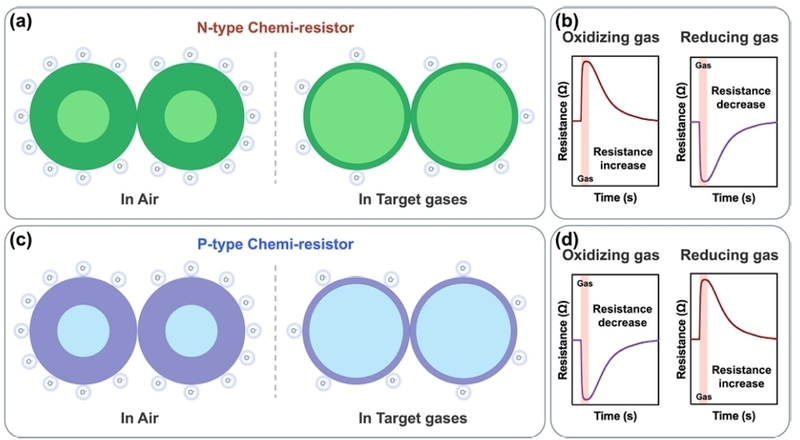
Schematic illustration of gas sensing mechanism and resistance behavior in air and target gases for 2-type of chemiresistor.
Based on this mechanism, nanomaterials have been widely engineered via structural modification, doping, and junction formation to improve gas-sensing performance. For instance, multi-walled carbon nanotubes, which possess high electrical conductivity and a large specific surface area due to their elongated morphology, have been extensively employed in various wearable sensor applications [29].
1.3 Material and structural design strategies for fibrous gas sensors
Enhancing the performance and reliability of fibrous chemi-resistive gas sensors has been achieved through the utilization of various materials and surface functionalization techniques. For instance, strong binding between the fibrous scaffold and functional nanomaterials ensures signal stability under mechanical deformation and environmental stress. Weak adhesion between sensing materials and fibrous substrates remains a key challenge in fibrous gas sensors. Such insufficient interfacial bonding can induce delamination of the sensing layer, disrupt charge transport pathways, and lead to progressive degradation of sensing performance. To mitigate this issue, various adhesion-enhancement strategies have been developed, accompanied by standardized evaluation protocols to assess durability under practical use conditions. Among durability metrics for wearable sensors, washability is particularly critical and is generally defined as the ability to retain electrical and sensing performance after repeated laundering cycles under controlled conditions, including washing mode, detergent exposure, water temperature, mechanical agitation, and drying processes. To achieve adequate washability, three complementary approaches have been explored: (i) reinforcing the sensor–fiber interface through surface functionalization or adhesive interlayers to suppress delamination, (ii) introducing protective encapsulation layers that reduce water, detergent, and abrasion damage while maintaining gas permeability, and (iii) designing textile-compatible sensor architectures that minimize stress concentration during washing. Meanwhile, mechanical robustness is also commonly assessed via repeated bending tests. Strategies such as surface functionalization, plasma treatment, or polymer buffer layers have demonstrated significant adhesion improvements, with sensors maintaining stable resistance (less than 2–4% variation) after 1,000–10,000 bending cycles [30]. Beyond robust adhesion, the active sensing layer itself must provide abundant adsorption sites, high carrier mobility, and sufficient chemical selectivity toward target gases. Two-dimensional materials such as graphene, transition-metal dichalcogenides (TMDs), and MXenes, offer ultrahigh surface area and tunable surface chemistries, enabling low detection limits at the ppb level (as low as 9–100 ppb) for NO2 and NH3 [31,32]. Notably, graphene offers high electrical conductivity with excellent flexibility and mechanical robustness, enabling reliable operation even under frequent bending and twisting in textile environments. In addition, graphene provides a large specific surface area with abundant adsorption sites, which facilitates gas adsorption and induces pronounced resistance changes via donor/acceptor charge transfer [33-36]. Building on this, nanocomposites, such as noble-metal nanoparticles-decorated MoS2 flakes and heterostructures formed with metal oxides, further enhance the gas sensing performance and selectivity owing to catalytic and charge-transfer effects [37,38]. Consequently, it is essential to fabricate nanocomposites for efficient gas sensing performance. Therefore, carbon nanotube (CNT) conductive matrices, metal-oxide nanowire arrays, and hybrid CNT/metal nanoparticle coatings have been widely employed to tailor network density and junction resistance [39-41].
2. FIBROUS GAS SENSORS AS A FUNCTION OF DIMENSION
From a practical gas sensor perspective, fibrous gas sensors can be extended through different levels of integration depending on the target application and manufacturing complexity. At the most immediate level, sensing fibers can be attached to clothes via sewing and embroidery, allowing the implementation of proof-of-concept designs using existing textile substrates. A more advanced and wearable-oriented approach involves yarn-level integration, in which gas-responsive fibers are directly woven or knitted into textiles, enabling distributed sensing while preserving flexibility and breathability. Advanced fabric architectures (including multilayer textiles and hierarchical fiber networks) can offer a pathway toward fully integrated smart fabrics, in which sensing performance, mechanical robustness, and environmental stability are simultaneously optimized. Together, these approaches demonstrated that fibrous gas sensors represent a scalable wearable platform, spanning from simple device attachment to fully textile-integrated sensing systems.
2.1 One-dimensional (1D) fibrous substrate-based gas sensor
Uniform and robust immobilization of active nanomaterials on fiber surfaces is a fundamental challenge in improving gas sensing performance.
Su and Liao reported a room-temperature layer-by-layer (LbL) process to deposit alternating GO and poly (allylamine hydrochloride) (PAH)/poly(4-styrenesulfonic acid) sodiumsalt (PSS) polyelectrolyte bilayers directly onto cotton yarns [42]. This approach provides precise control over film thickness while modifying polar oxygen-containing functional groups on GO enhanced NH3 sensing performance. However, the LbL architecture of yarn still requires multistep dipping cycles and offers limited washing verification, motivating subsequent studies to pursue more scalable methods and chemical interaction that can endure repeated laundering and complex fabric integration.
To overcome these challenges, various studies have explored material functionalization and bio-inspired adhesion layers. Among the previous studies, Lee et al. used amyloid nanofibrils consisting of β-lactoglobulin as an adhesive layer to ensure robust attachment of graphene oxide (GO) flakes onto yarn surfaces by forming biofilm at the interface between amyloid nanofibrils and GO [43]. Commercial cotton yarns were coated with amyloid nanofibrils, which provides strong positive charges that enable reliable attachment to GO (negatively charged) through enhanced electrostatic attraction. After chemical reduction of GO to rGO, wrinkled and rippled surfaces were observed, demonstrating maintained attachment during the chemical process. In addition, these features were still preserved after five washing cycles and 1000 bending cycles. Moreover, the rGO/BLG/yarn exhibited a remarkable 6.5-fold enhancement in sensitivity compared to rGO/yarn, and 3–5-fold enhancement compared to rGO/other protein sensors. Furthermore, they controlled the length of amyloid nanofibrils through ultrasonication treatment, and the optimized amyloid showed the highest electrical conductivity and sensitivity with approximately 1.9-fold improvement. Consequently, bio-glue provides an effective and reliable approach for immobilizing nanomaterials onto 1D fibrous substrates.
The other approach of bio-glue was reported by Lee et al. using dopamine which inspired by marine mussel. In this work, catechol and amine functional groups, which found in dopamine were provide superior adhesive properties and biocompatibility [44]. Furthermore, dopamine can be attached to hydrophilic and hydrophobic materials with various interaction such as, hydrogen bonding, metal-catechol coordination, electrostatic interaction, cation-π interaction, and π-π aromatic interaction. As a result, the sensor was successfully fabricated with dopamine which acts as a glue between GO and yarn (Fig. 2(a)). After deposition of GO, chemical reduction process was successful to rGO, and sensor exhibited sensitive gas detection toward nitrogen dioxide. Compared with the rGO-coated yarn, dopamine-graphene hybrid electronic textile yarn (DGY) shows a markedly enhanced NO2 sensing performance. DGY shows a high gas response and maintained its after five washing cycles, demonstrating its durability and the strong attachment of the materials to the yarn. Furthermore, DGY exhibits 2-time faster response, and significantly higher sensitivity across both high (0–100 ppm) and low (1–9 ppm) NO2 concentrations (Fig. 2(b–g)).
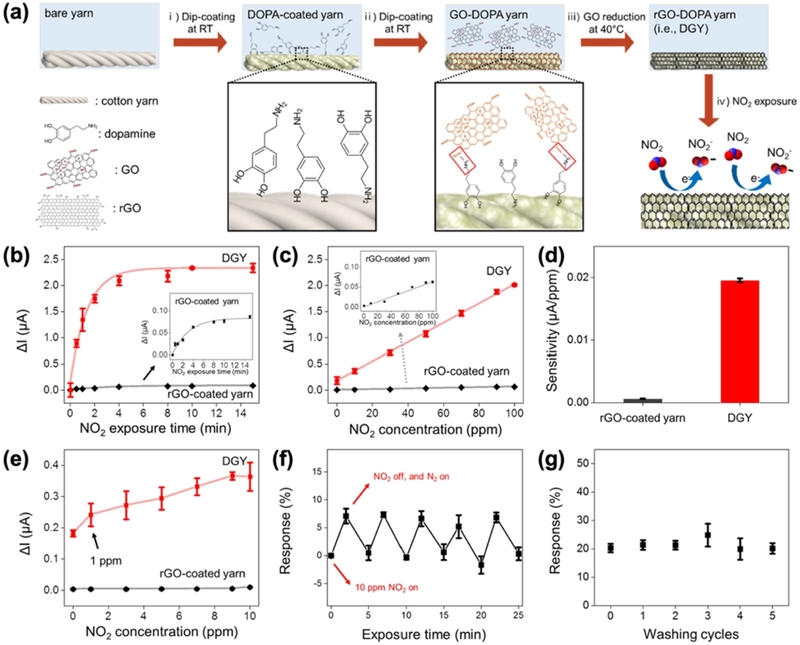
Structure and NO2 sensing performance of rGO-DOPA yarn. (a) Schematic illustration of the DGY fabrication process. Electrical characterization of the rGO-coated yarn and DGY (rGO-DOPA yarn) to NO2. (b) Electrical current changes of the yarns to NO2 (100 ppm) exposure time (inset: electrical current changes of rGO-coated yarn). (c) Linear response of the electrical current with various NO2 concentrations (0–100 ppm) (inset: electrical changes of rGO-coated yarn). (d) Sensitivity calculated from the slope of (c), indicating the DGY has better NO2 sensitivity than the rGO-coated yarn. (e) Electrical current changes of the yarns to the low concentration of NO2 (0–10 ppm). (f) Electrical responses of the DGYs on cyclic exposure to 10 ppm NO2 and N2. The repeatability test was conducted up to five times. (g) Electrical responses of the DGYs exposed to 50 ppm NO2 after washing process. Each data point represents triplicate measurements. Adapted from Ref. [44].
2.2 Two-dimensional (2D) fibrous substrate-based gas sensor
Two-dimensional (2D) fibrous substrates, including cotton fabrics, hemp fabrics, spandex textiles, and nanofiber meshes, have emerged as promising platforms for wearable chemi-resistive gas sensors. 1D fibrous substrates can be converted into robust 2D textile architectures using diverse fabric-forming/assembly methods such as weaving, knitting, or embroidery. This structural transition improves mechanical strength and stability, enabling the resulting sensor to be applied in practical applications. Owing to their intrinsically large specific surface area and highly porous morphology, the 2D fibrous substrate-based sensors enable ultra-sensitive gas detection with rapid response and recovery characteristics. Compared with 1D substrates, 2D fibrous platforms exhibit significantly enhanced gas adsorption capability and overall sensing performance.
In previous report, the electrospun nylon-6 nanofiber mesh-based E-textile using reduced graphene oxide (rGO) nanosheets exhibited high porosity caused by nanofiber [45]. The sensor exhibited high gas detection performance because the porous mesh structure increased the adsorption sites for gas molecule interaction. Furthermore, NO2 molecules easily access into the conductive pathways of the sensor through the pores of the mesh structure, leading to rapid response and recovery times. Moreover, the highly porous mesh structure distributes the applied stress throughout the fibrous network, making it easier to maintain continuous conductive pathways even under bending or stretching. This porous fibrous network is highlighted in the paper as one of the key reasons why the sensor shows almost no resistance change even after 5000 bending cycles. Bending is a critical mechanical stress in real-world e-textile applications, as it can significantly degrade the sensing performance of wearable gas sensors.
In this regard, Jung et al. systematically evaluated the bending stability of their rGO-coated silk e-textile sensor to demonstrate its practical reliability [46]. During the bending tests, the rGO-coated silk fabrics exhibited only a minimal variation in resistance over a wide range of bending radii and repeated deformation cycles. Even when the samples were subjected to up to 1,000 bending–releasing cycles, the normalized resistance variation remained below about 3%, indicating that the conductive rGO pathways are well preserved within the silk fiber network under cyclic mechanical loading. Furthermore, the sensor maintains a stable response even under repeated bending. This sensor was fabricated by a simple dip-coating process, which highlights one of the key advantages of e-textile platforms: the ease of scalable and low-cost manufacturing.
The 2D fibrous structure offers distinct advantages by providing a large specific surface area for high gas sensing performance and enabling facile fabrication of wearable sensing platforms. Sun et al. introduced simple and effective Ti3C2Tx (MXene)-based e-textile fabrication process using spray-coating method [47]. The high conductivity and hydrophilicity of MXene are suitable for spraying-coating onto the fabric substrates. The spandex fabric was used for optimal substrate. And owing to strong binding between spandex and MXene, the MXene-based E-textile displayed both superior washability and high selectivity toward NH3 gas with 96.7% gas response and low detection limit (0.4 ppm).
Moreover, Olusanya et al. introduced customized simple dip-coating method for rGO/MoS2-based e-textile fabrication [48]. Briefly, the textile was immersed in rGO/MoS2 dispersion following vigorous agitation shaking for a few seconds. Then, wet rGO/MoS2-coated fabric was hung vertically by stapling on hydrophobic plastic bag in ambient air condition for drying. The fabricated rGO/MoS2 E-textile exhibited exceptional washability which was confirmed by International Standard Organization (ISO) standard washing treatment over 100 cycles without any encapsulation or material functionalization. In addition, rGO/MoS2 E-textile sensitively detected NO2 gas with a detection limit of 7.3 ppb under 60% relative humidity (RH) condition.
Considering the key characteristics, including high porosity, mechanical durability, and facile fabrication, 2D fibrous substrates are well suited for practical gas-sensing applications. For instance, Kim et al. reported CMC-DA (dopamine-conjugated carboxymethyl cellulose ligands) MXene E-textile with exceptional NO2 sensing performance [49]. The CMC-DA MXene E-textile sensitively detected NO2 gas with detection limit of 200 ppb. And it remained stable gas response both in mechanical bending (up to 60 degree) and in washing treatment (up to 8 cycles) with high robustness. The endurance of e-textile gas sensor is attributed to not only surface functionalization of MXene (i.e., CMC-DA) but also durable fabric platform. The hemp fabric was used for a substrate of E-textile gas sensor due to its high porosity. The porous hemp fabric has large voids in the textile pattern, which is highly breathable, demonstrating effective application as wearable sensor. Thus, E-textile was applied onto mask platform to analyze human breathing and selectively distinguished normal and deep breathing with humidity response (Fig. 3).
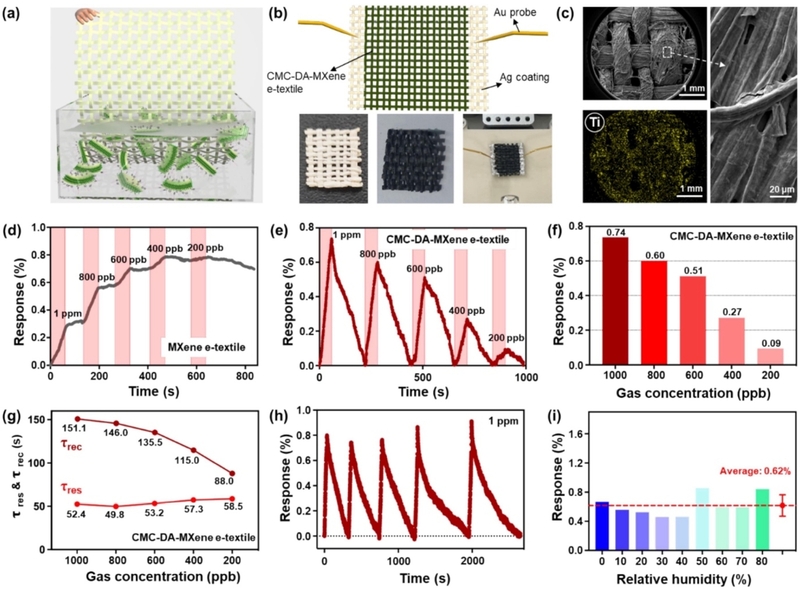
Stable and sensitive gas sensing performance of CMC-DA-MXene gas sensor. (a) Schematic showing the synthesis process of the CMC-DA-MXene e-textile by dip-coating. (b) Schematic of the CMC-DA-MXene e-textile gas sensor with silver paste coating as contacts (top), and digital images of pristine hemp textile (bottom-left), CMC-DA-MXene coated hemp textile (bottom-center), and CMC-DA-MXene e-textile gas sensor (bottom-right). (c) FE-SEM images and ‘Ti’ elemental mapping profile of CMC-DA-MXene e-textile. Dynamic response-recovery curves of (d) MXene and (e) CMC-DA-MXene e-textile gas sensors for various NO2 gas concentrations (1 ppm-200 ppb) at room temperature under 50% RH. (f) Maximum response and (g) response time and recovery time of the CMC-DA-MXene e-textile sensor for various NO2 gas concentrations (1 ppm-200 ppb). (h) Repeatability and (i) response under 0–80% RH of the CMC-DA-MXene e-textile to 1 ppm NO2 gas exposure. Adapted from Ref. [49].
3. AN OVERVIEW OF SENSING MATERIALS IN FIBROUS GAS SENSORS
Carbon-based nanomaterials (such as MWCNTs, reduced graphene oxide (rGO)) and MXene families (Ti3C2Tx, V2CTx, Ti2CO2, and Zr2CO2) are promising materials for gas sensing application due to their excellent electrical conductivity, large specific surface area, and outstanding mechanical strength [50-52]. These properties offer exceptional durability and sensitivity, which are essential for e-textile gas sensing (Fig. 4).
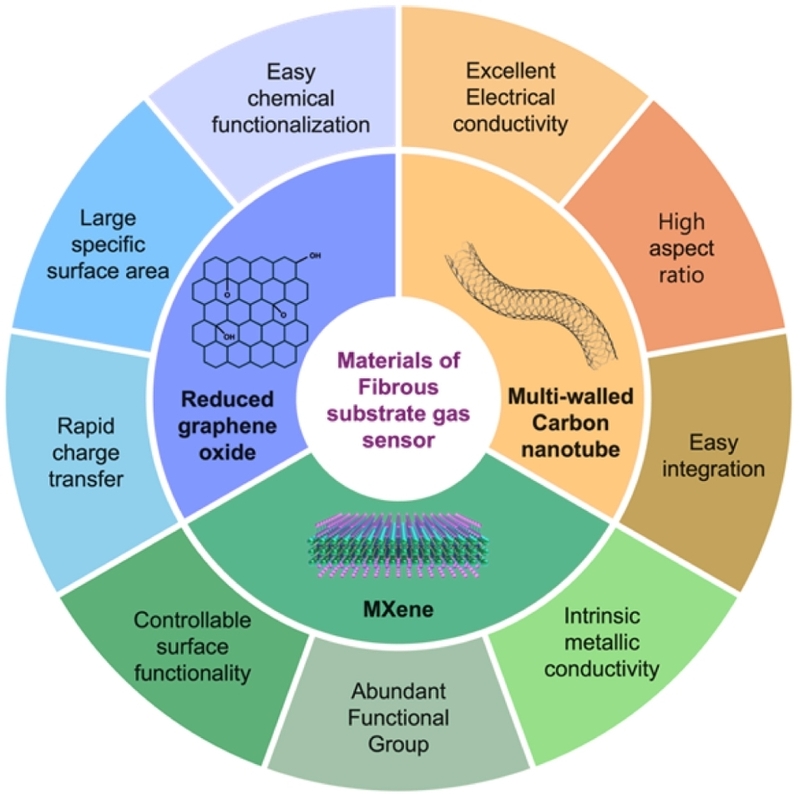
Schematic illustration of fibrous substrate gas sensor materials highlighting structural features and properties.
3.1 Multi-walled carbon nanotubes (MWCNT) applied fibrous substrate-based gas sensors
Multi-walled carbon nanotubes (i.e., MWCNTs) are extensively applied in chemi-resistive gas sensors due to their outstanding electrical conductivity and large specific surface area, which arise from their unique cylindrical nanostructure. These characteristics facilitate enhanced chemisorption of target gas molecules and promote charge transfer, thereby enabling high applicability to wearable gas sensing platforms.
For instance, Maity et al. developed a wearable gas sensor platform based on MWCNTs for the detection of ammonia (NH3) gas [53]. The MWCNTs were functionalized via in situ aniline polymerization to synthesize MWCNT/polyaniline (PANI) composites (Fig. 5(a)). The resulting MWCNT/PANI were subsequently deposited onto a fabric substrate using a spray coating method, yielding F-MWCNTs/PANI (Fig. 5(b,c)). The functionalized fabric was simply integrated into the clothing using copper wires and silver paste for testing. The as-fabricated F-MWCNTs/PANI exhibited rapid response and recovery times of 9 s and 30 s, respectively. Furthermore, it exhibited high sensitivity, with a gas response of 92% toward 100 ppm NH3 and a low detection limit of 200 ppb, demonstrating enhanced performance compared to F-MWCNT and PANI (Fig. 5(d–g)). In addition, F-MWCNTs/PANI displayed excellent mechanical durability under repeated bending (90–270°), without noticeable baseline resistance drift. The F-MWCNTs/PANI selectively detected NH3 gas among various interfering substances, including acetone, methanol, ethanol, xylene, and toluene. These results demonstrate that MWCNTs serve as an effective gas sensing material, owing to their rapid, sensitive, and selective detection capabilities. In another study, Dong et al. integrated MWCNTs/PANI onto an electrospun polyacrylonitrile (PAN) nanofiber substrate to fabricate an NH3 gas sensing platform [54]. The resulting PAN/MWCNTs/PANI exhibited a low detection limit of 300 ppb and demonstrated excellent mechanical durability, as confirmed by mechanical strain testing. Furthermore, due to its inherent flexibility, the sensor was successfully applied to various wearable configurations, including face masks, laboratory coats, and elbow joints. Across these diverse platforms, the PAN/MWCNTs/PANI reliably detected NH3 gas with clear response and recovery characteristics. These studies confirmed that MWCNTs effectively serve as an NH3 gas sensing material on various fibrous substrates.
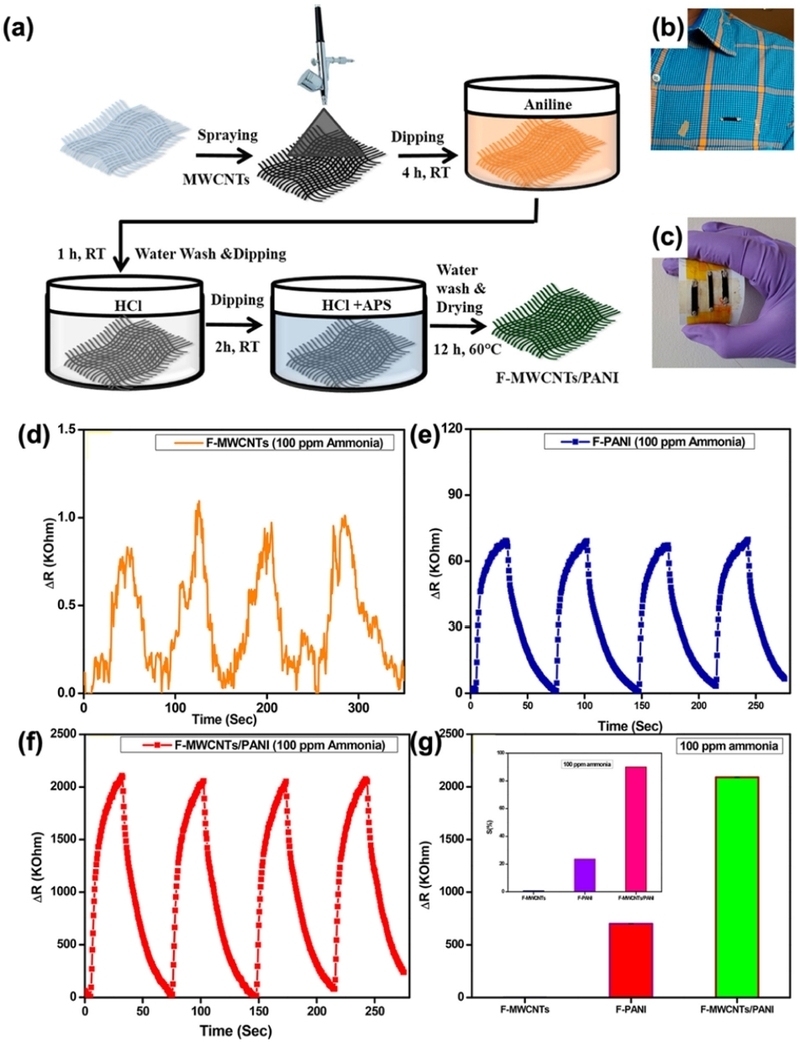
Development of F-MWCNTs/PANI sensor for ammonia detection. (a) Schematic showing spray deposition of MWCNTs on the fabric (F-MWCNTs) and PANI synthesis on MWCNTs coated fabric surface. (b) Sensor integration in shirt and (c) sensor array for ammonia sensing. Reproducibility cycle of (d) F-MWCNTs (e) F-PANI (f) F-MWCNTs/PANI. (g) Change of resistance and sensor response (inset) of F-MWCNTs, F-PANI, and F-MWCNTs/PANI. Adapted from Ref. [53].
Meanwhile, Arun Kumar et al. presented an MWCNT-based low-cost and flexible gas sensor for detecting carbon monoxide (CO), a toxic gas posing significant health risks [55]. Initially, plain-woven cotton fabric was treated with NaOH to remove surface-bound cementing substances. This treatment reduced functional groups and formed dangling bonds, thereby improving the adhesion of MWCNTs. The cotton fabric was then immersed in an MWCNTs dispersion (0.5 mg/mL) and dried—a dip-and-dry process—which was repeated 15 times to ensure uniform MWCNTs coating, resulting in cotton fabric coated with MWCNTs (CCM). The fabricated CCM exhibited a gas responses of 9.11% and 15.2% toward 25 ppm and 100 ppm CO gas, respectively. Moreover, CCM demonstrated a selective gas response toward CO gas over other interfering gases such as ammonia (NH3), nitrogen dioxide (NO2), methane (CH2), and hydrogen (H2). These findings confirm that MWCNTs are promising material for fibrous substrate-based gas sensing platforms, owing to their high mechanical strength, sensitivity, and selectivity.
3.2 MXene applied fibrous substrate-based gas sensors
Two-dimensional transition metal carbides and nitrides (i.e., MXene) have attracted considerable attention as functional materials for fibrous substrate-based gas sensors. MXenes exhibit exceptional conductivity, tunable surface terminations (–O, –OH, –F), intrinsic hydrophilicity, a high aspect ratio, and outstanding mechanical flexibility. These combined features promote rapid target analyte adsorption, efficient charge-transport networks, and intimate integration with textile substrates. Lee et al. developed MXene/graphene hybrid fibers through a scalable wet-spinning process for NH3 gas sensing [56]. The resulting MXene/rGO hybrid fibers exhibited significantly enhanced NH3 sensing performance with a response (R/R0) of 6.77, which was 7.9 times higher than MXene alone and 4.7 times higher than rGO fiber. The synergistic effect between MXene and rGO was attributed to band gap engineering (1.57 eV) and increased TiO2 terminal groups, which provide abundant active sites for NH3 adsorption.
Moreover, the hybrid fibers demonstrated excellent mechanical durability, maintaining minimal resistance fluctuations (ΔR/R0 < 0.2%) after 2,000 bending cycles. These flexible fibers were successfully woven into a lab coat, showing a gas response of 7.21 to 100 ppm NH3 at room temperature, demonstrating their potential for wearable gas-sensing applications. In another study, Zhao et al. introduced polypyrrole (PPy) and MXene-coated polyurethane (PU) yarns via a facile polymerization method [57]. The PU-PPy/MXene sensor exhibited the gas response of 26% toward 100 ppm NH3 exposure at room temperature, and exceptional mechanical durability under a stretch-release test (over 600 cycles).
Tang et al. developed a wearable conductometric sensor for the detection of acetone based on an MXene/polyurethane core-sheath fiber [58]. The MXene/PU core-sheath fibers were fabricated via wet spinning, resulting in micro-cracks and micro-wrinkles in the sheath to amplify swelling-induced resistance changes. Compared to flat MXene, the core–sheath fiber achieved a 5- to 325-fold enhancement in acetone sensitivity, a 160% boost in signal-to-noise ratio (SNR), and maintained functionality under 30% tensile strain, which meets the strain ranges of human skin deformations. As a result, this work suggests MXene as an effective sensing material with microstructure engineering. Gupta et al. synthesized a MoO3/Ti3C2Tx nanocomposite for acetone gas detection [59]. The nanocomposites were coated on both borosilicate glass and cotton yarn substrates to compare sensing performance between rigid and flexible platforms. Remarkably, the cotton yarn-based sensor exhibited a gas response of 66.5% toward 25 ppm acetone at room temperature, which was significantly higher than that of the glass substrate-based sensor (40.9%). This enhanced performance on cotton yarn was attributed to the increased surface area and porous structure of the textile substrate, which facilitated greater gas molecule adsorption and diffusion pathways. The formation of a MoO3/MXene heterostructure created additional active sites and improved charge transfer properties through p-n junction mechanisms. Furthermore, the MoO3 decoration provided enhanced selectivity toward acetone over other volatile organic compounds (VOCs) due to its oxygen vacancy sites and catalytic oxidation properties. This study demonstrates that textile substrates not only provide mechanical flexibility for wearable applications but also enhance gas-sensing performance compared to conventional rigid substrates, highlighting the dual advantages of fibrous platforms in practical sensor development.
Consequently, MXene-based fibrous substrates are evolving into ultra-fast, highly sensitive, and mechanically robust wearable gas sensors through the integration of anchoring strategies, heterostructured nanocomposite, microstructure engineering, and core-sheath architectures.
3.3 rGO applied fibrous substrate-based gas sensors
Reduced-graphene oxide (i.e., rGO) is a promising candidate for gas sensing with various advantages, including high conductivity, a large surface area, durable mechanical strength, and facile chemical functionalization. Based on these attributes, rGO has been widely adopted as a gas sensing material, especially for fibrous substrate-based sensors.
Yun et al. developed highly stretchable, mechanically stable, and weavable rGO electronic yarns (e-yarns) for wearable NO2 gas sensors [60]. The rGO e-yarns were fabricated by coating GO flakes onto pre-strained (400%) commercial spandex/polyester core-spun elastic yarns using a dip-coating process with bovine serum albumin as a molecular adhesive, followed by chemical reduction with hydriodic acid. The pre-strain strategy was critical for achieving a wrinkled rGO morphology and stable percolation pathways after strain release. The fabricated rGO e-textiles exhibited outstanding mechanical stability with minimal resistance variation over 5,000 stretch-release cycles at 400% applied strain. For gas-sensing performance, the rGO e-yarns demonstrated high NO2 sensitivity (55% response to 5.0 ppm) at room temperature even under 200% external strain, with response and recovery times of 1.9 min and 40 min, respectively. Furthermore, the rGO e-yarns were easily woven into wrist-band fabrics using commercial knitting techniques, demonstrating practical wearable gas-sensing applications with a 25% response to 500 ppb NO2.
Lin et al. demonstrated an rGO/ZnO-QDs hybrid E-textile gas sensing system [61]. The ZnO-QDs were prepared via KOH-mediated precipitation using zinc acetate, resulting in uniform particles with a diameter of ~5 nm. Then, ZnO-QDs were drop-casted onto the rGO-coated nylon yarn and dried at 80℃. The fabricated rGO/ZnO-QDs-coated nylon yarn exhibited superior NO2 sensing performance. The R2 value in the detection of various NO2 concentrations ranging from 20 to 100 ppm was 0.998, and the sensitivity was analyzed as 0.4958/ppm. Additionally, the rGO/ZnO-QDs-coated nylon yarn selectively distinguished NO2 among various interferences such as CO, NH3, and VOCs. Furthermore, mechanical durability was confirmed through both bending and stretching tests. The rGO/ZnO-QDs retained their initial response not only after 1,000 bending cycles but also under repeated stretching conditions (~20% strain) with minimal degradation (less than 10%). These results demonstrated that rGO/ZnO-QDs have excellent robustness toward various mechanical stress environments. Furthermore, to demonstrate a real-world application, the mask-based wearable gas sensor was introduced. The rGO/ZnO-QDs nylon yarn was integrated into a mask with a low-power microcontroller, visual LEDs, and an audible buzzer. The integrated system provided auditory and visual alerts upon the detection of NO2 gas. This system successfully suggests the practical potential of rGO/ZnO-QDs nylon yarn for personal air-quality monitoring.
Meanwhile, Li et al. suggested another strategy to maximize the NO2 sensing performance of rGO-based fibrous gas sensors [62]. APTES is employed as a bifunctional linker to turn inert, rough textile fibers into chemically active substrates that can firmly anchor GO (later rGO) and mesoporous ZnO nanosheets. An amine-terminated silane layer is introduced onto cotton and elastic threads by simple dip-coating and low-temperature curing, enabling uniform, adherent solution-processed sensing layers. This yields a hierarchical “fiber-APTES-rGO-APTES-ZnO” structure (Fig. 6(a)). APTES first forms siloxane bonds with fiber hydroxyls; GO is then dip-coated and reduced to rGO, bound via amide/hydrogen bonds; finally, ZnO nanosheets are immobilized from an APTES-containing dispersion. The as-fabricated sensor demonstrates the gas-sensing advantages of the rGO/ZnO hybrid fibers over rGO-only counterparts (Fig. 6(b)). Dynamic response curves and concentration–response plots confirm significantly enhanced NO2 sensitivity at room temperature, with fast response/recovery times (Fig. 6(c,d)). The sensor further exhibits NO2 selectivity against common interfering gases and excellent long-term stability under ambient storage (Fig. 6(e,f)). From the low-concentration response, the authors derived a ppb-level theoretical detection limit, highlighting that the chemically anchored, uniformly distributed rGO/ZnO network formed by the multistep solution process directly translates into superior e-textile NO2 sensing performance (Fig. 6(g)).
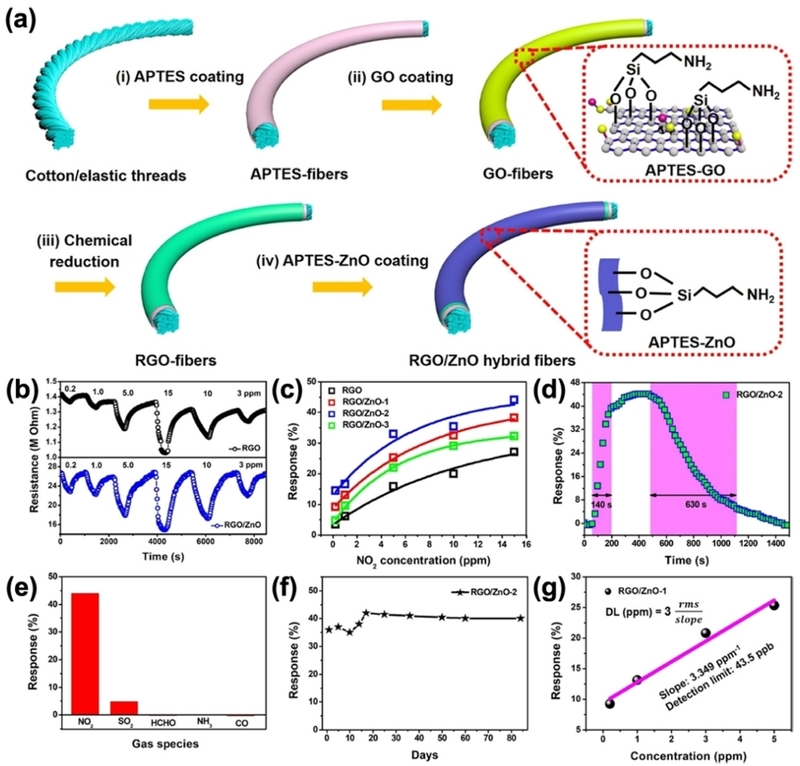
Approaches for attached materials and gas sensing performance. (a) Schematic diagram of the fabrication process for rGO/ZnO hybrid fibers. Sensing behaviors of rGO and rGO/ZnO CT sensors at RT. (b) Real-time resistance curves to 0.2–15 ppm NO2. (c) Plot of response versus NO2 concentration. (d) Enlarged part of response vs time in 15 ppm NO2. (e) Selectivity and (f) stability (10 ppm NO2) of rGO/ZnO-2 CT sensor. (g) Theoretical detection limit. Adapted from Ref. [62].
4. CONCLUSION AND OUTLOOK
Fibrous chemi-resistive gas sensors have emerged as a promising platform for the efficient monitoring of hazardous gases such as NO2 and NH3. The application of functional nanomaterials—MWCNTs, rGO, MXenes, and metal-oxide hybrids—onto fibrous substrates facilitates the sensitive target gas detection of target gases with high sensitivity, rapid response/recovery times, and mechanical durability under bending, stretching, and repeated washing treatments. Robust adhesion strategies, including bio-inspired nanoglues, silane linkers, and polymer interlayers, ensure stable electrical conductivity and a high specific surface area on fibrous scaffolds. Collectively, these advantages demonstrate that e-textile platforms can bridge the gap between high-performance gas sensing and diverse applications. Based on these results, fibrous gas sensors exhibit significant potential as wearable gas sensing platforms and for personal healthcare monitoring when integrated with garments. Nevertheless, a reliable wearable chemi-resistive gas sensing system necessitates the co-design of dedicated hardware and software infrastructures. On the hardware side, wireless readout electronics capable of resolving minute currents (i.e., resistance variations) are required, and the software layer should implement robust compensation and calibration strategies to correct resistance drift induced by fluctuations in temperature and humidity. Such an integrated platform would enable continuous, real-time gas monitoring in practical settings, thereby reducing the risk associated with inadvertent gas exposure during daily activities. Overall, this review highlights fibrous chemi-resistive gas sensors as a versatile and scalable platform for next-generation wearable sensing, while outlining the key material, structural, and system-level challenges that must be addressed to accelerate their translation into real-world e-textile applications.
Acknowledgments
This research was supported by the Regional Innovation System & Education (RISE) program through the (Chungbuk Regional Innovation System & Education Center), funded by the Ministry of Education (MOE) and the (Chungcheongbuk-do), Republic of Korea (2025-RISE-11-004).
REFERENCES
-
M.W. Frampton, J. Boscia, N.J. Roberts, M. Azadniv, A. Torres, C. Cox, et al., Nitrogen dioxide exposure: effects on airway and blood cells, Am. J. Physiol. Lung Cell. Mol. Physiol. 282 (2002) L155–L165.
[https://doi.org/10.1152/ajplung.2002.282.1.L155]

-
Y. Cao, M. Chen, D. Dong, S. Xie, M. Liu, Environmental pollutants damage airway epithelial cell cilia: Implications for the prevention of obstructive lung diseases, Thorac. Cancer 11 (2020) 505–510.
[https://doi.org/10.1111/1759-7714.13323]
-
W.S. Tunnicliffe, P.S. Burge, J.G. Ayres, Effect of domestic concentrations of nitrogen dioxide on airway responses to inhaled allergen in asthmatic patients, Lancet 344 (1994) 1733–1736.
[https://doi.org/10.1016/S0140-6736(94)92886-X]
-
W. Cao, H. Huang, Z. Chang, Z. Liang, H. Li, Z. Cheng, et al., Short-term air pollution exposure and risk of respiratory pathogen infections: an 11-year case-crossover study in Guangzhou, China, BMC Public Health 25 (2025) 1411.
[https://doi.org/10.1186/s12889-025-22435-7]
-
R. Helleday, D. Huberman, A. Blomberg, N. Stjernberg, T. Sandstrom, Nitrogen dioxide exposure impairs the frequency of the mucociliary activity in healthy subjects, Eur. Respir. J. 8 (1995) 1664–1668.
[https://doi.org/10.1183/09031936.95.08101664]
-
X. Chen, L. Qi, S. Li, X. Duan, Long-term NO2 exposure and mortality: A comprehensive meta-analysis, Environ. Pollut. 341 (2024) 122971.
[https://doi.org/10.1016/j.envpol.2023.122971]
-
J. Heinrich, E. Thiering, P. Rzehak, U. Krämer, M. Hochadel, K.M. Rauchfuss, et al., Long-term exposure to NO2 and PM10 and all-cause and cause-specific mortality in a prospective cohort of women, Occup. Environ. Med. 70 (2013) 179–186.
[https://doi.org/10.1136/oemed-2012-100876]
-
P. Huangfu, R. Atkinson, Long-term exposure to NO2 and O3 and all-cause and respiratory mortality: A systematic review and meta-analysis, Environ. Int. 144 (2020) 105998.
[https://doi.org/10.1016/j.envint.2020.105998]
-
X. Peng, T. Wang, W. Wang, A.R. Ravishankara, C. George, M. Xia, et al., Photodissociation of particulate nitrate as a source of daytime tropospheric Cl2, Nat. Commun. 13 (2022) 939.
[https://doi.org/10.1038/s41467-022-28383-9]
-
M. Gen, Z. Liang, R. Zhang, B.R. Go, C.K. Chan, Particulate nitrate photolysis in the atmosphere, Environ. Sci. Atmos. 2 (2022) 111–127.
[https://doi.org/10.1039/D1EA00087J]
-
M. Wang, H. Li, S. Huang, Y. Qian, K. Steenland, Y. Xie, et al., Short-term exposure to nitrogen dioxide and mortality: A systematic review and meta-analysis, Environ. Res. 202 (2021) 111766.
[https://doi.org/10.1016/j.envres.2021.111766]
-
G. Wang, Q. Liu, Y. Zhou, J. Feng, M. Zhang, Effects of Different Ammonia Concentrations on Pulmonary Microbial Flora, Lung Tissue Mucosal Morphology, Inflammatory Cytokines, and Neurotransmitters of Broilers, Animals 12 (2022) 261.
[https://doi.org/10.3390/ani12030261]
-
J. Marzec, S. Nadadur, Countermeasures against Pulmonary Threat Agents, J. Pharmacol. Exp. Ther. 388 (2024) 560–567.
[https://doi.org/10.1124/jpet.123.001822]
-
B.-M. Sundblad, B.-M. Larsson, F. Acevedo, L. Ernstgård, G. Johanson, K. Larsson, L. Palmberg, Acute respiratory effects of exposure to ammonia on healthy subjects, Scand. J. Work Environ. Health 30 (2004) 313–321.
[https://doi.org/10.5271/sjweh.800]
-
K.L. Raby, C. Michaeloudes, J. Tonkin, K.F. Chung, P.K. Bhavsar, Mechanisms of airway epithelial injury and abnormal repair in asthma and COPD, Front. Immunol. 14 (2023) 1201658.
[https://doi.org/10.3389/fimmu.2023.1201658]
-
B. Liu, Y. Yang, Y. Fu, Y. Zhao, W. Chen, S. Wei, et al., In-house ammonia induced lung impairment and oxidative stress of ducks, Poultry Sci. 103 (2024) 103622.
[https://doi.org/10.1016/j.psj.2024.103622]
-
X. Wang, M. Wang, S. Chen, B. Wei, Y. Gao, L. Huang, et al., Ammonia exposure causes lung injuries and disturbs pulmonary circadian clock gene network in a pig study, Ecotoxicol. Environ. Saf. 205 (2020) 111050.
[https://doi.org/10.1016/j.ecoenv.2020.111050]
-
E. Slawsky, C.K. Ward-Caviness, L. Neas, R.B. Devlin, W.E. Cascio, A.G. Russell, et al., Evaluation of PM2.5 air pollution sources and cardiovascular health, Environ. Epidemiol. 5 (2021) e157.
[https://doi.org/10.1097/EE9.0000000000000157]
-
L. Liu, W. Xu, X. Lu, B. Zhong, Y. Guo, X. Lu, et al., P. Vitousek, Exploring global changes in agricultural ammonia emissions and their contribution to nitrogen deposition since 1980, Proc. Natl. Acad. Sci. U.S.A. 119 (2022) e2121998119.
[https://doi.org/10.1073/pnas.2121998119]
-
C. Ti, L. Xia, S.X. Chang, X. Yan, Potential for mitigating global agricultural ammonia emission: A meta-analysis, Environ. Pollut. 245 (2019) 141–148.
[https://doi.org/10.1016/j.envpol.2018.10.124]
-
M. Lee, B.W. Auvermann, L.O. Tedeschi, J.A. Koziel, C.B. Brandani, V.N. Gouvêa, et al., Ammonia emissions from beef cattle feedyards: a review, Front. Anim. Sci. 6 (2025) 1608387.
[https://doi.org/10.3389/fanim.2025.1608387]
-
C.E. Stockwell, R.J. Yokelson, S.M. Kreidenweis, A.L. Robinson, P.J. DeMott, R.C. Sullivan, et al., Trace gas emissions from combustion of peat, crop residue, domestic biofuels, grasses, and other fuels: configuration and Fourier transform infrared (FTIR) component of the fourth Fire Lab at Missoula Experiment (FLAME-4), Atmos. Chem. Phys. 14 (2014) 9727–9754.
[https://doi.org/10.5194/acp-14-9727-2014]
-
M.M. Twigg, A.J.C. Berkhout, N. Cowan, S. Crunaire, E. Dammers, V. Ebert, et al., Intercomparison of in situ measurements of ambient NH3: instrument performance and application under field conditions, Atmos. Meas. Tech. 15 (2022) 6755–6787.
[https://doi.org/10.5194/amt-15-6755-2022]
-
T. Li, C. Wang, W. Ji, Z. Wang, W. Shen, Y. Feng, et al., Cutting-edge ammonia emissions monitoring technology for sustainable livestock and poultry breeding: A comprehensive review of the state of the art, J. Clean. Prod. 428 (2023) 139387.
[https://doi.org/10.1016/j.jclepro.2023.139387]
-
S. Zhang, K. Vinod Ram, R.Z.T. Chua, J.C.Y. Foo, J. Perumal, U. Dinish, et al., Biophotonics technologies for the detection of VOCs in healthcare applications: Are we there yet?, Appl. Phys. Rev. 10 (2023) 031304.
[https://doi.org/10.1063/5.0145194]
-
I. Myeong, Y. Song, Review of Ionic-Motion-based Chemimemristive Gas Sensors using Metal-Oxide Semiconductors, J. Sens. Sci. Technol. 34 (2025) 721–728.
[https://doi.org/10.46670/JSST.2025.34.6.721]
-
J. Kwon, High-Sensitivity NO2 Gas Sensor Based on PbS Quantum Dots with WO3 Nanoparticle Catalytic Layer, J. Sens. Sci. Technol. 34 (2025) 645–650.
[https://doi.org/10.46670/JSST.2025.34.6.645]
-
Y.-M. Jo, Recent Trends in Conductive Metal–Organic Framework-Based Sensors for Hazardous and Environmental Gas Detection, J. Sens. Sci. Technol. 34 (2025) 585–593.
[https://doi.org/10.46670/JSST.2025.34.5.585]
- J.K. Kim, J. Lee, S.H. Kong, D. Jung, Room Temperature Hydrogen Gas Sensor Based on Carbon Nanotube Yarn, J. Sens. Sci. Technol. 27 (2018) 132–136.
-
E. Singh, M. Meyyappan, H.S. Nalwa, Flexible Graphene-Based Wearable Gas and Chemical Sensors, ACS Appl. Mater. Interfaces 9 (2017) 34544–34586.
[https://doi.org/10.1021/acsami.7b07063]
-
T. Kim, W. Kim, S. Kim, W. Lee, Sensitive and stable NO2 sensor in a wide range based on rGO/ZnO via simple spray coating, Microchem. J. 212 (2025) 113250.
[https://doi.org/10.1016/j.microc.2025.113250]
-
N. Kong, T. Ren, H. Yang, M.A.N. Judicpa, K.A.S. Usman, X. Zhao, et al., High-Performance Flexible Gas Sensor Using Natural Rubber/MXene Composite for Selective and Stable VOC Detection, Adv. Mater. Interfaces 12 (2025) 2400565.
[https://doi.org/10.1002/admi.202400565]
-
Y.J. Yun, W.G. Hong, D.Y. Kim, H.J. Kim, Y. Jun, H.-K. Lee, E-textile gas sensors composed of molybdenum disulfide and reduced graphene oxide for high response and reliability, Sens. Actuators B Chem. 248 (2017) 829–835.
[https://doi.org/10.1016/j.snb.2016.12.028]
-
S.W. Lee, H.G. Jung, J.W. Jang, D. Park, D. Lee, I. Kim, et al., Graphene-based electronic textile sheet for highly sensitive detection of NO2 and NH3, Sens. Actuators B Chem. 345 (2021) 130361.
[https://doi.org/10.1016/j.snb.2021.130361]
-
D.Y. Cheong, S.W. Lee, I. Park, H.G. Jung, S. Roh, D. Lee, et al., Bioinspired lotus fiber-based graphene electronic textile for gas sensing, Cellulose 29 (2022) 4071–4082.
[https://doi.org/10.1007/s10570-022-04541-6]
-
H.R. Ansari, A. Mirzaei, H. Shokrollahi, R. Kumar, J.-Y. Kim, H.W. Kim, et al., Flexible/wearable resistive gas sensors based on 2D materials, J. Mater. Chem. C 11 (2023) 6528–6549.
[https://doi.org/10.1039/D3TC00806A]
-
C. Han, X. Li, Y. Liu, Y. Tang, M. Liu, X. Li, et al., Flexible All-Inorganic Room-Temperature Chemiresistors Based on Fibrous Ceramic Substrate and Visible-Light-Powered Semiconductor Sensing Layer, Adv. Sci. 8 (2021) 2102471.
[https://doi.org/10.1002/advs.202102471]
-
T. Kim, T.H. Lee, S.Y. Park, T.H. Eom, I. Cho, Y. Kim, et al., Drastic Gas Sensing Selectivity in 2-Dimensional MoS2 Nanoflakes by Noble Metal Decoration, ACS Nano 17 (2023) 4404–4413.
[https://doi.org/10.1021/acsnano.2c09733]
-
O. Lupan, F. Schütt, V. Postica, D. Smazna, Y.K. Mishra, R. Adelung, Sensing performances of pure and hybridized carbon nanotubes-ZnO nanowire networks: A detailed study, Sci. Rep. 7 (2017) 14715.
[https://doi.org/10.1038/s41598-017-14544-0]
-
S. Woo, M. Jo, J. Lee, S. Choi, S. Lee, H. Jeong, et al., Metal-organic frameworks-driven ZnO-functionalized carbon nanotube fiber for NO2 sensor, J. Sens. Sci. Technol. 30 (2021) 369–375.
[https://doi.org/10.46670/JSST.2021.30.6.369]
-
Y.-F. Sun, S.-B. Liu, F.-L. Meng, J.-Y. Liu, Z. Jin, L.-T. Kong, et al., Metal Oxide Nanostructures and Their Gas Sensing Properties: A Review, Sensors 12 (2012) 2610–2631.
[https://doi.org/10.3390/s120302610]
-
P.-G. Su, Z.-H. Liao, Fabrication of a flexible single-yarn NH3 gas sensor by layer-by-layer self-assembly of graphene oxide, Mater. Chem. Phys. 224 (2019) 349–356.
[https://doi.org/10.1016/j.matchemphys.2018.12.043]
-
S.W. Lee, W. Lee, I. Kim, D. Lee, D. Park, W. Kim, et al., Bio-Inspired Electronic Textile Yarn-Based NO2 Sensor Using Amyloid–Graphene Composite, ACS Sens. 6 (2021) 777–785.
[https://doi.org/10.1021/acssensors.0c01582]
-
S.W. Lee, H.G. Jung, I. Kim, D. Lee, W. Kim, S.H. Kim, et al., Highly Conductive and Flexible Dopamine–Graphene Hybrid Electronic Textile Yarn for Sensitive and Selective NO2 Detection, ACS Appl. Mater. Interfaces 12 (2020) 46629–46638.
[https://doi.org/10.1021/acsami.0c11435]
-
H.J. Park, W.-J. Kim, H.-K. Lee, D.-S. Lee, J.-H. Shin, Y. Jun, et al., Highly flexible, mechanically stable, and sensitive NO2 gas sensors based on reduced graphene oxide nanofibrous mesh fabric for flexible electronics, Sens. Actuators B Chem. 257 (2018) 846–852.
[https://doi.org/10.1016/j.snb.2017.11.032]
-
W.T. Jung, J.W. Jeon, H.-S. Jang, D.Y. Kim, H.-K. Lee, B.H. Kim, Commercial silk-based electronic textiles for NO2 sensing, Sens. Actuators B Chem. 307 (2020) 127596.
[https://doi.org/10.1016/j.snb.2019.127596]
-
Z. Sun, J. Shen, Y. Pan, Y. Jiang, J. Jiang, MXene anchored fabric for room-temperature operated ammonia sensing, Chem. Eng. Sci. 302 (2025) 120845.
[https://doi.org/10.1016/j.ces.2024.120845]
-
P.W. Oluwasanya, T. Carey, Y.A. Samad, L.G. Occhipinti, Unencapsulated and washable two-dimensional material electronic-textile for NO2 sensing in ambient air, Sci. Rep. 12 (2022) 12288.
[https://doi.org/10.1038/s41598-022-16617-1]
-
S. Kim, Y.H. Park, S. Lee, A.S. Nissimagoudar, S.-C. Lee, J. Kim, et al., Surface functionalized MXene ink-enabled washable smart e-textiles with exceptional gas sensing properties, Mater. Today 88 (2025) 251–262.
[https://doi.org/10.1016/j.mattod.2025.06.032]
-
P. Dariyal, S. Sharma, G.S. Chauhan, B.P. Singh, S.R. Dhakate, Recent trends in gas sensing via carbon nanomaterials: outlook and challenges, Nanoscale Adv. 3 (2021) 6514–6544.
[https://doi.org/10.1039/D1NA00707F]
-
R.A.B. John, K. Vijayan, N.L. Septiani, A. Hardiansyah, A.R. Kumar, B. Yuliarto, et al., Gas-Sensing Mechanisms and Performances of MXenes and MXene-Based Heterostructures, Sensors 23 (2023) 8674.
[https://doi.org/10.3390/s23218674]
-
P.V. Vaishag, J.-S. Noh, A Comparative Review of Graphene and MXene-Based Composites towards Gas Sensing, Molecules 29 (2024) 4558.
[https://doi.org/10.3390/molecules29194558]
-
D. Maity, R.T.R. Kumar, Polyaniline Anchored MWCNTs on Fabric for High Performance Wearable Ammonia Sensor, ACS Sens. 3 (2018) 1822–1830.
[https://doi.org/10.1021/acssensors.8b00589]
-
H. Dong, X. Li, Y. Liu, W. Cheng, X. Li, D. Lu, et al., Ultra-Flexible, Breathable, and Robust PAN/MWCNTs/PANI Nanofiber Networks for High-Performance Wearable Gas Sensor Application, ACS Sens. 9 (2024) 3085–3095.
[https://doi.org/10.1021/acssensors.4c00273]
-
A.K. D.S, S.S. Chauhan, K. K, D.B. P, K.D. Bharathi, A. Ravikumar, M.R. Rahman, Flexible and cost effective CNT coated cotton fabric for CO gas sensing application, Sens. Actuators A Phys. 362 (2023) 114640.
[https://doi.org/10.1016/j.sna.2023.114640]
-
S.H. Lee, W. Eom, H. Shin, R.B. Ambade, J.H. Bang, H.W. Kim, et al., Room-Temperature, Highly Durable Ti3C2Tx MXene/Graphene Hybrid Fibers for NH3 Gas Sensing, ACS Appl. Mater. Interfaces 12 (2020) 10434–10442.
[https://doi.org/10.1021/acsami.9b21765]
-
Z. Zhao, Y. Wang, P. Chen, L. Wu, Fabrication of PU-supported PPy/Ti3C2Tx yarns for flexible and multi-functional sensors, Surf. Interfaces 53 (2024) 105004.
[https://doi.org/10.1016/j.surfin.2024.105004]
-
Y. Tang, Y. Xu, J. Yang, Y. Song, F. Yin, W. Yuan, Stretchable and wearable conductometric VOC sensors based on microstructured MXene/polyurethane core-sheath fibers, Sens. Actuators B Chem. 346 (2021) 130500.
[https://doi.org/10.1016/j.snb.2021.130500]
-
M. Gupta, P. Chaudhary, D.K. Maurya, B.C. Yadav, 2D-MoO3/Ti3C2Tx nanocomposite deposited on borosilicate glass and cotton yarn substrates for acetone sensing, Surf. Interfaces 56 (2025) 105497.
[https://doi.org/10.1016/j.surfin.2024.105497]
-
Y.J. Yun, D.Y. Kim, W.G. Hong, D.H. Ha, Y. Jun, H.-K. Lee, Highly stretchable, mechanically stable, and weavable reduced graphene oxide yarn with high NO2 sensitivity for wearable gas sensors, RSC Adv. 8 (2018) 7615–7621.
[https://doi.org/10.1039/C7RA12760J]
-
Q. Lin, F. Zhang, N. Zhao, L. Zhao, Z. Wang, P. Yang, et al., A Flexible and Wearable Nylon Fiber Sensor Modified by Reduced Graphene Oxide and ZnO Quantum Dots for Wide-Range NO2 Gas Detection at Room Temperature, Materials 15 (2022) 3772.
[https://doi.org/10.3390/ma15113772]
-
W. Li, R. Chen, W. Qi, L. Cai, Y. Sun, M. Sun, et al., Reduced Graphene Oxide/Mesoporous ZnO NSs Hybrid Fibers for Flexible, Stretchable, Twisted, and Wearable NO2 E-Textile Gas Sensor, ACS Sens. 4 (2019) 2809–2818.
[https://doi.org/10.1021/acssensors.9b01509]

Taeju Kim is a master’s student in Department of Electrical Engineering, Korea National University of Transportation, South Korea. His research field is gas sensors, electrochemical sensors and biosensors.

Seonyeop Kim is a master’s student in Department of IT-Energy Convergence, Chemical Industry institute, Korea National University of Transportation, South Korea. His research field is gas sensors, electrochemical sensors and biosensors.

Wonseok Lee is an Associate Professor at the Department of Electrical Engineering at Korea National University of Transportation, South Korea. He received his Ph.D. degree from Yonsei University in 2018 and received his B. S. degree from the same University in 2012. His research focuses on the development of electrochemical sensor devices for detecting environmental pollutants, including harmful gases as well as disease-related biomarkers. His research interest is in nano/micro biosensor devices and platforms composed of nano/micro composite materials.