
Self-Powered Synaptic Devices: Mechanisms, Structures, and Applications

ⓒ The Korean Sensors Society
This is an Open Access article distributed under the terms of the Creative Commons Attribution Non-Commercial License(https://creativecommons.org/licenses/by-nc/3.0/) which permits unrestricted non-commercial use, distribution, and reproduction in any medium, provided the original work is properly cited.
Abstract
With the rapid advancement of artificial intelligence and the Internet of Things (IoT), developing high-efficiency, lowpower brain-inspired perceptual computing systems to overcome the limitations of the von Neumann architecture has become a widely recognized research focus. Conventional artificial synaptic devices generally require an external power source, which constrains system energy efficiency and integration density. As an emerging technology, self-powered synaptic devices modulate synaptic weights by directly harvesting energy from the environment—such as mechanical energy or optical energy—offering a new pathway for constructing intelligent systems capable of autonomous perception, information processing, and memory. This review first elucidates the operating mechanisms and typical structures of self-powered synaptic devices based on different physical effects. It then summarizes recent advances in their applications to visual, auditory, and tactile perception, as well as to more complex multimodal perceptual systems, highlighting their potential for building efficient and low-power artificial perception networks. Finally, this review concludes with an outlook on self-powered synapses. Although they show significant advantages in reducing power consumption and enabling sensorimotor integration, challenges remain in material optimization, performance uniformity, and integration processes. Future research will focus on further breakthroughs at the device, system, and application levels.
Keywords:
Self-powered synapse, Triboelectric effect, Piezoelectric effect, Photoelectric effect, Bio-inspired device1. INTRODUCTION
With the rapid advancement of artificial intelligence and the Internet of Things (IoT) technologies, today's demand for data processing is undergoing an unprecedented explosion. In response to this demand, the traditional von Neumann architecture—due to the physical separation of its computing and memory units—suffers from frequent data transfers that consume significant time and energy, creating a “memory wall” bottleneck that severely constrains system energy efficiency and processing speed. The drawbacks of this memory-computation separation paradigm become even more pronounced when handling real-time processing tasks involving unstructured data, such as visual and speech information. Furthermore, conventional sensing systems typically adopt a sequential process of sensing, conversion, and computation, which not only generates substantial redundant data but also significantly increases system latency and energy consumption. Therefore, developing a new generation of high-efficiency computing architectures has become a critical and urgent issue. Brain-inspired neuromorphic computing offers a promising solution to these current computational challenges. The human brain accomplishes complex cognitive and computational tasks with extremely low power consumption, relying fundamentally on its highly parallel network of neurons and synapses. As the basic units of information transmission and modulation, synapses can dynamically adjust their connection strength based on neural activity. Thus, constructing artificial synaptic devices that emulate biological synaptic behavior is essential for realizing neuromorphic computing hardware that integrates sensing, memory, and processing. Such devices hold the potential to fundamentally overcome the performance limitations of conventional architectures [1,2]
Most existing artificial synaptic devices, including memristors and synaptic transistors, still rely on an external power supply to update synaptic weights and transmit signals. This not only increases the overall energy consumption and complexity of the system but also severely limits its application in scenarios such as mobile devices, wearable electronics, and implantable medical devices. To fundamentally overcome this energy efficiency bottleneck, researchers have proposed self-powered synaptic devices. These devices can directly capture energy from the environment (e.g., optical or mechanical energy) and use it to update synaptic weights, thereby performing signal sensing, processing, and learning [3,4]. By integrating the energy-harvesting unit with the synaptic device, they significantly reduce power consumption while enabling perception of optical and mechanical signals and the non-volatile modulation of synaptic weights—all without the need for an external bias voltage.
The development of self-powered synapses carries profound implications. They have the potential to reduce the power consumption of neuromorphic computing to levels closer to those of biological systems, offering a solution for building self-sustaining intelligent edge-sensing systems [5]. Moreover, self-powered synapses unify sensing and computing at both the physical and spatiotemporal levels, enabling in situ and immediate processing of dynamically changing analog signals—much like biological sensory nervous systems—thereby significantly improving processing speed and reducing latency. Most importantly, they greatly expand the application boundaries, making it feasible to develop implantable medical devices, self-powered soft robotics, large-scale environmental monitoring networks, and even autonomous systems for extreme environments including deep-space exploration [6,7].
This review introduces the fundamental principles and operating mechanisms of self-powered synapses, covering three driving modes: triboelectric, piezoelectric, and photoelectric. It summarizes the structural characteristics of existing self-powered synaptic devices and their applications in visual, auditory, and tactile perception, as well as in multimodal information fusion. Finally, the review provides an in-depth discussion and outlook on the technical advantages, current challenges, and future development prospects of self-powered synapses.
2. MECHANISMS AND STRUCTURES OF SELF-POWERED SYNAPSES
2.1 Mechanism of self-powered synapse
In specific materials with non-centrosymmetric structures (such as piezoelectric ceramics, wurtzite structures, and piezoelectric polymers), the application of external stress can induce a piezoelectric potential [8,9]. By utilizing the piezoelectric potential generated in piezoelectric materials under mechanical stress as a gate signal, the transport behavior of charge carriers at electrical contacts or junctions can be effectively modulated (Fig. 1(a)) [10]. Such devices, which are based on piezoelectric nanogenerators (PENGs), can convert mechanical energy into electrical energy to directly power or modulate the operational state of signal processing units. This field is collectively referred to as piezotronics. Taking a piezotronic-effect-modulated field-effect transistor as an example, when tensile or compressive strain is applied to the device, the alignment of dipoles within the piezoelectric material changes, thereby inducing an equivalent positive or negative gate-electric field at the bottom gate of the transistor [11]. In this process, the piezoelectric potential autonomously generated by the PENG under mechanical stimulation not only eliminates the need for an external power supply required by traditional sensing units but also achieves a fully self-powered sensing mechanism. It is noteworthy that this process of mechano-electric coupling and signal conversion functionally mimics the spatiotemporal dynamics of mechanical stimulus perception and signal processing in biological sensory neurons. Therefore, piezoelectric potential-driven synaptic transistors are capable of realizing low-power, self-powered synaptic behaviors, while also providing a feasible hardware implementation pathway for constructing bio-realistic neuromorphic perceptual systems.
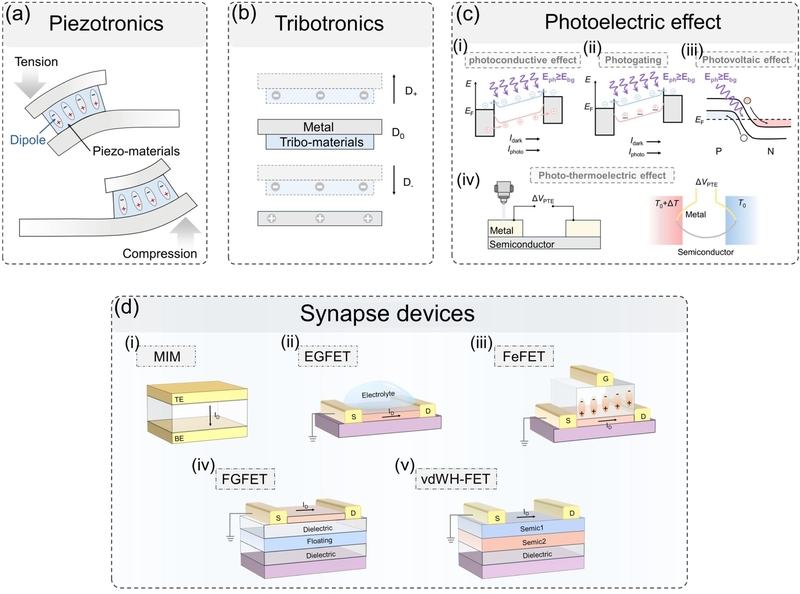
Schematic illustration of self-powered synaptic mechanisms. (a) Schematic of the piezotronic effect. (b) Schematic of the tribotronic effect. (c) Schematic of photoelectric effects: (i) photoconductive effect, (ii) photogating effect, (iii) photovoltaic effect, and (iv) photo-thermoelectric effect. (d) Common synaptic device structures: (i) memristor, (ii) electrolyte gated field-effect transistor, (iii) ferroelectric field-effect transistor, (iv) floating gate field-effect transistor, and (v) van der Waals heterojunction field effect transistor.
Triboelectric nanogenerators (TENGs) represent an emerging technology for energy harvesting and conversion. Their operational principle is based on the combined effects of contact electrification and electrostatic induction [12]. TENGs can generate a triboelectric potential when driven by mechanical displacement, enabling the conversion of distributed and disordered mechanical energy into electrical energy (Fig. 1(b)) [13]. This capability allows TENGs to provide sustainable power for distributed IoT nodes and sensing units, significantly reducing device energy consumption. By coupling the triboelectric potential generated by TENGs with semiconductor devices, direct and active modulation of charge carrier transport in the channel can be achieved under mechanical input [14]. Further integration of TENGs with synaptic devices enables the construction of mechanical-stimulus-driven neuromorphic systems, establishing a direct correlation between mechanical behavior and synaptic function at the hardware level. Such integrated architectures not only exhibit an information-processing mode that closely resembles the bio-inspired sensing-processing-integrated paradigm, but also provide a feasible pathway for developing novel neuromorphic devices with autonomous perception and learning capabilities [1,6,13,15].
In specialized optoelectronic devices, when light pulses of a specific wavelength illuminate the photosensitive layer (e.g., semiconductors, perovskites, or two-dimensional materials), photons with energy exceeding the material bandgap are absorbed, thereby exciting electron-hole pairs, known as photogenerated carriers (Fig. 1(c)). These photogenerated carriers can replace external electrical signals to directly modulate the synaptic weights in a non-contact and low-power manner. Driven by an external bias or a built-in electric field, the photogenerated carriers separate and migrate, forming a photocurrent or photovoltage, manifested specifically as the photoconductive effect (Fig. 1(c)(i)) [16] and the photovoltaic effect (Fig. 1(c)(iii)) [17]. When photogenerated carriers are trapped by localized states in the material, a photogating effect (Fig. 1(c)(ii)) [18] can be formed, leading to persistent modulation of the material conductivity. Meanwhile, temperature gradients induced by non-uniform heating under illumination can also generate photocurrent or photovoltage via the photo-thermoelectric effect (Fig. 1(c)(iv)) [19]. These optoelectronic signals can directly serve as gate signals to regulate the post-synaptic current, emulating the excitatory and inhibitory behaviors of biological synapses. By tuning the intensity, duration, and frequency of the light pulses, the carrier injection dynamics can be precisely controlled, enabling various neuro-inspired functions such as short-term plasticity (STP) and long-term plasticity (LTP). Notably, optoelectronic synaptic devices can harness optical energy from the environment as both the sensing signal and the operational power source, enabling information processing without the need for continuous external power input, thereby realizing genuine “integrated sensing and processing”. This operational mechanism not only demonstrates high energy efficiency but also provides a highly promising hardware platform for constructing highly parallel neuromorphic systems based on optical communication.
2.2 Structure of self-powered synapse
Currently, mainstream synaptic devices primarily include memristors, electrolyte-gated field-effect transistors (EGFETs), ferroelectric field-effect transistors (FeFETs), floating-gate field-effect transistors (FG-FETs), and van der Waals heterostructure-based field-effect transistors (vdWH-FETs) (the structural diagrams of these devices are shown in Fig. 1(d) [20]. Building upon these, self-powered synapses have been developed that utilize external energy sources such as PENGs, TENGs, or light to directly modulate synaptic weights, replacing conventional electrical pulses and thereby offering a new pathway for constructing ultra-low-power neuromorphic systems.
Memristors typically employ a characteristic metal-insulator-metal (MIM) structure (Fig. 1(d)(i)) [21]. The insulating layer generally consists of electrically resistive materials, such as metal oxides, chalcogenides, two-dimensional transition metal dichalcogenides (TMDs), perovskites, and heterostructures. Their operating mechanism relies on switching between a high-resistance state (HRS) and a low-resistance state (LRS), induced by either the formation/rupture of conductive filaments or phase transitions within the insulating material [22]. Owing to their merits, including continuously tunable resistance, non-volatile information storage, low power consumption, and high integration density, memristors have emerged as one of the most promising candidates for constructing synaptic devices in neuromorphic chips [23].
In recent years, EGFETs have been widely employed as artificial synaptic devices for emulating synaptic functions (Fig. 1(d)(ii)) [24]. EGFETs modulate channel conductance through ion migration within the electrolyte dielectric layer, with operating mechanisms primarily involving reversible electrostatic modulation and partially irreversible electrochemical doping. In this structure, the gate electrode resembles the presynaptic membrane, while the semiconductor layer acts as the postsynaptic membrane. The channel conductance corresponds to the synaptic weight. When an electric field is applied to the gate, the migration of ions in the electrolyte mimics the release and response of neurotransmitters, effectively simulating signal transmission between neurons. The core operating mechanism lies in the formation of an electrical double layer (EDL) at both the semiconductor/electrolyte and gate/electrolyte interfaces, which modulates channel carriers via the field effect, thereby generating a postsynaptic current [25,26]. The reversible conductance changes induced by electrostatic modulation are suitable for emulating STP, whereas electrochemical doping can lead to partially irreversible conductance alterations, providing a foundation for achieving LTP.
Ferroelectric materials possess non-volatile spontaneous polarization that can be precisely modulated by an external electric field. Leveraging ferroelectric materials as the gate dielectric, FeFETs (Fig. 1(d)(iii)) serve as excellent memory devices, offering advantages such as low power consumption and high read/write speeds [27]. Furthermore, by adjusting the gate voltage to alter the polarization state and thereby modulate channel conductance, FeFETs can integrate memory and logic functions while effectively emulating synaptic behavior [28]. Ferroelectric materials exhibit superior multi-domain polarization switching capabilities. By precisely controlling the amplitude and duration of the applied electric field, non-volatile and continuous multilevel polarization states can be achieved. These characteristics non-volatility, low power consumption, and ease of controlrender FeFETs highly significant for applications in artificial synaptic devices [29].
FG-FETs modulate channel conductivity by incorporating a floating gate within the dielectric layer, which enables charge trapping and detrapping (Fig. 1(d)(iv)). By altering the charge state stored in the floating gate, the FG-FET achieves precise control over the channel conductance [30]. This programmability allows the FG-FETs to effectively emulate and regulate the synaptic potentiation and depression behaviors observed in biological neural synapses [31]. Furthermore, the slow leakage characteristic of charges stored in the floating gate endows the channel current with non-volatile memory retention. This non-volatile nature enables the FG-FET to effectively simulate long-term memory effects in biological synapses.
Heterojunction field-effect transistors are fabricated from different semiconductors and utilize the energy band alignment and interface effects between these materials to regulate carrier transport and device performance (Fig. 1(d)(v)). By tuning the bandgap and electron mobility of the constituent semiconductor materials in the heterojunction, key synaptic parameters such as weight update rate, response time, and depression strength can be effectively controlled, laying the foundation for emulating synaptic plasticity [4,32]. In recent years, 2D materials have attracted extensive attention due to their atomically thin channel characteristics. The rapid development of 2D materials has expanded possibilities for constructing novel heterostructures. Transistors formed by stacking different two-dimensional layered materials via van der Waals forces to create heterojunctions are referred to as vdWH-FETs. This architecture allows the flexible combination of 2D materials with distinct band structures, yielding unique electrical or optical properties that enable widespread application in emulating biological synaptic behavior [33].
3. THE APPLICATIONS OF SELF-POWERED SYNAPSES
3.1 Visual perception based on self-powered synapses
Vision is one of the most essential senses through which humans perceive the world. This process relies on a sophisticated biological signaling system: the human eye detects external light signals via photoreceptor cells in the retina and converts them into electrical impulses, which are then relayed and preliminarily integrated through complex synaptic connections and neuronal networks, ultimately reaching the visual cortex of the brain for in-depth interpretation. This entire procedure enables the perception of external optical information. Inspired by this neurobiological mechanism, bio-inspired vision systems aim to emulate the structure and function of the retina [34]. The core objective involves developing photodetectors with memory functionality using light-responsive advanced materials, thereby mimicking the perception of optical signals by the human eye [35]. Furthermore, neuromorphic devices for bionic vision must be capable of modulating synaptic weights through variations in optical signals, which generally requires synaptic devices to exhibit persistent photoconductivity. Self-powered synapses based on photoelectric effects demonstrate significant potential in this field [36,37]. Such devices can directly convert optical energy into regulatory signals, enabling integrated sensing and processing without relying on additional electrical pulses. This offers a novel technological pathway for constructing highly efficient, low-power intelligent visual perception systems.
Inspired by the synergistic operation of photoreceptors and neural synapses in the biological retina. In 2024, Luo et al. developed a bio-inspired retina based on an ion-gel heterojunction (Fig. 2(a)(i)) [19]. This device integrates self-powered characteristics driven by the photo-thermoelectric effect with synaptic plasticity, achieving monolithic integration from light perception to information processing. The system successfully demonstrated neuromorphic imaging and motion tracking capabilities. By projecting an optical pattern of the letter “I” directly onto the device array, the system converted optical signals into neural signals via photoreceptors, amplified them into voltage signals, and finally rendered the image through grayscale visualization. As shown in Fig. 2(a)(ii), as the number of training pulses increased from 10 to 30, the synaptic weights of the device were continuously updated, resulting in progressively sharper images. This indicates that the system can achieve effective image learning through enhanced training. After light removal, the encoded image gradually faded but remained recognizable after 300 seconds, demonstrating visual memory retention capability analogous to biological systems. Furthermore, the study utilized a 455 nm point source as a moving target, combined with a 5×5 sensing array and an automated acquisition system, to evaluate motion trajectory tracking and velocity measurement. Enabled by neuromorphic computing and the memory capability of each pixel, the complete contour of the motion trajectory was recorded and mapped. In tracking paths at different speeds, a similar temporal evolution of visual intensity was observed. Across all speeds, the visual intensity exhibited a consistent temporal pattern: due to signal decay, the brightness at stationary points was significantly higher than that at previous positions. This characteristic provides a feasible basis for real-time velocity estimation based on luminance features (Fig. 2(a)(iii)).
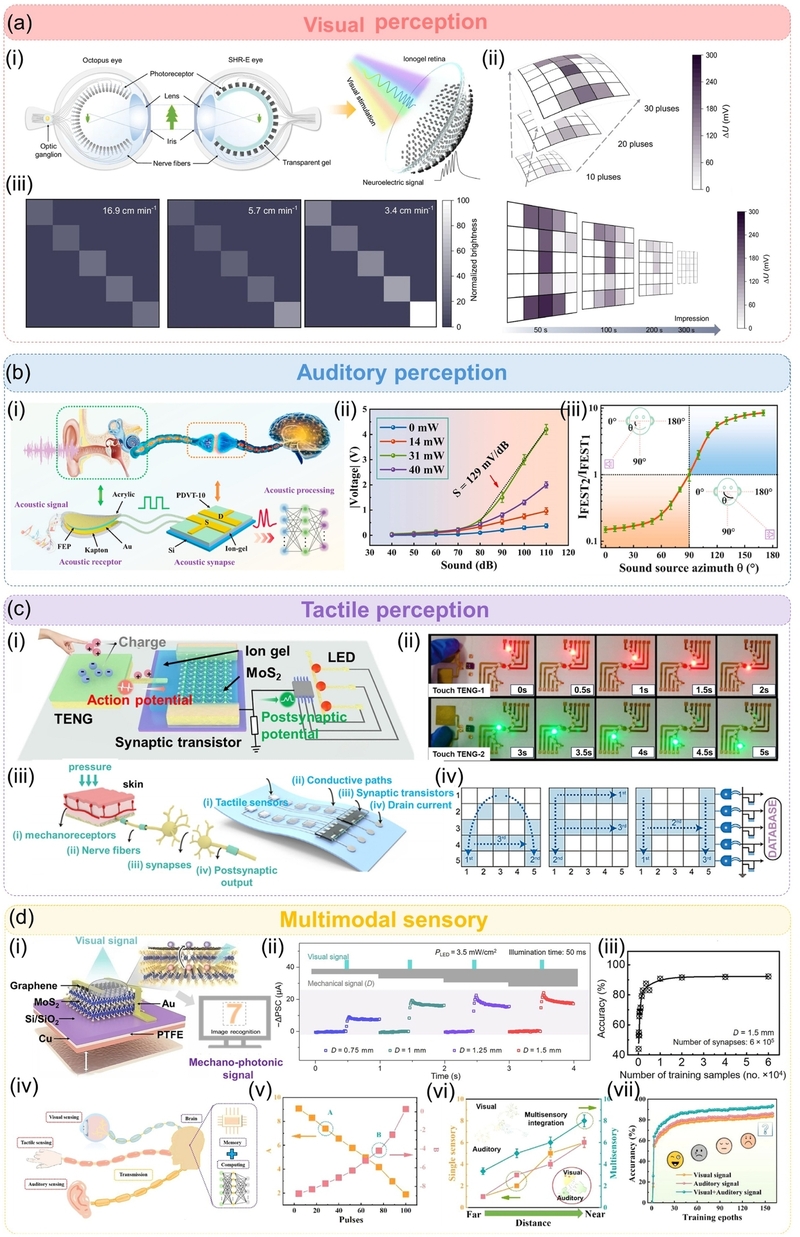
Applications based on self-powered synapses. (a) Visual perception: (i) Schematic of a bionic eye structure (ii) Enhanced learning and evolution of images in neuromorphic vision by increasing pulse number and modulating memory decay within the retention period (iii) Real-time trajectories of moving points at different speeds. (Adapted from Ref. [19]) (b) Auditory perception: (i) Schematic of the human auditory pathway and a bionic auditory pathway structure (ii) Sensitivity index of devices to different sound intensities after various laser treatments (iii) Recognition of auditory signals from different angles by the bionic auditory pathway. (Adapted from Ref. [40]) (c) Tactile perception: (i) Schematic of a triboelectric artificial afferent neuron structure (ii) Schematic of spatial information recognition performance. (Adapted from Ref. [45]) (iii) Tactile neuromorphic system and bionic tactile neuromorphic system (iv) Schematic of handwritten letter recognition. (Adapted from Ref. [46]) (d) Multimodal perception: (i) Schematic of a graphene/MoS₂ heterostructure-based mechano-photonic artificial synapse (ii) Schematic of −ΔPSC variation under synergistic light and mechanical stimulation (iii) Recognition accuracy of visual signal stimuli under varying numbers of training samples. (Adapted from Ref. [51]) (iv) Schematic of a biological multimodal perception system (v) Variation of weight constants with increasing stimulation from sensory systems (vi) Single sensory stimulus versus multisensory stimuli with different intensities. (vii) Recognition accuracy of a multimodal emotion recognition system for identifying six emotions. (Adapted from Ref. [52])
3.2 Auditory perception based on self-powered synapses
The human auditory system is one of the body's most efficient and vital biological systems, capable of receiving acoustic signals from the surrounding environment, such as alarms, vehicle noises, and animal calls. This ability not only enables humans to adapt to their environment but also helps identify potential threats and mount timely responses. Hearing has a distinct advantage over vision, touch, and olfaction in specific contexts, as it can deliver substantial information even when other sensory modalities are limited. The auditory organs receive sound waves and discerning their characteristics, while the brain interprets the interaural time difference to localize sound sources. In simulating auditory perception, sound or vibration methods can be employed to reproduce the hearing experience. TENGs, owing to their effectiveness in harvesting weak mechanical vibrations, offer a promising pathway for developing self-powered synaptic devices capable of detecting sound-wave-induced vibrations [38,39]. These devices can convert sound waves into vibration patterns and subsequently transform them into corresponding electrical signals. Owing to their high sensitivity, self-sustaining operation, and appropriate spectral response, TENGs demonstrate considerable promise for the development of electronic components in biomimetic auditory systems.
In 2020, Liu et al. reported a TENG-based self-powered artificial auditory pathway, whose structure is illustrated in Fig. 2(b)(i) [40]. This pathway employs a TENG as an acoustic sensor integrated with a field-effect synaptic transistor to form an acoustic synapse, constructing a complete sensing–processing integrated loop capable of simulating fundamental biological auditory functions and achieving sound detection and neuromorphic computation. By treating the TENG with a femtosecond laser, the engineered device exhibited excellent acoustic response characteristics, achieving a sensitivity of 129 mV/dB (Fig. 2(b)(ii)). By dynamically modulating the input of the TENG, the system successfully emulated basic synaptic functions and realized various auditory capabilities, including voice command recognition and sound source localization. For speech recognition, the research team processed excitatory postsynaptic current (EPSC) signals corresponding to different letters using the KNN algorithm, significantly reducing recognition error rates. Meanwhile, the system effectively determined sound source direction by analyzing the EPSC amplitude ratio induced by dual-channel auditory signals (Fig. 2(b)(iii)).
3.3 Tactile perception based on self-powered synapses
Tactile memory represents one of the essential modalities of human sensation, enabling the skin to perceive and interpret the surrounding environment. Through tactile encoding, humans can identify objects and execute accurate responses, thereby achieving rapid interaction with dynamic environments and precise manipulation of target objects. Therefore, in the development of bionic perceptual modules, it is crucial to construct tactile perception systems that can mimic biological tactile recognition and sensorimotor integration. Current research on tactile sensors primarily focuses on emulating mechanoreceptors. By establishing connections between tactile sensors and neuromorphic devices, intelligent perceptual functions can be partially realized [41-43]. However, the integration of intelligent sensor networks is constrained by the spatial separation of sensors and neuromorphic units. Moreover, both the connected sensors and neuromorphic devices require external power supplies, thereby increasing overall system power consumption. Self-powered synaptic devices that use triboelectric or piezoelectric mechanisms can perceive external mechanical stimuli and convert them into electrical energy, thereby providing power for distributed electronics or sensors in the IoT [44]. This capability not only enables the direct coupling of mechanical actions with artificial synaptic behaviors—vividly simulating the information processing mechanisms of neuromorphic systems—but also brings the energy consumption of such devices closer to the levels observed in biological neurons.
In 2021, Yu et al. developed a triboelectric artificial afferent neuron that could be activated by femtojoule-level energy. This neuron could integrate spatiotemporally correlated stimuli from multiple presynaptic terminals to trigger postsynaptic currents, thereby establishing dynamic logic relationships within an artificial neural network. Structurally, the device integrated a TENG with a MoS₂ synaptic transistor to form a self-powered synaptic unit (Fig. 2(c)(i)) [45]. Activated via the contact electrification mechanism, it successfully emulated spatiotemporal dynamic logic behaviors. The study also incorporated an LED flashing circuit to convert external stimuli such as displacement, pressure, and touch into visible light responses (Fig. 2(c)(ii)), providing a visualized demonstration of the spatiotemporal recognition process and fully highlighting the system's excellent capabilities in processing complex spatiotemporal information. In 2023, Wu et al. developed a stretchable, skin-integrated neuromorphic tactile system (structural schematic shown in Fig. 2(c)(iii)) [46]. This system was based on a synergistic architecture combining a TENG tactile sensor with a hydrogel-gated organic electrochemical transistor synapse. It exhibited a low-pressure sensitivity of 0.04 kPa⁻¹ (within a range of 0.24–23.56 kPa), multi-level memory states, symmetric weight update characteristics, and excellent stretchability of nearly 100%. This flexible system could sense, integrate, and recognize various pressure inputs in real time, successfully demonstrating human-computer interaction applications such as a Morse code reader and handwritten letter recognition (Fig. 2(c)(iv)), showcasing its broad application potential in flexible electronics and intelligent perception.
3.4 Multimodal sensory based on self-powered synapses
Multisensory neurons in the brain exhibit remarkable integration capabilities, enabling the fusion of spike signals originating from different sensory modalities. Within human multisensory neural networks, the deep integration and interaction of vision, touch, hearing, smell, and taste facilitate the formation of higher cognitive functions such as cross-modal integration, precise recognition, and rich imagination. The fusion of multiple sensory information streams not only enhances the capacity to handle complex recognition and decision-making tasks but also demonstrates superior sensitivity compared to any single sensory modality. Inspired by the mechanisms of human sensory processing and perceptual learning, researchers have continually explored innovations, developing various sensors alongside corresponding fusion algorithms and technologies. These sensors and algorithms can capture information from different perceptual modalities and achieve precise perception through efficient fusion and accurate processing [47,48]. The fabrication and study of self-powered synaptic devices provide a new pathway for constructing next-generation multimodal neuromorphic systems. TENGs and PENGs can flexibly collect diverse sensory signals—including tactile, auditory, and even gustatory cues—based on varied device designs and material choices, and directly convert mechanical stimuli into electrical signals [49,50]. This inherent capability naturally equips them to sense and drive artificial synapses. Building on this foundation, the combination of optoelectronic artificial synaptic devices with suitable machine learning algorithms holds promise for constructing highly efficient, low-power multimodal perception systems.
In 2021, Yu et al. proposed a novel mechano-photonic artificial synapse based on a graphene/MoS₂ heterostructure, with the device structure as shown in Fig. 2(d)(i) [51]. This device integrates a Gr/MoS₂ heterojunction phototransistor with a TENG, utilizing the triboelectric potential generated by the TENG to drive synaptic operation, thereby achieving synergistic plasticity modulation through mechanical stimuli and optical input. The synaptic device employs light illumination to regulate charge transfer and band structure within the transistor, thereby modulating the optoelectronic synaptic behavior. As shown in Fig. 2(d)(ii), through the synergistic action of mechanical displacement and optical pulses, the synapse successfully demonstrated enhanced synaptic plasticity. Combined with artificial neural network simulations, the device improved recognition accuracy under bimodal conditions, confirming the effective cooperation between mechanical and optical plasticity in artificial synapses (Fig. 2(d)(iii)). In 2022, Liu et al. developed a self-powered, highly sensitive monolithic vertical tribotronic transistor capable of multi-sensing, memory, and computing functions (Fig. 2(d)(iv)) [52]. This device can simultaneously process visual, tactile, and auditory information, enabling multi-perceptual integration and multimodal emotion recognition. Compared to traditional CMOS architectures, it can process large amounts of external sensory information in parallel, thereby reducing data exchange between memory and computing units, thereby enhancing processing speed and reducing power consumption. Fig. 2(d)(v) illustrates the corresponding changes in weight coefficients as external sensory pulses increase, while Fig. 2(d)(vi) presents a comparison of signals under multi-perceptual fusion versus auditory perception alone. Based on this, the study constructed a multimodal emotion recognition system that, by fusing visual and auditory sensory signals, achieved a recognition accuracy of 94.05% after 140 training cycles (Fig. 2(d)(vii)), significantly enhancing the precision of affective recognition.
4. SUMMARY AND OUTLOOK
Benefiting from their inherent self-powering capability, self-powered synapses represent a breakthrough at the device level. This characteristic eliminates their reliance on complex external power sources, significantly reduces operational energy consumption, and lays a physical foundation for highly integrated neuromorphic systems. Furthermore, self-powered synapses exhibit high energy efficiency and massively parallel processing capacity, enabling synchronous handling of multiple tasks under low power consumption. This effectively mimics the highly efficient operational mechanisms of the human brain and supports the deep integration of multimodal information—such as visual and tactile cues—thereby overcoming the perceptual limitations of traditional single-modal devices. Moreover, their capability for real-time adaptation and homeostatic stability allows these devices to continuously adjust their internal states in dynamic environments. Collectively, these properties endow self-powered synapses with brain-inspired information processing and robust performance, enabling them to maintain stable recognition and decision-making capabilities even in the presence of noise and interference. This significantly enhances environmental interaction accuracy and system reliability in complex scenarios such as robotics and intelligent sensing, providing a key technological pathway toward building truly continuous-learning edge intelligence systems.
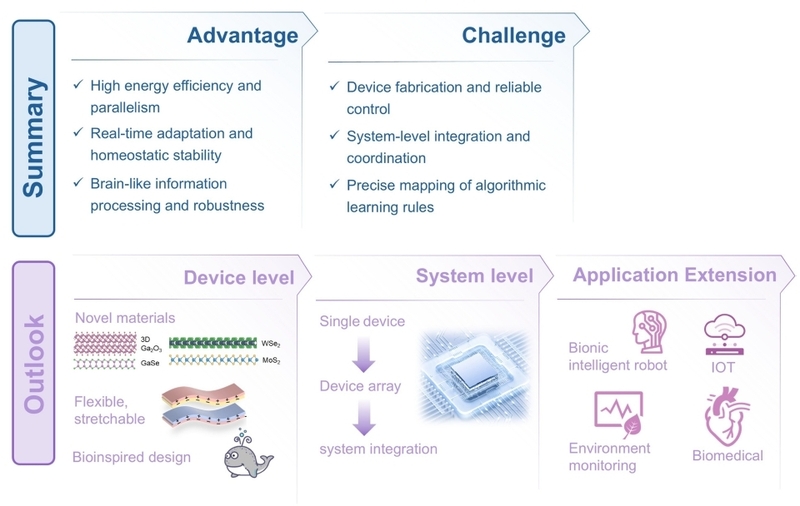
Advantages, challenges, and outlook of self-powered synaptic devices.
Despite the significant potential demonstrated by self-powered synaptic devices across multiple fields, they still face numerous challenges. In the fabrication process, achieving self-powered synaptic arrays with consistent performance, good reproducibility, and long-term stability at the nanoscale remains difficult, while maintaining device durability over extended periods is also an urgent issue to be addressed. At the system integration level, current research on self-powered synapses primarily focuses on individual devices; integrating multiple self-powered synapses into a functionally stable, complete system capable of executing complex tasks is highly challenging. Further exploration is needed regarding how to optimize the design of integrated systems to improve processing efficiency and feasibility. Finally, algorithm-hardware co-design also presents issues requiring resolution. Mapping theoretical learning rules (such as spike-timing dependent plasticity) accurately onto physical devices with non-ideal characteristics and implementing complex tasks like effective supervised learning warrant further in-depth investigation [53].
Building upon the unique advantages and existing challenges in the development of self-powered synaptic devices, future research may advance synergistically across three levels: device, system, and application. Notably, the foundation for system-level integration research remains relatively weak, constituting the primary bottleneck in current development, while the performance of individual devices also demands immediate improvement. The expansion at the application level, in turn, is highly dependent on breakthroughs in the aforementioned two aspects. At the device level, efforts should focus on exploring novel materials and structural innovation. Two-dimensional materials such as graphene and MoS2, owing to their excellent electrical properties and surface sensitivity, provide an ideal platform for constructing high-performance self-powered synaptic devices [54]. Furthermore, bio-inspired structural designs can further enhance the biomimetic functionality of these devices. The introduction of flexible, stretchable substrates and functional materials will effectively expand their applications in wearable and implantable fields [55]. At the system level, it remains essential to progress from single-device studies to the integration of device arrays, and ultimately, to full system integration. This requires addressing signal matching and coordinated control between self-powered units and synaptic signal processing modules, particularly by optimizing self-powered mechanisms such as triboelectric or piezoelectric effects to achieve efficient driving of synaptic arrays. Additionally, attention must be paid to signal coordination across devices and power consumption management at the array level [56]. Currently, research on algorithm-hardware co-design remains in its early stages, and existing learning rules have yet to adequately adapt to the nonlinear and stochastic physical characteristics of self-powered synapses. Only by strengthening fundamental research at the system and algorithm levels can the device-level advantages of self-powered synapses be translated into genuine system-level capabilities [57]. Such advances are crucial for realizing truly parallel, brain-like information processing at the system level. In terms of application expansion, self-powered synapses will strongly drive the development of next-generation bio-inspired intelligent robots, the intelligent IoT, environmental monitoring systems, and biomedical devices. By achieving low power consumption, multimodal perception, and adaptive learning, these systems are expected to perform more complex cognitive tasks in dynamic real-world environments, ultimately providing core hardware support for the realization of embodied intelligence and a sustainable electronic information society.
Acknowledgments
This research received no external funding.
REFERENCES
-
O. Song, Y. Cho, S.-Y. Cho, J. Kang, Solution-processing approach of nanomaterials toward an artificial sensory system, Int. J. Extreme Manuf. 6 (2024) 052001.
[https://doi.org/10.1088/2631-7990/ad4c29]

-
F. Zhou, Y. Chai, Near-sensor and in-sensor computing, Nat. Electron. 3 (2020) 664–671.
[https://doi.org/10.1038/s41928-020-00501-9]
-
L. Gu, S. Poddar, Y. Lin, Z. Long, D. Zhang, Q. Zhang, et al., A biomimetic eye with a hemispherical perovskite nanowire array retina, Nature 581 (2020) 278–282.
[https://doi.org/10.1038/s41586-020-2285-x]
-
C. Gao, Q. Nie, C.-Y. Lin, F. Huang, L. Wang, W. Xia, et al., Touch-modulated van der Waals heterostructure with self-writing power switch for synaptic simulation, Nano Energy 91 (2022) 106659.
[https://doi.org/10.1016/j.nanoen.2021.106659]
-
Y. Fu, L. Liang, Y. Wang, Z. Huo, N. Zhang, C. Hu, et al., Emerging artificial synaptic devices based on triboelectric nanogenerators, Chem. Eng. J. 509 (2025) 161293.
[https://doi.org/10.1016/j.cej.2025.161293]
-
B. Zhang, Y. Jiang, T. Ren, B. Chen, R. Zhang, Y. Mao, Recent advances in nature inspired triboelectric nanogenerators for self-powered systems, Int. J. Extreme Manuf. 6 (2024) 062003.
[https://doi.org/10.1088/2631-7990/ad65cc]
-
J. Chen, J. Zhang, N. Xu, M. Chen, J.-H. Lee, Y. Wang, et al., Self-powered flexible sensors: from fundamental mechanisms toward diverse applications, Int. J. Extreme Manuf. 7 (2025) 012011.
[https://doi.org/10.1088/2631-7990/ad8735]
-
J. Niu, J. Wang, W. Sha, Y. Long, B. Ma, W. Hu, Manufacture and applications of GaN-based piezotronic and piezo-phototronic devices, Int. J. Extreme Manuf. 7 (2025) 012005.
[https://doi.org/10.1088/2631-7990/ad8732]
-
W. Wu, L. Wang, Y. Li, F. Zhang, L. Lin, S. Niu, et al., Piezoelectricity of single-atomic-layer MoS2 for energy conversion and piezotronics, Nature 514 (2014) 470–474.
[https://doi.org/10.1038/nature13792]
-
Y. Wang, Q. Sun, Z.L. Wang, Piezotronics and tribotronics of 2D materials, Mater. Sci. Eng. R Rep. 164 (2025) 100951.
[https://doi.org/10.1016/j.mser.2025.100951]
-
X. Lin, Z. Feng, Y. Xiong, W. Sun, W. Yao, Y. Wei, et al., Piezotronic neuromorphic devices: principle, manufacture, and applications, Int. J. Extreme Manuf. 6 (2024) 032011.
[https://doi.org/10.1088/2631-7990/ad339b]
-
S. Niu, S. Wang, L. Lin, Y. Liu, Y. S. Zhou, Y. Hu, et al., Theoretical study of contact-mode triboelectric nanogenerators as an effective power source, Energy Environ. Sci. 6 (2013) 3576–3583.
[https://doi.org/10.1039/c3ee42571a]
-
X. Cui, J. Nie, Y. Zhang, Recent advances in high charge density triboelectric nanogenerators, Int. J. Extreme Manuf. 6 (2024) 042001.
[https://doi.org/10.1088/2631-7990/ad39ba]
-
F. Xue, L. Chen, L. Wang, Y. Pang, J. Chen, C. Zhang, et al., MoS2 tribotronic transistor for smart tactile switch, Adv. Funct. Mater. 26 (2016) 2104–2109.
[https://doi.org/10.1002/adfm.201504485]
-
U. Khan, T.H. Kim, H. Ryu, W. Seung, S.W. Kim, Graphene tribotronics for electronic skin and touch screen applications, Adv. Mater. 29 (2017) 1603544.
[https://doi.org/10.1002/adma.201603544]
-
Z. Wang, L. Lu, J. Meng, T. Wang, Emerging negative photoconductivity effect-based synaptic device for optoelectronic in-sensor computing, Adv. Mater. 37 (2025) 2504710.
[https://doi.org/10.1002/adma.202504710]
-
M. Buscema, J.O. Island, D.J. Groenendijk, S.I. Blanter, G.A. Steele, H.S. van der Zant, et al., Photocurrent generation with two-dimensional van der Waals semiconductors, Chem. Soc. Rev. 44 (2015) 3691–3718.
[https://doi.org/10.1039/C5CS00106D]
-
T. Serghiou, J.D. Fernandes, V. Karthikeyan, D.S. Assi, D.H. Vieira, N. Alves, et al., Sustainable and tunable synaptic electrolyte-gated organic field-effect transistors (EGOFETs) for light adaptive visual perceptive systems, Adv. Funct. Mater. 35 (2025) 2417355.
[https://doi.org/10.1002/adfm.202417355]
-
X. Luo, C. Chen, Z. He, M. Wang, K. Pan, X. Dong, et al., A bionic self-driven retinomorphic eye with ionogel photosynaptic retina, Nat. Commun. 15 (2024) 3086.
[https://doi.org/10.1038/s41467-024-47374-6]
-
J. Yu, Y. Wang, S. Qin, G. Gao, C. Xu, Z. L. Wang, et al., Bioinspired interactive neuromorphic devices, Mater. Today. 60 (2022) 158–182.
[https://doi.org/10.1016/j.mattod.2022.09.012]
-
D. Ielmini, G. Pedretti, Device and circuit architectures for in-memory computing, Adv. Intell. Syst. 2 (2020) 2000040.
[https://doi.org/10.1002/aisy.202000040]
-
Z. Huo, Q. Sun, J. Yu, Y. Wei, Y. Wang, J.H. Cho, et al., Neuromorphic devices assisted by machine learning algorithms, Int. J. Extrem. Manuf. 7 (2025) 042007.
[https://doi.org/10.1088/2631-7990/adba1e]
-
Z. Xu, Y. Li, Y. Xia, C. Shi, S. Chen, C. Ma, et al., Organic frameworks memristor: an emerging candidate for data storage, artificial synapse, and neuromorphic device, Adv. Funct. Mater. 34 (2024) 2312658.
[https://doi.org/10.1002/adfm.202312658]
-
X. Zhu, D. Li, X. Liang, W.D. Lu, Ionic modulation and ionic coupling effects in MoS2 devices for neuromorphic computing, Nat. Mater. 18 (2019) 141–148.
[https://doi.org/10.1038/s41563-018-0248-5]
-
M. Jin, H. Lee, C. Im, H.J. Na, J.H. Lee, W.H. Lee, et al., Interfacial Ion-trapping electrolyte-gated transistors for high-fidelity neuromorphic computing, Adv. Funct. Mater. 32 (2022) 2201048.
[https://doi.org/10.1002/adfm.202201048]
-
D.G. Jin, H.Y. Yu, First demonstration of yttria-stabilized hafnia-based long-retention solid-state electrolyte-gated transistor for human-like neuromorphic computing, Small 20 (2024) 2309467.
[https://doi.org/10.1002/smll.202309467]
-
S. Wang, L. Liu, L. Gan, H. Chen, X. Hou, Y. Ding, et al., Two-dimensional ferroelectric channel transistors integrating ultra-fast memory and neural computing, Nat. Commun. 12 (2021) 53.
[https://doi.org/10.1038/s41467-020-20257-2]
-
K. Zhang, J. Yu, Y. Wei, L. Cheng, Z. Feng, J. Gong, et al., Tribopotential mediated ferroelectric polarization for versatile reconfigurable p–n junction, Chem. Eng. J. 521 (2025) 166513.
[https://doi.org/10.1016/j.cej.2025.166513]
-
Y. Wang, T. Zhou, Y. Cui, M. Xu, M. Zhang, K. Tang, et al., Reconfigurable sensing-memory-processing and logical integration within 2D ferroelectric optoelectronic transistor for CMOS-compatible bionic vision, Adv. Funct. Mater. 34 (2024) 2400039.
[https://doi.org/10.1002/adfm.202400039]
-
M. Jia, P. Guo, W. Wang, A. Yu, Y. Zhang, Z.L. Wang, et al., Tactile tribotronic reconfigurable p-n junctions for artificial synapses, Sci. Bull. 67 (2022) 803–812.
[https://doi.org/10.1016/j.scib.2021.12.014]
-
Y. Wei, J. Yu, Y. Li, Y. Wang, Z. Huo, L. Cheng, et al., Mechano-driven logic-in-memory with neuromorphic triboelectric charge-trapping transistor, Nano Energy 126 (2024) 109622.
[https://doi.org/10.1016/j.nanoen.2024.109622]
-
H. Tian, X. Cao, Y. Xie, X. Yan, A. Kostelec, D. DiMarzio, et al., Emulating Emulating bilingual synaptic response using a junction-based artificial synaptic device, ACS Nano 11 (2017) 7156–7163.
[https://doi.org/10.1021/acsnano.7b03033]
-
K. Zhang, Z. Huo, Y. Wang, H. Yan, J. Yu, L. Cheng, et al., Neuromorphic tactile-visual perception based on 2D ReS2/CIPS heterojunction artificial synapse, Nano Energy 144 (2025) 111399.
[https://doi.org/10.1016/j.nanoen.2025.111399]
-
Y. Fu, Q. Sun, Seeing beyond nature: nanowire lights up retinal prosthesis, SmartSys 1 (2025) e70006.
[https://doi.org/10.1002/sys3.70006]
-
L. Mennel, J. Symonowicz, S. Wachter, D.K. Polyushkin, A.J. Molina-Mendoza, T. Mueller, Ultrafast machine vision with 2D material neural network image sensors, Nature 579 (2020) 62–66.
[https://doi.org/10.1038/s41586-020-2038-x]
-
D. Kumar, H. Li, U.K. Das, A.M. Syed, N. El‐Atab, Flexible solution-processable black-phosphorus-based optoelectronic memristive synapses for neuromorphic computing and artificial visual perception applications, Adv. Mater. 35 (2023) 2300446.
[https://doi.org/10.1002/adma.202300446]
-
M. Li, C. Li, K. Ye, Y. Xu, W. Song, C. Liu, et al., Self-powered photonic synapses with rapid optical erasing ability for neuromorphic visual perception, Research 7 (2024) 0526.
[https://doi.org/10.34133/research.0526]
-
Y. Jiang, Y. Zhang, C. Ning, Q. Ji, X. Peng, K. Dong, et al., Ultrathin eardrum-inspired self-powered acoustic sensor for vocal synchronization recognition with the assistance of machine learning, Small 18 (2022) 2106960.
[https://doi.org/10.1002/smll.202106960]
-
S.Y. Zhou, S.H. Wang, J. Zhang, L.F. Wu, W.S. Wang, B.C. Gong, et al., Self-adaptive auditory perceptual system for voice instruction recognition powered by triboelectric acoustic sensor, Chem. Eng. J. 525 (2025) 170267.
[https://doi.org/10.1016/j.cej.2025.170267]
-
Y. Liu, E. Li, X. Wang, Q. Chen, Y. Zhou, Y. Hu, et al., Self-powered artificial auditory pathway for intelligent neuromorphic computing and sound detection, Nano Energy 78 (2020) 105403.
[https://doi.org/10.1016/j.nanoen.2020.105403]
-
M. Li, F. Luo, L. Gong, J. Zeng, Y. Li, Z. Wang, et al., Neuromorphic tactile perception enabled by triboelectric artificial synapse for material identification, Adv. Funct. Mater. 36 (2025) e14750.
[https://doi.org/10.1002/adfm.202514750]
-
J. Guo, F. Guo, H. Zhao, H. Yang, X. Du, F. Fan, et al., In-sensor computing with visual-tactile perception enabled by mechano-optical artificial synapse, Adv. Mater. 37 (2025) 2419405.
[https://doi.org/10.1002/adma.202419405]
-
S. Ren, K. Wang, X. Jia, J. Wang, J. Xu, B. Yang, et al., Fibrous MXene synapse-Based biomimetic tactile nervous system for multimodal perception and memory, Small 20 (2024) 2400165.
[https://doi.org/10.1002/smll.202400165]
-
G. Yao, L. Xu, X. Cheng, Y. Li, X. Huang, W. Guo, et al., Bioinspired triboelectric nanogenerators as self-powered electronic skin for robotic tactile sensing, Adv. Funct. Mater. 30 (2020) 1907312.
[https://doi.org/10.1002/adfm.201907312]
-
J. Yu, G. Gao, J. Huang, X. Yang, J. Han, H. Zhang, et al., Contact-electrification-activated artificial afferents at femtojoule energy, Nat. Commun. 12 (2021) 1581.
[https://doi.org/10.1038/s41467-021-21890-1]
-
M. Wu, Q. Zhuang, K. Yao, J. Li, G. Zhao, J. Zhou, et al., Stretchable, skin-conformable neuromorphic system for tactile sensory recognizing and encoding, InfoMat 5 (2023) e12472.
[https://doi.org/10.1002/inf2.12472]
-
H. Tan, Y. Zhou, Q. Tao, J. Rosen, S. van Dijken, Bioinspired multisensory neural network with crossmodal integration and recognition, Nat. Commun. 12 (2021) 1120.
[https://doi.org/10.1038/s41467-021-21404-z]
-
H. Fang, S. Ma, J. Wang, L. Zhao, F. Nie, X. Ma, et al., Multimodal in-sensor computing implemented by easily-fabricated oxide-heterojunction optoelectronic synapses, Adv. Funct. Mater. 34 (2024) 2409045.
[https://doi.org/10.1002/adfm.202409045]
-
H. Pei, H. Hu, Y. Dong, H. Zhu, C. Zhang, Y. Zhou, et al., Electric eels inspired iontronic artificial skin with multimodal perception and in-sensor reservoir computing, Adv. Funct. Mater. 35 (2025) 2506431.
[https://doi.org/10.1002/adfm.202506431]
-
H. Chen, L. Shan, C. Gao, C. Chen, D. Liu, H. Chen, et al., Artificial Artificial multisensory system with optical feedback for multimodal perceptual imaging, Chem. Eng. J. 487 (2024) 150542.
[https://doi.org/10.1016/j.cej.2024.150542]
-
]J. Yu, X. Yang, G. Gao, Y. Xiong, Y. Wang, J. Han, et al., Bioinspired mechano-photonic artificial synapse based on graphene/MoS2 heterostructure, Sci. Adv. 7 (2021) eabd9117.
[https://doi.org/10.1126/sciadv.abd9117]
-
Y. Liu, D. Liu, C. Gao, X. Zhang, R. Yu, X. Wang, et al., Self-powered high-sensitivity all-in-one vertical tribo-transistor device for multi-sensing-memory-computing, Nat. Commun. 13 (2022) 7917.
[https://doi.org/10.1038/s41467-022-35628-0]
-
R. Shang, H. Chen, X. Cai, X. Shi, Y. Yang, X. Wei, et al., Machine learning-enhanced triboelectric sensing application, Adv. Mater. Technol. 9 (2024) 2301316.
[https://doi.org/10.1002/admt.202301316]
-
K. Sun, J. Chen, X. Yan, The future of memristors: materials engineering and neural networks, Adv. Funct. Mater. 31 (2021) 2006773.
[https://doi.org/10.1002/adfm.202006773]
-
C. Zhang, Z. Zhao, O. Yang, W. Yuan, L. Zhou, X. Yin, et al., Bionic-fin-structured triboelectric nanogenerators for undersea energy harvesting, Adv. Mater. Technol. 5 (2020) 2000531.
[https://doi.org/10.1002/admt.202000531]
-
P. Guo, J. Zhang, H. Pu, B. Yang, C. Huang, T. Sun, et al., Wafer-scale photolithographic fabrication of organic synaptic transistor arrays, Device 2 (2024) 100409.
[https://doi.org/10.1016/j.device.2024.100409]
-
J. Won, J. Kang, S. Hong, N. Han, M. Kang, Y. Park, et al., Device-algorithm co-optimization for an on-chip trainable capacitor-based synaptic device with IGZO TFT and retention-centric Tiki-taka algorithm, Adv. Sci. 10 (2023) 2303018.
[https://doi.org/10.1002/advs.202303018]

Qijun Sun, Professor, Ph.D. supervisor, Principal Investigator of Functional Soft Electronics Lab in Beijing Institute of Nanoenergy and Nanosystems, Chinese Academy of Sicences. His main research interests include piezo/triboelectric potential modulated semiconductor devices, mechanoplastic artificial synapse, 2D and organic semiconductor devices, nanogenerators, self-powered E-skins, etc. Based on the research topics, they aim to develop advanced systems for human health monitoring and human-machine interface. He has published over 150 papers in Nat. Mater., Nat. Commnun., Sci. Adv., Chem. Rev., Energy Environ. Sci., Adv. Mater., Adv. Energy Mater., etc. He has managed several projects from National Natural Science Foundation of China and National Key R&D project from Ministry of Science and Technology. His group has independently developed the first domestic Multi-channel Testing System for nanogenerators - TENG3.